The US Congress wrote off $2bn and 10,000 person-years of effort in 1993 when it cancelled the giant, high-energy particle accelerator project known as the Superconducting Super Collider (SSC), approved in 1987. The repercussions of this decision have been severe and long-lasting. Five years later, when I interviewed one of the abandoned project’s keenest advocates, particle physicist and Nobel laureate Steven Weinberg, he was still mourning its loss. “In a way, the vote that cancelled it was democracy in action,” Weinberg told me. “The public has always been interested in things that are directly important to them – medical cures, national defence – and they have a certain general interest in cosmology. Our big failure was that we did not succeed in making the public feel excited about learning the laws of nature.” This was true despite Weinberg’s own general-interest book, Dreams of a Final Theory, which was conceived as an inspiring argument for the SSC and published in 1992. “They felt excited about putting a man on the Moon,” he reflected ruefully.
But it was not only the public and its political representatives in Washington DC who failed to support the completion of the SSC. Many US physicists, too, had reservations about the importance of its scientific agenda, its military-industrial organization and, especially, its enormous and ever-growing price tag. The last of these had the inevitable knock-on effect of reducing the funding for other fields of science. In 1989 Weinberg’s fellow physics Nobel laureate, Philip W Anderson, testified against the SSC before a Senate committee as follows: “Scientists like myself in the fields of condensed-matter physics…are caught between the Scylla of the glamorous big-science projects like the SSC, the genome and the Space Station, and the Charybdis of programmed research with ‘deliverables’ aimed at some misunderstood view of ‘competitiveness’ or at some unrealistically short-term goal.” This emboldened other condensed-matter physicists, including two Nobel laureates (Nicolaas Bloembergen and J Robert Schrieffer), to speak out against the SSC. Indeed, in 1990 feelings were running so high that condensed-matter physicists threatened, as a community, to leave the American Physical Society because of its unequivocal support for the project.
The Anderson quote comes from the brilliantly titled Tunnel Visions, an anatomy of the SSC’s failure that its authors describe as “three decades in the making”. Michael Riordan, Lillian Hoddeson and Adrienne Kolb are experienced US historians of science; the latter two recently collaborated on a history of Fermilab, the flagship US particle-physics laboratory (see “From prairie to energy frontier”). Their book is based partly on oral interviews with more than 100 participants in the SSC project, including politicians, political advisers, physicists and science journalists (but not including former presidents George H W Bush and Bill Clinton, or, surprisingly, Anderson). Other facts are drawn from published statements dating from the 1970s to the present, or from the many archives of unpublished evidence. It is not the first history of the SSC, but it is likely to be the last word on the subject. Although too lengthy and detailed for a general reader, and sometimes needlessly repetitious, Tunnel Visions will unquestionably be vital reading for anyone interested in the complications of funding “big science”, especially projects requiring international contributions.
The authors identify five chief factors directly responsible for the SSC’s cancellation, if we leave aside the project’s underlying failure to inspire the public. The first was beyond the control of the SSC’s supporters. After the end of the Cold War in 1991, the incoming Clinton administration shifted the government’s decades-long support for physics (and its possible military spin-offs) towards other kinds of science, such as genetics and climate science. The second factor was the rhetoric of the Reagan administration, which approved the SSC as an essentially national project, unlike its lower-energy European equivalent at CERN. This, combined with the subsequent failure of the first Bush administration to attract a substantial contribution to the project from any foreign government (despite Bush’s public commitment to do so and his wooing of the Japanese) meant that few non-Americans had much invested in its completion. The third factor was the choice of an unprepared site in Texas, far from any centres of high-energy physics, rather than a site in Illinois, where the project could have benefited from Fermilab’s long experience. The fourth was the poor management of the construction phase, in which there was no single project manager. Instead, a dysfunctional clash between academic physicists inexperienced in project management and engineers habituated to a military-industrial ethos produced chaos on site.
Finally, and probably most fatally, there was the escalating cost. The finished project was projected to cost $4.4bn in 1987, but by 1993 the revised estimate was running at over $10bn and heading, some feared, for $15bn – all this at a time of government cutbacks in science funding. Because of its cost, the authors report, “the SSC had crossed an invisible line beyond which sole-sourcing its management contract was politically impossible”. Its construction had become “more like building an aircraft carrier than a high-energy physics laboratory”.
Why did the later Large Hadron Collider (LHC) at CERN succeed, where the SSC failed? Parts of Tunnel Visions, especially its epilogue (“The Higgs boson discovery”), address this important question in considerable and revealing detail. In the first place, the management of CERN was not subjected to direct political interference by the European Union or national governments. Second, the LHC benefited from the contributions of more than 20 nations worldwide. Third, it was built in the same tunnel as the previous Large Electron–Positron Collider, so lessons could be learnt from the latter’s construction and operation. Fourth, it was project-managed from 1993 until its completion in 2008 by a single physicist, Lyn Evans (the son of a Welsh coal miner), who was assisted by the burgeoning World Wide Web platform invented at CERN. Finally, although the LHC certainly suffered from cost overruns – and eventually cost more than $10bn – its physicists and engineers enjoyed the strong support of CERN’s management.
As Tunnel Visions is driven to conclude: “pure-science projects at the multibillion-dollar scale should henceforth be attempted only as international enterprises involving interested nations from the outset as essentially equal partners” – as with the LHC. “Nations that attempt to go it alone on such immense projects are probably doomed to failure like the Superconducting Super Collider.”
2015 Chicago University Press $40.00/£28.00hb 480pp
The best estimate yet of how much mass is contained within the long, tenuous threads of hot gas thought to span the vast distances between galaxy clusters has been made by a team of astrophysicists in Europe. The researchers used the XMM-Newton X-ray satellite to characterize three “filaments” of plasma extending from the galaxy cluster Abell 2744. Such filaments are believed to make up a cosmic web that permeates the universe, and the team says that the filaments are likely to contain much of the universe’s ordinary or “baryonic” matter.
Observations of the afterglow of the Big Bang known as the cosmic microwave background (CMB) suggest that protons, neutrons and other (three-quark) baryon particles only account for about 5% of the universe’s energy density – the rest is believed to consist of enigmatic dark matter and dark energy. However, the combined mass of all of the stars within a radius of about a billion light-years from Earth only amounts to about 2.5% of the energy density within that region. Computer simulations predict that the missing baryons instead exist within low-density plasma filaments millions of light-years long.
Indeed, in regions of the sky containing two galaxy clusters, smaller groups of galaxies can be seen tracing out a line between the clusters. These filaments are thought to permeate the universe, creating a “cosmic web” of galaxy clusters that is surrounded by an extremely low-density “void”. The seeds for this web can be seen in the tiny fluctuations within the CMB; as the universe expanded, gravitational attraction caused slightly denser regions to accumulate mass, while less-dense regions lost mass.
Good target
To measure the baryonic mass of several filaments, Dominique Eckert of the University of Geneva in Switzerland and colleagues looked towards Abell 2744, which is a vast galaxy cluster with a mass 1000 trillion times that of the Sun lying about four billion light-years from Earth. Like other clusters, its mass consists of galaxies (about 2%), gas (around 15%) and dark matter (80–85%). It is a good target, say the researchers, because its composition suggests that it is located at the intersection of several filaments of the cosmic web.
Although the gas in the filaments would be cooler than that in the cluster – at around several million degrees, as opposed to some 100 million degrees – it would still be hot enough to radiate at X-ray wavelengths. Eckert and his colleagues turned XMM-Newton towards Abell 2744 for 30 h last December, and studied the X-ray emission from the cluster and from a large volume of space around it.
The researchers identified three structures of interest, each of which is several tens of millions of light-years long. A close match between the position of these structures and the location of galaxy concentrations away from the centre of the cluster allowed Eckert and colleagues to conclude that they had observed filaments of the cosmic web.
Hot gas
“Where we see hot gas, we see galaxies,” says Eckert. “This is telling us that these galaxies are embedded in this cosmic web, and that we are seeing the gas within the filaments.”
The team worked out the temperature and density of the plasma in each of the filaments using the X-ray spectra and a model that simulates emission from very dilute plasmas. This revealed that each cubic metre of filament typically contains no more than a few tens of particles. While this may seem paltry, it is some 200 times greater than the average density of baryons in the universe.
Trillions of solar masses
The researchers then established what fraction of the filaments’ total mass the gas represents. To do so, they studied images from the Hubble Space Telescope and ground-based telescopes of galaxies lying behind Abell 2744, and worked out how much the light from those galaxies is bent by the gravitational pull of the intervening matter. They concluded that the filaments each weigh in at a few tens of trillions of solar masses. In other words, the researchers say, gas makes up roughly 10% of each filament by mass, with most of the rest being dark matter.
According to Eckert, galaxy surveys and numerical simulations show that most of the universe’s galaxies and dark matter lie in the filaments of the cosmic web. As such, he says, if the filaments contain significant amounts of hot gas, then that gas would contain a sizeable proportion of all baryons – about half, he estimates. “Our findings strengthen evidence for a picture of the universe in which a large fraction of the missing baryons resides in the filaments of the cosmic web,” he and his colleagues wrote in a paper published in Nature.
Glittering gong: who will be taking home this year’s Breakthrough of the Year award?
By Hamish Johnston
This week marks the beginning of awards season here at Physics World and we have been polishing the 2015 Breakthrough of the Year trophy in anticipation of presenting it to the winner on Friday 11 December.
The winning research must have been published in 2015 and also has to meet four criteria:
• fundamental importance of research;
• significant advance in knowledge;
• strong connection between theory and experiment; and
• general interest to all physicists.
Last year’s ESA’s Rosetta mission was our winner for the remarkable feat of landing a spacecraft on a comet while acquiring a wealth of scientific data. In 2013 the IceCube South Pole Neutrino Observatory won for making the first observations of high-energy cosmic neutrinos. But please don’t think that all the winning research is done by large collaborations. Aephraim Steinberg and colleagues from the University of Toronto were winners in 2011 for their bench-top experimental work on the fundamentals of quantum mechanics, while the inaugural prize in 2009 went to Jonathan Home and colleagues at NIST for creating the first small-scale device that could be described as a quantum computer.
We also commend nine runners-up each year who we believe deserve recognition for their contributions to physics.
A new laser based on a swirling vortex of light has been created by physicists in the US. The “topological-defect laser” could be a useful addition to lab-on-a-chip devices, where it could manipulate fluids and tiny particles. The design could also be modified to create beams of light with orbital angular moment (OAM).
Conventional lasers confine light by bouncing it back and forth in an optical cavity made of two opposing mirrors. Hui Cao and colleagues at Yale University and the Joint Quantum Institute at the University of Maryland have taken a new twist on this design by making an optical cavity that confines light by having it swirl around in a vortex. They made their optical cavity within a photonic crystal, which is a material containing a regular array of elements which are separated by distances on par with the wavelength of light. Light at certain wavelengths and travelling in certain directions will pass freely through a photonic crystal, whereas light not meeting these criteria will be diffracted into a new trajectory.
Topological vortex
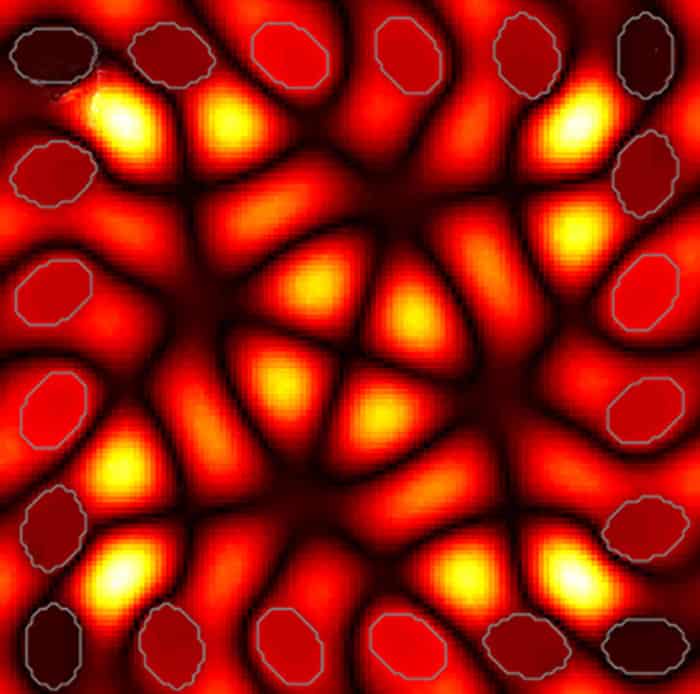
The team’s photonic crystal comprises an array of holes in a thin sheet of gallium arsenide. Each hole is elliptical and the rotational orientations of the individual ellipses are set to create a vortex-like “topological defect”. The laser’s optical cavity lies at the centre of the defect and is a solid square of gallium arsenide with no air holes. The structure is designed so that light inside the cavity is reflected from its walls, thereby causing the light to flow around the cavity in a vortex.
The gallium-arsenide sheet also contains three layers of quantum dots made of indium arsenide. To operate their topological-defect laser, the researchers first “pump” their device using pulses from an external laser. This puts the quantum dots into an excited state, which then decays with the emission of laser light. This emission is stimulated by the trapped vortex of light and the device behaves like a laser, but with the light travelling in a circle rather than bouncing back and forth.
Twisted light
One potential application of the laser is to manipulate fluids of tiny particles in a lab-on-a-chip device. “I have been talking to people who are experts on particle sorting,” Cao told physicsworld.com. Cao also said that her team is working on a new topological-defect laser that is designed to emit “twisted light” that carries OAM. Such light could have a wide range of uses including optical telecommunications, quantum computing and new analytical techniques for chemistry and biology.
The new laser is described in a paper in Journal of Optics that can be read free of charge.
A lot of ink has been spilled trying to explain how to get good ideas out of the lab and into commercial technologies. In his book Monsters, the veteran science writer Ed Regis is interested in precisely the opposite challenge: how to prevent monumentally awful ideas from getting off the drawing board. Regis’ prime example of what he terms “pathological technologies” is the hydrogen airship, or zeppelin, which enjoyed remarkable popularity in the early 20th century despite its appalling safety record. The most famous zeppelin disaster was, of course, the Hindenburg, which caught fire and crashed during a landing attempt in 1937, killing 36 of the 97 people on board. But as Regis shows, at least nine earlier zeppelins – eight German and one British – met almost identical fates, and their American counterparts were no safer despite being filled with non-flammable helium. Regis’ tone is a lively mixture of exasperation, comic understatement and black humour, and his inventiveness in coming up with fresh denunciations for zeppelins (“a technology very much worth abandoning”) is frequently a delight. Some physicists will, however, feel their hackles rising when Regis turns his rhetorical fire on the never-completed particle accelerator known as the Superconducting Super Collider (SSC). Though the SSC was not dangerous, Regis argues that it fulfilled other criteria of a pathological technology: it was physically huge; it inspired deep, almost spiritual devotion among its proponents (some of whom still mourn its loss); the scientific risks associated with it were played down; and its enormous financial cost outweighed the benefits. This verdict seems a trifle harsh, but few will question Regis’ stance on another cancelled physics experiment: Project Plowshare. The idea behind this US-based effort was to use nuclear weapons for “peaceful” purposes, such as carving out new harbours or canals. Eventually, Regis reports, the sheer lunacy of doing civil engineering with hydrogen bombs proved too much to ignore – but only after 17 years and hundreds of millions of dollars had been poured into Plowshare and its offshoots. Now that’s pathological.
2015 Basic Books £19.77/$29.99hb 352pp
Quantum physicists are Go
“Astrophysics is easy,” quips a grinning Brains on the cover of Brains Explains Quantum Physics – a slim, illustrated volume in which the cerebral character from the 1960s TV series Thunderbirds takes readers on a whirlwind tour of the quantum world. The book is actually written by Ben Still, a physicist at Queen Mary University of London who works on the T2K neutrino experiment in Japan, and he/Brains begins this light-hearted chronicle by explaining that quantum mechanics did not emerge fully formed from the brain of one individual. Instead, it developed gradually as a response to contradictory and downright bizarre experimental results of the late 19th and early 20th centuries. There are good descriptions about how early modern physicists scratched their heads over blackbody radiation, the photoelectric effect and Rutherford scattering as the ideas of quantum mechanics were forming. The book also explains how quantum theory revolutionized the way chemists think about bonding – something that many physicists may not fully appreciate. Next on the agenda is a nice explanation of how the atomic measurements of Pieter Zeeman led Wolfgang Pauli to the concept of spin and his famous exclusion principle. Only at this point does the book return to the astrophysics promised on the cover, as Brains takes off in a Thunderbirds ship for the nearest neutron star, where he explains how quantum mechanics alone prevents some stars from collapsing into black holes. Much of the book is written in narrative form, and at times it reads like a “who’s who” of quantum physicists, emphasizing the human aspect of science. The only point where it falls down is when Brains presents a chart showing all the particles in the Standard Model of particle physics, with one very notable exception: for some reason, the Higgs boson is not on the chart. This seems an odd editorial decision for a book published well after the Higgs’ discovery in July 2012.
2015 Cassell £10.00hb 96pp
Cooking with maths
What does “beauty” mean in mathematics? Jim Henle, a mathematician at Smith College in the US, describes mathematical beauty as “an elusive concept, subtle, abstract and intellectual” and admits that he’s “struggled for years” to grasp it. In time, though, the answer came to him: cheesecake. He isn’t joking. In fact, one of the most endearing characteristics of Henle’s book The Proof and the Pudding: What Mathematicians, Cooks and You Have in Common is just how earnest it is. The book is a decidedly strange dish, one that combines such diverse ingredients as mathematical puzzles, recipes, homespun philosophy and a dash of self-help. By rights, it shouldn’t work. Somehow, though, it does, thanks to some fun mathematics (including a proof that the 13th of the month falls on a Friday more often than any other day) and Henle’s gently encouraging tone. In mathematics, as in cooking, he writes, “stumbling around is a method”, and the best results come to those with the right combination of confidence and humility. Sometimes unexpected combinations (such as Cambozola ice cream with salted caramel sauce) work. Often, they don’t. This is okay. Keep trying.
2015 Princeton University Press £18.95/$26.95hb 176pp
Feynman’s words of wisdom
So much has been said by and about the charismatic physicist Richard Feynman that it is no surprise to find that his witticisms fill a book nearly 400 pages long. The Quotable Feynman was edited and compiled by Feynman’s daughter Michelle, and it includes some 500 quotations sourced from letters, lectures, books, articles and interviews. Divided into 27 sections with labels such as “youth”, “how physicists think”, “Challenger” and, of course, “humour”, the quotations range from pithy one-liners to ponderous paragraphs. A few, such as “The thing that doesn’t fit is the most interesting”, are relatively well known, but some of the less-famous ones are just as delightful. For example, when the young Feynman discovered that Santa Claus was not real, he was apparently relieved “that there was a much simpler phenomenon to explain how so many children all over the world got presents on the same night”. Most of the quotes are not in context, and this is definitely a reference book rather than a piece of light reading. However, it does boast a wonderful selection of photographs, plus a gushingly over-the-top foreword by the particle physicist and science communicator Brian Cox. (A second foreword, by the cellist Yo-Yo Ma, is both more personal and less effusive.) All in all, the book is a good choice for those interested in the history of science, as well as a fun present for any Feynman fanboys and fangirls in your life.
2015, Princeton University Press, £16.95hb, 405pp
Johannes Kepler, faithful son
In December 1615, when the astronomer Johannes Kepler should have been enjoying the modest fame that followed the publication of his treatise Astronomia Nova, he was instead confronted by a family emergency. His aged mother, Katharina, stood accused of witchcraft, and powerful enemies were plotting to have her imprisoned and perhaps even killed. Ulinka Rublack’s book The Astronomer and the Witch is a detailed portrait of Katharina’s trial, the circumstances surrounding it and the role her famous son played in defending her. Both the trial and the events that led up to it are remarkably well documented and Rublack, a historian at the University of Cambridge, mines this rich seam of primary sources to place the Kepler family’s situation in context. Within the book are descriptions of the official correspondence associated with the trial; the scientific patronage system that Kepler depended on to earn his living; the outcomes of other witchcraft trials, and many other topics. Even apparently tangential aspects of Katharina’s case are given plenty of careful attention. All of this context does, however, mean that Rublack doesn’t begin to describe the actual steps that Kepler took to defend his mother until page 119, and readers without a deep interest in history (as well as science) are unlikely to get that far. Those who stick with her story, however, will gain a much deeper understanding of the life and work of one of the most influential and revered scientists of the European Renaissance.
2015 Oxford University Press £20.00hb 400pp
Loads of prezzies
How many gifts are given, in total, in the traditional song “The 12 Days of Christmas”? To find the answer, you could, of course, count up all the various calling birds, French hens and turtle doves by hand. However, if you and your true love have better things to do this holiday season, you might prefer to pick up Arthur Benjamin’s book The Magic of Maths: Solving for x and Figuring out Why. In a chapter on “the magic of counting”, Benjamin presents a general formula for this type of problem: on the nth day of Christmas, he explains, your true love will fork over n(n+1)/2 presents. But Benjamin, a mathematician at Harvey Mudd College in California, doesn’t stop there. Next, he shows how the gift-counting problem relates to patterns in a mathematical construct called “Pascal’s triangle” – a triangular table of numbers in which each number is the sum of the two numbers diagonally above it. And before you know it, he’s on to another, even more beautiful construction: the fractal pattern known as Sierpinski’s triangle. As soon as the reader has absorbed one “trick”, Benjamin is already moving on to the next one – and each is more dazzling than the last.
As the festive season approaches, many of you will be looking forward to popping open a bottle of champagne. But before you treat yourself to a bottle, do check out the December 2015 issue of Physics World magazine, in which fizzy-wine physicist Gérard Liger-Belair from the University of Reims Champagne-Ardenne reveals his top six champagne secrets.
In the article, Liger-Belair explains why a fog appears when you pop open a bottle, the angle at which you should pour the wine into a glass, and how many bubbles there are in a typical glass of fizz. He also wades into that age-old question among sparkling-wine aficionados: flute or coupe?
The new issue also contains a fabulous flow chart, in which you can find out what sort of scientist you are. Don’t miss either our look back at the International Year of Light, a fantastic selection of Christmas books and a feature all about how origami is moving from art to application.
If you’re a member of the Institute of Physics (IOP), you can get immediate access to this article in the award-winning digital edition of the magazine on your desktop via MyIOP.org or on any iOS or Android smartphone or tablet via the Physics World app, available from the App Store and Google Play. If you’re not yet in the IOP, you can join as an IOPiMember for just £15, €20 or $25 a year to get full digital access to Physics World. You can also read Liger-Belair’s article online here.
As the festive season approaches, many of us will look forward to popping open a bottle of champagne, whether it’s to celebrate Christmas with family and friends or to welcome in the new year. Next time you treat yourself to a bottle, your pleasure will surely be enhanced by a little scientific understanding of these fizzy, fine white wines. Champagne-making is an art form that has been refined over centuries, but thanks to advanced scientific instruments, we now know a lot about the subtle processes that give this legendary wine its sparkle to the eye, its tingle to the tongue.
As a physicist who studies champagne for a living, I can say that examining the bubbles in a glass of fizz is far from frivolous. Yes, the work has a pure, intrinsic interest, but it also has implications for other areas where bubbles play a role. In marine science, for example, we know that when an ocean wave breaks, it can trap air bubbles that burst when they reach the surface, ejecting aerosol droplets into the atmosphere – just like the bubbles in champagne.
So don’t feel guilty. Just sit back and enjoy my six scientific secrets of champagne – they’re bound to be a talking point when you next crack open a bottle. Oh, and before you ask where we get our champagne from, our university has its own small vineyard producing several hundred bottles per year. We also receive samples from various champagne houses that show an interest in our research, including Moët & Chandon, Veuve Clicquot and Pommery. My colleagues and I don’t drink the samples…if we did, we might never get any work done.
1. What’s that fog you see after popping open a champagne bottle?
Before enjoying the pleasures of champagne, you obviously need to uncork the bottle so you can pour that lovely liquid out. Although it’s safer to do so by gingerly prising the cork out bit by bit, most of us will surely have popped open a bottle of champagne with a dramatic bang (see image series below). Look closely as the cork flies out of the bottleneck, however, and you’ll see a cloud of fog immediately forming. To understand how this beautiful effect is created, we need to remember that champagne is a mixture of water and ethanol, supersaturated with dissolved carbon dioxide (CO2).
Popping champagne corks Close-up photos of a cork popping out of a bottle of champagne to reveal the fog that forms as the released gas depressurizes. (Courtesy: University of Reims Champagne-Ardenne)
The wines are created by first fermenting grapes harvested from the Champagne region of France in open vats. The CO2 is formed (along with further ethanol) during a second fermentation stage (the prise de mousse) that takes place after the wine has been transferred to hermetically sealed bottles. Champagne has special aromas too. These are volatile compounds that come from the grapes and the yeasts used for fermentation, as well as from the ageing process itself, in which those compounds slowly oxidize to create new molecules.
The amount of CO2 that gets dissolved in champagne is ruled by Henry’s law, which states that the equilibrium concentration of dissolved gas in a liquid is proportional to its “partial pressure” in the gas phase. (The partial pressure is the hypothetical pressure that one gas in a mixture would have if it alone occupied the volume of the mixture at the same temperature.) So when it comes to fizzy wine, Henry’s law means that getting lots of CO2 dissolved in the liquid requires a high pressure in the “headspace” between the wine and the cork. That’s why champagne bottles use tough glass and a tightly fitting cork.
But the amount of CO2 dissolved in champagne also depends on temperature, with the gas becoming much more soluble as the liquid cools. At 8–10 °C, which is the ideal serving temperature for champagne, there will usually be 11.5 g of dissolved CO2 per litre, while the pressure in the bottle is close to 5 bar. When you open a champagne bottle, the CO2 trapped in the headspace under the cork undergoes a huge drop in pressure from 5 bar down to an ambient pressure of 1 bar. Assuming the CO2 gas expands adiabatically (i.e. so fast that no heat exchange can occur), the gas cools by an incredible 80–85 °C, making water vapour and traces of ethanol vapour condense to create tiny droplets of fog (2013 J. Food Eng.116 78).
Moreover, once the bottle has been uncorked, the thermodynamic equilibrium of CO2 is broken. The dissolved CO2 steadily escapes from the liquid because the partial pressure of CO2 in the gas phase has dropped to roughly 0.0004 bar, which is the partial pressure of gas-phase CO2 in the atmosphere. Thermodynamically speaking, all the dissolved CO2 must now escape from the champagne, though fortunately that doesn’t occur instantaneously. You’ll need several tens of hours for your champagne to go completely flat, but hopefully you wouldn’t be daft enough to let such a good wine stand around for so long.
2. What’s the best way to pour champagne?
So you’ve popped open your bottle of precious champagne. Now how are you going to pour the wine into a glass to preserve the precious fizz and get the bubbles to stay for as long as possible? My colleagues and I at the University of Reims Champagne-Ardenne investigated this question using two different serving methods. The first involved pouring champagne straight down the middle of a vertically oriented flute, while the other was to pour it down the side of a tilted flute.
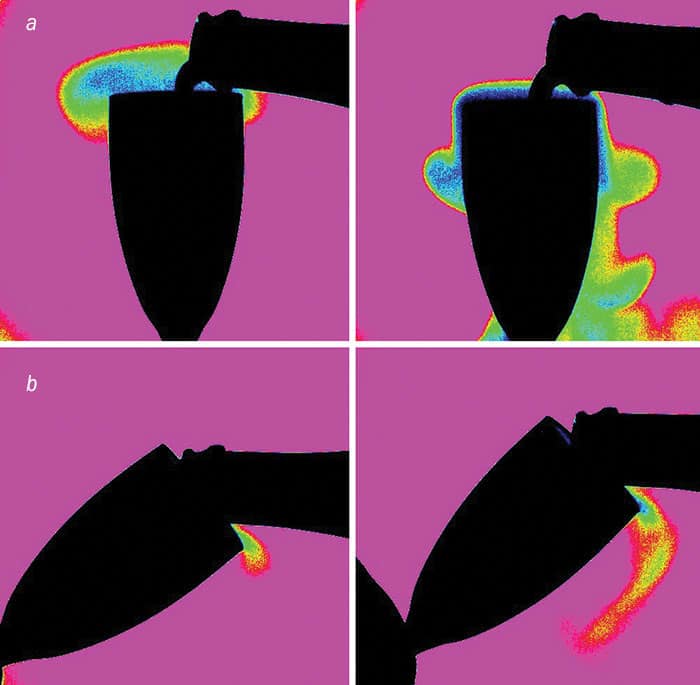
1 Vertical or tilted? These infrared images reveal the concentration of carbon-dioxide gas released as champagne is poured into a flute-shaped glass held either (a) vertically or (b) at an angle. Lots of gas (blue/green) is wasted if the glass is held upright, but less (orange/yellow) escapes if it is tilted. (Courtesy: University of Reims Champagne-Ardenne)
We found that tilting the glass, as you would when you pour beer, led to a much higher concentration of dissolved CO2 in the champagne than if the glass were kept upright. That’s because the beer-like way of serving champagne is much more gentle. It lets the champagne flow softly along the glass wall to progressively fill the flute. Pouring champagne straight down the middle of a vertically oriented glass, in contrast, creates turbulence and traps air bubbles in the liquid. Both effects force the dissolved CO2 to escape much more rapidly from the champagne.
These findings were corroborated using infrared imaging to visualize the clouds of gaseous CO2 that escape during the pouring process (figure 1). CO2 absorbs infrared light very strongly at wavelengths of about 4.2 μm, with the resulting images being brighter where there’s lots of the gas slopping about – down the sides of a vertical flute. My advice is to treat champagne a little more like beer – at least, when it comes to serving it. We also discovered that you lose less CO2 if the champagne is chilled because the wine gets more viscous as its temperature falls. But if the wine is warm, you get more turbulence and agitation in the champagne as it’s poured, forcing the dissolved CO2 to escape more rapidly from the champagne.
3. What’s better: flute or coupe?
For champagne lovers, there’s one question that has long been debated and mulled over in bars, restaurants and speciality wine magazines. What is the best type of glass to drink champagne from – a long, thin flute or a bowl-like coupe? With little or no analytical data having ever been brought to bear on this drinking-vessel dilemma, we decided to turn to science. One thing is clear: when you taste champagne from a glass, the gaseous CO2 and volatile aromatic compounds progressively invade the headspace above the vessel, slowly altering your overall perception of those smells.
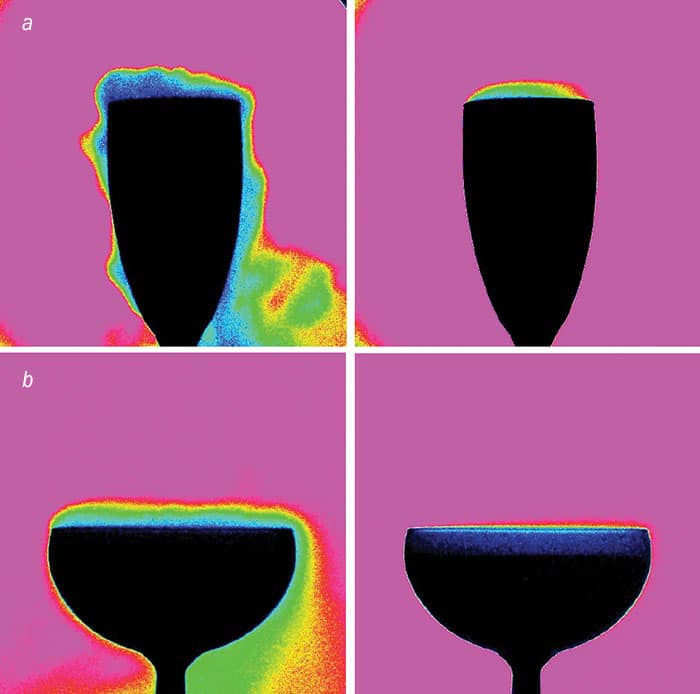
2 Flute or coupe? Infrared images show us how the shape of the glass affects how much carbon-dioxide gets funnelled up towards the taster: the concentration of the gas in the headspace above a flute-shaped glass (a) is much higher than above a more rounded glass (b). (Courtesy: University of Reims Champagne-Ardenne)
To find out how the geometry of the glass affects the drink’s smell, we measured the amount of gaseous CO2 and ethanol above the glass using gas chromatography. We found that when you pour champagne held at 20 °C into a flute, the headspace above the glass contains about 20% CO2 – roughly twice the figure above a coupe glass (2012 PLOS ONE7 e30628). The tendency of flutes to hang on to concentrated quantities of CO2 was confirmed by infrared-imaging experiments. It appears that a narrow flute funnels the gaseous CO2 (and therefore the aromas) more effectively (figure 2a), whereas the broader coupe “dilutes” them (figure 2b).
Our findings chime with sensory analyses of champagne and other sparkling wines carried out by human tasters, who generally agree that the smell of champagne, and especially its first nose, is more irritating when champagne is served in a flute than in a coupe. Be careful not to sniff too deeply, as CO2 can burn or sting your nose if it’s too concentrated, especially if you’re drinking from a flute. In my opinion, a tulip-shaped wine glass (a bit shorter than a traditional flute and curved slightly inwards at the top) would be the best compromise between not having too much CO2 on the one hand yet having enough of an aroma on the other.
4. How many bubbles are there in a glass of champagne?
Knowing how many bubbles of CO2 are likely to nucleate in a glass of champagne is not just a question for sommeliers, wine journalists and experienced tasters. It’s also a fascinating question for any physicists wondering about the complex phenomena at play in a glass of fizzy wine. Thermodynamically speaking, a bubble has to overcome an energy barrier before it can form. In weakly supersaturated liquids, such as champagne or other carbonated drinks, bubbles don’t just pop into existence from nothing. To nucleate and grow freely, bubbles need pre-existing gas cavities above a critical radius of several tenths of a micron.
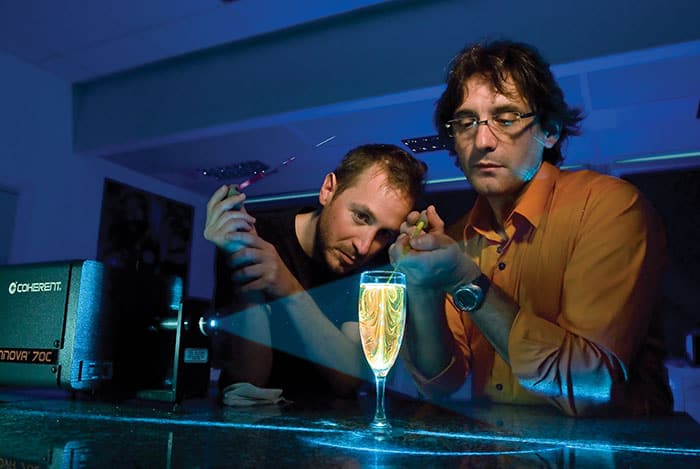
Gently does it At their optical workbench, Gérard Liger-Belair (left) and Guillaume Polidori use laser tomography to capture the flow patterns in champagne. (Courtesy: Hubert Raguet)
After using high-speed video cameras to examine wine glasses filled with champagne, we found that most bubble-nucleation sites are located on pre-existing gas cavities trapped within hollow, cylindrical cellulose fibres on the wall of the glass. Most of these fibres were either left behind by the towel we used to clean the glass or had been simply floating in the air before landing on the wall. Crucially, these fibres have an open tip that is several microns in size – exceeding the critical radius required for bubbles to grow.
To find out how many bubbles are likely to form in a glass, we developed mathematical models that combine the dynamics of bubble ascent with mass-transfer equations (2014 J. Phys. Chem. B118 3156). As you might expect, the number of bubbles depends on both the wine and the glass, increasing with the temperature of the champagne and with the ambient pressure. The number of bubbles falls, however, with the height of the champagne, which means that if you like a lot of fizziness, don’t pour yourself too big a drink.
Roughly speaking, if you pour 100 ml of champagne straight down the middle of a vertically oriented flute, you’ll nucleate about one million bubbles – if you can resist drinking from your flute that is. Serving champagne by pouring it down the wall of a tilted flute, which keeps more CO2 dissolved, will yield tens of thousands more bubbles before the wine goes flat.
5. How do flow patterns in champagne affect its aroma?
3 Champagne moments Laser tomography captures the flow patterns in champagne. If the glass has been thoroughly washed, there is no effervescence (a). But if the glass is slightly dirty, you get a lot of bubble trains (b). These trains help to bring the wine’s aroma to your nose. (Courtesy: University of Reims Champagne-Ardenne)
After being created from tiny gas pockets trapped inside particles stuck on the glass wall, bubbles rise in a line towards the surface of the champagne. As the bubbles float up, they continue to get bigger by continuously absorbing molecules of CO2 dissolved in the liquid. These rising bubbles displace surrounding fluid, which in turn disturbs neighbouring fluid layers, dragging fluid particles in their wakes. As the champagne is constantly moving, with the surface changing all the time, volatile aromas can escape relatively easily, which is one of the joys of champagne. A flat, non-bubbly wine, in contrast, will be at rest in your glass. So unless you swirl it, the wine will quickly lose its smell.
Together with my colleagues Guillaume Polidori and Fabien Beaumont – both experts in fluid mechanics at Reims – I used laser tomography to reveal what the naked eye could not. Before pouring champagne into the glass, we first seeded the wine with tiny, approximately spherical “Rilsan” particles about 10–100 μm in diameter. Made from plastic, these particles have the same density as the fluid and so float in it, without rising or sinking under the effect of buoyancy. They reflect a lot of laser light, letting us visualize the flow patterns inside freshly poured glasses of champagne (figure 3).
In one test, we washed the glass using formic acid so that it was perfectly clean with no fibres remaining in it, which prevented any bubbles from nucleating. Free from effervescence, the champagne looked like a still wine with the Rilsan particles motionless. However, in a glass that has not been rinsed with acid, you do get effervescence, with a few nucleation sites giving rise to several “bubble trains” in the champagne. These trains make the champagne flow upward, creating vertically oriented streaks of light as the bubbles sweep the Rilsan particles along their path.
Close-up Gérard Liger-Belair uses a high-speed camera to study the release of bubbles from tiny fibres left on a glass that has not been over-cleaned. (Courtesy: Hubert Raguet)
Flow patterns driven by ascending bubbles don’t just look pretty. They are a wonderful gift to the champagne taster, hugely increasing the diffusion of aromas above the champagne surface without having to lift a finger. In other words, there is absolutely no reason to swirl a glass of champagne or sparkling wine to enjoy the subtle mix of scents and flavours. The bubbles do the job for you.
6. Why do bursting bubbles make champagne have a better aroma?
The top of a flute filled with freshly poured champagne is a fantastic playground for exploring the physics behind collapsing bubbles. As an individual bubble reaches the surface of the liquid, it floats for a while like a mini iceberg, with only a tiny part of it emerging above the champagne surface. But when the emerged film of liquid disintegrates, a very complex hydrodynamic process ensues, causing the submerged part of the bubble to collapse. Together with Arnaud Antkowiak, Elisabeth Ghabache and Thomas Séon from Pierre and Marie Curie University in Paris, we studied this process using high-speed imaging combined with numerical modelling.
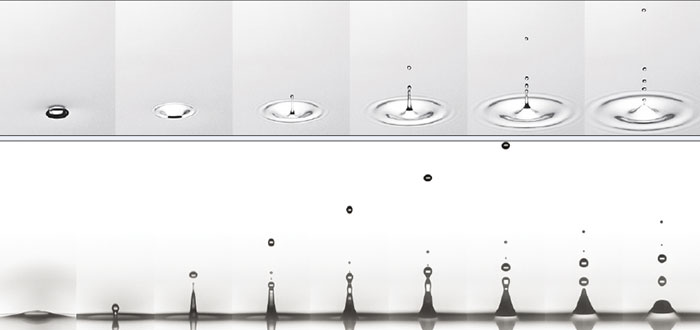
4 Burst of action Time sequence showing the various steps of a millimetre-sized bubble bursting at the surface of pure water, and propelling tiny droplets several centimetres above the surface. Each image is about 5 mm wide and taken about 0.5 ms apart. (Courtesy: Institute Jean Le Rond d’Alembert/Paris 6)
We found that when individual bubbles at the surface of champagne burst, they each produce a high-speed jet of liquid that quickly breaks up into several tiny champagne droplets (figure 4). In fact, the myriad of ascending bubbles collapse and spray a multitude of tiny droplets above the surface, creating wonderfully refreshing aerosols (figure 5). This characteristic champagne fizz releases far more flavours than you’d ever get from a flat wine.
Oceanographers have known for years that air bubbles trapped in sea water carry surface-active agents (or “surfactants”) that are released at the ocean surface when the bubbles burst, which led me and my team to wonder if champagne aerosols also have a high concentration of these molecules. Together with several friends and colleagues, led by Philippe Schmitt-Kopplin from the Department of Biogeochemistry and Analytics at Helmholtz Centre in Munich, we used ultrahigh-resolution mass spectrometry to analyse the chemical composition of champagne droplets (2009 Proc. Natl Acad. Sci.106 16545).
5 Pop science Laser tomography reveals the myriad of champagne droplets projected above the surface of a coupe-shaped glass. (Courtesy: University of Reims Champagne-Ardenne)
We found that hundreds of different kinds of surfactant molecules get carried up and out of the liquid by ascending and bursting bubbles. They enter the champagne aerosols, which end up with a very different chemical fingerprint from the bulk champagne. Moreover, tens of these compounds, concentrated in the champagne aerosols, were identified as being the chemical precursors to aromas. By drawing a parallel between the fizz of the ocean and the fizz of champagne, our study revealed a relationship between bursting bubbles and the aromatic boost often attributed to champagne and sparkling wines. Our work supported the idea that rising and bursting bubbles act as a continuous “elevator” for aromas in each and every glass of champagne.
Champagne perfection
So there you have it. To enjoy champagne at its best, first chill the wine to the ideal serving temperature of 8–10 °C. Pour the champagne gently down the side of a tilted glass (not straight down the middle) so plenty of CO2 remains dissolved in the liquid. A tulip-shaped glass will give you the ideal balance between lots of aroma and not too much prickly CO2 getting up your nose. Don’t over-clean your glass or you won’t get enough of the bubble trains that help to release the champagne’s wonderful aromas by bringing lots of bubbles to the surface. And remember there’s no need to swirl champagne (as you would do with still wines) as those bubble trains will automatically disturb the liquid and help aromas escape through the surface towards your nose. Sniff deeply (but not too deeply) to enjoy the aromas, then let the lovely liquid into your mouth.
A thin-film material that converts infrared light into visible light has been unveiled by researchers at the Massachusetts Institute of Technology (MIT). Made of two non-conventional semiconductors, the material works for infrared light at moderate intensities, and could be used to improve a range of technologies including solar cells, cameras and night-vision goggles.
The team, led by Vladimir Bulović, Moungi Bawendi and Marc Baldo of the Energy Frontier Research Center for Excitonics at MIT, made its films on top of glass microscope slides. The films have a simple, two-layer structure. The bottom layer consists of colloidal quantum dots. These are nanometre-sized chunks of the semiconductor lead sulphide coated with a molecular layer of fatty acids. The top layer is a crystalline film made of an organic molecule called rubrene.
Colliding excitons
The conversion process begins when a quantum dot absorbs an incoming infrared photon. This energy is then transferred to the neighbouring rubrene film in the form of an electron–hole pair. Called excitons, these pairs diffuse through the rubrene, where they can collide with each other.
“When two low-energy excitons collide, they can create a high-energy exciton, which we call a ‘singlet’ because of the spin physics in these materials,” explains team member Mark Wilson. “The high-energy singlet can emit visible light, so, in short, we are able to change the colour of the light from infrared to the visible,” he adds. Energy is conserved during this upconversion process and the absorption of two lower-energy infrared photons is required to generate each higher-energy photon of visible light.
The upconversion of infrared light at wavelengths greater than about 1 μm had proved difficult in the past because the materials used to absorb the infrared light tended to heat up rather than produce useful excitons. “We used colloidal nanocrystals as the infrared-light-sensitive materials to overcome this problem,” says Wilson. “We show that not only does this approach work, but that our devices are already quite efficient at upconverting light. The technology is not yet optimized and we are working on understanding how it works and so improving device performance.”
An important advantage of the excitonic process over other upconversion schemes is that it can operate efficiently at relatively modest light intensities. This makes it relevant for many applications, including biological imaging, night vision, multidimensional displays and photovoltaics.
The team, reporting its work in Nature Photonics, says that as well as trying to improve light-conversion efficiency, it is also looking to lower the light-intensity threshold for efficient operation. The researchers are also trying to improve the films so that they are able to convert infrared light with longer wavelengths of around 1.5 μm.
“If we succeed in doing this, our materials might be used to enhance the performance of industry-standard silicon camera technology,” explains Wilson. He points out that short-wave infrared light penetrates further into fog, so a camera containing the film would be ideal for use in all-weather autonomous vehicles.
Redox-flow batteries could be very useful for the safe storage of excess energy in electricity grids, but their deployment has been held back because they have far lower energy capacities than conventional lithium-ion batteries. Now, researchers in Singapore have built a new type of redox-flow battery that offers a higher energy capacity without losing the safety advantages that such batteries bring.
As more electricity is generated from renewable sources, electricity suppliers will have to find efficient ways of storing energy produced when the Sun is shining (or the wind is blowing) for use at times of peak demand. Storing energy in rechargeable batteries is one option, and various technologies that are used today including traditional lead–acid batteries and state-of-the-art lithium-ion batteries. However, these established technologies have their problems. Lead–acid batteries have limited storage capacity and lithium-ion batteries are prone to overheating, which makes the latter unsuitable for use in large-scale facilities.
A redox-flow battery employs liquid electrolytes that are stored in two separate tanks. During charging or discharging, one liquid is circulated around the battery’s anode and the other around its cathode – which are themselves separated by a semipermeable membrane. Such batteries are less prone to overheating and combustion because the energy is stored in the tanks, which can be isolated from the point at which the electrochemical power generation takes place.
Tanks of energy
“It’s a bit like with the internal-combustion engine, where you have a tank for the gasoline and you just pump it into the engine to produce power,” says materials scientist Qing Wang, who led this latest research. The most developed designs use vanadium, which is stored and transported in aqueous solution. Unfortunately, this severely restricts energy capacity, because the vanadium salts are not very soluble in water.
Wang and colleagues have developed a new type of redox-flow battery in which the cathodic tank contains lithium–iron-phosphate granules and the anodic tank contains granules of titanium dioxide. When the battery is charged, “redox mediators” dissolved in the electrolyte are pumped through both tanks. Under the influence of an applied voltage, one of the redox mediators oxidizes the lithium in the tank, transporting the lithium ions into the reaction vessel. The reaction vessel is divided by a partially permeable membrane that allows lithium ions to pass but not the redox mediators. In the anodic half of the reaction vessel, other redox mediators combine with the lithium ions. These are then pumped through the titanium dioxide, where the lithium ions are reduced back to lithium metal, which intercalates into the titanium dioxide.
When the battery is discharged, the reaction runs in reverse, returning the lithium to the cathode. Because the lithium is stored in solid form in both of the charged and discharged states of the battery, the energy density of the new lithium-flow battery is about 500 Wh/l. This is around 10 times that of a vanadium redox battery.
Better membrane
The researchers are now optimizing their new battery with an emphasis on improving the performance of the membrane. Conventional flow batteries use a membrane made from the polymer Nafion, which could not be used in the new battery because it lets through too many redox-mediator molecules. Wang and colleagues solved this problem by combining Nafion with the polymer PVDF, which stopped the redox mediators from passing through. However, this new membrane also restricts the lithium-ion flow, which reduced the charge/discharge rate of the battery. For grid storage, Wang says the permeability “works fine, but it’s not perfect”. If it can be improved further, Wang says, the battery could also be useful for electric vehicles – although he concludes that “there’s quite a long distance to go”.
Michael Aziz of Harvard University describes the work as “very innovative”, but he is sceptical of Wang’s claim that the charge/discharge rate is adequate for grid storage, saying that it is 10,000 times lower than that of an aqueous vanadium redox-flow battery. He points out that Nafion is very expensive and a practical battery would need 10,000 times the amount of membrane to achieve the same performance as aqueous vanadium. “For grid storage, it’s more important that a battery be cheap than that it take up a very small area,” he explains.
John Goodenough of the University of Texas at Austin – the inventor of the lithium-ion battery – agrees. “I don’t think they have the answer to the least-expensive battery for large-capacity electrical-energy storage,” he says, “but the approach may prove feasible one day.”
This week, people all over the world have been celebrating the 100th anniversary of Einstein’s general theory of relativity (GR). Einstein delivered his theory this week in November 1915. Not surprisingly, the Web has been buzzing with tributes to Einstein and explanations of his theory.
In the above video, the physicist Brian Greene and two young assistants demonstrate Einstein’s explanation of gravity using a huge piece of stretched Spandex. Why they have this Spandex ring in what appears to be their living room remains a mystery, but it and a large number of marbles do the trick when it comes to explaining GR.