Dipping into the physics of a chocolate fountain

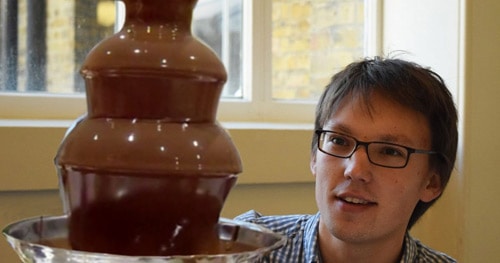
Picture of Adam Townsend with a chocolate fountain

By Tushna Commissariat

When most people look at a chocolate fountain in a restaurant or maybe at a party, they are mostly thinking about all the yummy treats they can dunk into the liquid-chocolate curtain. But when a physicist or a mathematician looks at one, they can’t help but notice some of the interesting fluid dynamics at play – most visible is how the curtain of chocolate does not fall straight down, rather it pulls inwards, and that melted chocolate is a non-Newtonian fluid.

University College London (UCL) student Adam Townsend decided to work on this topic for his MSci project and has now published a paper on his findings in the European Journal of Physics. To study the inflow effect, he looked into some classic research on “water bells”, where the same flow shape is seen. “You can build a water bell really easily in your kitchen,” says UCL physicist Helen Wilson, who was Townsend’s MSci project supervisor and the paper’s co-author. “Just fix a pen vertically under a tap with a 10p coin flat on top and you’ll see a beautiful bell-shaped fountain of water.”

(more…)

UK science funding protected from cuts

The UK chancellor of the exchequer, George Osborne, has announced that the country’s science budget will be protected in real terms until 2020, dispelling fears among many scientists that it would be cut. The £4.7bn per-year budget will now rise in line with inflation, to “ensure the UK remains a world leader in science and research”. The chancellor also re-affirmed that the UK will invest a further £6.9bn over the course of the parliament, which runs until 2020, in capital spending on science.

The government claims that by inflation-proofing the budget, the total spend on science will be more than £500m higher by 2020 than in 2015. “In the modern world, one of the best ways you can back business is by backing science,” Osborne noted during his budget speech to parliament. He also announced that to “further support innovation”, the government will dedicate 1.2% of its defence budget to science and technology, and invest more than £1.3bn by 2020 to attract new teachers, “particularly into science, technology, engineering and mathematics”.

Researchers and senior figures within the UK science community have welcomed the statement. “Across government there are programmes facing significant cuts, and against this background we acknowledge the value the government has placed on research with this settlement,” says Philip Nelson, chair of the Research Councils UK (RCUK) executive group – the umbrella organization for the UK’s seven research councils. “It means that the UK’s research base will be able to maintain its world-class research outputs, continue to partner with and attract industry, maintain its flow of trained researchers into the economy and society, and continue to inspire the next generation.”

In the modern world, one of the best ways you can back business is by backing science George Osborne, chancellor of the exchequer

Paul Hardaker, chief executive of the Institute of Physics, which publishes Physics World, says that while this budget boost will help UK science, “we still need to be mindful of how this compares with higher investment by international competitors”. Over the past five years, the UK’s flat science budget has been eroded in real terms by inflation, whereas other countries, notably Germany, have been increasing spending on science. “To grow our economy and create jobs, the UK must be competitive, and that means investing in science and bringing that science to market,” says Hardaker. “[The budget] shows that this government is committed to investing in science, and ensuring that we maximize the potential economic and societal gains from doing so in the future.”

Tucking in

Yet while the protection of science is good news for researchers who had feared deep cuts, the devil will be in the detail. As part of the science budget, the government announced a new £1.5bn “Global Challenges Research Fund” over the next five years that will “ensure UK science takes a leading role in addressing the problems faced by developing countries”. It is not yet clear how this will affect the science budget and if it is a case of “tucking in”, in which the same pot of money is made to fund additional programmes.

“At face value, the restoration of the link between the science budget and inflation is a great relief, having been eroded in real terms by 10% over the last five years,” says astronomer Paul Crowther of the University of Sheffield. “However, as usual we’ll have to wait for further details, since other items may be tucked into the overall budget, or higher funds may be directed to specific programmes already in the science budget, such as the UK Space Agency.” Crowther adds that researchers will now be eagerly awaiting details of how the cash will funnel down into the seven research-council budgets, which is likely to be known in January.

Osborne’s budget statement also announced that the government will implement the recommendations of a recent review carried out by the Nobel laureate Paul Nurse, who is president of the Royal Society. Nurse called for a new body – Research UK – that would replace RCUK. If created, Research UK would manage councils’ research funds and would be at “arm’s length” from the government. The statement also says that the government will “look to” integrate Innovate UK – the UK’s innovation agency – into Research UK, as well as “take forward” a review of the Research Excellence Framework, which assesses the quality of research in UK higher-education institutions.

Trafficking in big ideas

Some minds never cease to fascinate. They soar over difficulties and spot connections between fields that are invisible to others. They traffic in the big ideas. The mind of the mathematician John Horton Conway is an excellent case in point. Conway’s biggest idea (at least in the sense of being the most famous) is the “Game of Life”, a mathematical grid of cells in which simple rules about when a cell becomes “live” or “dead” can produce a riot of patterns. But Conway’s ideas stretch far beyond this one example, and they are the focus of Siobhan Roberts’ informative biography Genius at Play: the Curious Mind of John Horton Conway.

Born in Liverpool, UK, in 1937, Conway grew up as a typical, socially inept maths nerd. En route to the University of Cambridge though, he realized he could reinvent himself in a way he had only dreamt about, by becoming an extrovert who seemed to spend his time playing board games and card games, tying and untying knots, and messing about with the properties of numbers. He particularly liked tricks such as figuring out the day of someone’s birthday years into the future and factoring large numbers in his head; “Gimme a number!” was a typical conversation-starter. Yet he did well enough on Cambridge’s Mathematical Tripos to be accepted for post-graduate study, and a story Roberts heard from Conway’s PhD adviser, the eminent number theorist Harold Davenport, may explain why. Davenport recalled having two very good students at the same time, Conway and one other. When he gave the other student a problem, the student would return the next day with an excellent solution. Conway, however, would return with a very good solution to a completely different problem. Already, as a student, Conway showed how his mind meandered across the mathematical landscape.

Roberts first met Conway in 2003 at Princeton University, where he had been in the mathematics department since leaving a similar position at Cambridge 17 years earlier. She assumed the role of a sociologist scoping out an exotic, newly discovered tribe, and she describes Conway as “high comedy, in an orbit all his own – prankish, belligerent…he was in good company among artists who matched creativity with promiscuity, intellectual and/or personal – Picasso, for example”.

In order to show readers Conway the person as well as Conway the mathematician, Roberts describes his (often unsuccessful) attempts at balancing research, life and amorous escapades. Throughout all of this – as well as two heart attacks, a stroke and bouts of suicidal depression – Conway has persevered, fuelled by his passion for mathematics. As was the case for Einstein, Picasso and many other high-level thinkers, pretty much nothing else mattered. Like them, Conway could work anywhere, at any time. When his office – piled high with papers, books, homemade mathematical models and buried unconsumed food – became impossible to work in (or visit), he fled to the department’s common room in both Cambridge and Princeton. He was, in fact, more at home there, among students who, when he appeared, dropped what they were doing to join him in inventing new games and analysing their mathematical properties.

This was how Conway made his most well-known discovery. He came upon the Game of Life after years of studying the patterns that emerge as one places and removes tiles in Go, the Japanese board game. Depending on the pre-set properties of cells in their vicinity, Conway found that initial patterns of cells in the Game of Life change form as they move over an infinitely large grid. “Patterns emerged, seemingly from nowhere,” he recalled to Roberts with passion and wonder. In addition to its mesmerizing powers, the Game of Life turned out to have unexpected uses as a tool for exploring the evolution of spiral galaxies; calculating π (which Conway can recite “from memory to 1111-plus digits”, he boasted to Roberts); and investigating how ordered systems emerge from complex ones. The game has also been used to examine why, in a multiverse scenario, only certain universes are capable of supporting life due to initial conditions such as their fundamental constants, including the fine-structure constant.

Conway had hit on something universal, yet nowadays his attitude towards his creation is ambivalent at best. “I hate the damned Life game,” he told Roberts, an attitude not unlike that of Sergei Rachmaninoff towards his immensely popular prelude in C-sharp minor. What about all their other work, as many great thinkers have complained. Ah, the price of fame.

Conway rates highest his contributions to group theory, and Roberts rightly delves into them in great detail. Like many mathematicians, Conway was attracted to his subject by its beauty, and (again like many mathematicians) what he means by “beauty” is “symmetry”. Simply put, groups are a way of representing the symmetries of objects; they are a collection of operations on an object that preserves its original symmetry. A cube, for example, can be reflected or rotated in 48 ways and still look like a cube. The 48 operations of its symmetry group can be enumerated in what mathematicians call a character table. Since the cube is a 3D object, the symmetries that go with a particular operation or number can be visualized. Not so for higher dimensions, where numbers in character tables replace visualizations. Mathematicians read these numbers as they would a novel and are moved by the symmetries they represent.

Roberts tells the saga of how Conway and three collaborators took on the Herculean task of calculating the character tables of a large number of certain basic groups known as finite simple groups. Their result, The Atlas of Finite Groups, took 15 years to assemble and instantly became indispensable to group theorists.

Roberts’ biography, unflinchingly honest yet entertaining and lively, will be best appreciated by scientists and mathematicians. My main criticism is that it contains many lengthy quotes from Conway (taken from Roberts’ interviews) that would have benefitted from more judicious editing. I would also have liked to have learned more about how Conway approaches problems and how he discovers them – in other words, how he thinks. The author tells us that neuroscientists have used functional magnetic resonance imaging to observe Conway’s brain while he solves mathematical problems, but she omits any mention of how notoriously untrustworthy this method is.

When Roberts asked Conway what was left to do on the Atlas, his reply was emphatic, as if it should have been obvious to everyone. “Lots! Understand it all, for one thing.” Among the exceptions to the groups in the Atlas is one whose sheer size astonished mathematicians. This group – known as “the Monster” – exists in a space with 196,883 dimensions. Its character table has 194 columns and 194 rows, and the total number of symmetries in it is 54 digits long. “The one thing I want to do before I die is understand WHY the Monster exists,” an emotional Conway told Roberts. There is an outside chance that he will get his wish. Not surprisingly, the Monster has connections with other fields in mathematics, such as number theory, and the physicist Freeman Dyson entertains a “sneaking hope [that] 21st century physicists will stumble upon the Monster group.” After all, is not mathematics the structure of the universe, as scientists and mathematicians from Plato onwards have speculated?

  • 2015 Bloomsbury £16.59/$30.00hb 480pp

Web life: DSFP’s Spaceflight History

So what is the site about?

If you think you’re pretty knowledgeable about the history of space exploration, then this blog will make you think again. It will also send you down one of those Internet “rabbit holes” that spits you out, several hours later, with a newfound appreciation for a subject and a disquieting sense of disbelief about what time it is. (You have been warned.) The person responsible for this particular rabbit hole is the science writer and space aficionado David S F Portree, a veteran of the science blogosphere whose previous sites include the similarly themed Beyond Apollo, which was part of Wired magazine’s science blog network until earlier this year. Like Beyond Apollo, Portree’s new site focuses on the lesser-known aspects of space exploration, including missions and programmes that never got off the ground.

Isn’t that a bit of a downer?

“The history of spaceflight is mostly about dreaming and planning, not funding and launching,” Portree writes. “Focusing on this could become depressing really fast, but I try to strike a healthy balance, presenting both the hard lessons and great victories of our past, and the difficult challenges and exciting possibilities of our future.” It is also interesting to see how particular dreams and plans have cropped up repeatedly (albeit with variations) in the decades since humans began venturing outside the Earth’s atmosphere. For example, NASA’s current plans for capturing an asteroid and landing astronauts on it are reminiscent of a 1966 proposal by one Eugene Smith, an engineer at Northrop Space Laboratories. As Portree explains, Smith pointed out that the asteroid Eros was due to make a close approach to the Earth on 23 January 1975, and suggested that a flyby might make good practice for a future Mars mission.

Who is it aimed at?

The posts on DSFP’s Spaceflight History are written in clear, accessible prose, and most of the physics in them (orbital mechanics, some kinematics, bits of astrophysics and planetary science) is not hard to grasp, at least on a conceptual level. Some of the historical, political and spacecraft-engineering details do get rather technical, however, and you’ll need a high tolerance for acronyms and mission numbers to get through some of the longer, more complex essays. In short, this is a blog for people whose interest in space exploration goes beyond pretty pictures and dramatic stories, although there are plenty of those, too.

Anything else?

Now and then, Portree pokes his nose into topics with a more tangential connection to spaceflight. In one of these, he speculates on what would have happened if astronomers had discovered Pluto in the late 1970s, rather than in 1930. This alternative version of history is plausible, Portree notes, because “only a series of astronomical errors led us to believe that a planet might exist beyond Neptune”. Without those errors, early 20th-century astronomers would have had no reason to hunt for an additional planet, and the object we know as Pluto would probably have been found in 1978 (together with its moon, Charon, which was in fact discovered that year). At that point, we would have realized immediately that Pluto was too small to be a planet – thus avoiding the “dwarf planet” controversy entirely.

Can you give me a sample quote?

From an August 2015 post entitled “Failure was an option: what if Apollo astronauts could not ride the Saturn V rocket?”: “The Saturn V was the largest rocket ever developed. It had engines of unprecedented scale and power: the F-1 engines in the 33-foot-diameter S-IC first stage, which burned RP-1 kerosene fuel and liquid oxygen, remain today the largest ever flown. The J-2 engines in the top two stages, the 33-foot-diameter S-II second stage and the 22-foot-diameter S-IVB stage, gulped down temperamental liquid hydrogen and liquid oxygen propellants. Cautious engineers could see many opportunities for trouble, and they were aware that problems they could not foresee might be the most difficult to solve. Many believed that NASA should have in place backup plans in case the Saturn V suffered development delays.”

Einstein’s legacy, 100 years on

By Tushna Commissariat

As readers of Physics World, you probably don’t need me to tell you that this year marks 100 years since legendary physicist Albert Einstein laid the foundations for his revolutionary general theory of relativity (GR). This month marks the exact time when he began giving a series of four weekly lectures – the first of which was on 4 November 1915 – to the Prussian Academy of Sciences in Berlin. Indeed, today is the centenary of the final lecture, when he presented his “Field equations of gravitation”. In the video above, philosopher and one-time physicist Jürgen Renn, from the Max Planck Institute for the History of Science in Berlin, gives a short and sweet explanation of GR and its impact on physics.

(more…)

How to make better dental fillings last longer

Dental fillings could soon last longer thanks to a new study of how the movement and bonding of aluminium ions affects the toughness of a popular type of dental cement. The research was done by an international team of scientists that used neutron scattering and terahertz spectroscopy to observe the ions during the hardening process. The results could lead to the development of more effective dental materials.

Glass ionomer cements (GICs) have been used by dentists for 40 years to repair damaged teeth. While these materials do an adequate job, they the lack the toughness (resistance to fracturing) that characterizes both the dentine found in natural teeth and the mercury–silver amalgam fillings that have long been the mainstay of dentistry. A GIC filling will last about 10 years, whereas an amalgam filling can endure for a lifetime. The problem with mercury–silver amalgam, however, is that there are growing concerns about its potential toxicity to patients, dentists and the environment in general.

This latest research was done by Greg Chass of Queen Mary University London, Neville Greaves of the University of Aberystwyth and colleagues in the UK, Hungary, Denmark and China. The team studied GICs made from a commercial grade of glass powder that has been used by dentists since the 1970s. The powder is mixed with poly(acrylic) acid (PAA) and while hardening occurs quickly, the toughness of the cement will continue to change on a timescale of tens of hours.

Racing-car drivers

Researchers already know that hardening involves aluminium ions that leach out of the glass particles and then bind to both the glass and to molecules in the PAA. The toughness of the hardened cement is thought to be related to how many bonds each aluminium ion makes with its neighbouring atoms – a number that can range from four to six. Chass likens the effect to that of a seatbelt: “a racing-car driver constrained by a six-point harness can’t move at all”, he says. However, an ordinary driver in a three-point seatbelt has much more freedom to move. The idea is that a greater number of aluminium bonds will lead to a material that is more rigid and therefore more likely to crack under stress.

To test this idea, the team first had to understand when the aluminium bonds form during the hardening process. This was done using terahertz spectroscopy, which is sensitive to the dynamical processes that occur as bonds form in the material. This study found that the bonding process began about one hour after the glass and PAA were mixed, and the process continued for at least 10 hours. The team then used neutron-diffraction techniques to work out how the aluminium ions are bonded as a function of time. This study revealed that during the first 14 hours of hardening, most aluminium ions are bonded to four atoms. However, after about 14 hours, atoms with six bonds dominate the material.

Greaves told physicsworld.com that the research suggests that the key to making tougher cement could lie in stopping the hardening process before too many six-atom bonds are formed. He says that the research shows that the switching process from four to six bonds involves “many-atom collective vibrations that ‘choreograph’ configurational changes in the cement”.

New toughness technique

The team has also developed a new technique to measure the toughness of the cement without having to destroy it. This involves firing neutrons at the cement and measuring how much momentum is transferred from the neutrons to aluminium atoms in the sample. The width of the momentum-transfer peak is a measure of how strongly bonded the aluminium atoms are within the cement. By measuring the toughness and peak widths of a number of different cement samples, the team showed that peak width can be used to determine the toughness of the cement.

This neutron technique was used to measure the toughness of the cement as it hardened and showed that the material becomes less tough as time progresses.

Greaves also points out that the glass powder used to make GIC cement is a very complicated material that includes several distinct types of glass particle. Each type of glass probably plays a different role in determining other important properties of the cement, such as its colour or adhesion to dentin. As a result, making better cement would probably involve more than just focusing on aluminium bonding.

The team is now looking at how the techniques could be adapted to study other materials including Portland cement.

The study is described in Nature Communications.

What is Einstein’s general theory of relativity?

It was 100 years ago this month that Einstein first presented his general theory of relativity – a work that would transform our understanding of the nature of space and time. In a time dilation of sorts, philosopher Jürgen Renn gives a 100-second explanation of this great work and the impact it has had on physics.

Renn, a researcher at the Max Planck Institute for the History of Science in Berlin, describes how remarkable the theory is, especially given that Einstein was seemingly not aware of all it consequences. The theory has since been used to explain all manner of physical phenomena, including black holes, bending light and the expanding universe.

Renn and his research group have been building their own theory of how Einstein – along with his collaborators – could have arrived at such a revolutionary view of the physical world. “He did it as a transformation of the knowledge of classical physics from a new perspective,” says Renn.

If you enjoyed this video explainer, then check out more from our 100 Second Science series

Physicists entangle qubits in a semiconductor at room temperature

The quantum entanglement of a large ensemble of spins in a semiconductor has been carried out at room temperature for the first time, by researchers in the US. The team entangled more than 10,000 copies of two-qubit entangled states in a commercial silicon-carbide (SiC) wafer at ambient conditions. SiC is widely used in electronics, so this latest achievement could be an important step towards the creation of sophisticated quantum devices that harness entanglement.

Entanglement is a purely quantum-mechanical phenomenon that allows two or more particles to have a much closer relationship than is allowed by classical physics, no matter how far apart they may be. The states of entangled particles are inextricably linked such that any change made to one particle instantly influences the state of the other. Entangled particles are seen as a key component of quantum computers, but for entanglement to be truly utilized in practical applications, researchers must be able to entangle quantum bits (qubits) at room temperature and preserve the entangled state.

Ordered states

To produce entanglement between particles, the system must initially be in a highly ordered state. This is normally only possible at cryogenic temperatures of around –270 °C and involves applying extremely large magnetic fields – conditions that are rather impractical. Entanglement becomes even more difficult when a large number of qubits are involved, for example in a solid-state ensemble.

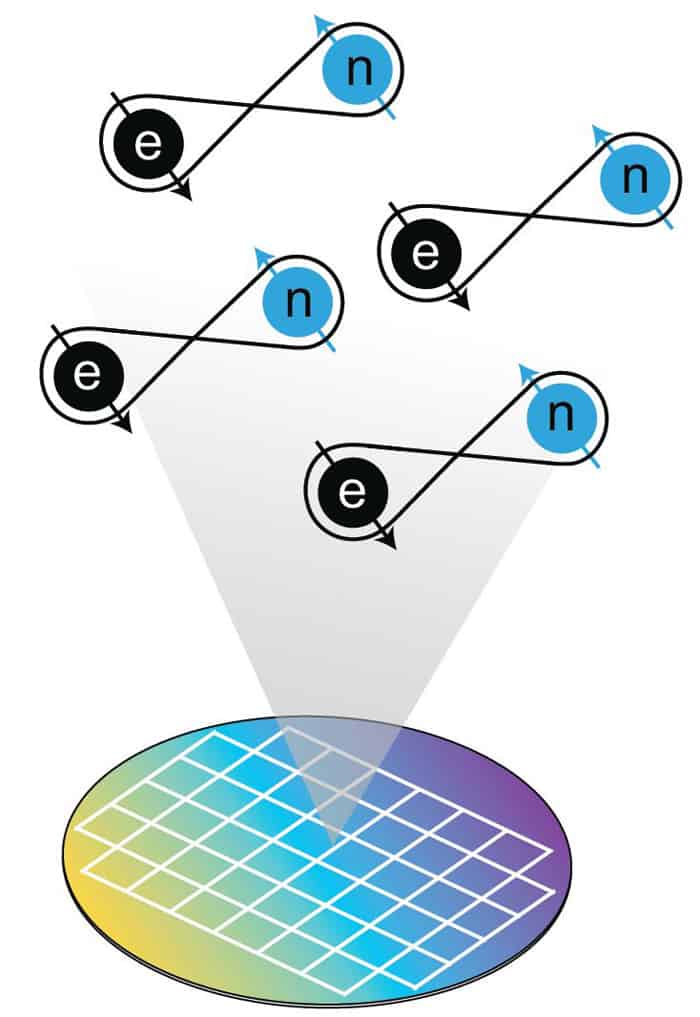
Now, Paul Klimov and David Awschalom from the University of Chicago, together with colleagues at the University of California, Santa Barbara and the Argonne National Laboratory, have developed a new method that addresses these challenges. It uses a combination of infrared laser light with microwave and radio-frequency pulses to entangle nearly 10,000 two-qubit electron and neutron spin pairs. This is done in a macroscopic 40 µm3 volume of the commercial SiC wafer.

The electron–nuclear spin pairs are located at the intrinsic “colour centre” defects found in SiC. These are similar to the “nitrogen vacancy” centres found in diamond, which can also be used as qubits. While the team’s techniques could be applied to diamond, Awschalom told physicsworld.com that the team used SiC because of the important role it plays in high-power electronics, optoelectronic devices and sensors. The fabrication techniques developed in these fields will transfer directly to the development of sophisticated entanglement-harnessing devices, says Awschalom, adding that “creating sophisticated devices from diamond is generally much more difficult”.

Two-step process

Creating the entangled ensemble is a two-step process. The team first “initializes” or polarizes the system, in a very small magnetic field using infrared laser light. The entanglement that the researchers measure starts out highly coherent – up to 88% fidelity with respect to a maximally entangled state – and then decays within 300 ns. This initial “inhomogeneous” entanglement coherence can then be extended by applying sequences of radio-frequency and microwave pulses.

“Many of the microwave/radio-frequency pulse techniques have been developed over decades of nuclear magnetic resonance (NMR) research, and many of them are implemented in commercial magnetic resonance imaging (MRI) technologies,” says Awschalom. “We believe that the ultimate limit of this coherence will be of the order of 100 μs, however, we have not performed the measurements necessary to confirm this.”

The entanglement is confirmed by performing “quantum state tomography”, which is a measurement of the quantum state of the system. It can be very difficult to measure the quantum state of a specific ensemble when it is intertwined with many other quantum systems that are naturally present in the substrate. To overcome this challenge, the team developed a new tomography protocol for precisely measuring the state of a specific ensemble, even when there is significant noise.

Surprisingly, the team found that this entanglement works best at ambient conditions – at lower temperatures, the polarization of the system degrades slightly, and so the maximum possible entanglement fidelity is also lowered. “With more sophisticated polarization techniques, however, the entanglement fidelity at cryogenic conditions can be made to approach the entanglement fidelity that is possible at ambient conditions,” says Awschalom.

Practical scaling

The team managed to entangle nearly 10,000 spin pairs, but by tweaking the experimental apparatus, it could be possible to create hundreds of billions of two-qubit entangled states in a chip of material that is 0.5 mm × 3 mm × 3 mm (the approximate size of the sample). “The more copies of the system, the stronger its signal-to-noise, and the stronger it can couple to things like other ensembles or light, for example,” cautions Awschalom.

While it is far too early to tell if this technique will directly lead to a practical quantum computer, the entangled states created could be used as building blocks in a quantum computer many years in the future. But even this is only possible if it can be expanded beyond two-qubit entanglement to much larger entangled states. This, according to Awschalom, is probably the biggest challenge in scaling up any quantum system – at room or cryogenic temperatures – into a useful quantum technology.

On the flip side, the entangled spins could be used as quantum sensors. “Given that the entanglement works at ambient conditions and the fact that SiC is bio-friendly, one particularly exciting application is in vivo biological sensing,” explains Awschalom, adding that “future devices of this type could include entanglement-enhanced magnetic resonance imaging probes, which could have important biomedical applications”.

The research is published in Science Advances.

Cyborg roses become transistors and logic gates

Researchers in Sweden have created electronic circuits and devices that are integrated within living plant material. The team introduced a conductive polymer into the vascular system of plants, which allowed the researchers to create the key components of an electrical circuit. They were also able to demonstrate transistor modulation, digital logic function and elements of a digital display. Plant-integrated electronics could enable us to monitor and regulate plant physiology and harvest energy from photosynthesis, the team says.

Organic electronic materials are polymers and molecules that can conduct and process both electronic and ionic signals. They can be shaped into almost any form and used to build devices that can convert electronic signals into chemical processes, and vice versa. The resulting electrochemical devices can then be used to regulate and monitor biological and chemical processes. Such technologies are currently being exploited in various medical settings, such as drug delivery, regenerative medicine, neuronal interconnects, and diagnostics.

Magnus Berggren and colleagues at Linköping University and the Swedish University of Agricultural Sciences are interested in whether similar organic bioelectronics can be used to sense, record and control chemical processes in plants. This could have many useful applications in agriculture, Berggren explains. For example, if you could monitor hormones that indicate when crops are ready to flower and were able to regulate that process, you could adjust flowering times to avoid periods of bad weather.

Conducting wires

The team tried merging electronic circuitry with sections of stems from Rosa floribunda (garden rose) by soaking them in solutions of conductive polymers. Only one, poly(3,4-ethylenedioxythiophene) or PEDOT, was taken up through the tube-like xylem, which transports water through the plant, and incorporated into the plant’s internal structure. The polymer was shown to have self-organized to form conducting wires – some of which were more than 5 cm in length – inside the xylem, while still allowing the transport of water and nutrients.

The researchers showed that the wires could interact with the electrolytic compartments in the surrounding cells. They used this interaction to create an electrochemical transistor that converts ionic signals to electronic output. They then created two such transistors in the same piece of PEDOT/rose-stem wire and showed that the pair can function as a NOR logic gate.

They also infused a variant of PEDOT into rose leaves, using a technique called vacuum infiltration. The conductive polymer made its way into compartments separated by the veins of the leaf, creating a 2D network of electrochemical cells. When a voltage was applied to the leaf, the polymer cells changed colour, indicating that they were interacting with the ions in the leaf.

Fundamental circuits

While the colour-changing leaves are a bit of a novelty, Berggren says they demonstrate that you can build “pretty advanced circuits inside the leaves”. He adds that although they have yet to develop sensors and other advanced devices, the research shows that you can create all of the “fundamental circuits and devices that are important to develop more dedicated applications for specific needs”.

This is yet another wonderful development in the field of living technologies Andy Adamatzky, University of the West of England

“This is yet another wonderful development in the field of living technologies – hybrids of wetware and hardware,” says Andy Adamatzky, director of the Unconventional Computing Centre at the University of the West of England. “I believe it could be used to develop embedded computers, where plants can sense their environments, analyse the information by employing internal computers and then send the results of their analyses to humans.”

The research is described in Science Advances.

Tiny gifts for world leaders, Hubble's birthday and more

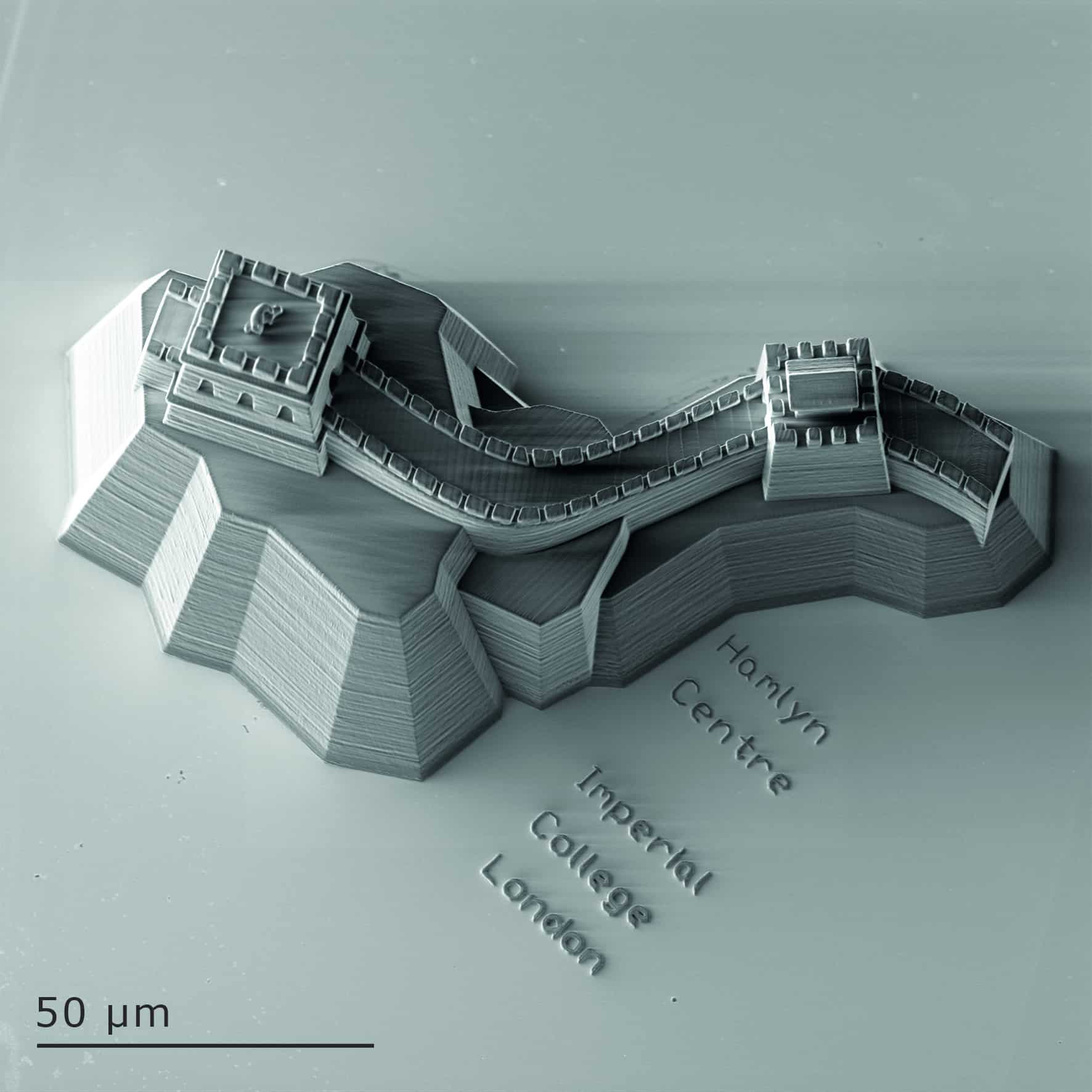
3D Great Wall of China section


By Hamish Johnston and Tushna Commissariat

Last month, China’s president Xi Jinping’s was on a state visit in the UK and while here, he toured a few academic institutions, including the UK’s new National Graphene Institute (NGI) in Manchester and Imperial College London. As we reported in an earlier blog, Nobel-prize-winning Manchester physicist Kostya Novoselov presented President Xi “with a gift of traditional Chinese-style artwork, which Kostya himself had painted using graphene paint”. This week we found out that the Imperial scientists also presented him with a “tiny gift” in the form of a 50 µm scale version of a section of the Great Wall of China, imaged above, created with a Nanoscribe 3D printer. Prince Andrew, who was also on the visit, was given an image of a panda leaping over a bamboo cane, which was printed on the tip of a needle.

(more…)

Copyright © 2026 by IOP Publishing Ltd and individual contributors