Silicon quantum logic gate is a first

The first quantum-logic device made from silicon has been unveiled by researchers in Australia and Japan. Their controlled-not (CNOT) gate, which is a fundamental component of a quantum computer, was made using conventional semiconductor manufacturing processes. The researchers now plan to scale up the technology to create a full-scale quantum-computer chip.

Quantum computers exploit the weird laws of quantum mechanics to perform some calculations much faster than conventional computers – at least in principle. The main challenge facing physicists trying to build quantum computers is how to preserve fragile quantum bits (qubits) of information, which tend to deteriorate rapidly in real-world devices.

One approach is to use the spin of the electron – which can point up or down – as a qubit. Spin qubits have been made from tiny pieces of semiconductor called quantum dots, and quantum-logic devices have been made by coupling these qubits together. Unfortunately, the spin states in these devices rapidly deteriorate – or “decohere” – by interacting with nuclear spins in the compound-semiconductor materials normally used to make quantum dots.

Silicon spins

This source of decoherence can be greatly reduced by making the dots from silicon, the most common isotope of which (silicon-28) has zero nuclear spin. The new CNOT logic gate, which has been created by Andrew Dzurak, Menno Veldhorst and colleagues at the University of New South Wales and Keio University, has been made by coupling two silicon spin qubits for the first time.

The two quantum dots were made by placing an array of electrodes on top of a piece of silicon-28. By applying voltages to some of the electrodes, two electrons are trapped within the silicon, separated by about 100 nm. These electron spin states are set by generating a microwave pulse using one of the electrodes as an antenna – a technique known as electron spin resonance (ESR). The states of the spin qubits can be set individually by using the electrodes to apply an electric field to one of the spins, which changes how that spin responds to the microwave signal. The values of the qubits are also read out using ESR.

The spins are coupled via the exchange interaction, which is a purely quantum-mechanical effect that can be tuned to cause the spins to point in the same direction, or in opposite directions. This tuning is done by adjusting the voltages on some of the electrodes.

Improvements needed

The team verified that it had created a CNOT gate by first initializing the spins in a specific configuration, for example both spin down. A series of microwave pulses and voltages was then applied to the qubits to create a CNOT gate. When the team read out the values of the qubits, they were found to be in line with the expected output from a CNOT gate.

However, the researchers say that they were not able to show that the two qubits were quantum-mechanically entangled during the CNOT process, which they say was the result of errors in the read-out process. Entanglement is required for the operation of a quantum-logic device, and the team is now working towards improving the read-out process to confirm that the qubits are indeed entangled.

“All the physical building blocks for a silicon quantum computer have now been successfully constructed,” says Veldhorst.

Dzurak adds that the team has “patented a design for a full-scale quantum computer chip that would allow for millions of our qubits, all doing the types of calculations that we’ve just experimentally demonstrated”. He says the team is also looking for an industrial partner to manufacture a full-scale quantum-processor chip.

The CNOT gate is described in Nature.

Ultrathin transistor can be turned on with a tiny voltage

A new transistor with an atomically thin current-carrying channel that operates at ultralow supply voltages has been unveiled by a team of researchers in the US. The new device, which is made from a 2D semiconducting crystal and a bulk germanium substrate, can be switched on at just 0.1 V. It could be used to create extremely dense and lower-power integrated circuits, and could also form the basis of ultrasensitive sensors of biological molecules.

Field-effect transistors (FETs) are the workhorses of modern-day electronics, and the size of FETs have been decreasing steadily over the last few decades – allowing more and more devices to be packed onto computer chips. However, this relentless downsizing cannot go on forever, and chip designers are running into major difficulties. One challenge on the horizon is that the switching of conventional FETs is limited by a quantity known as “sub-threshold swing” that cannot be lower than 60 mV per decade of drain current at room temperature. This puts a lower limit on the supply voltage required to operate the FET, which makes it difficult to create the low-power devices needed for the denser chips of the future.

Swing low

The tunnel field-effect transistor (TFET) is a new type of device that works by controlling the amount of current that can quantum-mechanically tunnel through a potential barrier. In contrast, a conventional FET involves the current being thermally excited over a potential barrier. This difference means that TFETs can have sub-threshold swing values lower than 60 mV per decade.

Now, Kaustav Banerjee and colleagues at the University of California, Santa Barbara, and Rice University have developed TFETs made from bilayer molybdenum disulphide and bulk germanium that have a sub-threshold swing of 31.1 mV per decade of drain current at room temperature. This makes the device a very good contender for making practical transistors that operate with supply voltages as low as 0.1 V. Such devices would require 90% less power to run compared with conventional FETs.

Dubbed the atomically and layered semiconducting channel TFET (ATLAS-TFET), the new device uses highly doped germanium as its source electrode. The current-carrying channel is an extremely thin (1.3 nm) layer of molybdenum sulphide just two molecules thick. Resembling graphene, molybdenum sulphide is a semiconductor that occurs in sheets one molecule thick. The resulting layered device has a strain-free interface, a low barrier for current-carrying electrons to tunnel through, and a large tunnelling area – which are all desirable properties for TFETs.

On the road map

The International Technology Roadmap for Semiconductors (ITRS) has called on researchers to develop devices with sub-threshold swing values lower than 60 mV per decade, over four decades of current. The only experimental TFET made so far to meet this criterion relies on nanowire structures, which are difficult to produce and manipulate.

“Our ATLAS-TFET is the first TFET with in-planar architecture to satisfy the ITRS prescription and, as such, might be used in the development of next-generation ultralow-power integrated electronics and ultrasensitive sensors,” say Banerjee and colleagues.

Creating a sensor from the ATLAS-TFET involves removing the gate junction and placing receptor molecules on the molybdenum-sulphide channel. When a molecule of interest binds to a receptor, it changes the current flowing through the channel – thus signalling the presence of the molecules, even at tiny concentrations.

The thin-channel TFET is described in Nature.

Why are rectangular pipes like circular pipes?

By Matin Durrani

Consider a spherical cow.

No, wait, actually, let’s try something different. Consider a rectangular pipe.

In fact, consider what happens when liquid flows along a rectangular pipe, by which I mean one with a rectangular cross section. The flow’s bound to be asymmetrical, right?

Yes, that’s true, but not always. New research published in Physical Review Letters suggests that for liquid flowing along a rectangular pipe that’s exactly 1.87 times wider than it is high, the flow is entirely symmetrical.

Now, I’ll admit that water flowing along a pipe is probably not something that keeps you awake at night, but the new discovery is weird. In fact, Roberto Camassa from the University of North Carolina, Chapel Hill, who was involved in the study, calls it “bizarre”.

(more…)

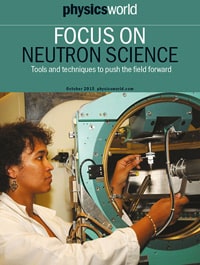
Physics World 2015 Focus on Neutron Science is out now

By Michael Banks

PWneutron15cover-200

For physicists who love scattering neutrons off materials, the recent ground-breaking ceremony at the European Spallation Source (ESS) in Lund, Sweden, will have been a long time coming. First proposed more than two decades ago, the ESS will – when it finally opens in 2020 – generate the world’s most intense beams of neutrons and help satisfy demand for these most useful of particles.

Neutron scattering has emerged as a mainstream scientific endeavour over the last 20–30 years, which is one reason why this month sees the first-ever Physics World focus issue on neutron science. We take a look at how researchers at the ESS are designing the facility’s tungsten target, as well as a new neutron source being built in China and how the ISIS Neutron and Muon Source in the UK is looking to bring in more users from industry.

(more…)

Individual recognition

In May the two largest collaborations at CERN’s Large Hadron Collider – ATLAS and CMS – broke the record for the number of authors on a single scientific publication. With more than 5000 people, the paper pinned down the mass of the Higgs boson, the discovery of which was announced in July 2012. These two collaborations are not new to having such a huge number of authors, as the papers that ATLAS and CMS publish regularly have thousands of authors.

The scale of scientific output worldwide has steadily grown thanks to the difficulty involved with achieving milestones, the cost involved in building and operating big facilities, as well as the increased mobility and virtual nature of collaborative work. I have been working in particle physics since 2002 and I believe the sizes of such author lists are necessary as they are the correct way to acknowledge the work done by people who have been involved with the design, construction and operation of the detector, as well as the analyses of data.

Yet large authorships also come with difficulties. How, for example, can one acknowledge noteworthy individual contributions or recognize candidates who deserve career advancement or an award? Differentiating between candidates when hiring in these fields has to be mostly based on recommendation letters and details of the work carried out by an individual. While that work may be understood within the community, it is incredibly difficult to gauge when that person is competing for a job that is also open to candidates from other disciplines. Even the Times Higher Education‘s World University Ranking now excludes papers that have more than 1000 authors from its evaluations.

Hitting targets

The issue of multiple authorship has been of a particular concern to me. South Africa has just reached 20 years as a democracy and, while the country has struggled to improve the education provided to most people, the scientific community has continued to grow. Convinced that forging a productive relationship with CERN would benefit the nation, in 2008 South Africa signed an agreement with the lab allowing its scientists to be closely involved with the ATLAS and ALICE collaborations.

This move was great as it let me fulfil one of my main career aspirations and start an ATLAS group in South Africa at the University of KwaZulu-Natal in 2010. However, I was hired based on a CV populated almost entirely by papers with 600 to 3000 co-authors and shortly after arriving at KwaZulu-Natal, I was faced with a problem: my research output as part of ATLAS would count for nothing.

The difficulty was that the university judges research output based on publications that attract a subsidy from the Department of Higher Education and Training (DHET). The effect of the DHET funding policy led directly to a new stream of income that the university then began to depend on. Unfortunately, the DHET does not pay the subsidy if there are more than 100 authors per paper and thus would not cover my research output, meaning it would not count towards my job performance targets.

For my first two years I engaged management on this issue, and was assured at various stages that the quality of my work was understood and that this would only be a problem for the “bean counters”. But when I was asked for the third year running to agree that my publications had no value – while at the same time being approached by the university to give public lectures on the Higgs boson – I decided not to agree with the terms. The university responded by disciplining me for being insubordinate and in breach of contract, with the chair of the disciplinary hearing labelling my actions those of a “sluggard”. Upon appeal, the verdict was upheld.

Yet I was lucky to have support from the South African Institute of Physics as well as my colleagues. In July 2015 at the first external process at the Commission for Conciliation, Mediation and Arbitration – a body that looks into labour issues before they go to court – the university agreed to expunge my disciplinary record. In the end, I believe that my previous university (I joined the University of Cape Town earlier this year) is now poorer, since particle physics is no longer accessible to its students.

Particle physics is not the only subject in South Africa that could be hit with this issue of large authorships. The country has been constructing major astronomy facilities such as the Southern African Large Telescope, the MEERKAT/KAT-9 radio telescopes and a significant fraction of the Square Kilometre Array (SKA). The SKA commitment, in particular, has been wonderful, and we appear to be reaping the rewards with many excellent academics choosing to come to South Africa. The government is also supporting students and postdocs on SKA-funded projects with much larger bursaries than students in other fields.

But as the SKA gets going and researchers begin to publish scientific papers – many of which will be multi-authored – I hope they are not hit with the same issue over how research outputs are measured.

Weighing up the options for neutrino mass


By Tushna Commissariat

As I am sure all of you know, the 2015 Nobel Prize for Physics was awarded yesterday to Arthur McDonald and Takaaki Kajita “for the discovery of neutrino oscillations, which shows that neutrinos have mass”. Following on from yesterday’s neutrino-flavoured excitement, here’s an explanation of why it’s so important that we better understand neutrino mass.

Our current observations and theories of neutrino oscillations suggest that at least two of the currently known three flavours of neutrinos have non-zero mass. While we know the mass differences between the different neutrino flavours accurately, their actual masses have not been measured. It’s not for lack of trying, it has simply proven very difficult to make the measurements.

(more…)

Pushing towards the human–Martian frontier

 By Tamela Maciel at the National Space Centre in Leicester

Last week, the planet Mars was under the international spotlight once more as NASA scientists announced that liquid water may still be flowing on the surface of the red planet. Also, the much-anticipated film adaptation of The Martian – a 2011 novel by American author Andy Weir a science-driven story of human survival on Mars, hit the box office.  Mars was also the hot topic at a recent event held at the National Space Centre in Leicester. The guest of honour was Apollo 7 astronaut Walter Cunningham and throughout the hour-long Q&A, he emphasized the need to push the “next frontier” and send humans to Mars.

Cunningham is not a man lacking in confidence or the experience of pushing boundaries. When asked if he ever felt the pressure of the astronaut selection or training process, he said “I thought I could fly anything, any time, anywhere. Was that true? I don’t know. But that’s how I felt.”

(more…)

Dark matter may power supernovae

Stellar explosions known as type Ia supernovae could be triggered by dark matter. So says a physicist in the US, who has worked out how certain burnt-out stars can explode even though they lack the mass to generate fusion reactions. According to the new research, the stars ignite because they accumulate so-called asymmetric dark matter, which, if real, could be detectable in a new generation of earthbound experiments.

Asymmetric dark matter, like familiar visible matter, would come in both matter and antimatter varieties. It was proposed on the basis that the density of dark matter in the universe today, as revealed by its gravitational interactions, is only about five times that of normal matter. In cosmological terms, the two matter densities are almost identical, and this suggests a common link between visible and dark matter. That being a very slight imbalance between matter and antimatter, which, following mutual annihilation in the early universe, resulted in the densities observed today.

This similarity does not apply to the current favourite dark-matter particles – weakly interacting massive particles (WIMPs) – which are their own antiparticles and could not have undergone a lopsided annihilation.

Explosive burst

In the latest work, Joseph Bramante of the University of Notre Dame in Indiana looked for evidence of asymmetric dark matter in observations of type Ia supernovae, the “standard candles” that showed the universe’s expansion to be accelerating. Such supernovae are thought to be generated by white dwarfs, the very dense burnt-out remnants of Sun-like stars. Normally, white dwarfs are not massive enough to compress to the point where their internal temperature allows fusion reactions to take place. But astrophysicists believe they can accumulate additional mass by sucking material from nearby stars. They would eventually reach the “Chandrasekhar limit” of about 1.4 solar masses, at which point they would collapse and then blow apart as a result of an explosive burst of fusion energy.

However, as Bramante points out, a 2014 study of the light emitted by a sample of relatively nearby type Ia supernovae showed that many of the associated white dwarfs failed to reach the Chandrasekhar limit, with some weighing as little as 0.9 solar masses. Other researchers have proposed that white dwarfs might merge with one another to ignite supernovae, but Bramante says that the low density of white-dwarf binary systems observed in our galaxy “presents a challenge to that idea”.

Extra energy

Bramante believes that dark matter could provide the extra gravitational energy needed for a supernova explosion. The idea is that over the course of its lifetime, a white dwarf sucks in dark matter from its surroundings, forming a ball of dark matter at its centre that eventually gets so massive it collapses in on itself. As it does so, the dark-matter particles scatter off carbon and oxygen nuclei in the white dwarf, so transforming gravitational potential into heat and allowing the nuclei to fuse, which results in a supernova. However, symmetrical dark-matter particles such as WIMPs would not do this because their mutual annihilation would limit the accumulated mass.

Bramante has calculated that asymmetric dark-matter particles with mass between 1015–1017 eV could trigger fusion in 0.9–1.4 solar-mass white dwarfs. In comparison, a proton has a mass of 109 eV. To back up his idea, Bramante investigated whether there is an inverse correlation between the mass and age of white dwarfs – the idea being that it takes less dark matter to collapse more massive objects. Indeed, by combining data from separate existing studies that compared supernovae light curves (brightness as a function of time) with their age and with their mass, he found that such a correlation is supported at the level of 2.8σ. While this is a strong correlation, it falls well below the 5σ level required of a discovery.

In addition, Bramante says that the mass of the asymmetric particles in this latest research roughly matches that needed to explain why there are fewer pulsars in the centre of the Milky Way than expected. Indeed, Bramante has shown in previous work that dark matter could accumulate inside pulsars and convert them to black holes. He acknowledges that the evidence for both his pulsar and supernova mechanisms is “circumstantial”, and hopes that astronomers can gather data from other supernovae to try and establish a 5σ correlation. He also notes that his ideas would be boosted by evidence of supernovae closer to the centre of galaxies igniting at a younger age – given that dark matter tends to accumulate in galactic centres.

Detection in the lab

However, even then, Bramante points out, people are only likely to take his claim seriously if it is confirmed via direct detection of dark-matter particles in the laboratory. The experiments best placed to do this, he says, are XENON1T at the Gran Sasso lab in Italy, which is due to switch on in an upgraded form this autumn, and LUX-ZEPLIN in South Dakota, US, construction of which is due to get under way next year. “If they find dark matter, it will be clear fairly early on whether it is as heavy as these scenarios predict,” he says.

According to Kevork Abazajian of the University of California, Irvine, the supernova hypothesis will make the already eagerly awaited results from these experiments “even more interesting”. He says that although the latest research does not provide “definitive proof” of dark matter triggering type Ia supernovae, he believes that confirmation from the direct-detection experiments would cause the ignition mechanism to “almost certainly become a standard consideration by type-Ia-supernova modellers”.

The research is published in Physical Review Letters.

Art McDonald and Takaaki Kajita win 2015 Nobel Prize for Physics

The 2015 Nobel Prize for Physics has been awarded to Arthur B McDonald and Takaaki Kajita “for the discovery of neutrino oscillations, which shows that neutrinos have mass”.

The prize is worth SEK 8m (£629,000) and will be shared by the two winners who will receive their medals at a ceremony in Stockholm on 10 December.

Kajita is a Japanese citizen and a member of the Super-Kamiokande collaboration. He is professor of physics at the University of Tokyo. McDonald is a Canadian citizen and director of the Sudbury Neutrino Observatory (SNO). He is emeritus professor of physics at Queen’s University.

Eureka moment

Speaking on the telephone from Canada after the announcement, McDonald said that “There was a eureka moment when we were able to see that neutrinos appeared to change from one type to the other in travelling from the Sun to the Earth.” He added that he is very pleased to have “many colleagues that share this prize with me”. “It is a tremendous accolade for our group,” he said. McDonald also said that he has a very good relationship with Kajita and his Super-Kamiokande colleagues.

Neutrinos are particles with no electrical charge that interact very weakly with matter – making them extremely difficult to detect. Their existence was first predicted in 1930 by Wolfgang Pauli as a “desperate remedy” for discrepancies arising in the study of beta decays. At the time Pauli was convinced that neutrinos would be impossible to detect but he was happily proved wrong in 1956 when Frederick Reines and Clyde Cowan detected antineutrinos emitted by a nuclear reactor, for which the pair went on to win the 1995 Nobel Prize for Physics.

In 1957 Italian physicist Bruno Pontecorvo suggested that multiple types, or “flavours”, of neutrinos exist and that they can change, or “oscillate”, from one to another. Multiple neutrino flavours were confirmed in 1962 when Leon Lederman, Melvin Schwartz and Jack Steinberger at Brookhaven National Laboratory in the US observed the existence of both Pauli’s electron neutrino and also the muon neutrino. A third type of neutrino – the tau – was predicted in 1975 and discovered in 2000.

The concept of neutrino oscillation came to the fore in 1964, when Raymond Davis and John Bahcall found that their solar-neutrino experiment in the Homestake Gold Mine in South Dakota detected only about 30% of the electron neutrinos predicted by a theory developed by Bahcall. This discrepancy could only be explained if neutrinos were oscillating between flavours as they travel from the Sun to the Earth. If oscillation was occurring, then it meant that neutrinos have mass, contrary to what the Standard Model of particle physics predicted.

Ends of the Earth

In 1998 Kajita presented data taken by the Super-Kamiokande experiment that showed that the ratio of electron to muon neutrinos coming from opposite sides of the Earth were different. This meant that these neutrinos – created when cosmic rays interact with nuclei in the upper atmosphere – were changing flavour as they passed through the Earth. This showed for the first time that neutrinos must have mass, albeit only about 0.1 eV.

Then, in 2001 and 2002 McDonald and his colleagues at SNO reported how many of the electron neutrinos produced in the Sun change into muon neutrinos or tau neutrinos as they travel to the Earth. This was possible because SNO could measure the number of neutrinos of all flavours arriving from the Sun as well as the number of electron neutrinos arriving from the Sun. These measurements allowed McDonald and colleagues to both confirm Bahcall’s theoretical prediction of the solar electron neutrino flux and also show that about two-thirds of the solar electron neutrinos change flavour by the time they reach the Earth.

The evidence for neutrino oscillations was further strengthened earlier this year when researchers at the T2K (Tokai to Kamioka) experiment in Japan fired a beam of muon neutrinos 295 km through the ground to Super-Kamiokande. There they detected electron neutrinos with a statistical significance greater than 5σ, confirming that muon neutrinos do indeed oscillate into electron neutrinos.

The discoveries are also triumphs of experimental physics because neutrinos have no electrical charge and interact very rarely with matter. As a result they are extremely difficult to detect. This is why both Super-Kamiokande and SNO are located deep underground, to shield them from cosmic radiation.

Earlier this year, McDonald explained to Physics World why such experiments are built underground:

McDonald was born in 1943 in Sydney, Nova Scotia and did a BSc and an MSc in physics at Dalhousie University in Halifax. He then moved to the US, where he completed a PhD at Caltech in 1969 before returning to Canada to work at Atomic Energy of Canada’s Chalk River Laboratories until 1982. After a seven-year stint at Princeton University, he joined Queen’s University in Kingston, Ontario in 1989, when he also became director of SNO.

Nick Jelley of the University of Oxford, who worked on SNO, describes McDonald as “a great person to work with and a great leader”. He told Physics World that McDonald made SNO possible because he was able to convince a senior executive at the Canadian mining company Inco to allow physicists to build the laboratory in a working nickel mine.

Kajita was born in 1959 in Higashimatsuyama, Saitama Prefecture and completed a BSc in physics at Saitama University in 1981. He then pursued MS and PhD degrees at the University of Tokyo, completing his studies in 1986. Two years later Kajita joined the Institute for Cosmic Ray Research at the University of Tokyo, where he is currently director.

Superconductor induces magnetism in non-magnetic gold

Physicists in the UK have shown that a superconductor can transfer a magnetic field from a magnet to a non-magnetic metal without becoming magnetized itself. The surprising effect is not predicted by any prevailing theory of superconductivity and could have important applications in the emerging field of superconducting spintronics.

In a conventional superconductor, electrical current is carried by “Cooper pairs” of electrons. The electron spins in a pair point in opposite directions and therefore the pair has zero net spin. The application of a strong magnetic field destroys superconductivity by encouraging both spins to point in the same direction, which tears the Cooper pairs apart. Weak magnetic fields cannot exist within a conventional superconductor, which acts to expel magnetic-field lines. As a result, superconductivity and magnetism are usually seen as mutually exclusive phenomena.

Pairs with spin

However, recent calculations suggest that when a superconductor is placed right next to a magnet, both spins in a Cooper pair can point in the same direction – thereby giving the pair a net spin of one. This intriguing theoretical development has given birth to the nascent field of superconducting spintronics, which seeks to create electronic devices that use the spin of Cooper pairs. While several experimental groups have claimed success in observing spin-one Cooper pairs, physicists have not been able to detect the expected magnetic fields within superconducting materials that are in close proximity to magnets.

Machiel Flokstra of the University of St Andrews and colleagues set out to map the field inside a device called a superconducting spin valve – a device that is designed to measure the interaction between magnetism and superconductivity. They used an exquisitely sensitive technique called low-energy muon spin rotation, in which muons are passed through a sample. The muon spins rotate around the local magnetic field until they decay, each emitting a positron along their spin axis as they do so. Detecting the positron reveals the muon’s spin-rotation rate, which in turn gives the local magnetic field.

The team’s spin valve comprised two ferromagnetic layers separated by a thin layer of a normal metal, all placed underneath a layer of superconducting niobium just 50 nm thick. Expecting it would make no difference to the outcome of the experiment, the researchers also included a layer of gold on the top of the spin valve: “There wasn’t any specific reason,” explains Flokstra, “but we thought ‘why not look into it?'”

Golden discovery

What the researchers found surprised them. They found no evidence of a magnetic field inside the superconductor, but they did see a magnetic field in the gold – even though gold is not normally magnetic. In other words, a magnet on one side of a superconductor can induce a magnetic field on the other side of the superconductor – even though there is no field within the superconductor. Furthermore, the researchers found that the induced magnetic field in the gold depended on the relative orientation of the fields in the two magnetic layers on the opposite side of the superconductor. When the two fields were perpendicular, a strong field was induced. When they were parallel, however, the effect was almost zero.

The researchers have several ideas for how the spin might be transferred, including the transfer of spin through the superconductor via spin-polarized Cooper pairs.

Jacob Linder of the Norwegian University of Science and Technology and Jason Robinson of the University of Cambridge both see the work as an important achievement. “Although this particular finding is surprising because it has no known theoretical explanation, it confirms a suspicion that it may be possible to do completely new physical things using superconductors and ferromagnets,” says Linder.

‘Really nice result’

Robinson says that of the three explanations the researchers posit, the most likely is the generation of spin-polarized Cooper pairs and their transmission through the superconductor. “It’s a really nice result,” he says, “and, for any of the people out there doubting that you could generate a spin triplet superconducting state then, I hope this will clarify that.” Linder and Robinson agree with Flokstra that, whatever its detailed explanation, the phenomenon could be important in superconducting spintronics. “This potentially opens a window for doing conventional, non-superconducting spintronics with much lower dissipational energy,” Linder says.

The research is published in Nature Physics.

Copyright © 2026 by IOP Publishing Ltd and individual contributors