

Whistling volcanoes: radio waves in volcanic lightning

It is the height of the First World War and, in the trenches, the German physicist Heinrich Barkhausen is eavesdropping on Allied telephone conversations. Using vacuum tube amplifiers and a couple of widely spaced metal prongs, the German forces are picking up on leakage from the enemy’s field telephone lines. Every now and then, though, the tapping effort is rendered fruitless – the Allied communications are drowned out by some very strange sounds.

The soldiers dubbed these nuisance noises “whistlers” because they sound similar to shells flying overhead. (To a modern ear, however, their descending “pee-yow” tone is more like a sound effect from an old-school space-themed arcade game.) Barkhausen was intrigued by the whistling noises and initially suspected a fault in the amplifying equipment. Once back in his laboratory in Dresden after the war, however, he was unable to reproduce the effect artificially – leading Barkhausen to conclude that whistlers are caused by an unidentified atmospheric phenomenon.

As it turned out, Barkhausen’s hypothesis was correct – although it would not be until the 1950s that the true source of whistler waves was identified. Whistlers are produced, bizarrely, from bolts of lightning thousands of kilometres away. That might seem very odd, as we usually associate lightning with the bright flashes of visible light that it produces. But lightning also creates very-low-frequency radio waves in the same way that an antenna emits radio waves: a moving charge creates an oscillating magnetic and hence electromagnetic field – an electromagnetic (radio) wave.

Hundreds of these bursts of radio waves – known as atmospherics, or “sferics” for short – are emitted every second from lightning strikes across the globe. Occurring at frequencies in the range of human hearing, the sferics can be converted directly into audible waves that sound like twigs snapping underfoot. Usually, sferics only travel a few thousand kilometres from their source, bouncing back and forth between the planet’s surface and the ionosphere (the ionized part of the upper atmosphere, which begins at an altitude of 60 km) before eventually attenuating.

In some cases, however, part of the energy penetrates the ionosphere and makes it into the plasmasphere. Also known as the inner magnetosphere, this doughnut-shaped region of space around the Earth consists of cool plasma and spans from an altitude of about 1000 km to as high as 32,000 km at the equator. In this region, the sferics can be guided along ducts – elongated channels that have either an irregularly low or high plasma density. Aligned with the north–south geomagnetic field, the ducts run from their starting location to the corresponding magnetic conjugate point in the opposite hemisphere. Unlike “antipodes” – places such as Christchurch in New Zealand and A Coruña in Spain that are directly opposite each other across the Earth – magnetic conjugate points are the two places where the same, arcing geomagnetic field line meets the Earth’s surface. Once the sferics reach this conjugate point at the other end of the duct, the small incident angle between the duct and the ionosphere may allow a small portion of the wave energy to pass back through the ionosphere and be received on the ground.
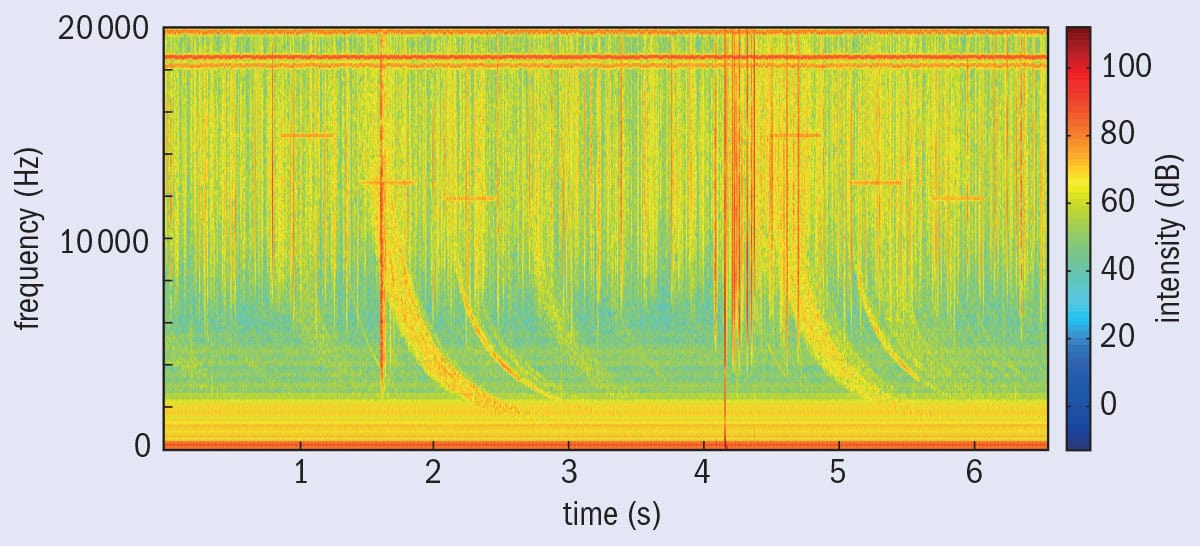
Spectrogram

Passing through the magnetosphere is what turns sferics into whistler waves, with their eerie descending quality. “What gives them their unique tone is the dispersion they undergo as they travel through the magnetospheric plasma,” explains Claire Antel, a physicist from the University of Cape Town in South Africa, who has studied whistlers since 2012 and analysed whistlers in Antarctica as part of the South African National Antarctic Expedition. “High frequencies travel faster than the low, making them last a second or two.”

Location, location, location

Whistler waves might at first seem an interesting curiosity but one that has little, if any, wider relevance. In fact, the passage of whistlers between the hemispheres provides a rare opportunity to investigate the plasmasphere without needing to launch expensive space probes to do the job. By gaining a better understanding of this near-Earth region of space, we should be able to get better at anticipating the impact of space weather events. Although space weather isn’t the biggest threat to our planet, it has the potential – through local increases in radiation, high-energy particles or magnetic disturbances – to endanger astronauts and disrupt both orbiting and ground-based electronic systems. In extreme cases, geomagnetic currents induced by space weather have even been known to cause large-scale electrical blackouts.

Researchers who use whistlers to improve their understanding of the plasmasphere need to feed a few factors into their models. First they must measure the whistler’s frequency as a function of time, with the resulting spectrogram (figure 1) revealing the dispersion each wave has undergone on its journey between the hemispheres. What the researchers would then like to do is to use the extent of the dispersion to assess the magnetosphere’s electron density profile along the geomagnetic field line that the wave has just traversed, and elucidate the structure of the plasma­sphere.

But here’s the problem: anyone wanting to do this calculation also has to know exactly where each whistler enters and leaves the plasmaspheric duct. Traditionally, it was assumed that whistler waves would enter ducts near to the lightning strikes that generated them. In other words, a whistler received in one hemisphere must have originated close to the corresponding conjugate point in the other – making the analysis relatively straightforward. But thanks to recent improvements in the automated analysis of whistler spectrograms, we now have a lot more data. These have shown, in contrast, that before whistlers enter a duct they can migrate significant distances sub-ionospherically, sometimes as far as 2500 km.
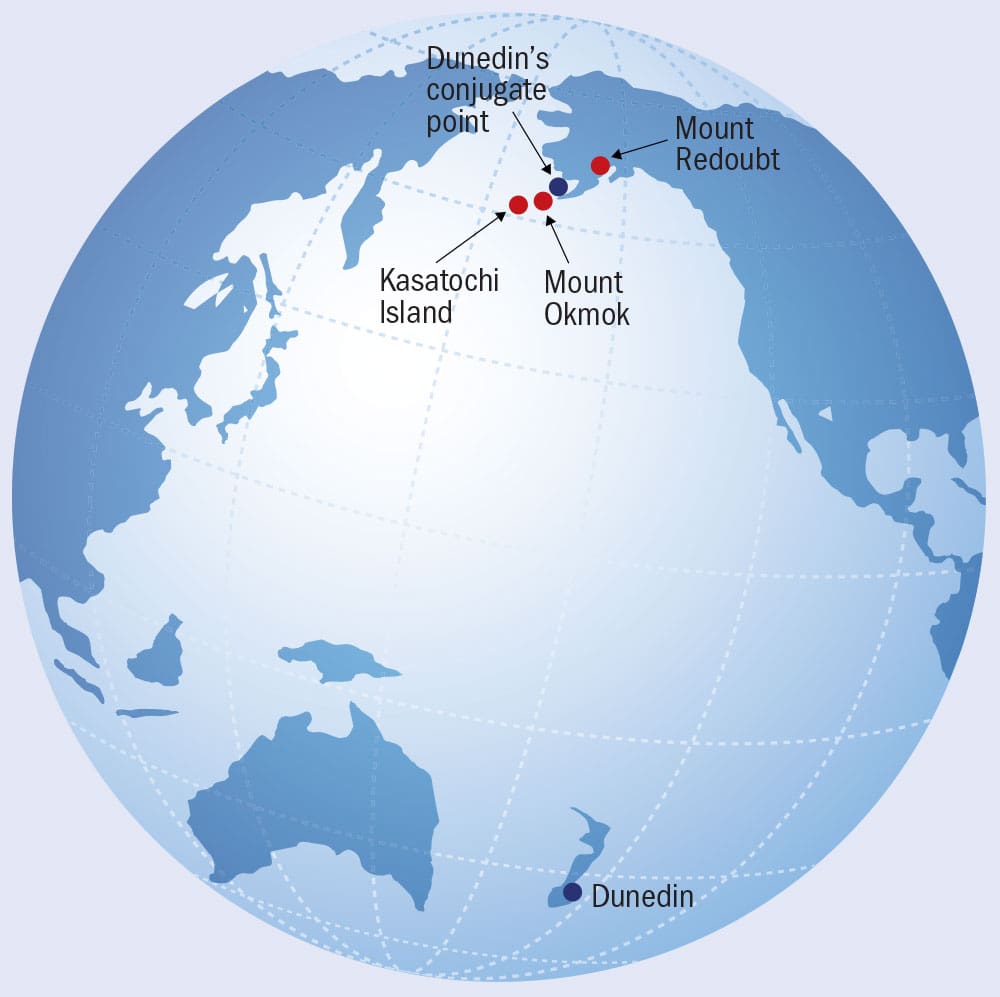
World map with the locations of Dunedin, its conjugate point and three volcanic islands marked with dots

Whistlers recorded from Hungary’s Tihany Peninsula in 2009, for example, show correlations with both lightning recorded near the region’s conjugate point – off the South African coast – as well as strikes from as far afield as South America and south-east Asia. Similarly, whistlers observed on the Antarctic Peninsula appear to come from as diverse regions as Central America, Africa and Asia in addition to the conjugate point in the Gulf Stream. So there can in fact be a huge error in the entry-point variables that have so far been used in whistler-based models of the plasmasphere.

Specific in the Pacific

It is usually impossible to pinpoint the location of a lightning bolt that caused a particular whistler wave – because the original sferic can travel thousands of kilometres before it enters a duct. However, the location of a certain recording station in Dunedin, on New Zealand’s South Island, provides a unique opportunity. Dunedin’s magnetic conjugate point lies in the Aleutian Islands – a volcanic chain in the northern Pacific Ocean (figure 2). The islands include more than 40 active volcanoes – a fact that is key to a recent study by Antel and her international team of colleagues (2014 Geophys. Res. Lett. 41 4420). That is because where there is volcanic activity, volcanic lightning often follows (see box).

To study Dunedin’s whistlers, the researchers looked at correlations between lightning data from the World Wide Lightning Location Network – which detects sferics – and whistler data from the Automatic Whistler Detectors and Analyzer (AWDA) system, which includes the recording station in Dunedin. Using data sourced over the period from 25 May 2005 to 31 December 2013, the researchers were able to identify whistlers occurring within two seconds of any lightning stroke. Alongside this analysis, records of prominent, high-latitude volcanic eruptions were sourced from the Global Volcanism Program database.

The Aleutian chain includes three active volcanoes located near Dunedin’s magnetic conjugate point: Mount Okmok, Kasatochi Island and Mount Redoubt – distanced 350, 815 and 870 km from the conjugate point, respectively. During the time period studied, all three volcanoes erupted one or more times, with each event producing both lightning locally and corresponding whistlers in Dunedin.

A volcanic island venting smoke

On 12 July 2008, for example, Mount Okmok erupted cataclysmically, releasing a 15 km high ash plume into the atmosphere. Within 35 minutes of the eruption, lightning strikes had been detected in the region of the volcano, and corresponding whistlers were also observed in Dunedin. By the end of the day, Dunedin’s whistler count had risen to more than 12,000 – a massive increase on the typical background rate of fewer than 500 observations per day, and one of the highest recorded counts in the AWDA’s eight-year history.

Mount Redoubt was also volcanically active during the study period and underwent 26 eruptive or explosive events in early 2009, many of which were accompanied by lightning. Of these, seven eruptions produced lightning that could be correlated to whistler activity, producing spikes in the whistler data ranging from 23 to 258 over barely a few minutes. Data from an eruption of the Kasatochi volcano in August 2008 also appeared to show a correlation between local lightning activity and whistlers detected in Dunedin, although the low rate of lightning activity – and the relatively high background level of whistlers around the eruption time – has made correlations for this particular event inconclusive, the researchers say.

Despite this, the researchers propose that the demonstrated correlations show that volcanic lightning can generate whistlers – providing the first evidence that volcanoes are able to couple with the inner magnetosphere. “I am left in awe,” says Antel, “at the immense influence volcanoes have on our planet!” Furthermore, the volcanic whistlers are certain to have originated near to Dunedin’s conjugate point – thereby providing accurately known travel paths between the two locations. “In other words,” Antel says, “the improved knowledge of whistler paths increases the fidelity of the plasma­spheric model that makes use of whistler data.”

Flashes in the ashes
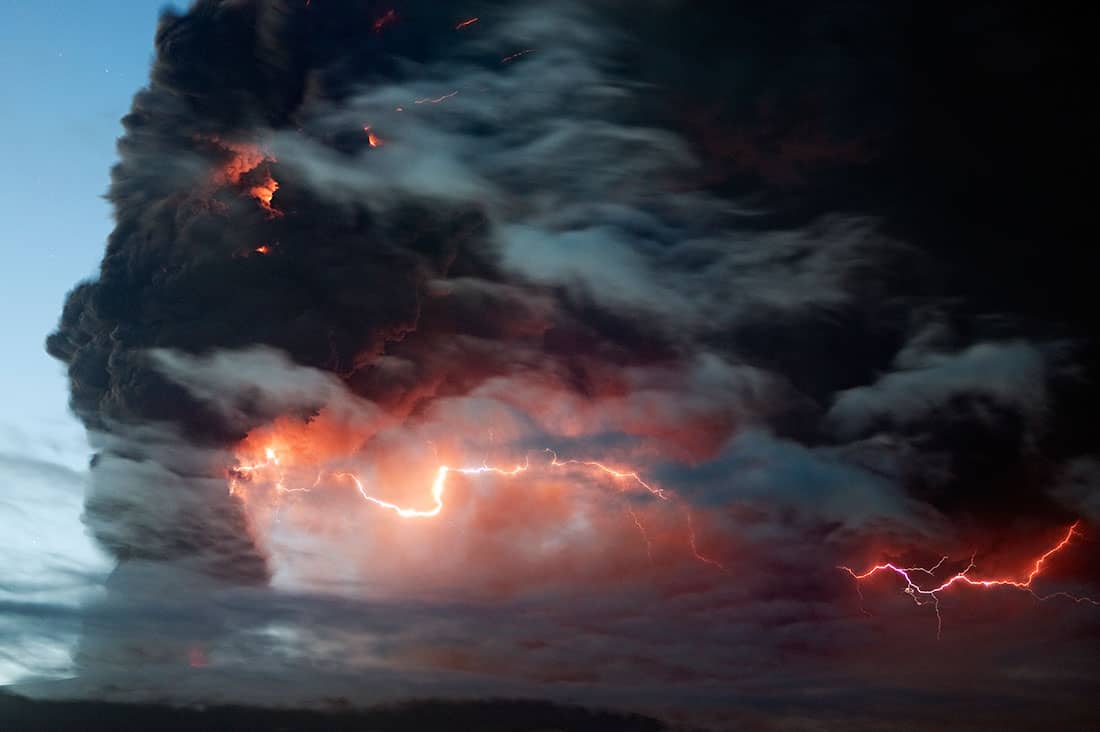
A band of lightning through thick black clouds venting from a volcano

Like regular lightning, volcanic lightning develops from the generation and separation of charges. While volcanic lightning can occur with a variety of eruption styles – including those in which lava flows are the main type of erupted material – volcanologist Corrado Cimarelli of Ludwig-Maximilians-Universät Munich explains that “most of the time, lightning is observed during eruptions where a large quantity of volcanic ash is produced”. A number of charging mechanisms have been proposed to bring about these strikes, ranging from the freeing of ions and electrons from fractured rocks, to friction between particles, and the rising and condensing of cooling water vapour in the volcanic plume.

“Once charge has been generated in a volcanic plume,” says Karen Aplin, an atmospheric physicist from the University of Oxford, “it is separated by convection, carrying smaller particles upwards, whereas heavier – and often oppositely charged – particles settle under gravity.” If the potential difference created overcomes the breakdown potential of the air, lightning occurs to neutralize the charge build-up. However, the separation of charged particles is highly variable and is dependent on the type of volcano and local atmospheric conditions. “This variability,” says Aplin, “and the difficulty of making repeatable measurements, means that volcanic lightning remains poorly understood.”

Out of this world

Although this whistler study was very much Earth-based, Mark Golkowski, a plasma-physics expert from the University of Colorado Denver, believes that this proof that whistlers can be reliably generated by sources outside of precipitating clouds has ramifications beyond our own planet. “For example, on Mars there are no clouds to generate moisture-driven lightning, but lightning from dust storms has been postulated.” He adds that the volcanic-whistler findings support proposed studies to use dust-storm lightning on Mars to probe the weak plasma densities of the planet’s upper atmosphere.

Robert Marshall, an electrical engineer at Stanford University, thinks this first observation of whistlers being directly correlated to volcanic lightning is exciting and unique. However, he warns that it remains to be seen if and how these volcanic whistlers will contribute to our understanding of either volcanic lightning, or whistlers and the magnetosphere.

Yet even if volcanic whistlers are not intrinsically important, the researchers are certainly pleased with their novel discovery. “I like the idea that a volcanic explosion can produce a radio wave that goes approximately 20,000 km into space and then is detected in Dunedin,” says Craig Rodger, a physicist at the University of Otago, who took part in the study. “They are,” he concludes, “pretty damn cool!”

Sandpit physics


By James Dacey

When you think of cutting-edge experimental physics, you might picture the grandiose detectors of the Large Hadron Collider (LHC), or perhaps a lab-coat-wearing scientist hunched over a shiny new microscope. Sometimes, however, all you need is a bucket of sand, a balloon and a pin.

(more…)

Pluto comes into focus as New Horizons nears the dwarf planet

Stunning images of Pluto have been acquired over the past few days by the New Horizons spacecraft as it approaches the dwarf planet 7.5 billion km from Earth. The NASA mission will come within 12,500 km of Pluto – which has never before been visited by a spacecraft – on Tuesday 14 July before it ventures deeper into the Kuiper Belt.

Launched in 2006 to study Pluto and the Kuiper Belt, New Horizons is carrying seven scientific instruments including visible, infrared and ultraviolet imagers and spectrometers. The Long Range Reconnaissance Imager (LORRI) was used to take the above image of Pluto on 7 July, when the spacecraft was 8,000,000 km from the dwarf planet. The image includes several features of interest to planetary scientists including the elongated dark feature at the equator, which has been dubbed the “whale”. The large heart-shaped bright region to the right of the whale measures about 2000 km across.

‘Incredible’ images expected

“The next time we see this part of Pluto at closest approach, a portion of this region will be imaged at about 500 times better resolution than we see today,” says Jeff Moore, geology, geophysics and imaging team leader of NASA’s Ames Research Center. “It will be incredible!”

Also on board New Horizons is the Pluto Energetic Particle Spectrometer Science Investigation (PEPSSI), which will study material such as nitrogen and carbon monoxide that escapes from Pluto’s atmosphere and is then ionized by ultraviolet light from the Sun. NASA heliophysicist Nikolaos Paschalidis helped design and build low-energy integrated circuits for PEPSSI – a technology that has since been upgraded and used on several subsequent missions.

“The challenge with this mission, and the PEPSSI instrument in particular, was making it as small as possible, and capable of taking highly reliable measurements using low power, under extreme environmental conditions,” says Paschalidis. Indeed, he points out that PEPSSI is the most compact, lowest-power energetic particle spectrometer ever to be flown on a space mission.

Communication breakdown

While the mission appears to be going to plan, NASA scientists had a scare last week when communications with New Horizons were lost for more than an hour on 4 July. The mission’s autopilot recognized that something was going wrong and placed the spacecraft in safe mode while engineers determined that a flaw in the timing of the spacecraft’s command sequence had caused the problem.

According to the mission’s principle investigator Alan Stern of the Southwest Research Institute, about 30 planned scientific observations were not made while the spacecraft was in safe mode. However, he points out that some of these were preliminary observations that were not expected to deliver useful data because of the large distance between the spacecraft and Pluto. Stern says that the lost data account for less than 1% of the information that New Horizons will acquire during its flyby of the dwarf planet and therefore their loss is not significant.

The spacecraft is now operating normally and Stern and colleagues looking forward to analysing data from the nearly 500 observations that New Horizons will make as it passes Pluto.

Lab lit revealed

In my column last December, I surveyed some novels that are set – or have key scenes – at physics labs. I found that some stories exploit the fact that a laboratory is a distinctive place, while others use labs simply as props. I also asked readers for other examples of lab-based novels that I might have overlooked.

Several respondents alerted me to LabLit.com, a website “devoted to the culture of science in fiction and fact”, which describes itself as “dedicated to real laboratory culture and to the portrayal and perceptions of that culture – science, scientists and labs – in fiction, the media and across popular culture”. The site includes a periodically revised list of novels, films, plays and TV shows that are “in the lab lit fiction genre”.

LabLit.com, it turns out, is 10 years old this year and was founded by Jennifer Rohn, a cell biologist at University College London. Rohn is also a blogger, journalist and author of two novels: Experimental Heart, a romantic thriller that turns on gene therapy research, and The Honest Look, a research thriller set in a corporate biotech lab.

I contacted Rohn to ask why she had started the site.

Untrampled ground

LabLit.com stemmed in large part from frustration,” Rohn wrote back. “I wanted to read about my world – scientific research – in novels, but there were so few books featuring it that it was bordering on the ridiculous.” Rohn added that she needn’t have been surprised. “The lack of scientist protagonists in realistic fiction mirrors a deeper problem, namely the near-invisibility of real scientists in popular culture.” By setting up the website, Rohn hoped to highlight the few lab lit novels and films that did exist and, perhaps more importantly, to inspire writers to use more science and scientists in their fiction by shedding light on what she calls “this invisible – but infinitely fascinating – world”.

But what makes a laboratory an infinitely fascinating place to set a novel? According to Rohn, any scientific setting – be it a lab, telescope or field station – is essentially “untrampled ground”. There are millions of novels set in homes, offices, hospitals, police stations, but by her reckoning barely 200 mainstream novels ever published with scientific settings. The lab is, to her, a rich and untapped environment where things happen that don’t happen anywhere else in the world.

“Sure, the human story will be universal – but when it happens in an unfamiliar territory, it offers scope for a fresh angle on a familiar trope,” she says. “Love, or lust, or jealously, or ambition, or demoralization, is going to feel different when it’s happening in a lab, because the situations are not as you’d find them in other settings.”

I pointed out to Rohn that much lab lit is concerned with instances of fraud or malpractice, including both of her novels. Older examples include C P Snow’s classic 1960 book The Affair, which her website had somehow overlooked. Set in the close and highly regulated community of the University of Cambridge, the novel involves an accusation of fraud and the slow, agonizing process by which this unjust accusation is reconsidered. The literary value of the accusation, it seemed to me, was that it served as a perturbation that reveals much about the research life: its resistance to the outside, reliance on trust, and respect for equality and integrity.

I suggested to Rohn the idea that perturbation was in fact a reigning motif in lab lit, whereby some disturbing force upsets the intense, highly regulated environment of the laboratory and thereby exposes its norms – and that the principal perturbing force in lab lit was fraud and malpractice. She agreed with my first point, pointing out that such misdemeanours even crop up at the end of The Hard Problem, Tom Stoppard’s latest play at the National Theatre in London. But Rohn noted that fraud and malpractice are far from the sole sources of perturbation.

“You can’t have a good story without a plot complication,” she says. “In literature, the complications are invariably something bad or negative that the protagonist must overcome. Nobody wants to read a story about a guy who goes to work every day and good things happen to him, The End.” But what can happen in a lab that’s noteworthy and negative? “For better or worse, fraud and misconduct are obviously choices,” she says. “But you see many others in lab-lit fiction, including unhealthy competition, rivalry, mistaken theories, ethical dilemmas, clashes with activists and of course, that ancient trope – Everything Going Horribly Wrong When You Meddle With Things You Weren’t Meant To Know.”

The critical point

I reminded Rohn of Eudora Welty’s famous 1955 essay “Place in fiction”, in which the US author remarked that great novels and short stories require a strong sense of location. Such fiction, Welty wrote, is “bound up in the local, the ‘real,’ the present, the ordinary day-to-day of human experience”. As Welty went on to say, “Fiction depends for its life on place.” Every great story would be not only different but “unrecognizable as art” if moved elsewhere. Welty writes, “Imagine Swann’s Way laid in London, The Magic Mountain in Spain, or Green Mansions in the Black Forest.”

Rohn agreed that Welty’s point holds equally true of lab lit. “A rivalry would be entirely different in an office setting instead of a lab.” She’s encouraged that lab lit has increased since she started the site – something she quantified a few years ago in Nature (465 552). Lab lit’s still rare, she says, but books like Barbara Kingsolver’s Flight Behaviour show that quality examples of the genre are “reaching a comfortable level of popular acceptance”.

X-ray analysis sheds light on fading Modernist paintings

Synchrotron radiation has been used to solve a long-standing mystery surrounding the degradation of a yellow pigment widely used in late 19th and early 20th century paintings. An international team of scientists used cutting-edge spectroscopic techniques to locate multiple products of pigment decay within the paint, and concluded that degradation arose from photo-oxidation.

The development of the modern chemical industry played an important role in the palette of colours that were available to Impressionist and early Modernist painters such as Vincent van Gogh, Pablo Picasso and Henri Matisse. However, over the years, many of these synthetic inorganic pigments started to break down.

Ivory-coloured crusts

New yellow pigments played an especially important role in paintings of this era, says conservation scientist Francesca Casadio of Northwestern University/Art Institute of Chicago Center for Scientific Studies in the Arts. “It’s also the beginning of electricity,” she explains, “So they depict interior scenes where there’s electric light in all shades of yellow, and they depict things outdoors, where there’s all declination of light.” Unfortunately, cadmium yellow (cadmium sulphide) has proved to be one of the unstable pigments, with samples fading or even becoming obscured by a thick, ivory-coloured crust.

Previous analyses of degraded pigment had revealed various chemical species of oxidized cadmium, but determining their source, and thereby devising strategies to prevent their formation, was far from straightforward. They might be photo-dissociation products, for example, but they might also be contaminants in the original pigments or even the result of previous restoration or cleaning work.

Now, art conservation scientist Emeline Pouyet of the European Synchrotron Radiation Facility (ESRF) in Grenoble and colleagues in France, the Netherlands, Belgium and the US have used infrared and X-ray radiation from the ID21 beamline at ESRF to study two paintings that have suffered from degradation. They used an imaging technique called X-ray near edge spectroscopy (XANES) on carefully prepared thin sections taken from tiny altered and unaltered samples of paint from The Joy of Life and Flower Piece by Matisse. XANES is a type of absorption spectroscopy whereby X-rays are passed through small samples in order to excite electrons into many-body bound states.

Sub-micron resolution

The researchers then detected the electrons emitted from these states, which allowed them to identify which compounds are present in different regions of the painting. In addition to XANES, the team used X-ray fluorescence to look at thin cross-sections through the paint. Pouyet and colleagues also used infrared imaging to look for organic compounds. Together, the techniques allowed the team to identify the decay products and also pinpoint their locations to sub-micron resolution within the paint.

In some severely degraded regions of ivory crust, they found that cadmium sulphide was completely absent, but that calcium sulphates were present alongside calcium carbonate. Cadmium sulphide was still present, however, in the yellow paint underneath, alongside cadmium sulphate. From this the team concluded that the cadmium sulphate had been produced at the surface by photo-oxidation of the cadmium sulphide in the presence of humid air.

Chain reaction

Cadmium sulphate is colourless, so it could explain the fading observed in some samples. It is also highly soluble so, once formed, the compound could diffuse easily into the paint layer. At the surface, however, the sulphate ion could be displaced by carbon dioxide from the air, forming cadmium carbonate, which is white and could be causing the ivory crusts. The team also found cadmium oxalate at the surface, which is also colourless. Oxalate ions could have been produced either by acid hydrolysis of the oil binding the paints, or alternatively by varnish previously applied to the surface. Cadmium oxalate might also decompose into white cadmium carbonate: “At the moment we have two hypotheses for the formation of the carbonate,” explains Pouyet.

Casadio, who was not involved in the research (although she has been invited by Applied Physics A to guest-edit the special issue in which the paper describing the work will appear) describes the work as “remarkable”. “The application of 2D–XANES to works of art is extremely new,” she says, “It’s very hard to have beam time at synchrotrons for experiments of this kind, so it’s really quite amazing that it was possible to utilize such techniques on samples from paintings. These experiments can now pave the way for everybody else to detect, maybe with point analysis, some of these materials and then infer by analogy what’s going on with other paintings.” Museums and galleries already filter out ultraviolet light and humidity, she says, but the new work might help inform decisions about treating and reinforcing the paintings.

The research is published in Applied Physics A.

How do you produce a single photon?

Single photons are very useful for physicists. When generated in a controlled fashion, they can be used for studying quantum physics and for transmitting and processing information. In this 100 Second Science film, Peter Mosley explains how these individual particles of light can be produced in a systemic way using a process known as parametric down conversion. Mosely, an optics researcher at the University of Bath in the UK, describes this process in an accessible way using just a whiteboard.

To find out more about the latest light-related research, take a look at the Physics World Focus on Optics & Photonics. This free-to-read issue includes a special feature about the vital role that optics and photonics play in the UK’s new £270m Quantum Technologies Programme.

  • With 2015 being the International Year of Light (IYL 2015) we have also produced a special edition of Physics World devoted to light and its varied applications in our lives. If you’re a member of the Institute of Physics (IOP), you can get immediate access to the special issue about light in our lives with the digital edition of the magazine on your desktop via MyIOP.org or on any iOS or Android smartphone or tablet via the Physics World app, available from the App Store and Google Play. If you’re not yet in the IOP, you can join as an IOPimember for just £15, €20 or $25 a year to get full digital access to Physics World.

Reptile skin inspires super-slippery steel surfaces

The skins of two slithery reptiles – the ball python and a type of lizard known as the sandfish skink – have inspired researchers to create a new kind of super-slippery biomimetic material. By etching patterns similar to those found on these creatures into the surface of steel, Christian Greiner and Michael Schäfer of the Karlsruhe Institute of Technology were able to cut friction by as much as 40%. The researchers say that the work could help to minimize friction in tiny mechanical devices where lubricants cannot be used.

The skin of some snakes and lizards is unusual in that it is slippery when the creature moves forward but resistant to movement in the opposite direction. Apart from allowing the creatures to propel themselves forward, this low friction associated with forward motion combined with the skin’s high resistance to wear has made it an attractive model for researchers seeking to develop new materials. In 2012, for example, scientists were inspired by the skin of the sandfish to create a material that is highly resistant to wear by sand and other particles.

Overlapping scales

Greiner and Schäfer created their reptile-inspired patterns on flat steel surfaces 7.5 mm in diameter using a technique called laser surface texturing. The two patterns they studied were inspired by the overlapping scales found on the python and sandfish, with each scale being oval shaped and about 50 μm long.

The scales protrude about 5 μm from the surface and overlap each other to form columns. In one pattern the columns are isolated from each other, whereas in the other pattern the columns overlap each other (see figure above).

The patterned surfaces were then slid across a smooth, dry sapphire surface at a constant speed of 0.1 m/s and downward force of 2 N. When compared with a smooth steel surface, the isolated columns had 40% lower friction, whereas the overlapping columns had a 22% reduction. The researchers had expected friction to be lower because the species they mimicked live in dry environments and do not secrete oils or other liquids onto their skin. However, they were amazed by the size of the reduction.

Leaping forward

“If we’d managed just a 1% reduction in friction, our engineering colleagues would have been delighted; 40% really is a leap forward and everyone is very excited!” says Greiner. Indeed, when the textured surfaces were lubricated with mineral oil, they experienced greater friction than did a smooth lubricated surface.

The researchers believe that their discovery could help to reduce friction in machines that cannot be lubricated. These include nanometre and micron-sized devices in which lubricants tend to gum up moving parts, rather than help them move. Potential applications include reducing friction in the sensors used in anti-lock braking systems, computer hard-disk drives, accelerometers used in mobile phones and machines that operate under vacuum conditions.

Unlike reptile skin, which has low friction when moving in only one direction, the new textured surfaces have reduced friction in at least two directions. Surfaces with unidirectional friction reduction could be used to create snake-inspired robots that would be useful for exploring extremely dusty environments on Earth or even in space. Greiner is currently trying to develop textured polymer surfaces that mimic the unidirectional nature of reptile skin.

The research is described in Bioinspiration & Biomimetics.

Shorter queues for taxiing planes?

By Ian Randall

If you’re as impatient as I am, the worst part about flying off for your summer vacation is the interminable hold-up that sometimes occurs right before take-off – waiting for the plane to taxi onto the runway and desperately hoping the in-flight entertainment will kick off soon. But these annoying delays may soon be cut down thanks to Georgios Vatistas and colleagues at Concordia University in Montreal. The team has developed a new mathematical airflow model to help refine the safe separation distances needed between planes during take-off and landing.

As an aeroplane moves along, the lift-generating difference in pressure between the top and bottom surfaces of its wings causes air to flow out from beneath each wing and up around the wing tip. This creates a circular vortex pattern behind each tip (pictured above), with a downwash in-between – forming a turbulent wake that can be hazardous to any craft that passes through it. If large enough, this turbulence can roll the next aircraft, faster than they can resist – leading to a crash.

(more…)

Graphene coating boosts battery performance

The capacity of a lithium-ion battery can be nearly doubled by using an anode made from tiny nanoparticles of silicon wrapped in several layers of graphene. Researchers from South Korea – including electronics giant Samsung – have found that the graphene coating boosts the electrical conductivity of the particles and stops them from being damaged as their volume expands when the battery is charged. The scientists describe their work as “a meaningful step” towards the development of commercial batteries with silicon anodes.

Ubiquitous in portable electronics, rechargeable lithium-ion batteries consist of two electrodes – anode and cathode – separated by an electrolyte. When the battery is being charged with electrical energy, lithium ions move from the cathode through the electrolyte to the anode, where they are absorbed into the bulk of the anode material.

Expansion and contraction

When the battery is discharged, lithium ions come out of the anode and return to the cathode. This makes the anode first expand and then contract, which can damage the anode over repeated charge/discharge cycles. Anodes made from graphite, though, are resistant to this damage, which is why this material has been used in commercial batteries for three decades.

As portable devices become more energy-hungry, however, researchers have sought to boost the amount of energy that can be stored in lithium-ion batteries by developing anodes made from silicon. As well as being cheap and easy to work with, silicon can absorb 10 times more lithium ions per unit mass than graphite. Unfortunately, the volume of silicon expands by a factor of four when it absorbs lithium, which makes the silicon anodes prone to fracture and failure.

Cracking and coating

One way round this problem is to make the anode from an agglomeration of tiny spheres of silicon – each about 100 nm diameter – that are more resistant to cracking. But this approach also has its own challenges. Silicon is a semiconductor and to be an effective anode it must be coated with an electrical conductor. This coating must also remain intact as the nanospheres expand and contract.

Now Mark Rümmeli and colleagues at the Institute for Basic Science in Korea, at Samsung and at the Korea Advanced Institute of Technology and the Centre of Polymer and Carbon Materials of the Polish Academy of Sciences have devised a way to coat silicon nanoparticles with multiple layers of graphene. Graphene is a layer of carbon just one atom thick that is both a good electrical conductor and an extremely strong material. These two properties combine to make the coated nanoparticles very good conductors that are able to increase in size without damage to the coating or to the nanoparticles.

An important challenge for Rümmeli and colleagues was how to coat silicon with graphene without creating a thin layer of silicon carbide between the two materials. This is because silicon carbide is an electrical insulator and also inhibits the flow of lithium ions. The team achieved silicon-carbide-free growth by heating the nanoparticles in the presence of methane and carbon dioxide.

High conductivity

Thanks to the graphene coating, a powder sample of nanoparticles has a conductivity that is 100 million times greater than a powder sample of uncoated particles. The team then made anodes from the coated nanoparticles and tested them in otherwise standard lithium-ion batteries. During the first charge–discharge cycle they found that the batteries held 1.8 times more energy than a battery with a conventional graphite anode. After 200 cycles, the batteries were still able to store 1.5 times more energy than a conventional device.

When the team took a closer look at individual nanoparticles using an electron microscope, the researchers found that each layer of graphene did not completely encapsulate a nanoparticle. This allowed the graphene layers to slide across each other as the nanoparticle grew in size, thereby creating an expandable shell. Rümmeli told physicsworld.com that a similar sliding effect has been seen in multiwalled carbon nanotubes – rolled up sheets of graphene – which can extend telescopically.

The team also believes that the sliding is offset by an inward “clamping” force that maintains the integrity of the graphene coating and reduces cracking in the nanoparticles. The incomplete layers also provide paths for the lithium ions to travel through the graphene coating to reach the anode.

The research is described in Nature Communications.

US survey reveals high value of physicists to industry

A survey by the American Institute of Physics (AIP) has found that US physicists with PhDs who go on to work in industry do not suffer a loss of earnings or intellectual satisfaction. Those who find jobs in the private sector, the survey finds, typically have careers that are rewarding both professionally and financially, even though they do not necessarily use the specific training they acquired in their doctoral and – for some – postdoctoral training.

The survey – Common Careers of Physicists in the Private Sector – focuses on 503 US-based physicists employed in the US private sector who were awarded their PhDs in 1996, 1997, 2000 or 2001. Those years were chosen because they were either side of the 2000 “dot-com” bubble, to provide a balance to the survey because Internet firms often hire physicists.

Carried out by Roman Czujko, recently retired head of the AIP’s Statistical Research Center, together with his colleague Garrett Anderson, the survey identifies eight main career paths outside academic and government work for physicists with PhDs. These are identified as self-employment; finance; government contracting; engineering; computer science; physics; other science, technology, engineering and mathematics (STEM) fields; and non-STEM fields.

Broad knowledge

In nearly all cases, those with PhDs were working in areas that require the frequent use of scientific and technical knowledge, with many finding their jobs “intellectually stimulating and challenging”. Czujko, who claims that the survey is the “first systematic study of what physicists do in the private sector”, adds that even physics PhD graduates who do not work in science or engineering “are making significant amounts of money and seem quite happy”.

Indeed, the survey found that more than 75% of physicists in the private sector in 2011 reported annual salaries of more than $100,000 – higher than many academic positions. Around 85% of respondents were working in STEM fields, even if not specifically in physics. Czujko and Anderson also discovered that physicists who were self-employed did not fit the stereotype of a solitary worker. Rather, they often ran their own businesses.

Michael Idelchik, vice-president for advanced technologies at GE Global Research, says that the survey’s findings agree with his own observations. “When you study physics, you learn how to deal with complexities, noise and uncertainties,” he says. “It really positions you to enter private companies and the corporate world. A degree in physics makes you very broad and very adaptable.”

Copyright © 2026 by IOP Publishing Ltd and individual contributors