Whether it’s the shortest wavelength, the lightest particle, the highest pressure or the brightest beam, there’s something intrinsically appealing about pushing boundaries to break records and establish new limits of what’s physically possible. Reaching new extremes is healthy for science too, spurring researchers to outperform rivals in the quest for grants, kudos or new jobs.
The November 2015 issue of Physics World, which is now out, covers three frontier-busting research endeavours. We kick off by looking at a human-made extreme: the search for the blackest materials ever produced – a tale that’s had a dark side of its very own. Next, we examine how physics techniques are unravelling the secrets of tough lifeforms that exist in some of the most extreme environments on Earth. Finally, we go beyond Earth to a cosmic extreme: magnetars – a special kind of rotating neutron star that are the strongest magnets in the universe.
If you’re a member of the Institute of Physics (IOP), you can get immediate access to this article in the digital edition of the magazine on your desktop via MyIOP.org or on any iOS or Android smartphone or tablet via the Physics World app, available from the App Store and Google Play. If you’re not yet in the IOP, you can join as an IOPimember for just £15, €20 or $25 a year to get full digital access to Physics World.
For the record, here’s run-down of the rest of the issue.
• Neutrino pioneers bag Nobel prize – Arthur McDonald and Takaaki Kajita share the 2015 Nobel Prize for Physics for discovering that neutrinos change flavours and therefore have mass, as Hamish Johnston reports
• Cooking Bacon – Few people have been as vilified as the philosopher, statesman and scientist Francis Bacon, argues Robert P Crease
• Nobel physics laureate migration – The movement of talented researchers across international borders has been the lifeblood of physics for more than a century. In these infographics, Hamish Johnston delves into the archives to discover which countries have gained the most physics Nobel laureates, and which have suffered the worst brain drains
• Fifty shades of black – Creating dark materials that prevent reflections has become hot competition recently, with Guinness World Records having to keep revising the darkest substance yet created. But depending on who’s asking, the best black may not be the blackest black, as Jon Cartwright discovers
• Surviving at the extremes – Wherever we look on Earth, even in the most inhospitable places, we find life. But how do organisms manage to survive such difficult conditions? Lorna Dougan explains how physicists are helping to unravel the properties of “extremophile” life
• The strongest magnets in the universe – On 27 December 2004 a blast of intense radiation overwhelmed NASA’s Swift telescope and Europe’s Integral craft. As Liz Kruesi explains, the light came from a star with the most powerful magnetic field ever seen
• Trafficking in big ideas – Arthur I Miller reviews Genius at Play: the Curious Mind of John Horton Conway by Siobhan Roberts
• A dark day for dinosaurs – Pete Edwards reviews Dark Matter and the Dinosaurs: the Astounding Interconnectedness of the Universe by Lisa Randall
• Fostering innovation – A cluster of independent consultancies has helped make Cambridge a hot spot in the UK’s hi-tech economy. Andrew Baker-Campbell describes what it’s like to be a part of this growing industry
• Once a physicst – Kevin Hollinrake, member of parliament for Thirsk and Malton, Yorkshire, UK
• Ant-Man and the quantum realm – Spiros Michalakis on his role as a Hollywood consultant
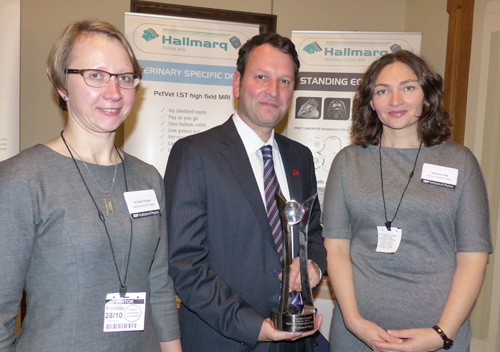
(Left to right) Physicists Giedre Podolyak, Steve Roberts and Snezhana Chater of Hallmarq Veterinary Imaging celebrate their success in the IOP Innovation Awards.
By Margaret Harris
Imagine you’re a veterinarian and a trainer asks you to take a look at a horse. The animal, a champion showjumper, is limping slightly but there is no obvious injury. Exploratory surgery would probably do more harm than good, and the alternative – magnetic resonance imaging (MRI) – isn’t risk-free either. You’d need to put the horse under a general anaesthetic, and you know horses don’t react well to that; in fact, around 0.5% suffer serious injuries while coming round afterwards. And that’s assuming you can even find a scanner big enough to fit a horse. What do you do?
This might sound like a fairly niche dilemma, but for Hallmarq Veterinary Imaging it has become the basis for a thriving business – a business, moreover, that has just won an IOP Innovation Award for the successful application of physics in a commercial product.
At the awards ceremony – which took place last night in the Palace of Westminster, London, just down the hall from the House of Commons chamber – I caught up with Hallmarq’s operations and technical director, Steve Roberts. After sketching out the scenario of the veterinarian and the injured horse, Roberts, a physicist, explained that Hallmarq’s MRI scanner fits around the horse’s leg. This means that equine patients can simply be led into it, sedated but conscious. Sophisticated error-correction and image-processing software helps the scanner compensate for the horse’s movement, and in 15 years of operation, Roberts estimates that veterinarians have used Hallmarq’s machines to scan more than 60,000 horses.
A device that uses sound waves to levitate, rotate and move objects in multiple directions has been developed by researchers in the UK and Spain. The “tractor beam” uses an array of miniature loudspeakers to create acoustic holograms that can manipulate objects in mid-air. Although they cannot propagate the vacuum in space to move spaceships and asteroids, sonic tractor beams could have a wide range of practical uses, such as moving delicate objects on a production line or transporting tiny drug capsules and microsurgical instruments through living tissue.
Bruce Drinkwater of the University of Bristol, who is one of the lead researchers in the current work, says that MacDonald and colleagues “did a really nice experiment showing you could get these attractive forces in acoustic systems. They had an array of loudspeakers, a bit like ours, and were able to apply a force to a specially shaped mass. We have gone from there and turned it into something that you could call a working stable tractor beam.”
Acoustic fields
Although acoustic levitation has been demonstrated before, it required particles to be enclosed by acoustic elements, while single-sided levitators have only managed to exert lateral or pulling forces, or required the use of an acoustic lens. The new device uses a grid of 64 off-the-shelf speakers (originally made for parking sensors) controlled by a programmable array of transducers. The transducer array – developed by Ultrahaptics, a spin-out company from the University of Bristol – creates haptic feedback in mid-air.
“When we realized we could use this equipment to create any acoustic field, we thought maybe we can create tractor beams,” says Drinkwater. The array creates acoustic shapes out of high-pressure ultrasound waves that can surround and trap objects. By carefully controlling the output of the speakers, the acoustic holograms can be adjusted to hold objects in mid-air and rotate and move them. The team created three different acoustic shapes – tweezers, a vortex that traps objects at its core, and a cage. Polystyrene particles ranging in diameter from 0.6 to 3.1 mm were controlled by the array, and it was strong enough to hold the spheres and counteract gravity from any direction.
Flexible devices
The tractor beam uses ultrasound at 40 kHz with a wavelength of about a centimetre. But Drinkwater plans to work on increasing the frequency and reducing the wavelength so that smaller particles can be manipulated. This could open up the possibility of using the technique for medical applications. An acoustic tractor beam could, for example, be used to move capsules into an exact location in the body and then blast them open to release drugs, or to manipulate tiny surgical instruments inside the body.
“This is a great paper, which shows a lot of acoustic-trapping techniques that are common in optical trapping but less so in acoustics,” says MacDonald. “As the paper says, all of the acoustic beams produced, and the manipulations achieved, could be done before, but usually with less flexible devices.” MacDonald told physicsworld.com that his original device was capable of producing all of the beams described in the new work, “but was made for focused ultrasound surgery. That means that although our device was already being used clinically, it was very expensive and less easily programmed.” He adds that the new approach is more flexible through the use of a programmable array.
“Just because a mystery is 4500 years old doesn’t mean it can’t be solved.” That is the tagline of a major new project to uncover the secrets of Egypt’s pyramids without damaging a single stone.
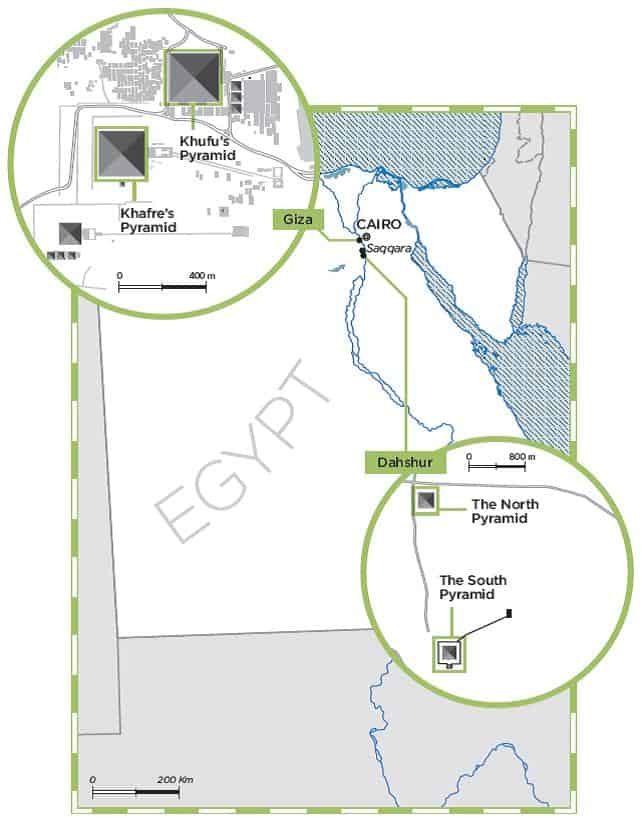
Study locations. (Courtesy: Scan Pyramids)
Scan Pyramids – launched by the Egyptian Ministry of Antiquities – will deploy an arsenal of non-invasive technologies to probe the structure of four pyramids from Egypt’s Fourth Dynasty (from 2575 BC to 2465 BC). On the Giza plateau, about 20 km south-west of Cairo, it will study the Pyramid of Khafre, along with the Pyramid of Khufu, aka the “Great Pyramid of Giza”, the oldest of the Seven Wonders of the Ancient World. Meanwhile, on the site of Dahshur, around 40 km south of the Egyptian capital, it will investigate the North and South pyramids. (Click to expand the map.)
Despite their global fame and familiarity, these ancient monuments still hold many mysteries. Chief among them is the question of how the ancient Egyptians managed to build these huge edifices. The Great Pyramid of Giza was originally 150 m tall and weighed 5 million tonnes, yet it was constructed in just 25 years. Egyptologists also believe that these pyramids could be concealing hidden chambers, which could house tombs and secret treasures.
A self-professed “space buff”, Talal Ashiq Qureshi originally intended to pursue a doctorate in physics. As an undergraduate, he attended the Florida Institute of Technology, which is located on the “space coast” of Florida, near NASA’s Kennedy Space Center. After obtaining his bachelor’s and Master’s degrees in electrical engineering there, he embarked on a PhD in physics, planning to specialize in some area of space science or astrophysics.
But in 2003, as Qureshi was finishing up the requirements for a physics Master’s, the uncertain state of the US economy (then still recovering from the dotcom bust) convinced him it would be better to start his career right away, rather than gamble on being able to find a job later with a PhD. So, after graduating with his Master’s degree, Qureshi took a position with the telecoms giant AT&T as a network integration engineering manager, overseeing the firm’s vast fibre-optics networks for scores of clients in the Fortune 500 list of major firms. When he left the corporation in 2007, he began consulting for the City of New York. Since 2012 he has worked full-time for the city’s department of information technology and telecommunications, as a programme manager focusing on networks, Wi-Fi and voice-over-Internet engineering.
Qureshi couldn’t be happier with his choice. Throughout his career, he says, the skills he learned in his physics Master’s have consistently aided him in managing projects and risk, as well as in project forecasting. “God knows how many times I have had to use the Gaussian or bell curve to explain something,” he says with a chuckle. The biggest gains, however, have been intangible. “It has improved my thought process,” he explains. The skills he developed in managing stress and making presentations have been particularly important, he says, because in his job “everything is needed yesterday, and the pressure is not just from the boss but from the citizens of New York”.
Qureshi is hardly alone in finding value in his degree, or in discovering that employers appreciate the skills that a physics Master’s provides. According to a 2014 report from the American Institute of Physics (AIP), which surveyed physics departments across the US, 44% of those who obtained a physics Master’s degree between 2009 and 2011 were working in the private sector within one year of graduation, while 23% found jobs in universities, 11% were employed by the government (not including active military) and 10% were high school teachers. Of those who obtained positions in the private sector, 87% worked in science and technology-related fields, including engineering, computer and information technology, physics and astronomy, as well as other areas of science and maths.
Nor is the appeal of the physics Master’s limited to the US. Sandra Hill, managing director of the Hill Group of recruiters based in Manchester, UK, says she regularly places candidates with a physics Master’s degree in a variety of industries, in roles that range from engineering and operations to research and development (R&D) and even strategic purchasing. “The physics degree is phenomenal because [it shows employers] you are good at maths, have an inventive mind, can solve engineering problems and can articulate [all of this]…No other degree offers experience in highly complex calculations, with the engineering and communications component,” Hill explains. “A programme manager with a physics Master’s [has the capacity] to understand all of the business.”
A plethora of options
For physics enthusiasts who aspire to lead their own research programme – and want the chance to dig very deeply into a subfield that fascinates them – the PhD is a better option than the Master’s (see To PhD or not to PhD below). But for others, the Master’s provides just the right fit. Daniel Olson, who received his Master’s in physics in 2010 from San Jose State University in California, enjoys science but has no desire to become a principal investigator. Instead, he explains, “I always wanted to be in a position supporting research. The Master’s is perfect for that.”
While he was still an undergraduate, Olson landed a position with the Search for Extra Terrestrial Intelligence (SETI) Institute, and he continued to work there during and after his Master’s degree studies. Since 2013 he has worked for the Bay Area Environmental Research Institute (part of NASA’s Ames Research Center) as a research associate, and he spends much of his time writing algorithms to process the large data sets generated by numerous NASA missions. He has recently worked on projects relating to the refractive properties of the rings of Saturn and tracing chemicals in the atmosphere produced from forest fires. He also spends about a quarter of his time helping the SETI Institute produce high-quality archives of planetary data.
Outside the research environment, numerous vocations and sectors are both suitable and achievable for physics Master’s graduates. One such career path is medical physics. Medical physicists focus on ensuring accuracy, safety and quality in the use of radiation in healthcare such as medical imaging and radiation therapy. They are the bridge between physicians and patients, using radiation-producing technology both to diagnose and treat people. Their responsibility is to make certain that the radiation prescribed in imaging and radiation therapy is delivered accurately and safely.
Some medical physicists are employed as consultants providing services to multiple facilities. Others labour for one hospital or hospital system, which may be community-based or affiliated with a university, says Nicole Ranger, a medical physicist who earned her Master’s in medical radiation physics from McGill University in Montreal, Canada. She has a perspective on the variety of roles medical physicists fulfil because she has worked in academic medical centres, has moonlighted as a consultant, and is now a senior research medical physicist at Landauer, a company based in Glenwood, Illinois, that provides integrated radiation safety products and services. “Regardless of the context in which we work, whether it be clinical work or research, medical physicists are essentially problem-solvers and no one day is like another,” Ranger says. “It’s a gift to be intellectually challenged every day, to find solutions that are practical and have a positive impact on the field of medicine and patient care.”
Communications and consulting
Science journalism, editing and communications are also exciting career paths for people with a physics Master’s. Julie Gould, the editor of Naturejobs – the careers arm of the journal Nature – has a physics MSc from Cardiff University, UK. She says that not only does her educational background give her the foundation she needs to get a better understanding of the technical aspects of the articles she oversees, but it also helps her organize her editing and writing strategy. “My physics degree gave me a broad base in critical thinking and analysis, predictive thinking and logic,” she says. Furthermore, having studied such difficult problems in physics helps her feel more confident in approaching subjects she doesn’t know and taking on complicated projects. “It’s so useful to have that extra bit of scientific method so when you talk with researchers you can rigorously ask the right questions to get the right information for your story,” she adds.
Consulting is another possibility, notes Edward Caner, director of the Science and Technology Entrepreneurship Programmes (STEP) at Case Western Reserve University (CWRU), which includes a Professional Science Master’s (PSM) degree in physics and entrepreneurship (see Mixing physics and innovation below). McKinsey & Company, one of the largest management and business consulting firms in the world, has recruited several of his students and regularly hires physics graduates from other universities. And for good reason. “Each graduate really attacks a problem with fervour,” Caner says. “They don’t just look for a stock solution. They always look at the problem carefully, especially just below the surface to understand it better.” The result, he says, is more creative and innovative solutions for McKinsey’s customers.
The “rep” of the Master’s
Masterful advice Physics Master’s graduates including (from left) Jeff Bargiel, Julie Gould, Daniel Olson and Nicole Ranger share why it was the right degree for them.
Given the range of careers open to people with a Master’s in physics – and the cachet that such a qualification has with employers – it is a surprisingly rare degree. In two separate reports published in 2014, the AIP found that, between 2009 and 2011, an average of 790 students per year left US physics departments with a Master’s degree, compared with a total of 6296 and 1688 people who received a physics bachelor’s and PhD, respectively. In the UK, the picture is complicated by the fact that some undergraduate degrees are “enhanced”, meaning that they include a Master’s-level qualification (an MSci or MPhys) gained during an additional fourth (or, in Scotland, fifth) year of undergraduate study. This “undergraduate Master’s” is fairly popular; a 2012 report by the Institute of Physics (which publishes Physics World) found that just under half of the 2730 students who completed undergraduate physics courses in 2009/10 obtained this enhanced degree. The separate postgraduate Master’s degree (MSc), however, is typically more specialized and much less common: only 530 physics students at British universities obtained this degree in 2009, compared with 710 who completed a PhD.
Part of the reason for those low numbers is that in some parts of the world, Master’s degrees in science suffer from a branding problem. Unlike a Master’s in engineering or an MBA, which carry a positive reputation, in some circles – especially academic ones – a science Master’s may be perceived as a potential mark of failure to achieve a PhD.
Such attitudes are hardly universal, though, and there is some evidence that they are changing. Gould notes she has received only positive responses to her Master’s education choice. “It’s viewed as one step further beyond a bachelor’s, giving me greater insight into the discipline,” she says. Within the US, where the view of a Master’s as a “consolation prize” for not getting the PhD is more entrenched, a number of universities have developed PSM programmes as a way to address the degree’s image problem, while also providing innovative career paths for students who want more depth in their subject than a bachelor’s degree can provide, but have no wish to spend four or more years pursuing a PhD (see “A new model Master’s”, August 2010 pp44–45).
Selling your skills
While some job advertisements will explicitly ask for a physics Master’s degree, most often this is not the case. Ray Ryan, a senior careers consultant at the University of Warwick, UK, whose focus is on students with bachelor’s and Master’s degrees in physics and maths, says that while he is “regularly” contacted by employers and recruiters looking for physics graduates, “In the UK recruiters do not generally specify that a Master’s level qualification is required for their graduate schemes.” He notes that employers specifically request physics candidates because of the plethora of robust abilities they bring to the table, including critical thinking, analysis, working in a team and being detail-oriented. But in his experience, he adds, “Although there may be a financial premium and higher entry point for physics Master’s level and PhD graduates for specific roles and sectors, in quantitative finance and R&D for example, this is not the case for the overwhelming majority of graduate schemes in the UK.”
Not everyone agrees with that assessment, however. A Master’s degree can “improve your earning potential”, argues Padraig Moloney, a senior scientist and programme manager at Lockheed Martin who received his PSM in nanoscale physics from Rice University, US, before pursuing a PhD. In many cases, though, the onus will be on you as an applicant to prove that your degree has given you skills that are worth a premium. A Master’s thesis, in particular, can set you apart from the competition and enable you to develop your “brand” (or promise of value) in a given field. “The physics Master’s thesis should relate to your [intended] industry,” advises Hill. “Focus on what you want to do when you leave university, because sometimes the thesis will get you the job more than experience.” As an example, Hill cites a candidate who had produced a thesis focusing on how vehicles can potentially be powered by their own emissions, and who she placed in an engineering role at an automotive firm.
Another potential pitfall for people with a physics Master’s is that many positions in industry request degrees in engineering or related technical fields, rather than physics. Sometimes, this problem starts before the Master’s level. When Jeff Bargiel, who earned his Master’s in physics entrepreneurship from STEP at CWRU, was an undergraduate looking for a co-op position (similar to an internship), he faced confusion from the careers adviser at his institution. “The co-op manager had no idea what to do with me because I was in physics,” he says, explaining that the counsellor was used to working with companies that requested engineers. “I had to educate her that I could be qualified for jobs that require electrical, mechanical or optical engineering degrees.” In the end he found a co-op position on his own.
Similarly, at the Master’s level, it is often up to applicants to make sure their application clarifies why their physics degree is a match. “Evaluate what skills you have to justify what you can do,” Qureshi suggests. “Try to understand what the [organization] is looking for,” and use the specific vocabulary of the position to describe your physics expertise in their terms.
Of course, physics-educated professionals who have migrated into industry jobs already understand the value that a physics degree provides. Many of them clamour to hire other physicists, as Matthew Thompson, a lead scientist at an alternative energy start-up, attests. A PhD physicist, he serves as group leader for the diagnostics and instrumentation at Tri Alpha Energy, a firm based in Foothill Ranch, California, and when given the choice between hiring an engineer or someone with a physics Master’s, he goes for the physicist every time. While engineers can build equipment and do technical analysis, in his view physicists provide something special: innovation. Physicists with Master’s degrees can conceptually design experiments and understand the parameters of what can and cannot be built, he notes, which is especially important in his physics-heavy company. “The devices we are trying to design have incomplete physics information associated with them,” he says, “so initial physics experiments are needed.”
Caner attests that “the MS in physics is the best kept secret in hiring” among employers, compared with someone with a Master’s in engineering. “If I am a CEO and I hire someone with a physics Master’s, I know that if something happens and I have to revamp the system, that person is going to be able to roll with the punches, redefine themselves,” and solve the problem better than anyone else, he says. Furthermore, the extra year or two spent learning and researching physics beyond the bachelor’s allow the students to “get to another level of problem-solving ability”, he says. “Your brain is trained as a problem solver and not as a regurgitater.”
Advice for blissful employment
Although it helps to know where you want to go after graduating with the degree, even if you are unsure, consider that extra year or two as an investment in your future. “I wanted to develop products and work on projects with commercial impact”, says Bargiel. “The physics Master’s degree is so universal. I made it into what I wanted it to be.” Adds Qureshi: “Physics is applicable to any career. The opportunities are endless.”
To PhD or not to PhD
(Courtesy: iStock/MorePixels)
If you want to do additional study after your undergraduate degree, but are trying to decide whether your final degree in physics should be a Master’s or a doctorate, do a self-assessment concerning your overall interests, career objectives, skills you enjoy using and tasks you enjoy doing. “For a PhD, you have to have a very specific reason for doing it: to add to the overall scope of human knowledge,” says Daniel Olson, a research associate in a division of NASA Ames who has a Master’s degree in physics. Given that a PhD can take four or more years to complete, ask yourself: Do I enjoy digging deeply into a very finite subject? Would I have fun doing this every day for the next four to six years?
If the answer to these questions is “yes”, the next thing to consider is whether the PhD will give you entrée into the career you desire. Is it required for your dream job? If you endeavour to work as a professor or in corporate R&D, the answer is generally yes. “A PhD is required for a very specific kind of success, such as a professor or in a national lab, where you conduct experiments and write papers,” notes Matthew Thompson, a lead scientist at Tri Alpha Energy in California. “If you like physics but don’t want to do that, a Master’s degree can be a better ticket.” This is especially true if you are keen to do “scientific problem-solving”, using your physics knowledge and skills as a means to find solutions in sectors such as government and industry, as opposed to conducting original research. “For a lot of people the PhD is not the best investment” of time and energy, concludes Thompson. “The Master’s level [professional] fills the role of scientific problem solver.”
Mixing physics and innovation
Although there are plenty of traditional Master’s physics programmes offered around the world, many other courses specialize in burgeoning areas of physics innovation, combine physics with business, or prepare students for very specific career paths. Here are a few to consider:
Science and Technology Entrepreneurship Programmes (STEP) at Case Western Reserve University, US: a Professional Science Master’s (PSM) in physics entrepreneurship
PSM in nanoscale physics at Rice University, US: for students interested in nanotechnology, combined with business and project management classes
MSc in radiation and environmental protection at the University of Surrey, UK: courses include radiation physics and biology, nuclear power and non-ionizing radiation, and environmental physics and protection
Master’s in beam physics and technology, from a joint partnership between Indiana University and the US Particle Accelerator School (a national consortium sited at Fermi National Accelerator Laboratory)
MSc in information security, from Royal Holloway University of London, UK: focuses on cyber security, security management, digital forensics, cyber crime and security testing
Polymer materials science and engineering MSc, from the University of Manchester, UK: one of many materials science Master’s programmes coveted by industry, according to recruiters
Master’s of applied physics, Michigan Technical University, US: launched in autumn 2015, it offers students flexibility to customize the programme to meet their interests in innovative areas such as optoelectronics, plasmonics and biophysics
Aggregations of fire ants can, on a macroscopic scale, show some surprisingly classical material properties, such as viscoelasticity and flow, researchers in the US have demonstrated. The research gives, they say, a fascinating example of “active matter” – in which the individual elements are able to use energy and rearrange themselves – and could potentially provide insights for developing new materials.
Fire ants are known for their ability to organize into remarkable macroscopic structures. They can link their legs together into elastic solids that can resist macroscopic applied loads or self-assemble into rafts to survive floods. They have also been seen to form liquid-like aggregations, in one remarkable case “dripping” from a tap. “Lots of people have looked at the ants as a biological entity,” explains physicist Michael Tennenbaum of Georgia Institute of Technology in Atlanta. “But no-one has ever looked at the ants as a material.”
Ant gymnastics
In the latest work, Tennenbaum and colleagues studied various macroscopic properties of such aggregations. They placed a lead sphere on top of an aggregation of the ants and calculated the aggregation’s viscosity by measuring the speed at which the sphere sank through it. Next, the researchers placed the aggregation inside a rheometer, between two plates coated with Velcro. The ants gripped the Velcro tightly, meaning that rotation between the plates could be achieved only by shear of the aggregation. The researchers then applied a variable stress to the plates, finding similar – although not identical – viscosity. As expected, they also found that applying greater stress resulted in faster rotation (shear) between the plates, but the relationship was complex.
At relatively low shear, for example, a greater increase in stress was required to produce the same increase in shear; whereas at high rates, increases in shear could be achieved with a smaller increase in stress. In the language of classical physics, the viscosity of the aggregation decreased as shear increased. This phenomenon, called shear-thinning, is commonly observed in conventional viscoelastic materials. “If you did this experiment with jelly, you would get very elastic behaviour at really small strains, but at large strains you would get flow,” says Tennenbaum. Nevertheless, on a microscopic basis, the aggregation is nothing like a conventional viscoelastic material.
Playing dead
Ants are continuously moving around within the aggregation, regardless of whether or not it is under stress. While trying to resist an applied stress, the ants first grab one another’s limbs, thereby dissipating strain energy through the movement of their joints. When necessary, they let go of ants they can no longer safely hold on to and grab hold of other ants. At higher rotation rates, the aggregation is sheared faster than the ants can rearrange to resist the applied stress – in this case, the ants “play dead”, lying still and allowing their limbs to entangle randomly with each other, thereby creating a constant resistance to flow of about 70 Pa.
Indeed, when the researchers tried the experiment with dead ants, the aggregate showed similar resistance to flow at high rotation rates, but it did not show the elastic behaviour at small strains. The ants did show some behaviour that would not be seen in conventional matter, however. For example, at stresses below 70 Pa, the ants sometimes actively resisted the shear for a time, producing a very stiff aggregate. Then, for no apparent reason, they gave up and allowed themselves to flow. After a period flowing, however, they once more resisted the flow.
Active systems
The team is now working towards a microscopic picture of why this occurs, but David Hu, who is one of the principal investigators in the team, says that “ants change their minds”. According to him, the research is part of a larger effort to “really understand how active systems can make new kinds of materials”. “Ants can maintain stresses enough that they can build a raft to support thousands of members, a bivouac that’s 30 stories tall – for an ant – or a bridge; but when the going gets tough, they can just liquefy,” says Hu.
David Weitz of Harvard University in Massachusetts, who was not involved in the new work, describes the research as “interesting and very amusing”, adding that these are some of the first results achieved by “applying the techniques of classical materials science to a biological system like this”. He says the ultimate significance of the work, however, will depend on “what people can do by following up this line of inquiry”.
A new technique, which is based on magnetic resonance imaging, should allow physicists to carry out more sensitive searches for the neutron’s putative electric dipole moment (EDM). While the neutron EDM is predicted by many extensions of the Standard Model, we are yet to find any evidence for it. The latest work should help researchers to either discover the subtle phenomenon or rule out a number of theories that predict it.
Although the neutron has no net charge, it is composed of charged quarks, and any permanent spatial offset between positively and negatively charged ones could, in theory, give rise to a dipole moment that is sensitive to electric fields. Experiments to look for such an EDM were first carried out in the 1950s and their sensitivity has since improved by more than six orders of magnitude. But physicists continue to push sensitivities ever higher, in the hope of discovering an effect that would violate so-called charge–parity symmetry, thereby explaining how matter came to dominate over antimatter in the early universe.
Precessing axes
In a typical EDM experiment, a batch of ultracold neutrons – at temperatures of 3 mK or less – are trapped in a chamber and polarized so that their spin magnetic moments are all aligned. Ultracold atoms are used as they can only reach a certain height – about 2 m at most – as they have very little kinetic energy. The atoms are then exposed to a magnetic field, causing their spin axes to precess around the field lines with a frequency that depends on the field strength. By then adding an electric field – which alternates between positive and negative values once every few hours – the EDM, should it exist, would couple to the electric field, and this, in turn, would change the neutron’s precession frequency.
To do this, researchers have to ensure that they account for any noise that could mimic an EDM signal. The magnetic field must be extremely stable and any fluctuations monitored precisely – even a car passing close by could have a measurable effect. While the researchers can monitor average field strength using mercury atoms with relative ease, they still cannot account for variations in the magnetic field along the chamber’s vertical axis. Any neutrons located in a region with fluctuations will not precess at the expected frequency, so reducing the strength of the signal from the combined magnetic dipoles. Also, as the neutrons will have a distribution of energies, they will be at different heights throughout the chamber. If this distribution is not known, then it is impossible to say how much of the variation in the dipole signal is due to a neutron EDM, as opposed to a more prosaic variation in the magnetic field.
Flipping spins
To overcome this problem, Philipp Schmidt-Wellenburg of the Paul Scherrer Institute in Switzerland and colleagues have exploited a phenomenon known as “spin echo”. Using a dedicated spallation source at the institute, the researchers loaded spin-polarized neutrons into a 12 cm-high chamber, exposed to a smoothly varying magnetic field that is aligned with the neutrons’ spin along the chamber’s vertical axis. They then applied a brief pulse of a weaker magnetic field that flipped the spin through 90°, causing them to start precessing in another plane. A few tens of seconds later, a second pulse once again flips the spins. By measuring the progress of the neutron spins after another gap of several tens of seconds, the researchers measured the amplitude of the precession frequency.
As expected, the biggest signal – the spin echo – came when the two gaps were of equal length. This resonance occurs because the spins exposed to a higher magnetic field precess quicker and get ahead of the others. But the flipping to the original axis causes a reversal of their positions, thereby refocusing them. By varying the relative duration of the two gaps, Schmidt-Wellenburg and colleagues generate a range of signal strengths at the output. Given that these signal strengths will depend on how many of the neutron spins lag behind or steal a march on the neutrons at different field strengths, a plot of signal strength versus gap length can be used to reconstruct the neutrons’ energy spectrum.
Schmidt-Wellenburg and co-workers will use this technique to maximize the sensitivity of a new EDM experiment they are currently working on, which should be up and running within the next five to 10 years. The current best upper limit on the neutron’s EDM is 3 × 10–26e cm, which was set by Philip Harris of Sussex University and colleagues in 2006 using an experiment located at the Institut Laue-Langevin in Grenoble, France – Harris’s group has since joined the Swiss-based collaboration. The new experiment is being designed to push that limit down to 5 × 10–28e cm, which, according to Schmidt-Wellenburg, is as low as the values predicted by many extensions to the Standard Model.
The National Graphene Institute (NGI) is a new £61m facility based at the University of Manchester in the UK. Recently crowned “major building project of the year” at the annual British Construction Industry Awards, the NGI is designed to bring researchers from academia and industry together to turn research into graphene and other 2D materials into commercial products. In this video we take you on a tour of the building and you will learn about its major design concepts from lead architect Tony Ling.
The five-storey, 7600 m2 building opened earlier this year and includes two large cleanrooms, optical labs and open spaces for collaboration. Ling works for the London-based architects Jestico + Whiles and the firm worked closely with Nobel laureate Konstantin Novoselov to meet the needs of the communities using the facility. The Russian-British researcher and his Manchester colleague Andre Geim shared the 2010 Nobel Prize for Physics for isolating graphene for the first time and their subsequent studies of the material.
Part of the design ethos has been to create a building with a sense of openness. Many of the internal walls are covered in black PVC so that researchers can freely share their ideas using special chalk-effect pens. Meanwhile, sections of the subterranean cleanrooms are visible from street level so that the public can catch a glimpse of the work taking place within the NGI. Last week, the NGI was visited by the Chinese president Xi Jinping during his inaugural state visit to the UK.
About 100 billion optical components would be needed to create a practical quantum computer that uses light to process information. That is the conclusion of physicists in the UK, who have calculated how many components are required to make a fault-tolerant linear optical computer. Their comprehensive study found that the total number of required components for a photon-based computer would be at least five orders of magnitude larger than for a matter-based processor.
Unlike the components of conventional computers – which are extremely reliable – quantum logic devices are prone to failure. This is because the entities used to store and transmit information – quantum bits (qubits) – quickly lose their quantum nature when in contact with the outside world. Ion-based qubits, for example, must be kept in ultrahigh-vacuum conditions to minimize their contact with air molecules. One way of dealing with this fragility is to create a fault-tolerant quantum computer, in which a single “logical qubit” is distributed across a number of different “physical qubits” – the latter being ions, superconducting circuits or photons. The idea is that if one or more physical qubits fail, then the logical qubit can be recovered and the calculation can continue.
Weakly interacting
Photons have several properties that make them attractive for use as physical qubits. They can store quantum information in several different ways, including in their polarization. Furthermore, photons can travel hundreds of kilometres in air or optical fibres and still retain their quantum information. Also, it is relatively straightforward to create pairs of entangled photons for use as input to a quantum computer. What is difficult, however, is to get these photons to interact with each other within the quantum computer – something that is needed for most quantum-computing processes.
One option is to use nonlinear optical components that cause photons to interact. The problem with such devices, however, is that most photons will not interact and large numbers of input photons are required to get the desired output. In 2001 Emanuel Knill, Raymond Laflamme and Gerard Milburn realized that quantum computing could be achieved without having photons interact with each other. Called “linear optical quantum computing” (LOQC), the scheme uses entangled photons as input to a quantum computer. But instead of having these photons interact while in the computer, specific measurements are made on some of the photons, with the output photons providing the result of the desired calculation.
While fault-tolerant LOQC can be implemented using relatively simple optical components such as mirrors, beamsplitters and photon detectors, it requires large numbers of photons as input – and therefore large numbers of these components are needed. The process is also non-deterministic, which means that not every attempt at performing the computation will succeed, which means even more resources are needed.
Tight tolerances
Now, Simon Benjamin and colleagues at Oxford and Bristol universities have calculated how many devices would actually be needed to create a fault-tolerant LOQC. The researchers assumed that a practical quantum computer would require about 1000 logical qubits to execute useful quantum processes such as Shor’s factoring algorithm. They assumed that each component in their model computer would lose one photon in 1000, and that the error rate of each component is one in 100,000. These tolerances are currently not possible, and Benjamin explains that if today’s tolerances were used, the size of the LOQC would be even larger. “We chose numbers that are beyond the state-of-the-art but perhaps not impossible to achieve, and showed that even then, the overall resource costs are high,” he adds.
The team looked at the resources required to create a “3D cluster state” quantum computer based on LOQC. In this fault-tolerant approach, all of the entanglement required for the calculation is created before the calculation, which is then executed by performing measurements. “A 3D cluster state is an entity involving multiple photons woven together to form the ‘fabric’ of the computer,” explains Benjamin. “By ‘woven’ I mean that they are in a highly entangled state, and the entanglement process is costly because photons don’t naturally interact with each other.”
Billions of components
Indeed, the high cost is borne out in the team’s calculation of the resources needed to create a practical quantum computer using this scheme. They reckon that 100,000 detectors are required for each physical qubit in their hypothetical quantum computer. The numbers of mirrors and beamsplitters would also be about 100,000. Furthermore, each logical qubit in the computer would comprise 1000 physical qubits to ensure fault tolerance. This means that a whopping 100 billion detectors would be needed to build a practical quantum computer comprising 1000 qubits.
Benjamin points out that the need for about 1000 physical qubits per logical qubit also applies to fault-tolerant systems made from ions or superconducting circuits. “Making a fault-tolerant quantum computer is hard and needs at least millions of physical qubits, but with the linear-optical approach there is the extra cost, another factor of 100,000 (or more) turning ‘hard’ into ‘so hard, it may be impossible’,” he explains.
While such a huge component count might seem like an insurmountable barrier to creating practical LOQC systems, Benjamin points out that there are ways forward. “In situations where small imperfections are acceptable, for example for simulators that predict chemical reactions, we don’t need full fault tolerance and then photonic machines may indeed be an elegant approach,” he says. Benjamin also told physicsworld.com that “there is another approach that I am a big fan of, where matter systems [such as ions] store and process information, but they are linked up optically”. “It’s a best-of-both-worlds picture where small, isolated matter systems do the processing, meanwhile photons do what they’re good at – communicating,” he says.
Researchers at the University of California at San Diego (UCSD) are the first to have used infrared nano-imaging to study how surface plasmons (collective oscillations of electrons) propagate in “moiré-patterned” graphene grown on hexagonal boron nitride. The observations, which reveal new collective plasmon modes, could help in the development of advanced plasmonic circuits for novel tunable optical and optoelectronic devices.
Graphene, a 2D honeycomb lattice of carbon first isolated in 2004, boasts a wealth of fascinating electronic properties, many of which come from the fact that it is a semiconductor with a zero-energy gap between its valence and conduction bands. Near where the two bands meet, the relationship between the energy and momentum of an electron in the material is described by the Dirac equation and resembles that of a photon.
These bands, called Dirac cones, enable electrons to travel through graphene at extremely high speeds, which means that graphene-based electronic devices, like transistors, could be faster than any that exist today.
Hexagonal boron nitride (hBN) is an excellent substrate for graphene because the two materials have very similar lattice constants. When graphene is epitaxially grown on top of hBN crystals at a small relative angle, moiré patterns appear. These periodic superlattice structures, which form whenever two similar 2D lattices are precisely overlaid, radically alter the electronic band structure of graphene so that “satellite” sub-Dirac cones appear at the superlattice zone boundaries.
Composite infrared surface plasmons
The researchers, led by Dmitri Basov and Michael Fogler, have now found that new interband transitions in the superlattice mini-bands together with free electrons in the Dirac bands produce composite infrared surface plasmons. “This novel form of collective modes is likely to be generic to other forms of moiré superlattice structures,” explains team member and first author of the study, Guangxin Ni. The experimental observations performed in conjunction with theoretical band structure calculations, were carried out by our colleague Jhih-Sheng Wu at UCSD.
“In such moiré-patterned graphene/hBN heterostructures, the surface plasmons are now composite modes, which is a drastically different situation to that in plain graphene,” he adds. “We also found that the interface between plain graphene and moiré-patterned graphene in our samples acts as a self-assembled “plasmonic reflector”. Such features are essential elements for nanoplasmonic circuits and ‘transformational plasmonics’, which allows us to tune plasmonic fields at will.”
The team, which includes researchers from the National University of Singapore, Shanghai Institute of Microsystem and Information Technology and Ludwig-Maximilians University and Center for Nanoscience in Munich, is now busy trying to extend its approach to the terahertz and far-infrared parts of the electromagnetic spectrum. “Composite plasmons should be even more robust in these regimes,” Guangxin tells nanotechweb.org.