Stars could be forming in the inhospitable environment near Sagittarius A*, which is the supermassive black hole at the heart of the Milky Way. That is the conclusion of an international team of astronomers that has discovered a possible signature of low-mass star formation just two light-years from the centre of our galaxy – a region that was previously thought to be too hostile for such activity. If confirmed, these observations identify a “laboratory” where astronomers can study star formation – and even possible planetary formation – near a supermassive black hole.
Stars form when a cloud of gas becomes dense enough to collapse in on itself under the influence of its own gravity. This process is affected by the environment surrounding the cloud. Close to a supermassive black hole, the self-gravity of the cloud will be countered by “tidal shear”, which is the stretching force that results from the intense gravitational pull of the black hole. Forming stars near a supermassive black hole is therefore expected to be very difficult, because the self-gravity of a cloud must be strong enough to overcome the tidal shear. Indeed, a star-forming cloud would have to be unusually dense to avoid being torn apart.
Searching for signatures
Understanding star formation near supermassive black holes is important because these objects are known to reside at the heart of most large galaxies. Previous observations of the central few light-years of the Milky Way had focused on a population of about 200 massive, young and very bright stars in tight orbits around Sagittarius A*. These stars are only a few million years old and prompted scientists to wonder whether they somehow manage to form in their current locations in spite of their close proximity to the black hole, or whether they form further from the black hole and then migrate in?
Motivated by this mystery, Farhad Yusef-Zadeh of Northwestern University and collaborators looked for evidence of even younger stars close to Sagittarius A*, which would demonstrate that star formation in the area is an ongoing process. “We have been searching for signatures of more recent star formation within a few light-years of the black hole for some time,” Yusef-Zadeh says.
Looking for signs of star formation in this region is difficult because the Earth lies in the disc of the Milky Way, and our view of the galactic nucleus is obscured by interstellar dust particles. Scientists therefore rely on telescopes that use non-optical wavelengths, such as radio telescopes, to peer through the dust and probe activity at the galactic centre. New capabilities of one such telescope, the Very Large Array (VLA) in New Mexico, were key in allowing Yusef-Zadeh and collaborators to make their recent discovery of small sources in one arm of activity near Sagittarius A*.
Heated discs
The team identified these small sources as candidate photoevaporative protoplanetary discs – “proplyds” – which are areas of dense, ionized gas and dust surrounding young, newly formed stars. The proplyd candidates are between 10,000 and 100,000 years old, and they lie along the edge of a large molecular cloud. It is likely that this cloud produced the discs by providing a reservoir of gas to feed the star-formation activity.
Bow shocks: Radio-telescope image highlighting two proplyd candidates (see arrows) located near Sagittarius A*. These objects are in the shape of bow shocks caused by a stellar wind from hot stars orbiting close to the supermassive black hole. (Courtesy: F Yusef-Zadeh et al.)
The region surrounding these proplyds is blasted with harsh ultraviolet radiation streaming from hot stars orbiting close to Sagittarius A*. The gas of the proplyds is heated and stripped away by the radiation from these stars and characteristic shock waves are formed around the discs on the side facing the galactic centre. Both the proplyds themselves and the “bow shocks” surrounding them are visible in Yusef-Zadeh’s observations.
Planetary possibilities
Unlike the young massive stars that have previously been identified in the galactic centre, the proplyd candidates in this study are associated with low-mass stars – objects of less than about one solar mass. The analysis by Yusef-Zadeh’s team has led the researchers to speculate that it may in fact be easier for low-mass stars to form in the hostile surroundings of the black hole than it is for them to form elsewhere in the Milky Way. In addition, the rate at which material is lost from such proplyds is expected to be low, so there is a chance for the disc to eventually form planets. With that comes the tantalizing possibility that as telescope resolution and data-analysis techniques improve, we may even be able to watch planet formation occur near Sagittarius A*.
“The inner few light-years of the galaxy is clearly a unique environment,” says Yusef-Zadeh. Determining exactly what role this environment plays in the formation of stars is the challenge. Further work is necessary to determine whether the extremes of these surroundings hinder or, in fact, help star formation, but the observations in this study are an important step in the direction of better understanding.
The following video abstract shows the locations of the proplyd candidates relative to Sagittarius A*, and provides more information about how the observations were made and analysed
A new type of electrode that could lead to the development of more efficient and lighter supercapacitors has been unveiled by researchers in India. The electrode has a new hybrid structure that is made from iron and nickel nanowires, and could be used to boost the capacitance, current density and charging/discharging rates of big capacitors used to store large amounts of electrical energy. The electrodes are inexpensive and environmentally friendly to produce, say the researchers, and could someday be used to make supercapacitors to power a range of devices, from mobile phones to electric cars.
Supercapacitors store energy by separating positive and negative charge through electrochemical reactions that involve the exchange of electrons and ions at the interfaces between two electrodes and an electrolyte. These devices combine the large-scale energy-storage properties of batteries with the rapid charging times and long lifespans of conventional capacitors. In principle, supercapacitors could be used to create electric cars that could be fully charged in minutes, and mobile phones that would charge in seconds. Today, however, a supercapacitor is much larger and heavier than a conventional battery that holds the same amount of energy.
Porous shell
Created by Ashutosh Singh and colleagues at the S N Bose National Centre for Basic Sciences in Kolkata, the new electrode has a two-part nanostructure comprising a conductive iron–nickel core and a hybrid iron-oxide–nickel-oxide outer shell. The electrodes are made in two stages. First, arrays of iron–nickel nanowires are created through electro-deposition into a porous, anodized alumina-oxide template. After the template is dissolved away, the second step of the process sees the wires temporarily exposed to oxygen at a temperature of 450°. This forms a porous iron-oxide–nickel-oxide hybrid shell around the iron–nickel core.
“The advantage of this core/shell hybrid nanostructure is that the highly porous shell nanolayer provides a very large surface area for redox reactions and reduces the distance for the ion-diffusion process,” explains Singh. Complementing the outer shell, the iron–nickel core provides a highly conductive pathway by which electrons may be transported to the current collector.
In addition, the way that the new electrode is structured means that no binding material is required to attach the redox active materials to the current collector – which is unlike conventional carbon or graphene electrodes. This, say the researchers, will help to lower the overall weight of the supercapacitor design.
Promising results
The researchers say that initial tests of their electrode design have been promising. In comparison with equivalent non-hybrid iron/iron-oxide or nickel/nickel-oxide electrodes, the new design achieved a higher capacitance of about 1415 F/g. The charging/discharging rate is about 2.5 A/g, and the current density is significantly higher than both nickel and iron-based non-hybrid electrodes. The electrode was also able to maintain up to 95% of its initial capacitance after 3000 charging–discharging cycles.
Cary Pint of Vanderbilt University in the US calls the new electrode design “innovative”, and highlights its potential relevance to other areas, such as catalysis and sensing applications. “The design of materials with complex hybrid functionality, as is demonstrated in this work, is a key pillar for innovation in next-generation high-power chemical-storage systems,” he adds.
With the initial tests of their demonstration electrode complete, the researchers are now moving to develop a functioning supercapacitor based around the hybrid-electrode design. Then they will test the functional performance and temperature stability of the device. A complete supercapacitor is expected to be developed in about 8–10 months, Singh told physicsworld.com. The researchers say that they will also be exploring avenues of commercial production.
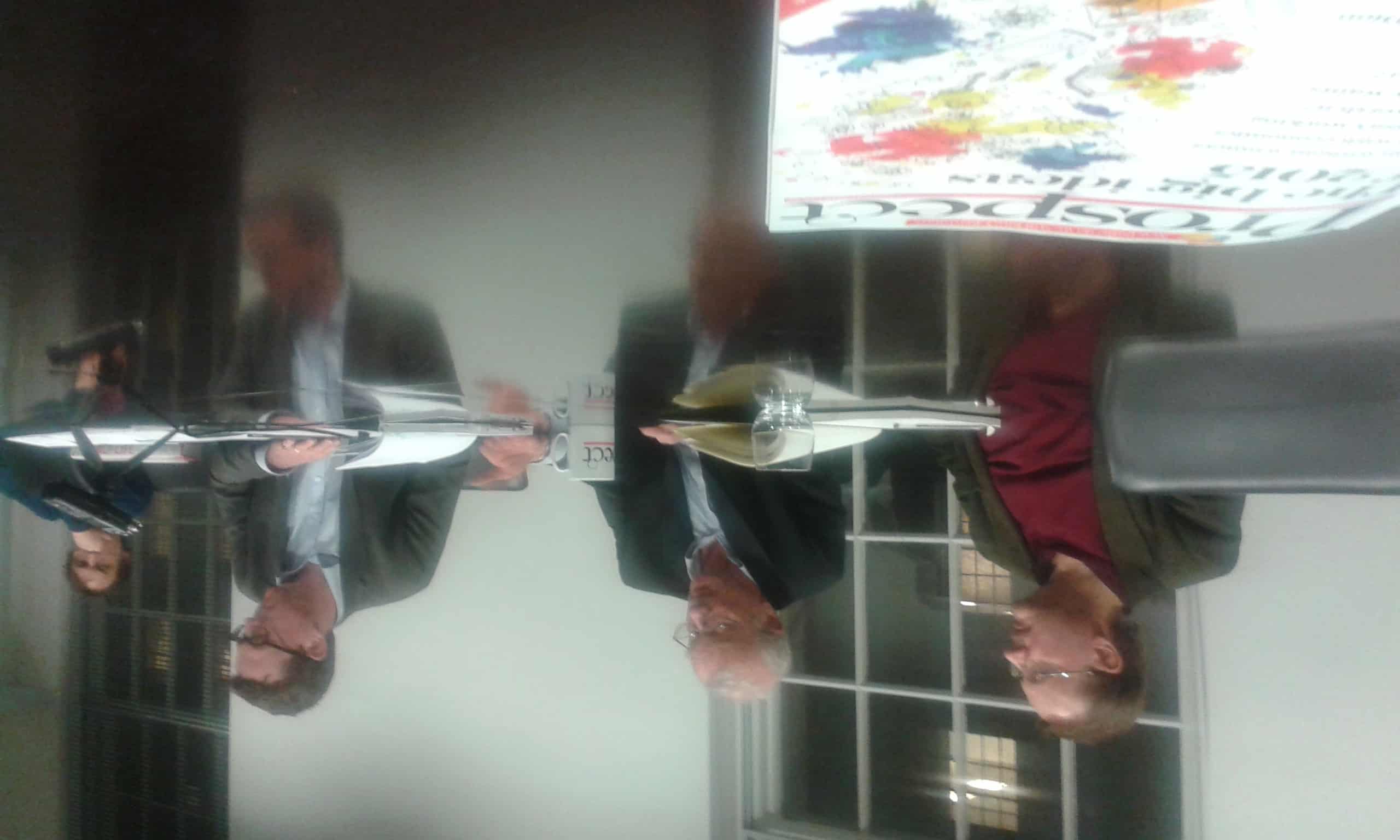
Reflecting on – Frank Close (centre) discusses the life of the Italian physicist Bruno Pontecorvo, who defected to the Soviet Union in 1950.
Like all good publications, Prospect has a strapline about itself – “the leading magazine of ideas”. Physics World is also about ideas, although sadly our magazine, great though it is, doesn’t have adverts for Cartier watches, Embraer executive jets or the Taj Exotica Resort & Spa in the Maldives as Prospect does. Clearly, some people with ideas have more money to spend than others.
I was kindly invited last week by the deputy editor of Prospect, Jay Elwes, to an event he hosted at the magazine’s headquarters in central London. The event featured the University of Oxford physicist Frank Close, who has just published a new book on the life and times of Bruno Pontecorvo. Close was on hand to discuss the key themes of the book, which is entitled Half Life: the Divided Life of Bruno Pontecorvo. Elwes described the attendees as a “small, high-powered group”, including as it did Pauline Neville Jones, the former chair of the UK’s Joint Intelligence Committee and Jonathan Evans, the former director-general of the British security service MI5.
Last week Physics World’s Michael Banks was at the APS March Meeting in San Antonio, and at the top of his to-do list was to belt out a few tunes at the event’s regular physics singalong. You can hear him in harmony with a roomful of physicists in a rendition of “(You Got Me) Lasing” in the video above. It is sung by Walter Smith of Haverford College to the tune of Britney Spears’ “(You Drive Me) Crazy” and his performance drives the dance floor into a frenzy of moshing physicists.
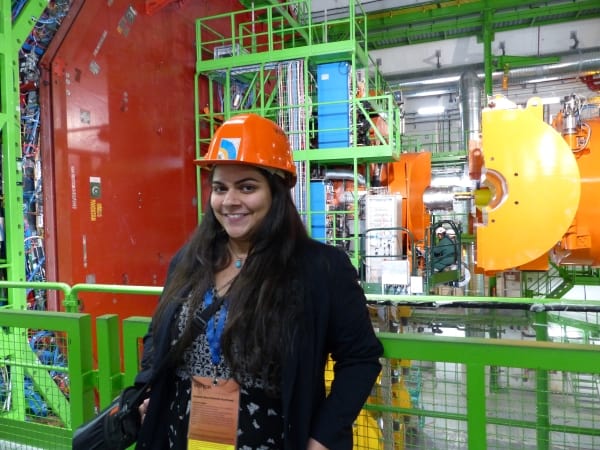
My photo opportunity: this could be the last we will see of the CMS for three years.
By Tushna Commissariat at CERN
Regular readers of Physics World will know that I am currently visiting the CERN particle physics lab in Geneva, ahead of the restart of the Large Hadron Collider (LHC) in the coming weeks. My first stop yesterday afternoon was a press conference in which CERN’s director-general Rolf Heuer and other leading physicists briefed us about “Run 2” and what researchers are hoping to discover. You can read about what they had to say here: “Large Hadron Collider fires up in a bid to overturn the Standard Model“.
I managed to squeeze in a quick last-minute visit to the Compact Muon Solenoid (CMS) detector before it is sealed up tight for the next three years. My host was CMS communications officer Achintya Rao, who took me and a few others deep underground into the bowels of the CMS – and what a sight it was!
After a two-year hiatus, CERN is set to restart the Large Hadron Collider (LHC) and its main experiments ALICE, ATLAS, CMS and LHCb over the next few weeks. After discovering the Higgs boson in 2012, the LHC was shut down in February 2013 for a major upgrade of the accelerator and its experiments. If all goes well, the LHC and its experiments will be fully operational and collecting data in late May or early June 2015.
Upgrade work – including a complete overhaul of the superconducting connections between magnets – was completed last June, and much of the LHC has now been cooled to its operating temperature of 1.9 K. On 7 March, the first proton beams were transported through some sectors of the 27 km-long collider. By May of this year, the revamped LHC is expected to be colliding protons at a collision energy of 13 TeV, heralding the beginning of what CERN has dubbed “Run 2”. While this energy is nearly double that of the previous 8 TeV run, it is below the LHC’s design energy of 14 TeV. The decision to run at 13 TeV was made because of the extra time that is required to “train” the LHC’s superconducting magnets for 14 TeV collisions.
The higher energy should allow CERN physicists to improve their understanding of the newly found Higgs boson, because the number of particles produced in collisions is expected to increase by a factor of 10. Overall, physicists will have to sift through nearly five times more data in Run 2 than were produced in the LHC’s first run. CMS spokesperson Tiziano Camporesi, says that they will not be using “brute force methods” to cope with this deluge of data, but have instead developed more efficient ways of processing it.
Another important goal of Run 2 is the search for evidence of physics beyond that described by the Standard Model of particle physics. In particular, physicists will be looking for evidence of supersymmetry (SUSY) – a theory that predicts that every fundamental particle has a so-far-undiscovered “superpartner” particle whose properties are imperceptibly different. Other signs of new physics that could be detected include evidence for extra dimensions, exotic particles and dark matter.
No theoretical beacon
Looking for these phenomena will be very different from the search for the Standard Model Higgs, says Camporesi. During the hunt for the Higgs, physicists had a “theoretical beacon guiding us” towards the particle, he says. Beyond the Standard Model, he points out that “theory is at a loss as there are too many competing hypotheses, and so in a way the experimentalists are taking over”.
I want to see the first light in the dark universe. If that happens, then nature is kind to me
Rolf Heuer, director-general of CERN
Ironically, the LHC researchers will begin this process by testing extremely precise predictions made by the Standard Model. “We know what should happen at 13 TeV, so we will look everywhere for any deviations from what is predicted,” explains Camporesi. While certain theories such as SUSY are appealing because they do make precise predictions, it is not clear if and when the LHC will be able to confirm or rule out these theories. “The parameter space of SUSY is such that we may find it in the first week [of Run 2] or in 2035,” he explains. Indeed, Camporesi points out that even if finding SUSY lies beyond the abilities of the LHC, the collider may be well equipped to make precise predictions in much the same way as its predecessor at CERN, the Large Electron–Positron Collider, helped physicists to make an accurate prediction of the mass of the top quark.
Both the CMS and ATLAS experiments will be revisiting some of the fluctuations or oddities in the data that both detectors saw in Run 1. While most of these are expected to be statistical fluctuations from the Standard Model, if they grow in statistical significance throughout Run 2 it could indicate the emergence of new physics. Indeed, ATLAS spokesperson David Charlton says that previously dismissed candidates such as B quarks may be the very particles that “break the Standard Model”.
Missing energy
The situation is different for physicists looking for hints of dark matter in Run 2, because if the elusive particles are produced at the LHC they are not expected to be detected directly. Instead, physicists will be looking for missing energy in particle collisions, energy that has been taken away undetected by dark matter. Indeed, the LHC is back as a leading contender in the race between a number of diverse experiments to see further evidence of dark matter.
Maria Chamizo-Llatas, who was the CMS run co-ordinator on Run 1, says that there is plenty of engagement and discussion between CERN physicists and astrophysicists trying to detect dark matter in astronomical sources. She says that this co-operation is fruitful and necessary, and must increase so that the two communities can guide each other in their respective searches. However, she does confess that she would prefer it if CERN were to “see it first”. Indeed, Rolf Heuer, director-general of CERN, said at the CERN press conference held yesterday for the LHC restart, “I want to see the first light in the dark universe. If that happens, then nature is kind to me.”
Droplets can be made to chase each other around a track and even self-assemble into devices, simply by mixing two everyday liquids. This remarkable discovery made by scientists in the US has already been used to create beautiful shapes and patterns, and could also be exploited to create optical components that assemble themselves and even to clean surfaces.
Surfaces such as glass have a strong attraction to water molecules and many other liquids. As a result, a drop of pure water or propylene glycol will normally spread itself out to form a very thin film on an ultraclean glass surface. On everyday surfaces, however, droplets will often remain stuck at a single point, like a raindrop stationary on a sloping car windscreen. This process is called “contact-line pinning”, and is caused by contaminants and surface roughness.
When he was an undergraduate at the University of Wisconsin-Madison, Nate Cira noticed something unexpected: droplets of water and food colouring mixed together not only endured on a surface but began to dance around each other in elaborate patterns. Cira is now working on a PhD at Stanford University, and has teamed up with Manu Prakash and others to study this curious effect.
Tension and evaporation
Prakash’s team realized that the key to understanding the phenomenon is an effect that was first described in 1865 by the Italian physicist Carlo Marangoni. He pointed out that in a liquid with a surface-tension gradient, fluid is drawn towards the region where the surface tension is higher.
The droplets have a little tornado inside, and that flux is what keeps the droplet from spreading
Manu Prakash, Stanford University
It turns out that this “Marangoni effect” is relevant to food colouring/water mixtures because the propylene glycol used in food colouring evaporates more slowly at room temperature than water. This means that as a droplet spreads on a clean surface, more water than propylene glycol evaporates from the growing surface of the droplet. This means that the concentration of water near the surface of the droplet is lower than in its centre. Propylene glycol has a much lower surface tension than water, which means that the edge of the droplet also has a lower surface tension than the centre. Fluid is therefore pulled into the centre of the droplets by the Marangoni effect, preventing the droplet from spreading further. “The droplets have a little tornado inside, and that flux is what keeps the droplet from spreading,” explains Prakash.
On a clean surface the effect overcomes any pinning caused by roughness, and the droplets are able to move freely and respond to tiny forces. This allows the droplets to interact with each other in surprising ways. If two droplets are close together, the water evaporating from the droplets makes the humidity higher in the gap between droplets than elsewhere in the surrounding air. This means that evaporation will be slower from the inward-facing sides of the drops than it is from sides facing away from the gap, the results being a net force drawing the droplets together.
Two droplets with the same composition will coalesce straight away, but when the composition of the droplets differs significantly, something different happens. They are attracted together initially, but at very short distances they begin to exchange molecules across the gap. This makes the humidity in the gap lower than at the outward-facing side of the droplet with a higher water concentration. This drop will move away from the drop containing less water, and the result is that one droplet chases the other until they both have the same water concentration.
Racetracks and lenses
Variations on these effects allow the team to have droplets chasing each other continuously around a track that is simply drawn on a surface using a marker, which creates hydrophobic lines that the droplets cannot cross. The droplets can also be made to sort themselves and even align themselves on parallel plates, to produce a fluidic lens that could focus an image (see video above). The effects could be seen in any droplets containing two fluids in which one had both a higher surface tension and a higher rate of evaporation than the other, on a variety of ultraclean substrates such as aluminium, silicon and flexible indium tin oxide.
While Prakash says that the work was “purely driven by curiosity”, the researchers believe that the system provides a useful test-bed for exploring many-body physics involving interacting particles. “The experiments are very easy to run but the outcomes are really fascinating,” Prakash says. Beyond this, they are exploring potential industrial uses for cleaning solar cells and silicon wafers without the need for harsh chemicals.
Manoj Chaudhury of Lehigh University in Pennsylvania is impressed: “I think it is definitely a very significant work – in fact it’s a beautiful work…This is a new phenomenon they have discovered – one just has to sit down and find applications.”
For most of us, life does not stop after a hard day’s work. Some people like to sit down with a good book. Others might want to study or catch up on some household chores. Often the desire is even simpler: a chance to relax and spend time with friends and family.
Such options are always open to about five and a half billion of us. However, for the remaining one and a half billion – some 20% of the world’s population – the choices are rather more limited. These are the people in the developing world who do not have access to on-grid lighting, a feature of modern life that the rest of us take for granted. “If you’re not connected to an electricity grid,” says Beth Taylor, “then at 6 p.m. when the Sun goes down, either life stops or you’re dependent on a smoky, dangerous kerosene lamp.”
Taylor is one of many individuals – others being charity workers, businesspeople, engineers and indeed former physicists – who want to improve access to alternative off-grid lighting. She is chair of the UK National Committee for the International Year of Light, and has been championing the UK effort in Study After Sunset – an initiative that is intended to bring safe off-grid lighting to school-age children in particular. Although the initiative has only just begun, and the number of affected people is huge, Taylor hopes that by the end of 2015 she and her colleagues will have been able to make a difference. “Our aim is to leave a real legacy at the end of the year,” she says.
The dark age
The disadvantages of kerosene lamps compared with electric lamps are almost too numerous to mention. They are inefficient devices that produce a dim glow, directed upwards rather than sideways or downwards where the light would be most useful. They rely on an expensive fuel. And worse still, the toxic black smoke they emit is deadly. According to the World Health Organization, the burning of kerosene contributes to indoor air pollution and respiratory diseases, which kill more than 1.5 million people every year – more than the total child deaths from HIV/AIDS and malaria combined.
It does not stop there. The United Nations Environment Programme estimates that every kerosene lamp generates on average 200 kg of carbon dioxide per year, contributing significantly to global warming. Kerosene itself is often sold in plastic drinks bottles, which children can easily mistake for actual drinks. But the most obvious problem is kerosene’s flammability: a 2012 analysis of Ugandan households by economist Chishio Furukawa at Brown University in the US, found that kerosene lamps were responsible for 70% of fires, many of them fatal.
In 2010 the then US Secretary of State Hillary Clinton launched the Global Alliance for Clean Cookstoves, which aims to reduce deaths from unsafe indoor stoves by partnering companies with charities, and by jointly talking to governments and investors. Taylor hopes that she can instigate a similar alliance in Study After Sunset, which aims to promote the manufacture and marketing of alternative light sources to kerosene lamps. “The Alliance for Clean Cookstoves has made a big impact, and that is the kind of thing I would really like the Year of Light to help with,” she says.
There have been alternatives to kerosene lamps available for a long time, but in recent years one technology has emerged that has blinded the competition: light-emitting diode (LED) lamps. Patrick Walsh began to think about the potential for such lighting in 2006 while he was a physics student at the University of Illinois at Urbana–Champaign, taking time off with the non-profit organization Engineers Without Borders USA to design and build an electricity generator that ran off vegetable oil for a village in India. While he was living in the village, Walsh quickly realized that the locals’ need for electricity mainly stemmed from lighting. “We had brought a couple of LED lamps with us, but the products were just junk,” he says. “At that time, LEDs were sky-rocketing in terms of efficiency and reliability, and it was clear that they were going to be the future, as a replacement for kerosene. The question was, who could make a product to meet that need?”
Walsh thought he could. He carried out a feasibility analysis to see if an LED lamp could be sufficiently more cost effective than a kerosene lamp to make manufacturing it a worthwhile business. He found out that it could be – but that calculation, he now admits, was the easy part. While completing his degree back in the US, Walsh took on extra studies in mechanical and electrical engineering, and then headed to China where he spent two years developing a cheap-yet-effective solar-powered LED lantern. It was only in 2009 that, together with fellow University of Illinois alumni Anish Thakkar and Mayank Sekhsaria, Walsh launched the first “Sun King”.
To anyone who is familiar with modern electrical technology, the Sun King might not seem like much. It looks like a typical portable spotlight that is mounted on a stand made out of bent wire. But, as Walsh explains, it is the details that matter – one of those details being the charging indicator. According to Walsh, many consumers were positioning their prototype lamp’s solar panel in a way that allowed the lamp to charge, but at only half the normal rate – so people would mount the panel on their wall, instead of on their roof. “A normal charging indicator would show that it’s charging, but it wouldn’t show that it’s not charging very quickly,” he adds. “You can solve that with education, but you can also just try to design the product so that it’s obvious to users. So we have on each [Sun King] a charging rate indicator, which influences the way people use the product.”
A new dawn
Walsh’s attention to detail paid off. By 2013 he was selling one million Sun Kings a year, and he estimates that for the company’s last financial year, 2014, that figure will be nearly double. He believes 15 million people worldwide are currently using the lamps, which now come in several variants – the more expensive models even contain a USB socket for charging mobile phones, for instance.
“I was recently in a market in an out-of-the-way city in Kenya,” he recalls. “There were probably 100 stalls, selling food and sundry items – and about half of the stalls were using Sun Kings. It was such a normal part of life that if you asked them about it they were like, ‘Yeah, it’s just what we use for light.’?”
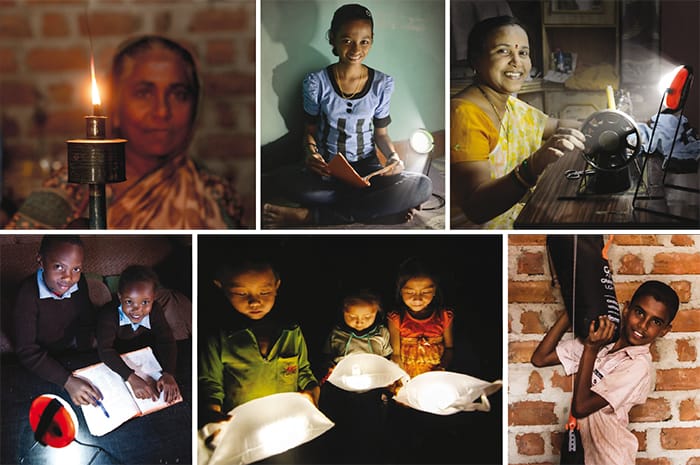
Light relief For homes without electricity, the Study After Sunset initiative aims to replace dangerous and polluting kerosene lamps (Top left) with cheap and safe LED alternatives such as the solar-powered Sun King, the LuminAID designed for disaster areas and the gravity-powered GravityLight. (Courtesy: (top row) GravityLight; Greenlight Planet; (bottom row) Greenlight Planet; LuminAID; GravityLight)
The Sun King is just one of many LED lanterns designed by small companies with the developing world in mind. Most work on the principle of recharging batteries with solar power, although there is at least one interesting exception. In 2013 product designers Martin Riddiford and Jim Reeves in the UK launched GravityLight, an LED lamp that turns gravitational potential energy into electrical energy. Aiming to be as affordable as possible, all you need to do to switch on this lamp is to attach to its hook a filled ballast bag, which gradually lowers, driving a small dynamo to supply electricity to the LEDs. Lifting about 10 kg, which takes only a few seconds, provides 25 minutes of power.
Other lamps have tackled slightly different off-grid lighting problems, such as those that arise in times of natural disasters. That is the focus of LuminAID, an inflatable LED lamp that was invented by product designers Anna Stork and Andrea Sreshta at Columbia University in New York, US, while watching coverage of the aftermath of the 2010 Haiti earthquake. The key strengths of LuminAID are that it is portable and durable. Fifty of the lamps can be folded and packaged into a space that would otherwise contain eight flashlights, and deploying one is as simple as inflating it like a rubber armband. The inflated packaging diffuses the LED’s light, and creates a shockproof, waterproof and buoyant exterior.
One of the turning points for the company came last year when it worked with ShelterBox, a disaster-relief organization based in the UK, to distribute more than 30,000 LuminAID lights to the victims of Typhoon Haiyan, which struck south-east Asia in November 2013. “We heard very positive feedback from the field on this distribution and the impact these lights had,” says Stork. “We have been selling and producing this product for a little over two years and this was the first instance where we had the production capacity and everything up and running to provide lights in a large volume after an emergency.”
Many companies that manufacture off-grid LED lighting have now joined forces under the non-profit Global Off-Grid Lighting Association (GOGLA), which acts as an industry advocate. Koen Peters, the executive director of GOGLA, says that the products currently have a market penetration of 2–5%. “It’s a huge market that we’re only just starting to reach,” he adds.
But it is worth it, he explains – and not just to rid people of the obvious problems of accidental fire and respiratory disease. “Once people have light, they aspire to something beyond it,” he says. “They might spend some of the saved money on a solar electricity generator to charge their phone, rather than go to a village where they will spend half a dollar to charge it. Then they might use the saved money from that to buy a better generator that can charge a radio, or a TV. LED lighting is the first stepping stone to an electric life, to which everyone aspires.”
Illuminating lives
In a sense, says Peters, the challenge for LED lighting is easier than that for clean stoves: whereas in all cultures good light is associated with safety, some cultures tend to cling to their traditional cooking habits of lighting fires indoors. Nonetheless, there are challenges. People need to be more aware of the availability of good LED technology, he says, and of the disadvantages of cheaper competitor products that still beset the marketplace. Moreover, the supply chain is still not as well financed as it could be. “The market is growing 100% a year – but it is being held back by supply, not demand,” he notes.
After all, off-grid lighting is not a purely charitable venture. It is a business and, as it grows, there may well be benefits for everyone. Peters believes that off-grid lighting products could find steadily more customers in developed nations such as the US, which, he says, has less reliable electricity grids than much of Europe. He also believes that developments in off-grid lighting and solar panels could spawn other off-grid technologies, such as flat-screen televisions that can be powered by a solar device via a USB port – particularly once big companies find interest. “Once the Samsungs and Panasonics of this world begin to see the potential in off-grid markets,” he says, “there will be a real benefit for the developed world too. I personally would be interested in a TV that runs off USB.”
The International Year of Light – can you remind me what that’s about?
Well, we’ve had international years of physics (2005), astronomy (2009), chemistry (2012) and crystallography (2014). Now it’s the turn of light. The idea for the International Year of Light and Light-based Technologies (IYL 2015) was originally dreamt up by top brass at the European Physical Society (EPS) and it’s since been endorsed by the UN Educational, Scientific and Cultural Organization (UNESCO) with support from more than 100 partners around the world. The year seeks to show not only why light is scientifically interesting, but also how it is so essential to modern life – be it to light up our streets, in medicine, as part of communications technology, or in art and culture.
So what is this site?
This is the official IYL 2015 blog. It’s run by Jorge Rivero González – a science-communications official from the EPS who is serving as the society’s outreach officer. But he’s not the author of the blog. His job is to commission and collate blog posts from anyone with an interesting tale to tell about light, including scientists, artists and educators.
What kind of topics does it cover?
Given that light means so many things to different people, there’s a huge variety of material. Some posts are about specific scientific advances, such as the benefits of photonics technology or the work of the Diamond synchrotron-radiation facility in the UK. But quite a few examine how light and light technology can improve our daily lives. One post, for example, tackles the Liter of Light project, in which people without access to mains electricity can generate eco-friendly light simply by installing a soda bottled filled with chlorinated water on their roof. There’s also an interesting post about how you can join thousands of people in measuring how bright (or dark) the night sky is where you are on 14 March and 12 September. Plus there are weekly updates about the many hundreds of IYL 2015 events going on around the world.
Can I contribute?
Yes, of course you can. As John Dudley, current EPS president and chair of the IYL 2015 steering committee, pointed out at the year’s opening ceremony at UNESCO headquarters in Paris in January, scientists have to grab this one chance to spread the message about light. So simply e-mail Rivero with any ideas you have. After all, once this year’s over, it’s over. (And who remembers the International Year of the Potato? Exactly.)
I’ve heard Physics World has made a guest appearance.
That’s right. Matin Durrani, the editor of Physics World, wrote about the work of University of Oxford physicist Josh Silver, who has developed a set of spectacles with liquid-filled lenses that can be adjusted by the wearer. The glasses are ideal for the millions of people in developing nations without access to professional eye-care. Physics World first covered Silver’s work in 2010 and we selected that article as one of our 10 best-ever features on light, which make up a free-to-read digital edition of the magazine available online or via our app. We’ve also made a podcast about Silver’s work, available online or via iTunes.