India-based Neutrino Observatory faces a new hurdle

Just months after receiving the green light from the Indian government, the India-based Neutrino Observatory (INO) has been dealt a blow after a court writ was filed against the facility’s new site by local environmentalists and politicians. The writ, filed in a state court and the National Green Tribunal, alleges that the site is in a seismic and highly biodiverse area, and that tunnelling required for the project could affect nearby aquifers.

Originally scheduled to be complete in 2012, the INO finally received the go-ahead in January this year when it received Rs 15bn ($236m) towards construction inside a mountain near Pottipuram – 110 km from the temple town of Madurai in the southern state of Tamil Nadu. Pottipuram was selected after environmentalists protested in 2010 that the original choice – Singara village in Tamil Nadu – was near an elephant corridor. The INO is to be built some 1.3 km beneath the mountain peak, accessible via a 2 km-long tunnel. The lab will comprise three caverns – the largest, being 132 m long, 26 m wide and 30 m high, will house the 50,000 tonne Iron Calorimeter neutrino detector.

Physicists in India say that the absence of such a facility deprives them of hands-on experience in experimental particle physics – a continuing weak point for the community. Scientists are now dismayed by the new writ, which is being heard at the Madurai bench of the High Court. “The site is a wasteland, a barren land,” says INO project director Naba Mondal of the Tata Institute of Fundamental Research in Mumbai. “We were not going to occupy a forest land or one with good vegetation.” That view is backed by a 2011 report from the ministry of environment and forests, which states that the forest clearance would be “notional” as “no forest land is expected to be occupied, since both the tunnels and laboratories are underground”.

“Unnecessary panic”

Mondal adds that the writ is taking valuable energy and time away from getting the project going. “Such petitions create a kind of question mark in the minds of people who do not understand physics, an unnecessary panic that is not warranted,” he says.

Thiagarajan Jayaraman of the Tata Institute of Social Sciences Mumbai disputes the claims in the petition, saying that the tunnelling zone for the observatory is a “charnockite” zone – one that contains feldspar and quartz rocks – with no groundwater. Indeed, a study carried out by the Geological Survey of India (GSI) last year concluded that there was no abnormal threat of groundwater getting into the access tunnel as well as the cavern area. This, combined with the fact that no habitation or water wells exist in the proposed site, suggests, according to the GSI, that there is little danger of the groundwater regime being disturbed by the proposed tunnelling.

However, V T Padmanabhan, chairman of the Society of Science Environment and Ethics – a non-governmental organization – based in Thrissur, Kerala, told physicsworld.com that the project is close to the border with Kerala, which is rich in biodiversity and groundwater sources.


A quantum sense of smell

On the face of it, Johnjoe McFadden and Jim Al-Khalili make unlikely collaborators. McFadden is a molecular geneticist who specializes in the study of tuberculosis. He thinks in pictures and concepts, and his laboratory at the University of Surrey in the UK is full of machines oscillating flasks and people monitoring colonies of bacteria. Al-Khalili, meanwhile, is a theoretical nuclear physicist. He thinks in mathematics and equations, and for the most part his work requires only a whiteboard and a computer.

What unites this apples-and-oranges pair of scientists is their interest in quantum biology – a new and growing field where practitioners seek to understand how quantum-mechanical processes affect biological systems. Biological systems such as the human nose.

In this podcast, you will hear McFadden and Al-Khalili discuss a possible quantum solution to a long-standing biological puzzle: how does the nose “know” the difference between scent molecules? One of the most intriguing theories, developed by the biophysicist Luca Turin, is that it might come down to a process called inelastic quantum tunnelling. As Al-Khalili explains in the podcast, inelastic quantum tunnelling occurs when an electron dumps a bit of excess energy in order to tunnel to an empty energy level in a nearby atom. Turin’s theory is that this type of tunnelling event is what triggers the firing of olfactory neurons in the nose, thus sending a signal to our brains that gives us the “experience” of smelling something. However, such tunnelling can only take place when a scent molecule is present and able to absorb the electron’s excess energy – and that will only happen if one of the chemical bonds in the scent molecule has the right vibrational frequency. So when we slice into an orange and take a sniff, our noses may actually be sensing the vibrations of chemical bonds in a molecule called limonene, which is responsible for most of the orange’s citrusy scent.

The nose isn’t the only biological system with a possible quantum connection, though. If this podcast whets your appetite for some more examples, you might want to check out McFadden and Al-Khalili’s new book Life on the Edge. The book is written for a popular-science audience, and at the end of the podcast, you’ll hear the pair discussing some of the challenges they faced in writing it.

UK unveils national strategy for stimulating growth in quantum technologies

The UK has released a national strategy to stimulate growth in quantum technologies. Announced last month by the Quantum Technologies Strategic Advisory Board (QTSAB), the plan outlines five actions that, if implemented, would allow the UK to capitalize on the country’s R&D in quantum technology. The QTSAB is chaired by David Delpy, a former head of the UK’s Engineering and Physical Sciences Research Council (EPSRC), and has 12 members from UK industry and academia.

The first action, which was already announced late last year, is the establishment of a national network of technology hubs that involve 17 universities and more than 50 industry partners. So far, £120m has been promised to the hubs from the UK government with an additional £60m from industrial partners. The hubs are part of the £270m National Quantum Technology Programme, which is overseen by the QTSAB, that was established in 2013 to encourage the growth of industries based on technologies such as quantum encryption and quantum metrology.

Demonstrating commercial products

The second action involves stimulating the development of commercial applications and markets for quantum technologies. This will be done by providing public funds to build “demonstrators” of potential commercial products, and through the creation of a roadmap for the future development of quantum technologies. “Quantum technologies stand to offer industry truly revolutionary capabilities in key areas,” says Trevor Cross, chief technology officer at e2v, a UK firm that develops RF power, imaging and semiconductor technologies, and is involved with the National Quantum Technology Programme. According to Delpy, a related goal is the development of quantum components that can be integrated into new products by a “competent engineer”, rather than a highly specialized quantum physicist.

Another action identified by the board is the need to grow a workforce that is skilled in the development of quantum technologies. To achieve this goal, £15m of the £270m will be devoted to training the next generation of quantum engineers through the funding of PhD students by ESPRC. “Quantum skills will allow us to bring game-changing advantages to future timing, sensing and navigation capabilities, in a sector that could be worth more than £1bn to the UK economy,” says Greg Clark, who is the UK’s universities, science and cities minister.

The QTSAB also says that the UK quantum-technology community should undertake an “early and broad engagement with UK society” to ensure that the industry grows in a responsible manner with the creation of effective regulatory and standard regimes.

Balancing international collaboration

The fifth and final action is to maximize the benefit to the UK through international collaboration. The QTSAB warns that several other countries have already established centres of excellence for quantum technologies, and that UK researchers and businesses need to strike a balance between international collaboration and supporting the development of home-grown research and development efforts.

Cross told physicsworld.com that e2v is particularly interested in the commercial development of quantum-metrology technologies that fit in with the firm’s expertise in vacuum technology. He says that sensors based on ultracold atoms, for example, could be used in a range of applications from navigation systems that do not rely on GPS satellites to gravimeters used by civil engineers for detecting underground features such a potential sinkholes along a stretch of road. He believes that demonstrators of these products will be available in two to three years, and that specialized products could be on the market in five years.

Bristol marvels at awe-inspiring solar eclipse


The south-west of England is not exactly known for its sunny skies at this time of year, so many of us in Bristol – home to Physics World HQ – had steeled ourselves to miss out on today’s solar eclipse, which coincidently is on the first day of spring. So, we were rather overjoyed when the Sun shone through the sparse cloud cover for nearly an hour of the celestial treat. While today’s eclipse was technically visible to anyone in North Africa and Europe, totality was only visible to those lucky few who happened to be on the Faroe Islands (where it was actually cloudy for most of the time) and in Svalbard in northern Norway. Here in Bristol, the eclipse peaked at about 9.30 a.m., when 87% of the Sun’s light was blocked by the Moon.

(more…)

Partial eclipse, meteorites and northern lights enthral a nation

this photograph of the Sun taken during the eclipse clearly shows a sunspot

Earlier today millions of people in north-western Europe had the opportunity to see a partial eclipse of the Sun – or a total eclipse for the lucky few in northern Norway and the Faroe Islands.  Although it was a bit hazy here in Bristol, we were treated to spectacular views of the Moon covering 87% of the Sun. We have put up a Flickr album of images taken by colleagues here at IOP Publishing including the amazing photo above. It was taken by David Bloomfield and clearly shows a sunspot in the upper-left portion of the Sun.

(more…)

New US philanthropy group picks physicist as boss

Marc Kastner

Marc Kastner, a physicist at the Massachusetts Institute of Technology (MIT), has become the first president of the Science Philanthropy Alliance (SPA) – a new grouping of six organizations aiming to increase private funding for fundamental research in the US. Kastner began the appointment earlier this week, having taken a leave of absence from MIT.

The alliance – composed of the Howard Hughes Medical Institute, the Kavli Foundation, the Gordon and Betty Moore Foundation, the Research Corporation for Science Advancement, the Alfred P Sloan Foundation and the Simons Foundation – formed two years ago. The alliance’s goal is to increase the value of philanthropic funding to fundamental research – currently estimated at about $2bn – by another $1bn within five years.

The SPA was created following concern that funding for basic research has dwindled in the US, with R&D funding at its lowest level – as a percentage of the federal budget – since the 1960s Apollo era. In addition, funding has shifted towards applied research, which Kastner feels neglects the importance of basic science. “We know historically that some of the greatest breakthroughs in technology have come about in that kind of discovery-driven research,” he says, pointing out that the creation of the Global Positioning System in 1995 evolved from fundamental research carried out several decades earlier.

Funding research

Kastner says that although private funding cannot make up the losses suffered from decreased government support, philanthropists are still in a position to make a big difference. To do this, he says that the alliance needs to show potential donors why fundamental research is important, as well as the technologies that can result from such research. “I think people forget about this,” says Kastner. “They see that you can write software and do wonderful things with computers, and they forget that this came out of decades of fundamental research.”

Kastner adds that the alliance will also “put in front of potential philanthropists ideas of how they could really make a difference and the satisfaction they could get out of it”. The alliance supports around 16 universities – and will soon add non-profit research laboratories and more universities – that share the same goals of increasing levels of fundamental research and have created funds to do so.

Key experience

Kastner has experience of securing philanthropic funding, having done so in his role as head of MIT’s physics department, a position he held for nine years. In November 2013 US president Barack Obama nominated him to head the Department of Energy’s Office of Science, which manages much of the nation’s basic-science research, but his appointment stalled in Congress last year with the position yet to be filled.

Have alien civilizations built cosmic accelerators from black holes?

Has an advanced alien civilization built a black-hole-powered particle accelerator to study physics at “Planck-scale” energies? And if such a cosmic collider is lurking in a corner of the universe, could we detect it here on Earth?

Brian Lacki of the Institute for Advanced Studies in Princeton, New Jersey, has done calculations that suggest that if such an accelerator exists, it would produce yotta electron-volt (YeV or 1024 eV) neutrinos that could be detected here on Earth. As a result, Lacki is calling on astronomers involved in the search for extraterrestrial intelligence (SETI) to look for these ultra-high-energy particles. This is supported by SETI expert Paul Davies of Arizona State University, who believes that the search should be expanded beyond the traditional telescope searches.

The nightmare of particle physics is the dream of astronomers searching for extraterrestrials
Brian Lacki, Institute for Advanced Studies

Like humanity, it seems reasonable to assume that an advanced alien civilization would have a keen interest in physics, and would build particle accelerators that reach increasingly higher energies. This energy escalation could be the result of the “nightmare scenario” of particle physics in which there is no new physics at energies between the TeV energies of the Standard Model and the 1028 eV Planck energy (10 XeV) – where the quantum effects of gravity become strong. “The nightmare of particle physics is the dream of astronomers searching for extraterrestrials,” says Lacki.

An important problem facing alien physicists would be that the density of electromagnetic energy needed to reach the Planck scale is so great that the device would be in danger of collapsing into a black hole of its own making. However, Lacki points out that a clever designer could, in principle, get round this problem and “reaching [the] Planck energy is technically allowed, if extremely difficult”.

Not surprisingly, such an accelerator would have to be rather large. Lacki believes that if electric fields are used for acceleration, the device would have to be at least 10 times the radius of the Sun. However, a magnetic synchrotron-type accelerator could be somewhat smaller. As for what materials could be used to make the accelerator, Lacki says that normal materials could not withstand the strong electromagnetic fields. Indeed, one of the few places where such a high energy density could exist is in the vicinity of a black hole, which he argues could be harnessed to create a Planck-scale accelerator.

“Vast amounts of pollution”

Colliding particles at tens of XeVs is only half the battle, however. Lacki calculates that the vast majority of collisions in such a cosmic collider would be of no interest to alien researchers. To get useful information about Planck-scale physics, he reckons that the total collision rate in the accelerator would have to be about 1024 times that of the Large Hadron Collider. “As such, accelerators built to detect Planck events are extremely wasteful and produce vast amounts of ‘pollution’,” explains Lacki.

While much of this pollution would be extremely high-energy particles, that in principle could reach Earth, it is unclear whether they could escape the intense electromagnetic fields within the collider. Furthermore, like colliders here on Earth, the builders of a cosmic machine would probably try to shield the surrounding region from damaging radiation. Indeed, Lacki’s analysis suggests that neutrinos are the only particles that are likely to reach Earth.

These neutrinos would have energies that are a billion or more times greater than the highest energy neutrinos ever detected here on Earth. However, unlike their lower-energy counterparts, these accelerator neutrinos would be much easier to detect because they interact much more strongly with matter. Lacki calculates that the majority of such neutrinos passing through the Earth’s oceans will deposit their energy in the form of a shower of secondary particles. While the oceans are far too murky for physicists to detect the light given off by the showers, Lacki reckons that the sound of a shower could be detected by a network of hydrophones in the water. However, because these neutrinos are expected to be extremely rare, he calculates that about 100,000 hydrophones would be needed to have a chance of detecting the neutrinos.

Whole of the Moon

Another possibility, albeit less sensitive, is to use the Moon as a neutrino detector. Indeed, the NuMoon experiment is currently using a ground-based radio telescope to try to detect showers created when 1020 eV neutrinos smash into the lunar surface.

While the detection of YeV neutrinos would not be proof that an alien accelerator exists – some theories suggest that they could be produced naturally by the decay of a cosmic strings – Lacki says that spotting such high-energy particles would be an important breakthrough in physics.

While Davies is keen to expand SETI, he does identify one important drawback of looking for cosmic colliders. “My main problem is that once the [alien] experiments are done, there would be no need to keep the thing running, so unless there are mega-machines like this popping up all over the place, there would be only transient pulses,” he told physicsworld.com.

Davies believes that it is very difficult for humans today to understand why an advanced civilization would want to build a Planck-scale collider. “Why do it? Perhaps to create a baby universe or some other exotic space–time sculpture,” he speculates. “Why do that? Perhaps because this hypothetical civilization feels it faces a threat of cosmic dimensions. What might that threat be? I have no idea! However, a civilization that knows a million times more than humanity might perceive all sorts of threats of which we are blissfully unaware.”

Lacki’s calculations are described in a preprint on arXiv.

A multiverse play divides opinion

The stage lights rise. A man and woman meet in a cute way – “Do you know why it’s impossible to lick the tips of your elbows?” she asks – they chat momentarily, and separate. The lights blink off and on; the pair resume their previous positions and meet the same way, but with another result. The lights blink again: same people, another permutation. Perturbations continue of the same basic situation, caused by slightly different gestures, phrasings and reactions.

The play is Constellations by Nick Payne, and it first opened in 2012 to an enthusiastic reception in a 90-seat space at London’s Royal Court Theatre. It is now on Broadway at the 622-seat Samuel J Friedman Theatre, where it is scheduled to run through to at least 15 March. It also has a UK tour coming soon. The man is Roland, the woman is Marianne, and they are standing on a platform of dark hexagonal tiles, beneath and surrounded by huge white (sometimes blue or purple) balloons. They could be ordinary people in a party room, huge people in space surrounded by stars, or tiny people surrounded by atoms. The staging changes slightly as the actors proceed through turning points in a relationship: meeting, seduction, marriage, betrayal, impending death. The choice of scenes, and their variations, are not random but diverge in key ways: the pair sleeps together, they don’t; he’s unfaithful, then she is; the tumour is benign, the tumour has metastasized and affects her speech, and so forth.

Variations on a scene is an age-old theatrical device. In Constellations it appears to acquire new meaning due to the characters’ professions: Roland is a bee-keeper, Marianne a quantum cosmologist. Through Marianne’s explanations of her work the author seems to prime us to view the play as a kind of “multiverse”, containing slightly branching paths from the same starting point.

Does it work? It depends. I saw the Broadway incarnation from the last row of the balcony. A friend of mine, a successful playwright, saw it from the third row. We had different reactions, and the two taken together answer that question.

Replaying a scene with variations is a common theatrical idea. It was used, for instance, in Sure Thing (1993) a 10-minute play by David Ives in which a couple on a blind date keep restarting their conversation until they romantically connect, and in Alan Ayckbourn’s series of plays Intimate Exchanges (1983). The film Sliding Doors (1998) depicts two different paths that a character’s life may take as the outcomes of one turning point, as does the musical If/Then (2014). To me, up in the balcony, much of Constellations seemed like a repeat of this familiar theatrical device; it was like watching an acting exercise: “Let’s try it this way!” Since the branching paths in this 70-minute play only last a minute or so, just as you begin to take any particular vignette seriously, or see a character begin to crystallize, the sequence ends and another begins. You care less about any one character because you are asked to care about so many fleeting ones. I did get caught up, however, by Marianne’s impending death: all paths come to an end, her mortality reinforced by the falling of the balloons/stars/atoms in the final variations.

On the other hand, my friend in the third row was enthusiastic. “Theatrical fireworks!” he said. “It’s not like Sure Thing. This play takes us to deeper emotions and darker places.” From close up, he appreciated how expertly the actors – Jake Gyllenhaal and Ruth Wilson – made full and instant commitment to each variation, which is not easy to do without tripping into caricature. “Maybe it’s not a great addition to dramatic literature, but it offers the opportunity for great performances – which is a different thing.” My friend also thought the play was successful in forging characters out of multiple short variations. “This play shows us the core of a character – how a single person behaves in different ways in response to different stimuli. The different variations allow you to see the same character logic.”

My friend and I also differed on the use of scientific language. Using the atomic world as a metaphor for human interactions is a familiar literary device, reaching all the way back to Lucretius’ De Rerum Natura in the 1st century BC and continuing in the present day (Björk’s latest album, released in January, includes a song called “Atom dance”). Such atomic language is not necessarily insightful: while it can be used to develop genuine insights, as in some John Updike novels and Michael Frayn’s Copenhagen, it can also become a mere gimmick. I found Marianne’s lines about multiverses, quantum theory, relativity and string theory distracting; I heard them as the author trying to give us the key to the play and the human interactions in it, and it didn’t open any doors. Roland’s discourses on beekeeping – an activity that requires an immense amount of practical knowledge in observing nature while controlling it – offer a better metaphorical grip on the human condition. Yet their characters’ personas imply that Marianne’s cosmological language is more profound. My fears seemed to be realized when, after Marianne outlines the difference between relativity and quantum mechanics, Roland gazes her and says, “This is really sexy, by the way!” My friend, on the other hand, wasn’t bothered by the quantum language, hearing it as Marianne talking to Roland, whose interest she wants to encourage and who she knows won’t get it, rather than to the audience.

Constellations‘ cast has star power; the audience applauds Gyllenhaal and Wilson the minute they walk onstage before they’ve even said anything, and waits for them in long lines at the stage door exit afterwards. Is it a successful play? That depends on who’s performing it, how close you sit, and how forgiving you are of physics terms used outside the laboratory.

  • Samuel J Friedman Theatre, New York City, US

Diamond bull’s-eye collects polarized photons at a rapid rate

A new optical grating shaped like a “bull’s-eye” that is extremely efficient at collecting photons from diamond nitrogen vacancy (NV) centres has been built by physicists in the US. The device can collect nearly three million photons per second from a single NV, which is the highest value reported to date. The grating could find use in a number of emerging technologies including nanoscale sensors, single-photon sources and quantum memories.

Atomic impurities, or defects, in natural diamond lead to the pink, blue and yellow colours seen in some diamonds. One such defect, the nitrogen vacancy (NV) centre, occurs when two neighbouring carbon atoms in diamond are replaced by a nitrogen atom and an empty lattice site.

Entangled with photons

For anyone trying to build a quantum computer, NVs are useful because they have an electronic spin that is extremely well isolated from the surrounding lattice – so if an NV is placed in a certain spin state, then it will remain in that state for a long time, even at room temperature. What is more, an NV’s electron spin can be entangled with the polarization state of a photon, and such spin–photon entanglement might help in the development of quantum networks and distributed quantum computers of the future.

NVs in nanoscale diamonds could also be used as biological probes and sensors because they are non-toxic, stable and can easily be inserted into living cells. They are also capable of detecting the very weak magnetic fields that come from surrounding electronic or nuclear spins. This means that they can be used as highly sensitive magnetic-resonance probes capable of monitoring local spin changes in a target material across distances of just tens of nanometres.

Efficiently collecting NV light

When illuminated with green laser light, an NV centre emits red light by fluorescence. The intensity of this light depends on the orientation of the NV’s electron spin. A major challenge here is to efficiently detect this light; and the more light that can be detected, the better the NV application, says Dirk Englund of the Massachusetts Institute of Technology (MIT). Collecting this light has proved to be difficult until now because of the high refractive index of diamond, which traps light by total internal reflection. Previous attempts to overcome this problem have included coupling NVs to optical cavities to enhance the light emitted from the defects, and building solid immersion lenses around NVs.

Now, Englund and colleagues at MIT, together with researchers at Columbia University in New York and Element Six in California, say that by etching a circular, “bull’s-eye”-shaped grating in the diamond membrane containing the NV, they can collect nearly three million photons per second from the structure. This is the highest value reported to date from a single NV.

The bull’s-eye grating consists of concentric slits etched into a diamond membrane containing the NV. The diamond membrane has a thickness that is about half a wavelength of visible light. The grating is centred on the NV and its period satisfies the so-called second-order Bragg condition. This helps to scatter light out of the membrane, say MIT team members Luozhou Li and Ed Chen. “The scattered light from each grating interferes constructively out of the plane of the membrane and into the far field – and it is this phenomenon that allows us to collect significantly more photons,” explain the researchers.

Enduring spins

Moreover, the researchers say that they have also measured a spin-coherence time for the NV (the time that it maintains its spin state) of around 1.7 ms. This value not only compares well with the highest reported spin-coherence times measured in previous NVs at room temperature, but also proves that the bull’s-eye fabrication process does not degrade the spin properties of an NV.

“The efficiency with which we can collect photons from an NV determines how fast we can measure the NV’s spin state,” Englund explains. “The more fluorescence we detect, the higher the signal. Detecting more photons is crucially important for many NV technologies, such as sensing, communication and computing, and with our circular grating, we are able to collect about an order of magnitude more fluorescence than is possible from an NV in unpatterned diamond.”

“Nice advance”

Ronald Walsworth of Harvard University, who was not involved in the work, says that “using a bull’s-eye diamond grating to enhance the photon-collection efficiency of single NV centres in diamond, while maintaining good NV spin-coherence time, is a nice advance that may aid diamond-based sensing and metrology”.

Englund and colleagues believe that such efficient photon collection should allow for a whole new range of hitherto impossible experiments, such as “non-demolition” measurements of NV spins. “Here, you could measure an NV spin and then ‘act back’ on this spin state,” explains Englund. “We are also using our technique to make medium-scale quantum registers that would contain tens of quantum bits (or qubits) made from NVs – for quantum-sensing applications.”

The bull’s-eye device is described in Nano Letters.

Guide to the solar eclipse

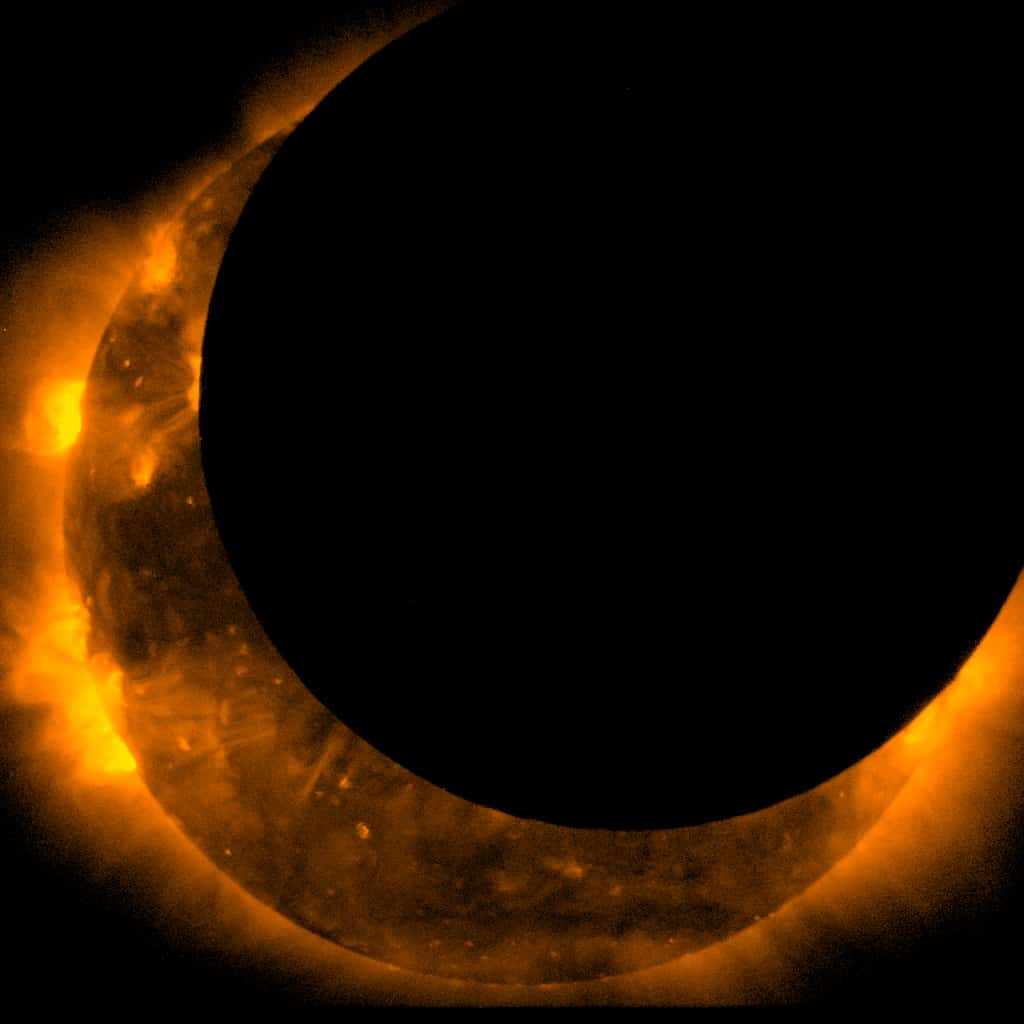
Solar eclipse captured by Hinode craft

On Friday, our old friend the Moon will swing by to remind us that she’s not just there to reflect the Sun’s light; she can sometimes block it out too. A total solar eclipse will be visible to those lucky few people living in the Faroe Islands or the Norwegian archipelago of Svalbard. Many others across Europe, North Africa and Russia will be treated to the (almost as good) spectacle of a partial solar eclipse.

(more…)

Copyright © 2026 by IOP Publishing Ltd and individual contributors