Here’s a Tuesday quiz for you. If you disagree with a colleague about something scientific, what should you do? Your choices are:
(a) Nothing. This is science, and the truth will win out no matter what I do;
(b) Take them aside and explain, privately, why you think they are wrong. Then, if they still disagree with you, get even by writing snarky anonymous reviews of their papers;
(c) Organize a panel “discussion” and tear them to shreds in front of all your colleagues;
(d) Take your case to the public by writing a popular-science book explaining the superiority of your own theory.
Okay, this is a trick question: I’m not sure any of those options is really a good idea (although I’m sure they’ve all been tried). I’d like to focus on the last one, though, because it was the subject of an interesting talk at the Science in Public conference, held last week in Physics World’s home city of Bristol.
When Amanda Gefter asked the cosmologist Kip Thorne to explain John Wheeler’s ideas on the universe and physical reality, Thorne was dismissive. “I think we [physicists] are less in a position to probe those issues than philosophers are…I steer clear of asking what is ultimate reality.” But Gefter was not to be dissuaded. Her quest to understand what physics has to say about that “ultimate reality” is the subject of her book Trespassing on Einstein’s Lawn and, on balance, I think she makes a good job of it. I certainly felt that I learned something, even though the book, like the quest itself, has some ups and downs along the way.
Gefter’s story begins when she is in high school. Disillusioned by her science classes, she is encouraged by her father to tackle the more “philosophical” ideas within physics – ideas about cosmology, gravity and quantum mechanics, as well as classic questions such as “What is nothing?” and “Where did the universe come from?” Gradually, Gefter and her father begin delving into physics together, seeking the answers to the universe more or less as a hobby. And while she goes on to study philosophy and creative writing (rather than science) at university, she later becomes a science writer as a pretext for continuing her quest – a quest in which she slowly realizes that the universe is far less “real” than we could ever imagine.
Initially, Gefter’s narrative reads like a very ordinary coming-of-age story, and aspects of it feel rather forced and unremarkable. She does, however, flag up some interesting issues. One is the importance of showing children the relevance of science at school, beyond simply abstract facts. Children need to understand how what they are learning fits into the real world, particularly the world with which they are familiar. Without this, the facts have no meaning. Another is “impostor syndrome”, which leads talented, intelligent people to believe they are not good enough and will soon be “found out” by colleagues or superiors. Gefter saw her transition from student to writer as extraordinary because she felt that she was just pretending. In truth, I think many people – especially, but not exclusively, women – experience this. Awed by our colleagues’ intelligence or performance, we end up always feeling like we are winging it.
Once Gefter embraces her own status as a bona fide science writer, her story somehow becomes more compelling. The concept of her journey resonated with me, as I have recently undertaken a similar one myself (although in my case, I have been learning about the Northern Lights rather than cosmology). Finding things out on this scale can be a transformational experience and is as much about the people as the physics, so it was good to hear about the physicists Gefter met along the way. I enjoyed the stories about Wheeler, the Los Alamos physicists and Einstein peering through Hubble’s telescope; indeed, there could have been more.
The narrative ties back nicely to discussions between Gefter and her father many years previously, showing not only how the small seed he planted had grown and blossomed, but also how his early ideas related to what physicists think about reality.
One of the first things that Gefter learns during her quest is that scientific theories aren’t about “things” at all. Instead, they are about mathematical structure. Our interpretations of theories – such as “gravity is a force that masses exert on one another from a distance” (Newton), or “gravity is the local curvature of space–time” (Einstein) – are just different stories we contrive to make sense of the maths. This helps to explain why Newtonian gravity looks the same as Einstein’s gravity in the low-energy limit. Newton was not wrong; he was simply looking at a small corner of the picture. The overall structure is the same.
Reading this reminded me of an anecdote I heard from another physicist at a conference. He had been visiting the cathedral in Seville, Spain, when he noticed that the floor he was standing on was laid out in a beautiful star pattern. He took a picture of it. Then he lifted the focus of his camera and took a picture of the rest of the floor. At this point he realized that the floor was not made of stars at all, but was a black-and-white pattern of squares and triangles. Only when viewed in isolation did small patches look like stars. The global view changed the picture.
This global view may help us reconcile classical physics with modern physics, but when it comes to the universe, there is no “God’s-eye” view. There are just different reference frames, and this problem lies at the heart of the incompatibility between general relativity and quantum mechanics. In relativity, observers are inside the system (space–time), whereas in quantum mechanics they are outside making the measurements. But to view the universe from outside is impossible.
While studying in London, Gefter realizes that what is real is what survives the translation between reference frames – in other words, what is invariant. She draws an analogy with languages. “Love” and “amor”, she points out, are not totally different things simply because they look different. The terms refer to the same thing. The underlying structure (the concept) is what is real, not the word itself (the description). Similarly, anything real must survive the translation between observers’ reference frames. Armed with this knowledge, Gefter and her father go on a search for invariance.
The middle of the book becomes somewhat convoluted, presenting multiple views from different physicists and using extensive dialogue. This confusion is compounded by the use of jargon and acronyms, which often make it difficult to grasp the essence of an exchange. Fortunately there are helpful summaries in the last chapters. Gefter also has some nice, almost poetic, ways of expressing things, as in phrases such as “the gravitational lifeblood of stars and galaxies” and she gives good, simple analogies for difficult concepts. She should, however, be careful of the lazy use of cliché in descriptions, and her style was often too colloquial for my taste. One can, I think, have an authentic “voice” without resorting to expletives.
During her quest, Gefter learns that many concepts we regard as invariant are, in truth, observer-dependent. Acknowledging this is difficult because it requires us to drop long-held assumptions, equivalent to recognizing the speed of light as finite. Even Einstein, who made the mental leap to formulate relativity, had trouble accepting quantum mechanics. The concepts are tricky and counter-intuitive, but ultimately Gefter’s book is an enlightening journey through the extremes of modern physics to the edge of the universe.
Scientists at IBM Research have made the first working prototype computer chips with circuit features as small as 7 nm. The milestone was achieved in collaboration with GlobalFoundries, Samsung and researchers at the SUNY Polytechnic Institute Colleges of Nanoscale Science and Engineering. Key features of the chips were made using silicon-germanium, rather than conventional silicon. The new technology could soon make it possible to pack 20 billion transistors onto a single chip – twice as many as is possible today.
In 1965 Gordon Moore, the co-founder of Intel, predicted that the number of transistors per unit area on integrated circuits would double every year, and this concept came to be known as Moore’s Law. The silicon industry has succeeded in following this law until quite recently, and this has given us myriad low-cost consumer electronics. Today, the smallest features on commercial chips measure 14 nm across, and some progress has been made on 10 nm and 7 nm devices. However, using conventional silicon-processing techniques to create working chips with features smaller than 10 nm requires several significant technological challenges to be overcome.
Bypassing convention
Now, the IBM-led collaboration has eschewed conventional semiconductor-manufacturing processes to create the first prototype 7 nm chip. The transistors used in the device are called “FinFETs” – complex devices that incorporate two gates. The transistor channels of the device – the parts that conduct electricity – are made from silicon-germanium (SiGe), rather than pure silicon. SiGe has higher electron mobility than pure silicon, which means that it is better suited for making tiny transistors.
The researchers have also managed to make use of very short wavelengths of ultraviolet light – extreme ultraviolet light (EUV) – to improve the lithography process for etching their tiny devices. EUV lithography can create much thinner lines than conventional techniques that rely on longer-wavelength light, although the etching rate is slower for EUV.
IBM also says that it used an “innovative” process to place the transistors closer together on a chip. Indeed, the devices boast a 30 nm pitch, which is the distance between the front edge of one transistor and the front edge of it neighbour.
Extending mainstream technologies
Mukesh Khare, vice president for semiconductor research at IBM, says that his company “has committed to spending $3bn on chip research and development aimed at further extending today’s mainstream semiconductor technologies”. He adds that IBM is also looking into materials other than silicon as the primary material in semiconductors and the use of transistors for processing data.
Stephen Chou, head of the NanoStructure Laboratory at Princeton University who was not involved in this work, says the 7 nm technology is a “significant step” for the integrated-circuit industry – in terms of both scaling and manufacturing. “Although my group fabricated the world’s smallest working individual silicon [transistors] (as small as 7 nm – in both length and width) in 1996, making [transistors] with similar dimensions on the industrial scale is extremely challenging and requires many innovations and billions of dollars of investment,” he says.
At the end of next week millions of children in England and Wales will start their summer holidays and many parents will now be scrambling to find activities to keep their little dears occupied. Physics World can recommend a virtual trip to ILC Science Kids Club courtesy of the Tokyo Cable Network and Japan’s Advanced Accelerator Association. ILC stands for International Linear Collider, which is one of several proposed to take over when the Large Hadron Collider is eventually retired. In the first video of the series, a boy called Haru learns why scientists are keen on building accelerators from his Uncle Tomo. The video is in Japanese with English subtitles, so as well as learning about particle physics, your little tykes might even pick up a little Japanese.
Physicists in the US are helping to develop non-electric incubating blankets, in a bid to improve the survival of premature babies and infants in developing countries. Together with start-up company Warmilu, the physicists from Kettering University in Michigan are working on blankets that are a more sophisticated version of the warming packs that can be slipped into shoes and gloves during winter. A clinical trial of a prototype of the blanket is being conducted in Bangalore, India.
According to the World Health Organisation (WHO), hypothermia at birth is one of the most crucial factors in the mortality of newborn infants of all birth weights and ages. Unlike adults, infants and young children cannot shiver to maintain body heat; they instead rely on “non-shivering thermogenesis”, which occurs in brown fat tissue. This makes hypothermia even more of a threat to babies born with a low birth weight or pre-term infants, who have less brown fat.
Early killer
This threat is greatest in developing countries and areas with limited resources. Indeed, a report from the WHO Reproductive Health Library estimates that 99% of the 4 million babies that die each year worldwide during the neonatal period (aged 0–27 days) live in areas where hypothermia is a leading cause of mortality. Carers in such areas are currently told to use everything from plastic wrap or bags to skin-to-skin contact to prevent hypothermia from setting in. However, these methods are not guaranteed. Also, using body heat to keep the infants warm has its own complications – the mother or carer must remain with the child at all times and often cannot rest through the night. According to UNICEF, preventing and managing hypothermia can help reduce neonatal mortality or morbidity by 18–42%.
Futuristic warming tech
To address these problems, entrepreneur Grace Hsia was keen to come up with a way of keeping infants warm and at a steady temperature through the night (or for at least five hours) without using electricity. To do this she set up Warmilu and is the startup’s chief executive. Inspired by warming packs, the company has developed what it describes as “an advanced phase-change materials-warming technology platform”. The packs start as a liquid, which crystallizes to a solid in seconds when the user presses a metal disc at the corner of the pack. As of now, the pack can keep warm for about five hours. It can be reused simply by boiling it for 15 minutes or heating it in a microwave for 6–12 minutes. While this is already a promising technology, Warmilu aims to make its packs last for up to eight hours, so users can keep warm through the night. The company also wants to achieve the perfect temperature to keep a newborn warm, without the pack ever getting too hot.
To help achieve this, Warmilu has partnered with physicists Uma Ramabadran and Gillian Ryan at Kettering University in Flint, Michigan. “We are trying to see how to extend the time,” says Ramabadran, adding that they “want to see if the caregiver can get a break throughout the night for at least eight hours”.
The warming pack itself is a polymer pouch that contains sodium acetate trihydrate. “You have this super-saturated liquid which is liquid below its freezing point,” says Ryan. “You cool it down and, as it turns into a crystal, it solidifies and releases heat. We want to slow down the process in which this pack forms into a crystal. You don’t want it to spontaneously form at once and have a flash in the pan. You want it to gradually crystallize so it releases heat over a longer period of time.”
Warmer for longer
The duo is exploring how it may be possible to slow down the liquid-to-solid phase transition, by studying the crystal growth pattern of the liquid. “The material grows radially out in a shallow dish, so we can film the growth of the crystals to see how we can block that and make it slower,” says Ramabadran, who explains that studying crystal growth can be a complicated business. As the material is polymorphic, it does not crystallize the same way every time – the process depends on external factors such as temperature and humidity.
To carefully access the crystal growth, Ramabadran and Ryan are using X-ray diffraction to study the crystal’s atomic structure and X-ray photoelectron spectroscopy to determine the exact chemical composition of the crystallized structure that forms. They hope to modify the structure by inserting nanoparticles into the fluid, thereby extending the warming life of the packs.
Warmilu is currently testing its incubated blankets in villages in India – a country that has one of the highest infant mortality rates in the world, partly due to the lack of electricity in rural villages. The company has sold more than 200 of its warming packs – which can be used for other purposes such as to ease joint pain – to consumers worldwide since 2013. The company charges consumers in the US nearly twice as much as those in poorer countries, to subsidize the costs.
It is the height of the First World War and, in the trenches, the German physicist Heinrich Barkhausen is eavesdropping on Allied telephone conversations. Using vacuum tube amplifiers and a couple of widely spaced metal prongs, the German forces are picking up on leakage from the enemy’s field telephone lines. Every now and then, though, the tapping effort is rendered fruitless – the Allied communications are drowned out by some very strange sounds.
The soldiers dubbed these nuisance noises “whistlers” because they sound similar to shells flying overhead. (To a modern ear, however, their descending “pee-yow” tone is more like a sound effect from an old-school space-themed arcade game.) Barkhausen was intrigued by the whistling noises and initially suspected a fault in the amplifying equipment. Once back in his laboratory in Dresden after the war, however, he was unable to reproduce the effect artificially – leading Barkhausen to conclude that whistlers are caused by an unidentified atmospheric phenomenon.
As it turned out, Barkhausen’s hypothesis was correct – although it would not be until the 1950s that the true source of whistler waves was identified. Whistlers are produced, bizarrely, from bolts of lightning thousands of kilometres away. That might seem very odd, as we usually associate lightning with the bright flashes of visible light that it produces. But lightning also creates very-low-frequency radio waves in the same way that an antenna emits radio waves: a moving charge creates an oscillating magnetic and hence electromagnetic field – an electromagnetic (radio) wave.
Hundreds of these bursts of radio waves – known as atmospherics, or “sferics” for short – are emitted every second from lightning strikes across the globe. Occurring at frequencies in the range of human hearing, the sferics can be converted directly into audible waves that sound like twigs snapping underfoot. Usually, sferics only travel a few thousand kilometres from their source, bouncing back and forth between the planet’s surface and the ionosphere (the ionized part of the upper atmosphere, which begins at an altitude of 60 km) before eventually attenuating.
In some cases, however, part of the energy penetrates the ionosphere and makes it into the plasmasphere. Also known as the inner magnetosphere, this doughnut-shaped region of space around the Earth consists of cool plasma and spans from an altitude of about 1000 km to as high as 32,000 km at the equator. In this region, the sferics can be guided along ducts – elongated channels that have either an irregularly low or high plasma density. Aligned with the north–south geomagnetic field, the ducts run from their starting location to the corresponding magnetic conjugate point in the opposite hemisphere. Unlike “antipodes” – places such as Christchurch in New Zealand and A Coruña in Spain that are directly opposite each other across the Earth – magnetic conjugate points are the two places where the same, arcing geomagnetic field line meets the Earth’s surface. Once the sferics reach this conjugate point at the other end of the duct, the small incident angle between the duct and the ionosphere may allow a small portion of the wave energy to pass back through the ionosphere and be received on the ground.
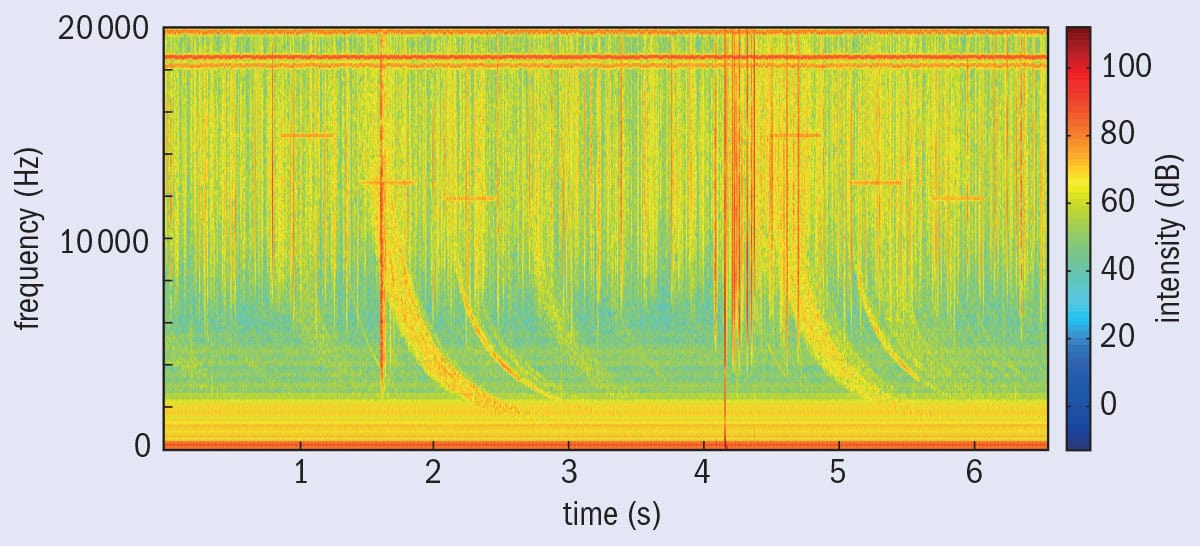
1 The sound of lightning… The vertical lines with curved bottoms in this spectrogram show the characteristic signature of whistler waves – radio waves produced by lightning that are dispersed when they travel around the world through ducts in the plasmasphere. These waves were recorded in Dunedin in New Zealand and are the result of volcanic lightning during the 12 July 2008 eruption of Mount Okmok in the Aleutian Islands. Intensity levels are uncalibrated and should only be taken as relative. (Courtesy: Claire Antel et al.)
Passing through the magnetosphere is what turns sferics into whistler waves, with their eerie descending quality. “What gives them their unique tone is the dispersion they undergo as they travel through the magnetospheric plasma,” explains Claire Antel, a physicist from the University of Cape Town in South Africa, who has studied whistlers since 2012 and analysed whistlers in Antarctica as part of the South African National Antarctic Expedition. “High frequencies travel faster than the low, making them last a second or two.”
Location, location, location
Whistler waves might at first seem an interesting curiosity but one that has little, if any, wider relevance. In fact, the passage of whistlers between the hemispheres provides a rare opportunity to investigate the plasmasphere without needing to launch expensive space probes to do the job. By gaining a better understanding of this near-Earth region of space, we should be able to get better at anticipating the impact of space weather events. Although space weather isn’t the biggest threat to our planet, it has the potential – through local increases in radiation, high-energy particles or magnetic disturbances – to endanger astronauts and disrupt both orbiting and ground-based electronic systems. In extreme cases, geomagnetic currents induced by space weather have even been known to cause large-scale electrical blackouts.
Researchers who use whistlers to improve their understanding of the plasmasphere need to feed a few factors into their models. First they must measure the whistler’s frequency as a function of time, with the resulting spectrogram (figure 1) revealing the dispersion each wave has undergone on its journey between the hemispheres. What the researchers would then like to do is to use the extent of the dispersion to assess the magnetosphere’s electron density profile along the geomagnetic field line that the wave has just traversed, and elucidate the structure of the plasmasphere.
But here’s the problem: anyone wanting to do this calculation also has to know exactly where each whistler enters and leaves the plasmaspheric duct. Traditionally, it was assumed that whistler waves would enter ducts near to the lightning strikes that generated them. In other words, a whistler received in one hemisphere must have originated close to the corresponding conjugate point in the other – making the analysis relatively straightforward. But thanks to recent improvements in the automated analysis of whistler spectrograms, we now have a lot more data. These have shown, in contrast, that before whistlers enter a duct they can migrate significant distances sub-ionospherically, sometimes as far as 2500 km.
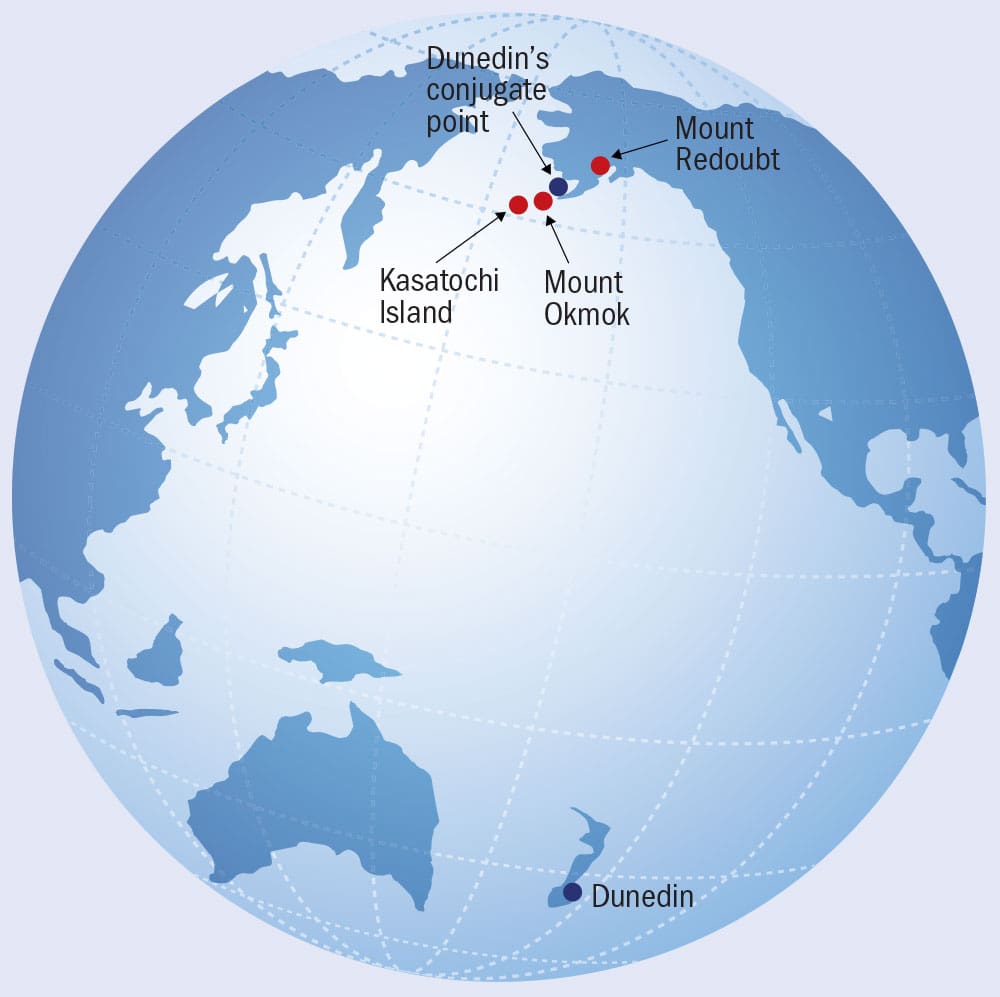
2 …heard from more than 11 000 km Dunedin in New Zealand’s South Island, its magnetic conjugate point in the Aleutian Islands and three volcanoes close to this point. (Courtesy: IOP Publishing)
Whistlers recorded from Hungary’s Tihany Peninsula in 2009, for example, show correlations with both lightning recorded near the region’s conjugate point – off the South African coast – as well as strikes from as far afield as South America and south-east Asia. Similarly, whistlers observed on the Antarctic Peninsula appear to come from as diverse regions as Central America, Africa and Asia in addition to the conjugate point in the Gulf Stream. So there can in fact be a huge error in the entry-point variables that have so far been used in whistler-based models of the plasmasphere.
Specific in the Pacific
It is usually impossible to pinpoint the location of a lightning bolt that caused a particular whistler wave – because the original sferic can travel thousands of kilometres before it enters a duct. However, the location of a certain recording station in Dunedin, on New Zealand’s South Island, provides a unique opportunity. Dunedin’s magnetic conjugate point lies in the Aleutian Islands – a volcanic chain in the northern Pacific Ocean (figure 2). The islands include more than 40 active volcanoes – a fact that is key to a recent study by Antel and her international team of colleagues (2014 Geophys. Res. Lett.41 4420). That is because where there is volcanic activity, volcanic lightning often follows (see box).
To study Dunedin’s whistlers, the researchers looked at correlations between lightning data from the World Wide Lightning Location Network – which detects sferics – and whistler data from the Automatic Whistler Detectors and Analyzer (AWDA) system, which includes the recording station in Dunedin. Using data sourced over the period from 25 May 2005 to 31 December 2013, the researchers were able to identify whistlers occurring within two seconds of any lightning stroke. Alongside this analysis, records of prominent, high-latitude volcanic eruptions were sourced from the Global Volcanism Program database.
The Aleutian chain includes three active volcanoes located near Dunedin’s magnetic conjugate point: Mount Okmok, Kasatochi Island and Mount Redoubt – distanced 350, 815 and 870 km from the conjugate point, respectively. During the time period studied, all three volcanoes erupted one or more times, with each event producing both lightning locally and corresponding whistlers in Dunedin.
Hot science Kasatochi Island, in the Aleutian chain off the south-west coast of Alaska, is 11,000 km from Dunedin in New Zealand, yet when Kasatochi’s volcano erupts, whistler waves can be heard in Dunedin. (Courtesy: Jerry Morris/Alaska Volcano Observatory)
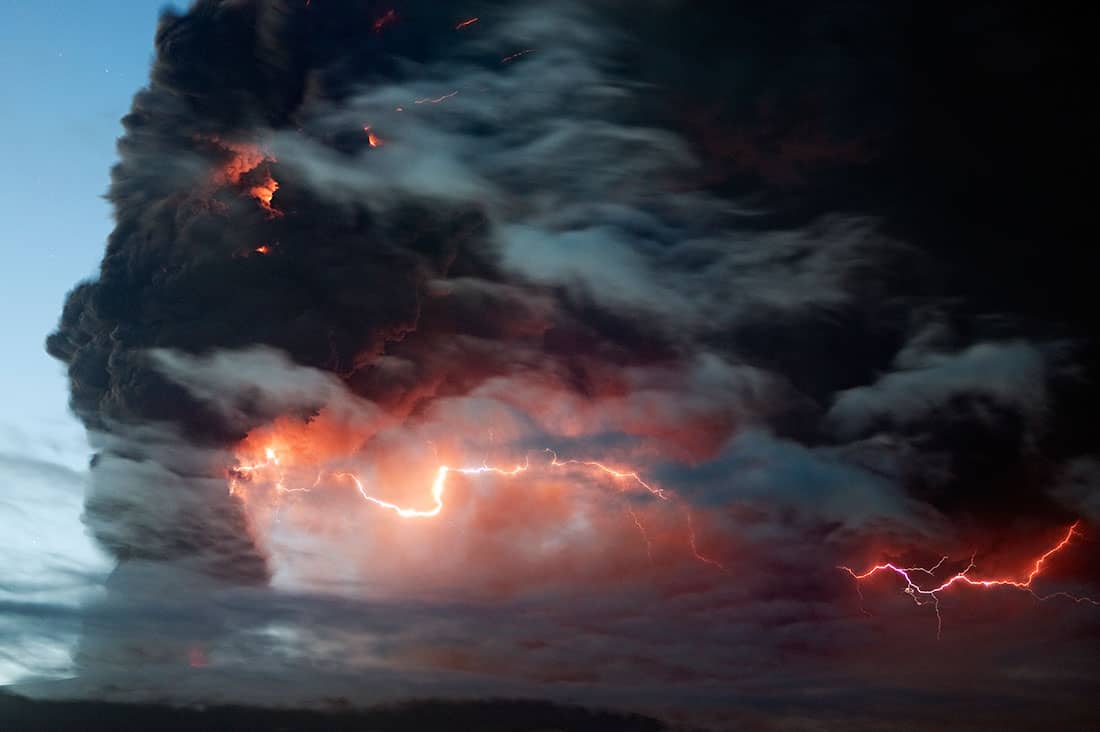
On 12 July 2008, for example, Mount Okmok erupted cataclysmically, releasing a 15 km high ash plume into the atmosphere. Within 35 minutes of the eruption, lightning strikes had been detected in the region of the volcano, and corresponding whistlers were also observed in Dunedin. By the end of the day, Dunedin’s whistler count had risen to more than 12,000 – a massive increase on the typical background rate of fewer than 500 observations per day, and one of the highest recorded counts in the AWDA’s eight-year history.
Mount Redoubt was also volcanically active during the study period and underwent 26 eruptive or explosive events in early 2009, many of which were accompanied by lightning. Of these, seven eruptions produced lightning that could be correlated to whistler activity, producing spikes in the whistler data ranging from 23 to 258 over barely a few minutes. Data from an eruption of the Kasatochi volcano in August 2008 also appeared to show a correlation between local lightning activity and whistlers detected in Dunedin, although the low rate of lightning activity – and the relatively high background level of whistlers around the eruption time – has made correlations for this particular event inconclusive, the researchers say.
Despite this, the researchers propose that the demonstrated correlations show that volcanic lightning can generate whistlers – providing the first evidence that volcanoes are able to couple with the inner magnetosphere. “I am left in awe,” says Antel, “at the immense influence volcanoes have on our planet!” Furthermore, the volcanic whistlers are certain to have originated near to Dunedin’s conjugate point – thereby providing accurately known travel paths between the two locations. “In other words,” Antel says, “the improved knowledge of whistler paths increases the fidelity of the plasmaspheric model that makes use of whistler data.”
Like regular lightning, volcanic lightning develops from the generation and separation of charges. While volcanic lightning can occur with a variety of eruption styles – including those in which lava flows are the main type of erupted material – volcanologist Corrado Cimarelli of Ludwig-Maximilians-Universät Munich explains that “most of the time, lightning is observed during eruptions where a large quantity of volcanic ash is produced”. A number of charging mechanisms have been proposed to bring about these strikes, ranging from the freeing of ions and electrons from fractured rocks, to friction between particles, and the rising and condensing of cooling water vapour in the volcanic plume.
“Once charge has been generated in a volcanic plume,” says Karen Aplin, an atmospheric physicist from the University of Oxford, “it is separated by convection, carrying smaller particles upwards, whereas heavier – and often oppositely charged – particles settle under gravity.” If the potential difference created overcomes the breakdown potential of the air, lightning occurs to neutralize the charge build-up. However, the separation of charged particles is highly variable and is dependent on the type of volcano and local atmospheric conditions. “This variability,” says Aplin, “and the difficulty of making repeatable measurements, means that volcanic lightning remains poorly understood.”
Out of this world
Although this whistler study was very much Earth-based, Mark Golkowski, a plasma-physics expert from the University of Colorado Denver, believes that this proof that whistlers can be reliably generated by sources outside of precipitating clouds has ramifications beyond our own planet. “For example, on Mars there are no clouds to generate moisture-driven lightning, but lightning from dust storms has been postulated.” He adds that the volcanic-whistler findings support proposed studies to use dust-storm lightning on Mars to probe the weak plasma densities of the planet’s upper atmosphere.
Robert Marshall, an electrical engineer at Stanford University, thinks this first observation of whistlers being directly correlated to volcanic lightning is exciting and unique. However, he warns that it remains to be seen if and how these volcanic whistlers will contribute to our understanding of either volcanic lightning, or whistlers and the magnetosphere.
Yet even if volcanic whistlers are not intrinsically important, the researchers are certainly pleased with their novel discovery. “I like the idea that a volcanic explosion can produce a radio wave that goes approximately 20,000 km into space and then is detected in Dunedin,” says Craig Rodger, a physicist at the University of Otago, who took part in the study. “They are,” he concludes, “pretty damn cool!”
When you think of cutting-edge experimental physics, you might picture the grandiose detectors of the Large Hadron Collider (LHC), or perhaps a lab-coat-wearing scientist hunched over a shiny new microscope. Sometimes, however, all you need is a bucket of sand, a balloon and a pin.
Stunning images of Pluto have been acquired over the past few days by the New Horizons spacecraft as it approaches the dwarf planet 7.5 billion km from Earth. The NASA mission will come within 12,500 km of Pluto – which has never before been visited by a spacecraft – on Tuesday 14 July before it ventures deeper into the Kuiper Belt.
Launched in 2006 to study Pluto and the Kuiper Belt, New Horizons is carrying seven scientific instruments including visible, infrared and ultraviolet imagers and spectrometers. The Long Range Reconnaissance Imager (LORRI) was used to take the above image of Pluto on 7 July, when the spacecraft was 8,000,000 km from the dwarf planet. The image includes several features of interest to planetary scientists including the elongated dark feature at the equator, which has been dubbed the “whale”. The large heart-shaped bright region to the right of the whale measures about 2000 km across.
‘Incredible’ images expected
“The next time we see this part of Pluto at closest approach, a portion of this region will be imaged at about 500 times better resolution than we see today,” says Jeff Moore, geology, geophysics and imaging team leader of NASA’s Ames Research Center. “It will be incredible!”
Also on board New Horizons is the Pluto Energetic Particle Spectrometer Science Investigation (PEPSSI), which will study material such as nitrogen and carbon monoxide that escapes from Pluto’s atmosphere and is then ionized by ultraviolet light from the Sun. NASA heliophysicist Nikolaos Paschalidis helped design and build low-energy integrated circuits for PEPSSI – a technology that has since been upgraded and used on several subsequent missions.
“The challenge with this mission, and the PEPSSI instrument in particular, was making it as small as possible, and capable of taking highly reliable measurements using low power, under extreme environmental conditions,” says Paschalidis. Indeed, he points out that PEPSSI is the most compact, lowest-power energetic particle spectrometer ever to be flown on a space mission.
Communication breakdown
While the mission appears to be going to plan, NASA scientists had a scare last week when communications with New Horizons were lost for more than an hour on 4 July. The mission’s autopilot recognized that something was going wrong and placed the spacecraft in safe mode while engineers determined that a flaw in the timing of the spacecraft’s command sequence had caused the problem.
According to the mission’s principle investigator Alan Stern of the Southwest Research Institute, about 30 planned scientific observations were not made while the spacecraft was in safe mode. However, he points out that some of these were preliminary observations that were not expected to deliver useful data because of the large distance between the spacecraft and Pluto. Stern says that the lost data account for less than 1% of the information that New Horizons will acquire during its flyby of the dwarf planet and therefore their loss is not significant.
The spacecraft is now operating normally and Stern and colleagues looking forward to analysing data from the nearly 500 observations that New Horizons will make as it passes Pluto.
In my column last December, I surveyed some novels that are set – or have key scenes – at physics labs. I found that some stories exploit the fact that a laboratory is a distinctive place, while others use labs simply as props. I also asked readers for other examples of lab-based novels that I might have overlooked.
Several respondents alerted me to LabLit.com, a website “devoted to the culture of science in fiction and fact”, which describes itself as “dedicated to real laboratory culture and to the portrayal and perceptions of that culture – science, scientists and labs – in fiction, the media and across popular culture”. The site includes a periodically revised list of novels, films, plays and TV shows that are “in the lab lit fiction genre”.
LabLit.com, it turns out, is 10 years old this year and was founded by Jennifer Rohn, a cell biologist at University College London. Rohn is also a blogger, journalist and author of two novels: Experimental Heart, a romantic thriller that turns on gene therapy research, and The Honest Look, a research thriller set in a corporate biotech lab.
I contacted Rohn to ask why she had started the site.
Untrampled ground
“LabLit.com stemmed in large part from frustration,” Rohn wrote back. “I wanted to read about my world – scientific research – in novels, but there were so few books featuring it that it was bordering on the ridiculous.” Rohn added that she needn’t have been surprised. “The lack of scientist protagonists in realistic fiction mirrors a deeper problem, namely the near-invisibility of real scientists in popular culture.” By setting up the website, Rohn hoped to highlight the few lab lit novels and films that did exist and, perhaps more importantly, to inspire writers to use more science and scientists in their fiction by shedding light on what she calls “this invisible – but infinitely fascinating – world”.
But what makes a laboratory an infinitely fascinating place to set a novel? According to Rohn, any scientific setting – be it a lab, telescope or field station – is essentially “untrampled ground”. There are millions of novels set in homes, offices, hospitals, police stations, but by her reckoning barely 200 mainstream novels ever published with scientific settings. The lab is, to her, a rich and untapped environment where things happen that don’t happen anywhere else in the world.
“Sure, the human story will be universal – but when it happens in an unfamiliar territory, it offers scope for a fresh angle on a familiar trope,” she says. “Love, or lust, or jealously, or ambition, or demoralization, is going to feel different when it’s happening in a lab, because the situations are not as you’d find them in other settings.”
I pointed out to Rohn that much lab lit is concerned with instances of fraud or malpractice, including both of her novels. Older examples include C P Snow’s classic 1960 book The Affair, which her website had somehow overlooked. Set in the close and highly regulated community of the University of Cambridge, the novel involves an accusation of fraud and the slow, agonizing process by which this unjust accusation is reconsidered. The literary value of the accusation, it seemed to me, was that it served as a perturbation that reveals much about the research life: its resistance to the outside, reliance on trust, and respect for equality and integrity.
I suggested to Rohn the idea that perturbation was in fact a reigning motif in lab lit, whereby some disturbing force upsets the intense, highly regulated environment of the laboratory and thereby exposes its norms – and that the principal perturbing force in lab lit was fraud and malpractice. She agreed with my first point, pointing out that such misdemeanours even crop up at the end of The Hard Problem, Tom Stoppard’s latest play at the National Theatre in London. But Rohn noted that fraud and malpractice are far from the sole sources of perturbation.
“You can’t have a good story without a plot complication,” she says. “In literature, the complications are invariably something bad or negative that the protagonist must overcome. Nobody wants to read a story about a guy who goes to work every day and good things happen to him, The End.” But what can happen in a lab that’s noteworthy and negative? “For better or worse, fraud and misconduct are obviously choices,” she says. “But you see many others in lab-lit fiction, including unhealthy competition, rivalry, mistaken theories, ethical dilemmas, clashes with activists and of course, that ancient trope – Everything Going Horribly Wrong When You Meddle With Things You Weren’t Meant To Know.”
The critical point
I reminded Rohn of Eudora Welty’s famous 1955 essay “Place in fiction”, in which the US author remarked that great novels and short stories require a strong sense of location. Such fiction, Welty wrote, is “bound up in the local, the ‘real,’ the present, the ordinary day-to-day of human experience”. As Welty went on to say, “Fiction depends for its life on place.” Every great story would be not only different but “unrecognizable as art” if moved elsewhere. Welty writes, “Imagine Swann’s Way laid in London, The Magic Mountain in Spain, or Green Mansions in the Black Forest.”
Rohn agreed that Welty’s point holds equally true of lab lit. “A rivalry would be entirely different in an office setting instead of a lab.” She’s encouraged that lab lit has increased since she started the site – something she quantified a few years ago in Nature (465 552). Lab lit’s still rare, she says, but books like Barbara Kingsolver’s Flight Behaviour show that quality examples of the genre are “reaching a comfortable level of popular acceptance”.
Synchrotron radiation has been used to solve a long-standing mystery surrounding the degradation of a yellow pigment widely used in late 19th and early 20th century paintings. An international team of scientists used cutting-edge spectroscopic techniques to locate multiple products of pigment decay within the paint, and concluded that degradation arose from photo-oxidation.
The development of the modern chemical industry played an important role in the palette of colours that were available to Impressionist and early Modernist painters such as Vincent van Gogh, Pablo Picasso and Henri Matisse. However, over the years, many of these synthetic inorganic pigments started to break down.
Ivory-coloured crusts
New yellow pigments played an especially important role in paintings of this era, says conservation scientist Francesca Casadio of Northwestern University/Art Institute of Chicago Center for Scientific Studies in the Arts. “It’s also the beginning of electricity,” she explains, “So they depict interior scenes where there’s electric light in all shades of yellow, and they depict things outdoors, where there’s all declination of light.” Unfortunately, cadmium yellow (cadmium sulphide) has proved to be one of the unstable pigments, with samples fading or even becoming obscured by a thick, ivory-coloured crust.
Previous analyses of degraded pigment had revealed various chemical species of oxidized cadmium, but determining their source, and thereby devising strategies to prevent their formation, was far from straightforward. They might be photo-dissociation products, for example, but they might also be contaminants in the original pigments or even the result of previous restoration or cleaning work.
Now, art conservation scientist Emeline Pouyet of the European Synchrotron Radiation Facility (ESRF) in Grenoble and colleagues in France, the Netherlands, Belgium and the US have used infrared and X-ray radiation from the ID21 beamline at ESRF to study two paintings that have suffered from degradation. They used an imaging technique called X-ray near edge spectroscopy (XANES) on carefully prepared thin sections taken from tiny altered and unaltered samples of paint from The Joy of Life and Flower Piece by Matisse. XANES is a type of absorption spectroscopy whereby X-rays are passed through small samples in order to excite electrons into many-body bound states.
Sub-micron resolution
The researchers then detected the electrons emitted from these states, which allowed them to identify which compounds are present in different regions of the painting. In addition to XANES, the team used X-ray fluorescence to look at thin cross-sections through the paint. Pouyet and colleagues also used infrared imaging to look for organic compounds. Together, the techniques allowed the team to identify the decay products and also pinpoint their locations to sub-micron resolution within the paint.
In some severely degraded regions of ivory crust, they found that cadmium sulphide was completely absent, but that calcium sulphates were present alongside calcium carbonate. Cadmium sulphide was still present, however, in the yellow paint underneath, alongside cadmium sulphate. From this the team concluded that the cadmium sulphate had been produced at the surface by photo-oxidation of the cadmium sulphide in the presence of humid air.
Chain reaction
Cadmium sulphate is colourless, so it could explain the fading observed in some samples. It is also highly soluble so, once formed, the compound could diffuse easily into the paint layer. At the surface, however, the sulphate ion could be displaced by carbon dioxide from the air, forming cadmium carbonate, which is white and could be causing the ivory crusts. The team also found cadmium oxalate at the surface, which is also colourless. Oxalate ions could have been produced either by acid hydrolysis of the oil binding the paints, or alternatively by varnish previously applied to the surface. Cadmium oxalate might also decompose into white cadmium carbonate: “At the moment we have two hypotheses for the formation of the carbonate,” explains Pouyet.
Casadio, who was not involved in the research (although she has been invited by Applied Physics A to guest-edit the special issue in which the paper describing the work will appear) describes the work as “remarkable”. “The application of 2D–XANES to works of art is extremely new,” she says, “It’s very hard to have beam time at synchrotrons for experiments of this kind, so it’s really quite amazing that it was possible to utilize such techniques on samples from paintings. These experiments can now pave the way for everybody else to detect, maybe with point analysis, some of these materials and then infer by analogy what’s going on with other paintings.” Museums and galleries already filter out ultraviolet light and humidity, she says, but the new work might help inform decisions about treating and reinforcing the paintings.