Making a biographical film about someone who is still alive is tricky, especially when the subject is both famous and intensely guarded about his private life. But with The Theory of Everything – a biopic of the physicist Stephen Hawking that focuses on his relationship with his first wife Jane, based on her memoir of their 30 years together – director James Marsh seems to have pulled it off. The film starts in 1963, when Hawking (played by Eddie Redmayne) is a cosmology student at the University of Cambridge. Already determined to find a “simple, eloquent explanation” for how the universe works, the young Hawking comes across as both intelligent and awkward – a combination that intrigues and charms Jane Wilde, an arts student he meets at a party. Early in their courtship, Hawking is diagnosed with motor neurone disease and told that it will kill him in about two years. Despite this bleak prediction, the pair get engaged and initially it seems they can navigate the troubled waters of illness (and rising fame) together. As time passes and Hawking’s physical limitations become more significant, however, stresses take their toll and previously stiff upper lips begin to wobble, especially after an emergency tracheotomy causes Hawking to lose his voice. The Theory of Everything is, in the main, a love story, but it is no saccharine drama, and Marsh deliberately steers away from the maudlin. While the character of Jane Hawking (played by Felicity Jones) appears slightly naive at the start, she comes into her own as the film progresses, rationing her tears as she tries to cope with the burdens of raising a family and dealing with her husband’s increasing fame, as well as the looming shadow of his illness. The film is not without its lighter moments, though: when Hawking gets a new computerized voice, one of the first things he says with it is “Ex-ter-minate!” While strong on Hawking’s humanity (and humour), The Theory of Everything has less to say about the physics research that made him famous. A few scenes do show him working on his theories and presenting them to ever-increasing audiences of friends and colleagues, but these merely skim the surface. While it seems odd to give so little time to the source of Hawking’s celebrity, Marsh was clearly aiming to depict Hawking the man, rather than Hawking the brilliant scientist. In this, he succeeds, with a subtle, restrained portrait of the lives of some very clever people.
2014 Universal Pictures/Focus Features, a Working Title production
A daily dose of mathematics
In a religious context, the term “devotional” refers to a book containing short prayers or other spiritual reflections for each day of the year. In The Mathematics Devotional, author Clifford Pickover strips out the religious element, replacing holy writ with quotations about mathematics and saintly iconography with computer-generated artwork, but otherwise leaves the devotional format intact. What you will find inside the crisp covers of his book are a short introductory essay, an even shorter set of micro-biographies of mathematicians, 366 quotations about the wonders (or frustrations) of mathematics and 366 pretty pictures to accompany them. And that’s it. Although sparse in its form and content, The Mathematics Devotional is (like some of its religious counterparts) a beautiful object, and the daily quotations are well selected from a diverse range of sources, including novelists, philosophers, physicists and mathematicians. On 20 January there’s even a snippet from Physics World’s own columnist, Robert P Crease, on the subject of great equations. Disappointingly, though, the illustrations are more or less information-free. Drawn from an opaque list of sources with only the briefest attribution, it is generally quite difficult to tell what (if any) mathematics they contain, and many bear little relation to the quotations that appear below them. Given that several robotic Twitter accounts provide their followers with much the same sort of thing, and for infinitely less money, it is a little hard to see where the audience for a book like this will come from – unless it’s made up of people who would otherwise struggle to think of gift ideas for mathematician in-laws or distant relatives.
Physicists around the world are gearing up for the International Year of Light and Light-based Technologies (IYL), which kicks off later this month at an official opening ceremony at the headquarters of the United Nations Educational, Scientific and Cultural Organization (UNESCO) in Paris. Some 1500 delegates are set to converge on the French capital for the event, which runs from 19 to 20 January, and will include representatives from the UN and UNESCO as well as the Nobel laureates Zhores Alferov, Steven Chu, Serge Haroche and William Phillips. Designed to highlight how light and light-based technologies touch every aspect of our lives, the IYL will involve more than 100 partners from 85 countries – including the Institute of Physics (IOP), which publishes Physics World.
The UN has declared “international years” since 1959 to draw attention to topics deemed to be of worldwide importance. In recent years, there have been a number of successful science-based themes, including physics (2005), astronomy (2009), chemistry (2011) and crystallography (2014), with the idea for a celebration of light having been initiated by the European Physical Society (EPS) in 2009.
Photonics is a technology that underpins modern life and provides real solutions to global problems
John Dudley, European Physical Society
“We began the IYL focusing primarily on outreach and education, but we rapidly realized that there was a political dimension that we hadn’t appreciated,” John Dudley, president of the European Physical Society (EPS), told Physics World. “Photonics is a technology that underpins modern life and provides real solutions to global problems, and we need to make sure that this is fully appreciated on all levels. We also need to stress that research can take decades before practical outcomes are apparent; a strategic long-term vision is required in investing in research and technology.”
Marking several anniversaries
This year was picked to celebrate light because it marks a number of anniversaries, including 1000 years since the publication of the work on optics by Ibn al-Haytham, during the Islamic Golden Age. The year also marks 200 years since Augustin-Jean Fresnel’s seminal paper introducing the notion of the wave nature of light, 150 years since James Clerk Maxwell’s work on electromagnetism that paved the way for technologies from lasers to mobile phones, as well as the centenary of the incorporation of the speed of light as an essential part of our description of space and time in Einstein’s equations of general relativity.
“One of the most exciting aspects of this International Year is the way in which it brings together such a wide range of different communities, from astronomy to medicine and photonics to arts and culture,” says Beth Taylor, chair of the UK National Committee for the IYL. “It creates a unique opportunity to cross traditional cultural divides and engage new and different audiences with the excitement of light and its applications.”
Worldwide events
The IYL will consist of a series of co-ordinated events around the world to communicate the importance of light and optical technologies in society – ranging from the Story of Light Festival in Goa, India, to Worldwide Pinhole Photography Day.
While Dudley does not want to single out any specific event, he says that the opening ceremony will be “high profile” to make an impact on a political level. “There are many wonderful and varied things happening and we will see many different outcomes in many different countries,” he says.
Hundreds of events are planned in countries all around the world. In the UK, a launch event will be hosted by the Duke of York, who is UK patron for the year, at St James’s Palace on 28 January. It is expected to highlight the strength of the photonics sector in the UK, which is worth some £10.5bn to the economy. The year will also feature events that monitor light pollution, while talks and exhibitions will be held aimed at educating the public about light-based technologies.
Proud legacy
Taylor says she is “particularly inspired” by the IYL’s Study after Sunset initiative, which aims to promote the use of solar lanterns in regions where there is little or no reliable source of light. “If we can help to make a difference to the uptake of solar lighting by families in the developing world with no current access to safe, clean, affordable light, we will ensure that the IYL leaves a real legacy after 2015, of which we can all be very proud,” she told Physics World.
The IYL was officially launched by the EPS during the Passion for Light workshop held in Varenna, Italy, on 16 September 2011, which was attended by more than 100 physicists and officials from UNESCO. A resolution endorsing the IYL was first adopted by UNESCO in October 2012 and submitted to the UN in November 2013. At the 68th session of the UN General Assembly in Paris in September 2013, the resolution was then adopted to declare 2015 the International Year of Light and Light-Based Technologies.
While officials are firmly focused on the myriad of events happening this year, Dudley, for one, is setting his sights beyond 2015. “One of the pleasures of organizing the IYL over the last few years has been to see the emergence of the next generation of leaders in education and public communication of science,” he says.
A free-to-read collection of our 10 favourite features on light from Physics World will be available later this month online via the digital version of the magazine or via the Physics World app, available from the App Store and Google Play
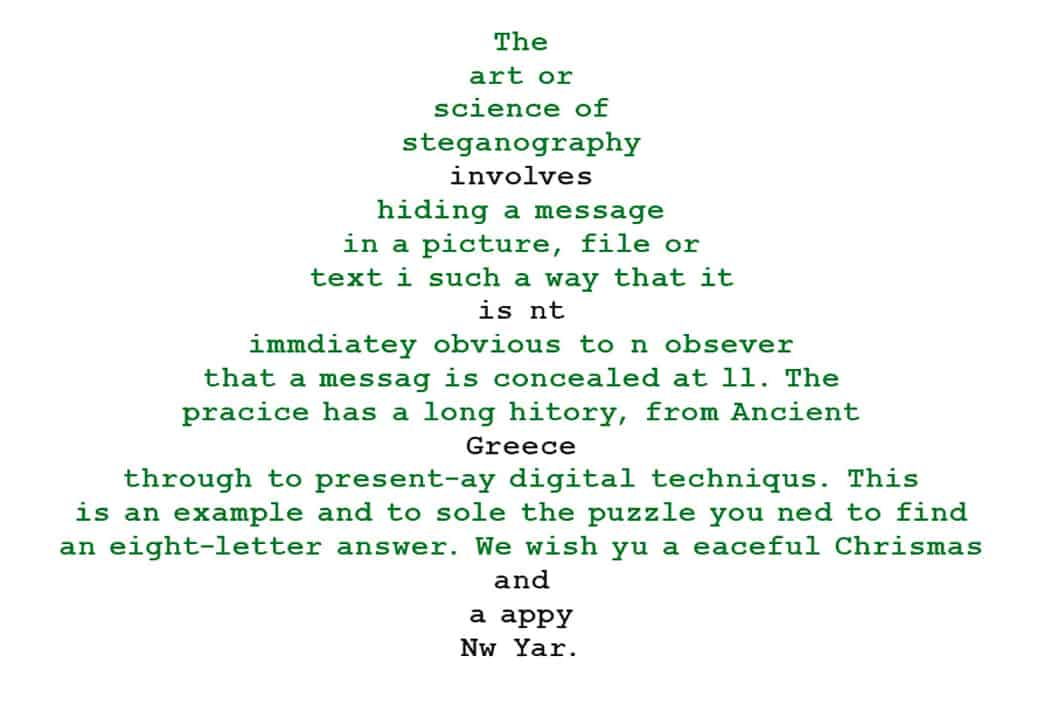
The image above is the second and final part of Physics World’s festive puzzle 2014. If this is the first you’ve heard about the puzzle, start by checking out Physics World’s festive puzzle: part 1, which was published a week ago.
Can you solve it? Let us know how you get on by posting a comment below, but please do keep the answer to yourself, if you work it out, to avoid giving the game away for others.
We hope you enjoy this bit of fun. There are no prizes – the only reward is the satisfaction of finishing the puzzle. Solutions will be published on this blog in January.
Although I wouldn’t want to tar us all with the same brush, for many people – including me – the festive period marks indulging in rest, rich food and a reacquaintance with the goggle-box.
Switching off and slumping on the sofa seems like the best thing ever for a few days, but eventually I find it gets a bit boring. That’s when I find myself craving some mental stimulation, whether that be gorging on crosswords, designing a new knitting pattern or learning a new programming language.
But how about you – are you busy right now digesting roast potatoes and zoning out on Indiana Jones, or do you have an appetite, instead, for a challenge?
Particle physicists in India have had much to cheer about since 2012. Not only could they take some of the credit for having helped to discover the Higgs boson at the CERN particle-physics lab near Geneva, but also the discovery spilled over from the confines of department coffee rooms to newsrooms around the country. The resulting TV and press bulletins clearly pointed to the enormous contributions that Indian physicists from both national research institutes and universities had played in one of the biggest discoveries in particle physics in recent memory – a finding that led to François Englert and Peter Higgs being awarded the 2013 Nobel Prize for Physics.
India’s Department of Atomic Energy entered into an agreement with CERN in 1991 to participate in the lab. Since 2002, India has had “observer” status at CERN and contributes towards many aspects of the lab, including the design of the detectors at the Large Hadron Collider (LHC) – including CMS and ATLAS – as well as the software that is used to monitor and analyse data. Indeed, those efforts will be all the more important given that CERN will begin to hunt for particles beyond the Standard Model of particle physics when the LHC starts up again in mid-2015. It is expected that the LHC will then be accelerating and colliding protons with an energy of about 6.5 TeV – near the LHC’s 7 TeV design energy.“For the past 40 years, international collaboration in particle physics has always been our strength,” says particle physicist Atul Gurtu of the Tata Institute of Fundamental Research (TIFR) in Mumbai, who is a formerspokesperson for the LHC’s CMS experiment.
Still miles to go
With an economy that was expanding by around 10% a year, the Indian government recognized that more scientists and engineers were needed to sustain the continued development of science. So in 2008 the then Prime Minister Manmohan Singh announced that the government would set up eight new Indian Institutes of Technology (IIT) to build on the country’s five existing IITs. Singh also announced the new Indian Institute of Science Education and Research, as well as plans to fund 30 new central universities.
While these initiatives will take time to have an effect, most scientists in India agree that the country has done exceedingly well in theoretical particle physics, but needs to improve its performance in experimental particle physics before the country can emerge as a top player in the field. India’s weaknesses include a lack of financial clout as well as a lack of technological expertise to do the necessary hardware and instrumentation R&D. “We do not have that many financial resources as well as the necessary number of trained scientists to participate in diverse international projects,” says Gurtu. “That is now biting us.”
Sunanda Banerjee from the Saha Institute of Nuclear Physics in Kolkata heads a 22-member group that works at the LHC. The team is involved with CMS, monitoring the performance of its hadron calorimeter, which measures the energies of elementary particles that are produced during the collisions. Banerjee’s team is also involved in constructing the electronics for a planned upgrade to the hadron calorimeter and tracking system.
Although particle physicists in India have gained recognition for their work in software, Banerjee says that the credit for that mostly goes to the efforts of individual physicists rather than “concerted institutional efforts in the sector”. Another area of struggle is specifically in acquiring the know-how to build particle detectors. “We are good in following well-established techniques in making a detector, but we are far away from making a detector of novel design,” adds Banerjee, who is also a member of the Geant4 team – an international collaboration with scientists from CERN, Fermilab and other key international labs – that isdeveloping a software toolkit to track particles.
One reason why India is struggling in these areas could be because the country does not have an indigenous high-energy particle accelerator of its own. “In India, we don’t have an accelerator that can provide even 1 GeV centre-of-mass energy,” says CERN-based physicist Archana Sharma. “We need to learn from CERN how to design high-current, high-energy accelerators.” Sharma adds that even if India did build a new particle collider, it would also need to develop much more expertise in electronics design and microchip development.
That view is backed by physicist Jasbir Singh from Panjab University. “In experimental particle physics, most faculty members and students are involved in data analysis and software development, but participation in detector development, especially making detectors for big projects is lacking,” says Singh. “Most Indian universities do not create facilities to strengthen the experimental base.”
Chasing China
While India has not yet been able to reach a level competitive with that of Europe, the US or Japan, some physicists in India think that the country has slipped behind China – its long-time rival since the mid-1970s. China has been developing the necessary technology for accelerators such as high-vacuum systems, fast electronics and precision-guided waveguides as well as sending hundreds of young physicists to labs abroad to learn.
“China is doing better than India when it comes to taking on big projects domestically,” says Rohini Godbole of the Indian Institute of Science’s Centre for High Energy Physics in Bangalore. Singh agrees that China is doing well in detector development adding that some aspects of Chinese development such as accelerator technology is “on par with the West”.
While many say that India needs to provide much greater investment to train scientists and develop the necessary technology so that it can compete globally, it is not all doom and gloom for India’s particle physicists. Fermilab director Nigel Lockyer says that in some areas, such as the design of cyclotron accelerators, India is “neck and neck with other countries”. Lockyer predicts that India will be a leading nation in particle physics in the coming decade, even with competition from China, thanks to India’s national commitment to science, from training in schools and universities to advanced research institutes.
“This gives India a significant advantage compared with its peers, as evidenced by its early and significant participation in the software and computing industries,” says Lockyer. “With these successes, India has the chance to continue to lead through focused commitment to national science facilities such as observatories, accelerators and new laboratories.”
Towards the forefront of neutrino physics
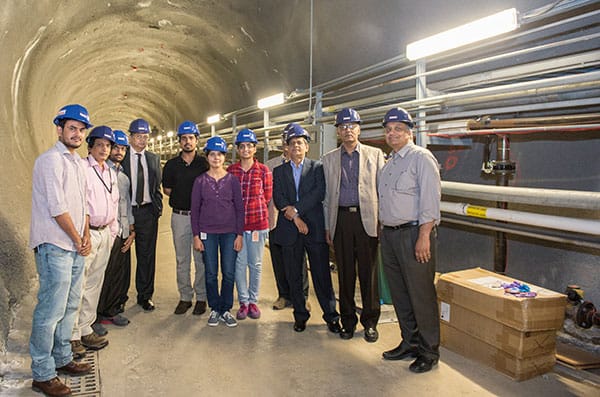
Guided tour Researchers from the Bhabha Atomic Research Center see the construction of the Main Injector Neutrino Oscillation Search – a long baseline experiment at Fermilab. (Courtesy: Reidar Hahn/Fermilab)
It is not just CERN where India has a focus on particle physics but also at Fermilab near Chicago in the US. A number of Indian institutes, including the Bhabha Atomic Research Centre in Mumbai, Raja Ramanna Centre for Advanced Technology in Indore and the Variable Energy Cyclotron Centre in Kolkata, are involved in developing the technology for accelerators based on superconducting magnets. The country’s universities are also making their presence felt too. Physicists at Panjab University in Chandigarh, for example, contributed towards the construction of the Tevatron’s now-defunct DZero detector as well as the Bubble Chamber Detector Neutrino Experiment.
Physicists at Panjab are now involved in the planned Long Baseline Neutrino Experiment (LBNE), which will study neutrino mass and interactions when it is switched on in the coming decade. They are involved in the integration and construction of one of the LBNE’s two main detectors – the “near” neutrino detector that will be placed right at the neutrino beam at Fermilab. (The second detector – the far neutrino detector – lies 800 km away from the Chicago lab.)
In the euphoria of India’s independence in 1947, the country’s first Prime Minister Jawaharlal Nehru described its national laboratories as “temples of modern India”. These national institutes have for decades played a key role in India’s progress in science and technology by carrying out basic science research often of world-leading quality. The Tata Institute of Fundamental Research in Mumbai, for example, was built to kick-start Indian research in the aftermath of the Second World War.
Yet what Nehru and other Indian leaders since him have neglected, however, is to support the nurseries that train budding young scientists to go and work at such “temples”. Except for a few pockets of excellence, university science education in India is in the doldrums. The result is that Indian universities are now the poor cousins of elite, national research institutes when it comes to receiving government funds and in infrastructure.
The Indian university system comprises a mix of public- and private-funded universities plus single institutions that are autonomous but not allowed to have off-campus colleges. The latter are dubbed “deemed” universities and the Indian Institute of Science (IIS) in Bangalore, for example, is one. According to India’s University Grants Commission, there are now an estimated 45 national universities, 320 state universities, 130 deemed universities together with 189 private universities.
It is the publicly funded universities that form the backbone of India’s higher education, but they have endemic problems ranging from poor funding and neglected buildings to a lack of staff and equipment, too much red tape and political influences in some university appointments. But what holds such universities back the most is that funding and research focus is so skewed in favour of the national institutes. This leaves most public-funded universities, except a few such as those in Delhi, Jammu, Kolkata and Punjab, unable to engage in quality research. “Isolated cases of academic excellence are not enough,” says Sunil Mukhi, chair of the physics programme at the Indian Institute of Science Education and Research (IISER), Pune. “You need them across the country.”
Divides and divorces
State universities in India mostly offer students three-year undergraduate degrees that are done in “colleges” and two-year postgraduate degrees that they carry out in university departments. What this means is that most undergraduate lecturers at public-funded universities do not carry out any research as they are forced to spend all of their time teaching – only those who teach postgraduate students can engage in research, as at Delhi University. Elite institutions such as the IIS in Bangalore, on the other hand, run degrees that do offer a year of hands-on research experience. “It is a very big gap and an artificial divide,” says physicist Vikram Vyas of St Stephens College, which is Delhi University’s top-ranked undergraduate college.
There is a feeling, however, that if those who teach undergraduates also did research, it could benefit their teaching. “These lecturers could then point out the messy areas at the frontiers, where knowledge is still evolving, and where there are unsolved problems and unanswered questions with no clear answers,” says Vyas. “I believe that the absence of this perspective in undergraduate teaching is one of the main reasons for the paucity of original ideas in science” Vyas adds that India needs to rethink its university system so that every teacher in an undergraduate college is associated with the corresponding research department in the university. Similarly, every faculty member in the main department should be associated with an undergraduate college. “This is possible only if we have many more smaller and compact universities,” he says.
However, Sri Krishna Joshi of the National Physical Laboratory (NPL) in Delhi, and a former head of the Council of Scientific and Industrial Research, says that many state and central universities do not in fact distinguish between those who teach undergraduate and postgraduate courses. Institutions like Delhi University are an exception, not the rule, according to Joshi, a former member of India’s University Grants Commission that funds public universities. The main issue, he says, is rather the quality of physics teachers in state universities. Such staff are responsible for teaching more than four-fifths of India’s postgraduate physics students and even higher numbers of undergraduate students (see box below). “On both counts, nearly all state universities, barring a few, and even some central universities are not doing well,” Joshi says.
Whatever the causes, the bottom line is that physics students in India are by and large disconnected from top-class research and researchers. Indeed, Joshi goes as far as saying that there is a “total divorce” between teaching and research outside the country’s elite institutions such as the Indian Institutes of Technology, the IISERs or some central universities where teachers are appointed after taking their research contributions into account.
Another problem at non-elite institutions is the often outdated nature of the syllabus itself. Joshi says that universities often follow a syllabus that may not have changed much over the years or even have been decided by India’s leading physicists. “The syllabus does not offer students the scope to know the latest trends in the field or be exposed to emerging inter-disciplinary areas of research,” he says.
The physics syllabi for undergraduate courses are often based on broad guidelines and updating them is time-consuming, complicated and often involves bitter wrangles. They also do not give undergraduate physics students problem-solving skills but rather only encourage derivations to be memorized. Grants to buy laboratory equipment are based on a decades-old syllabus, which leaves little or no scope for colleges to devise new teaching and experimental projects in tune with recent advances in a field.
Infrastructure woes
The poor condition of laboratories in most state universities is a big problem in the declining quality of university physics education in India. Unlike national research institutes, where funds for costly, hi-tech equipment are more readily available, most state universities have to go with a begging bowl for funds. “Even to buy a simple thing like a laptop, not to speak of equipment, we face delays and difficulties,” complains Amitava Raychaudhuri, a physicist at Calcutta University. “Departments in state universities are so cash-strapped that they cannot get modern laboratories or equipment. Students make do with aging equipment.”
Even if money is forthcoming, delays and red tape can be an issue. Unlike research institutes that receive research project funds direct from the government, universities depend on funds from national funding agencies. Unfortunately, India’s funding agencies are slow moving and the money can arrive months after a university department has had a project sanctioned, according to Raychaudhuri, who insists that despite the problems his university still gets “extremely sharp, intelligent and motivated students”.
What is more, as grant money is handed out towards the end of a financial year, undergraduate colleges end up buying equipment or software towards the end of the teaching year. So even if a university gets approval to buy something, any students whose semesters have already ended (or are about to end) lose out on learning how to work with the equipment.“Apart from administration and salary funding, there is not much available for development of infrastructure,” says Shobhit Mahajan, a physicist at Delhi University who teaches postgraduates and researchers. “Poor infrastructure and lack of opportunities is a major determinant.”
Back at the IISER in Pune, Mukhi suggests that the government should also periodically review universities through external committees, as is already done with the IISERs. “Reviews are an important tool to assess if universities are performing according to expectations,” adds Mukhi. He thinks that universities should not merely follow a textbook-bound approach, but encourage creative ideas and a research spirit in the classroom. “If we could do it in the five years since the IISERs were set up, the universities should be able to do it too.”
Reason for hope
One brief opportunity for students to learn directly from top researchers are summer camps and training programmes run by science academies, the Department of Science & Technology and the Council of Scientific and Industrial Research. Active researchers do most of the teaching, giving students first-hand experience about research. “Teaching should not be reduced to a blackboard exercise,” says physicist Anand Bharadvaja of the Bhaskaracharya College of Applied Sciences, one of the newer colleges run by the Delhi state government.
Another welcome step, says Bharadvaja, is Delhi University’s new initiative to encourage undergraduate teachers to carry out interdisciplinary and innovation-driven research. Bharadvaja’s team, for example, has collaborated with other scientists in a study on the potential of agricultural waste as an alternative source of energy. Some also see benefits to undergraduate students of universities that are engaged in international collaborations. “When they see hardware activities centred on the cutting-edge technology being done at their home institutions, they get enthused to take up challenging tasks in science and technology as a career option,” says Archana Sharma, an Indian physicist at CERN.
Things, however, might about to be turning out for the better, given that science minister Jitendra Singh announced in September that scientists from national institutes would be required to spend a few months teaching in universities. However, not everyone is convinced. “I don’t think that a handful of scientists from research institutes jet-setting to a university to deliver some lectures will make too much of a difference,” says Mahajan. “Unless they have a stake in the teaching per se, it will soon evolve into a chore that is performed for the sake of regulation.”
Filling the vacancies
Lying vacant In physics, some 30% of faculty positions still need to be appointed. (Courtesy: iStockphoto/Elenathewise)
One major problem for physics in India is that most universities, especially those that are state funded, have many job vacancies that they cannot fill. In the case of physics, around 30–40% of the faculty positions are lying vacant. “Universities are not able to hire people,” says Atul Gurtu, a former researcher at the Tata Institute of Fundamental Research in Mumbai. “It is very frustrating.”
What this means is that physics and other sciences are therefore mostly taught by ad hoc teachers who are not well paid and who face an uncertain future, including candidates with just a Master’s degree and no research track record. Despite their lack of experience, if such appointees continue for several years, they are eventually appointed as regular teachers. “This is doing a lot of damage to science education in general, including physics education,” says Sri Krishna Joshi of the National Physical Laboratory in Delhi.
To make matters worse, advertisements for faculty positions are often not well publicized to attract the best talent. Even if top people are interested in the positions, they have to battle through university red tape before they can start work. At the University of Calcutta, for example, it may take up to two years between the advertisement of aposition and final recruitment. “By then, the best candidates would have a found a good job elsewhere,” says theoretical particle physicist Amitava Raychaudhuri of the University of Calcutta.
Another deterrent is the comparatively low salaries for state universities compared with central universities and national research institutes. Many say that political interference and corruption in university appointments, including even the vice-chancellor, is a common and serious problem across India. Unlike central universities, which usually boast a top-class academic as vice-chancellor, the bosses at state universities are often political appointees. “In India, state governments are like parasites, using state universities to wield clout but not rewarding academic performance,” says Raychaudhuri. “This is demoralizing to the state universities and political appointments are destroying universities.”
How does it feel now that India has reached the red planet?
I am happy and contented that we have done our job. It was a historic moment for everyone in the country. It was a technological mission primarily, and we have successfully achieved that.
How challenging was it to develop the Mars Orbiter Mission?
It was a race against time to build the craft as we had to make sure that it was launched no later than November 2013, since the specific celestial positions of the Earth, Mars and the Sun gave India the opportunity to use a relatively low-power launcher – the Polar Satellite Launch Vehicle (PSLV) – to head to Mars.
How long did it take to build?
The mission was realized in less than two years. We also had to build autonomy into the spacecraft and then go through all simulations to ensure that the satellite does not make wrong decisions by itself.
What are you studying on Mars?
The primary objective is establishing the capability of keeping a spacecraft around Mars. We also have five scientific instruments on board to see if methane is present, and whether its origin is biological or geological.
So, we are asking if we’re alone in the universe?
Yes. The second aim is to study the atmosphere of Mars in terms of the deuterium and hydrogen, and the other particles that are there.
To find out why Mars has lost water?
Yes, that is one of the questions.
What are the big things from this mission that the world needs to wake up to?
What we have established is that our PSLV is capable of delivering a mission to Mars. We are also showing that there is a novel way of doing low-cost planetary exploration and that we can do such complex missions in a short time. There are also several technological spin-offs from this mission in communication, navigation and observation.
What does it mean for India?
There have been 51 missions to Mars, and the success rate has not been high because of the sheer complexity of the missions. So, we are the fourth group in the world to succeed after Europe, Russia and the US – and also the first to do so at the first attempt.
After Mars, what other big missions is India planning?
Two things are happening. One is that our Geosynchronous Satellite Launch Vehicle Mark III – the vehicle needed to put a four-tonne class of communication satellite into orbit – is going through experimental mission preparation. The vehicle is being integrated and we should be able to have the launch in 2014. This mission is essentially to understand the atmospheric phase of the flight. The second thing is that we are also building a crew module that could be used for a possible human spaceflight.
So you are the testing technology for putting Indian astronauts into space?
This crew module, without any human beings, is being tested to see how it withstands re-entry into the Earth’s atmosphere.
What is the state of India’s second mission to the Moon?
Chandrayaan II is a mission with a lander and a rover. At the moment, we are designing the Indian lander for Chandrayaan II. It should take at least three years for us to have that lander ready.
And what about the Sun?
The Aditya satellite will study the Sun and scientists would like to put it in the Langrangian point, which is 1.5 million kilometres away from Earth. Preparations and studies are under way and we should be able to synchronize that with the solar activity, so it would come somewhere in 2017–2018. Another exciting mission is AstroSAT, which is going to be a multiwavelength astronomy satellite. We are in the final phase of integration and testing, so it should launch by 2015.
And how are spirits inside the ISRO?
It is exciting, it is challenging, it is rewarding, and at the end of the day we feel there is a purpose in life in working in this organization.
Is India in a 21st-century space race?
Yes, we are in race, but with ourselves. We need to excel. We need to do much more and get into the next level of excellence. This is our objective.
When the Aztecs first happened upon a certain valley near modern-day Mexico City back in the 14th century, what they saw must have come as a shock. Before them lay a vast deserted city, comprised of such grand monuments that the tribe believed it to be the site at which the gods had created the universe. They named it Teotihuacan – “The City of the Gods”.
Today, tourists are similarly awed as they stroll down the Avenue of the Dead – the two kilometre-long processional road at the heart of the city. Of the numerous monumental buildings that line this street, two immediately catch the eye because they are so much bigger than the rest: the Pyramid of the Moon and the even larger Pyramid of the Sun, which by volume is the third-largest pyramid in the world.
Archaeologists have scrutinized the city over the years and learned a lot, finding, for example, that Teotihuacan was established in around 100 BC, before growing to become one of the largest cities of ancient times with at least 125,000 people. But one question remains as mysterious as it was in the time of the Aztecs: where are the ancient rulers of Teotihuacan buried? We know that Egypt’s pyramids were built as tombs for the country’s pharaohs, but the past rulers of Teotihuacan are nowhere to be found. What’s more, there is no sign that the Pyramid of the Sun contains any burial chambers at all – or so it would seem from the outside.
To find out once and for all what – if anything – is inside the Pyramid of the Sun, in 2000 a team of physicists from the National Autonomous University of Mexico (UNAM) hung up their lab coats, strapped on their boots and helmets and went to Teotihuacan. Taking advantage of the muons that continually shower the Earth’s surface, the researchers set up an imaging tool that would allow them to explore the insides of the ancient structure without moving so much as a single pebble. But their method would take time and patience, relying as it does on building up a signal very slowly. It will have been more than a decade before they are ready to reveal what the Sun Pyramid conceals within.
Muons to the rescue
The idea of imaging the internal structures of pyramids using muons was developed in the 1960s by Luis Alvarez at the University of California at Berkeley, who also won the 1968 Nobel Prize for Physics for developing the hydrogen bubble chamber and who later postulated the idea that the dinosaurs became extinct after an asteroid crashed into the Earth. Muons are charged elementary particles that continually rain down from the sky where they are created in muon–antimuon pairs as by-products of cosmic rays interacting with the atmosphere. Roughly 200 times heavier than their cousins the electrons, muons are able to penetrate dense materials such as rock, but in doing so they gradually lose energy and slow down.
The principle behind the technique involves placing a muon detector within or beneath a pyramid
The principle behind Alvarez’s pyramid-imaging technique involves placing a muon detector within or beneath a pyramid and measuring the energies and trajectories of the incident muons. When a muon passes through a material, the amount of energy it loses increases with the density of the substance, which means that the energy of a muon travelling through an air-filled hidden chamber will be hardly affected at all. By comparing the muon data with simulated data based on what would be expected if the pyramid were solid through and through, researchers can pinpoint differences in density within a structure that might indicate an archaeologically significant feature. Named “muography”, the technique is similar to radiography, except that in muography a 2D image is taken of a pyramid’s insides using muons, whereas in radiography a 2D image is taken of a patient’s insides using X-rays.
Alvarez first developed the technique in the late 1960s in a search for hidden chambers inside the Pyramid of Chephren in Egypt. He set up a muon detector inside an inner chamber and found “nothing”, as some people incorrectly put it. Arturo Menchaca, leader of the physics team at Teotihuacan, recalls making the mistake of saying this to Alvarez back in the 1970s. “He furiously corrected me: he had demonstrated there was nothing inside the pyramid,” says Menchaca, who at the time was a postdoc at the Lawrence Berkeley Laboratory with an interest in this new field. Menchaca explains that this is no subtlety: finding there is nothing inside these huge structures is incredibly useful to archaeologists, who can then conclude that there are no hidden wonders for them to explore and can move on to other sites.
Adventuring below
The “Alvarez test” – as Menchaca nicknamed it – suited the Sun Pyramid well since beneath the massive structure, which is 75 m tall and 225 × 225 m at its square base, is a deep underground tunnel leading towards the pyramid’s centre and ending with a small clover-shaped chamber. The tunnel was most likely excavated by humans to get soil and rubble to build the pyramid, and is centrally located 6 m beneath the pyramid’s structure. The existence and position of the cavity was a stroke of luck because it is a rather uncommon feature of American pyramids but is the ideal place in which to position a muon detector. (Not all pyramids are so fortuitously designed – see box about pyramids at the La Milpa site in Belize below.)
Besides updating Alvarez’s original experiment with modern technology, one of the major issues Menchaca’s team has faced over the last decade’s work has been adjusting to the on-site conditions, which were extremely different from those in the lab. Needless to say, the chamber wasn’t exactly designed to fit a physics experiment inside it. Access to the tunnel is through a small hatch at the base of the pyramid that leads to a two-storey metal staircase down into pitch darkness. The tunnel leading to the chamber is narrow and irregular – in some parts researchers had to line up and crouch down just to get through. The detector, which is 1.5 m3 in size, could not have fit through the tunnel in its final form, so had to be custom built so that its smaller constituent parts could be taken through one by one, before being re-assembled inside the chamber, within a small shed. The team managed to get power from the electrical grid about a mile away by running cables through hosepipes all the way to the pyramid. And since oxygen became scarce towards the far end of the tunnel, they installed a pump to send fresh air throughout the entire passage, while carbon-dioxide monitors and oxygen tanks were placed in critical areas as a safety measure.
It took the team almost a decade to custom-design the final detector. As the imaging angle of a muon detector increases with its surface area, the researchers scaled up small models until their detector was big enough to look at almost the entire Sun Pyramid at once. They would have to tilt the detector a little bit to get a glimpse of the few remaining blind areas, but otherwise it was completely stationary. The final detector was an array of rectangular multi-wire chambers, and since tiny drops of water condense all over the internal rock walls, these chambers had to be made robust enough that they would be unaffected by the humid conditions.
Waiting for the final verdict
After a decade’s work, the physicists at the Sun Pyramid have now packed up. Having collected all the data they need, they are finishing their analyses and preparing to publish their results. Their most significant finding, which Menchaca presented at a UNAM conference in February, is that within the pyramid they have found an area with a base the shape of an equilateral triangle with 60 m sides that is less dense than the rest of the structure. Since their image is 2D, their data cannot tell them the height or volume of what they have found.
This preliminary result hit the headlines earlier this year, but – disappointingly for Menchaca – reports tended to focus on one alarming scenario out of several possible interpretations. The Sun Pyramid was reported as being at risk of collapsing “like a sandcastle”, going with the scenario that, since the less-dense area is on the southern, sunnier side, the density difference is due to a drier area that might be weakening the entire structure. But the team is not ready to reveal its final interpretations just yet. “We reserve the right to declare whether or not we have found chambers within the pyramid until we finish our analysis and publish our results this year,” says Menchaca. Before then, the team still has to finish analysing the data obtained when the detector was tilted towards the highest part of the pyramid.
While the theory that the Sun Pyramid could collapse like a sandcastle is plausible, it is premature to jump to firm conclusions
Menchaca explains that while the sandcastle theory is one of many that are plausible, it is premature to jump to firm conclusions. After all, the muography is a 2D projection, so height distribution is indeterminable. “For all we know, this area we see might be an ancient nightclub,” he jokes. “We won’t be able to find out until we report our final results for the archaeologists to interpret and they decide the best way to physically probe into that area to get an actual glimpse of it.” In the meantime, Menchaca assures us that he honestly doesn’t think the pyramid will collapse. “My guess is that the Sun Pyramid will be here for the next 2000 years, just as always,” he says.
The once-busy tunnel under the Sun Pyramid is now silent. The detector has been stripped of all its electronics. Some of the light bulbs that used to faintly light the way along the dark passageway are burnt out. And the ever-present hum of the oxygen pump has given way to silence. Soon the remains of the experiment will be removed for good, and the detector will be exhibited in the site’s museum.
After more than a decade-long renaissance of pyramid detective work, we could be in store for some great revelations from the particle physicists who have gone out tomb-seeking. As we await the final report on the Sun Pyramid, and with the new detectors now collecting data at La Milpa in Belize, the collaboration between particle physics and archaeology is alive and well.
Muons at La Milpa
Tough terrain The pyramids at La Milpa in Belize are buried under jungle – not the easiest place to set up a physics lab. (Courtesy: Roy Schwitters)
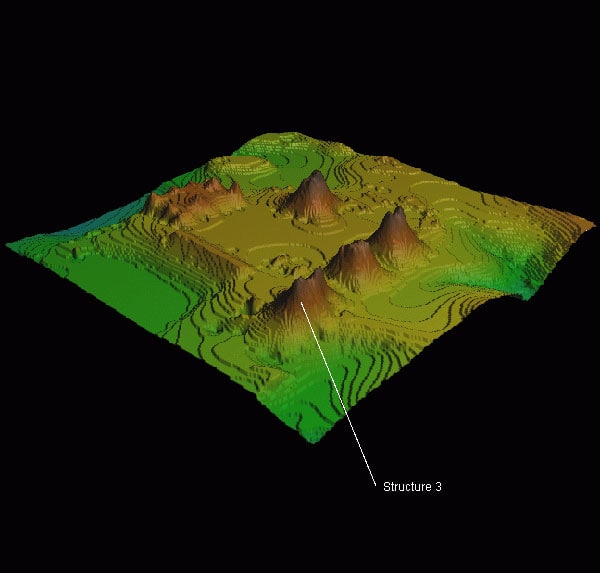
(Courtesy: Francisco Estrada Belli /La Milpa Archaeological Project, Boston University/Norman Hammond and Gair Tourtellot)
The researchers at Mexico’s ancient city of Teotihuacan are not the only group using muons to image pyramids in the Americas. Another team of physicists, led by Roy Schwitters from the University of Texas (UT) at Austin, travelled this summer to a remote Mayan site in Belize where they installed two muon detectors in search of royal tombs. “All over Central America there are things that look like jungle-covered hills, but there are rubble-covered marvellous pyramids underneath that haven’t been exposed at all,” says Schwitters.
The site, called La Milpa, lies in a jungle near the border with Guatemala and Mexico, where the team’s target is a tree-covered mound about 20 m high. Simply named “Structure 3”, it is one of four large structures likely to hold pyramids within. “Mayan pyramids are built like nested dolls – there is one structure inside of the next,” says Fred Valdez, an archaeologist from UT Austin who is in charge of the site and is collaborating with Schwitters’ team. “The detector will allow us to see internal walls and internal staircases; it may detect voids or holes within the structure, and if they are sizeable, they might represent tombs.”
Mayan pyramids typically contain royal tombs, but in La Milpa, the third-largest Mayan site in Belize, archaeologists have yet to find any. “We know there are tombs in these buildings; the question is: where are they located?” asks Valdez. Tombs are often discovered by sheer luck, with archaeologists at La Milpa unable to use standard technologies such as ground-penetrating radar that require flat terrains free from rocks and roots to operate. But by using “muon-tomography” (a 3D version of tomography – see main text), which suits large volumes and uneven terrains, archaeologists will find out exactly where to look.
The two pyramids that have been imaged using muons previously – the Chephren and Sun pyramids – have tunnels running underneath or inside them, in which the detector was placed. Structure 3 does not have such a tunnel, so instead, Schwitters’ team placed two solar-powered detectors – each the size of a large household boiler – in trenches either side of the mound. Each detector will collect muons crossing sideways through the pyramid, and once the data are put together they will create a stereographic 3D image of its internal structure. The system is fully stand-alone because the local climate is so rainy that the team can work on-site only during a single eight-week window each year. The researchers plan to return to collect their first data in 2015.
Things are winding down for the holidays at Physics World and we are all looking forward to recharging our batteries before we get stuck in to all the exciting physics that is sure to come our way in 2015.
If you are like me, you probably haven’t finished your Christmas shopping so here are a few suggestions that are sure to get a smile out of the physicists in your life. In the above video, author and scientist Neil Downie recommends a few traditional gifts as well as several quirky presents. I’m not sure that many people have a retort stand on their wish list, but I would certainly welcome a multimeter if I didn’t own one already.
The science story of 2014, which Physics World picked as its Breakthrough of the Year, simply had to be the successful landing of a man-made probe onto a comet, for the first time. Philae dropped on to comet 67P/Churyumov–Gerasimenko in November after a 10-year journey aboard the Rosetta craft – triggering scenes of wild jubilation among scientists and engineers at the European Space Agency (ESA), who had lived through a nail-biting final hour as they waited for radio signals to travel the 511 million kilometres from the comet to Earth after its scheduled landing time. Data from the mission are likely to keep astronomers busy for years to come, including signs that water on Earth came not from comets, as was previously thought, but from asteroids.
In fact, 2014 was quite a year for space science, with India putting its Mangalyaan craft in orbit around Mars for the first time and Japan launching the country’s second asteroid sample-return mission, Hayabusa 2. Further new findings also came in from the Planck mission, confirming the standard model of cosmology and further constraining what dark matter could be. But what of 2015? What will be the key events in physics and who will have taken the accolades in 12 months’ time?
Let there be light
One thing we know for sure is that 2015 has been officially designated the International Year of Light and Light-based Technologies (IYL). Designed to highlight how light touches every aspect of our lives, the IYL will involve more than 100 partners from 85 countries – including the Institute of Physics, which publishes Physics World. A string of events will take place across the globe next year, ranging from the Story of Light Festival in Goa, India, to Worldwide Pinhole Photography Day, and much more besides.
The year has been picked to celebrate light because it marks a number of anniversaries, including 1000 years since the publication of the work on optics by Ibn al-Haytham, during the Islamic Golden Age. Next year is also the bicentenary of Augustin-Jean Fresnel’s paper introducing the notion of the wave nature of light, 150 years since James Clerk Maxwell’s work on electromagnetism that paved the way for everything from lasers to mobile phones, as well as the centenary of Einstein’s equations of general relativity – the latter having a series of special events of its own.
The IYL kicks off formally next month at an official opening ceremony at the headquarters of the United Nations Educational, Scientific and Cultural Organization (UNESCO) in Paris. Physics World, which is an official media partner for the IYL, will be reporting from the event, where we will also be launching a special, free-to-read digital collection of the magazine containing our 10 best light-related features of all time. Selecting the 10 articles was hard but great fun – so stay tuned for more details about how to access that issue.
Hunting high and low
Elsewhere next year, over at the CERN particle-physics lab in Geneva, physicists and engineers are set to restart the Large Hadron Collider (LHC) and its main experiments ALICE, ATLAS, CMS and LHCb, following a major maintenance and upgrade programme that finished last June. After a long fallow period, the LHC has now been cooled to near its operating temperature of 1.9 K, and the first proton beams are expected to be circulated round the 27 km-long collider in March. Researchers then plan to collide protons together at energies of 13 TeV, just short of the LHC’s design energy of 14 TeV, in May. Previously, the LHC operated with collision energies of just 7 TeV, or 3.5 TeV per beam.
Following a long maintenance and upgrade programme, the Large Hadron Collider will fire up in March, with the aim of colliding particles at a total energy of 13 TeV. (Courtesy: CERN)
In “Run 2” at the revamped LHC, CERN scientists will be able to study the Higgs boson, which was discovered at the lab in 2012, in greater detail than has been possible so far, with the number of Higgs bosons produced expected to increase by an order of magnitude in total. The upgrade could also shed light on the nature of dark matter and why there is so much more matter than antimatter in the universe. Run 2 could also yield possible evidence for “supersymmetry”, which predicts that for every fundamental particle we know about, there should be so-far-undiscovered “superpartner” particle with subtly different properties. Next year will also see current CERN boss Rolf-Dieter Heuer start handing over the reins to his successor Fabiola Gianotti, before she takes over in 2016.
Away from CERN, 2015 will see a series of fascinating missions in space science and astronomy bearing fruit. After many years’ planning, ESA-led researchers have set a launch date of July for the Lisa Pathfinder mission, which will test the technology needed to develop future space-borne gravitational wave detectors. Another ESA craft due to blast off in July 2015 is ADM-Aeolus, which will monitor Earth’s winds. The Japanese space agency, JAXA, also has plans to launch its Astro-H X-ray telescope, while in March NASA is set to launch the Magnetospheric Multiscale (MMS) to study the mystery of how magnetic fields around Earth connect and disconnect, explosively releasing energy through “magnetic reconnection”. We can also expect further interesting insights from the Curiosity rover about possible signs of life on Mars.
Am I hot or not?
But what will be the burgeoning fields of physics in 2015? For some help in answering this question, we can turn to the Research Fronts 2014 report from science-information provider Thomson-Reuters, which identifies the 10 hottest fields in physics, based on citation data. The list is topped by studies of the Higgs boson, followed second by neutrino data analysis, and “nonlinear massive gravity” third. Six of the remaining seven spots in the list are all in condensed-matter physics, including three topics that we have covered a lot on physicsworld.com in recent times – spin-orbit-coupled Fermi gases, graphene plasmonics and topological Mott insulators. Relativistic heavy-ion collisions are in 10th place.
Meanwhile, staff at Altmetric – a London-based firm specializing in “alternative article-level metrics” – have drawn up their annual list of which 100 papers have attracted the most attention online in 2014 (though that does not mean they are necessarily the best). Taking into account all mentions and shares of articles published from November 2013 onwards in mainstream and social media, blogs, post-publication peer-review forums and so on, the list is, sadly for physicists, dominated by research into biology and the life sciences. The highest “physics-y” paper – and even this is stretching the definition quite far – is a paper about dogs being sensitive to small variations of the Earth’s magnetic field. So if you are a physicist who wants your work to get talked about in 2015, our suggestion is to do something involving animals.
Who will be in the news?
So what of the people and personalities in physics? Last year we put our money on Anton Zeilinger from the University of Vienna bagging the Nobel Prize for Physics for his work in quantum computing and communication. We were wrong, as it turned out, but surely 2015 must be the year he finally gets honoured. In fact, Zeilinger’s university is hosting a high-profile event in May on the “quantum physics of nature” that marks numerous anniversaries in the field. Another giant of physics – Stephen Hawking – could well be back in the limelight in March at next year’s Oscars, with the movie The Theory of Everything – which covers his stormy relationship with his first wife Jane – possibly picking up a prize.
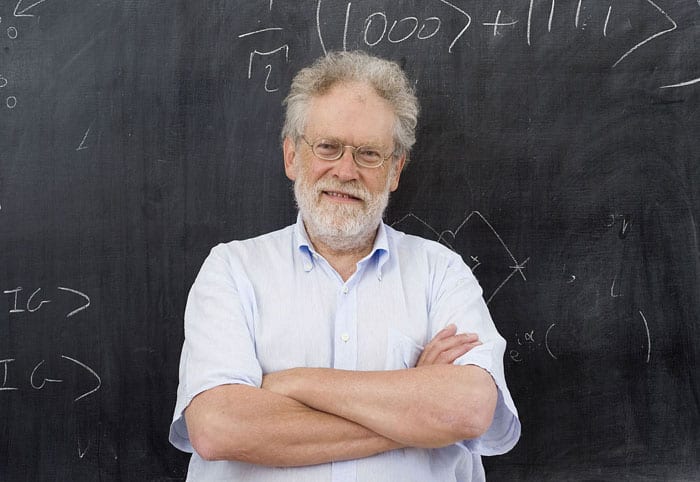
Top effort: will 2015 see Anton Zeilinger win a Nobel prize? Zeilinger is based at the University of Vienna, where a major meeting to celebrate research into quantum physics will be held in May. (CC-SA Jaqueline Godany)
Also likely to make the news are the scientists behind the BICEP2 collaboration, who earlier this year claimed to have seen evidence for primordial gravitational waves and for cosmic inflation. Those early results appear to have been ruled out by researchers on the Planck collaboration, but 2015 could well see the question settled once and for all. There are also sure to be more findings from the Rosetta mission scientists, although hopefully project scientist Matt Taylor will not be wearing that shirt. But we will finish by saying something we say every year, which is that the beauty of physics is that you just do not know what’s around the corner.
As for Physics World, which is published by the Institute of Physics (IOP), we have special issues coming up on light (March), weird natural phenomena (July) and extremes in physics (December). All IOP members can read the magazine online or through our apps and, if you are not already an IOP member, don’t forget to join to get instant access to every issue. We will also be publishing reports on Mexico (September), as well as focus issues on medical imaging (February), nanotechnology (May), optics and photonics (June), vacuum technology (August), neutron scattering (September) and astronomy and space science (December). And, of course, we will be brining you our audio and video programme, including more Google hangouts.
Happy with our predictions? Annoyed at something we missed? Tell us what you think by commenting below.