Physicists in Germany have found an alternative explanation for an anomaly that had previously been interpreted as potential evidence for a mysterious “dark force”. Originally spotted in ytterbium atoms, the anomaly turns out to have a more mundane cause. However, the investigation, which involved high-precision measurements of shifts in ytterbium’s energy levels and the mass ratios of its isotopes, could help us better understand the structure of heavy atomic nuclei and the physics of neutron stars.
Isotopes are forms of an element that have the same number of protons and electrons, but different numbers of neutrons. These different numbers of neutrons produce shifts in the atom’s electronic energy levels. Measuring these so-called isotope shifts is therefore a way of probing the interactions between electrons and neutrons.
In 2020, a team of physicists at the Massachusetts Institute of Technology (MIT) in the US observed an unexpected deviation in the isotope shift of ytterbium. One possible explanation for this deviation was the existence of a new “dark force” that would interact with both ordinary, visible matter and dark matter via hypothetical new force-carrying particles (bosons).
Although dark matter is thought to make up about 85 percent of the universe’s total matter, and its presence can be inferred from the way light bends as it travels towards us from distant galaxies, it has never been detected directly. Evidence for a new, fifth force (in addition to the known strong, weak, electromagnetic and gravitational forces) that acts between ordinary and dark matter would therefore be very exciting.
Measuring ytterbium isotope shifts and atomic masses
Mehlstäubler, Blaum and colleagues came to this conclusion after measuring shifts in the atomic energy levels of five different ytterbium isotopes: 168,170,172,174,176Yb. They did this by trapping ions of these isotopes in an ion trap at the PTB and then using an ultrastable laser to drive certain electronic transitions. This allowed them to pin down the frequencies of specific transitions (2S1/2→2D5/2 and 2S1/2→2F7/2) with a precision of 4 ×10⁻⁹, the highest to date.
They also measured the atomic masses of the ytterbium isotopes by trapping individual highly-charged Yb42+ ytterbium ions in the cryogenic PENTATRAP Penning trap mass spectrometer at the MPIK. In the strong magnetic field of this trap, team member and study lead author Menno Door explains, the ions are bound to follow a circular orbit. “We measure the rotational frequency of this orbit by amplifying the miniscule inducted current in surrounding electrodes,” he says. “The measured frequencies allowed us to very precisely determine the related mass ratios of the various isotopes with a precision of 4 ×10⁻¹².”
From these data, the researchers were able to extract new parameters that describe how the ytterbium nucleus deforms. To back up their findings, a group at TU Darmstadt led by Achim Schwenk simulated the ytterbium nuclei on large supercomputers, calculating their structure from first principles based on our current understanding of the strong and electromagnetic interactions. “These calculations confirmed that the leading signal we measured was due to the evolving nuclear structure of ytterbium isotopes, not a new fifth force,” says team member Matthias Heinz.
“Our work complements a growing body of research that aims to place constraints on a possible new interaction between electrons and neutrons,” team member Chih-Han Yeh tells Physics World. “In our work, the unprecedented precision of our experiments refined existing constraints.”
The researchers say they would now like to measure other isotopes of ytterbium, including rare isotopes with high or low neutron numbers. “Doing this would allow us to control for uncertain ‘higher-order’ nuclear structure effects and further improve the constraints on possible new physics,” says team member Fiona Kirk.
Door adds that isotope chains of other elements such as calcium, tin and strontium would also be worth investigating. “These studies would allow to further test our understanding of nuclear structure and neutron-rich matter, and with this understanding allow us to probe for possible new physics again,” he says.
Located about 40 light years from us, the exoplanet Trappist-1 b, orbiting an ultracool dwarf star, has perplexed astronomers with its atmospheric mysteries. Recent observations made by the James Webb Space Telescope (JWST) at two mid-infrared bands (12.8 and 15 µm), suggest that the exoplanet could either be bare, airless rock like Mercury or shrouded by a hazy carbon dioxide (CO2) atmosphere like Titan.
The research, reported in Nature Astronomy, provides the first thermal emission measurements for Trappist-1 b suggesting two plausible yet contradictory scenarios. This paradox challenges our current understanding of atmospheric models and highlights the need for further investigations – both theoretical and observational.
Scenario one: airless rock
An international team of astronomers, co-led by Elsa Ducrot and Pierre-Olivier Lagage from the Commissariat aux Énergies Atomiques (CEA) in Paris, France, obtained mid-infrared observations for Trappist-1 b for 10 secondary eclipse measurements (recorded as the exoplanet moves behind the star) using the JWST Mid-Infrared Instrument (MIRI). They recorded emission data at 12.8 and 15 µm and compared the findings with various surface and atmospheric models.
The thermal emission at 15 µm corresponded with Trappist-1 b being almost null-albedo bare rock; however, the emission at 12.8 µm refuted this model. At this wavelength, the exoplanet’s measured flux was most consistent with the surface model of an igneous, low-silica-content rock called ultramafic rock. The model assumes the surface to be geologically unweathered.
Trappist-1 b, the innermost planet in the Trappist-1 system, experiences strong tidal interaction and induction heating from its host star. This could trigger volcanic activity and continuous resurfacing, which could lead to a young surface like that of Jupiter’s volcanic moon Io. The researchers argue that these scenarios support the idea that Trappist-1 b is an airless rocky planet with a young ultramafic surface.
The team next explored atmospheric models for the exoplanet, which unfolded a different story.
Scenario two: haze-rich CO2 atmosphere
Ducrot and colleagues fitted the measured flux data with hazy atmospheric models centred around 15 µm. The results showed that Trappist-1 b could have a thick CO2-rich atmosphere with photochemical haze, but with a twist. For an atmosphere dominated by greenhouse gases such as CO2, which is strongly absorbing, temperature is expected to increase with increasing pressure (at lower levels). Consequently, they anticipated the brightness temperature should be lower at 15 µm (which measures temperature high in the atmosphere) than at 12.8 µm. But the observations showed otherwise. They proposed that this discrepancy could be explained by a thermal inversion, where the upper atmosphere has higher temperature than the layers below.
In our solar system, Titan’s atmosphere also shows thermal inversion due to heating through haze absorption. Haze is an efficient absorber of stellar radiation. Therefore, it could absorb radiation high up in the atmosphere, leading to heating of the upper atmosphere and cooling of the lower atmosphere. Indeed, this model is consistent with the team’s measurements. However, this leads to another plausible question: what forms this haze?
Trappist-1 b’s close proximity to Trappist-1 and the strong X-ray and ultraviolet radiation from the host star could create haze in the exoplanet’s atmosphere via photodissociation. While Titan’s hydrocarbon haze arises from photodissociation of methane, the same is not possible for Trappist-1 b as methane and CO2 cannot coexist photochemically and thermodynamically.
One plausible scenario is that the photochemical haze forms due to the presence of hydrogen sulphide (H2S). The volcanic activity in an oxidized, CO2-dominated atmosphere could supply H2S, but it is unlikely that it could sustain the levels needed for the haze. Additionally, as the innermost planet around an active star, Trappist-1 b is subjected to constant space weathering, raising the question of the sustainability of its atmosphere.
The researchers note that although the modelled atmospheric scenario appears less plausible than the airless bare-rock model, more theoretical and experimental work is needed to create a conclusive model.
What is the true nature of Trappist-1 b?
The two plausible surface and atmospheric models for Trappist-1 b provide an enigma. How could a planet be simultaneously an airless, young ultramafic rock and have a haze-filled CO2-rich atmosphere? The resolution might come not from theoretical models but from additional measurements.
Currently, the available data only capture the dayside thermal flux within two infrared bands, which proved insufficient to decisively distinguish between an airless surface and a CO₂-rich atmosphere. To solve this planetary paradox, astronomers advocate for broader spectral coverage and photometric phase curve measurements to help explain heat redistribution patterns essential for atmospheric confirmation.
JWST’s observations of Trappist-1 b demonstrate its power to precisely detect thermal emissions from exoplanets. However, the contradictory interpretations of the data highlight its limitations too and emphasize the need for higher resolution spectroscopy. With only two thermal flux measurements insufficient to give a precise answer, future JWST observations of Trappist-1 b might uncover its true picture.
Co-author Michaël Gillon, an astrophysicist at the University of Liège, emphasizes the importance of the results. “The agreement between our two measurements of the planet’s dayside fluxes at 12.8 and 15 microns and a haze-rich CO2-dominated atmosphere is an important finding,” he tells Physics World. “It shows that dayside flux measurements in one or a couple of broadband filters is not enough to fully discriminate airless versus atmosphere models. Additional phase curve and transit transmission data are necessary, even if for the latter, the interpretation of the measurements is complicated by the inhomogeneity of the stellar surface.”
For now, TRAPPIST-1 b hides its secrets, either standing as airless barren world scorched by its star or hidden underneath a hazy thick CO2 veil.
Last year the UK government placed a new cap of £9535 on annual tuition fees, a figure that will likely rise in the coming years as universities tackle a funding crisis. Indeed, shortfalls are already affecting institutions, with some saying they will run out of money in the next few years. The past couple of months alone have seen several universities announce plans to shed academic staff and even shut departments.
Whether you agree with tuition fees or not, the fact is that students will continue to pay a significant sum for a university education. Value for money is part of the university proposition and lecturers can play a role by conveying the excitement of their chosen field. But what are the key requirements to help do so? In the late 1990s we carried out a study aimed at improving the long-term performance of students who initially struggled with university-level physics.
With funding from the Higher Education Funding Council for Wales, the study involved structured interviews with 28 students and 17 staff. An internal report – The Rough Guide to Lecturing – was written which, while not published, informed the teaching strategy of Cardiff University’s physics department for the next quarter of a century.
From the findings we concluded that lecture courses can be significantly enhanced by simply focusing on three principles, which we dub the three “E”s. The first “E” is enthusiasm. If a lecturer appears bored with the subject – perhaps they have given the same course for many years – why should their students be interested? This might sound obvious, but a bit of reading, or examining the latest research, can do wonders to freshen up a lecture that has been given many times before.
For both old and new courses it is usually possible to highlight at least one research current paper in a semester’s lectures. Students are not going to understand all of the paper, but that is not the point – it is the sharing in contemporary progress that will elicit excitement. Commenting on a nifty experiment in the work, or the elegance of the theory, can help to inspire both teacher and student.
As well as freshening up the lecture course’s content, another tip is to mention the wider context of the subject being taught, perhaps by mentioning its history or possible exciting applications. Be inventive –we have evidence of a lecturer “live” translating parts of Louis de Broglie’s classic 1925 paper “La relation du quantum et la relativité” during a lecture. It may seem unlikely, but the students responded rather well to that.
Supporting students
The second “E” is engagement. The role of the lecturer as a guide is obvious, but it should also be emphasized that the learner’s desire is to share the lecturer’s passion for, and mastery of, a subject. Styles of lecturing and visual aids can vary greatly between people, but the important thing is to keep students thinking.
Don’t succumb to the apocryphal definition of a lecture as only a means of transferring the lecturer’s notes to the student’s pad without first passing through the minds of either person. In our study, when the students were asked “What do you expect from a lecture?”, they responded simply to learn something new, but we might extend this to a desire to learn how to do something new.
Simple demonstrations can be effective for engagement. Large foam dice, for example, can illustrate the non-commutation of 3D rotations. Fidget-spinners in the hands of students can help explain the vector nature of angular momentum. Lecturers should also ask rhetorical questions that make students think, but do not expect or demand answers, particularly in large classes.
More importantly, if a student asks a question, never insult them – there is no such thing as a “stupid” question. After all, what may seem a trivial point could eliminate a major conceptual block for them. If you cannot answer a technical query, admit it and say you will find out for next time – but make sure you do. Indeed, seeing that the lecturer has to work at the subject too can be very encouraging for students.
The final “E” is enablement. Make sure that students have access to supporting material. This could be additional notes; a carefully curated reading list of papers and books; or sets of suitable interesting problems with hints for solutions, worked examples they can follow, and previous exam papers. Explain what amount of self-study will be needed if they are going to benefit from the course.
Have clear and accessible statements concerning the course content and learning outcomes – in particular, what students will be expected to be able to do as a result of their learning. In our study, the general feeling was that a limited amount of continuous assessment (10–20% of the total lecture course mark) encourages both participation and overall achievement, provided students are given good feedback to help them improve.
Next time you are planning to teach a new course, or looking through those decades-old notes, remember enthusiasm, engagement and enablement. It’s not rocket science, but it will certainly help the students learn it.
Orthopaedic implants that bear loads while bones heal, then disappear once they’re no longer needed, could become a reality thanks to a new technique for enhancing the mechanical properties of zinc alloys. Developed by researchers at Monash University in Australia, the technique involves controlling the orientation and size of microscopic grains in these strong yet biodegradable materials.
Implants such as plates and screws provide temporary support for fractured bones until they knit together again. Today, these implants are mainly made from sturdy materials such as stainless steel or titanium that remain in the body permanently. Such materials can, however, cause discomfort and bone loss, and subsequent injuries to the same area risk additional damage if the permanent implants warp or twist.
To address these problems, scientists have developed biodegradable alternatives that dissolve once the bone has healed. These alternatives include screws made from magnesium-based materials such as MgYREZr (trade name MAGNEZIX), MgYZnMn (NOVAMag) and MgCaZn (RESOMET). However, these materials have compressive yield strengths of just 50 to 260 MPa, which is too low to support bones that need to bear a patient’s weight. They also produce hydrogen gas as they degrade, possibly affecting how biological tissues regenerate.
Zinc alloys do not suffer from the hydrogen gas problem. They are biocompatible, dissolving slowly and safely in the body. There is even evidence that Zn2+ ions can help the body heal by stimulating bone formation. But again, their mechanical strength is low: at less than 30 MPa, they are even worse than magnesium in this respect.
Making zinc alloys strong enough for load-bearing orthopaedic implants is not easy. Mechanical strategies such as hot-extruding binary alloys have not helped much. And methods that focus on reducing the materials’ grain size (to hamper effects like dislocation slip) have run up against a discouraging problem: at body temperature (37 °C), ultrafine-grained Zn alloys become mechanically weaker as their so-called “creep resistance” decreases.
Grain size goes bigger
In the new work, a team led by materials scientist and engineer Jian-Feng Nei tried a different approach. By increasing grain size in Zn alloys rather than decreasing it, the Monash team was able to balance the alloys’ strength and creep resistance – something they say could offer a route to stronger zinc alloys for biodegradable implants.
In compression tests of extruded Zn–0.2 wt% Mg alloy samples with grain sizes of 11 μm, 29 μm and 47 μm, the team measured stress-strain curves that show a markedly higher yield strength for coarse-grained samples than for fine-grained ones. What is more, the compressive yield strengths of these coarser-grained zinc alloys are notably higher than those of MAGNEZIX, NOVAMag and RESOMET biodegradable magnesium alloys. At the upper end, they even rival those of high-strength medical-grade stainless steels.
The researchers attribute this increased compressive yield to a phenomenon called the inverse Hall–Petch effect. This effect comes about because larger grains favour metallurgical effects such as intra-granular pyramidal slip as well as a variation of a well-known metal phenomenon called twinning, in which a specific kind of defect forms when part of the material’s crystal structure flips its orientation. Larger grains also make the alloys more flexible, allowing them to better adapt to surrounding biological tissues. This is the opposite of what happens with smaller grains, which facilitate inter-granular grain boundary sliding and make alloys more rigid.
The new work, which is detailed in Nature, could aid the development of advanced biodegradable implants for orthopaedics, cardiovascular applications and other devices, says Nei. “With improved biocompatibility, these implants could be safer and do away with the need for removal surgeries, lowering patient risk and healthcare costs,” he tells Physics World. “What is more, new alloys and processing techniques could allow for more personalized treatments by tailoring materials to specific medical needs, ultimately improving patient outcomes.”
The Monash team now aims to improve the composition of the alloys and achieve more control over how they degrade. “Further studies on animals and then clinical trials will test their strength, safety and compatibility with the body,” says Nei. “After that, regulatory approvals will ensure that the biodegradable metals meet medical standards for orthopaedic implants.”
The team is also setting up a start-up company with the goal of developing and commercializing the materials, he adds.
Researchers in China have unveiled a 105-qubit quantum processor that can solve in minutes a quantum computation problem that would take billions of years using the world’s most powerful classical supercomputers. The result sets a new benchmark for claims of so-called “quantum advantage”, though some previous claims have faded after classical algorithms improved.
The fundamental promise of quantum computation is that it will reduce the computational resources required to solve certain problems. More precisely, it promises to reduce the rate at which resource requirements grow as problems become more complex. Evidence that a quantum computer can solve a problem faster than a classical computer – quantum advantage – is therefore a key measure of success.
The first claim of quantum advantage came in 2019, when researchers at Google reported that their 53-qubit Sycamore processor had solved a problem known as random circuit sampling (RCS) in just 200 seconds. Xiaobu Zhu, a physicist at the University of Science and Technology of China (USTC) in Hefei who co-led the latest work, describes RCS as follows: “First, you initialize all the qubits, then you run them in single-qubit and two-qubit gates and finally you read them out,” he says. “Since this process includes every key element of quantum computing, such as initializing the gate operations and readout, unless you have really good fidelity at each step you cannot demonstrate quantum advantage.”
At the time, the Google team claimed that the best supercomputers would take 10::000 years to solve this problem. However, subsequent improvements to classical algorithms reduced this to less than 15 seconds. This pattern has continued ever since, with experimentalists pushing quantum computing forward even as information theorists make quantum advantage harder to achieve by improving techniques used to simulate quantum algorithms on classical computers.
Recent claims of quantum advantage
In October 2024, Google researchers announced that their 67-qubit Sycamore processor had solved an RCS problem that would take an estimated 3600 years for the Frontier supercomputer at the US’s Oak Ridge National Laboratory to complete. In the latest work, published in Physical Review Letters, Jian-Wei Pan, Zhu and colleagues set the bar even higher. They show that their new Zuchongzhi 3.0 processor can complete in minutes an RCS calculation that they estimate would take Frontier billions of years using the best classical algorithms currently available.
To achieve this, they redesigned the readout circuit of their earlier Zuchongzhi processor to improve its efficiency, modified the structures of the qubits to increase their coherence times and increased the total number of superconducting qubits to 105. “We really upgraded every aspect and some parts of it were redesigned,” Zhu says.
Google’s latest processor, Willow, also uses 105 superconducting qubits, and in December 2024 researchers there announced that they had used it to demonstrate quantum error correction. This achievement, together with complementary advances in Rydberg atom qubits from Harvard University’s Mikhail Lukin and colleagues, was named Physics World’s Breakthrough of the Year in 2024. However, Zhu notes that Google has not yet produced any peer-reviewed research on using Willow for RCS, making it hard to compare the two systems directly.
The USTC team now plans to demonstrate quantum error correction on Zuchongzhi 3.0. This will involve using an error correction code such as the surface code to combine multiple physical qubits into a single “logical qubit” that is robust to errors. “The requirements for error-correction readout are much more difficult than for RCS,” Zhu notes. “RCS only needs one readout, whereas error-correction needs readout many times with very short readout times…Nevertheless, RCS can be a benchmark to show we have the tools to run the surface code. I hope that, in my lab, within a few months we can demonstrate a good-quality error correction code.”
“How progress gets made”
Quantum information theorist Bill Fefferman of the University of Chicago in the US praises the USTC team’s work, describing it as “how progress gets made”. However, he offers two caveats. The first is that recent demonstrations of quantum advantage do not have efficient classical verification schemes – meaning, in effect, that classical computers cannot check the quantum computer’s work. While the USTC researchers simulated a smaller problem on both classical and quantum computers and checked that the answers matched, Fefferman doesn’t think this is sufficient. “With the current experiments, at the moment you can’t simulate it efficiently, the verification doesn’t work anymore,” he says.
The second caveat is that the rigorous hardness arguments proving that the classical computational power needed to solve an RCS problem grows exponentially with the problem’s complexity apply only to situations with no noise. This is far from the case in today’s quantum computers, and Fefferman says this loophole has been exploited in many past quantum advantage experiments.
Still, he is upbeat about the field’s prospects. “The fact that the original estimates the experimentalists gave did not match some future algorithm’s performance is not a failure: I see that as progress on all fronts,” he says. “The theorists are learning more and more about how these systems work and improving their simulation algorithms and, based on that, the experimentalists are making their systems better and better.”
Sometimes, you just have to follow your instincts and let serendipity take care of the rest.
North Ronaldsay, a remote island north of mainland Orkney, has a population of about 50 and a lot of sheep. In the early 19th century, it thrived on the kelp ash industry, producing sodium carbonate (soda ash), potassium salts and iodine for soap and glass making.
But when cheaper alternatives became available, the island turned to its unique breed of seaweed-eating sheep. In 1832 islanders built a 12-mile-long dry stone wall around the island to keep the sheep on the shore, preserving inland pasture for crops.
My connection with North Ronaldsay began last summer when my partner, Sue Bowler, and I volunteered for the island’s Sheep Festival, where teams of like minded people rebuild sections of the crumbling wall. That experience made us all the more excited when we learned that North Ronaldsay also had a science festival.
This year’s event took place on 14–16 March and getting there was no small undertaking. From our base in Leeds, the journey involved a 500-mile drive to a ferry, a crossing to Orkney mainland, and finally, a flight in a light aircraft. With just 50 inhabitants, we had no idea how many people would turn up but instinct told us it was worth the trip.
Sue, who works for the Royal Astronomical Society (RAS), presented Back to the Moon, while together we ran hands-on maker activities, a geology walk and a trip to the lighthouse, where we explored light beams and Fresnel lenses.
The Yorkshire Branch of the Institute of Physics (IOP) provided laser-cut hoist kits to demonstrate levers and concepts like mechanical advantage, while the RAS shared Connecting the Dots – a modern LED circuit version of a Victorian after-dinner card set illustrating constellations.
Hands-on science Participants get stuck into maker activities at the festival. (Courtesy: @Lazy.Photon on Instagram)
Despite the island’s small size, the festival drew attendees from neighbouring islands, with 56 people participating in person and another 41 joining online. Across multiple events, the total accumulated attendance reached 314.
One thing I’ve always believed in science communication is to listen to your audience and never make assumptions. Orkney has a rich history of radio and maritime communications, shaped in part by the strategic importance of Scapa Flow during the Second World War.
Stars in their eyes Making a constellation board at the North Ronaldsay Science Festival. (Courtesy: @Lazy.Photon on Instagram)
The Orkney Wireless Museum is a testament to this legacy, and one of our festival guests had even reconstructed a working 1930s Baird television receiver for the museum.
Leaving North Ronaldsay was hard. The festival sparked fascinating conversations, and I hope we inspired a few young minds to explore physics and astronomy.
The author would like to thanks Alexandra Wright (festival organizer), Lucinda Offer (education, outreach and events officer at the RAS) and Sue Bowler (editor of Astronomy & Geophysics)
I’m standing next to Yang Fugui in front of the High Energy Photon Source (HEPS) in Beijing’s Huairou District about 50 km north of the centre of the Chinese capital. The HEPS isn’t just another synchrotron light source. It will, when it opens later this year, be the world’s most advanced facility of its type. Construction of this giant device started in 2019 and for Yang – a physicist who is in charge of designing the machine’s beamlines – we’re at a critical point.
“This machine has many applications, but now is the time to make sure it does new science,” says Yang, who is a research fellow at the Institute of High Energy Physics (IHEP) of the Chinese Academy of Sciences (CAS), which is building the new machine. With the ring completed, optimizing the beamlines will be vital if the facility is to open up new research areas.
From the air – Google will show you photos – the HEPS looks like a giant magnifying glass lying in a grassy field. But I’ve come by land, and from my perspective it resembles a large and gleaming low-walled silver sports stadium, surrounded by well-kept bushes, flowers and fountains.
I was previously in Beijing in 2019 at the time ground for the HEPS was broken when the site was literally a green field. Back then, I was told, the HEPS would take six-and-a-half years to build. We’re still on schedule and, if all continues to run as planned, the facility will come online in December 2025.
Lighting up the world
There are more than 50 synchrotron radiation sources around the world, producing intense, coherent beams of electromagnetic radiation used for experiments in everything from condensed-matter physics to biology. Three significant hardware breakthroughs, one after the other, have created natural divisions among synchrotron sources, leading them to be classed by their generation.
Along with Max IV in Sweden, SIRIUS in Brazil and the Extremely Brilliant Source at the European Synchrotron Radiation Facility (ESRF) in France, the HEPS is a fourth-generation source. These days such devices are vital and prestigious pieces of scientific infrastructure, but synchrotron radiation began life as an unexpected nuisance (Phys. Perspect. 10 438).
Classical electrodynamics says that charged particles undergoing acceleration – changing their momentum or velocity – radiate energy tangentially to their trajectories. Early accelerator builders assumed they could ignore the resulting energy losses. But in 1947, scientists building electron synchrotrons at the General Electric (GE) Research Laboratory in Schenectady, New York, were dismayed to find the phenomenon was real, sapping the energies of their devices.
Where it all began Synchrotron light is created whenever charged particles are accelerated. It gets its name because it was first observed in 1947 by scientists at the General Electric Research Laboratory in New York, who saw a bright speck of light through their synchrotron accelerator’s glass vacuum chamber – the visible portion of that energy. (Courtesy: AIP Emilio Segrè Visual Archives, John P Blewett Collection)
Nuisances of physics, however, have a way of turning into treasured tools. By the early 1950s, scientists were using synchrotron light to study absorption spectra and other phenomena. By the mid-1960s, they were using it to examine the surface structures of materials. But a lot of this work was eclipsed by seemingly much sexier physics.
High-energy particle accelerators, such as CERN’s Proton Synchrotron and Brookhaven’s Alternating Gradient Synchrotron, were regarded as the most exciting, well-funded and biggest instruments in physics. They were the symbols of physics for politicians, press and the public – the machines that studied the fundamental structure of the world.
Researchers who had just discovered the uses of synchrotron light were forced to scrape parts for their instruments. These “first-generation” synchrotrons, such as “Tantalus” in Wisconsin, the Stanford Synchrotron Radiation Project in California, and the Cambridge Electron Accelerator in Massachusetts, were cobbled together from discarded pieces of high energy accelerators or grafted onto them. They were known as “parasites”.
Early adopter A drawing of plans for the Stanford Synchrotron Radiation Project in the US, which became one of the “first generation” of dedicated synchrotron-light sources when it opened in 1974. (Courtesy: SLAC – Zawojski)
In the 1970s, accelerator physicists realized that synchrotron sources could become more useful by shrinking the angular divergence of the electron beam, thereby improving the “brightness”. Renate Chasman and Kenneth Green devised a magnet array to maximize this property. Dubbed the “Chasman–Green lattice”, it begat a second-generation of dedicated light sources, built not borrowed.
Hard on the heels of Synchrotron Radiation Light Source, which opened in the UK in 1981, the National Synchrotron Light Source (NSLS I) at Brookhaven was the first second-generation source to use such a lattice. China’s oldest light source, the Beijing Synchrotron Radiation Facility, which opened to users in Beijing early in 1991, had a Chasman–Green lattice but also had to skim photons off an accelerator; it was a first-generation machine with a second-generation lattice. China’s first fully second-generation machine was the Hefei Light Source, which opened later that year.
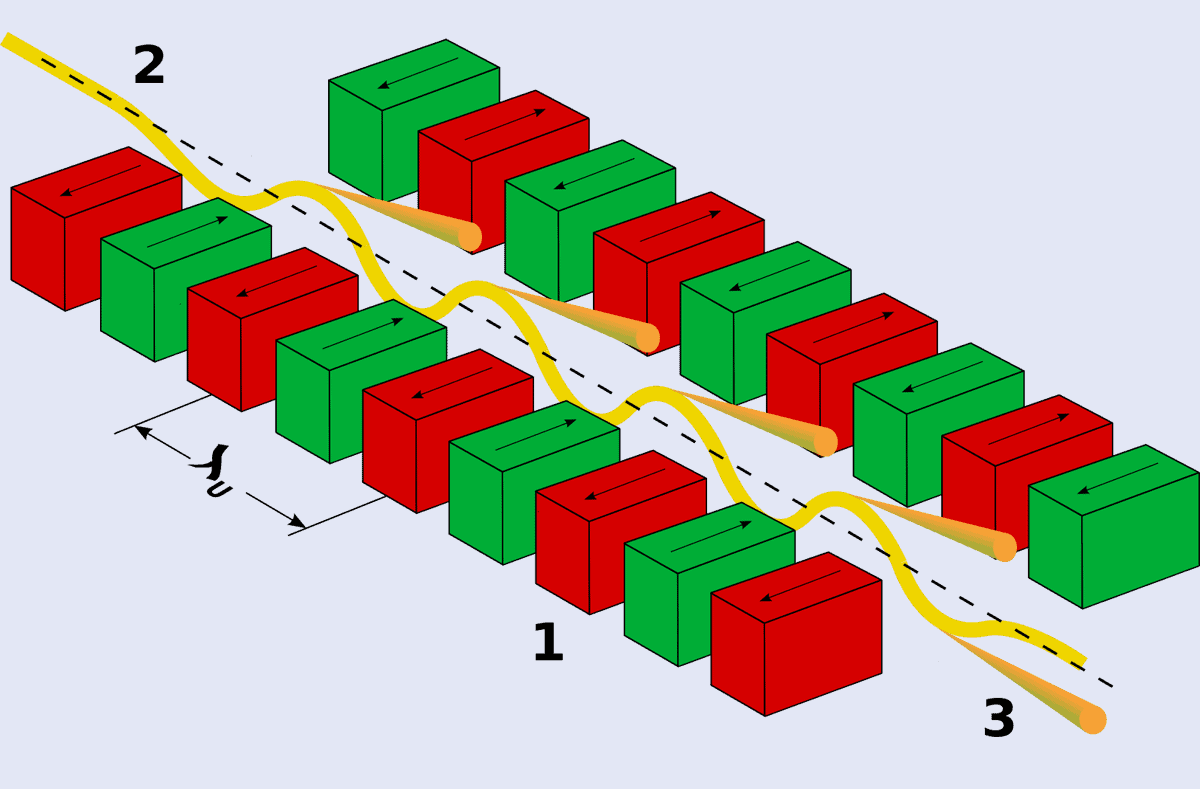
By then instruments called “undulators” were already starting to be incorporated into light sources. They increased brightness hundreds-fold, doing so by wiggling the electron beam up and down, causing a coherent addition of electron field through each wiggle. While undulators had been inserted into second-generation sources, the third generation built them in from the start.
Bright thinking Consisting of a periodic array of dipole magnets (red and green blocks), undulators have a static magnetic field that alternates with a wavelength λu. An electron beam passing through the magnets is forced to oscillate, emitting light hundreds of times brighter than would otherwise be possible (orange). Such undulators were added to second-generation synchrotron sources – but third-generation facilities had them built in from the start. (Courtesy: Creative Commons Attribution-Share Alike 3.0 Bastian Holst)
The first of these light sources was the ESRF, which opened to users in 1994. It was followed by the Advanced Photon Source (APS) at Argonne National Laboratory in 1995 and SPring-8 in Japan in 1999. The first third-generation source on the Chinese mainland was the Shanghai Synchrotron Radiation Facility, which opened in 2009.
In the 2010s, “multi-bend achromat” magnets drastically shrank the size of beam elements, further increasing brilliance. Several third generation machines, including the APS, have been upgraded with achromats, turning third-generation machines into fourth. SIRIUS, which has an energy of 3 GeV, was the first fourth-generation machine to be built from scratch.
Next in sequence The Advanced Photon Source at the Argonne National Laboratory in the US, which is a third-generation synchrotron-light source. (Courtesy: Argonne National Laboratory)
Set to operate at 6 GeV, the HEPS will be the first high-energy fourth-generation machine built from scratch. It is a step nearer to the “diffraction limit” that’s ultimately imposed by the way the uncertainty principle limits the simultaneous specification of certain properties. It makes further shrinking of the beam possible – but only at the expense of lost brilliance. That limit is still on the horizon, but the HEPS draws it closer.
The HEPS is being built next to a mountain range north of Beijing, where the bedrock provides a stable platform for the extraordinarily sensitive beams. Next door to the HEPS is a smaller stadium-like building for experimental labs and offices, and a yet smaller building for housing behind that.
Staff at the HEPS successfully stored the machine’s first electron beam in August 2024 and are now enhancing and optimizing parameters such as electron beam current strength and lifetime. When it opens at the end of the year, the HEPS will have 14 beamlines but is designed eventually to have around 90 experimental stations. “Our task right now is to build more beamlines” Yang told me.
Looking around
After studying physics at the University of Science and Technology in Hefei, Yang’s first job was as a beamline designer at the HEPS. On my visit, the machine was still more than a year from being operational and the experimental hall surrounding the ring was open. It is spacious unlike of many US light sources I’ve been to, which tend to be crammed due to numerous upgrades of the machine and beamlines.
As with any light source, the main feature of the HEP is its storage ring, which consists of alternating straight sections and bends. At the bends, the electrons shed X-rays like rain off a spinning umbrella. Intense, energetic and finely tunable, the X-rays are carried off down beamlines, where are they made useful for almost everything from materials science to biomedicine.
New science Fourth-generation sources, such as the High Energy Photon Source (HEPS), need to attract academic and business users from home and abroad. But only time will tell what kind of new science might be made possible. (Courtesy: IHEP)
We pass other stations optimized for 2D, 3D and nanoscale structures. Occasionally, a motorized vehicle loaded with equipment whizzes by, or workers pass us on bicycles. Every so often, I see an overhead red banner in Chinese with white lettering. Translating, Yang says the banners promote safety, care and the need for precision in doing high-quality work, signs of the renowned Chinese work ethic.
We then come to what is labelled a “pink” beam. Unlike a “white” beam, which has a broad spread of wavelengths, or a monochromatic beam of a very specific colour such as red, a pink beam has a spread of wavelengths that are neither broad nor narrow. This allows a much broader flux – typically two orders of magnitude more than a monochromatic beam – allowing a researcher fast diffraction patterns.
Another beamline, meanwhile, is labelled “tender” because its energy falls between 2 keV (“soft” X-rays) and 10 keV (“hard” X-rays). It’s for materials “somewhere between grilled steak and Jell-O” one HEPS researcher quips to me, referring to the wobbly American desert. A tender beam is for purposes that don’t require atomic-scale resolution, such as the magnetic behaviour of atoms.
Three beam pipes pass over the experimental hall to end stations that lie outside the building. They will be used, among other things, for applications in nanoscience, with a monochromator throwing out much of the X-ray beam to make it extremely coherent. We also pass a boxy, glass structure that is a clean room for making parts, as well as a straight pipe about 100 m long that will be used to test tiny vibrations in the Earth that might affect the precision of the beam.
Challenging times
I once spoke to one director of the NSLS, who would begin each day by walking around that facility, seeing what the experimentalists were up to and asking if they needed help. His trip usually took about 5–10 minutes; my tour with Yang took an hour.
But fourth-generation sources, such as the HEPS, face two daunting challenges. One is to cultivate a community of global users. Nearby the HEPS is CAS’s new Yanqi Lake campus, which lies on the other side of the mountains from Beijing, from where I can see the Great Wall meandering through the nearby hills. Faculty and students at CAS will form part of academic users of the HEPS, but how will the lab bring in researchers from abroad?
The HEPS will also need to get in users from business, convincing companies of the value of their machine. SPring-8 in Japan has industrial beamlines, including one sponsored by car giant Toyota, while China’s Shanghai machine has beamlines built by the China Petroleum and Chemical Corporation (Sinopec).
Yang is certainly open to collaboration with business partners. “We welcome industries, and can make full use of the machine, that would be enough,” he says. “If they contribute to building the beamlines, even better.”
The other big challenge for fourth-generation sources is to discover what new things are made possible by the vastly increased flux and brightness. A new generation of improved machines doesn’t necessarily produce breakthrough science; it’s not like one can turn on a machine with greater brightness and a field of new capabilities unfolds before you.
Going fourth The BM18 beamline on the Extremely Brilliant Source (EBS) at the European Synchrotron Radiation Facility (ESRF) in Grenoble, France. The EBS is a dedicated fourth-generation light source, with the BM18 beamline being ideal for monitoring very slowly changing systems. (Courtesy: ESRF)
Instead, what can happen is that techniques that are demonstrations or proof-of-concept research in one generation of synchrotron become applied in niche areas in the next, but become routine in the generation after that. A good example is speckle spectrometry – an interference-based technique that needs a sufficiently coherent light source – that should become widely used at fourth-generation sources like HEPS.
For the HEPS, the challenge will be to discover what new research in materials, chemistry, engineering and biomedicine these techniques will make possible. Whenever I ask experimentalists at light sources what kinds of new science the fourth-generation machines will allow, the inevitable answer is something like, “Ask me in 10 years!”
Yang can’t wait that long. “I started my career here,” he says, gesturing excitedly to the machine. “Now is the time – at the beginning – to try to make this machine do new science. If it can, I’ll end my career here!”
Cell separation Illustration of the fabricated optimal acousto-microfluidic chip. (Courtesy: Afshin Kouhkord and Naserifar Naser)
Analysing circulating tumour cells (CTCs) in the blood could help scientists detect cancer in the body. But separating CTCs from blood is a difficult, laborious process and requires large sample volumes.
Researchers at the K N Toosi University of Technology (KNTU) in Tehran, Iran believe that ultrasonic waves could separate CTCs from red blood cells accurately, in an energy efficient way and in real time. They publish their study in the journal Physics of Fluids.
“In a broader sense, we asked: ‘How can we design a microfluidic, lab-on-a-chip device powered by SAWs [standing acoustic waves] that remains simple enough for medical experts to use easily, while still delivering precise and efficient cell separation?’,” says senior author Naser Naserifar, an assistant professor in mechanical engineering at KNTU. “We became interested in acoustofluidics because it offers strong, biocompatible forces that effectively handle cells with minimal damage.”
Acoustic waves can deliver enough force to move cells over small distances without damaging them. The researchers used dual pressure acoustic fields at critical positions in a microchannel to separate CTCs from other cells. The CTCs are gathered at an outlet for further analyses, cultures and laboratory procedures.
In the process of designing the chip, the researchers integrated computational modelling, experimental analysis and artificial intelligence (AI) algorithms to analyse acoustofluidic phenomena and generate datasets that predict CTC migration in the body.
“We introduced an acoustofluidic microchannel with two optimized acoustic zones, enabling fast, accurate separation of CTCs from RBCs [red blood cells],” explains Afshin Kouhkord, who performed the work while a master’s student in the Advance Research in Micro And Nano Systems Lab at KNTU. “Despite the added complexity under the hood, the resulting chip is designed for simple operation in a clinical environment.”
So far, the researchers have evaluated the device with numerical simulations and tested it using a physical prototype. Simulations modelled fluid flow, acoustic pressure fields and particle trajectories. The physical prototype was made of lithium niobate, with polystyrene microspheres used as surrogates for red blood cells and CTCs. Results from the prototype agreed with numerical simulations to within 3.5%.
“This innovative approach in laboratory-on-chip technology paves the way for personalized medicine, real-time molecular analysis and point-of-care diagnostics,” Kouhkord and Naserifar write.
The researchers are now refining their design, aiming for a portable device that could be operated with a small battery pack in resource-limited and remote environments.
D-Wave Systems has used quantum annealing to do simulations of quantum magnetic phase transitions. The company claims that some of their calculations would be beyond the capabilities of the most powerful conventional (classical) computers – an achievement referred to as quantum advantage. This would mark the first time quantum computers had achieved such a feat for a practical physics problem.
However, the claim has been challenged by two independent groups of researchers in Switzerland and the US, who have published papers on the arXiv preprint server that report that similar calculations could be done using classical computers. D-Wave’s experts believe these classical results fall well short of the company’s own accomplishments, and some independent experts agree with D-Wave.
While most companies trying to build practical quantum computers are developing “universal” or “gate model” quantum systems, US-based D-Wave has principally focused on quantum annealing devices. While such systems are less programmable than gate model systems, the approach has allowed D-Wave to build machines with many more quantum bits (qubits) than any of its competitors. Whereas researchers at Google Quantum AI and researchers in China have, independently, recently unveiled 105-qubit universal quantum processors, some of D-Wave’s have more than 5000 qubits. Moreover, D-Wave’s systems are already in practical use, with hardware owned by the Japanese mobile phone company NTT Docomo being used to optimize cell tower operations. Systems are also being used for network optimization at motor companies, food producers and elsewhere.
Trevor Lanting, the chief development officer at D-Wave, explains the central principles behind quantum-annealing computation: “You have a network of qubits with programmable couplings and weights between those devices and then you program in a certain configuration – a certain bias on all of the connections in the annealing processor,” he says. The quantum annealing algorithm places the system in a superposition of all possible states of the system. When the couplings are slowly switched off, the system settles into its most energetically favoured state – which is the desired solution.
Quantum hiking
Lanting compares this to a hiker in the mountains searching for the lowest point on a landscape: “As a classical hiker all you can really do is start going downhill until you get to a minimum, he explains; “The problem is that, because you’re not doing a global search, you could get stuck in a local valley that isn’t at the minimum elevation.” By starting out in a quantum superposition of all possible states (or locations in the mountains), however, quantum annealing is able to find the global potential minimum.
In the new work, researchers at D-Wave and elsewhere set out to show that their machines could use quantum annealing to solve practical physics problems beyond the reach of classical computers. The researchers used two different 1200-qubit processors to model magnetic quantum phase transitions. This is a similar problem to one studied in gate-model systems by researchers at Google and Harvard University in independent work announced in February.
“When water freezes into ice, you can sometimes see patterns in the ice crystal, and this is a result of the dynamics of the phase transition,” explains Andrew King, who is senior distinguished scientist at D-Wave and the lead author of a paper describing the work. “The experiments that we’re demonstrating shed light on a quantum analogue of this phenomenon taking place in a magnetic material that has been programmed into our quantum processors and a phase transition driven by a magnetic field.” Understanding such phase transitions are important in the discovery and design of new magnetic materials.
Quantum versus classical
The researchers studied multiple configurations, comprising ever-more spins arranged in ever-more complex lattice structures. The company says that its system performed the most complex simulation in minutes. They also ascertained how long it would take to do the simulations using several leading classical computation techniques, including neural network methods, and how the time to achieve a solution grew with the complexity of the problem. Based on this, they extrapolated that the most complex lattices would require almost a million years on Frontier, which is one of the world’s most powerful supercomputers.
However, two independent groups – one at EPFL in Switzerland and one at the Flatiron Institute in the US – have posted papers on the arXiv preprint server claiming to have done some of the less complex calculations using classical computers. They argue that their results should scale simply to larger sizes; the implication being that classical computers could solve the more complicated problems addressed by D-Wave.
King has a simple response: “You don’t just need to do the easy simulations, you need to do the hard ones as well, and nobody has demonstrated that.” Lanting adds that “I see this as a healthy back and forth between quantum and classical methods, but I really think that, with these results, we’re pulling ahead of classical methods on the biggest scales we can calculate”.
Very interesting work
Frank Verstraete of the University of Cambridge is unsurprised by some scientists’ scepticism. “D-Wave have historically been the absolute champions at overselling what they did,” he says. “But now it seems they’re doing something nobody else can reproduce, and in that sense it’s very interesting.” He does note, however, that the specific problem chosen is not, in his view an interesting one from a physics perspective, and has been chosen purely to be difficult for a classical computer.
Daniel Lidar of the University of Southern California, who has previously collaborated with D-Wave on similar problems but was not involved in the current work, says “I do think this is quite the breakthrough…The ability to anneal very fast on the timescales of the coherence times of the qubits has now become possible, and that’s really a game changer here.” He concludes that “the arms race is destined to continue between quantum and classical simulations, and because, in all likelihood, these are problems that are extremely hard classically, I think the quantum win is going to become more and more indisputable.”
Artificial intelligence is transforming physics at an unprecedented pace. In the latest episode of Physics World Stories, host Andrew Glester is joined by three expert guests to explore AI’s impact on discovery, research and the future of the field.
Tony Hey, a physicist who worked with Richard Feynman and Murray Gell-Mann at Caltech in the 1970s, shares his perspective on AI’s role in computation and discovery. A former vice-president of Microsoft Research Connections, he also edited the Feynman Lectures on Computation (Anniversary Edition), a key text on physics and computing.
Caterina Doglioni, a particle physicist at the University of Manchester and part of CERN’s ATLAS collaboration, explains how AI is unlocking new physics at the Large Hadron Collider. She sees big potential but warns against relying too much on AI’s “black box” models without truly understanding nature’s behaviour.
Felice Frankel, a science photographer and MIT research scientist, discusses AI’s promise for visualizing science. However, she is concerned about its potential to manipulate scientific data and imagery – distorting reality. Frankel wrote about the need for an ethical code of conduct for AI in science imagery in this recent Nature essay.
The episode also questions the environmental cost of AI’s vast energy demands. As AI becomes central to physics, should researchers worry about its sustainability? What responsibility do physicists have in managing its impact?