The UK government has announced that four universities – Birmingham, Glasgow, Oxford and York – will serve as hubs in a £120m programme to explore the properties of quantum mechanics and how it can be used to develop new technologies. The four Quantum Technology Hubs, which will involve a total of 17 UK universities and 132 companies, will be funded by the Engineering and Physical Sciences Research Council (EPSRC). The money comes from the £270m investment National Quantum Technologies Programme that was first announced in 2013 by UK chancellor George Osborne and will run across the next five years.
Details of the funding package were unveiled today by Greg Clark, the UK’s minister of state for universities, science and cities, who says that quantum technologies “could support multi-billion-pound markets in the UK and globally”. Clark also announced that the National Physical Laboratory will receive £4m towards the creation of a Quantum Metrology Institute (QMI) at its Teddington site near London.
Philip Nelson, EPSRC chief executive, adds that the hubs “will draw together scientists, engineers and technologists from across the UK, who will explore how we can exploit the intriguing properties of the quantum realm”. He adds that “The area offers great promise, and the hubs will keep the UK at the leading edge of this exciting field.”
Quantum quartet
The Birmingham hub will focus on quantum sensing and metrology, and will partner with researchers at the universities of Glasgow, Nottingham, Southampton, Strathclyde and Sussex. The hub will be led by Kai Bongs, who works on the physics of ultracold atoms, and will aim to develop commercially viable quantum technologies for measuring time, frequency, rotation, magnetic fields, gravity and other fundamental properties. These technologies could find use in a range of fields, including financial trading, medical imaging and navigation.
Quantum sensing and imaging, meanwhile, will be the focus of the hub co-ordinated by Glasgow and led by the optical physicist Miles Padgett. This hub includes Bristol, Edinburgh, Heriot-Watt, Oxford and Strathclyde universities, and aims to build ultrasensitive light detectors for a range of applications including medical imaging, security monitoring and manufacturing. Hub members will also collaborate on the development of quantum sensors capable of detecting tiny signals such as those from single molecules or gravitational fields.
The Oxford hub is led by the optical physicist Ian Walmsley and will focus on quantum computing and simulation. It will include the universities of Bath, Cambridge, Edinburgh, Leeds, Southampton, Strathclyde, Sussex and Warwick, as well as a number of national and international companies. The hub will create quantum-computing systems for applications such as simulating molecules for drug development and processing large quantities of information in disciplines such as economics, climate science and healthcare.
Quantum communications is the focus of the fourth hub, which will be co-ordinated at the University of York. Led by quantum-information specialist Tim Spiller, this hub includes researchers at the universities of Bristol, Cambridge, Heriot-Watt, Leeds, Royal Holloway, Sheffield and Strathclyde. The aim of this hub is to create quantum-encryption systems for secure communications that can be widely and cheaply deployed.
Companies and government organizations that are involved in one or more of the hubs include BT, Toshiba, e2v, M Squared Lasers, Dstl, AWE, the National Physical Laboratory, Thales, Coherent Lasers, BP, Compound Semiconductor, Government Communications Headquarters (GCHQ), Selex, Oxford Instruments and Kelvin Nanotechnology.
Clear development strategies
Peter Knight of Imperial College London, who has been involved in getting the National Quantum Technologies Programme off the ground, told physicsworld.com that the disciplines covered by the hubs represent areas of strength for the UK research community, and have clear development strategies for creating commercial technologies. Knight expects the hubs to deliver some technologies – such as sensors, clocks and quantum cryptography – within the first five years of the programme, while the development of others with take longer. However, he is confident that funding for the programme will be renewed after the first five years.
The hubs were put together by first asking UK researchers to organize themselves into consortia for developing quantum technologies. This process resulted in 16 bids, which were then reduced down to eight, in part by the researchers themselves, in a process that Knight describes as “self-organization”. Finally, a panel of international experts and industry members selected the four hubs. Now, the directors are looking at expanding their hubs by including worthy researchers that were part of previously excluded consortia. The hubs will also be integrated within the UK’s mainstream science-funding programme, so that postgraduate students can take part in research activities.
Jazz pianist Joe Stilgoe performed at the panel discussion on the science of music.
There was a telling moment early on at the event I attended last night when science writer Philip Ball was asked to name his “perfect song”. With a slightly bemused look, Ball picked a tune that I’m pretty sure few in the audience had heard of – “The Most Wanted Song”, which was co-written by a neuroscientist to incorporate the musical elements that people find most pleasing to the ear. Give the tune a listen and you’ll realize that it is a horrible saccharine track that you’ll quickly want to turn off. Of course, the point of the song – and Ball’s choice – was to ridicule the idea that you can create beautiful music with a formula.
Ball was part of a panel discussion at the Royal Opera House in London on “What makes the perfect song?”. He was joined by physicist-turned-opera singer Christine Rice and musicologist Maria Witek, and the event was chaired by the physicist, broadcaster and former pop star Brian Cox (by angela). While the panellists were unanimous in their belief that music is a complex emotional thing that cannot be fully explained by physics, they did have some fascinating insights into the science of song.
Two new particles have been discovered by physicists at the Large Hadron Collider (LHC) by sifting through data acquired in 2011–2012. The particles, called Ξb′– and Ξb*– are excited states of the Ξb– particle, which was first reported in 2007, and have half-lives that are tiny fractions of a second. The discoveries were made by physicists working on the LHCb detector and provide further evidence of that experiment’s ability to make extremely precise measurements of particle masses.
The Ξb– baryon comprises three quarks – the down quark from the lightest quark generation, the strange quark from the middle generation and the beauty (or bottom) quark from the heaviest one. Thanks to the large mass of the beauty quark, this baryon is more than six times as massive as the proton. In the baryon’s ground state its spin quantum number is 1/2, but two metastable excited states are also theoretically possible. The lower energy – and therefore lighter – state, the Ξb′–, occurs when the spins of the down and strange quarks point in opposite directions; whereas in the higher energy state, the Ξb*–, the spins of all three quarks are aligned.
Pion or photon?
Both of these metastable baryons are predicted by quantum chromodynamics (QCD) to decay to the ground state. The Ξb*– should decay extremely rapidly by emitting a Ξb0 and a bound quark–antiquark pair called a π-meson (or pion). Predictions of the decay of Ξb′– have been more difficult to calculate, with some physicists concluding that the particle has enough energy to decay in the same way. Others, however, argue that it does not have enough energy to decay via pion emission and instead decays by emitting a photon.
Now, the LHCb collaboration has resolved this debate by looking at events in which both a Ξb0 baryon and a pion had apparently been produced from the same point in the detector and at the same time. This is a challenge because the Ξb0 particle itself decays rapidly via the weak interaction, and the particles that actually appear in the detectors are its decay products.
By calculating the total kinetic energy of the Ξb0 baryon and pion, the researchers found two clear peaks in the spectrum – a high, sharp peak at around 3.7 MeV and a broader peak at about 24 MeV. Converting these energies to masses using Einstein’s famous equation E = mc2, the researchers calculated how much mass had been converted to energy during each decay. Adding this mass to the known masses of the pion and the Ξb0 baryon revealed the masses of the particles that had decayed to create the pair. The sharp peak at 3.7 MeV confirmed that the Ξb′– has just enough energy to decay via pion emission, whereas the 24 MeV peak is in good agreement with QCD predictions for the Ξb*– decay.
Lucky mass
“Nature was kind and gave us two particles for the price of one,” says LHCb physicist Matthew Charles of Paris VI University. “The Ξb′– is very close in mass to the sum of its decay products: if it had been just a little lighter, we wouldn’t have seen it at all using the decay signature that we were looking for.”
Measuring the widths of the peaks, the researchers estimated the lifetimes of the particles. The peak at 24 MeV, arising from the decay of the Ξb*– baryon, was much broader than the resolution of the detector. The spread of the measured particle-energy values therefore represents the fundamental quantum limit imposed by Heisenberg’s uncertainty principle on the accuracy with which one can determine the uncertainty of a particle that exists for a very small amount of time, and suggests that the particle has a half-life of about 4 ×10–23 s. The width of the narrower peak caused by the Ξb′– decay, however, was comparable with the detector resolution. The researchers can, therefore, only measure a maximum width for the peak, and thereby calculate a minimum existence time of 8 ×10–21 s. “We know [the particle] is longer-lived,” explains particle physicist and LHCb spokesperson Guy Wilkinson, “even though it’s still very, very short-lived in absolute terms.”
Exquisite instrument
Jonathan Rosner, a particle physicist at the University of Chicago who was not involved in the present work, helped predict the masses of the Ξb– excited states in 2009, concluding that the Ξb′– would be too light to undergo pion decay. He is surprised to see this peak and extremely impressed at its detection. “What impresses me – and it’s not just this result – it’s a whole host of results from the LHCb experiment,” he says, “is how exquisite an instrument it is, with incredibly good mass resolution.”
Researchers have, for the first time, used data from flashing neutron stars to constrain what form of matter these dense objects, known as pulsars, might take. Although what we call neutron stars are made mainly of neutrons, mystery surrounds the true nature of the matter contained deep within them.
Previous studies of the interior of neutron stars relied on pulsars’ precursors – low-mass X-ray binaries (LMXBs). LMXBs exist in binary systems, accreting matter from their companion star until the partner gets entirely eaten up to create a pulsar spinning incredibly fast – once every millisecond or so. Unfortunately, LMXBs can only provide limited information about what kind of matter exists inside neutron stars.
Core matter
All known matter is made of quarks and is held together – or “confined” – by strong interactions in the form of hadrons. The matter in neutron stars, however, could well be more exotic, because the physical conditions are so extreme – they have the strongest known magnetic fields and only black holes are denser. Indeed, their density is so high that the interactions between quarks could become weak, allowing the quarks to separate, or become “deconfined”. This could result in a form of matter called “quark matter” that is different to anything we have ever observed.
Researchers have, in the past, looked at LMXB data to rule in or out possible forms of matter that neutron stars might take, but LMXBs are messy systems and the rate at which they spin tells us little about their interior. “All the increasing spin rate of a LMXB tells you is how much it ate that morning from its companion,” says Alford. It is therefore hard to tell if the properties being measured relate to the composition of the star or how it interacts with its companion. Another drawback of using LMXBs is that we have very limited data from just a few dozen LMXBs.
Millisecond pulsars, in contrast, are extremely well-defined systems, rotating at frequencies so precise that they rival atomic clocks. Another bonus is that data exist for hundreds of them. However, millisecond pulsars have a problem of their own, in that we know nothing about their temperatures, a measure that researchers previously relied on to figure out what neutron stars are made of.
New equations
What Alford and Schwenzer have done is to find a way to connect previously existing data from millisecond pulsars to the stars’ interior properties – without having to use temperature measurements. Instead the researchers use the rate at which the spinning of the pulsars gradually slows as they emit energy in the form of electromagnetic and perhaps even gravitational waves.
This let the researchers exploit the large and accurate database of millisecond-pulsar timing data to better discriminate between different possible ideas for what the matter inside neutron stars is really like.
To demonstrate the new method, Alford and Schwenzer confirmed with more confidence than previous methods that the crust of confined hadron matter that we know pulsars have could contain a core of unconfined, interacting quark matter. “It is interesting that the considered form of quark matter is compatible with the pulsar data,” says Schwenzer, “but compact stars are complicated objects, and more work is required to understand what they are made of.”
A word of caution
A key part of the new method involves relating the decline in spin rate of millisecond pulsars to the amount of damping that occurs in the pulsars because of global oscillations. Known as “r-modes”, this damping is linked to the viscosity of the interior matter, which means that possible details of the matter itself can be worked out.
However, Werner Becker, managing director of the International Max-Planck Research School on Astrophysics at the University of Munich, Germany, who was not involved with the work, takes issue with the method’s reliance on the existence of r-modes in neutron stars. “This existence is not experimentally proven at all and is mostly a ‘possible’ scenario,” he says.
My journey into the start-up world began a little over three years ago, when I was working as a programme officer for FOM, the Dutch physics funding agency. Part of my role at FOM was to support scientists who wanted to start their own companies, and after spending time with so many enthusiastic entrepreneurs and entrepreneurial scientists, I was inspired to make the leap myself. And so in 2011 I founded a company with two physicists, Sander Dorenbos and Val Zwiller, from Leo Kouwenhoven’s group at Delft University of Technology in the Netherlands.
Dorenbos had worked on single-photon detectors during his PhD, and under Zwiller’s supervision, he had used superconducting nanowires to develop a device with unparalleled detection efficiency in the near-infrared region of the electromagnetic spectrum. The idea behind our company, Single Quantum, was to bring these single-photon detectors to market in an easy-to-use package: a “closed-cycle” cryostat that would not need to be refilled with helium.
Our product was well received in the market of scientific instruments for quantum-optics research, with a six-figure turnover in our first year. It was, however a rocky road from the start, and I learned a lot of important lessons about founding scientific start-ups – most of them, unfortunately, the hard way.
Lesson 1: Choose your team wisely
Conflicts among co-founders are one of the most common reasons why start-ups collapse. In our case, a series of team quarrels revealed that my co-founders and I had irreconcilable differences regarding the company’s strategy and management, and in the spring of 2013, I decided to leave. The lesson I learned from this is that when you start a company, you should be picky in choosing your partners. Make sure your working styles match and that you have a shared vision for the company – not only for the first few years, but also for the long term.
You should also take time at the start to discuss roles and responsibilities, time commitment and compensation. This is especially relevant for academic spin-offs, since professors with “day jobs” and students with academic commitments are unable to put in 100% of their time. Make a clear distinction between operational roles (i.e. “running the business”) and technical and scientific advisory roles. Don’t put a professor on your board of directors unless they have specific management experience and enough time to be involved hands-on. Taking time in the beginning to make fair and clear agreements and to check whether every co-founder is on the same page will improve your team dynamics in the long run.
Lesson 2: Secure your IP
Intellectual property (IP) is an important asset in academic spin-off companies, and university technology transfer offices (TTOs) are designed to help manage it. However, negotiating a deal with a TTO can be challenging and frustrating. A common pattern is that the TTO will assign a value to the IP based on the amount of research funding used to create it – suggesting in some way or another that the eventual revenue generated for the university should cover at least part of this funding. Do not go along with this approach. Instead, past spending should be viewed as sunk costs. The only value of the IP is in the future commercial opportunity. You need to de-couple the past from the future.
To do this, make sure to prepare well for the IP negotiations. Invest some time in understanding relevant IP concepts. Speak to people at other academic spin-offs from your university who have already gone through the process. And get a good lawyer: they’re worth the money, and they can help ensure that you are the first to put a draft agreement on the table. Once you’ve done that, the basic terms of the discussion will be defined, and you can work from there to a contract that is acceptable to all parties. Don’t rely on the legal information the TTO employees give you – remember, it’s not always the best law students who take jobs at a university TTO.
The most important thing to remember about IP, though, is that there’s no value in it whatsoever if no-one is willing to put in the hard, high-risk work of building a company around it.
Lesson 3: Get out of the building
A common pattern in tech-heavy start-ups is for engineers to spend months or even years working on a product without getting any feedback and guidance from customers. Then, when the product is finally launched, it turns out that a lot of effort was spent building something that nobody wants to buy. To avoid this, don’t assume you know what your customers want. Test your assumptions over and over again by getting out of the building and interacting with them. As the successful Silicon Valley serial entrepreneur Steve Blank put it, “There are no facts inside your building. So get out.”
Don’t assume you know what your customers want; test your assumptions over and over again
When you talk to your customers, ask about the problem your product is supposed to fix. Why is it a problem for them? How are they trying to solve the problem now?
Don’t get too attached to your initial ideas about how your product is going to make money. Be flexible and change your business model if necessary. Rarely do innovations emerge from a science lab market-ready and poised for success.
At Single Quantum, we had no choice but to launch our product right away, because when we founded the company we knew there was a Japanese research group that couldn’t wait to buy a system. Having a customer so early on was great, but it also gave us the (wrong) impression that we were “done” when it came to understanding our customers. In fact, our customers had many things to consider when deciding to buy or not buy our product, and I didn’t learn about these until much later, when I started talking to them at conferences and trade shows. The deep understanding of your customers needed to build a great product that people want to buy will not be found inside your building. So keep getting out.
Lesson 4: No product sells itself
Scientists and engineers generally have a hard time with sales. The idea of having to convince someone to buy our product seems awkward or even distasteful to us. Often we fall into the trap of believing that our product’s amazing technical specifications alone will win the game: “Our product is so good it sells itself!” In reality, regardless of how good your product is, getting paying customers requires putting effort into sales.
If I’m honest, when we started Single Quantum, we fell into the “our product will sell itself” trap. As a result, five months after starting the company we still had only one sale: the initial one to the Japanese group. True, we had also received 20-odd requests for quotations, and I had taken the time to make all of them a nice offer by e-mail. But I didn’t hear back from a single one.
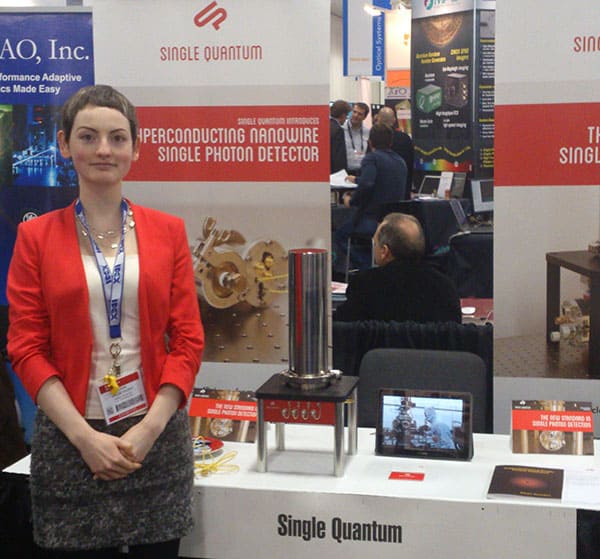
Get outside The author marketing Single Quantum and its product, a single-photon detector (centre of image). (Courtesy: Floor van de Pavert)
Around this time I remember having a conversation with a senior entrepreneur during a networking reception. He had a lot of sales experience, so I explained the situation to him and asked, “What am I doing wrong?” He replied without hesitating, “You should stop sending out quotations right away.” “But they’re asking for one!” I replied. “I don’t care. People buy from people, so just sending an e-mail is not going to get you far when it comes to sales. Politely refuse to send them anything until after speaking to them, preferably in person. Drop everything and get on the phone to make appointments with those 20 people.”
At this moment I realized it had been a little foolish of me to think that people would happily fork over 7100,000 (or thereabouts) of their hard-earned research money after just getting an e-mail quotation and a spec sheet from a company that was only a few months old. This realization was a turning point for me. I started to educate myself and my team on sales techniques by following training programmes and working with a dedicated sales coach.
I learned that in sales it’s crucial to build a relationship with your customers, and that selling is mostly about listening and asking the right questions. I also learned that sales is a numbers game: it’s a given that a substantial percentage of your sales calls and visits will not result in an order, and you shouldn’t get discouraged by this. However, the high ratio of leads to sales means that a structured approach to handling leads – including a good customer relationship management (CRM) system – is a must.
Most of all, though, I learned you should never underestimate the time and effort that sales requires, because no product sells itself.
Lesson 5: Make marketing work for you
To support your sales work, you need to have good marketing materials. To make good marketing materials, you need to start with a well-defined idea of how you want to position your company in the market. This boils down to two questions: what kind of company do you want to be and why should customers buy your product? The answer to these questions is your brand, and this brand should be reflected in every form of communication you have with your customer.
Clearly, different products will require different brands, but for start-ups, a big part of that brand should be basic professionalism. Your marketing materials and practices need to do more than just communicate product specifications; they also need to leave no doubt in the minds of prospective customers that you are a real company, one that can be trusted to deliver on its promises.
This means that nothing in your marketing should have that “home-made” look I see too often with new spin-offs. Invest in a real designer to create a logo for you. Make sure you have a spiffy website. Get your leaflets professionally designed and printed in full colour. This does not need to be expensive; with sites such as Odesk and Elance, it’s easy to find good and cheap freelancers.
Marketing is also about the way you and your people personally interact with your customers. Set rules for phone, Skype and e-mail communication with customers and suppliers, and educate your entire team about them. Even if, in reality, you’re still a bunch of engineers and scientists beavering away in a corner of the lab, your marketing should exude competence and professionalism.
Lesson 6: Focus
As a start-up founder, your to-do list is by definition longer than everything you can do. So focus is a must. You may be asked to participate in business plan competitions, interviews, photo shoots, networking events and conference talks (especially if you’re a woman like me). Before you decide to spend time on any of these, ask yourself whether you’re doing it because it’s an ego boost, or because it contributes substantially to building your company. If it’s the former, say no and spend your time on something with higher priority instead.
As a start-up founder, your to-do list is by definition longer than everything you can do; so focus is a must
On the road again
Despite its rocky start, Single Quantum is still going strong, determined to bring its photon detector to every quantum-optics lab in the world. Its early difficulties did not scare me away from entrepreneurship, either. On the contrary, I am now applying the lessons I learned at a new tech start-up with a wonderful co-founder. The company is still very early stage, and I can’t share many details, but one thing is certain: building a company from scratch is a very interesting and rewarding experience and I am looking forward to doing it again – but this time with different, and better, mistakes.
Many of you reading this will have, at least once in your lives, thought of some clever invention that doesn’t yet exist but which you were sure would change the lives of countless people. It seemed really obvious once you thought of it, and if you’d only had a bit more free time you could have developed your fantastic idea. “Why has no-one thought of this before?” you said to your friends as you told them at length about how it works. In the end though, everyday life got in the way and either the world is still waiting for your genius invention or somebody else got there first.
That’s because, although great ideas and beer-swigging visionaries are rarely in short supply, much rarer are the individuals or teams with that perfect blend of innovation and business know-how – plus the bloody-minded determination needed to persist even when faced with frequent set-backs and personal financial sacrifices.
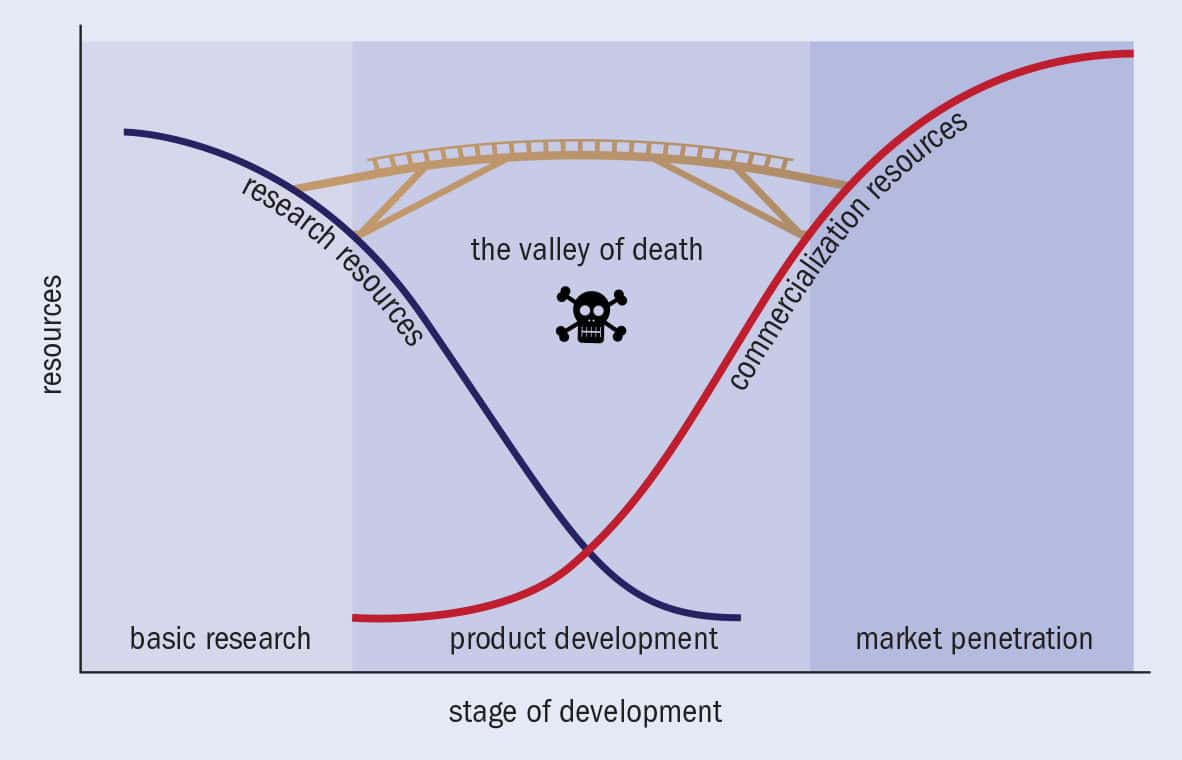
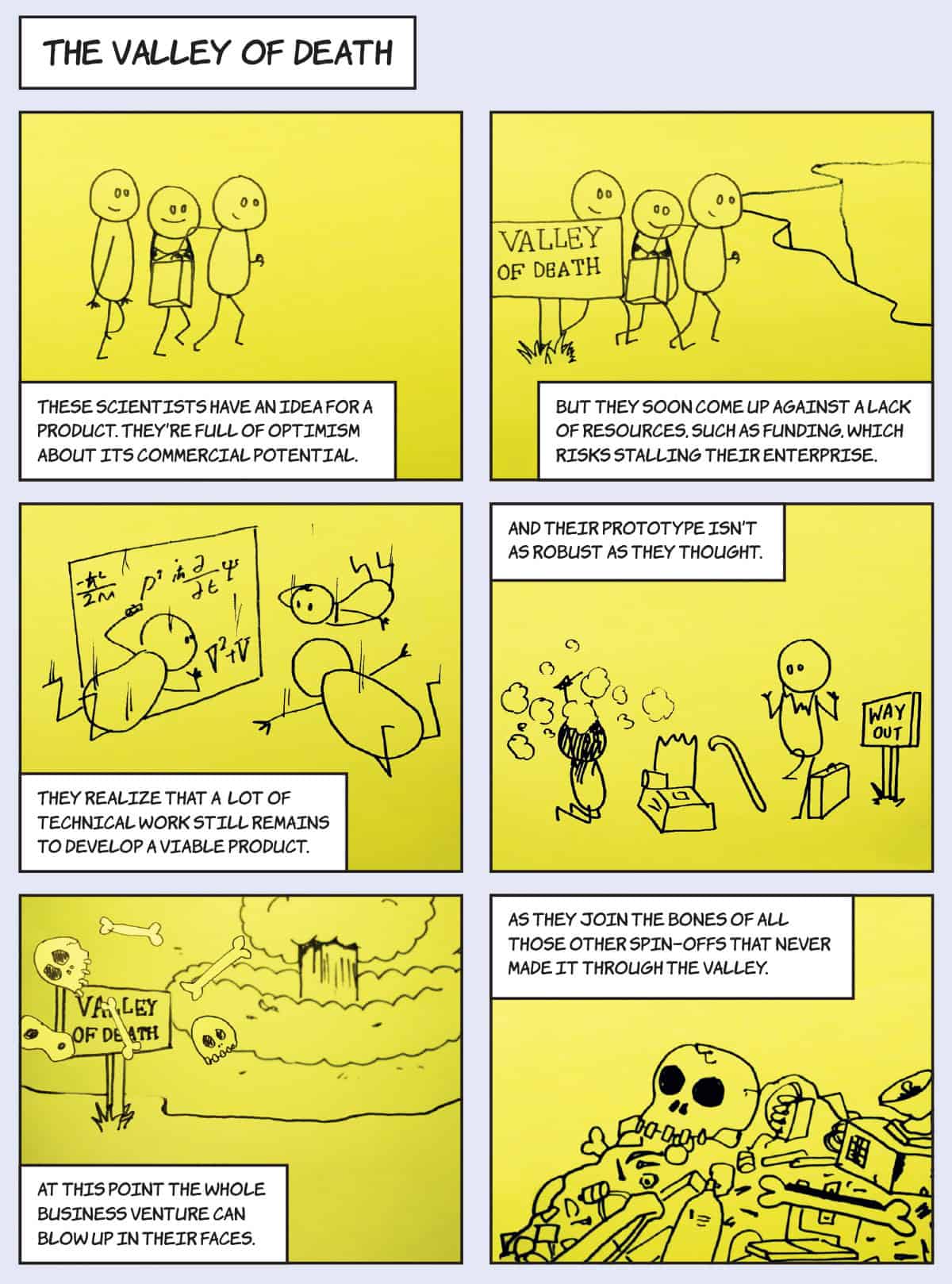
One of the most gruelling challenges faced by any start-up company is finding a way to navigate through what is known as the “valley of death”. Precise definitions vary, but this is essentially the stage at which a company has an initial prototype for a product or service, but lacks the resources needed to translate this into a fully fledged profitable business (figure 1). Not having enough money to transform a prototype into a viable product is usually the main culprit. To overcome this hurdle, innovators must reach into their own pockets, approach individual investors or even seek crowdfunding (see “A little help from the crowd” on pp45–48). Often, though, the start-up simply runs out of money and falls by the wayside. It has been estimated that thousands of ideas meet this fate for every one product or company that succeeds.
1 Caught between a rock and a hard place
(Courtesy: IOP Publishing)
Scientists translating an innovation from the lab to the marketplace often find themselves caught in limbo once their research funding has dried up but they are not yet making any money from their product. Known as the valley of death, this stage is where start-ups often fail unless extra investment can be found to bridge the gap in resources.
Cash-flow problems are not, however, the only factors that can keep a company trapped in the valley of death. In tandem with developing a sellable product, a company must acquire an in-depth knowledge of the market it is entering – which takes time and money. There may also be extensive health and safety regulations to comply with, particularly when developing innovations for medical applications.
An even deeper valley
Innovators from all disciplines – from brewers to toymakers – have to contend with the valley of death. But the bad news for physicists is this: they face an even deeper valley because physics-based inventions are usually at the technological cutting edge, making them typically far from being market-ready. And sometimes, physics start-ups face the biggest business taboo of all: that there is no market yet for their product at all (see “More push than pull” Physics World November 2014 pp35–37).
But physicists are a resourceful bunch, accustomed as they are to solving problems by finding the right tools for the job – be it the right spanner, software or project funding – as well as tracking down people to collaborate with on projects for which they don’t have the correct expertise. One place where physicists and the right resources collide, resulting in a hotbed of science innovation, is the Boston area of the US, which hosts world-leading universities such as Harvard and the Massachusetts Institute of Technology (MIT), as well as many wealthy investors and other sources of financial support.
One such investor is venture capitalist Stan Reiss, who works for Matrix Partners – a firm that primarily supports companies developing technical components, systems and software. Reiss says that the valley of death can be particularly punishing for innovators in the physical sciences who are at the stage where they’ve got off the ground and built a team, but still have a lot of technical development to do before their product is commercial. “In physics-based start-ups that happens very, very frequently because physics is hard and commercializing physics can take a very long time,” he says.
According to Reiss, one reason for the high death-rate among physics start-ups is that the products often turn out to be a lot more complicated than the inventors originally thought. Early on in a company’s life, the founders often receive initial investments from people like Reiss, based on a yearly financial forecast and how promising the product seems. The start-up then invests this cash in resources – such as developing a prototype and setting up a work space – and hires a small team to get the project off the ground. But if the product development runs into teething problems, the company could easily reach the end of its first year still way off its initial targets. Unless the investors have a lot of faith and deep pockets to match, the start-up could find itself in grave trouble very early on.
One reason for the high death-rate among physics start-ups is that the products often turn out to be a lot more complicated than the inventors originally thought
“Academic people tend to be slightly optimistic in terms of what still needs to be done,” admits Reiss, who says he’s met a lot of professors who have a great idea and want it to succeed, but aren’t prepared to put in the necessary graft to make it happen. Reiss says that in his experience, the science start-ups that succeed are those co-founded by academics who are prepared to set aside their research – either tenured staff who take long-term sabbaticals, or postdocs who are willing to leave academia and focus on the business. In fact, Reiss is only prepared to invest in start-ups if he feels the firm has somebody committed to the cause full-time.
One Boston-area firm that brought dedicated business brains on board from the start is MC10. The company was co-founded in 2008 by materials scientist John Rogers at the University of Illinois, Urbana-Champaign, who had developed processes for printing flexible electronics that can be integrated with the human body. According to Ben Schlatka, another co-founder of MC10, right from the start the company also employed a team of business personnel – including himself – to identify and build relationships with customers, while a group of engineers was hired as well to take the science developed by Rogers and translate it into products that appeal to customers. Indeed, Schlatka feels that employing people with a diverse set of skills was key to the success of the company. He adds that watching the family of staff grow over time – from an initial team of four or five to about 40 people currently – has been “a really exciting adventure to be a part of”.
MC10 successfully bypassed the valley of death and now has products in a range of sectors including health and defence. One of its high-profile products is the Reebok CHECKLIGHT, developed in partnership with the consumer sports giant Reebok. Essentially a type of skull cap that can be worn in contact sports, when the device flexes it provides a measure of the severity of blows to the head. In the event of a collision, medics can see the extent of the impact by looking at the data on a small digital interface at the back of the skullcap that pokes out beneath a player’s helmet.
Safely through the valley The Reebok CHECKLIGHT, developed by physics spin-off company MC10, is designed for contact sports. When the device flexes it provides a measure of the severity of blows to the head via a small digital interface at the back of the skullcap. (Courtesy: MC10)
The funding gap
Along with getting the right people involved, MC10 had a healthy start from a funding point of view. Rogers had a connection with an investor in the Boston area, who helped get the company off the ground. Other start-ups, however, may lack those personal links that can provide financial support during its early days. In fact, the valley of death could be viewed as an inevitable feature of the way that many capitalist societies are structured. Industry tends to invest in products that are far along the innovation spectrum due to the lower perceived risk, while fundamental research is by-and-large supported by government money. The bit in the middle, where science is translated into commercial products, tends to miss out on the cash (see illustration below).
The funding gap is related to the perceived risk among investors, who are acutely aware that the process of translating an innovation from the lab to the marketplace requires far more than just the initial invention. These risks can be uniquely large in the physical sciences, according to a recent paper by Jesko von Windheim and Barry Myers of Duke University in the US (2014 Transl. Mater. Res.1 016001). Von Windheim and Myers point out that the time and capital required in the early stages of developments in the physical sciences are often much higher than their equivalents in other sectors such as information technology or consumer electronics. “Typical physical-science companies require 3–10 years for the concept stage alone,” the authors write. Faced with such risky long-term ventures, investors often reject the physics and place their money on a safer bet.
To cross the valley of death, physics start-ups often have to explore a range of financial options. They may look to venture capitalist firms, the wealthiest of which are able to invest tens of millions of dollars in a company over its lifetime while spending time helping the start-up to grow into a business. Or the start-up may look for smaller one-off sums from affluent individuals known as angel investors who may have fallen in love with the potential of a particular product. There may also be some funding available from government sources. In the US, for example, researchers can receive investment from the National Science Foundation (NSF).
Fortunately for academics, there do exist some “shepherds” that can help to guide them through these difficult early stages in the valley of death. Staff at the Deshpande Center for Technological Innovation, for example, support academics at MIT in two main ways, according to the organization’s executive director, Leon Sandler. First, it provides small amounts of money for researchers to further their research to the point where it can be spun out. And second, it offers support services and advice from business professionals to help academics to understand the market they are targeting. Since it was founded in 2002, the Deshpande Center has so far backed about 150 projects, which have led to 28 spin-offs that have together raised more than $500m in capital.
Sandler says that from his experience of working with MIT academics, those who do succeed in business have recognized how important it is to understand the marketplace. “I’d say a critical point – even before you start – is that you need to have something that is viable, which starts with customers,” says Sandler. “Whatever the product is that you’re about to produce, it has to be something that will meet a need, so there will be viable customers and it’s going to be competitive.”
(Courtesy: Ricky Martin)
Sticking to research
Commercializing research is all well and good, but how much of this process should scientists take on themselves? Joanna Aizenberg, who heads a bio-inspired engineering lab just down the road from MIT at Harvard, is one scientist faced with this dilemma. Aizenberg spends her days trying to understand some of the basic principles of biological architectures with a view to designing advanced materials inspired by the natural world. As an example, her group’s studies of the Nepenthes pitcher plant – which is notoriously slippery and traps unfortunate insects that land on it – led to them designing a highly fluid-repellent surface, which they call “slippery liquid-infused porous surface(s)”, or SLIPS.
Such a technology could be used, for example, to coat medical instruments to stop bacteria from sticking to them, or to line pipes to transport crude oil more efficiently. But as Aizenberg makes clear, being in the lab is what she enjoys and where she intends to stay. “I’m a scientist. To me, understanding basic concepts – basic physical, chemical, materials designs, that are involved in creating these materials – is extremely important,” she says. Indeed, her lab is not involved in the fine details of creating a finished product that come at the later stages of product development. “That is something that should be done in the start-up company, or should be developed further by industries that are interested in this technology,” she says.
Aizenberg does recognize, however, that her lab can provide more than just the initial science in the process of commercialization. In fact, her team does a range of optimization and development work that is not typical of everyday research. What’s more, some of the researchers in her lab are employed specifically to explore how these materials and systems can be transferred to the market, effectively providing a bridge between the lab and the commercial world. These researchers have been involved in the development of SLIPS and another technology spin-off called Watermark-Ink (W-INK), which can be used to identify liquids and liquid contaminants.
Taking the initiative
The model in Aizenberg’s lab of employing people who wear both science and business hats is a progressive move, which will perhaps become more commonplace in universities with the increasing pressure on academics to show the practical benefits of their research.
Likewise, academic institutions will no doubt take inspiration from business-support services such as the Deshpande Center given the revenue and prestige they can bring to a university. Indeed, in their paper in Translational Materials Research, Von Windheim and Myers outline a “roadmap” that could be adopted by universities to improve their ability to move the most promising academic projects towards real commercial activities. The most important focus, they say, should be on engaging sooner and more effectively with the marketplace when developing new products. While these initiatives will not in themselves plug the funding gap for translational research, they will at least make academics more aware of the possibilities and pitfalls in taking an idea from the lab to the marketplace.
What is clear from success stories such as MC10 is that anyone serious about navigating the valley of death needs to equip themselves with far more than just a nifty idea. Those people to have made it across the valley have surrounded themselves with teams with a diverse range of skills. They have also put in a heck of a lot of hard work and often set their research to one side while they focus on the business project.
So next time you come up with that brilliant idea for a product, don’t just tell your close friends about it, but share it with that contact on the other side of the campus who has an MBA from Harvard Business School. And rather than try to build a prototype yourself in the garage, make sure you enlist somebody who has at least a vague idea about design. Finally, no matter how confident you are of success, never forget these words of venture capitalist Stan Reiss: “There are a lot of dead bones and skeletons at the end of that valley.”
Students at Camden School for Girls in London have published a lovely book of haiku about science. Called Sciku: The Wonder of Science – in Haiku!, the volume contains 400 poems and is on sale with proceeds going to upgrading the science labs at the school. The students are not the only ones at the school with literary ambitions. Their science teacher Simon Flynn has also written a book called The Science Magpie, which we reviewed two years ago.
Below is a little taste of what is inside the book of haiku and you can also watch several of the students reading their poems in the video above.
Gravity: An attractive force Between all objects with mass Just like you and me
A European team of astronomers has used a brand new technique to uncover evidence of a magnetic field surrounding the exoplanet HD 209458b. It is hoped the method can be applied to many of the other exoplanetary systems found to date, adding another dimension to our understanding of these distant, alien worlds.
Discovered in 1999, HD 209458b is 30% larger than Jupiter. However, unlike Jupiter, it completes one orbit in just 3.5 days, as the planet sits very close to its parent star – more than 50 times closer than the Earth is to the Sun. Being at such close quarters, its gaseous atmosphere is puffed up by the intense heat that it has to endure. Such planets are known as “hot Jupiters”. Researchers led by Kristina Kislyakova of the Austrian Academy of Sciences in Graz have now confirmed this picture by observing the planet with the Hubble Space Telescope.
Speedy hydrogen
As HD 209458b passes between us and its parent star, the star’s light passes through the planet’s atmosphere before continuing towards Earth. Some wavelengths of light are missing, however, because they are absorbed by the elements in the planet’s atmosphere. This shows up as dark bands in the light’s spectrum known as absorption lines. Of particular interest to Kislyakova were the so-called Lyman-alpha lines, which are created when hydrogen absorbs light. “There was enhanced absorption in Lyman alpha, which means the planet has an extended hydrogen atmosphere,” she told physicsworld.com.
Most of the spectral lines were shifted towards the blue and red ends of the spectrum. This implies that the hydrogen atoms that absorbed the light were moving at very high speeds – those moving towards us resulted in blueshifted spectral lines, those moving away in redshifted ones. Kisylakova and her team explored various mechanisms for how these atoms undergo such high acceleration, but they found the best fit when factoring in the interaction between the stellar winds blowing off the star and a planetary magnetic field. As the star is very similar to the Sun, the team were able to use our star as a proxy in the model.
Windy atmospheres
The researchers found that the data were best matched by a solar wind travelling at about 400 km s–1 and a planetary magnetic moment about 10% that of Jupiter’s. “This is the first time an exoplanetary magnetic field has been determined from Lyman-alpha lines,” says Kislyakova. As well as providing an insight into other planets’ magnetic fields, the technique could also be used to study the solar winds on stars other than the Sun. However, it can only be deployed for “transiting” planets, i.e. those that move in front of their star from our perspective.
The findings could also provide clues about the likely future of HD 209458b. Closely orbiting hot Jupiters are thought to be gradually spiralling inwards, since their orbits decay as the result of gravitational interactions with their host star. Losing mass in the form of these fast-moving hydrogen atoms affects this process. “This result shows that hot Jupiters can have strong magnetic fields that capture and channel the material driven off by radiation from their star,” says Coel Hellier of Keele University in the UK. “This will affect how much material evaporates from the planet, and will thus be important in understanding what will happen to such a planet and how it will meet its end.”
Anaïs Tondeur in collaboration with Jean-Marc Chomaz, Paul Syrillin, 2014, shadowgram, 11 × 24 cm. Image courtesy of the artist and GV Art gallery.
The story of Nuuk began in the early 18th century when a French naval officer landed on a barren, ice-covered island and noted its coordinates in his logbook. The island, he reported, was volcanic in nature, but little else was known about it; indeed, later visitors to its supposed location found no sign of land. Rediscovered in the 20th century, Nuuk was soon visited by a series of scientific expeditions, one of which noted that the island’s surface area was shrinking. An observation station was set up on a prominent headland, but in 2012, it abruptly ceased transmitting; satellite images later revealed that Nuuk had vanished entirely beneath the ocean surface. Coincidentally, the final signal from Nuuk arrived just as the 34th International Geological Congress was meeting in Australia to discuss the emergence of a new, human-influenced geological age: the Anthropocene.
Nuuk and the various forces that contributed to its demise are the subject of a fascinating exhibition currently on show (until 29 November) at the GV Art gallery in London. Lost in Fathoms is a collaboration between an artist, Anaïs Tondeur, and a physicist, Jean-Marc Chomaz, who specializes in fluid dynamics. To develop her ideas about Nuuk, Tondeur spent a year in residence at Chomaz’s Laboratoire d’Hydrodynamique at the Ecole Polytechnique in France, while other parts of the exhibition grew out of a summer school in Cambridge, UK, that focused on fluid dynamics, sustainability and the environment.
Researchers in the US say that they have made the best 3D topological insulator to date. The material is called bismuth antimony tellurium selenide (BiSbTeSe2) and could be of fundamental importance for testing a number of condensed-matter and particle-physics theories. The material could also find use in spintronics devices and be used to build robust topological quantum bits (qubits) for quantum computers.
Topological insulators are materials that are electrical insulators in the bulk but can conduct electricity on their surface via special surface electronic states. “Most topological insulators made to date have not been completely insulating in the bulk, because of impurities (unintentionally introduced during material synthesis or processing) that doped the bulk and made it conducting,” explains Yong Chen of Purdue University, who led the research. “Our topological insulator appears not to conduct at all in the bulk but does so only at its surface.”
The researchers worked this out by measuring how thin flakes of BiSbTeSe2 of various thicknesses conducted electricity. They found that the conductance of different samples was almost independent of their thicknesses. Such behaviour is completely different to that seen in normal 3D materials, in which conductance is proportional to sample thickness.
Room-temperature effect
“Our result is consistent with the picture that bulk BiSbTeSe2 is only conducting at its surface,” Chen explains. “It is like you were to keep cutting and reducing the material to ever smaller thicknesses and strangely never finding the conductance to change much. This is because every time you create a new surface, you get the same conduction.” Indeed, the researchers observed this topological surface conduction even at room temperature for samples thinner than around 100 nm – properties that could lead to practical applications.
And that is not all: Chen and colleagues also found evidence for a well-defined “half-integer” quantum Hall effect (QHE), where the top and bottom surfaces of their thin-slab samples each contribute a half-integer unit of quantum conductance (e2/h), where e is the charge on the electron and h is the Planck constant. These two half-integer units make up the measured Hall conductance plateau – quantized at integer units of e2/h. Such half-integer QHE is another unique signature of topological surface-state charge carriers, which are, in fact, spin-polarized massless Dirac fermions.
These massless Dirac fermions are analogous to the massless Dirac fermions that exist in graphene – one-atom-thick sheets of carbon – and give that material its exceptionally large electrical conductivity. In graphene, the charge carriers are not spin-polarized and exist in four degenerate states, whereas on a topological insulator surface there is only one state – the simplest, or “1/4 graphene” state.
High magnetic fields
The researchers observed the QHE in BiSbTeSe2 flakes that were between tens to hundreds of nanometres thick, at cryogenic temperatures of below 30 K and at high magnetic fields applied perpendicular to the top and bottom surfaces of the samples.
“For this part of our experiments, we used a powerful magnet (where we can get up to 33 T) at the National High Magnetic Field Lab in Tallahassee, Florida,” says Chen. Together, these results suggest that BiSbTeSe2 is a “perfect” topological insulator that behaves just how theory says it should. It is thus an excellent material platform on which to look for the exotic physics phenomena that are predicted to exist in topological insulators.
One phenomenon involves collective excitations – or quasiparticles – that resemble Majorana fermions. First predicted by the Italian physicist Ettore Majorana in 1937, the Majorana fermion has zero charge and is its own antiparticle. While Majorana fermions have never been seen as free particles, there is some evidence that Majorana-like quasiparticles can exist at the interface between an ordinary superconductor and a topological insulator. If Majorana quasiparticles could be created reliably, they could be used to make “topological qubits”. Unlike conventional qubits, such topological qubits would be immune to being destroyed by environmental noise and could therefore form the basis of fault-tolerant quantum computers.
Spintronics and “topological magnetoelectronics”
Another promising application for BiSbTeSe2 is to use the spin-polarization of the charge carriers to create spintronic devices. This is a relatively new technology that seeks to use electron spin to create devices that are smaller, faster and more energy-efficient than conventional electronics.
Another possible application is “topological magnetoelectronics”, which would involve creating effective magnetic monopoles in the material. This could be done by exploiting an unusual form of electromagnetism (different from that described by conventional Maxwell’s equations) that is predicted for such 3D topological insulators.
The team, which includes physicists from Purdue University, Princeton University and the University of Texas at Austin, reports its work in Nature Physics.