You may remember last year when particle physicist Sascha Mehlhase of the Niels Bohr Institute in Copenhagen unveiled a 560-piece LEGO model of CERN’s ATLAS detector at the Large Hadron Collider.
Well, not to be outdone, LEGO fan Jason Allemann has now created a LEGO-inspired particle accelerator. Dubbed the LEGO Brick Collider (LBC), the design has been submitted to LEGO’s CUUSOO site, which lets fans share blueprints of their own models.
Graphene sheets are 8 to 10 times better than steel when it comes to absorbing impacts from supersonic “microbullets”. That is the conclusion of researchers in the US, who have fired tiny silica spheres at the carbon material and compared the kinetic energy of the spheres before and after they had penetrated the sheets. The result implies that graphene might be ideal for making bullet-proof vests, among other applications, and the technique employed in these experiments could be used to test the strength and toughness of other nanomaterials as well.
The “wonder material” graphene – sheets of carbon just one atom thick – is thought to be the strongest material in the world, thanks to its 2D hexagonal lattice of covalently bonded carbon atoms. Indeed, researchers recently measured its in-plane Young’s modulus – a measure of how well it resists deformation – to be more than 1 TPa, which is nearly that of diamond. Although such experiments provide valuable information on a material’s mechanical properties, they are essentially low-speed tests with impacts occurring at less than 1 m s–1. As a result, they cannot measure deformations that happen very fast, which is the case in ballistic impacts, where projectile velocities can be 1000 times faster. Although high-speed, high-strain-rate mechanical characterization techniques do exist, these methods are inappropriate for very thin layers of material.
Laser-based testing
A team led by Edwin Thomas of Rice University recently came up with a new technique called laser-induced projectile impact testing (LIPIT), and has now improved on this to test the strength of graphene. LIPIT sees the researchers fire a single micron-sized solid silica sphere travelling at speeds of nearly 3 km s–1 into a carbon sheet and measuring the velocity of the microbullet before and after it has penetrated the material. This allows them to calculate the kinetic energy of the bullet lost during the test. The experiments are performed on multilayer graphene membranes ranging in thickness from 10 to 100 nm – which is equivalent to 30 to 300 graphene layers – and the technique allows a tiny part of the sample to be strained, or deformed, at very high rates.
The researchers used multilayer graphene samples that were shaved off blocks of graphite. They were able to fire their microbullets at supersonic speeds using a laser pulse. “Instead of gunpowder, we vaporize a thin (50 nm) gold film using a focused laser beam, and it is the resulting expanding gold gas that accelerates the microbullet,” explains team member, Jae-Hwang Lee.
After analysing microscope images of the impacts, the researchers discovered that graphene dissipates the kinetic energy from the microbullet by first stretching into a cone shape at the impact site and then cracking along its crystallographic directions. These cracks extend outwards, well beyond the impact area, says Lee.
Efficient energy dissipation
“When a microbullet penetrates a thin target material, it dissipates the kinetic energy of the projectile by transferring this energy back to itself,” Lee says. “Graphene can dissipate this energy very efficiently, which makes it better than other materials (even steel).”
The result means that graphene might be ideal for making bullet-proof vests and other types of armour, he says. “It might even be used in futuristic applications such as coatings for satellites and the International Space Station that protect against micrometeorites,” he adds.
The researchers claim that their micro-ballistic technique could also be a unique way to study the mechanical behaviour of various other nanostructured materials.
The team, which includes researchers from the University of Massachusetts Amherst, is now busy trying out its miniaturized ballistic test on various other graphene systems. These include graphene composites and graphene with engineered defects, which is expected to be weaker than pristine graphene.
If someone puts you in an armlock, what should you do? If you happen to be a martial artist well-practised in the art of joint manipulation, or chin na, you will know the answer already: there is one simple move that will allow you to turn the tables on your aggressor, leaving them on the wrong end of a throw. However, if your skill set tends more toward manipulating mathematical symbols, there is still hope, for the answer is also closely tied to theoretical physics.
Before I describe the move, let’s consider some martial arts history. Many styles of kung fu are based on observations of the natural world – specifically, the behaviour of animals. For example, the legendary founder of the Northern Praying Mantis style, Wong Long, supposedly learned his art by testing that insect’s reactions to being prodded with a twig – a method one might be tempted to call proto-scientific (and probably unethical). Other styles have allegedly been inspired by the crane, monkey, snake, tiger and dragon, to name just a few (the person who observed the dragon was presumably a proto-theorist).
To understand how to escape from the armlock, however, we are going to take our inspiration from an altogether different species – this time one from the “particle zoo”. Imagine we have two electrons in a plane. Because all electrons are identical, if we borrow Wong Long’s twig and prod our two electrons into switching places, everything will be just as it was, right? Not quite. Electrons are fermions, so the combined two-electron wavefunction picks up a minus sign when the electrons swap places – it is antisymmetric under exchange. That’s all well and good, but we also have to account for the spin-statistics theorem, which says that swapping two particles is equivalent to rotating one of them through 360°. Hence, rotating an electron’s spin one full turn doesn’t bring it back to its original state. We have to rotate it twice.
The mathematical objects that share this property – needing to be “turned” through two full rotations to return to their original orientation – are called spinors. They were introduced to physics by Paul Dirac in his study of the electron, which won him the 1933 Nobel Prize for Physics. They remain very strange things, though, and in Graham Farmelo’s biography of Dirac, The Strangest Man, the mathematical physicist Michael Atiyah had this to say about them: “No-one fully understands spinors. Their algebra is formally understood but their general significance is mysterious. In some sense they describe the ‘square root’ of geometry and, just as understanding the square root of –1 took centuries, the same might be true of spinors.”
Taking the square root of geometry is fine in the weird world of quantum physics, but how does it help us get out of an armlock? Surely any object in everyday life requires at most one full turn to return to its original position? Not so. We now arrive at the solution to our problem: the “plate trick” or, as it’s known in martial arts, coiling.
Stand with your feet shoulder width apart and your right hand held out in front of you as if you were holding a plate of soup in your palm. Now rotate your hand to the left, towards your body, so that the plate passes under your right armpit. You don’t want to spill the soup, so your palm had better stay face up throughout. Continue moving the plate round in a circle until it is back in front of your body. The plate is now in its original position, but the system of you-plus-plate is certainly not – you’re all coiled up!
One full rotation didn’t bring you back. How about a second? Continue round in the circle, this time allowing the plate to pass over (rather than under) your right shoulder on its way round. Upon completing the second full rotation you’ll find yourself back in your starting position, plate and all, with not a drop of imaginary soup spilt. In so doing you have provided a simple demonstration of a spinor – albeit one that you should perhaps not take too seriously when being quizzed on the niceties of the SU(2) Lie algebra in exams.
And to escape the armlock? Just apply the same manoeuvre. Wherever your aggressor’s hand is gripping your arm, there will be a gap in their grip where their thumb meets their fingers. They can withstand at most a 360° rotation of your arm before you slip through this gap, but as we have just demonstrated, you can go all the way to 720° and be right back where you started. At that point, I recommend you apply another consequence of the antisymmetry of electrons under exchange: the Pauli exclusion principle. This can be done by demonstrating that the electrons in your aggressor’s leg cannot simultaneously occupy the same position as those in your foot. A similar demonstration regarding the electrons in the ground and those in your (former) aggressor’s body will follow presently.
As with any physical theory, there is a caveat: this move will only work if your aggressor is not skilled in the art of topology. If they are, they will choose a lock that forms a closed loop around your body – a kimura is one example – knowing that the linking number is topologically protected, so you can’t get out without breaking the loop. Which is an option. Aside from that, though, the answer to the question of what to do if someone puts you in an armlock is simple: you take the square root of geometry.
• If you’re feeling inspired, why not write your own Lateral Thought? Submissions must be 900–950 words long and may be e-mailed to pwld@iop.org
Physicists using the SOLEIL synchrotron in France are the closest yet to realizing a thought experiment first proposed in 1927 by Albert Einstein. A variation on the much-loved double-slit experiment, the measurement confirms an aspect of quantum theory that Einstein had sought to discredit. The SOLEIL experiment uses two excited atoms in place of the two slits of Einstein’s experiment and shows that when one can determine which atom has emitted an electron, a quantum interference pattern vanishes.
Einstein made several attempts to refute the inherent uncertainty of quantum mechanics by proposing thought experiments, which could not be performed in the lab at the time. One involved the principle of wave–particle duality, which predicts that a succession of single particles passing through two slits will build up a wave-like diffraction pattern on a screen. This occurs because the wave-like property of each particle allows it to travel through both slits at once. Einstein pointed out that an extremely sensitive sensor could detect the recoil of the individual slit that each electron passed through, while not disturbing the diffraction pattern. This flew in the face of quantum mechanics, and Einstein’s great rival, Niels Bohr, countered by arguing that the diffraction pattern would simply not occur if the experimenter knew which slit each electron had passed through.
While this was a pure thought experiment at the time, its combination of conceptual simplicity and formidable experimental difficulty has provided an irresistible challenge for modern-day experimentalists. In 2001 Serge Haroche and colleagues at the Ecole Normale Supéérieure in Paris demonstrated the principle in an analogue system, using a microwave pulse to split the internal state of a small number of Rydberg atoms into two separate states that evolved at different rates before being recombined. Then in 2011 Jörg Schmiedmayer and colleagues at the Vienna University of Technology achieved a closer approximation.
Double-atom experiment
Now, Catalin Miron and colleagues at SOLEIL, together with collaborators in Sweden, Japan and Romania, are the closest yet to recreating the original thought experiment in the lab. They use a diatomic oxygen molecule that is excited by tunable X-ray synchrotron radiation on the PLÉIADES beamline. By adjusting the X-ray energy, the researchers can promote an electron from an inner molecular orbital into either a high-energy bound state or a repulsive state in which the molecule breaks apart. After this transition, one of the atoms emits another electron called an Auger electron, recoiling as it does so.
If the first electron has been promoted to the bound state, it relaxes back to the molecular ground state and the two atoms recoil together when the Auger electron is emitted. This means that measuring the recoil of the atoms reveals nothing about which atom emitted the electron. However, if the electron has been promoted to the repulsive state, the molecule breaks apart to create separate oxygen atoms. If the Auger electron is emitted after the molecule breaks apart, the atoms will not recoil together, and measuring the recoil of the atoms will reveal which atom ejected the electron. The two atoms therefore act as the slits of the thought experiment, and the emission of an electron is analogous to a particle emerging from the two slits. If the atoms recoil together, we do not know through which slit the electron passed – but if only one recoils, we do know which slit was used.
In place of the screen, the team used an extremely elaborate, self-built and unique machine called EPICEA, which measures all three components of the momenta of both the emitted electron and the recoiling atom left behind. “This is actually what I built for my PhD thesis 20 years ago,” says Miron.
Einstein wrong again
By correlating the emitted electron energy to the angle between the electron emission and the axis of the diatomic molecule for a large number of photon–molecule collisions, the researchers electronically reconstructed the “interference pattern”. By looking at the Doppler shift of the recoiling ion, the researchers could also calculate whether one or both atoms had recoiled. When the two atoms were indistinguishable, interference fringes were produced (see figure); whereas when the emission bore a clear signature of having come from one atom or the other, a continuous band was produced with no evidence of fringes. This is in good agreement with high-level theoretical calculations – and shows once again that Bohr’s interpretation of the thought experiment is the correct one.
Jörg Schmiedmayer calls the work “a nice demonstration of a very fundamental effect”, and explains that while, in principle, “the physics is exactly the same in Haroche’s experiment or in our experiment…in these other papers up till now the slit was a photon or something like that. Here you have two matter particles that are your two slits. These are steps that are getting closer and closer to the original proposal of Einstein and Bohr.”
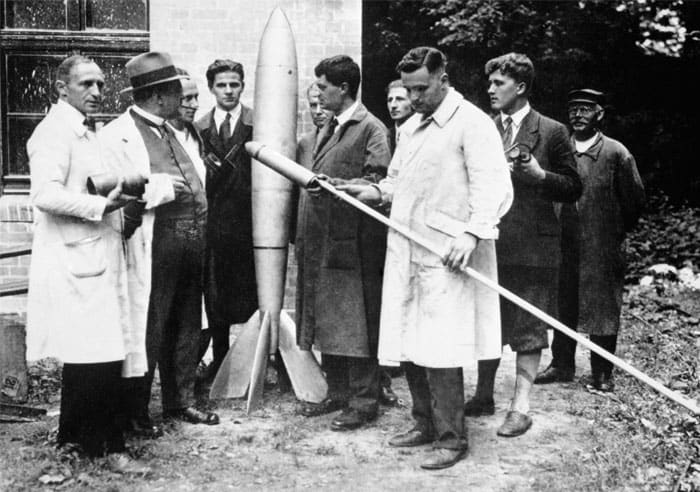
Nazi rocketeer turned father of the US space programme Wernher von Braun. (Courtesy: Library of Congress/Science Photo Library)
Murky business
In the autumn of 1944, with the Second World War rumbling towards its nightmarish conclusion, a small group of Western scientists embarked on one of the Allied campaign’s more dubious missions. Their task was to locate and capture scientists who had served the crumbling Nazi regime, ferret out their secrets and put them to work in the war against Japan (and, later, in the Cold War against the Soviet Union). But as the US journalist Annie Jacobsen documents in her book Operation Paperclip, this theoretically justifiable goal soon collided with some ugly realities. At best, the scientists targeted by the operation were “apolitical” types who had turned a blind eye to atrocities as long as the research funds kept flowing. Many others, like the Nazi rocketeer turned father of the US space programme Wernher von Braun, had much dirtier hands than either they or their new American chums cared to admit. And a few were out-and-out war criminals. As Jacobsen shows, the distinction between who got hired and who got hanged was disturbingly fine. In one of the book’s most unsettling passages, she describes how representatives of an American group charged with arresting a suspected war criminal found their efforts stymied by an officer from a different US agency, which was trying to give that same war criminal a government contract. This would be farcical if it were not so horrible: the scientist in question, Otto Ambros, was a chemical weapons expert who had tested poison gas on concentration camp inmates, and had also managed the synthetic rubber factory at Auschwitz. Thoroughly researched and compellingly written, Operation Paperclip is a masterful critique of the ethics of science in wartime, and would make a good companion to Philip Ball’s book Serving the Reich, which focuses on the role of civilian physicists in Nazi Germany (February p42).
2014 Little, Brown $30.00hb/£12.99pb 592/576pp
Disquieting: Real and imagined horrors populate the pages of these books. (Courtesy: iStock/Renphoto)
The mathematical undead
Craig Williams teaches mathematics at a small liberal-arts college in western Massachusetts. Or at least he did, until the day a zombie shambled into his calculus class and started snacking on his students. Soon afterwards, the hero of Colin Adams’ delightfully silly novel/teaching aid Zombies and Calculus is holed up in an office with an assortment of sidekicks, including his biggest rival, his worst student, his onetime lover and the departmental secretary. Oh yes, and the rapidly zombifying local police chief, who got bitten in an earlier attack. At this point, Williams decides that what everyone really needs is a lesson on the mathematics of exponential growth (the better to model how the zombie epidemic is spreading), followed by a quick analysis of how much force is required to crack a zombie’s skull. This sets the pattern for the rest of the book, in which characters periodically take breaks from decapitating zombies in order to consider the finer points of exponential functions, differential equations and whether a fleeing university administrator can outrun the hordes of undead chasing him (spoiler alert: nope). It’s implausible, of course, but pleasingly surreal, and the mathematics is nicely done. If you are a current calculus student looking to spice up your revision, or a former one wanting to refresh your rusty u substitution skills, reading Zombies and Calculus is one of the most entertaining ways to do it.
2014 Princeton University Press $24.95/£16.95hb 240pp
(Courtesy: iStock/Zeppelie)
We come in peace
Do-it-yourself motor enthusiasts have long relied on Haynes manuals to guide them through the ins and ours of automotive repair. A few years ago, fans of space exploration got a Haynes manual of their own, when the company honoured the 40th anniversary of the Moon landings by publishing an “owner’s manual” for the Apollo 11 mission (July 2009 p3). Now Haynes has taken the space theme to its logical conclusion (and perhaps beyond) by producing a manual for resisting alien invasion. Written by Sean Page and illustrated by Ian Moores, the Haynes Alien Invasion Owners’ Resistance Manual includes a step-by-step guide for making your own tin-foil hat and plenty of handy tips like “If they vaporize you with phasers, you know they’re hostile” and “Don’t get drawn into any discussion on time dilation, string theory or why they cancelled the TV series Firefly”. It’s all clearly tongue-in-cheek, and good for a few chuckles, but in some areas of the manual, the humour does have a bit of an edge to it. In particular, a page containing genuine, pro-UFO-sighting quotes from a British Royal Air Force chief, a Chinese general and two former US presidents (among others) brings to mind Poe’s Law of the Internet, which states (roughly) that there is no parody so absurd that someone won’t mistake it for the real thing.
2014 Haynes £16.99hb 128pp
Solutions to climate change: If the aliens don’t get us, the carbon dioxide may. (Courtesy Peter Menzel/Science Photo Library)
No quick fix
According to Hinchliffe’s Rule, whenever the title of an academic paper is phrased as a question with a yes/no answer, the answer always turns out to be “no”. At first glance, Mike Hulme’s book Can Science Fix Climate Change? seems like a good example. In the book, Hulme, a climate scientist at King’s College London, strongly criticizes the idea that the Earth’s warming climate can (or should) be modified by injecting sunlight-blocking aerosols into the upper atmosphere. Such a technological “fix” would, he argues, be “undesirable” (because reducing temperature isn’t the same thing as controlling climate) “ungovernable” (because there is no mechanism for agreeing who would control the thermostat) and “unreliable” (because of the risks of unintended consequences). Of these three arguments, the second one is the most convincing. Because the benefits of such an intervention would be unevenly spread, Hulme notes that powerful states (and perhaps also non-state actors, such as corporations or eccentric billionaires) would have tremendous incentives to act in ways that favoured them. Injecting aerosols into the atmosphere is not, however, the only possible strategy for adjusting the Earth’s climate, and Hulme does not object to milder, more localized forms of “geoengineering” such as carbon capture and storage or painting roofs white to reflect sunlight. This suggests that the real answer to the question “Can science fix climate change?” is not a simple “no”, but rather something that depends on your definition of “science” or “fix”. A better, longer book might have weighed up the pros and cons of other scientific solutions, rather than focusing exclusively on the downsides of a single (rather barmy) one.
2014 Polity Press £9.99pb 144pp
Your inner scientist awaits
If you’ve already taught your dog quantum physics and relativity, what do you do for an encore? For Chad Orzel, whose first two popular-science books (How to Teach Quantum Physics to Your Dog and How to Teach Relativity to Your Dog) were based on imagined conversations with his German shepherd mix, the answer was simple: move on to humans. Specifically, humans who think they don’t like science very much. In his latest book, Eureka! Discovering Your Inner Scientist, Orzel sets out to convince people who regard science as “difficult” (or “nerdy”, or “esoteric”, or whatever) that they, too, are capable of thinking like scientists, and of applying the scientific method to whatever pursuits they find pleasant and meaningful. Pursuits like cooking, for example. As Orzel points out, successful chefs must master a repertoire of basic techniques, and then learn how to apply them in new situations. When they do this, he explains, they are following a path similar to that of the American physicist Luis Alvarez, who used techniques from particle physics to solve some notable problems in archaeology and geoscience. Readers who are already sold on the idea that science is useful and interesting are not, of course, Orzel’s primary audience here, but scientists will nevertheless find the stories in the book agreeably diverting – even if, ultimately, they are not completely convinced that what they do is comparable to baking a cake, playing basketball or bidding in a card game.
2015/2014 Basic Books £11.49/$17.99pb 368pp
Mixing maths and art
“Alice believes that Bob assumes that Alice believes that Bob’s assumption is incorrect.” If you didn’t follow the logic in that statement, it’s not your fault: it is, in fact, impossible for Alice to hold such a belief, because it is inherently self-contradictory. This conundrum is one of many fascinating little puzzlers found in John Barrow’s latest book, 100 Essential Things You Didn’t Know You Didn’t Know About Maths and the Arts. Like its predecessor, in which Barrow, a mathematician at the University of Cambridge, expounded on 100 essential unknowns related to maths and sport, the book is well written and varied, with chapters on such diverse subjects as systems of finger counting, computability and betting. There’s just one problem: many of the chapters (including the Alice and Bob example above) have, at best, a very tangential connection to art. So why does “the arts” appear in the book’s title? According to Barrow, the answer is that mathematics and art are natural bedfellows, since they both involve the exploration and study of patterns. However, in reading the book, one gets the impression that Barrow’s real reason is simply that he finds them both interesting. Either way, it is probably best to ignore the words on the book’s cover and just enjoy the titbits inside.
Rigatoni, fettucine, tagliatelle, penne? We think they’ve had their day.
It’s time to say hello to “anelloni” – a new kind of pasta created by two physicists from the University of Warwick in the UK. Consisting of giant loops, it’s the brainchild of Davide Michieletto and Matthew Turner, who invented the pasta in an attempt to demonstrate the complicated shapes that ring-shaped polymer molecules can adopt.
With its name derived from anello – the Italian word for “ring” – the new pasta is exclusively unveiled in an article that Michieletto and Turner have written in the December 2014 issue of Physics World magazine, which also contains their secret recipe for making it.
The two researchers created the large loops of pasta using just two eggs and 200 g of plain flour. When cooked and thrown together in a bowl, the pasta rings get hugely tangled up, in much the same way that real ring-shaped polymers become massively intertwined with each other.
Michieletto explains more about ring-shaped polymers in the video above, which was filmed at Physics World headquarters in Bristol. As he explains, whereas it’s easy when faced with a bowl of normal spaghetti to suck or pull a single strand out, it’s much harder to extract a single piece of pasta from a pile of anelloni, which get horribly tangled up.
While the new kind of pasta is just a bit of fun, Michieletto and Turner’s real work involves carrying out computer simulations of ring-shaped polymers. These studies have shown that if the molecules are long enough, they are likely to get so tangled up that they would appear frozen in place. If this were true in real life – and there is some evidence to suggest that it is – then they believe they would have discovered a new state of matter, which the pair dub a “topological glass”.
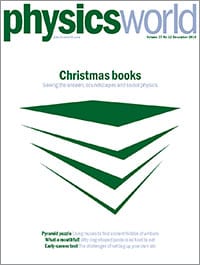
You can find out more about the new pasta and polymer mysteries in the December issue of Physics World. If you’re a member of the Institute of Physics (IOP), you can now enjoy immediate access to the new issue with the digital edition of the magazine. If you’re not yet in the IOP, you can join now to get full access to Physics World as well as many other member benefits. The Michieletto and Turner article is also available online here.
For the record, here’s a run-down of all the highlights of the December issue:
• Driving the innovation agenda – The Fraunhofer Centre for Applied Photonics is the first UK branch of Germany’s famed applied-research organization. Margaret Harris travels to Glasgow to find out how it will boost Scotland’s laser industry.
• Driving the innovation agenda – Arti Agrawal says that more needs to be done to address the gender gap in science.
• Literature of the lab – Robert P Crease surveys novels with scenes set in physics laboratories, and wants your suggestions of others.
• The pyramid detectives – Lucina Melesio explores how physicists are mapping the internal structures of ancient pyramids in Mexico and Central America using muons – potentially revealing hidden chambers that could finally lead archaeologists to where ancient rulers are buried.
• A taste for anelloni – The behaviour of ring-shaped polymers is one of the last big mysteries in polymer physics. Davide Michieletto and Matthew S Turner illustrate just why they are so hard to understand – using some delicious home-cooked pasta that they dub “anelloni”.
• Listening to the world – Philippe Blondel reviews Sonic Wonderland: a Scientific Odyssey of Sound by Trevor Cox.
• A strong model, with flaws – Sabine Hossenfelder reviews Cracking the Particle Code of the Universe: the Hunt for the Higgs Boson by John W Moffat.
• Artistic influences – Dan Falk reviews Colliding Worlds: How Cutting-Edge Science is Redefining Contemporary Art by Arthur I Miller.
• Social physics and antisocial science – Martin ZaltzAustwick reviews Social Physics: How Good Ideas Spread – the Lessons from a New Science by Alex Pentland.
• A cabinet of invisible curiosities – Ulf Leonhardt reviews Invisible: the Dangerous Allure of the Unseen by Philip Ball.
• Elegant constructions – Margaret Harris reviews Beautiful Geometry by Eli Maor and Augen Jost.
• Finding balance in a new lab – Setting up a new laboratory is a formidable challenge for early-career researchers. Sarah Bohndiek shares a few lessons she learned in her first
year as a group leader.
Anelloni: a new form of ring-shaped pasta that is a great analogy for ring-shaped polymers. (Courtesy: Davide Michieletto)
For Italians, there’s nothing better to cheer you up than a bowlful of handmade pasta drizzled with extra-virgin olive oil and sprinkled with some good-quality Parmesan cheese. A mouthful of spaghetti perfectly rolled around your fork, they would argue, is without equal in the culinary world and can evoke a feeling of joy in even the hardest of souls. Indeed, rolling spaghetti around a fork is an art that every Italian is expected to learn from a young age. Mastering this skill takes years of practice, however, and children who’ve not yet got the knack will try to eat spaghetti by sucking up each spaghetto one at a time.
Vulgar and embarrassing though that might be, it is perfectly possible to eat a bowl of spaghetti in this way because each individual strand has two ends, meaning each can be pulled free from a pile of others. But what would happen if you were to eat a bowl of spaghetti in which each strand was not linear, but shaped into a ring? “Ring spaghetti” can’t be bought in the shops – in fact, as far as we’re aware, it’s never previously been served at any Italian dining table (though tiny pasta hoops can be bought). So to find out what happens, we decided to create our own ring spaghetti – or “anelloni” as we’ve decided to call it (anello in Italian meaning “ring”). Actually, we made our rings not from strands of spaghetti, which have a circular cross-section, but from linguine, which is flatter, but it makes no difference to anyone wishing to check the difference between ring-shaped and linear pasta. If you fancy trying the experiment in your own kitchen, we’ve included a simple recipe for anelloni (see below).
Faced with a dish of ring-shaped pasta like our anelloni, it turns out to be much harder to pull one piece of pasta free than if you were eating a plate of spaghetti, making the meal take longer. How much longer will depend on the length of the rings – and on your dexterity! We haven’t actually tried an experiment with anelloni of different sizes, but calculations show that as rings become longer, they can get more and more entangled with each other, with 100% of rings getting tangled up in the limit of infinitely long chains.
Running rings around pasta
Well, this is all very interesting, we hear you say – but what has pasta got to do with physics? Actually, strands of spaghetti (or linguine) are a very good macroscopic analogy of polymers – those long-chain molecules that make up everything from plastics to proteins. Normal spaghetti can be seen as an analogy for conventional “linear” polymers, such as polyethylene or polystyrene, while our novel ring-shaped pasta resembles ring polymers. These ring polymers are hard (though not impossible) to make synthetically, but they are more commonly found in nature.
For example, while DNA is a long double helix, pieces of DNA, known as plasmids, can be found as closed rings inside bacteria. Meanwhile, tiny single-celled organisms known as Kinetoplastida keep all their mitochondrial DNA as a mass of rings that are interlocked rather like the loops of metal on a medieval knight’s chainmail armour (mitochondria being objects in which chemical energy from food is turned into a form the cell can use). These rings, which are double-stranded sections of DNA, are different from rings of our anelloni pasta, which get tangled up but can, in principle, be pulled apart, even if it’s hard to do so. In fact, when Kinetoplastida divides, the only way it can physically separate the loops is to use a particular enzyme to cut each ring, which can then de-link from its neighbour before joining itself up again.
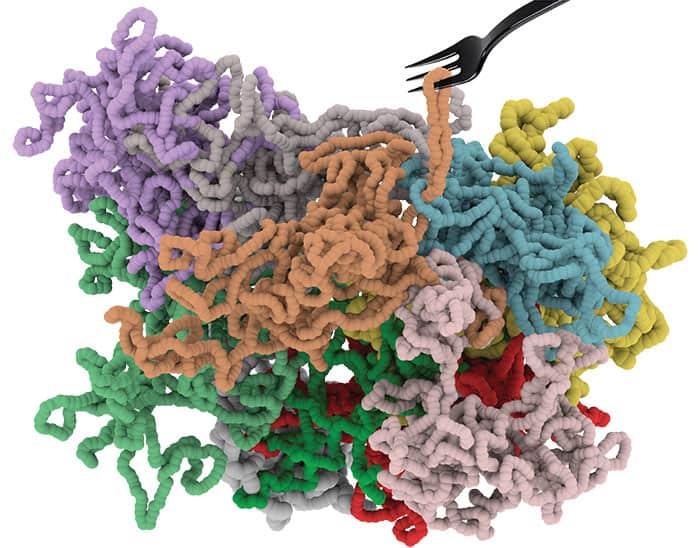
The thing about ring-shaped polymers, though, is that they’re very poorly understood – in fact, they’re one of the last big mysteries in polymer physics. Physicists are now pretty clear about how individual linear poly-mer molecules move: each chain slides along like a snake moving through tall grass in a process dubbed “reptation”. Similarly, suck on a strand of spaghetti and it’ll slither through the others in the bowl and up into your mouth. But reptation doesn’t apply to rings because they have no free ends. There are theories conjecturing how rings move and what shape they adopt, but none really captures the whole story.
1 Knotty issue Computer simulations can give us a better understanding of the dynamic motion of ring polymers, which move ever more slowly as the chains get longer and more tangled up. (Courtesy: Davide Michieletto)
In our work, we are interested in knowing what shapes ring polymers adopt when placed in a gel of linear polymers, which we model as a 3D lattice of obstacles. As each ring polymer must form a continuous loop that weaves itself between the obstacles, the ring polymers don’t stay circular but end up adopting some curious shapes dubbed “lattice animals” because they can, rather amusingly, look like real animals. While the idea of ring polymers forming these lattice-animal shapes is rather cute, the fact that individual ring polymers must stay as isolated loops (known as “un-knots” in the language of topology) is what makes studying these materials really hard.
Ring polymers are free to adopt different configurations and don’t necessarily stay circular but can crumple up into different shapes. Unlike linear polymers, in which you can just examine all the local interactions between individual segments, or “monomers”, of the molecule in isolation, for ring polymers you have to keep track of the overall topological state of the chain. Judging the likelihood of a ring polymer adopting a particular configuration is therefore much more tricky and what makes studying these molecules hard.
Recent computational studies of the dynamics of ring polymers have revealed that these macro-molecules can entangle in a very different way from their linear cousins. Because of their topology, ring polymers can form horribly complicated structures, in which one ring is threaded through another, which is threaded through another and so on to form what we call “hierarchical threadings”. The most tightly bound ring in this giant network can only get free if the other rings are pulled apart one by one in a particular order.
Towards a topological glass
The bottom line is that the individual ring polymers in a network find it very hard to move freely even though they don’t actually form any knots, which are topological states that can only be undone by cutting the ring (see figure 1, above). In fact, recent simulations that we’ve carried out suggest that if they are long enough, ring polymers become so sluggardly that they could eventually appear frozen into place. If this were to occur – and we have evidence, though no definite proof, that it does – we would have identified a new state of matter, which we have called a “topological glass” (2014 ACS Macro Lett. 3 255 and 2013 Europhys. Lett. 102 58005).
Ordinary glassy materials are made by cooling a viscous liquid, with the amount of movement dropping exponentially as temperature falls; it becomes a glass only once the material is cool enough that the molecules in it have stopped moving. A topological glass made from ring polymers would be rather different: the motion would slow down exponentially not just with temperature but with ring length too. Despite not yet having definite proof that such a state exists, we have shown with our simulations that ring polymers certainly start to slow down in exactly the way you’d expect if it were a true topological glass. What’s holding us back from getting a definitive answer is computer power: as the rings get longer and more tangled up, the time it takes to probe the motion rises exponentially, though we’ve recently bid for more supercomputer time to push our simulations to the limit.
“Topological phases” are all the rage in condensed-matter physics these days, with researchers studying exotic materials such as topological insulators (materials that don’t conduct electrically in the bulk but do along the edge) and rod-shaped liquid-crystal molecules that contain topological defects. What would be nice about a topological glass is that its properties would be governed purely by topology, rather than the system-specific chemical details that often control when and how classical glasses form. Physicists love that kind of universal behaviour – in fact, obtaining a universal description of glasses has been a central goal in condensed-matter physics for several decades. What’s more, ring polymers could also inspire the design of novel materials that could have applications that we cannot yet even imagine.
So while we are not entirely sure yet that topological glasses really do exist, what we do know from our research is that when it comes to eating pasta, the Italians were right all along – you’re better off sticking to spaghetti, which you can eat nice and quickly. Make yourself a bowl of anelloni and it’s likely to have gone cold by the time you’ve pulled all the rings apart and struggled your way to the messy end.
A recipe for anelloni
Sheets of pasta from which ring-shaped “anelloni” can be cut. (Courtesy: Davide Michieletto)
Shape the flour into a mound on a clean surface and make a large well in the middle.
Add the eggs bit by bit to the flour and mix until you get a smooth dough, taking care to avoid the dough becoming clumpy.
Knead rigorously by hand for 15–20 min until the dough is smooth and elastic.
Flatten the dough out with a rolling pin to form a thin sheet.
Cover one half of the sheet with a piece of baking paper so that the dough doesn’t stick as you take one end of the sheet and fold it over itself, making sure it overlaps by about 1 cm.
Moisten the overlapped region with water and then seal the sheet together to create a flat, open cylindrical shape (see image above).
Using scissors, cut thin strips along the dough at 90° to the sealed edge to form closed rings of pasta, or anelloni (see image above).
Cook for 3–5 min in plenty of boiling water.
Enjoy it with a generous drizzling of olive oil and lots of Parmesan!
Pasta cut into large “anelloni” rings. (Courtesy: Davide Michieletto)
Giving a fired-up talk at a physics conference is a good way for aspiring researchers to make themselves known to the community, but unless you have a natural gift, lots of practice is required. That’s why many universities and labs host “slams” to encourage staff and students to talk about their research to a broader audience. Above is a video of the sold-out Fermilab Physics Slam 2014, which was held last week at the lab on the outskirts of Chicago.
The first commercial shipment of medical isotopes produced using a new particle-accelerator-based technique has been made by scientists at the Canadian Light Source (CLS). Molybdenum-99 (Mo-99) decays to create technetium-99m (Tc-99m), which is used to tag radiopharmaceuticals and plays a unique and vital role in medical imaging. Unlike nuclear reactors, which currently make most of the world’s Mo-99, the system is small enough to be deployed within a large hospital and could thereby improve the supply of the short-lived isotopes.
The material is made at the Medical Isotope Project (MIP) facility at the CLS, which is located at the University of Saskatchewan in Saskatoon. According to Mark de Jong, director of accelerators at the CLS, the facility is the first of its kind anywhere in the world, and uses a small high-power industrial electron linear accelerator to produce a flux of high-energy X-rays through bremsstrahlung radiation. The X-rays strike a target made of enriched Mo-100, in the process “knocking out” a neutron from the nuclei of some of the target atoms to produce Mo-99.
No fission required
“The main advantage of this method is the complete avoidance of any use of uranium or fission, with all the problems that arise from both volatile short-lived isotopes, as well as disposing of the long-lived radioactive waste,” says De Jong.
After several days of irradiation at the CLS facility, the target is shipped 800 km to the Winnipeg Health Sciences Centre’s Radio-Pharmacy Department, where it is dissolved and the Tc-99m is extracted. Transport across long distances is possible because Mo-99 has a half-life of 66 hours, but significant losses do occur. The half-life of Tc-99m is just 6 hours, so it must be produced as near as possible to where it will be used.
De Jong says that future implementations will not necessarily require such long-distance shipping. “The electron linear accelerator is small enough to be located close to where the Mo-99 is required, possibly even within major hospitals, reducing the losses caused by decay in shipping Mo-99. In the present fission-based production, more than 80% of the Mo-99 produced has decayed before it reaches the hospitals,” he adds.
Reactor shutdowns
The MIP was created in the wake of serious Mo-99 shortages in 2007 and 2009, which were both related to two unscheduled shutdowns of the ageing NRU nuclear reactor at Atomic Energy of Canada’s Chalk River Laboratories. NRU provides most of Mo-99 for North America, and isotope production is an important industry in Canada. In 2010, fearful of damage to the industry, the Canadian government launched a call under its Non-nuclear-reactor-based Isotope Supply Program (NISP) to encourage alternative isotope production using either photo-neutron production of Mo-99, or direct production of Tc-99m using proton cyclotrons. The CLS proposal was one of two photo-neutron production projects funded, the other being run by Winnipeg-based Prairie Isotope Production Enterprise (PIPE).
“Once the work to approve the processes involved – Mo-99 production, target dissolution and Tc-99m extraction – is completed by Health Canada, the facility should produce enough for the hospitals serving a population of more than two million people. The health approvals are the next phase that we are working on with our colleagues at PIPE. We hope to have the New Drug Application (NDA) submitted to the authorities by the end of 2015, with routine clinical use possible by the end of 2016,” says De Jong.
Other options
In 2012 scientists at the Vancouver-based TRIUMF national laboratory for particle and nuclear physics pioneered two methods for producing Tc-99m using Mo-100 targets and medical cyclotron-based accelerator technology. Cyclotrons are particle accelerators that rely on electricity and magnets to create isotopes by accelerating ions and bombarding non-radioactive materials.
“Our process is suitable for large population bases, using medical cyclotrons already installed and operational in our major hospitals throughout the country. We have demonstrated that cyclotrons in Vancouver, London and Hamilton have sufficient capacity to supply their respective hospital catchments with Tc-99m,” says TRIUMF’s Melissa Baluk.
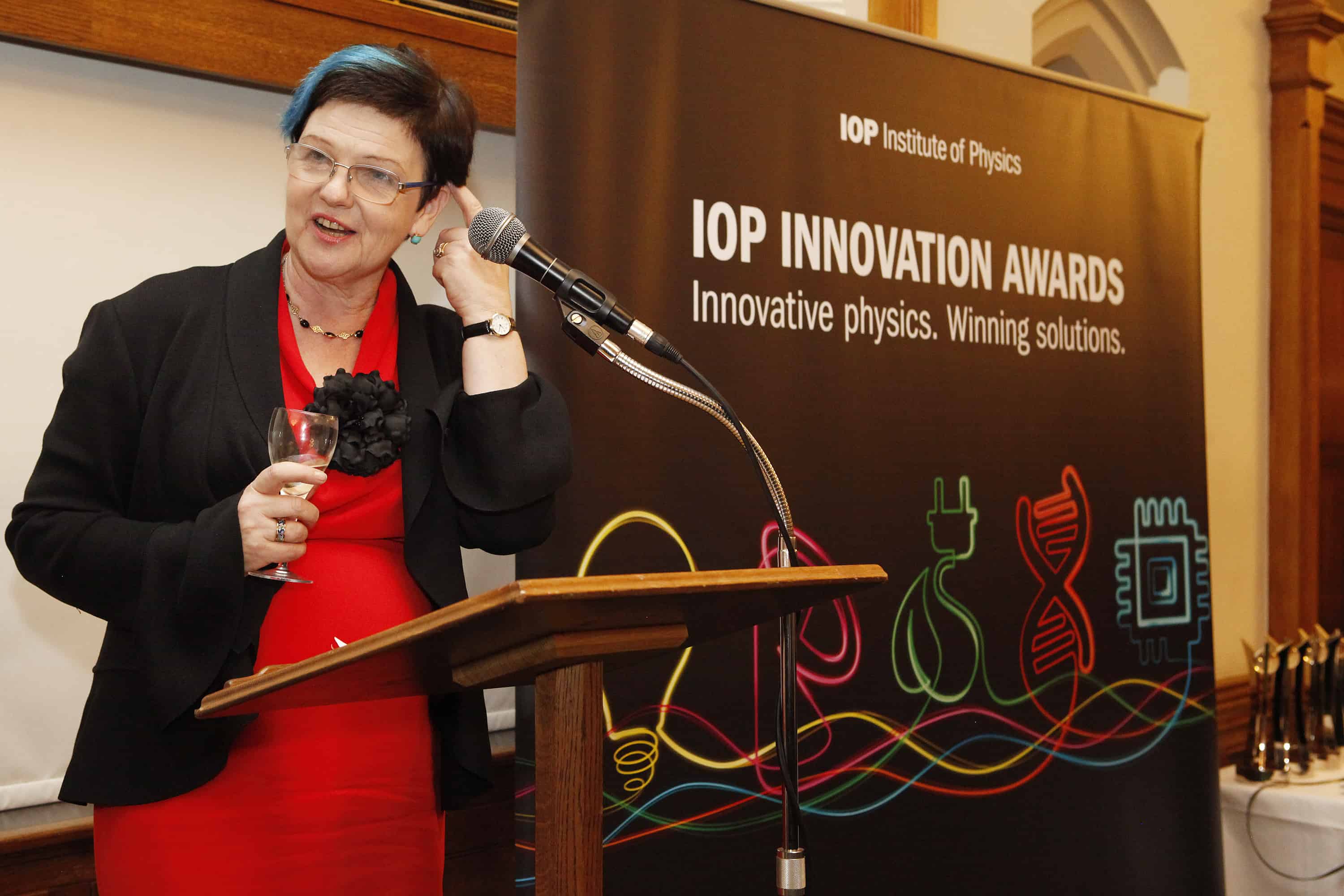
Clever thinking: Baroness Neville-Rolfe celebrates the winners of the 2014 Institute of Physics innovation awards. (Courtesy: Richard Lewis)
“Commercializing physics” is the theme of the November issue of Physics World and it was therefore timely that last night saw a special ceremony at the House of Commons to celebrate the winners of this year’s Innovation Awards from the Institute of Physics (IOP), which publishes the magazine.
The awards, which are now in their third year, are given by the Institute to firms in the UK and Ireland “that have built success on the innovative application of physics”.
Four firms were honoured this year: Gas Sensing Solutions, which makes carbon-dioxide sensors; Gooch & Housego, for an opto-acoustic device that can modulate laser beams for industrial processing; nuclear-power firm Magnox for a clever way of refuelling a reactor at the Wylfa power station; and MBDA for a novel “missile-system upgrade”.





 You can find out more about the new pasta and polymer mysteries in the December issue of Physics World. If you’re a member of the Institute of Physics (IOP), you can now enjoy immediate access to the new issue with the digital edition of the magazine. If you’re not yet in the IOP, you can