Majorana quasiparticles glimpsed in magnetic chains

The strongest evidence yet that Majorana quasiparticles (MQPs) can be found lurking in some solids has been unveiled by physicists in the US. The team used a scanning tunnelling microscope (STM) to locate MQPs at the ends of atomic chains of magnetic iron lying on the surface of a lead superconductor. MQPs have special properties that could make them ideal for use in quantum computers, and this latest breakthrough could lead to practical devices that make use of the quasiparticles.

First predicted by the Italian physicist Ettore Majorana in 1937, the Majorana fermion has zero charge and is its own antiparticle. Unlike conventional fermions such as the electron – which obey Fermi–Dirac statistics – the Majorana fermion obeys “non-Abelian” statistics. This means that quantum information encoded in the particles would be highly resistant to decoherence. Decoherence is the bane of physicists who are trying to develop practical quantum computers, and therefore devices based on Majorana fermions could be used in future quantum-information systems.

Exciting excitations

Although Majorana fermions have never been spotted as free particles, there is growing evidence that collective excitations of electrons – called quasiparticles – in some solids can have the same properties as Majorana fermions. Evidence of such MQPs has already been seen at the interface between a superconductor and a non-superconductor in several different experiments – however none of these studies have been conclusive.

Now, Ali Yazdani and colleagues at Princeton University and the University of Texas at Austin have found further evidence of MQPs at the interface of a superconductor and a magnet. The team looked at magnetic chains of iron atoms on the surface of a superconducting lead crystal that is chilled to 1.4 K. Using a spin-polarized tip on their STM, the researchers were able to show that the iron chain is ferromagnetic. Then, using the STM to measure the energy spectrum of electrons in the chain, they showed that the iron was also behaving as a superconductor – a phenomenon known as the proximity effect.

Swirling electrons

The superconductivity in the iron chain involves paired electrons travelling in helical orbits. This rare type of pairing makes the chain a “topological superconductor”, and MQPs are expected to occur at the end of the chains.

To locate MQPs, the team looked for something called a zero bias peak (ZBP) in the electron energy spectrum of the iron chain. The STM measures the ease with which an electron can be added or removed from the chain by applying a bias voltage between the tip and the chain. However, because the MQPs are a combination of a negative particle and a positive antiparticle, they can only move in and out of the chain when a zero applied voltage – or bias – is applied at the tip.

The team scanned the STM tip along a chain, and found the expected ZBPs at either end. But the ZBP could be due to an unrelated magnetic resonance that can occur in the chains. This was ruled out by repeating the measurement in a weak magnetic field, which stops lead from being a superconductor. The ZBP vanished as expected. If the ZBP was related to a magnetic resonance, it would have been enhanced by the magnetic field, not diminished.

Mobile Majoranas

While the physicists are not alone in seeing ZBPs at the ends of tiny wires, they are the first to be able to rule out the effect of magnetic resonances. Yazdani told physicsworld.com that the team is now studying edges of 2D islands of magnetic atoms on a superconductor for evidence of MQPs. Such MQPs should be able to move along the edge of an island, allowing physicists to further study their properties.

Joel Moore of the University of California Berkeley sees the work as a significant contribution to MQP research: “It goes beyond the previous efforts also seeing zero-bias tunnelling peaks in that it has excellent spatial resolution and a clearly defined system that can probably be reproduced by other groups.”

However, Moore points out that for MQPs to be useful in quantum computers, their non-Abelian nature must be established – something Yazdani and colleagues are also working on at the moment.

The video below shows how the iron chains were made and studied using STM.

The research is described in Science.
How can geophysicists ‘see’ inside the Earth?

In less than 100 seconds, William Symes of Rice University in the US explains how geophysicists use sound to infer structures within the Earth. The basic idea is to fire sound waves into the Earth (or track natural seismic signals) and then measure the distribution of reflected waves at the Earth’s surface and the time it took for them to return. This information can help geophysicists to identify features of interest within the planetary interior.

Of course, it is not quite as simple as that because sound varies in its speed within the Earth depending on the physical properties of the material through which it is passing. Symes explains that geophysicist have teamed up with mathematicians to develop computational models to help them to interpret their echoes.

Watch more from our 100 Second Science video series.

Physics road trip through the north-east of Brazil

The new IIP building in Natal

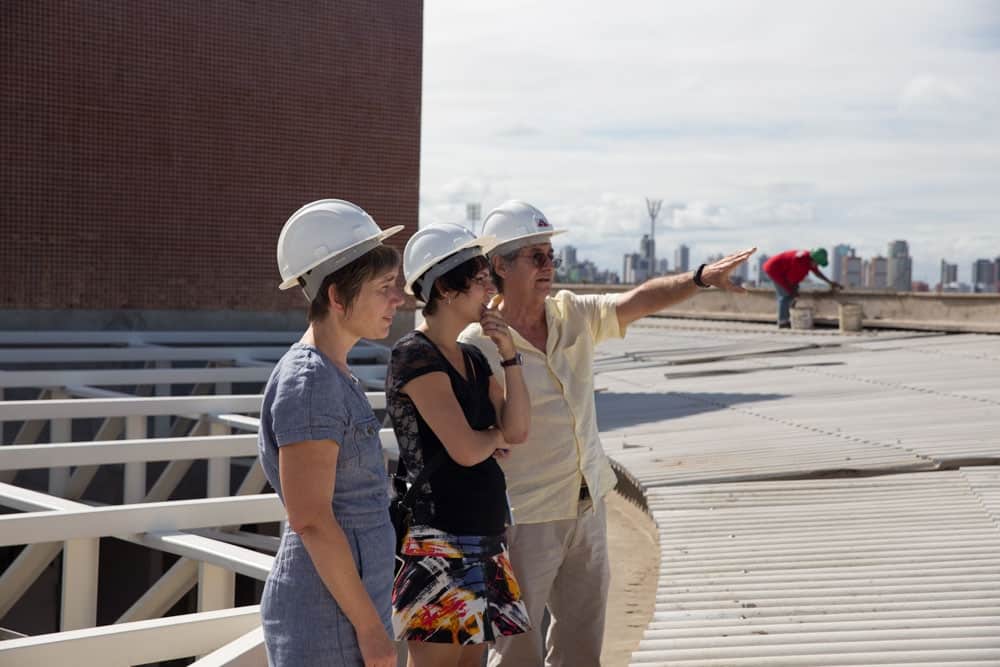
This week, several of us from IOP Publishing have been visiting the north-east of Brazil. Our prime focus has been the annual meeting of the Brazilian Materials Research Society in João Pessoa, where we launched a new Science Impact report highlighting materials research in Brazil. But during the week I travelled to Natal with my colleague Sarah Andrieu to visit Alvaro Ferraz, director of the International Institute of Physics (IIP).

(more…)

Abdus Salam's legacy celebrated

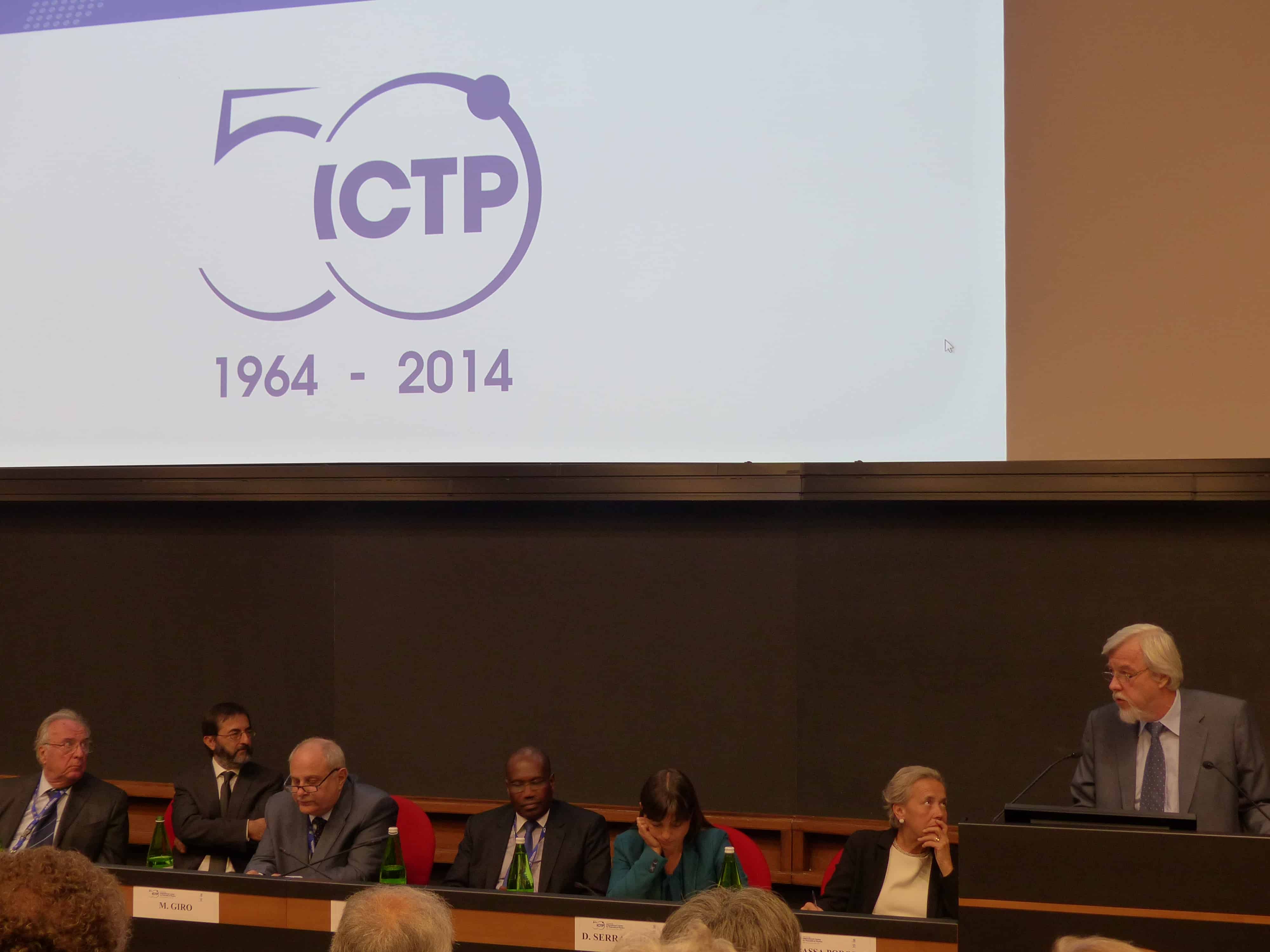
Photo of opening session at ICTP 50th-anniversary meeting

By Matin Durrani in Trieste, Italy

It was a small touch, but certainly quite surprising.

To kick off the opening session of the 50th-anniversary meeting of the International Centre for Theoretical Physics (ICTP), no-one spoke. Instead, the lights were dimmed until the audience was sitting in total darkness. Then emerged the voice of the ICTP’s founding father – the Pakistani theorist Abdus Salam, who died in 1996 – as a film started rolling on the screen at the front of the lecture hall. This was followed by a series of short video messages from selected physicists from around the world who benefited from the support of the ICTP early in their careers. As one physicist put it, the ICTP was “the launching pad” for their career. “It is a rare opportunity that so many people dream about,” added another.

(more…)

All eyes on the ICTP as it turns 50

View from the guest house at the International Centre for Theoretical  Physics in Trieste, Italy

By Matin Durrani in Trieste, Italy

When the Pakistani physicist Abdus Salam founded the International Centre for Theoretical Physics (ICTP) here in Trieste in 1964, I am sure he would have never quite dared to believe that it would go on to be such a success in helping to further the careers of some of the brightest minds from the developing world. Salam’s dream was for the ICTP to be a focal point for talented theorists from countries seeking to build up their research strengths, bringing such people into contact with leading physicists from front-ranking nations to carry out top-quality collaborative projects.

Now, 50 years after it began, the ICTP is hosting a golden-jubilee conference, where it is quite rightly celebrating all that it has achieved – and looking ahead to the future too.

(more…)

Nobel mania – predictions, discussions, hangouts and more


By Tushna Commissariat

In this week’s Red Folder, we are looking at all things Nobel-prize-related, as the winner(s) of the 108th Nobel Prize for Physics will be announced in Stockholm next Tuesday.

Kicking off the Nobel round-up is our own infographic that tells you what branch of physics you should take up if you are keen to become a laureate yourself. In case you haven’t seen it already, take a look at it here and work your way through our seven categories that encompass all 107 physics Nobel prizes handed out to date.

Next, watch the video above where the Smithsonian Magazine’s science editor Victoria Jaggard hosts a Google Hangout to discuss the science and scientists predicted to win this year’s award. In it, she talks with Charles Day of Physics Today, Andrew Grant of Science News, Jennifer Ouellette of Cocktail Party Physics and Amanda Yoho of Starts With A Bang!, as they discuss everything from topological conductors to graphene to neutrinos.

(more…)

Nobel laureate Martin Perl dies at 87

The US particle physicist Martin Perl has died at the age of 87. Perl was instrumental in discovering the tau lepton – an elementary particle similar to the electron but 3477 times heavier. The work led him to share the 1995 Nobel Prize for Physics with Frederick Reines, who discovered the neutrino, for their “pioneering experimental contributions to lepton physics”.

Born in New York City on 24 June 1927, Perl originally trained as a chemical engineer, obtaining a degree in the subject at the Brooklyn Polytechnic Institute in 1948. He then went on to work for General Electric, where he was involved in producing electron vacuum tubes. It was there that Perl’s interests turned to physics, and he began to enrol in physics courses at Union College in New York.

In 1955 Perl was awarded a PhD in physics from Columbia University, which he did under the supervision of the 1944 physics Nobel laureate Israel Isaac Rabi. Perl’s thesis applied Rabi’s nuclear-magnetic-resonance technique to measure the nuclear quadrupole moment of sodium. After his PhD, Perl moved into particle physics, heading to the University of Michigan, where he used bubble chambers to study the scattering of pions with nucleons.

The third generation

In 1963 Perl joined the Stanford Linear Accelerator Center (SLAC), and it was there that he carried out his Nobel-prize-winning work in the 1970s. We now know that three generations of leptons and quarks make up the known fundamental matter states in the universe, but in the early 1970s only two generations of leptons were known to exist. The first consists of the electron and its associated neutrino – the electron neutrino (together with their antiparticles) – while the second generation includes the muon and the muon neutrino.

Perl’s discovery opened up the third generation of elementary particles. In 1972 SLAC had just completed the SPEAR electron–positron collider, which could collide electrons and positrons at a then-record energy of 4.8 GeV (later reaching 8 GeV). In conjunction with the magnetic detector – developed at the Lawrence Berkeley National Laboratory – the facility could detect and distinguish between leptons, hadrons and photons.

Using SPEAR between 1974 and 1977, Perl and colleagues observed events in which the electron–positron annihilation produced electron–antimuon or positron–muon pairs with an energy less than the initial energy and with no other particles visible. Perl’s interpretation was that the initial electron–positron pair had annihilated to produce a new lepton–antilepton pair, which Perl dubbed the tau–lepton pair. The tau then decayed into an electron (or muon) plus two undetected neutrinos, while the antitau decayed into an antimuon (or positron) and two neutrinos.

Given that the signal could be explained by other events, some particle physicists were initially sceptical about the discovery. What finally convinced the community that the tau lepton had been discovered was when Perl’s results were later confirmed by the DESY particle-physics lab in Hamburg, Germany, as well as by further experiments at SPEAR.

Perl was active in physics until the end of his life. Indeed, recently he had turned his sights on experiments to understand the nature of dark energy. One such proposal, in 2011, involved dropping caesium atoms through two 1.5 m-long atom interferometers in the hope of detecting any hitherto unknown “dark content of the vacuum”.

What type of physics should you do if you want to bag a Nobel prize?

Infographic showing awards of Nobel physics prizes by subject area

At 11.45 a.m. CET (at the earliest) on Tuesday 7 October, the winner(s) of the 108th Nobel Prize for Physics will be announced in Stockholm. Like just about everyone else, I have no information about who will win – although I do have my suspicions (more on those tomorrow).

Predicting the future is never easy, but help is at hand with a new infographic that Physics World has created charting the history of the physics Nobel by discipline. Using the categories that we apply to articles on physicsworld.com, we have split the 107 prizes since 1901 into seven categories. If you click on the image above, you can see the infographic in all its glory.

The most popular discipline with Nobel committees through the ages is nuclear and particle physics, which accounts for nearly one-third of the prizes. As well as dominating the prizes in the 1950s and 1960s, nuclear and particle physics spreads its tentacles from the very first prize – to Wilhelm Röntgen for the discovery of X-rays – to last year’s prize, which went to François Englert and Peter Higgs for predicting a much more esoteric boson.

Interestingly, that very first prize in 1901 flags up an important challenge I faced while categorizing the prizes using contemporary disciplines. You could argue that when Röntgen discovered X-rays, he was doing atomic physics. Indeed, some of those X-rays would have come from atomic processes, while others would have been bremsstrahlung – which I would consider particle physics. However, because Röntgen accelerated electrons into a target and analysed the radiation produced, I decided that it was a particle-physics experiment.

What else can we learn from the infographic? One striking observation is that while today condensed-matter physics is a vast enterprise, it didn’t get a look-in until 1913, when Heike Kamerlingh Onnes won for his low-temperature studies and for producing liquid helium. And unlike nuclear and particle physics, there is no “golden era” of condensed-matter physics, with prizes spread out evenly since 1913.

Astronomy, astrophysics and cosmology arrived on the scene even later: in 1936, in fact, when Victor Hess shared half the prize for his discovery of cosmic rays. Researchers in the field had to wait until 1967 for their next prize, when Hans Bethe won a Nobel gong for his work on stellar nucleosynthesis, although in every decade since then at least one further prize has been awarded to those who study the heavens.

One very interesting trend that gets going around 1980 is that the prizes appear to be alternating between five categories. Does this mean that in the past 35 years or so, Nobel committees have made an effort to spread prizes across disciplines? If that’s the case, the infographic suggest that in 2014 we are due a winner from atomic, molecular and optical physics.

Turning to the number of laureates per prize (denoted by the thicknesses of the coloured lines and timeline markers), it is clear that shared prizes have become more prevalent since about 1950. Perhaps this is recognition that most science is a collaborative process, or perhaps that physics has become so complicated that a major breakthrough can’t be achieved by one person alone. The last two solo prizes came over two decades ago, when the French physicists Pierre-Gilles de Gennes and Georges Charpak won in 1991 and 1992, respectively.

The category with the highest average number of laureates per prize (2.25) goes to astronomy, astrophysics and cosmology, which could reflect the fact that all but one of the prizes in this field were awarded after 1950, when multiple laureates dominate. Quantum physics and classical physics are both just shy of one laureate per prize, which probably reflects the fact that most of these prizes were awarded before 1950 when the trend of sharing prizes began. Overall, the number of laureates per prize is a little over 1.8.

Finally, the strangest prize that I came across while compiling the infographic is the 1908 award, which went to Gabriel Lippmann “for his method of reproducing colours photographically based on the phenomenon of interference”. Lippman was a French physicist and his photography technique was so difficult to perform that it never made it out of the lab and was quickly overtaken by more practical colour processes. Even the Nobel committee sometimes get their judgements wrong.

NB Astute readers will notice that the infographic does not illustrate the fact that the prize has been shared by three winners in two different ways: three one-third prizes or one half prize and two quarters. We struggled with finding a way of showing this, but in the end decided that this distinction was not important in terms of understanding the temporal trends in disciplines and number of laureates that we are trying to illustrate.

Megatelescope snaps up former fusion boss

Edward Moses joins the Giant Magellan Telescope Organization (GMTO) today as its first president, after stepping down as a scientific manager at the Lawrence Livermore National Laboratory. Moses had spent the past 15 years overseeing the effort to develop laser-based fusion at Livermore’s National Ignition Facility (NIF), but will now focus on managing the construction of the massive 25.4 m optical telescope on northern Chile’s Las Campanas Peak.

When it comes online about a decade from now, the $880m GMT will have almost 10 times as much light-gathering capacity as any existing instrument. Astronomers will use the telescope for everything from spotting exoplanets and examining the formation of stars and galaxies shortly after the Big Bang to measuring the masses of black holes and exploring dark matter and dark energy. Moses’ appointment comes as the project moves from design to construction, with the first of the instrument’s seven primary 8.4 m mirrors having been completed, and two others being ground and polished. Workers have also cleared more than 40,000 m3 of rock from the Chilean site to make way for construction.

Eye on the sky

Moses takes up his new position 16 months after he left the directorship of NIF to concentrate on Livermore’s photon science directorate. At the time, critics accused him of mismanaging NIF and speculated that he had paid the price for NIF’s failure to hit its target of achieving a self-sustaining fusion reaction by 2012. But those murmurings have seemingly not affected his ability to land new roles. “We looked into how people related to him as staff and many at NIF came close to worshipping [Moses] and would have followed him off the cliff,” says Rocky Kolb – dean of physical sciences at the University of Chicago – who is a member of the GMTO board that recruited Moses. “There’s simply no substitute for experience with large technical projects and we’re convinced that he’s the person to get the telescope into operation.”

Moses intends to draw on his 30-year experience in big-science facilities and other ground-breaking projects, which included having to develop new systems and technologies at NIF that did not exist before the facility started. “To manage that, do the R&D, and integrate it together was the big issue,” says Moses, who promises to take the GMT “from a giant telescope to a great laboratory”. GMTO director Patrick McCarthy adds that Moses brings “an order of magnitude attitude, skill and vision” to the project. “We think this is a transformative moment,” he says.

Aliens and atheists

By Margaret Harris

Press releases are supposed to be attention-grabbing, but occasionally, I come across one that really goes the extra mile. That was the case this morning when – my eyes still a bit bleary, my coffee still un-drunk – I spotted a real doozy in my in-box.

“Are the world’s religions ready for ET?” the headline asked.

Some might regard this question as unimportant. Even if you care about the official views of religious groups (and many people – including some religious people – do not), their opinions about life on other planets are surely less relevant to daily life than their guidelines on, say, human morality. After all, if extraterrestrial life does exist, it is an awfully long way away: the nearest star system to ours, Alpha Centauri, is more than four light-years off, and astronomers do not regard it as a good candidate for habitable planets. So, if extraterrestrial life is ever discovered, the Earth’s religions will have plenty of time to get used to it before it causes them any practical problems down at the local synagogue, mosque, temple or church (“Baptismal Ceremony ET: For alien life forms unable to answer for themselves”).

(more…)

Copyright © 2026 by IOP Publishing Ltd and individual contributors