As an acoustical physicist at the University of Salford, Trevor Cox spends much of his time developing ways to minimize distortions and other unwanted effects in concert halls and recording studios. A few years ago, however, an “acoustic epiphany” in a Victorian sewer, of all places, opened his mind – and his ears – to the beauty and wonder of less-conventional soundscapes. Since then, Cox has been on “scientific odyssey of sound” that has included trips to the singing sands of the Mojave Desert, a Cold War listening post and a vast underground oil tank that holds the Guinness World Record for the longest echo.
In this podcast, you’ll hear Cox describing some of these “sonic wonderlands” to Physics World‘s reviews editor Margaret Harris, who visited him in Salford to learn more about the science of unusual sounds – and to experience a few of these sounds first-hand.
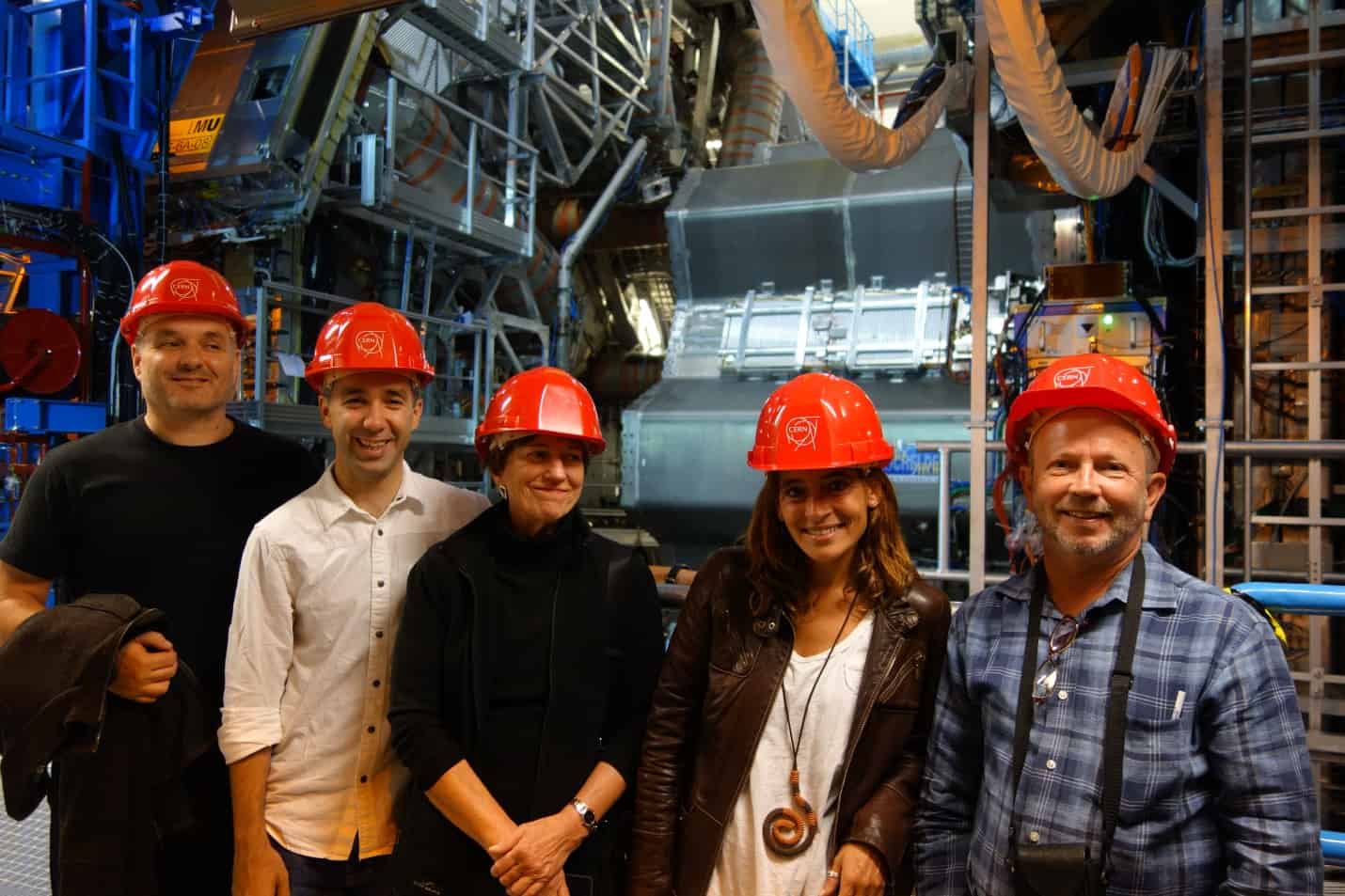
All-star line-up – Physics World columnist Robert P Crease (far right) in front of the ATLAS detector at CERN’s Large Hadron Collider as he and his fellow speakers brace themselves ahead of today’s TEDx talks at CERN.
By Robert P Crease in CERN, Geneva
On Tuesday morning I addressed 1300 empty chairs.
I was the first of several presenters yesterday at a dress rehearsal for the TEDxCERN event, which takes place this afternoon, Wednesday 24 September. The rehearsal was held in a huge tent specially constructed for this event, and for CERN’s 60th-anniversary celebrations next week. The programme will be broadcast live today starting at 1.30 p.m. CEST (GMT+2).
It isn’t easy, I discovered, to grab the attention of empty chairs. I stumbled over sentences and forgot to click my slides. Occasionally I felt on automatic pilot, and had the eerie experience of hearing myself speak with a half-second delay, as if I were listening to myself from the back of my head. I went a minute over time and also discovered a typo in a slide that I had viewed approximately a zillion times before. I was relieved to find I wasn’t the only one; some of those who followed, too, tripped over delivery or had trouble with slides.
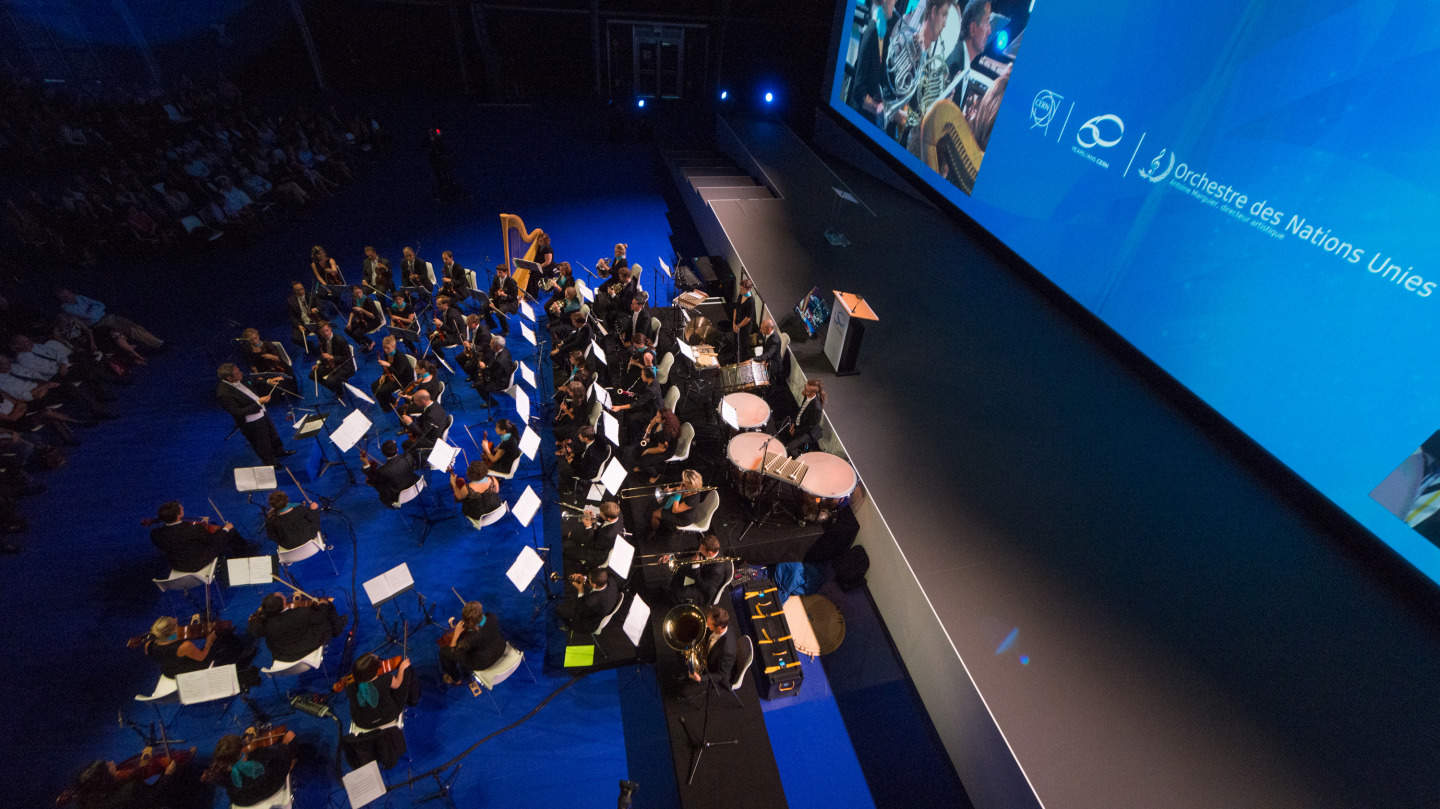
Sorry, you missed this concert by the UN Symphony Orchestra on 19 September, but there is more music coming up. (Courtesy: CERN)
All this week the people at CERN and in its member states will be celebrating 60 years of particle physics at the world-famous lab in Geneva. There is something for everyone to enjoy and here are a few highlights that we have picked out
An international team of physicists has shown that information stored in the nuclear spins of hydrogen isotopes in an organic LED (OLED) can be read out by measuring the electrical current through the device. Unlike previous schemes that only work at ultracold temperatures, this is the first to operate at room temperature, and therefore could be used to create extremely dense and highly energy-efficient memory devices.
With the growing demand for ever smaller, more powerful electronic devices, physicists are trying to develop more efficient semiconductors and higher-density data-storage devices. Motivated by the fact that traditional silicon semiconductors are susceptible to significant energy losses via waste heat, scientists are investigating the use of organic semiconductors. These are organic thin films placed between two conductors and they promise to be more energy efficient than silicon semiconductors. Furthermore, the availability of many different types of organic thin film could help physicists to optimize the efficiency of these devices.
Chip and spin
Conventional memory chips store data in the form of electrical charge. Moving this charge around the chip generates a lot of waste heat that must be dissipated, which makes it difficult to miniaturize components and also reduces battery life. An alternative approach is to store information in the spins of electrons or atomic nuclei – with spin-up corresponding to “1” and spin-down to “0”, for example. This could result in memories that are much denser and more energy efficient than the devices used today.
Atomic nuclei are particularly attractive for storing data because their spins tend to be well shielded from the surrounding environment. This means that they could achieve storage times of several minutes, which is billions of times longer than is possible with electrons. The challenge, however, is how to read and write data to these tiny elements.
Now, Christoph Boehme and colleagues at the University of Utah, along with John Lupton of the University of Regensburg and researchers at the University of Queensland, have shown that the flow of electrical current in an OLED can be modulated by controlling the spins of hydrogen isotopes in the device. “Electrical current in an organic semiconductor device is strongly influenced by the nuclear spins of hydrogen, which is abundant in organic materials,” explains Lupton. The team has shown that the current flowing through a plastic polymer OLED can be tuned precisely, suggesting that inexpensive OLEDs can be used as efficient semiconductors.
Just like MRI
Boehme and his team applied a small magnetic field to their test OLED, which creates an energy difference between the orientations of the nuclear spins of protons and deuterium (both hydrogen isotopes). The researchers then used radio-frequency signals to alter the directions of the spins of the protons and deuterium nuclei – a process that is also done during a nuclear magnetic resonance (NMR) experiment.
The changes to the nuclear spins affect the spins of nearby electrons, and this results in changes to the electrical current. The magnetic forces between the nuclear and electron spins are millions of times smaller than the electrical forces needed to cause a similar change in current. This suggests that the effect could be used to create energy-efficient semiconductor memories.
This recent work follows on from research done in 2010, when Boehme and colleagues showed that the technique could be used to control current in a device made from phosphorus-doped silicon. However, this was only possible in the presence of strong magnetic fields and at temperatures within a few degrees of absolute zero. Such conditions are impractical for commercial devices, but the OLED-based device needs neither ultracold temperatures nor high magnetic fields.
Time to relax
“In organic semiconductors, the spin-relaxation time does not change significantly with temperature,” explains Lupton. “In contrast, the spin-relaxation time in phosphorus-doped silicon increases significantly when the temperature is lowered; so in phosphorus-doped silicon, the experiments had to be carried out at low temperatures and high magnetic fields.”
The team believes that its technique should also work with other nuclei with non-zero spin, with some limitations. “Since protons and deuterium are both hydrogen isotopes, they can be interchanged in the synthesis without changing the chemical structure of the polymer, which may not be possible with other types of nuclei,” Lupton explains. “Tritium, the third hydrogen isotope, is radioactive, so would not be much good in experiments.”
Astronomers working on the Background Imaging of Cosmic Extragalactic Polarization (BICEP2) telescope at the South Pole hit the headlines earlier this year when they claimed to have seen the first evidence for the primordial “B-mode” polarization of the cosmic microwave background (CMB). But a new analysis of polarized dust emission in our galaxy, carried out by the Planck collaboration, has shown that the part of the sky observed by BICEP2 has much more dust than originally anticipated.
The B-modes observed by the BICEP telescope are therefore most likely to be “local” galactic contamination rather than an imprint left behind by the rapid “inflation” of the early universe – the extremely rapid expansion that cosmologists believe our universe underwent a mere 10–35 s after the Big Bang. While the new analysis does not completely rule out BICEP2’s original claim just yet, it does establish that the dust emission is nearly as big as the entire BICEP2 signal.
Extraordinary claims
The BICEP2 team initially claimed its measurement was at a statistical certainty of 7σ – well above the 5σ gold standard for a discovery in physics. Many scientists hailed the result as the initial proof for inflation, but not everyone was convinced and other researchers soon pointed out that the BICEP2 team might have seriously underestimated the contribution of dust in our galaxy in their signal.
A foreground, such as the dust that BICEP2 may have detected, could consist of any emissions that could be confused with primordial CMB photons since they were last scattered at the “epoch of recombination”, when neutral atoms first formed and the decoupling of matter and radiation allowed photons to travel freely across the universe. When carrying out large-scale surveys of the CMB, researchers need to account for two important sources of electromagnetic emissions in our galaxy – synchrotron radiation from electrons moving in the galactic magnetic field and polarized emission from dust – to ensure that they do not mimic the signal they are searching for.
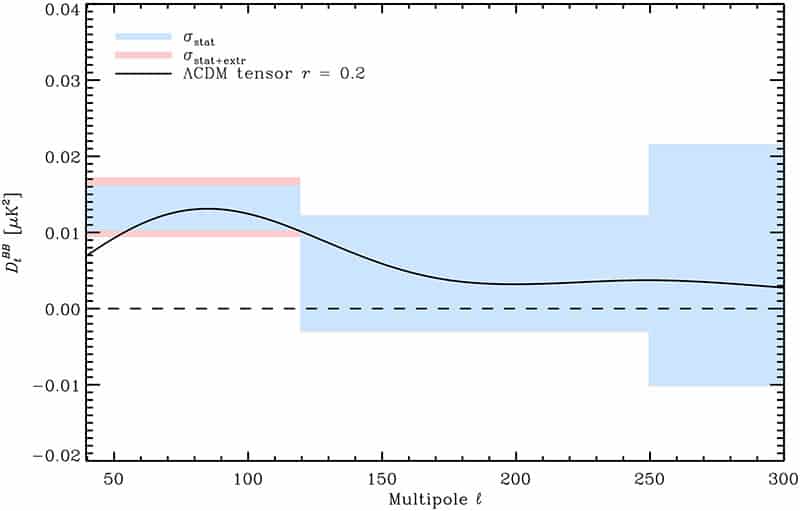
Perfect match: plot showing the expected amount of B-mode polarization as a function of angular size (the multipole moment). The light-blue rectangles are Planck’s dust observations and the black line denotes the amplitude of gravitational waves one would see from the BICEP2 signal. As they overlap so well, the BICEP2 signal can be well explained by dust. (Courtesy: Planck Collaboration)
While the BICEP2 researchers claimed to have ruled out known contamination from synchrotron radiation and dust at a statistical significance of about 2σ by cross-correlating what they saw with preliminary results from the Planck data available last year, we now know that their estimate was too low. Another criticism is that the method the team used to check its signal against that of the dust was not robust. Furthermore, BICEP2 only makes its measurements at a single frequency of 150 GHz.
Dusty doubts
Neil Turok, director of the Perimeter Institute of Theoretical Physics in Canada, who has been a vocal critic of the BICEP2 result from the start, says that the experiment itself “has many limitations, the main one being that it is only at one frequency”. BICEP2 could not therefore check if its signal is also seen at other frequencies, which it would have to be if it were a truly cosmological effect. Indeed, Turok says that BICEP2’s measurements in themselves were sound; it was the collaboration’s claims of having found the smoking gun for inflation that were excessive and unnecessary.
Peter Coles, an astrophysicist at the University of Sussex in the UK, who has also been sceptical of the BICEP2 findings, is unsurprised by the new Planck analysis. “There’s been quite a lot of circumstantial evidence accumulating that the polarized emission from galactic dust is more significant and more complicated than cosmologists had expected,” he says. “My feeling, though, is galactic astronomers always felt this was going to be the case.”
Following BICEP2’s announcement in March, Subir Sarkar – a particle theorist at the University of Oxford and the Niels Bohr Institute in Copenhagen – claimed to have found evidence of emissions from magnetized dust in local structures of dust in our galaxy. These “radio loops” could generate a previously unknown polarized signal, casting further doubt on the BICEP2 finding. According to Sarkar and colleagues, this previously unrecognised foreground at microwave frequencies is present at high galactic latitudes and could easily be misinterpreted as a B-mode polarization signal.
Jumping through loops
In light of the new Planck data, Sarkar is convinced that a loop structure, which crosses the BICEP2 observation region, may be the main culprit. “Planck data have confirmed that there is indeed such an emission from the Milky Way. This radiation is polarized and can plausibly account for the high polarization fraction of 20% required in the BICEP2 observation region,” says Sarkar. He adds that further detailed cross-correlation studies of Planck and BICEP2 data will be required for a definitive answer.
The Planck and BICEP2 collaborations are now joining forces to examine all of their data, to suss out any possible signal that may have originated from primordial gravitational waves. Their joint results should be available by the end of the year and should set the debate straight on BICEP2’s observation.
“A joint BICEP2/Planck analysis will have the benefit of complementarity between Planck’s much better frequency coverage and all-sky mapping capability versus BICEP2’s higher sensitivity, so it remains possible that a primordial gravitational wave signal can be extracted from the data through this combination,“ says Coles. “It will be difficult, though, and if I had to bet I’d probably guess that it will end with no detection.”
“To get the required sensitivity, sky coverage and frequency range will probably require a dedicated satellite mission,” says Coles and currently proposed missions such as LiteBIRD and COrE may fit the bill. However, Planck’s current observations also found certain patches of the sky that are cleaner and more devoid of dust than that studied by BICEP2. “So perhaps the existing ground-based polarization experiments, such as the South Pole Telescope or Atacama Cosmology Telescope, might have a chance if they are deployed to those regions,” says Coles. Observations made by these experiments, in conjunction with Planck, will hopefully settle the debate on gravitational waves within the next three to five years.
A pre-print of the new Planck result is available on the arXiv server.
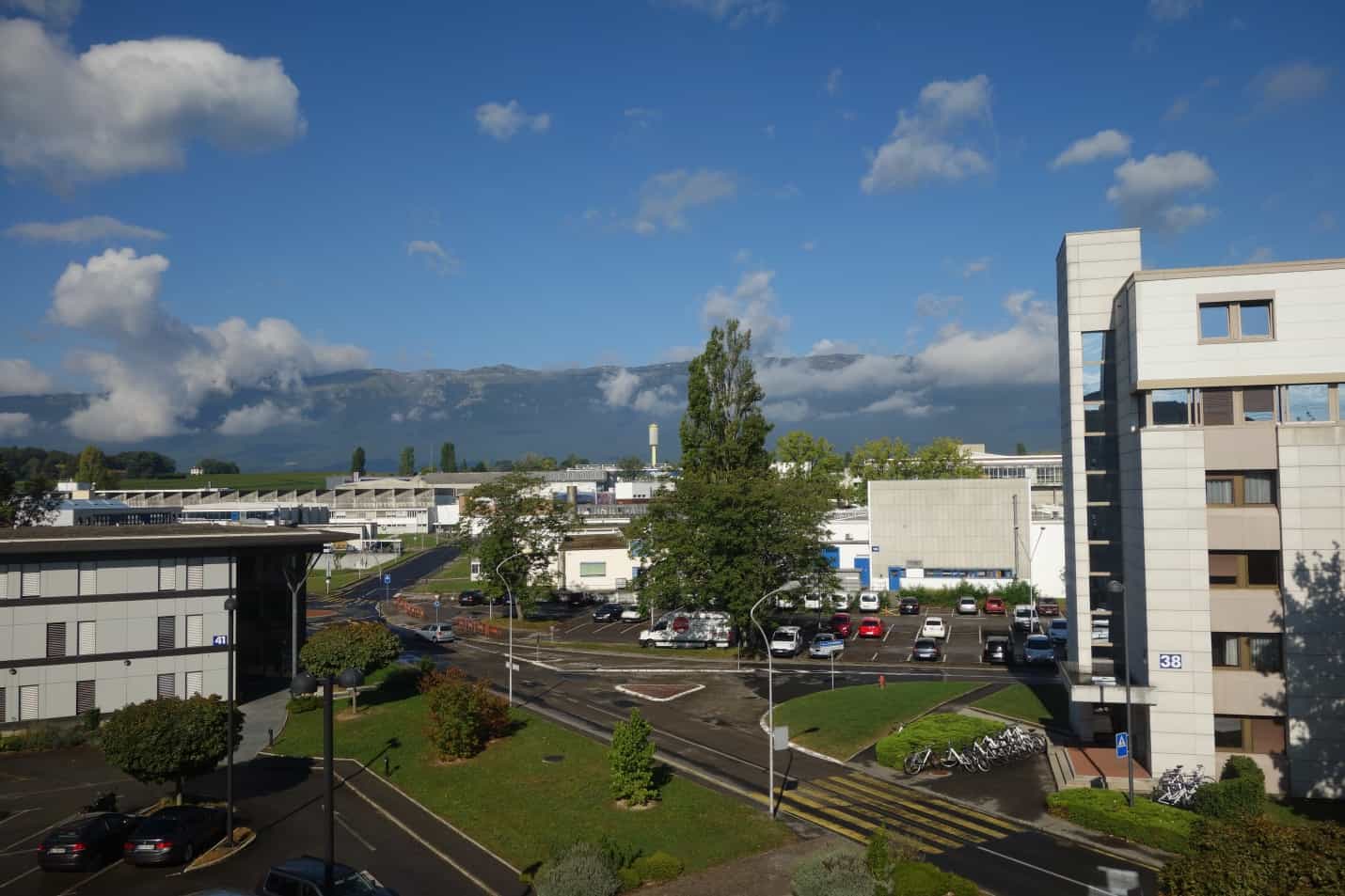
Calm before the storm – the view of CERN from Robert P Crease’s bedroom window as he tries desperately to shave a final two minutes off his TEDx talk.
By Robert P Crease in CERN, Geneva
On Sunday morning I arrived at CERN to find workers putting finishing touches on a huge tent where the lab will host its TEDx event on Wednesday, and its 60th anniversary festivities next week.
“TED”, which stands for Technology, Entertainment, Design, is a non-profit organization that promotes talks on what it calls “ideas worth spreading”; the “x” denotes an independent event organized in that spirit. This is the second TEDxCERN – the first took place last year – and it’s hosted by Brian Cox. More than 1000 people will watch 14 speakers, three performances and three animations; tens of thousands more viewers are expected online.
James Gillies, CERN’s head of communication, invited me to be a speaker. The subject this year, he said, was how science could better engage with major social challenges. He said that my May Physics World column “Why don’t they listen?” – on why scientists have difficulty getting politicians’ ears – had “hit the nail on the head”, and asked if I’d be interested in discussing the idea.
A week at CERN? A great excuse to implore colleagues take over my classes? Sure! All I had to do, I thought, was talk my way through some extended version of the column.
Pyramid power: this lovely object has nothing to do with postdocs. It is a simpler version of a much larger Sierpinski tree that can be found on London’s South Bank.
Just this week six people were convicted in Bristol of crimes related to running a pyramid scheme. This involves taking money from lots of new investors and giving it to a smaller number of investors who signed up earlier – until the pyramid collapses. Is the current model for training scientists a pyramid scheme of sorts? That is the claim in a piece on the US’s National Public Radio (NPR) website written by Richard Harris.
The CERN particle-physics laboratory near Geneva is celebrating its 60th anniversary this month with a host of symposia, meetings, plays, films, concerts and other events being held at the lab and at member states across Europe. CERN will mark its official birthday on Monday 29 September, which was the date when the CERN convention was ratified by its first 12 member states in 1954 and the European Organization for Nuclear Research was officially established.
Today’s event sees the laboratory celebrating the 60th anniversary of its first council session, which was actually held in Geneva on 7–8 October 1954, with a “Science and peace” symposium this afternoon, featuring talks by people involved in outreach and early-career researchers as they tell their personal stories of life at CERN. The symposium will be followed by a concert by the United Nations Orchestra at the lab’s Globe of Science and Innovation.
The special birthday symposium on 29 September, meanwhile, will include an address from CERN’s director-general Rolf-Dieter Heuer, video presentations about the history of the laboratory and the science being developed there, as well as discussions of CERN’s contributions to society at large and musical and film presentations. “With its discoveries and innovations, CERN has been bringing the world together through science for 60 years,” says Heuer. All of the events will be webcast and can be viewed the world over.
Together through science
Established in the aftermath of the Second World War by a handful of pioneering European scientists, including Nobel laureates Louis de Broglie and Niels Bohr, CERN was seen as the perfect opportunity to construct an international laboratory for fundamental research that would bring nations together through science. The 12 founding states included Belgium, Denmark, France, the Federal Republic of Germany, Greece, Italy, the Netherlands, Norway, Sweden, Switzerland, the UK and Yugoslavia. The lab now has 21 member states with many other countries from around the world – including the US, Japan and India – participating in its research programme.
The lab’s early successes included the discovery of weak neutral currents in 1973, followed by its 1983 discovery of the W and Z bosons. In early 1989, CERN scientist Tim Berners-Lee came up with his blueprint for the World Wide Web (the first servers were up and running by late 1990) and soon after, the 27 km Large Electron Positron collider (LEP) began operating. The collider, which helped to confirm the Standard Model of particle physics with extraordinary precision, was dismantled in 2000 to make way for the Large Hadron Collider (LHC).
Undoubtedly, the LHC is CERN’s most famous and successful endeavour – work began on the device in 1999, but was first switched on in September 2008, before shutting down again two days later due to failing magnets. The collider started up again in November 2009, and then swiftly hunted down the elusive and long sought-after Higgs boson by July 2012. Since then, both of the LHC’s two major detectors – ATLAS and CMS – have confirmed the findings with more data, and the discovery won François Englert and Peter Higgs the 2013 Nobel Prize for Physics for the prediction of the existence of the Higgs boson.
New frontiers
In February 2013 the LHC was turned off for a planned, major maintenance and upgrade programme following a successful three-year run operating at 7 TeV. Staff at CERN have gradually been restarting the collider since June this year and they hope that the €124m upgrade will boost the collider to the full design energy of 13 TeV.
Over the next few months, the LHC will undergo months of intensive testing to ensure that the upgrade was successful before the full physics programme can resume next year. Testing includes putting a current through each of the LHC’s eight sections and Lamont adds that all eight sections of the LHC should be cooled down by October to the operating temperature of around 2 K. By 2015 the upgraded LHC should have enhanced capabilities that will allow it to approach a new high-energy frontier.
Scotland: staying in the UK following the referendum. (CC BY-SA 2.0/Jack Torcello)
In the end, it was perhaps not too unexpected when Scotland voted against independence in yesterday’s referendum. Almost all of the polls in the run-up to the vote had signalled a win for the “no” camp – and so it turned out, with 55% of voters wanting Scotland to remain tied to England, Wales and Northern Ireland as part of the UK. But it was a relatively close-run affair and many will be relieved that the two sides have avoided having to spend the next few years arguing, like a divorcing couple, over how to divide their spoils.
A supermassive black hole (SMBH) has been found lurking in an unexpected location – at the heart of an ultra-compact dwarf galaxy – according to new observations made by an international team of astronomers. Although SMBHs are thought to reside at the centre of most large galaxies including our own Milky Way, this is the smallest galaxy known to host a black hole. The team’s findings suggest that many other such ultra-compact dwarf galaxies may house black holes, meaning that there may be many more SMBHs in our galactic neighbourhood than previously thought.
SMBHs are the largest type of black hole, and can have masses that are 105–109 times that of the Sun. On the other hand, ultra-compact dwarf galaxies are small galaxies that are also among the densest star systems in the universe. They are less than a few hundred light-years across as compared with our Milky Way’s 100,000 light-year diameter. However, astronomers have been puzzled by the very large estimated masses of these small galaxies, which seemed to suggest the unexpected presence of SMBHs.
Black hole inside
This theory now seems to be confirmed by observations, made by Anil Seth from the University of Utah in the US and colleagues, of a supermassive black hole inside the brightest-known ultra-compact dwarf galaxy M60-UCD1.
“We’ve known for some time that many ultra-compact dwarf galaxies are a bit overweight. They just appear to be too heavy for the luminosity of their stars,” says team member Steffen Mieske from the European Southern Observatory in Chile. “We had already published a study that suggested this additional weight could come from the presence of supermassive black holes, but it was only a theory. Now, by studying the movement of the stars within M60-UCD1, we have detected the effects of such a black hole at its centre.”
The team’s observations have also highlighted that there may be many black holes that have gone unnoticed to date. Indeed, there may be as many as double the known number of black holes in what astronomers refer to as our “local universe”.
Lying about 50 million light-years away from Earth, M60-UCD1 is a tiny galaxy with a diameter of 300 light-years across. However, despite its modest size, it contains some 140 million stars. While this is a characteristic of an ultra-compact dwarf galaxy, M60-UCD1 happens to be the densest ever seen. The black hole itself has a mass of nearly 21 million Suns, which accounts for almost 15% of M60-UCD1’s total mass.
Small but dense
“That is pretty amazing, given that the Milky Way is 500 times larger and more than 1000 times heavier than M60-UCD1,” says Seth. “In fact, even though the black hole at the centre of our Milky Way galaxy has the mass of four million Suns, it is still less than 0.01% of the Milky Way’s total mass, which makes you realize how significant M60-UCD1’s black hole really is.”
The team made its discoveries using both the NASA/ESA Hubble Space Telescope and the Gemini North 8-metre optical and infrared telescope in Hawaii. The sharp Hubble images provided information about the galaxy’s diameter and stellar density, while Gemini was used to measure the movement of stars in the galaxy as they were affected by the black hole’s gravitational pull. These data were then used to calculate the mass of the unseen gravitational behemoth.
Stellar struggle
The team’s findings also have an impact on current theories of how ultra-compact dwarf galaxies themselves are formed. “This finding suggests that dwarf galaxies may actually be the stripped remnants of larger galaxies that were torn apart during collisions with other galaxies, rather than small islands of stars born in isolation,” explains Seth. “We don’t know of any other way you could make a black hole so big in an object this small.”
Seth and colleagues suggest that M60-UCD1 was, at one time, a much larger galaxy made up of 10 billion stars and hosted an appropriately sized SMBH. This ancient galaxy may have then passed too close to the centre of its much larger neighbouring galaxy, M60, thereby losing its outer part to its larger companion, leaving behind the small, compact galaxy we observe today. (M60 is also pulling in another galaxy, named NGC4647, which is 25 times less massive than it.)
The team says that, in the future, M60-UDC1 may merge with M60 – which harbours its own humongous black hole that is 4.5 billion solar masses and 1000 times bigger than our galaxy’s black hole – to form a single galaxy. A merger between the two galaxies would also cause the black holes to merge, creating an even more monstrous black hole.