Scotland’s future

Castle Stalker

In the end, it was perhaps not too unexpected when Scotland voted against independence in yesterday’s referendum. Almost all of the polls in the run-up to the vote had signalled a win for the “no” camp – and so it turned out, with 55% of voters wanting Scotland to remain tied to England, Wales and Northern Ireland as part of the UK. But it was a relatively close-run affair and many will be relieved that the two sides have avoided having to spend the next few years arguing, like a divorcing couple, over how to divide their spoils.

(more…)

Gargantuan black hole found at the heart of dwarf galaxy

A supermassive black hole (SMBH) has been found lurking in an unexpected location – at the heart of an ultra-compact dwarf galaxy – according to new observations made by an international team of astronomers. Although SMBHs are thought to reside at the centre of most large galaxies including our own Milky Way, this is the smallest galaxy known to host a black hole. The team’s findings suggest that many other such ultra-compact dwarf galaxies may house black holes, meaning that there may be many more SMBHs in our galactic neighbourhood than previously thought.

SMBHs are the largest type of black hole, and can have masses that are 105–109 times that of the Sun. On the other hand, ultra-compact dwarf galaxies are small galaxies that are also among the densest star systems in the universe. They are less than a few hundred light-years across as compared with our Milky Way’s 100,000 light-year diameter. However, astronomers have been puzzled by the very large estimated masses of these small galaxies, which seemed to suggest the unexpected presence of SMBHs.

Black hole inside

This theory now seems to be confirmed by observations, made by Anil Seth from the University of Utah in the US and colleagues, of a supermassive black hole inside the brightest-known ultra-compact dwarf galaxy M60-UCD1.

“We’ve known for some time that many ultra-compact dwarf galaxies are a bit overweight. They just appear to be too heavy for the luminosity of their stars,” says team member Steffen Mieske from the European Southern Observatory in Chile. “We had already published a study that suggested this additional weight could come from the presence of supermassive black holes, but it was only a theory. Now, by studying the movement of the stars within M60-UCD1, we have detected the effects of such a black hole at its centre.”

The team’s observations have also highlighted that there may be many black holes that have gone unnoticed to date. Indeed, there may be as many as double the known number of black holes in what astronomers refer to as our “local universe”.

Lying about 50 million light-years away from Earth, M60-UCD1 is a tiny galaxy with a diameter of 300 light-years across. However, despite its modest size, it contains some 140 million stars. While this is a characteristic of an ultra-compact dwarf galaxy, M60-UCD1 happens to be the densest ever seen. The black hole itself has a mass of nearly 21 million Suns, which accounts for almost 15% of M60-UCD1’s total mass.

Small but dense

“That is pretty amazing, given that the Milky Way is 500 times larger and more than 1000 times heavier than M60-UCD1,” says Seth. “In fact, even though the black hole at the centre of our Milky Way galaxy has the mass of four million Suns, it is still less than 0.01% of the Milky Way’s total mass, which makes you realize how significant M60-UCD1’s black hole really is.”

The team made its discoveries using both the NASA/ESA Hubble Space Telescope and the Gemini North 8-metre optical and infrared telescope in Hawaii. The sharp Hubble images provided information about the galaxy’s diameter and stellar density, while Gemini was used to measure the movement of stars in the galaxy as they were affected by the black hole’s gravitational pull. These data were then used to calculate the mass of the unseen gravitational behemoth.

Stellar struggle

The team’s findings also have an impact on current theories of how ultra-compact dwarf galaxies themselves are formed. “This finding suggests that dwarf galaxies may actually be the stripped remnants of larger galaxies that were torn apart during collisions with other galaxies, rather than small islands of stars born in isolation,” explains Seth. “We don’t know of any other way you could make a black hole so big in an object this small.”

Seth and colleagues suggest that M60-UCD1 was, at one time, a much larger galaxy made up of 10 billion stars and hosted an appropriately sized SMBH. This ancient galaxy may have then passed too close to the centre of its much larger neighbouring galaxy, M60, thereby losing its outer part to its larger companion, leaving behind the small, compact galaxy we observe today. (M60 is also pulling in another galaxy, named NGC4647, which is 25 times less massive than it.)

The team says that, in the future, M60-UDC1 may merge with M60 – which harbours its own humongous black hole that is 4.5 billion solar masses and 1000 times bigger than our galaxy’s black hole – to form a single galaxy. A merger between the two galaxies would also cause the black holes to merge, creating an even more monstrous black hole.

The research was published in Nature.

The right questions

Photo of a brittlestar creature

Quantum mechanics, writes the US philosopher Karen Barad, seems to inspire “all the right questions”. So how come we can’t seem to get the answers? Writing specifically about Michael Frayn’s play Copenhagen, for instance, Barad notes that it leaves the audience with the “empty feeling that quantum theory is somehow at once a manifestation of the mystery that keeps us alive and a cruel joke that deprives us of life’s meaning”.

Barad received her PhD in theoretical physics from Stony Brook University (though I do not know her) and pursued a physics career before joining the feminist-studies department at the University of California, Santa Cruz. In 2007 she wrote a book, Meeting the Universe Halfway: Quantum Physics and the Entanglement of Matter and Meaning, that is fascinating for the vigilance it pays to the philosophical implications of physics. After discovering the book, I’ve made parts of it required reading for my science-philosophy students.

Faulty inheritance

Philosophers are in many ways like scientists, in that each generation inherits various assumptions, concepts and methods that it uses to try to understand our world. Inevitably, some elements prove inadequate, creating paradoxes and mysteries that force us to continually revise that inheritance.

Barad’s book attacks a specific philosophical inheritance known as “representationalism”. It’s the idea that knowledge consists of theories and concepts that represent – but are not connected to – real things such as lumps of metal or ocean waves. At the heart of what’s wrong, Barad argues, is the assumption that knowledge involves a subject over here, an object over there, and a space to be crossed to connect them.

Barad’s alternative position, which is not new, is known as “naturalism”. It’s the view that “we are part of that nature that we seek to understand” – knowers and known are bound up in a single process. What’s novel is that Barad articulates her view from insights into quantum physics. Taking it seriously, she suggests, means that “every aspect of how we understand the world, including ourselves, is changed”.

Ambitious stuff. Barad starts her discussion with Niels Bohr’s point that, to understand nature, we interact with it. Barad argues, wielding the double-slit experiment as the classic illustration, that quantum phenomena are events produced by interactions between component parts of nature, including the experimental set-up itself. Barad extends Bohr’s insight using an elaborate analogy involving diffraction (she uses the word interchangeably with interference) to show how experimental practices cannot be subtracted from a result to leave an “objective” residue that was there all along.

Barad, however, finds that Bohr did not go far enough. He wanted to view human beings as part of nature, but ended up treating an experimentalist as a subject who “stands fully formed before the action and chooses a particular apparatus as part of doing an experiment”. In other words, Bohr saw the person doing an experiment as “an external observer, a spectator, removed from the scene of action”.

Barad in fact thinks humans are a bit like quantum phenomena. She regards us as “emergent phenomena like all other physical systems”, who arise within larger configurations of social practices and material worlds. Human cognition and “agency” (the ability to exert force) cannot be ascribed to single, dimensionless consciousnesses but are distributed among and exerted by these configurations. In fact, she doesn’t think “knowing” is exclusive to human subjects; it is “not a human-dependent characteristic”. She calls her position “agental realism”.

Barad’s most remarkable illustration of agency not being located in a single consciousness but distributed in a material context – her “Exhibit A” – is the brittlestar, an invertebrate marine creature that is a relative of the starfish. Brittlestars flee from predators, knowing and acting intelligently without eyes. They do so thanks to arrays of microlenses that collect and focus light on nerve bundles. “Brittlestars don’t have eyes; they are eyes,” Barad writes. “The brittlestar is a living, breathing, metamorphizing optical system” – a live diffraction grating. “For a brittlestar, being and knowing, materiality and intelligibility, substance and form, entail one another,” she says. It is a brilliant use of a scientific image for philosophical effect.

Barad compares her own book to a diffraction grating, producing a design that cannot be understood without taking into account all the individual elements. Skipping over parts, she warns, makes it “difficult to appreciate the intricacies of the pattern”. I’ve left out much of that overall pattern, but many of the book’s intriguing features – and how it puts physics to philosophical effect – appear in the curtailed view I’ve provided.

The critical point

Still, it is a jump from brittlestars to humans; how big a jump? A weak point is that Barad does not fully address the “nature” to which we belong and that we seek to understand. Does it include the entire realm of what it is to be human, including how we enjoy, say, rainbows or are outraged by injustice? If so, naturalism is hardly a position at all, and rather tautological. Or does the word “nature” involve a more scientific conception of the real, what experimental scientists find in the laboratory? If so, then we’re effectively relegating many aspects of human life to secondary status. Barad’s emphasis on the distributed and material character of agency sometimes makes it hard to tell which perspective she is writing from. In fact, that ambiguity led one student of mine to complain (while acknowledging that this is not Barad’s intent) that suddenly “racism, sexism and homophobia are no more problematic than waves grinding rock into sand”.

Barad sometimes writes as though solving long-standing philosophical problems were just a matter of watching what scientists do and heeding the implications. It is indeed impressive how much she accomplishes by following that path. Still, “What do we mean by nature?” is among the right questions that we have to ask.

New plasmonic nanolaser is cavity-free

A new design for a cavity-free nanolaser has been proposed by physicists at Imperial College London. The design builds on a proposal from the same team earlier this year to reduce the group velocity of light of a particular frequency to exactly zero in a metal–dielectric–metal waveguide. The laser, which has yet to be built, makes use of two such zero-velocity regions, and would achieve population inversion and create a laser beam without the need for an optical cavity. The researchers suggest that the design could have important applications in optical telecommunications and computing, as well as theoretical implications in reconciling the physics of lasers with plasmonics.

The traditional design for a laser involves encasing a gain medium such as a gas in a cavity containing two opposing mirrors. The gain medium contains two electronic energy levels, and, in the natural state, the lower energy level is the more populated. However, by injecting electrical or light energy into the cavity, some electrons can be “pumped” into the upper state. At low pumping levels, atoms pushed to the upper level decay spontaneously back to the ground state with the emission of a photon. However, above a certain threshold, transitions back to the ground state are predominantly caused by an excited atom’s absorption of a second photon. The two photons are emitted perfectly in phase, and go on to excite emission from more atoms. The resulting beam of phase-coherent photons is the laser beam.

Lasers have revolutionized modern science and technology, with tiny lasers can be found everywhere from cheap pointers to state-of-the-art telecommunications systems. While much smaller nanoscale lasers would be useful for creating chip-based optical circuits, the need for a cavity limits means that it is difficult to miniaturize a conventional laser beyond the wavelength of the light it produces. This limit is about one micron for the light used in telecommunications technologies.

Plasmonic interactions

Now, Ortwin Hess and colleagues have devised a new way of producing a sub-wavelength laser by removing the cavity altogether. The researchers designed a layered metal–dielectric–metal waveguide structure that supports plasmonic interactions between light and conduction electrons at the metal–dielectric interfaces. Such a plasmonic waveguide supports two “zero-velocity singularities” at closely spaced but distinct frequencies. Light of other frequencies will propagate through the semiconductor very slowly – allowing it plenty of time to interact with the gain material. While slow and stopped light might sound like unphysical concepts, they can occur when light interacts with plasmons. Injecting a pulse of this slow light, the researchers calculated, will pump carriers from a lower energy state to a higher state. This higher state would then decay to an intermediate state, which would then decay to produce the laser light. The presence of the zero-velocity singularities causes the laser light to be trapped in the material, where it drives the desired coherent stimulated emission.

To produce a laser beam, however, some of the laser light must be able to leave the device. In previous work (see “Plasmonic waveguide stops light in its tracks”), Hess and colleagues proposed exciting a zero-velocity mode by passing the light through the cladding in the form of an evanescent wave – a special type of wave the frequency of which is a complex number. Radiation incident on the cladding would excite an evanescent wave, which would in turn excite the stopped-light mode in the dielectric inside. In their new paper, Hess and colleagues turn this idea on its head and use the evanescent field to allow laser light to escape. By varying the precise properties and thickness of the cladding layer, the proportion of light allowed to escape could be tuned, producing a laser beam of variable intensity.

Biomedical applications

Nicholas Fang, a nanophotonics expert at the Massachusetts Institute of Technology, believes that, if such cavity-free nanolasers could be produced, they could have major practical implications not only in computation and signalling, but also in less-obvious fields such as prosthetics: he suggests they could be embedded in synthetic tissue to provide sensors with output signals detectable by the nervous system. “Here you’d have a laser source that could be directly implantable,” he explains.

Hess, meanwhile, is excited by the potential theoretical implications of the work. While the current research focuses on using plasmonic interactions to produce coherent light, he believes that it should also be possible to keep the plasmons themselves confined within the waveguide to produce a miniature surface plasmon laser or “spaser”.

The research is described in Nature Communications.

Tiny scaffolds toughen ceramics

A nanostructured ceramic material that does not break when deformed has been developed by researchers at the California Institute of Technology. The new material incorporates a scaffolding of nanotubes, which gives it ultra-low density and high strength but none of the brittleness that is seen in artificially nanostructured ceramics.

Julia Greer and colleagues created the material by arranging alumina nanotubes with diameters of about one micron into a trussed lattice structure. This familiar arrangement of criss-crossed struts is widely used in buildings and other large structures. “It turns out that there is a critical thickness-to-diameter ratio of the [nanotube] struts, below which it is possible for the nanolattice to deform via shell buckling rather than via fracture,” explains Greer.

Eight triangles bear the load

Trusses are structures comprising five or more triangular units, and Greer and Caltech graduate students Lucas Meza and Satyajit Das chose a structure that exploits eight individual triangles. Greer explains that an octet-truss is one of very few lattice geometries with mechanical behaviour dominated by stretching, rather than bending, in response to applied loads.

“The octet connectivity is maintained under stress, but each layer becomes compressed and collapses upon compression, as shown in our video,” says Greer.

The researchers experimented with structures made from alumina nanotubes with thicknesses ranging from 5 to 60 nm and diameters from 0.45 to 1.38 μm, while the unit-cell width of the nanolattice varied from 5 to 15 μm. Compression experiments, whereby a sample is subject to a cycle of loading and unloading, were performed to determine the Young’s modulus – or stiffness – of the material as well as the yield stress, which is the point at which the sample does not return to its original shape.

The walls of the nanotube structures were relatively thick compared with their diameters. Tubes with thickness–diameter ratios of more than 0.03 demonstrated linear elastic deformation (similar to rubber), with bursts of strain leading to catastrophic brittle failure. However, thinner-walled nanotubes with ratios of less than 0.02 exhibited elastic followed by ductile responses to loading. This behaviour is similar to that of metals such as copper, and does not involve strain or catastrophic failure.

Bizarre behaviour

Were the researchers surprised to find this behaviour in the thinner structures? “Of course,” says Greer. “These structures don’t fail in a brittle fashion like any macro material of the sort would, or even like the 50 nm-thick walled octet in our study.”

Eager to understand their observations, the team developed a model for the critical transition point between fracture and elastic failure. This was able to predict that the thicker alumina tubes would fail because of brittle fracture, while the thinner tubes were more prone to buckling through an elastic failure mode.

Like macro-scale engineering structures, the stress was largely localized at the nodes of the truss structures. “There are several ways to improve nodal strength,” says Greer. “But that’s not really what we are working on. Improving strength is something that engineers do; we are scientists, so we do scientific discovery and leave ‘improvements’ for engineers.”

The structures are described in Science.

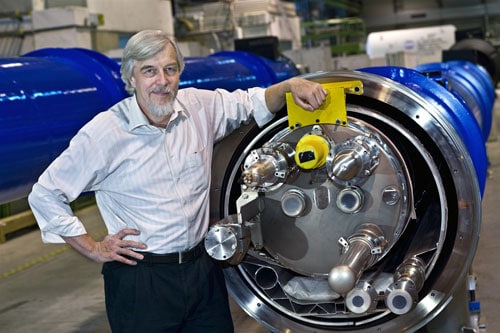
A day in the life of CERN’s director-general

By Rolf-Dieter Heuer, Geneva

There is no such thing as a typical day in the life of a CERN director-general (DG), certainly not this one in any case. In my experience, each incumbent has carved out a slightly different role for themself, shaped by the laboratory’s priorities and activities at the time of their mandate. For me, every day goes beyond science, management and administration, and I am particularly fortunate to have been DG through a remarkable period that has seen not only the successful launch of the Large Hadron Collider (LHC) and confirmation of the Brout–Englert–Higgs mechanism, but also an opening of CERN to the world – an area that I have pursued with particular vigour.

As I regularly joke, we have changed the “E” of CERN from “Europe” to “Everywhere”, and that has meant a lot of travel for the CERN DG, as we hold discussions with prospective new members of the CERN family. And when the CERN Council opened up membership to countries from beyond the European region in 2010, it seemed to me that we should also be extending our contacts in other directions as well.

(more…)

Leadership required

The advertisement on CERN’s jobs site was just over one page long, and its tone seemed almost deliberately matter of fact. “The term of office of the present director-general, Professor Rolf-Dieter Heuer, ends on 31 December 2015,” it stated. “The council is therefore inviting applications.” According to the bullet points that followed, duties associated with being CERN’s boss include leading the European particle-physics laboratory’s research programme (“with emphasis on the full exploitation of the scientific potential of the LHC”) and developing “strategic options” for its future.

For most physicists, the idea of applying for the job of CERN director-general (DG) is only a daydream. Even so, the advert raises some interesting questions. How does someone develop the skills required to lead a lab with multiple scientific experiments, some of the world’s most advanced machinery and 10,500 scientific users from all over the world? And beyond the advert’s broad statements about “effective building of consensus” and “excellent communication and negotiation skills,” what qualities does a CERN boss really need to succeed?

Ask the experts

As one of only 14 people who have served as CERN’s DG since the lab was founded in 1954, Chris Llewellyn Smith knows more than most about what the job takes. Between 1994 and 1998, he oversaw the approval of both the LHC and the final upgrade for its predecessor, the Large Electron–Positron (LEP) collider. According to Llewellyn Smith, leadership, charisma and presentation skills are all necessary, but he also emphasizes the importance of being “a good judge of people” who can choose a capable senior management team and then delegate responsibilities to them. “Any serious candidate to be DG will worry about the expectations and challenges,” he explains. “Having the support of a first-rate team of directors makes it possible to cope with pressures that can be – and in the 1990s were – enormous.” His main challenges, he says, were getting the LHC approved in the face of opposition from some CERN members, and bringing Japan and the US into the project.

One of Llewellyn Smith’s predecessors, Herwig Schopper, emphasizes the motivational aspect of the role. “Formally, the DG of CERN has all the power, and is only controlled by [the lab’s] council,” he explains. “But in practice the spirit and mentality of CERN is completely different. It’s very rare that the DG simply gives orders.” Instead, Schopper, who served as DG between 1981 and 1989, says that its leader “has to convince people to go in the right direction and motivate them to fulfil their tasks”. Such skills were particularly important for Schopper when the LEP was being built because the budget was both fixed and lower than it had been in preceding years.

As the current director of Fermilab, the US’s flagship particle-physics facility, Nigel Lockyer agrees that jobs like his are not about giving orders. Any director of a large physics research facility, he says, needs to listen to other people’s views, follow advice and communicate equally well with scientists and non-scientists. In addition, they need to cope well with multiple challenges while maintaining a positive outlook. On a lighter note, he adds, it helps to be someone who “gets excited about learning new?things”.

As for how to develop these qualities, Schopper suggests that prospective DGs should hone their management skills at smaller laboratories, as he did while managing the DESY accelerator centre in Hamburg, Germany. During his tenure, DESY had around 500 staff and 700 foreign users – smaller than CERN but big enough to provide a good management training ground.

In some circumstances, professional training can also help. Colin Hudson, the director of career development at Cranfield University’s School of Management, says that short courses in specific areas (such as complexity management or multinational influencing) might be useful for prospective DGs. For the most part, though, he believes that people in very senior positions can do just as well by working with an executive coach or with a mentor who has held a senior role in the sector.

Lockyer agrees that mentoring is important, noting that he sought advice from CERN’s current DG, Rolf-Dieter Heuer, when he was starting his role at Fermilab. The pair spoke about various topics, including management structure. “Call up your colleagues around the world and find out how they do business,” Lockyer advises. “See what works and what doesn’t work, and tailor it to yourself.”

Room for an outsider?

Skills such as people management, delegation and communication are not exclusive to science, of course. So could someone who has experience of managing a large organization – but no physics training – succeed as CERN’s DG?

Definitely not, says Dave Wark, a University of Oxford physicist who leads the particle-physics department at the nearby Rutherford Appleton Laboratory and is also a member of CERN’s scientific policy committee. “When you’re doing research that is at the very limits of human knowledge…you simply have to understand what you’re doing or you’ll screw it up,” he explains, adding that many of the DG’s decisions come down to making a judgement between different particle-physics arguments. Schopper, too, feels that a manager without a science background would be “completely lost” when making decisions about where to focus research efforts. “At the present time, theory doesn’t really tell us where to look for gold,” he says.

Even so, Cranfield’s Hudson – an engineer who previously directed UK operations for British Gas – believes it’s possible to overstate the importance of physics expertise to the DG’s job. While he stresses that CERN’s leader must understand the sector, the scientific issues and some of the technology, “it is not vitally important for them to be the most qualified physicist there”. If they are, he says, they will probably struggle to present the research in a way that government ministers and other outside influencers can understand.

What the advert leaves out

A few of the qualities that previous DGs found useful are perhaps more surprising. Physical stamina is one example. Llewellyn Smith notes that he flew to North America three times in his first five weeks as DG, and when the lab’s council met, he often stayed up at night writing memos or revising budget plans. During weeks when the council and committees for scientific policy and finance meet, Schopper adds, “sometimes there is no time for a meal and at other times one has to eat two lunches the same day to satisfy important visitors”. Because the lab is an international facility, Llewellyn Smith says it also helps to speak as many European languages as possible.

A more serious challenge, Schopper says, is that the DG sometimes has to take “difficult, lonely decisions and be criticized for developments beyond their control”. For example, both he and Llewellyn Smith had to deal with budget squeezes and make hard decisions about where to direct limited resources. Under the circumstances, Schopper adds, “leading a normal private family life is difficult”.

But despite the challenges, the two former DGs interviewed for this article are quick to mention the rewards of their former job. “It’s fascinating if you can see something can be done which is unique in the world, and promotes our scientific knowledge,” Schopper says. Meanwhile, Llewellyn Smith recalls an occasion when he spent a full hour meeting with China’s then-president Jiang Zemin. “Not many people spend an hour with somebody responsible for a quarter of the world’s population,” he says. “Things like that happen to you as director-general of CERN and are really unrepeatable experiences.”


Proton-beam therapy explained

The story of young brain-tumour patient Ashya King has gripped the British public over the past few weeks, with every twist and turn covered extensively in the media. In a nutshell, the five year old was removed from a hospital in Southampton at the end of August by his parents, without the authorization of doctors. They wanted their son to receive proton-beam therapy, which was not offered to them through the National Health Service (NHS). The family went to Spain in search of the treatment, triggering an international police hunt that subsequently saw the parents arrested before later being released.

The drama was accompanied by a heavy dose of armchair commentary, with Ashya’s parents, the hospital in Southampton and the police all receiving both criticism and praise. Even the British Prime Minister, David Cameron, got caught up in the affair, as he offered his personal support to the parents. To cut a long story short, Ashya’s parents finally got their wish and they have ended up at a proton-therapy centre in the Czech Republic where their son’s treatment begins today.

But what is proton therapy? It is a relatively new medical innovation that shows great promise in the treatment of cancer, though it is only currently available in certain countries. Beams of protons can be directed with precision at tumours in the body – allowing the energy to destroy cancer cells, while causing less damage to the surrounding tissue than is possible with conventional radiation therapies. The treatment, however, is only really useful in specific cases of cancer, such as where is vitally important that surrounding structures are not damaged. And because it is relatively new, there is less information available about how effective it is compared with more established treatments.

(more…)

Rosetta reveals its target landing site

The European Space Agency’s Rosetta mission has pinpointed the spot where its Philae landing module will touch down on the surface of a comet in November this year. The site, along with a second “back-up” location, has been chosen after much deliberation, and sits in the “head” of the comet – an area that is thought to be relatively flat and devoid of large boulders.

The region, dubbed Site J, was one of five locations that the team considered as potential landing sites on the oddly shaped Comet 67P/Churyumov–Gerasimenko, which is just over 4 km across at its widest point. The 100 kg Philae should reach the comet’s surface on 11 November, if all goes to plan. Images taken by Rosetta in July showed that the comet’s nucleus is made up of two distinct segments joined by a “neck”, giving it a “rubber-duck”-like appearance. The team revealed earlier today that the decision to select Site J as the primary site was unanimous. The back-up Site C is located on the “body” of the comet. Once at either of the sites, Philae will begin making in-depth measurements to characterize the nucleus in situ, providing researchers with a unique insight into the composition, structure and evolution of a comet.

Site selection

“As we have seen from recent close-up images, the comet is a beautiful but dramatic world – it is scientifically exciting, but its shape makes it operationally challenging,” says Stephan Ulamec, at the DLR German Aerospace Centre, who is the project manager for the lander.

Finding the prime landing site on Comet 67P was no easy task – none of the five chosen sites met all of the criteria preferred by the team, but site J is touted as the best solution. While the shortlist of five sites had been identified on 24 August, the spacecraft was still 100 km from the comet. Since then, the spacecraft has moved to within 30 km of the icy body, allowing the researchers to make more detailed scientific measurements of all five sites. This past weekend, engineers and scientists from Philae’s Science, Operations and Navigation Centre at France’s CNES space agency, along with researchers at the Lander Control Centre at DLR and the Rosetta team, met at CNES, Toulouse, France, to consider the available data and choose the primary and back-up sites.

Image of comet 67P with all five landing sites marked

The group considered a number of key factors, including the identification of a safe trajectory for sending Philae to the surface, as well as making sure that there were minimal visible hazards in the landing zone. Other factors, including the balance of daylight and night-time hours at potential landing sites and how often the lander could communicate with the rest of the orbiting spacecraft, were also considered. According to the statement from the Rosetta team released today, the “descent to the comet is passive and it is only possible to predict that the landing point will place within a ‘landing ellipse’ typically a few hundred metres in size. A one-square-kilometre area was assessed for each candidate site. At Site J, the majority of slopes are less than 30° relative to the local vertical, reducing the chances of Philae toppling over during touchdown”. The site also has fewer boulders and receives the right amount of sunlight each day to recharge Philae and continue science operations on the surface beyond the initial battery powered phase.

Perfect landing?

For the trajectory that the team has currently plotted, the lander should take about seven hours to reach the surface – a duration that does not compromise the on-comet observations by using up too much of the battery during the descent. Once deployed from the main Rosetta spacecraft, Philae will be on its own, with all of its commands already prepared and uploaded before it separates from the craft. Indeed, the module will be taking images and making other observations of the comet’s environment even as it descends. The landing itself should take place at a walking pace, and the module will use harpoons and ice screws to fix itself onto the surface. It will then make a 360° panoramic image of the landing site to help determine where and in what orientation it has landed.

For now, the Rosetta team will come up with a detailed plan of how the spacecraft will approach the planned trajectory to make its landing, which must take place by mid-November, because the comet is predicted to grow more active as it moves closer to the Sun. The landing date should be confirmed on 26 September after further trajectory analysis, and the final call to land at Site J will be made on 14 October.

Timely target

“There’s no time to lose, but now that we’re closer to the comet, continued science and mapping operations will help us improve the analysis of the primary and back-up landing sites,” says ESA Rosetta flight director Andrea Accomazzo. “Of course, we cannot predict the activity of the comet between now and landing, and on landing day itself. A sudden increase in activity could affect the position of Rosetta in its orbit at the moment of deployment, and in turn the exact location where Philae will land, and that’s what makes this a risky operation.”

Assuming that all goes well with Philae’s landing, the module will be studying the plasma and magnetic environment, and the surface and subsurface temperature. The lander will also drill and collect samples from beneath the surface, delivering them to the on-board laboratory for analysis. The interior structure of the comet will also be explored by sending radio waves through the surface towards Rosetta.

Pushing the frontiers of precision

By Michael Banks in Stuttgart, Germany

“There is nothing like this in Germany,” states Klaus Kern, a director of the Max Planck Institute (MPI) for Solid State Research in Stuttgart, Germany, as we walk around the institute’s Precision Laboratory, which opened in 2012 at a cost of €25m.

Kern took me on a guided tour of the the centre, which he has been involved with since its conception in 2008, during a break from attending a symposium celebrating the life of Manuel Cardona, a former institute director who passed away earlier this year.

The building is unique, not only in Germany but worldwide, as it offers researchers a space in which to do experiments that are seismically, acoustically and electrically isolated from the environment.

(more…)

Copyright © 2026 by IOP Publishing Ltd and individual contributors