Modelling molecular magnets

The complete magnetic properties of the prototype molecular magnet Mn12 have been modelled, for the first time, by an international team of researchers. The calculations will be crucial for developing real-world devices from the material, as well as to study fundamental nanoscale quantum-phenomena such as magnetic tunnelling.

Single-molecule magnets, such as Mn12, Fe8, Mn4 and V15, are natural ensembles of identical, weakly interacting magnetic nanoparticles that can switch their magnetization between two states, from “spin up” to “spin down” for example. At low temperatures, the magnetic state of the molecule persists even in the absence of a magnetic field. Such a “memory effect” could be exploited to make high-density information storage devices for computing applications and in molecular electronics in general.

Mn12 is a prototype molecular magnet and as such, is also an ideal model object in which to study physical phenomena such as spin dynamics and quantum decoherence in nanoscale quantum systems. The molecule contains 12 magnetic ions with high spins, so the space taken up by these quantum states (known as the Hilbert space) is very large.

No ‘adjustable parameters’

“Our calculations prove that modern quantum-physics models can be used to study magnetic interactions in such a complicated system, from first principles,” explains team leader Mikhail Katsnelson of Radboud University of Nijmegen in the Netherlands. “Thanks to methods that we developed previously, we have now managed to analyse all the magnetic interactions within this molecule – and without any ‘adjustable parameters’.” The calculations seem to back up results from inelastic neutron scattering experiments on Mn12, he further explains.

Until now, most theoretical work on molecular magnets mainly relied on the so-called rigid-spin model, in which the whole system of interacting spins is replaced by just one big spin, with some magnetic anisotropy being introduced “manually”. However, such a description is rather simplistic and largely ignores intermolecular interactions.

Interactions are important

From their earlier work, the researchers had suspected that special kinds of magnetic interactions, known as antisymmetric exchange or Dzyaloshinskii–Moriya (D–M) interactions, could, on the contrary, play a crucial role in the physics of molecular magnets. “We have now confirmed this assumption quantitatively,” says Katsnelson.

The D–M interaction is a consequence of the spin-orbital interaction, which couples electronic orbital and intrinsic spin magnetism. It is the part of this interaction that favours perpendicular coupling of magnetic moments, rather than the normal parallel/antiparallel coupling. The interaction causes a periodic (left, right, left, right) twisting (or “canting”) in weak ferromagnets. It also appears to be responsible for the magnetoelectric effect in multiferroics – materials with both magnetic and electric ordering. The latest calculations could perhaps now inspire new experiments for detecting a weak in-plane antiferromagnetic ordering originating from the D–M interactions.

Spurred on by their new results, Katsnelson says that he and his co-workers will now be applying their model – which also takes into account Heisenberg exchange interactions and magnetic anisotropy – to other molecular magnets and nanoscale magnetic clusters.

The research is published in Physical Review B.

A huge cycle in Sheffield, $30,000 for falsifying global warming and another physicist goes into advertising

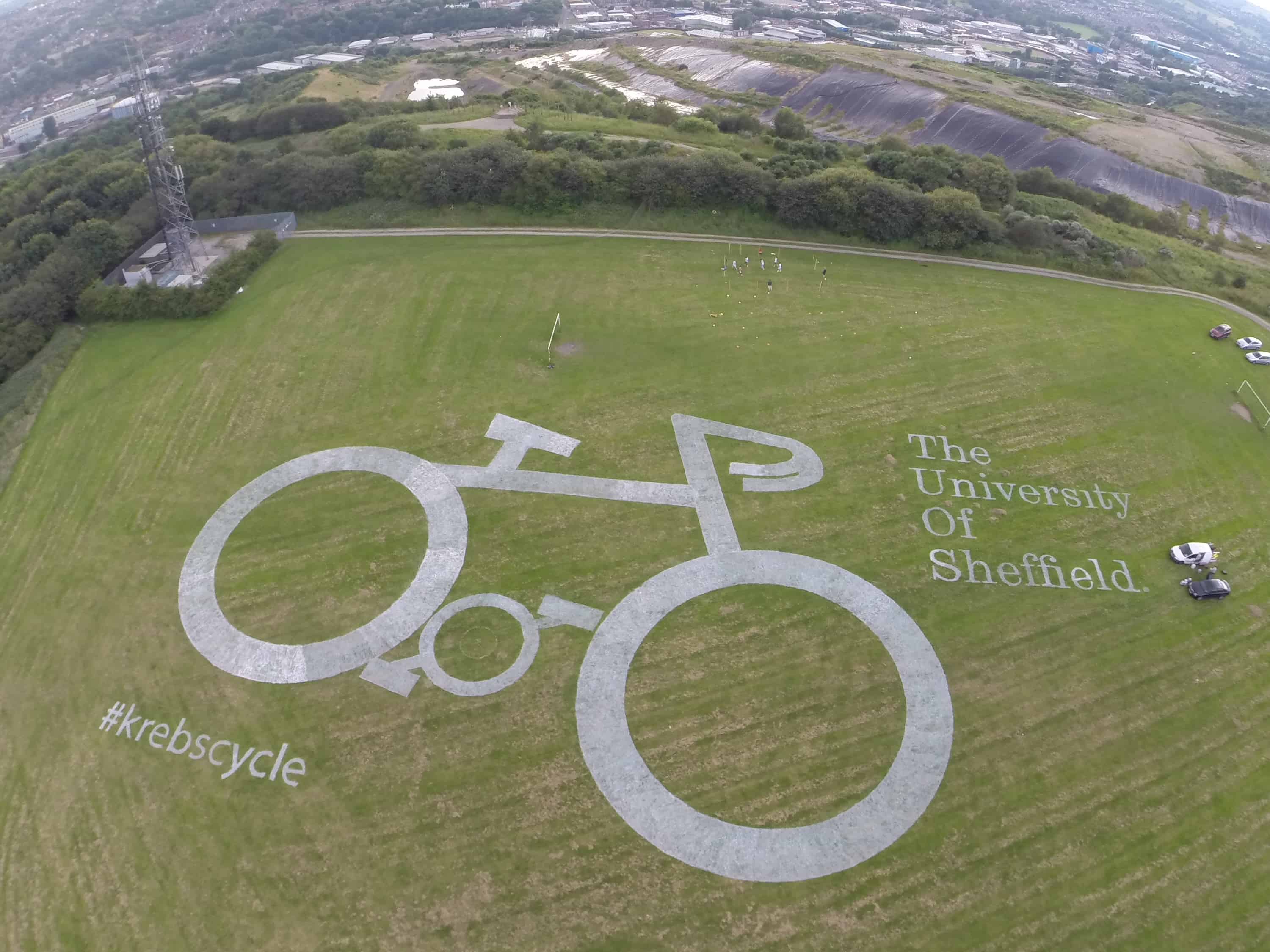
A large chalk outline of a bicycle on grass, with the text #krebscycle and University of Sheffield

Sports fans in the UK are spoiled for choice this weekend, with the Wimbledon finals in London and the kick-off of the Tour de France in Leeds. This is only the second time that the famous bicycle race has started in the UK and to celebrate, the University of Sheffield has created a huge image of a bicycle in a field near to the route. But as well as celebrating the passing cyclists, the image honours a very different cycle that makes the race and indeed much of life on Earth possible.

(more…)

Nuclear-inspection protocol inspired by game of marbles

Modern cryptography combined with simple radiation detectors could allow nuclear-weapons checks to be carried out with almost complete security. That is the conclusion of scientists in the US, who have used computer simulations to show how a beam of neutrons can establish the authenticity of a nuclear warhead without revealing any information about that weapon’s composition or design.

Current arms-control arrangements between the US and Russia limit the number of nuclear warheads inside missiles. However, future agreements could require that all warheads be accounted for, including those in storage. This would rely on inspectors being able to tell a real nuclear warhead apart from a fake one – which would prevent a country from secretly stashing away some of its declared warheads.

Plutonium-239 in a concealed warhead can be revealed by exposing it to gamma rays or neutrons. However, this means of detection would also reveal secret information about the design of the weapon, which must be kept from the inspectors to prevent nuclear proliferation.

Open to abuse

Proposed schemes to avoid this problem involve passing the detector’s output through an electronic device that strips the data of their sensitive elements, such as the precise amount of radioactive material contained in the weapon. Such techniques, however, are open to abuse. The inspector could syphon off sensitive data, while the weapon’s owner could interfere with the device and make innocuous objects appear to be nuclear warheads.

The newly proposed technique closes these loopholes by not producing any sensitive information in the first place. It is based on the “zero-knowledge proof”, in which two objects can be shown with near certainty to be identical, even though nothing is known about the objects themselves. In their work, Alexander Glaser of Princeton University and colleagues adapt a game in which a character known as Alice must prove to a second person, Bob, that the number of marbles in each of two cups she is holding is the same, without revealing what that number (N) is.

Alice empties the contents of each cup into a separate bucket, each of which she says already contains 100–N marbles. Bob then counts the number of marbles in each bucket to find out whether or not they add up to 100. Alice could try to deceive Bob by not putting the same number of marbles in each bucket. However, if Bob specifies which cup must be emptied into which bucket he has a 50-50 chance of discovering Alice’s deception. If the process is repeated many times – and Alice continues to lie – it is unlikely that she can maintain her deception for long.

Arrays of neutron detectors

For weapons verification, the idea is for the host (Alice) to show the inspector (Bob) that an unknown, concealed object is identical to a known nuclear warhead. Both items are exposed to beams containing equal numbers of high-energy neutrons, with the transmitted radiation recorded by two separate arrays of simple detectors that cannot be tampered with clandestinely. Playing the role of the buckets, the detectors are set by the host to compensate precisely for the reduction in recorded intensity that the warhead in question is known to cause.

The inspector should find that all of the detectors display the same, maximum count that would be recorded if no object were to be placed in the neutron beam. However, to make sure that no cheating has taken place, the inspector chooses which detector array is assigned to which object. If the host has lied then some of the detectors will not show the maximum count – and if the process is repeated enough times, the chance of evasion is close to zero. The inspector can therefore establish whether or not the unknown object is a nuclear warhead, and does so without finding anything out about the weapon itself.

To investigate the feasibility of their technique, Glaser and colleagues carried out a Monte Carlo simulation in which neutrons with an energy of 14 MeV irradiate a 19-cm-diameter ball containing concentric rings of polystyrene, tungsten, aluminium, graphite and steel. This standard object is used to calibrate nuclear-weapon imaging systems. They found that their technique should reveal whether the tungsten had been removed or replaced by lead, even for relatively small neutron doses.

Cheating could leak information

John Finney of University College London believes that the new approach should be less vulnerable to cheating than existing techniques that rely on an information barrier. “It could potentially be a major step-change in improving confidence in inspections,” he says, “as long as you work through to prove that the system works as designed.” Another “nice twist” to the work, he adds, is that any attempt by a host to tweak pre-loaded data might actually lead to classified information leaking out. “It is an inherent property of the system that it goes against attempts to cheat,” he says.

Glaser is now looking to reproduce his group’s results experimentally, using neutrons from the Princeton Plasma Physics Laboratory and bubble chambers as detectors. One priority is ensuring the stability of the neutron source to guarantee that unknown and reference objects are exposed to equally large neutron fluxes. Also critical is establishing the consistency of the detectors. “Can we distinguish a fresh bubble from a pre-loaded bubble?” he asks. “If it turns out we can, then that is something we have to know.” These tests should yield results within about six months, and then the technique will be evaluated using real weapons materials.

The research is described in Nature.

Choosing physics, or not

I’ve been mulling over this topic for a while, but a pair of blog posts this week has finally prompted me to write about it. One of them, entitled “Why I won’t be studying physics at A-level” appeared yesterday in the education section of the Guardian newspaper. In it, the anonymous female author lists a number of reasons why she is leaving physics, including a lack of female teachers and an “uninspiring” GCSE physics syllabus that “seemed out of touch compared with the stem cells and glucoregulation we were studying in biology”. There’s plenty to debate there already, but to me, the following paragraph was the most striking:

“I don’t dislike physics; neither do I find it boring or particularly difficult. But I do enjoy my other subjects more, so when it came to choosing between physics and geography for my fourth AS-level I opted for the latter. I thought it would be good to take a humanities subject to balance out the sciences.”

(more…)

Physicist explains why Spaniards aren’t actually lazy

We’re not the kind of people here at Physics World who resort to national stereotypes – if anything, physicists are pretty much the same the world over no matter where they’re from.

But in the case of Spain, there is a widely held (and probably unfair) view that the Spanish are a bit on the lazy side, saddled with a reputation for long lunches, snoozy siestas and late nights out.

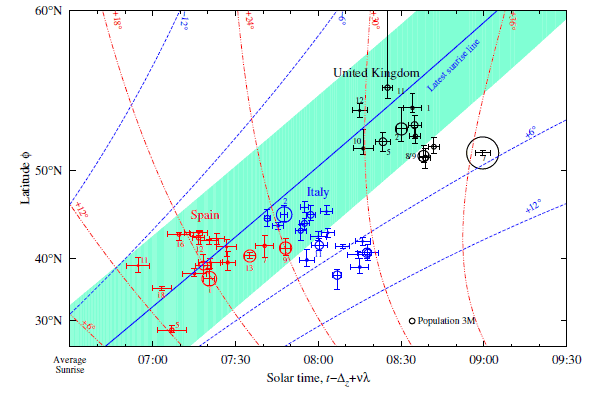
In fact, the Spanish are aware of the problem and there has been much debate in the Spanish media over what can be done to improve productivity and working lives. A Spanish parliamentary commission last year even proposed that the country should turn its clocks back by an hour from Central European Time (CET) to Greenwich Mean Time (GMT). Doing so, the commission said, would improve “productivity, absenteeism, stress, accidents and school drop-out rates”.

(more…)

New proton detectors could lead to better cancer treatment

A new detector that could improve the effectiveness of proton-beam cancer therapies has been developed by researchers in the UK and South Africa. The system tracks protons that have travelled through the body and gives medical physicists a detailed picture of how a therapeutic proton beam will interact with the treatment area. Having this information could lead to better cancer therapy and the team plans to build a prototype scanner that could eventually be commercialized.

Protons are ideal for some cancer treatments because when fired into living tissue, a beam of protons deposits most of its energy at a very specific depth that depends on its initial energy. As a result, protons can be used to destroy tumours while leaving surrounding healthy tissue relatively unharmed.

Before a patient can receive treatment, medical physicists must calculate the appropriate radiation dose distribution to be delivered by the proton beam. Normally this is done by doing a conventional X-ray computed-tomography (CT) scan of the treatment area and using this information to calculate how much energy will be absorbed from the proton beam – a quantity called the “stopping power”. However, uncertainties can arise in these calculations and therefore medical physicists are keen on developing better methods for determining the stopping power.

Researchers at the Proton Radiotherapy Verification and Dosimetry Applications (PRaVDA) consortium – funded by the Wellcome Trust – are designing and building the first proton transmission CT scanner based on silicon-based CMOS active pixel sensor (APS) technology. Such scanners work by exposing the treatment area to a beam of protons and then detecting the protons that have passed through the body. This information is used to build up a 3D image of the region to be treated, which provides an accurate measure of the stopping power. The benefit of using these APS detectors over existing calorimeter detectors is that they can track more than one proton at a time, which reduces the amount of time needed to perform a scan.

Localized interactions

In their latest work, the researchers have shown that their DynAMITe sensor can resolve individual protons passing through it. Developed by PRaVDA researchers in a previous project, the radiation-hard pixellated sensor has a 12.8 × 12.8 cm area and two wafer diode layers, one with 100 µm pixels and another with 50 µm pixels. The pixelated design allows proton-sensor interactions to be localized within the sensor area.

“This allows you to measure the passage of more than one proton in the device at once,” explains team member Gavin Poludniowski, a medical physicist at the University of Surrey. The capability is an advantage over calorimeter-based sensors that handle one proton at a time. “[For these] it has been a challenge to get the event rate high enough to take a scan in a practicable time,” explained Poludniowski.

Telescopic tracking

In the planned proton CT scanner, a stack of the CMOS sensors – essentially a “telescope” – will determine proton energy loss in the patient. Combined with other detectors that were not a subject of this study, data from the telescope will also determine the direction of protons exiting the patient. With this information, the path of the proton in the patient – that is a result of multiple coulomb scattering events – can be reconstructed, generating images with superior spatial resolution to those achievable by detectors that assume an unscattered, linear trajectory.

The researchers demonstrated the sensor’s proton counting ability by irradiating it with a 36 MeV beam produced by the MC40 cyclotron at the University of Birmingham in the UK and a therapeutic 200 Mev beam at the iThemba treatment facility in Somerset West in South Africa. Low beam currents and high frame rates of 1400 Hz – achieved by reading 10 of the 2520 rows on the sensor – maximized the ability of the sensor to resolve individual proton interactions.

Detected events increased linearly with beam current up to a nominal current of 0.1 nA, then fell off with further increases. The observation is consistent with pulse pile-up in the sensor pixels that, in turn, indicates the detection of individual protons. Experimental observations also agreed with Monte Carlo simulations of the same set-up, providing further evidence of proton counting by the sensor.

Stacks of DynAMITe

When two DynAMITe sensors were stacked together – double DynAMITe – event distributions in the two matched. Eliminating fluctuations in beam current as a confounding factor, the high correlation that the researchers observed (r = 0.854) indicated that the pair was detecting the same protons, confirming its tracking ability.

With proof-of-concept established, the researchers are redesigning the DynAMITe sensors for improved performance, with increased frame rates a major focus of their efforts. Estimating that the proton CT scans will require tens of millions of image frames, their goal is to achieve a 1000 Hz frame rate for the readout of the entire sensor area to limit scan duration to a few minutes.

“We are investigating various aspects of hardware design to get the frame rate that we need. Pixel size and bit-depth are factors,” says Poludniowski. “Substantial innovations are [also] being made in the read-out design and electronics.”

First scans in late 2015

Investigations into the effects of telescope geometry on performance and the radiation hardness of the sensor are also in progress. The consortium plans to build a device and perform the first scans by the end of 2015, and then commercialize the technology with an industrial partner.

The research is described in Physics in Medicine and Biology.

Portrait of a radio icon

This first short film paints a picture of Jodrell Bank, the famous observatory near Manchester in the UK. It is a story of contrasts. There is the juxtaposition of gentle surrounding countryside and the stark angular geometry of the iconic Lovell Telescope. There is the contrast between the relatively small size of the facility’s radio dishes compared with the vast swathes of the universe they are capable of exploring. And there is the contrast between today’s earnest pursuit of scientific discovery and the origins of the observatory following the Second World War.

“Portrait of a radio icon” tells the history of the observatory, which was founded by the British astronomer Bernard Lovell in 1945 using radar equipment left over from the war. Jodrell Bank’s associate director Tim O’Brien talks about these early years and the drama surrounding the construction of the facility’s most iconic instrument: the Lovell Telescope, which was formerly the world’s largest radio telescope. “Nobody had ever built anything like [it] before, so really they didn’t understand how much it would cost,” says O’Brien. “They’d overrun their budget massively. And so actually Lovell was in danger of being thrown into prison as a result.”

O’Brien also brings us up to the present day. The film features the Jodrell Bank Discovery Centre, which opened in 2011 and now attracts thousands of visitors every year. You also see footage of the observatory’s music/science festivals, which have been graced by high-profile bands such as Elbow, Sigur Rós and the Flaming Lips. For his role in the public-engagement and education programme at Jodrell Bank, O’Brien has this week been awarded the Kelvin medal by the Institute of Physics, which publishes Physics World.

To make the outreach centre as interactive as possible, Jodrell Bank employs a number of “science explainers”, who are on stand-by to answer visitors’ questions about the exhibits and astronomy in general. In this second short film, we had a bit of fun by putting some of these explainers to the test by asking them some tricky questions on astronomy, cosmology and science communication. We also asked them a selection of questions sent to us by readers via Physics World‘s Facebook page. Find out how they fared by watching the film below.


Mathematical bridges

Mathematicians from around the world will be converging on the Korean capital of Seoul next month to attend the largest international conference in the mathematical community. Held every four years, the International Congress of Mathematicians (ICM) attracts several thousand participants. One highlight is the announcement of the Fields medal, which is regarded as the highest award a mathematician can achieve and is dubbed (along with the Abel Prize) the “mathematician’s Nobel”.

But elsewhere in Seoul, another event will be unfolding at the same time, called Bridges: Mathematical Connections in Art, Music, and Science. Held annually, the Bridges conferences are much smaller than the ICM but are far more diverse, with participants crossing from maths into sculpture, painting, weaving, tiling, theatre, music and even dance. In a shrewd move to boost public attention, the ICM’s planners have invited the Bridges conference to be a satellite event to their own. Much of what mathematicians do is not usually that comprehensible to the public, and Bridges will provide good “eye candy” for the media.

Beyond the script

The driving force behind Bridges is Reza Sarhangi, a mathematics professor at Towson University in Maryland. Originally from Iran, he worked as a drama teacher, playwright and set designer in the 1980s while studying mathematics at Pars University in Tehran. During the 1990s, after Sarhangi became a mathematics professor at Southwestern College in Kansas, he attended small gatherings of people exploring connections between mathematics and art.

Bubbly, energetic and visionary, Sarhangi saw more potential in the gatherings than their initiators did. He therefore created a non-profit corporation to manage the conferences, gave them academic respectability by publishing printed proceedings, and established an active board of directors. In 1998 he staged the first of a series of larger and more ambitious meetings at Southwestern, and organized subsequent events at places of interest to mathematicians and artists, such as the University of Granada in Spain, the Banff Centre in Canada, London’s Institute of Education, and Leeuwarden in the Netherlands (the birthplace of M C Escher). The Bridges meetings are now the conferences on mathematics and art.

Sarhangi’s background in theatre is essential to the success of the Bridges conferences. “Theatre involves making connections with the audience that go beyond just the script,” he says. “So at Bridges, I – and the other three board members – want the conference attendees to get more than just the content of the papers, but to have an enjoyable experience that integrates art, dance, and other performances.” To encourage speakers to improvise their talks, he publishes the proceedings in advance of the conference.

This year’s Bridges conference is being held at the relatively new Gwacheon National Science Museum, the largest science museum in Asia. Special events include evenings devoted to music, theatre and film; a giant Zometool ball-and-stick construction; and dance and mime performances. George Hart – a colleague of mine at Stony Brook University – plans to stage one of his signature “barnraisings” – a large mathematical sculpture to be put together by a community of participants, at Seoul’s Mathlove Museum, one of the world’s few museums devoted to mathematics.

Featured speakers at Bridges, too, have crossover appeal. These include the US computer scientist Alan Kay, a Turing Award winner and a creator of the modern computer; the French mathematician Cédric Villani, a Fields medallist and director of the Henri Poincaré Institute, whose flamboyant dress and demeanour earned him the nickname “the Lady Gaga of mathematics”; the artist and mathematician Thomas Banchoff, whom Salvador Dalí once consulted about the fourth dimension; and Hinke Osinga and Bernd Krauskopf, a wife-and-husband team now in the Department of Mathematics at the University of Auckland, whose work includes a crochet version of Lorenz’s equations describing the behaviour of chaotic systems.

Other talks concern quilting, the physics of tops, 4D geometry, the architecture of mosques, the mathematics of juggling and torus-knot carbon nanotubes – structures made of beads that could also be made of carbon atoms. One speaker will also unveil the first ever sculpture whose symmetry is the same as that of a “quaternion group”.

The critical point

To me the Bridges events are fascinating. But why can physics not do something similar? After all, its bridges with artistic and other creative disciplines already exist. As Hart puts it, by creating bridges to painting, sculpture, poetry and dance, mathematicians can reach out to non-mathematicians who do not understand the creative and artistic side of the subject. In fact, the traffic on those bridges, he says, goes both ways. “Ideas from mathematics get visualized or inspire artists, while in the other direction the desire to create or engineer an art work brings up math problems.”

What is more, the Bridges conferences have given birth to their own community, mainly of people in mathematics departments with artistic interests who attend the conferences to see what others are working on. The Bridges community has also spawned a spin-off of smaller events that begin this autumn called MoSAIC: Mathematics of Science, Art, Industry, and Culture. A joint project with Berkeley’s Mathematical Sciences Research Institute, it consists of a series of mathematics–art festivals and will bring the Bridges spirit to a larger audience over the next academic year.

The first will be held at Berkeley in October, with subsequent festivals at Columbia University in New York, the University of Illinois at Urbana-Champaign, and at Portland, Boulder and Towson. An art exhibition will be shipped from each festival to the next, and involve local presenters and an audience that might not attend the annual Bridges conference. It is surely possible for physicists to follow the lead of the mathematicians – after all, it is only a question of seeing the value in widening and cementing the bridges between our field and art.

Physics in the fast lane

Most of us want everything in life right here, right now. From fast food to fast cars, none of us can be bothered to hang about any longer than absolutely necessary. Where’s your reply to my e-mail I sent five minutes ago? Why haven’t you responded to my Tweet? Do you really expect me to read that 500-page novel for fun?

It was perhaps as an antidote to the ever-faster pace of life that so much has been made of two physics experiments that recently produced new data for the first time in years. I’m talking, of course, about the “pitch-drop” experiments at Trinity College Dublin in Ireland and the University of Queensland, Australia, which both consist of a glass funnel of sticky tar-like substance. A drop from the Trinity experiment finally fell last July, with a video of the event quickly going viral, while the Queensland set-up dripped this April for the first time in 13 years. (For more on why both experiments proved so popular, check out our great feature by Shane D Bergin, Stefan Hutzler and Denis Weaire from Trinity.)

But if you can’t be bothered to hang around for 10 years or more, you’ll be pleased to hear that physicists at Queen Mary University of London – led by Kostya Trachenko – have now set up a new pitch-drop experiment to explore the difference between solid and liquids on the much shorter timescale of just a few months.

(more…)

Reborn carbon mission launches after five-year wait

NASA has successfully launched a mission to measure carbon-dioxide (CO2) levels in the Earth’s atmosphere in unprecedented detail. The $465m Orbiting Carbon Observatory (OCO-2) was launched today at 09:56 GMT on a Delta 2 rocket from Vandenberg Air Force Base in California. OCO-2 will now be put in an orbit around the Earth at an altitude of 705 km, where its instruments will be calibrated before being put into full use.

OCO-2 is a reincarnation of the $270m Orbiting Carbon Observatory (OCO), which crashed in the Pacific Ocean near Antarctica on 24 February 2009 shortly after take-off, following a rocket malfunction. In late 2009 the US government decided to build an identical mission, which was scheduled for launch in February 2013.

However, when the $424m Glory satellite, which would have studied how the Sun and aerosols in our atmosphere affect the Earth’s climate, also failed in a similar manner to OCO after launch on 4 March 2011, NASA officials delayed the launch of OCO-2. NASA also decided to launch OCO-2 using a bigger Delta 2 rocket – rather than the Taurus rocket that was used for OCO and Glory’s launch – which added to the cost of launching the new mission.

“The launch of OCO-2 will not only allow many of us who worked on the original OCO mission to complete unfinished business, but to take the next step in an important journey to understanding our home planet,” OCO-2 project manager Ralph Basilio from NASA’s Jet Propulsion Laboratory in California told physicsworld.com.

Joining the A-train

OCO-2, which weighs 454 kg, is NASA’s first spacecraft that is dedicated to making space-based observations of atmospheric carbon dioxide. OCO-2 carries a single instrument that it will use to produce “concentration maps” of carbon sources and sink throughout the world. As sunlight is reflected from the Earth’s surface, gases such as CO2 and oxygen absorb this light at specific wavelengths. OCO-2 contains three spectrometers tuned to detect changes in the intensity of this absorption.

“OCO-2 will deliver on the promises made on the original OCO mission – to obtain space-based measurements of carbon dioxide with the precision, resolution and coverage to improve our understanding of the carbon cycle and climate-change process,” says Basilio.

OCO-2 now joins the “A-train”, a set of six Earth-observing satellites that are already in orbit. These include the CALIPSO and Cloudsat satellites looking at the levels of aerosols in the Earth’s atmosphere and monitoring cloud formation, which were both launched in April 2006.

Copyright © 2026 by IOP Publishing Ltd and individual contributors