Physicist nominated as US defence secretary

Ashton Carter

US president Barack Obama has nominated physicist Ashton Carter as secretary of defence – one of the key positions in the US cabinet. With a DPhil in theoretical physics from Oxford University, the 60 year old has extensive experience in government and academia, working predominantly on national security and military issues. His nomination will first require confirmation by the US Senate, but insiders indicate that Carter’s passage will be smooth. “I can’t imagine that he’s going to have opposition to his confirmation,” says Oklahoma senator James Inhofe, a Republican who is frequently at odds with the Obama administration.

Carter was not talking to the media – a tradition among government nominees until they have appeared before the Senate. However, former colleagues have praised Carter as being capable of performing the task of overseeing US defence policy. “He comes grounded in the conceptualization of a physicist – he is very good in policy areas,” Graham Allison of Harvard University’s Belfer Center for Science and International Affairs told Physics World. “Both his intellectual foundation and his work as a practitioner in government have been informed by evidence-based analysis, as opposed to hocus-pocus.”

From physics to the Pentagon

Carter earned a degree in physics and medieval history from Yale University in 1976, and won a Rhodes Scholarship to Oxford, where he chose to concentrate on physics, graduating in 1979. “My arrogant view at the time was that life would eventually teach me political science, sociology, psychology and even economics, but it would never teach me linear algebra,” he wrote in a short autobiography for the Belfer Center.

In 1981, following a year as a research associate in theoretical physics at Rockefeller University, and another in the Congressional Office of Technology Assessment, he joined the Pentagon as a civilian programme analyst. Three years later, he applied his background in physics to missile defence, dubbing former US president Ronald Reagan’s “Star Wars” nuclear-weapons defence system as “unworkable”.

Between 1984 and 1993, Carter then held a variety of academic positions at the Massachusetts Institute of Technology and Harvard, focusing on international affairs and becoming an expert on defence issues and international security. He rejoined the Pentagon in 1993 as assistant secretary of defence for international security policy. There, he helped to secure nuclear weapons in Eastern Europe following the collapse of the former Soviet Union.

After some years in industry and academia, during which he wrote three books and contributed a multitude of journal and popular-science articles, Carter returned to government in 2009 as undersecretary of defence for acquisition, technology and logistics. In that position, he earned praise for his ability to guide the defence department through the government sequester, which forced all departments to reduce their spending, with minimal damage to military readiness.

Carter became deputy to defence secretary Leon Panetta from 2011 to 2013. In that role, he identified and carried out cuts to the military budget mandated by Congress. Panetta compared him to Scotty, the engineer in Star Trek: “I worked on the bridge while he manned the engine room,” Panetta wrote in his recent book Worthy Fights: A Memoir of Leadership in War and Peace.

Challenges ahead

Carter was tipped to replace Panetta when the latter left the defence department two years ago, but the Obama administration instead selected former Nebraska Senator Chuck Hagel. Hagel’s retirement from the position, announced in November, has now opened the way for Carter, who is currently lecturing at Stanford University.

Once confirmed, Carter will face fresh challenges within a tightly controlled financial situation, including the struggle with Islamic State in the Middle East, the small but continuing US military presence in Afghanistan and Iraq, and maintaining a US military presence in Asia. “We are trying to manage on a lower budget at a time when the threat is not receding,” Carter told the Boston Globe in 2012. “The world hasn’t gotten any safer.”
Planck offers another glimpse of the early universe

Results of four years of observations made by the Planck space telescope provide the most precise confirmation so far of the Standard Model of cosmology, and also place new constraints on the properties of potential dark-matter candidates. That is the conclusion of astronomers working on the €700m mission of the European Space Agency (ESA). Planck studies the intensity and the polarization of the cosmic microwave background (CMB), which is the thermal remnant of the Big Bang. These latest results will no doubt frustrate cosmologists, because Planck has so far failed to shed much light on some of the biggest mysteries of physics, including what constitutes the dark matter and dark energy that appears to dominate the universe.

Planck ran from 2009–2013, and the first data were released in March last year, comprising temperature data taken during the first 15 months of observations. A more complete data set from Planck will be published later this month, and is being previewed this week at a conference in Ferrara, Italy (“Planck 2014 – The microwave sky in temperature and polarization”). So far, Planck scientists have revealed that a previous disagreement of 1–1.5% between Planck and its predecessor – NASA’s Wilkinson Microwave Anisotropy Probe (WMAP) – regarding the mission’s “absolute-temperature” measurements has been reduced to 0.3%.

One of the biggest challenges for Planck is to separate dust and CMB polarization in frequency bands around 100–200 GHz where both emissions are nearly indistinguishable. With that in mind, Planck was designed to have a channel dedicated to the observation of polarized dust – the 353 GHz channel.

“With the proper extrapolation in frequency, the 353 GHz data can be used to clean the lower frequency channels and get to the pristine CMB signal,” says Marc-Antoine Miville-Deschênes at the Institut d’Astrophysique Spatiale in Orsay, France. “Interestingly, the 353 GHz channel is also bringing totally new information on the magnetic field of the Milky Way,” adds Miville-Deschênes, who is part of the Planck collaboration. In fact, he tells physicsworld.com that this is the first time that such images could be obtained and that “Planck is providing us with all-sky data. We will be able to answer fundamental questions that were raised more than 60 years ago about the role of the magnetic field in the formation of stars”.

Winnowing dark matter

Planck’s latest measurement of the CMB polarization rules out a class of dark-matter models involving particle annihilation in the early universe. These models were developed to explain excesses of cosmic-ray positrons that have been measured by three independent experiments – the PAMELA mission, the Alpha Magnetic Spectrometer and the Fermi Gamma-Ray Space Telescope.

The Planck collaboration also revealed that it has, for the first time, “detected unambiguously” traces left behind by primordial neutrinos on the CMB. Such neutrinos are thought to have been released one second after the Big Bang, when the universe was still opaque to light but already transparent to these elusive particles. Planck has set an upper limit (0.23 eV/c2) on the sum of the masses of the three types of neutrinos known to exist. Furthermore, the new data exclude the existence of a fourth type of neutrino that is favoured by some models.

Planck versus BICEP2

Despite the new data, the collaboration did not give any insights into the recent controversy surrounding the possible detection of primordial “B-mode” polarization of the CMB by astronomers working on the BICEP2 telescope. If verified, the BICEP2 observation would be “smoking-gun” evidence for the rapid “inflation” of the early universe – the extremely rapid expansion that cosmologists believe the universe underwent a mere 10–35 s after the Big Bang. A new analysis of polarized dust emission in our galaxy, carried out by Planck earlier in September, showed that the part of the sky observed by BICEP2 has much more dust than originally anticipated, and while this did not completely rule out BICEP2’s original claim, it established that the dust emission is nearly as big as the entire BICEP2 signal. Both Planck and BICEP2 have since been working together on joint analysis of their data, but a result is still forthcoming.

  • This article was updated on 5 December 2014.

A strong model, with flaws

John Moffat’s new book covers the history of the Standard Model of particle physics from its beginnings to the recent discovery of the Higgs boson – or, as Moffat cautiously calls it, the new particle most physicists believe is the Standard Model Higgs. But Cracking the Particle Code of the Universe isn’t just any book about the Standard Model: it’s about the model as seen through the eyes of an insider, one who has witnessed many fads and statistical fluctuations come and go. As an emeritus professor at the University of Toronto, Canada and a senior researcher at the nearby Perimeter Institute, Moffat has the credentials to do more than just explain the theory and the experiments that back it up: he also offers his own opinion on the interpretation of the data, the status of the theories and the community’s reaction to the discovery of the Higgs.

The first half of the book is mainly dedicated to introducing the reader to the ingredients of the Standard Model, the particles and their properties, the relevance of gauge symmetries, symmetry breaking, and the workings of particle accelerators. Moffat also explains some proposed extensions and alternatives to the Standard Model, such as “technicolor”, supersymmetry, preons, additional dimensions and composite Higgs models as well as models based on his own work. In each case he lays out the experimental situation and the technical aspects that speak for and against these models.

In the second half of the book, Moffat recalls how the discovery unfolded at the Large Hadron Collider (LHC) and comments on the data that the collisions yielded. He reports from several conferences he attended, or papers and lectures that appeared online, and summarizes how the experimental analysis proceeded and how it was interpreted. In this, he includes his own judgment and relates discussions with theorists and experimentalists. We meet many prominent people in particle physics, including Guido Altarelli, Jim Hartle and Stephen Hawking, to mention just a few. Moffat repeatedly calls for a cautious approach to claims that the Standard Model Higgs has indeed been discovered, and points out that not all necessary characteristics have been found. He finds that the experimentalists are careful with their claims, but that the theoreticians jump to conclusions.

The book covers the situation up to March 2013, so of course it is already somewhat outdated; the ATLAS collaboration’s evidence for the spin-0 nature of the Higgs boson was only published in June 2013, for example. But this does not matter all that much because the book will give the dedicated reader the necessary background to follow and understand the relevance of new data.

Moffat’s writing sometimes gets quite technical, albeit without recourse to equations, and I doubt readers will fully understand his elaborations without at least some knowledge of quantum field theory. He introduces the main concepts he needs for his explanations, but he does so very briefly; for example, his book features the shortest explanation of gauge invariance I have ever come across, and many important concepts, such as cross-sections or the relation between the masses of force-carriers and the range of the force, are only explained in footnotes. The glossary can be used for orientation, but even so, the book will seem very demanding for readers who encounter the technical terms for the first time. However, even if they are not able to follow each argument in detail, they should still understand the main issues and the conclusions that Moffat draws.

Towards the end of the book, Moffat discusses several shortcomings of the Standard Model, including the Higgs mass hierarchy problem, the gauge hierarchy problem and the unexplained values of particle masses. He also briefly mentions the cosmological constant problem, as it is related to questions about the nature of the vacuum in quantum field theory, but on the whole he stands clear from discussing cosmology. He does, however, comment on the anthropic principle and the multiverse and does not hesitate to express his dismay about the idea.

While Moffat gives some space to discussing his own contributions to the field, he does not promote his point of view as the only reasonable one. Rather, he makes a point of emphasizing the necessity of investigating alternative models. The measured mass of the particle-that-may-be-the-Higgs is, he notes, larger than expected, and this makes it even more pressing to find models better equipped to address the problems with “naturalness” in the Standard Model.

I have met Moffat on various occasions and I have found him to be not only a great physicist and an insightful thinker, but also one who is typically more up to date than many of his younger colleagues. As the book also reflects, he closely follows the online presentations and discussions of particle physics and particle physicists, and is conscious of the social problems and cognitive biases that media hype can produce. In his book, Moffat especially criticizes bloggers for spreading premature conclusions.

Moffat’s recollections also document that science is a community enterprise and that we sometimes forget to pay proper attention to the human element in our data interpretation. We all like to be confirmed in our beliefs, but as my physics teacher liked to say, “belief belongs in the church”. I find it astonishing that many theoretical physicists these days publicly express their conviction that a popular theory “must be” right even when it is still unconfirmed by data – and that this has become accepted behaviour for scientists. A theorist who works on alternative models today is seen too easily as an outsider (a non-believer), and it takes much courage, persistence and stable funding sources to persevere outside the mainstream, as Moffat has done for decades (and still does). This is an unfortunate trend that many in the community do not seem to be aware of, or do not see why it is of concern, and it is good that Moffat in his book touches on this point.

In summary, Moffat’s new book is a well-done and well-written survey of the history, achievements and shortcomings of the Standard Model of particle physics. It will equip the reader with all the necessary knowledge to put into context the coming headlines about new discoveries at the LHC and future colliders.

  • 2014 Oxford University Press £19.99/$29.95hb 256pp

Artistic influences

In the autumn of 1610, the Italian painter Lodovico Cardi (better known by his professional name, Cigoli) began his most challenging work: a fresco to adorn the inside of the dome of the Basilica di Santa Maria Maggiore in Rome. Based on a biblical scene, the fresco depicts the Virgin Mary as the “queen of heaven”, standing on the Moon, wearing a multicoloured robe and carrying a sceptre, with a halo of 12 stars floating above her head. A closer look, however, reveals something new in Mary’s otherwise familiar pose: the Moon beneath her feet is pock-marked with numerous crater-like features. Cigoli, it turns out, was friends with Galileo, and historians believe he either looked through one of Galileo’s telescopes or at least closely perused Galileo’s Sidereus Nuncius, published just a few months earlier.

Cigoli’s fresco, then, is an early example of art drawing inspiration from science. It would not be the last. True, as science became more specialized, its practitioners tended to work in ever-narrower domains – but the bridge between art and science was never fully severed, and at the turn of the 20th century the links once again seemed to strengthen. At that time, both science and art were grappling with new ways of seeing the world, and it may be more than a coincidence that the application of non-Euclidean geometry to physics – notably by Einstein in his general theory of relativity – came just as painters such as Pablo Picasso and Georges Braque were experimenting with bold new ways of interpreting the world on canvas. The movement they founded, known as cubism, challenged traditional ideas of space and time – and echoed the latest developments in mathematics and physics.

The interplay between science and the arts in the early 20th century is a subject that Arthur I Miller explored in his earlier (very good) book Einstein, Picasso: Space, Time and the Beauty That Causes Havoc. Miller, an emeritus professor at University College London, has now turned his attention to the last 50 years, with a particular focus on the art–science scene today. Colliding Worlds bears witness to what Miller sees as a new phase in the history of art – one in which boundaries between disciplines have become blurred. Many of the artists Miller profiles have benefited from collaborations with scientists or engineers; a few of them are scientists themselves. One of the artists that he speaks with declares that today’s art “is an offspring of science and technology”.

In this entertaining, thorough investigation, we meet dozens of artists taking the field in a myriad of new directions. There’s Harold Cohen, for example, whose computer program, named AARON, produces much-sought-after abstract paintings; Katherine Dawson, who uses lasers to sculpt glass into biologically accurate depictions of the human brain; and Tim Otto Roth, who uses data from the Hubble Space Tele-scope to project “the heartbeat of the primordial universe” onto the sides of buildings. There’s no getting around the impression that a few of them are oddballs: ORLAN is an artist whose raw materials include her own skin cells; before meeting her, Miller received an e-mail from an assistant reminding him that her name is to be spelled in all capitals. But to be fair, the world of science has no shortage of oddballs either.

One question that looms in the background is whether the art–science influence flows in two directions or just one. Even the word “influence” is offensive to some artists. Miller recounts how, when chairing an art–science debate, he offhandedly used the phrase “science-influenced” to describe some of the artists taking part, and was immediately attacked by the panellists for suggesting “a hierarchy of disciplines – that science was above art”. It’s not clear how fruitful the evening was; as Miller writes, “The panellists seemed to know little of what went on in the world of science outside biology. This held for the audience, too, the vast majority of whom were artists.” At any rate, the impression one is left with after reading Colliding Worlds is that “influence” is a perfectly good word to describe what’s happening. Moreover, the influence is primarily, if not exclusively, one-way: whether the artists Miller has profiled will admit it or not, they are, in fact, deeply influenced by science, with little evidence to suggest a similar kind of influence going the other way. The book’s subtitle suggests Miller himself is sympathetic to this view, although he does record a small handful of exceptions. In one case, an encounter with an artist led a physicist to study the interaction between laser beams and soap bubbles; in another, a biophysicist was inspired to investigate artificial photosynthesis.

Miller also tackles a more difficult problem: can science explain the appeal of art? More generally, is there a scientific basis for aesthetics? He quotes from Richard Taylor, a physicist who is also an artist: science, Taylor hopes, will “throw a narrow beam of light into those dim corners of the mind where great paintings exert their power”. Yet there is, at this point, no consensus on the matter. Even trickier is the question of whether art and science are driven by similar motivations – perhaps, Miller suggests, by a quest for symmetry, or, more generally, for “beauty”. A fully satisfying answer is too much to hope for, especially given how hard it is to even pin down definitions of “art” and “science” that everyone can agree on; ultimately Miller leaves the issue unresolved. (Even so, an analysis of Jackson Pollock’s drip-paintings, said to exhibit a fractal structure, makes for a fascinating intermezzo mid-way though the book.)

It’s hard to doubt Miller’s assertion that a new art movement is blossoming. He presents more than enough examples to make the case. Yet his prediction that art and science are on their way to a merger – an argument he mounts in the book’s final pages – must be taken with a grain of salt. Although both art and science will surely surprise us in the years and decades ahead, I suspect they will surprise us in their own, separate ways.

  • 2014 W W Norton £22.00hb 352pp

Elegant constructions

“In science, one plus one is always two; in art it can also be three or more.” This quotation from the artist Josef Albers appears early on in Beautiful Geometry, and it makes an excellent motto for this slyly humorous and – yes – beautiful book about the most visual branch of mathematics. A collaboration between a historian of mathematics, Eli Maor, and a mathematically-inspired artist, Eugen Jost, the book contains 51 short essays about different topics in geometry, each of them accompanied by at least one full-colour artwork.

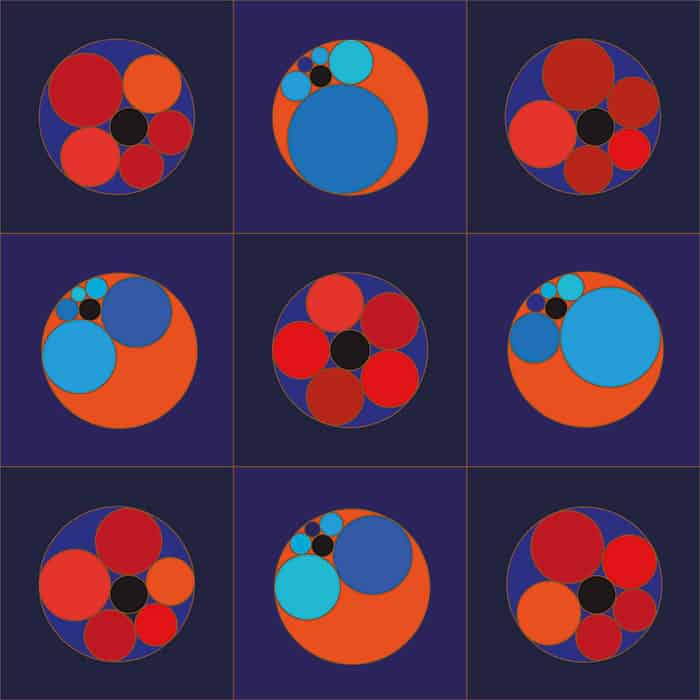
Artwork based on Steiner's porism, showing a 3x3 matrix in which each cell contains brightly coloured chains of circles inscribed inside larger circles

Throughout the book, these vibrant illustrations (a mix of computer-generated images and acrylic on canvas) function both as stand-alone artworks and as demonstrations of mathematical concepts – albeit with a dash of artistic licence from Jost, who is clearly a fan of Albers’ views on the sum of 1 + 1.

The journey through geometry begins with the Pythagoreans, the cult-like group in ancient Greece whose motto “Number rules the universe” reflected their belief in a mathematically ordered world. Their leader, Pythagorus, did not discover the theorem that bears his name, but he may have been the first to prove it, and his followers certainly used it to explore related geometric concepts. One such concept appears in Jost’s artwork “The (3,4,5) Triangle and Its Four Circles” (see image at top of article). At the heart of this image is a right triangle inscribed with an “incircle” that is tangent to all three sides. Outside the triangle are three “excircles”, each of which is tangent to one side of the triangle and to the continuations of the other two sides. The fact that the lengths of this triangle’s three sides form a “Pythagorean triple” (a trio of positive integers a, b and c for which a2 + b2 = c2) has a curious consequence: it means that the radii of the incircles and excircles must also be integers. This property, Maor notes, leads to some interesting relationships between the radii of the four circles; for example, the product of the radii of the smaller excircles ra and rb is equal to the area of the triangle, ab/2.

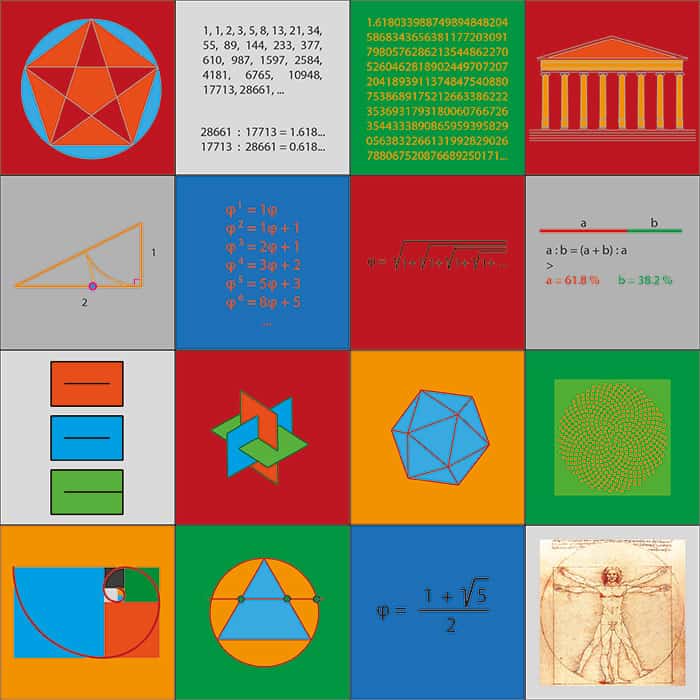
Artwork inspired by the golden ratio, composed of 12 tiles representing different ways the ratio appears in mathematics and nature

Such relationships delighted the Pythagoreans, but later developments in mathematics were less to their liking. As Maor explains, the discovery that √2 cannot be expressed as the ratio of two positive integers “brought about a serious intellectual crisis” among the group’s members.

Of course, knowledge of these new “irrational” numbers also brought about advances in geometry, including studies of the “golden ratio” that crops up in so many areas of art and nature (see image above). And even the Pythagoreans might have been pleased with a few of the modern pieces of geometry that appear later in the book. Another image (also above), for example, illustrates a theorem known as “Steiner’s porism”, which concerns the behaviour of chains of non-concentric circles. Its co-discoverer, Jakob Steiner, helped to revive “classical” geometry in the early 19th century and, despite its antiquity, this well-studied discipline turned out to have some new tricks up its sleeve.

Artwork inspired by Morley's Theorem, made up of a grid of nine tiles containing triangles or significant dates in Morley's life, with the inscription "In any triangle the angle trisectors lying near the sides intersect in an equilateral triangle" written around the edges

A good example is Morley’s Theorem (see image above), which involves angle trisection but could otherwise have come straight out of Euclid’s Elements. Even in classical geometry, Maor concludes, “surprises may still be awaiting us around the corner – or perhaps around the vertex!”

  • 2014 Princeton University Press £17.77/$27.95hb 208pp

Japan launches second asteroid mission

The Japanese space agency, JAXA, has launched the country’s second asteroid sample-return mission. Hayabusa 2 blasted off this morning at 1.22 p.m. local time (4.22 a.m. GMT) from the Tanegashima Space Centre in Japan, and will now spend two years travelling to asteroid 1999 JU3 – an almost spherical carbon-rich asteroid that is 920 m in diameter and is thought to contain organic matter and hydrated minerals. The probe will bring back a sample to Earth sometime in 2020.

Hayabusa 2 is a successor to Japan’s original Hayabusa craft, which returned with the first-ever samples from an asteroid back in 2010. Weighing almost 600 kg and costing about $250m, Hayabusa 2 will attempt to find out the origin of JU3’s organic matter and water, and how these are related to life and ocean water on Earth. The Space Activities Commission, which governs funding for the Japanese space programme, formally approved the Hayabusa 2 mission in January 2012.

The craft was launched when the asteroid’s path was at its closest to Earth, and Hayabusa 2 will eventually reach the body by the middle of 2018. The craft will then land on the asteroid and stay there for around 18 months to retrieve samples, before beginning its return journey to Earth in 2020. While the configuration and payloads for Hayabusa 2 are similar to the original mission – which only scraped the surface of the asteroid it landed on – the new craft will instead release a 2 kg impactor before touching down. The impactor will hit the asteroid’s surface and make a small crater several metres in diameter. Hayabusa 2 will then land in the crater to collect samples from within the asteroid.

Extraterrestrial grains

Japan will be hoping that Hayabusa 2 is as successful as its predecessor. Launched in 2003, Hayabusa was sent to the Itokawa asteroid – a 500 m-long body that lies about 300 million kilometres away from Earth. It was due to return in 2007 but, following a few technical glitches, including being hit by a solar flare, its return home was delayed by three years.

However, Hayabusa was still a success, with JAXA announcing last year that it had identified about 1500 grains as being extraterrestrial in origin. The recovered minerals include olivine, pyroxene, plagioclase and iron sulphide. Although these minerals are found on Earth, the composition of the grains, which were about 10 μm in diameter, matched the measurements taken by the X-ray spectrometer on board Hayabusa before the craft landed on Itokawa. This ruled out the possibility that the signal was contaminated by terrestrial materials after the probe landed back on Earth in the Australian outback.

The launch of Hayabusa 2 comes weeks after the European Space Agency’s Rosetta mission successfully put its Philae lander on the surface of a comet.

Build your own LEGO particle collider


By Michael Banks

You may remember last year when particle physicist Sascha Mehlhase of the Niels Bohr Institute in Copenhagen unveiled a 560-piece LEGO model of CERN’s ATLAS detector at the Large Hadron Collider.

Well, not to be outdone, LEGO fan Jason Allemann has now created a LEGO-inspired particle accelerator. Dubbed the LEGO Brick Collider (LBC), the design has been submitted to LEGO’s CUUSOO site, which lets fans share blueprints of their own models.

(more…)

Supersonic bullets test graphene’s strength

Graphene sheets are 8 to 10 times better than steel when it comes to absorbing impacts from supersonic “microbullets”. That is the conclusion of researchers in the US, who have fired tiny silica spheres at the carbon material and compared the kinetic energy of the spheres before and after they had penetrated the sheets. The result implies that graphene might be ideal for making bullet-proof vests, among other applications, and the technique employed in these experiments could be used to test the strength and toughness of other nanomaterials as well.

The “wonder material” graphene – sheets of carbon just one atom thick – is thought to be the strongest material in the world, thanks to its 2D hexagonal lattice of covalently bonded carbon atoms. Indeed, researchers recently measured its in-plane Young’s modulus – a measure of how well it resists deformation – to be more than 1 TPa, which is nearly that of diamond. Although such experiments provide valuable information on a material’s mechanical properties, they are essentially low-speed tests with impacts occurring at less than 1 m s–1. As a result, they cannot measure deformations that happen very fast, which is the case in ballistic impacts, where projectile velocities can be 1000 times faster. Although high-speed, high-strain-rate mechanical characterization techniques do exist, these methods are inappropriate for very thin layers of material.

Laser-based testing

A team led by Edwin Thomas of Rice University recently came up with a new technique called laser-induced projectile impact testing (LIPIT), and has now improved on this to test the strength of graphene. LIPIT sees the researchers fire a single micron-sized solid silica sphere travelling at speeds of nearly 3 km s–1 into a carbon sheet and measuring the velocity of the microbullet before and after it has penetrated the material. This allows them to calculate the kinetic energy of the bullet lost during the test. The experiments are performed on multilayer graphene membranes ranging in thickness from 10 to 100 nm – which is equivalent to 30 to 300 graphene layers – and the technique allows a tiny part of the sample to be strained, or deformed, at very high rates.

The researchers used multilayer graphene samples that were shaved off blocks of graphite. They were able to fire their microbullets at supersonic speeds using a laser pulse. “Instead of gunpowder, we vaporize a thin (50 nm) gold film using a focused laser beam, and it is the resulting expanding gold gas that accelerates the microbullet,” explains team member, Jae-Hwang Lee.

After analysing microscope images of the impacts, the researchers discovered that graphene dissipates the kinetic energy from the microbullet by first stretching into a cone shape at the impact site and then cracking along its crystallographic directions. These cracks extend outwards, well beyond the impact area, says Lee.

Efficient energy dissipation

“When a microbullet penetrates a thin target material, it dissipates the kinetic energy of the projectile by transferring this energy back to itself,” Lee says. “Graphene can dissipate this energy very efficiently, which makes it better than other materials (even steel).”

The result means that graphene might be ideal for making bullet-proof vests and other types of armour, he says. “It might even be used in futuristic applications such as coatings for satellites and the International Space Station that protect against micrometeorites,” he adds.

The researchers claim that their micro-ballistic technique could also be a unique way to study the mechanical behaviour of various other nanostructured materials.

The team, which includes researchers from the University of Massachusetts Amherst, is now busy trying out its miniaturized ballistic test on various other graphene systems. These include graphene composites and graphene with engineered defects, which is expected to be weaker than pristine graphene.

The work is described in Science.

Quantum kung fu

If someone puts you in an armlock, what should you do? If you happen to be a martial artist well-practised in the art of joint manipulation, or chin na, you will know the answer already: there is one simple move that will allow you to turn the tables on your aggressor, leaving them on the wrong end of a throw. However, if your skill set tends more toward manipulating mathematical symbols, there is still hope, for the answer is also closely tied to theoretical physics.

Before I describe the move, let’s consider some martial arts history. Many styles of kung fu are based on observations of the natural world – specifically, the behaviour of animals. For example, the legendary founder of the Northern Praying Mantis style, Wong Long, supposedly learned his art by testing that insect’s reactions to being prodded with a twig – a method one might be tempted to call proto-scientific (and probably unethical). Other styles have allegedly been inspired by the crane, monkey, snake, tiger and dragon, to name just a few (the person who observed the dragon was presumably a proto-theorist).

To understand how to escape from the armlock, however, we are going to take our inspiration from an altogether different species – this time one from the “particle zoo”. Imagine we have two electrons in a plane. Because all electrons are identical, if we borrow Wong Long’s twig and prod our two electrons into switching places, everything will be just as it was, right? Not quite. Electrons are fermions, so the combined two-electron wavefunction picks up a minus sign when the electrons swap places – it is antisymmetric under exchange. That’s all well and good, but we also have to account for the spin-statistics theorem, which says that swapping two particles is equivalent to rotating one of them through 360°. Hence, rotating an electron’s spin one full turn doesn’t bring it back to its original state. We have to rotate it twice.

The mathematical objects that share this property – needing to be “turned” through two full rotations to return to their original orientation – are called spinors. They were introduced to physics by Paul Dirac in his study of the electron, which won him the 1933 Nobel Prize for Physics. They remain very strange things, though, and in Graham Farmelo’s biography of Dirac, The Strangest Man, the mathematical physicist Michael Atiyah had this to say about them: “No-one fully understands spinors. Their algebra is formally understood but their general significance is mysterious. In some sense they describe the ‘square root’ of geometry and, just as understanding the square root of –1 took centuries, the same might be true of spinors.”

Taking the square root of geometry is fine in the weird world of quantum physics, but how does it help us get out of an armlock? Surely any object in everyday life requires at most one full turn to return to its original position? Not so. We now arrive at the solution to our problem: the “plate trick” or, as it’s known in martial arts, coiling.

Stand with your feet shoulder width apart and your right hand held out in front of you as if you were holding a plate of soup in your palm. Now rotate your hand to the left, towards your body, so that the plate passes under your right armpit. You don’t want to spill the soup, so your palm had better stay face up throughout. Continue moving the plate round in a circle until it is back in front of your body. The plate is now in its original position, but the system of you-plus-plate is certainly not – you’re all coiled up!

One full rotation didn’t bring you back. How about a second? Continue round in the circle, this time allowing the plate to pass over (rather than under) your right shoulder on its way round. Upon completing the second full rotation you’ll find yourself back in your starting position, plate and all, with not a drop of imaginary soup spilt. In so doing you have provided a simple demonstration of a spinor – albeit one that you should perhaps not take too seriously when being quizzed on the niceties of the SU(2) Lie algebra in exams.

And to escape the armlock? Just apply the same manoeuvre. Wherever your aggressor’s hand is gripping your arm, there will be a gap in their grip where their thumb meets their fingers. They can withstand at most a 360° rotation of your arm before you slip through this gap, but as we have just demonstrated, you can go all the way to 720° and be right back where you started. At that point, I recommend you apply another consequence of the antisymmetry of electrons under exchange: the Pauli exclusion principle. This can be done by demonstrating that the electrons in your aggressor’s leg cannot simultaneously occupy the same position as those in your foot. A similar demonstration regarding the electrons in the ground and those in your (former) aggressor’s body will follow presently.

As with any physical theory, there is a caveat: this move will only work if your aggressor is not skilled in the art of topology. If they are, they will choose a lock that forms a closed loop around your body – a kimura is one example – knowing that the linking number is topologically protected, so you can’t get out without breaking the loop. Which is an option. Aside from that, though, the answer to the question of what to do if someone puts you in an armlock is simple: you take the square root of geometry.

• If you’re feeling inspired, why not write your own Lateral Thought? Submissions must be 900–950 words long and may be e-mailed to pwld@iop.org

SOLEIL scientists create double-slit thought experiment

Physicists using the SOLEIL synchrotron in France are the closest yet to realizing a thought experiment first proposed in 1927 by Albert Einstein. A variation on the much-loved double-slit experiment, the measurement confirms an aspect of quantum theory that Einstein had sought to discredit. The SOLEIL experiment uses two excited atoms in place of the two slits of Einstein’s experiment and shows that when one can determine which atom has emitted an electron, a quantum interference pattern vanishes.

Einstein made several attempts to refute the inherent uncertainty of quantum mechanics by proposing thought experiments, which could not be performed in the lab at the time. One involved the principle of wave–particle duality, which predicts that a succession of single particles passing through two slits will build up a wave-like diffraction pattern on a screen. This occurs because the wave-like property of each particle allows it to travel through both slits at once. Einstein pointed out that an extremely sensitive sensor could detect the recoil of the individual slit that each electron passed through, while not disturbing the diffraction pattern. This flew in the face of quantum mechanics, and Einstein’s great rival, Niels Bohr, countered by arguing that the diffraction pattern would simply not occur if the experimenter knew which slit each electron had passed through.

While this was a pure thought experiment at the time, its combination of conceptual simplicity and formidable experimental difficulty has provided an irresistible challenge for modern-day experimentalists. In 2001 Serge Haroche and colleagues at the Ecole Normale Supéérieure in Paris demonstrated the principle in an analogue system, using a microwave pulse to split the internal state of a small number of Rydberg atoms into two separate states that evolved at different rates before being recombined. Then in 2011 Jörg Schmiedmayer and colleagues at the Vienna University of Technology achieved a closer approximation.

Double-atom experiment

Now, Catalin Miron and colleagues at SOLEIL, together with collaborators in Sweden, Japan and Romania, are the closest yet to recreating the original thought experiment in the lab. They use a diatomic oxygen molecule that is excited by tunable X-ray synchrotron radiation on the PLÉIADES beamline. By adjusting the X-ray energy, the researchers can promote an electron from an inner molecular orbital into either a high-energy bound state or a repulsive state in which the molecule breaks apart. After this transition, one of the atoms emits another electron called an Auger electron, recoiling as it does so.

If the first electron has been promoted to the bound state, it relaxes back to the molecular ground state and the two atoms recoil together when the Auger electron is emitted. This means that measuring the recoil of the atoms reveals nothing about which atom emitted the electron. However, if the electron has been promoted to the repulsive state, the molecule breaks apart to create separate oxygen atoms. If the Auger electron is emitted after the molecule breaks apart, the atoms will not recoil together, and measuring the recoil of the atoms will reveal which atom ejected the electron. The two atoms therefore act as the slits of the thought experiment, and the emission of an electron is analogous to a particle emerging from the two slits. If the atoms recoil together, we do not know through which slit the electron passed – but if only one recoils, we do know which slit was used.

In place of the screen, the team used an extremely elaborate, self-built and unique machine called EPICEA, which measures all three components of the momenta of both the emitted electron and the recoiling atom left behind. “This is actually what I built for my PhD thesis 20 years ago,” says Miron.

Einstein wrong again

By correlating the emitted electron energy to the angle between the electron emission and the axis of the diatomic molecule for a large number of photon–molecule collisions, the researchers electronically reconstructed the “interference pattern”. By looking at the Doppler shift of the recoiling ion, the researchers could also calculate whether one or both atoms had recoiled. When the two atoms were indistinguishable, interference fringes were produced (see figure); whereas when the emission bore a clear signature of having come from one atom or the other, a continuous band was produced with no evidence of fringes. This is in good agreement with high-level theoretical calculations – and shows once again that Bohr’s interpretation of the thought experiment is the correct one.

Jörg Schmiedmayer calls the work “a nice demonstration of a very fundamental effect”, and explains that while, in principle, “the physics is exactly the same in Haroche’s experiment or in our experiment…in these other papers up till now the slit was a photon or something like that. Here you have two matter particles that are your two slits. These are steps that are getting closer and closer to the original proposal of Einstein and Bohr.”

The research is described in Nature Photonics.

Copyright © 2026 by IOP Publishing Ltd and individual contributors