“Our new data show that large waves in the Southern Ocean – those bigger than 3 m – are able to break sea ice over greater distances than previously believed, and that this process may be the missing science that explains the increase in the Antarctic, and rapid decrease in Arctic, sea-ice extent,” explains Alison Kohout of New Zealand’s National Institute of Water and Atmospheric Research.
As waves move through sea ice they create broken ice floes that are easily deformed by winds and currents. This effectively removes the barrier between the air and ocean, and aids heat transfer.
Linear decline in energy
Scientists used to think that a wave’s energy dropped exponentially once it moved into an area of sea ice. Kohout and colleagues from the National Institute of Water and Atmospheric Research in New Zealand and the University of Newcastle, Australia, found that this was true for small waves, but some of the biggest waves lost their energy more slowly, with the decline almost linear as the wave moved away from the open ocean. As a result, these big waves could break up sea ice hundreds of kilometres from its edge.
According to the researchers, climate models have failed to capture recent changes in sea ice in both polar regions. Including the effects of ocean waves on sea ice could help to solve this problem, they believe.
“Climate models are forecasting increased storminess in the Southern Ocean,” says Kohout. “I was interested in what effects this would have on sea ice.” Larger storm waves are also likely to occur in the Arctic as ice cover decreases, a factor that could accelerate sea-ice retreat further.
Broken ice floes
To come up with their results, the researchers deployed five wave sensors in September 2012 in a marginal ice zone – a region of broken ice floes between the open ocean and sea ice – in Antarctica as part of SIPEX II (the second Sea Ice Physics and Ecosystem Experiment). The sensors, deployed along a 250 km transect, measured wave heights between 60.5° south and 63° south.
“Similar experiments were carried out in the 1970s and 1980s,” says Kohout. “Since then, more affordable and autonomous technology has enabled us to collect more and improved data about large waves.” The earlier experiments took place over a relatively short time frame and in fairly small swells.
Retreat and expansion
Analysis revealed that between 1997 and 2009, during both the ice-growth and ice-decay season, the Antarctic sea-ice edge retreated in areas where the modelled average wave height increased. In regions where the wave height decreased, the sea ice expanded. A 2 m increase in significant wave height over a decade correlated with a sea-ice retreat of 2° latitude. Wave height increased the most over this period in the Amundsen-Bellingshausen Sea, an area that has seen regional sea-ice retreat, and decreased most strongly in the Western Ross Sea, where sea ice has expanded.
So what’s next? “We aim to explain how Antarctic sea ice has been able to increase in some areas yet decrease in others,” says Kohout. “This observed change is in contrast to the predictions from climate models that Antarctic sea ice should have already begun retreating.”
The nanophotonics panel: Jennifer Dionne (left), Satoshi Kawata (middle) and Adarsh Sandhu.
By Hamish Johnston
At first glance, visible light and nanotechnology seem incompatible because of the diffraction limit, which dictates that features smaller than about half the wavelength of light cannot be resolved optically. For visible light, the diffraction limit is about 300 nm and this means that there is no point in trying to make conventional optical components that are any smaller.
But that pessimistic outlook has changed over the past decade or so thanks to the development of nanophotonics, which makes use of near-field (or evanescent) light and plasmons to manipulate light on length scales much smaller than the diffraction limit. Today, nanophotonics is being used across a range of disciplines, including biological imaging, telecommunications, solar energy and semiconductor processing.
“I wanted to make a film about an old space cowboy” is how British director Mark Craig introduced his new film on Sunday afternoon here at Sheffield Doc/Fest. The Last Man on the Moon takes a fresh look at the the Apollo era through the story of Eugene Cernan, who was the last person to set foot on the lunar surface when he did so in 1972 as commander of Apollo 17.
The documentary interleaves a profile of “Gene” Cernan with NASA archive footage and special effects, focusing on the personal stories of the astronauts and their families. To give you a flavour, the film opens in the present day with close-ups of Cernan’s facial reactions at a rodeo event as he admires the spectacle and the bravery of the men being thrown around on the back of bulls. Later in the film, Cernan recounts his experiences of being rotated rapidly in space during the Gemini 9A and Apollo 10 missions.
Immediately after the showing, Cernan and Craig stayed for a Q&A session and the audience gave an extended standing ovation as the 80-year-old astronaut walked to the front of the auditorium. I was fortunate to catch up with the pair this morning to get some insights into the inspiration for the film and how it was adapted from the book Cernan co-authored in 1999.
A new type of invisibility cloak that hides objects from light in diffusive media such as a cloudy liquid – rather than a clear medium such as air – has been unveiled by physicists in Germany. Based on the same physical principle used in cloaks that shield objects from heat, the device has been created by Robert Schittny and colleagues at the Karlsruhe Institute of Technology. Although applications of the device are limited, the researchers say that it could be used to create aesthetically pleasing yet burglar-proof glass.
Invisibility cloaks work by diverting light around an object in much the same way as water flows around a smooth stone in a gently flowing stream. The problem is that the diverted light takes a longer path than neighbouring beams of light that are not diverted, which means that the associated delay can reveal the presence of the object to an observer. The solution is to build a cloak in which the phase velocity of the diverted light exceeds the speed of light in the surrounding medium. Unfortunately, this can only be done for light over an extremely narrow band of wavelengths – and a broadband cloak would violate Einstein’s special theory of relativity.
The situation is different for light travelling through a diffusive medium such as water containing tiny particles. Instead of moving in a straight line at the speed of light, the light scatters its way through the medium at a much slower effective velocity. Therefore, it is possible to create a broadband cloak in which the diverted light travels substantially faster than light in the surrounding medium.
Core strengths
To make such a cloak, the team combined an opaque core – the object to be cloaked – surrounded by a diffusive shell made of silicone doped with particles that are about 10 μm in diameter. Two cloaks were made and tested: one was spherical and the other cylindrical. Calculations based on Fick’s diffusion equation revealed a simple relationship linking the dimensions of the shell to the diffusivities of the shell and the surrounding medium.
The objects on the left are the opaque cores that were shielded by the cylindrical and spherical cloaks. The objects on the right are enclosed in the cloaking shells. The R values refer to the inner and outer radii of the cylinder. D1 is the diffusivity of the opaque cores (zero in both objects) and D2 is the (non-zero) diffusivity of the shells. (Courtesy: Robert Schittny)
This allowed the team to create ideal spherical and cylindrical cloaks. The cylindrical cloak has an outer radius of about 2 cm and is about 0.4 cm thick. Its “diffusivity” – a measure of how quickly light moves through it – was nearly five times that of the surrounding medium of paint particles dispersed in water. The radius and thickness of the spherical cloak were about the same as the cylindrical shell but the different geometry means that its diffusivity need only be about three times that of the surrounding media.
The team tested its cloaks by placing them in a transparent-walled tank filled with the paint/water mixture. White light is shone through the tank from one side and an image is captured by a digital camera placed on the opposite side. When an uncloaked object is in the tank, its dark shadow is clearly visible. However, when the cloak is put in place, the shadow vanishes.
Although the cloaking is not perfect – some of the region containing the object actually appears slightly brighter than its surroundings – the cloak appears to work across the entire visible spectrum. Sebastien Guenneau of the Fresnel Institute in Marseille, France, who last year joined forces with Schittny to make a thermal cloak that hides an object from heat diffusing through a medium, says that the new research is “very nice work on cloaking for diffusion phenomena”.
Behind bars
While applications for the new cloak are limited, Schittny believes that the technology could be used to hide the presence of unsightly security bars or other structures in frosted glass of the type used in bathroom windows. However, this would not work in conventional frosted glass, which has etched surfaces and is clear in the bulk of the glass. The glass would instead have to be doped with scattering particles much like the silicone used to make the cloak itself.
Curtain call at CERN: last year’s comedy show was a great success. (Courtesy: Comedy Collider)
By Hamish Johnston
“Bad Boy of Science” Sam Gregson and colleagues are organizing an evening of physics-related comedy at CERN in Geneva on Friday 13 June. “LHComedy: No Cause for ConCERN” will kick off in the CERN Globe at 19:30 and is billed as “a fantastic and innovative new way of presenting the work going on at CERN and engaging with the public”. The line-up from CERN includes Canadian PhD student Nazim “License to Thrill” Hussain, quantum diarist Aidan “The Mole” Randle-Conde and Cat “Schrödinger” Demetriades. You can watch last year’s comedy extravaganza from CERN here. Others involved in the project are Clara Nellis, Alex Brown, Hugo Day, Claire Lee and Rob Knoops.
One of the world’s most powerful laser facilities has been used to create tiny versions of supernova explosions in the laboratory. The goal of the research, which has been done by an international team of physicists, is to gain insight into one of the most energetic and unpredictable events in the universe. The researchers also hope that their experiments could lead to a better understanding of the role played by cosmic turbulence in creating the powerful magnetic fields seen in some atypical supernova remnants, such as Cassiopeia A.
Supernovae are massive stellar explosions that are triggered either when the fuel within a star reignites or its core collapses under extreme gravitational forces. The explosion expels most of the star’s material, which in turn sends out a shock wave that expands over long distances in interstellar space. The shock wave binds most of the ejected stellar material and other dust in its path, creating what is known as a supernova remnant (SNR). While most SNRs have regular, shell-like features, some, such as Cassiopeia A, have irregular and unexplained shapes. The Cassiopeia SNR is about 11,000 light-years from Earth and light from it first reached our planet 300 years ago. Optical images of the explosion reveal irregular “knotty” features, while X-ray and radio observations show the presence of magnetic fields about 100 times stronger than those in the surrounding interstellar medium.
Knotted shock
It is these oddities of Cassiopeia A that caught the attention of plasma physicist Gianluca Gregori of Oxford University and his team of international researchers. Gregori told physicsworld.com that the initial idea for the study came from conversations with astronomers about the problems in understanding the formation of magnetic fields in the universe. “Over a coffee break, we started realizing that perhaps we should try to perform a lab experiment to see if what we think is happening is really happening,” he says.
While the origin of the large magnetic field in the interior of Cassiopeia A is still unknown, one possibility is that the shock wave could have passed through a region of space that is filled with dense clumps or clouds of gas. “In Cassiopeia A, the probable explanation that we proposed is that the irregular feature is caused by the supernova shock being perturbed and fragmented by dense clouds that surrounds the star,” says Gregori.
It may sound surprising that a table-top laboratory experiment that fits inside an average room can be used to study astrophysical objects that are light years across
Gianluca Gregori, Oxford University
To test this idea, Gregori and colleagues decided to recreate a slightly smaller “bang”, devising a laboratory-based method to investigate this turbulence. “It may sound surprising that a table-top laboratory experiment that fits inside an average room can be used to study astrophysical objects that are light-years across,” says Gregori. The researchers used the Vulcan laser facility at the Rutherford Appleton Laboratory to recreate their SNRs. “Our team began by focusing three laser beams onto a carbon-rod target, not much thicker than a strand of hair, in a low-density gas-filled chamber,” says Jena Meinecke, an Oxford University graduate student who headed the experiment. When the rod is heated to a temperature of a few million degrees kelvin, it explodes. This creates an asymmetric shock wave that expands outwards through the argon gas, much like a real supernova in space.
Turbulent flows
In the experiments, the dense gas clumps or clouds that would surround an exploding star were simulated by placing a plastic grid 1 cm from the target. This disturbs the shock front and results in turbulent flow. The shock and the turbulent flow is captured a 300 billionth of a second after the laser shot, using a special imaging technique.
Gregori mentions that the team was lucky in that its meticulously planned experiment worked perfectly in the time available at the Vulcan facility. “Sometimes, even when you prepare for months, you encounter problems. This time all the diagnostics and the team were fantastic,” he exudes, pointing out that access to the laser is fairly competitive.
The researchers found that as the shock wave moved through the grid, turbulence and irregular features began to appear. “We found that the magnetic field is higher with the grid than without it,” says Gregori, explaining that the result “is consistent with both observations and numerical models of a shock wave passing through a ‘clumpy’ medium”. As higher magnetic fields imply a more efficient generation of radio and X-ray photons, the team’s results call into question the currently accepted idea that supernova explosions expand into uniformly distributed interstellar material.
Gregori points out that the research has an impact on more than just SNRs, because the amplification of magnetic field via turbulence applies to many astrophysical systems. “We know that there are magnetic fields, but we don’t know how they got there in the first place. The standard mechanism that is usually invoked is that tiny ‘seed’ fields were produced just after the Big Bang and then those fields were amplified by turbulence.”
An international team of astronomers has uncovered the most ancient habitable exoplanet found to date. The discovery is all the more interesting because the planet originated outside of our Milky Way galaxy. At around 11.5 billion years old, the super-Earth is more than twice as old as our own planet and shows that habitable worlds were around much earlier in the universe’s history than previously thought.
The highly unusual find came from a survey of nearby, low-mass stars led by Guillem Anglada-Escudé of Queen Mary University of London. As part of their trawl, the researchers observed Doppler shifts in the light from Kapteyn’s star. Named after the Dutch astronomer who discovered it, it is one of the nearest stars to the Sun at just 13 light-years away. The Doppler shifts observed by the team were caused by two planets gravitationally tugging on their host and causing it to move slightly towards and away from the Earth. The researchers used new data from the HARPS spectrograph at the European Southern Observatory’s La Silla observatory, the Planet Finding Spectrograph at the Magellan/Las Campanas Observatory in Chile, and the HIRES instrument at the W M Keck Observatory in Hawaii to measure tiny periodic changes in the motion of the star.
In the zone
The team was able to infer that the two planets have orbital periods of 48 days and 121 days, respectively. As the star is a cooler red dwarf, its habitable zone is much closer than that of the Sun. This means that, despite its relatively proximity to its parent star, the innermost planet – dubbed Kapteyn b – should be able to support liquid water. It is thought to be a rocky super-Earth that is about five times more massive than our planet.
A super-Earth that lies within the habitable zone of a red-dwarf star has been found before. What makes this discovery unique, however, is the troubled history of Kapteyn’s star. “It has a very high velocity and a peculiar trajectory – it is not following the other stars around the galaxy,” Anglada-Escudé told physicsworld.com. Most of the stars in the Milky Way orbit slowly around the galactic centre, in the same plane. Astronomers believe that Kapetyn’s star bucks this trend because it did not form inside the Milky Way but rather was dragged into our galaxy at an angle at some later point from a dwarf galaxy that has now merged with the Milky Way.
Extragalactic voyage
This means the conditions that allow the formation of rocky planets in the habitable zones of stars were present in the universe long before the Sun was around Guillem Anglada-Escudé, Queen Mary University of London
The origins of Kapteyn’s star have been traced back to the ancient globular cluster Omega Centauri, the largest such object in orbit around our galaxy. That makes the star 11.5 billion years old – it formed just two billion years after the Big Bang. The planets encircling it are just as ancient and survived their host’s capture by the Milky Way. “We believe that these planets formed around the star – it would be almost impossible for the star to capture these planets at a later date,” says Anglada-Escudé. “This means the conditions that allow the formation of rocky planets in the habitable zones of stars were present in the universe long before the Sun was around,” he adds. It was previously thought that there were not sufficiently heavy elements around in the universe’s infancy with which to construct heavy, rocky planets.
According to Carole Haswell of the Open University in the UK, the finding adds to a growing realization that planets with significantly different histories to Earth might still be capable of hosting life. “It’s beginning to look as though habitable environments are plentiful and persistent in the galaxy,” she told physicsworld.com.
The paper has been accepted for publication in the Monthly Notices of the Royal Astronomical Society; a preprint of the work is available on the arXiv server.
One of the beauties of physics, I’m sure you’ll agree, is that it stretches from the very big (cosmology) to the very small (particle physics). In fact, the great questions at the heart of those fields may well have attracted you to physics in the first place. But a lot goes on in-between these extremes, not least at the nanoscale. It might lack the glamour of research into dark energy or the Higgs boson, but nanotechnology has far more of an immediate impact on everyday life than physics at either end of the length scale.
If you want to find out about some of those applications, take a look at the latest Physics World focus issue on nanotechnology, out now in print and digital formats. It covers, for example, the work of the UK firm P2i, which has developed a “dunkable” nano-coating that can keep a mobile phone functioning after being submerged in water for up to half an hour. Could be handy next time you go swimming.
Sean Carroll in full flow at the 2014 Cheltenham Science Festival.
By Matin Durrani in Cheltenham
I made the short journey yesterday from Bristol to the regency spa town of Cheltenham, which this week is hosting its annual science festival. One of the largest such events in the UK, it’s been running since 2002 and has a packed programme of A-list speakers and topics ranging from genetics to geology, from cocktails to cake, and from the human brain to the Higgs boson.
My main reason for attending the festival, though, was to meet Caltech physicist Sean Carroll, whose book about the search for the Higgs boson (called The Particle at the End of the Universe ) was picked by Physics World last year as one of our top 10 books of 2013. Carroll was in the Gloucestershire town to give a one-hour talk about the Higgs, although the festival organizers were clearly working him hard as he also spoke in separate lectures on dark matter and dark energy, and on his role as a science adviser to Hollywood. (Carroll’s worked on films including Thor, Avengers Assemble and TRON: Legacy and even played a tiny role on TV’s The Big Bang Theory – stay tuned for more on that in our upcoming audio interview with him.)
It started innocuously enough with a 2004 study showing that nanoparticles grown in the presence of certain molecules develop stripe-like structures on their surfaces. In recent years, however, “stripy nanoparticles” have become one of the most controversial areas in nanoscience, so much so that the debate over their existence has given rise to allegations of “cyber bullying” (see box). Now the publication of a new critique on the existence of stripes threatens to fire up the debate once more.
The story of stripy nanoparticles began in 2004, when materials scientist Francesco Stellacci, who was then at the Massachusetts Institute of Technology in Cambridge, US, and colleagues investigated the growth of gold nanoparticles in the presence of ligands – molecules that bond to metal atoms. Nanoparticles are often grown in the presence of ligands, because they act to stabilize the nanoparticles and hence prevent them from getting too big. Stellacci and colleagues claimed that when they used a mixture of two types of ligand – octanethiol and mercaptopropionic acid – for the process, the ligands organized themselves into stripes as thin as 5 Å on the nanoparticles’ surfaces.
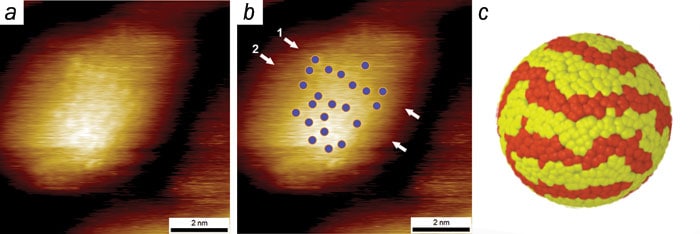
Their principal evidence came from using scanning tunnelling microscopy (STM). In this technique, a fine, electrically conducting tip is passed over a surface, which releases electrons to quantum-mechanically tunnel upwards. By recording the subtle changes in current that ensue through the tip, scientists can reconstruct the structure of the surface. In their STM reconstructions, Stellacci’s group found that the bright circles of their nanoparticles were covered with fuzzy stripes (Nature Materials3 330).
In the same paper, the researchers claimed that the stripy nanoparticles could repel proteins, a property that could be important for certain types of drug delivery. And in the following years Stellacci, working in conjunction with other research groups, has reported various other findings related to the nanoparticles, such as their apparent ability to penetrate biological cell membranes spontaneously. To date, stripy nanoparticles have been the subject of more than 25 papers, some of which have been published in high-impact-factor journals such as Nature, Nature Materials and Science.
Claims and counterclaims
Yet after these papers emerged, biophysicist Raphaël Lévy at the University of Liverpool in the UK became critical of Stellacci’s publications. In 2007 he submitted a technical comment to the journal Science about a paper of Stellacci’s that was about nanoparticle “polarity” – specifically that molecules can easily be placed at either end of a metal nanoparticle (Science315 358). That comment was never published, but it led Lévy to examine in more detail the evidence for nanoparticle stripes.
In 2009 Lévy submitted a manuscript to Nature Materials – the journal in which Stellacci published his original paper in 2004 – entitled “Stripy nanoparticles revisited”, which largely cast doubts on the evidence from Stellacci’s STM images. Nature Materials rejected the manuscript, as did the journal Nano Letters later that year without review; and it was only in 2012, following a lengthy review process taking around three years, that it was finally published as correspondence in the journal Small (8 3714).
Lévy’s criticism for the evidence of stripy nanoparticles derives from the pattern of the stripes themselves. In the STM images, Lévy and colleagues claim that the width of the stripes appeared constant from one pole of a nanoparticle to the other – which is surprising, they say, given that the nanoparticle’s spherical shape must be projected onto the 2D movement of an STM tip.
Just like the surface features of the Earth are distorted when they are projected onto a flat map, say Lévy and colleagues, one would expect the apparent width of the stripes to decrease as the STM tip progressed to the nanoparticle’s edge. They claim that the periodic “stripes” observed were nothing more than a common imaging artefact – the result of oscillatory electrical noise generated by a feedback system that tries to keep the STM tip at a constant distance from the nanoparticle surface.
The real thing? (a) STM image of a nanoparticle; (b) same image with position of molecules showing stripe-like domains (ACS Nano7 8529); (c) a simulation of the stripes (Phys. Rev. Lett.99 226106).
Online discussions
Stellacci, who had by this point moved to the École Polytechnique Fédérale de Lausanne (EPFL) in Switzerland, responded to Lévy and colleagues in the same issue of the journal Small. He countered that the STM tip maintained a constant distance from each particle’s centre of mass, which meant that the nanoparticle features were actually being projected onto a semicircle, for which there would be no distortion. Furthermore, he claimed, it is possible with STM to identify individual molecules on nanoparticles that have no stripes.
If there were distortion, the spacing between such molecules would be greater at the centres than at the edges of the nanoparticles; as it happens, said Stellacci, the spacing in such STM images is constant, meaning that any features were being projected onto a semicircle after all (Small8 3720).
Stellacci’s response did not settle the matter. Frustrated by the three years it had taken him and his colleagues to have their correspondence published, Lévy took to his blog – Rapha-z-lab. Over the next 14 months, he and a few guest contributors wrote more than 30 blog entries pulling apart the evidence for stripy nanoparticles in minute detail. Although most of the commentators sided with Lévy and his colleagues, a few sought to defend Stellacci’s work. At times, the debate became heated.
Stellacci himself was notably absent from the online discussions, but they did prompt him in October last year to publish work in collaboration with two independent groups led by Christoph Renner at the University of Geneva in Switzerland and Steven De Feyter at the University of Leuven in Belgium. The works, which were published in the journals ACS Nano (7 8529) and Langmuir (29 13723), sought to corroborate Stellacci’s original evidence with more advanced STM techniques. Unfortunately, they muddied the water even more: despite the images appearing almost stripe-free at first glance, the authors claimed that their analysis had indeed shown the stripe-like features to be present.
A tirade of comments
A guest post on Lévy’s blog by University of Liverpool chemist Mathias Brust summed up the sceptics’ view: “The authors [of the ACS Nano and Langmuir papers] employ an arsenal of image-analysis techniques to convince presumably themselves and evidently the referees that the now barely discernible ripples at the noise level represent all the features Stellacci et al. had previously reported. The new study thus implicitly admits interpretation errors in the original work, while explicitly aiming to corroborate it.”
This is one of the main criticisms outlined in the most recent paper by Lévy and colleagues, which is currently undergoing review at the journal PLOS One, that also re-examines the body of evidence for stripy nanoparticles to date. The conclusion of the paper states that the STM evidence rests on instrumental artefacts, improper data acquisition and analysis, and “observer bias”.
Already the paper has generated a tirade of comments on PubPeer, an online forum where scientists can review papers freely. The debate looks unlikely to conclude anytime soon, although the central point of contention remains the same. Lévy, like many other sceptics, believes the recognition of feedback artefacts is “elementary” STM science. On the other hand, Stellacci and his supporters consider the data much more difficult to interpret.
“Three groups of the highest standings have done measurements on my particles, and concluded that there are stripe-like domains,” says Stellacci. “Of course they could be wrong, but it is impossible that this is the trivial matter that Lévy portrays.” Stellacci will have a hard time convincing everyone that his nanoparticles are structured as he says they are. If he does, however, he can be assured of one fact: he really will have earned his stripes.
Peer review in the Internet age
Open for discussion Are forums and blogs the best place to discuss controversies in science? (Courtesy: Shutterstock/Maksim Kabakou)
The validity of evidence taken from scanning tunnelling microscopy about ligands organizing themselves into stripes on the surface of nanoparticles is not the only debate surrounding “stripy nanoparticles”. Another area of contention is how scientific discourse should take place in a time when online forums are beginning to displace traditional models of publishing.
Sceptics of Francesco Stellacci’s work, such as Raphaël Lévy, took to the Internet early on because they were frustrated with how long it took for their technical comments to be refereed and published in print journals. Lévy told Physics World it has been a “mistake” for Stellacci not to participate in online discussions too. “The idea that the only legitimate way of discussing scientific data and their interpretation is through the lengthy process of pre-publication peer review is frankly outdated,” he says.
But Stellacci believes the online discussions have not always been professional. He claims to have been accused several times of misconduct and fraud before he has had a chance to respond to the underlying criticisms. This, combined with other “personal attacks” and the “systematic use of lies”, has led him to claim to be a victim of “cyber bullying”.
Stellacci has shown Physics World an open letter that he is planning to publish online (but had not done so as Physics World went to press). “I have nothing against online scrutiny on published data, indeed I believe this is helpful,” he writes in the letter. “I do, however, not wish on any scientist [these] kind of attacks…To be clear what I find bullying is the instantaneous mocking…before the researcher has the physical time to reply to the accusation.”
Stellacci has not been the only one to fall victim to online mockery, however. Lévy’s blog has been copied – allegedly by supporters of Stellacci. The blog, called Fake Rapha-z-lab, is filled with fake posts – some of which are fake “guest posts” from Lévy’s colleagues – that mock the sceptics. The blog seems to have finished, though, as the last post was written last November. The Internet may offer a convenient forum to enter scientific discussion, but it would appear impossible to guard against less professional contributions.