Extra dimensions, other-worldly football, the ISS at night and more


By Tushna Commissariat

This week, we came across the above video on “extra dimensions”, in which physicist Don Lincoln talks about the possible physical reality of such dimensions and why we need them. The video begins with Lincoln pointing out just how weak a force gravity is, especially when compared with, say, magnetism. He then goes on to talk about how gravity may exist in more than the three dimensions we experience, making sure to point out that these “extra dimensions” are not of the Hollywood variety in which a different reality may exist. This video is part of Fermilab’s “Big Mysteries” video series – be sure to take a look at the rest.

(more…)

The cure is success

By Margaret Harris

Last Sunday I went up to Cheltenham for the final day of the town’s annual Science Festival. My plan was to meet the University of Maryland theorist Jim Gates before lunch and then stay to hear his lecture on science and policy.

I was already somewhat familiar with Gates’ research thanks to a feature he wrote for Physics World in June 2010. I could also have made an educated guess about his activities as a member of the President’s Council of Advisers on Science and Technology (PCAST). However, I knew very little about his personal history before his evening lecture, when he was interviewed by the physicist and science presenter Jim Al-Khalili.

Gates was born in 1950 and grew up during a period when African-Americans faced severe institutionalized discrimination across the US. However, being from a military family helped insulate him from some of the worst effects, and he told the audience that he didn’t feel the full impact until his family moved to Florida after he turned 11. For the first time, he attended a racially segregated school, and there, he said, he had “the very curious experience of having to learn how to be black”.

(more…)

Germany set to pull out of €2bn radio telescope

The head of the €2bn Square Kilometre Array (SKA) is confident that the project will go ahead, despite Germany saying that it will pull out of the project in 12 months’ time. In a press conference held in Sicily today, where more than 250 radio astronomers gathered to discuss the project, SKA director-general Philip Diamond reiterated that the withdrawal would not have a “long-term effect” on what will be the world’s largest radio telescope when built in 2023 in Australia and southern Africa.

Progress was also made at the meeting on drawing together the 130 chapters that will make up the updated SKA “science book”, which will be released by the end of this year. Appearing 10 years after the previous version was published, the new SKA science book will set the direction of what will be the world’s most sensitive radio telescope. Germany was the third largest contributor to the publication, behind Italy and the UK.

Germany’s decision to withdraw was announced last week following a letter sent last month by Georg Schütte, the state secretary of the Germany’s federal science ministry (BMBF), to SKA director-general Philip Diamond. The letter informed SKA officials that Germany’s membership would end on 30 June 2015 – only two years after it first joined the organization. The BMBF took the decision because it is apparently under financial pressure as it has to find money for two large German-based projects – the X-ray Free Electron Laser in Hamburg and the Facility for Anti-Proton Research in Darmstadt.

This has come completely out of the blue. It will have a catastrophic impact on German astronomy
Michael Kramer, director of the Max Planck Institute for Radio Astronomy in Bonn

“We’re obviously disappointed by Germany’s decision,” Diamond told Physics World. Although he says that the withdrawal will not have a major impact on the project “in the near future”, Germany’s decision has caused some concern among researchers. Germany had been expected to contribute towards the SKA’s construction and had already spent around €1m on a membership fee and contributed around €2.8m towards the €140m cost of the SKA’s design. Moreover, the move to pull out was apparently taken without consultation with the astronomy community. “This has come completely out of the blue,” says Michael Kramer, director of the Max Planck Institute for Radio Astronomy in Bonn. “It will have a catastrophic impact on German astronomy.”

Germany has already played a major role in determining what science the SKA will do, with the German radio-astronomy community having been involved in a number of science working groups to define this. “German industry is involved in some of the design work too,” adds Diamond.

Extreme sensitivity

Germany is currently the 10th full member of the SKA Organisation, which includes researchers from Australia, Canada, China, Italy and South Africa working together to build a giant facility in the form of more than 3000 antennae with a total collecting area of one million square metres spread across Australia and southern Africa. The main site in South Africa is in the Karoo semi-desert region more than 500 km north-east of Cape Town, while most of the Australia antennae will be in the Murchison region, more than 300 km from the nearest town, Geraldton, on the country’s west coast.

Construction of the first phase of the project is scheduled to begin in 2018. It will see an array of 254 dishes built in South Africa covering the bulk of the high- and mid-frequencies of the radio spectrum, while Australia will host the low-frequency section of the array with 96 dishes accompanied by approximately 250,000 individual dipole antennas. Astronomers will use the telescope to probe the early universe by looking as far back into time as the first 100 million years after the Big Bang. It will also search for life and planets, as well as study the nature of dark energy.

Design work for the first phase of the SKA got under way in 2013 and one of the key aims for 2014–2016 is to secure funding for the construction of the array. If all goes to plan, the first science results will appear from 2020 onwards, with the first phase of the array scheduled to be fully complete in 2023. Construction is scheduled to begin on phase two of the telescope in 2023 and is due to be finished by 2030.

Knock-on effect

The SKA Organisation will now have to manage Germany’s withdrawal, including finding other partners to pay for what the country might have contributed towards construction. Construction costs have yet to be divided between member states, but estimates – as a starting point to negotiations – show Germany would have been set to pay about 10–12% of the total. “That makes this decision to pull out even more baffling, as we don’t yet know how much Germany would have needed to pay,” says Kramer, who adds that his institute will continue to contribute to the SKA.

However, Diamond is hopeful that if Germany does not backtrack, then other countries could step into its shoes. “There are a number of other countries actively interested in joining the SKA, and we expect to see more in the next few years as we ramp up our funding search, which we’ve only just started,” says Diamond. But he thinks the real losers in the withdrawal will be German industry, which will not now be able to compete for engineering contracts to build the SKA, as well as the German science community, which will now find it harder to get time on the telescope. “That’s unfortunate given Germany’s long tradition of radio astronomy,” adds Diamond. “But interest in SKA science is strong in Germany, and we believe the German scientific community will continue to work with us, and we will support them in that.”

A mixed bag of science books

By Margaret Harris

The longlist for the 2014 Royal Society Winton Prize for Science Books has been announced today, and, with a few exceptions, I’m not impressed.
Logo for the Royal Society Winton Prize for Science Books

I’ll begin with the exceptions. Of the six books on the 12-strong longlist that have come across my desk as Physics World’s reviews editor, two of them – Philip Ball’s Serving the Reich and Pedro Ferreira’s The Perfect Theory – fully deserve to be in contention for the £25,000 prize. I reviewed Ball’s book myself and found it fascinating, and although Physics World’s review of Ferreira’s book won’t be published until July, I can reveal that the reviewer found it “timely, expert and highly readable”. I also gave a pass mark to Brian Clegg’s Dice World, which is a good, serviceable treatment of a topic – quantum randomness – that deserves more love than it gets. Congratulations to all three authors.

(more…)

Using magnetic cooling for ‘green’ refrigeration

A large, rotational magnetocaloric effect – which could be used as the basis for a low-temperature magnetic refrigeration device – has been observed in crystals of the compound HoMn2O5, according to research carried out by scientists in Canada and Bulgaria. This finding expands our knowledge of magnetocaloric materials, adding to our progress towards a practical and environmentally friendly magnetic cooler that might be usable in a domestic setting.

Hot and cold

In recent times, the potential of magnetic refrigeration techniques as an alternative to traditional, vapour-compression solutions has been attracting considerable attention. This is mainly thanks to the lower energy demands of the technique, and the fact that it is not reliant on hazardous fluids. Such devices take advantage of the magnetocaloric effect – a phenomenon in which certain materials change temperature in response to an externally applied magnetic field. Such fields cause the magnetic dipoles of the atoms within magnetocaloric compounds to align. To balance out this decrease in entropy – and thereby satisfy the second law of thermodynamics – the motion of the atoms also becomes more disordered, and the material heats up. In contrast, when the applied field is removed, the process reverses and the material cools. In magnetic refrigerators, these temperature changes can be harnessed, using a fluid or gas, to drive a heat pump.

The cooling potential of a magnetic refrigerator is proportional to both the size of the applied field and the magnetic moment of the active material being used. While alloys of gadolinium are conventionally associated with the magnetocaloric effect, materials with greater cooling potential are being actively sought. To this end, researchers from the Université de Sherbrooke in Canada and the Bulgarian Academy of Science set out to examine the magnetocaloric effect in the manganese compound HoMn2O5. This material is attractive both for its resistance to corrosion and for its insulating properties, which prevent energy losses from eddy currents induced by varying the applied magnetic field.

Rotated fields

While expecting to observe only the standard magnetocaloric effect in the compound, the researchers were surprised to discover that, at a temperature of 10 K, HoMn2O5 also exhibits a large magnetocaloric effect when simply rotated by 90° within a constant magnetic field. Such an effect is caused by the material experiencing a different magnetic response depending on its orientation. This makes the compound a candidate for use in a rotary magnetic cooler: an established variation of the standard magnetic refrigeration solution, in which repeated rotations of the active material are used to effect cooling. The researchers propose, for example, that their material might be employed to liquify hydrogen or helium for use as a heat-transfer fluid.

The advantage of the rotary approach comes from the simplification of the refrigeration device. “The magnetization–demagnetization process when using [the] standard magnetocaloric effect generally requires a large mechanical energy for moving the active material in and out of the magnetic field source,” explains lead author Mohamed Balli, a physicist at the Université de Sherbrooke. In contrast, keeping the active material within the field leads to not only an improvement in efficiency, but also a more compact device. Additionally, Balli notes, “the implementation of such [an] effect allows the conception of rotary magnetic refrigerators working at high frequency, leading to a large cooling power”.

Having demonstrated the potential of HoMn2O5 for application in rotary magnetic refrigerators, the researchers are now exploring the possibility of enhancing the cooling effect in the compound – along with seeking other materials with similar properties, especially those that might function at room temperature.

The research is described in Applied Physics Letters.

From the past, a fiery warning

I wanted to dislike this book. After all, there are so many books out there about volcanoes already. Did we really need another? But Island on Fire is interesting. It focuses on one particular eruption, rather than volcanoes in general, and it also investigates what the consequences would be if such an eruption were to happen again. Using accounts written during the eruption itself, Island on Fire documents the evolution of an important event in volcanic history through the eyes of those who experienced it.

The eruption in question is not a well-publicized one such as that of Vesuvius in 79 AD, Mount St Helens in 1980, Montserrat in 1995 or even Eyjafjallajökull in 2010. Nor is it some mysterious event that happened millions of years ago. Rather, it is a “forgotten” eruption that took place in 1783 – which, while obviously not within living memory, certainly feels a lot closer to home. The eruption of the Icelandic volcano Laki in that year was not the first to have an impact far beyond the island itself, and it would certainly not be the last. But unusually for an historic eruption, we have a very detailed eyewitness account of its effects.

Much of what we know about the 1783 Laki eruption comes from the writings of Reverend Jón Steingrím-sson – an early volcanologist, natural scientist and priest whose parish lay directly in the path of the eruption. His story forms a central part of Island on Fire. Beginning on 8 June 1783, Steingrímsson observed the changing mood of the volcano as earthquakes heralded a rise in river levels; a cloud of “vog”, or volcanic smog, settled over the island; ash fell from the sky; and finally lava began flowing down the valleys on Laki’s flanks. Over a period of a month, numerous villages and farms in the surrounding area were destroyed by lava flows or covered in ash, and by 20 July 1783 it looked as though the lava would next consume Steingrímsson’s own village of Klaustur and the chapel where he preached. On that day – a Sunday – he preached for rather longer than usual, leading the congregation in prayers that the village and people would be spared. When the service was over and they went outside, they saw that the lava had stopped advancing. As a result of this apparent miracle, Steingrím-sson became a celebrity and was dubbed the “Fire Priest”.

We now know that this episode marked a change in the activity at Laki, and that while Klaustur was indeed spared from the lava flows, the devastation was far from over. In the months that followed, Steingrímsson continued to document the effects of the eruption on local people and their livelihoods, including the horrific poisoning of both animals and humans by volcanic fluorine, which could be inhaled or ingested with the ash. By the end of the eight-month eruption, half of Iceland’s livestock and 20% of its human population were dead.

Today, Steingrímsson is well known not only in Iceland, but also in volcanological circles worldwide thanks to his careful documentation of the progress of the eruption and its effects. And like Steingrímsson’s reputation, the consequences of Laki’s eruption were not confined to remote farms and villages in Iceland. The outside world first heard of the eruption after travellers to the island returned to Europe or the Americas, but by then, people in those places were already experiencing their own unusual and ghastly phenomena.

Between 17 and 23 June 1783, a mysterious warm haze began drifting across northern parts of the UK, Scandinavia and eventually much of central Europe, engulfing the area in an acidic mist that scorched crops. The haze extended from sea level up to at least 3000 m, where it was reported by shepherds in the Dauphiné Alps. It smelt sulphurous and left a bitter aftertaste. Occasionally, ash fell through the haze and was spotted as far away as Venice. By July the haze had reached the Altai Mountains in Asia, and there are reports of a severe dry fog in central China. Records from South America and Alaska likewise suggest strange happenings that summer.

These unusual weather conditions led to sudden and violent thunderstorms and floods, followed by an unusually severe winter in both Europe and the US. The American scientist Benjamin Franklin, who spent some time in France during the worst of the haze and then returned to the US in time to endure the cold winter, was apparently the first to suggest that these unusual phenomena might be connected to the eruption in Iceland. Even more astutely, Franklin also suggested that if it could be shown that hard winters in the past were preceded by hot summers, there might be scope to make preparations if this were to happen again. This is probably the first recognition of a link between volcanoes and climate change.

The effects of the Laki eruption were widespread and devastating. Estimates of the death toll range from a conservative 9350 to a cool 6 million, and there is even speculation that the combination of harsh winters, cool summers and the inevitable crop failures that followed were catalysts for the French Revolution in 1789. By comparison, the air-travel chaos caused by the rather small and short-lived eruption of another Icelandic volcano, Eyjafjallajökull, in 2010, seems insignificant.

Events like the 1783 eruption of Laki have happened before and they will happen again. The big difference now is that we are very much more vulnerable than we were in the 18th century. While the complete systems breakdown that followed the 2010 Eyjafjallajökull eruption was annoying, the brevity of that eruption made a speedy recovery possible. But the 1783 Laki eruption lasted for months, and a similar eruption could last even longer. Extrapolating the impact that such an eruption would have today makes for gloomy reading.

There is no way of preventing such natural hazards. We can only try to mitigate the worst of their effects through better preparedness and by improving our understanding of the precursory signals. Island on Fire is an enjoyable and informative read, and it provides a timely reminder of how essential it is to improve our understanding of volcanic processes.

  • 2014 Profile Books £10.99hb 224pp

EXO-200 narrows its search for Majorana neutrinos

The first two years of data from the Enriched Xenon Observatory-200 (EXO-200) have been released by an international collaboration of physicists. The experiment looks for evidence of a process known as “neutrinoless double beta decay”, in a sample of isotopically enriched xenon-136. While the EXO-200 collaboration has not yet found any statistically significant evidence for the decay process, they have put an improved lower limit on the half-life of the decay.

They have also shown that they can efficiently suppress background noise from cosmic rays and radioactive decays. Observing any signs of neutrinoless double beta decay would show that neutrinos are “Majorana fermions” (particles that are their own antiparticles). This would constitute discovering a new class of particles that lies beyond the Standard Model of particle physics and would be a major breakthrough in modern physics.

Produced by a neutron undergoing β decay, neutrinos are chargeless particles that interact with matter via the weak force. Although we now have experimental evidence that neutrinos come in three “flavours” – the electron neutrino, the muon neutrino and the tau neutrino – that each have a different mass, researchers have been unable to nail down the individual masses. However, measurements of neutrinoless double β decay – if it were to occur – could be used to determine the absolute mass of a neutrino.

Double trouble

Neutrinoless double β decay is a special case of the common nuclear β decay process wherein the neutron in an unstable nucleus emits an electron and an antineutrino and becomes a proton. A more exotic version of the process, known as “double β decay”, occurs when a nucleus is forbidden to decay through a single β decay. One way for this double decay to happen is for two ordinary β decays to occur, but with no way of measuring the intermediate state between the two decays and with the final nucleus having a larger binding energy than the original nucleus. Two neutrons in the nucleus would be converted to protons and two electrons, with the emission of two electron antineutrinos – this is known as “two-neutrino double β decay” and is predicted by the Standard Model. Two-neutrino double β decay is very rare, thanks to the exceedingly long half-lives of the double β isotopes, above 1020 years. This is more than a billion times longer than the age of the universe itself. Select isotopes do undergo this type of double β decay however (it was first observed in 1986), including xenon-136, which decays, with the emission of two neutrinos, to barium-136. Indeed, the EXO-200 experiment was the first to observe this decay in xenon-136 in 2011.

But the other type of double β decay – the elusive and currently unseen neutrinoless double β decay – is what the EXO-200 collaboration, along with a host of other experiments worldwide, is looking for. This type of decay would only occur if the neutrino was a Majorana particle, first predicted in the 1930s by the equally enigmatic Italian physicist Ettore Majorana, but so far undetected. As neutrinos have no electrical charge, they could conceivably be their own antiparticle. In this case then, the antineutrino emitted from one of the β decays could be absorbed as a neutrino in the other β decay. This process, as observed from outside the nucleus, would result only in the observation of two electrons being emitted, with no neutrinos at all. The electrons would carry all the energy of the decay, unlike normal double β decay, in which the antineutrinos carry away energy. The experimental signature of this decay process is the detection of two electrons, the sum of whose total energy is equal to the mass difference between the parent and daughter nuclei.

No neutrino?

The EXO-200 experiment looks for this signature using 200 kg of liquid xenon, enriched to 80% of the 136 isotope, and held in a “time-projection chamber”. The chamber is placed within a cryostat system to help keep the xenon at liquid temperature. The cryostat is then shielded with lead and is located deep in the bowels of a disused salt mine, 641 m underground at the Waste Isolation Pilot Plant in Carlsbad, New Mexico, in the US. This remote underground location is crucial to the experiment’s success because it acts as a shield from background radioactive decay and cosmic rays, while the detector is made up of materials that constitute the lowest possible levels of radioactive contamination.

The EXO-200 experiment has been running for two years, allowing the collaboration to place the most stringent bound on the half-life for neutrinoless β decay. The researchers found that it is greater than 1.1 × 1025 years, at the 90% confidence level, improving on their own previous limit of 1.6 × 1025 years. The collaboration says that the high sensitivity of its measurement “holds promise for further running of the EXO-200 detector and future [neutrinoless double β decay] searches with an improved Xe-based experiment, nEXO”. This long lifetime suggests that neutrinos probably have small masses. Most recent experiments have now set limits to the Majorana neutrino mass at 0.2–0.4 eV. The nEXO experiment is a larger detector, with 5000 kg of xenon that is currently being proposed and simulated, and the current EXO-200 data will help refine its future design.

David Waters, a particle physicist at University College London, says that the EXO-200 “is a beautifully executed experiment and one of the most sensitive currently in operation. Although no signal for neutrinoless double β decay has been seen, experiments such as EXO are getting closer and closer to a promising region of parameter space that is suggested by neutrino oscillation experiments”. Waters, who also works on the another such experiment, the Super Neutrino Ettore Majorana Observatory (SuperNEMO) points out, “The next five years will be a very interesting time with several experiments such as EXO, but also others including SNO+ and SuperNEMO in which the UK plays leading roles, having the potential to make a major discovery that would shed light on some very fundamental questions in particle physics.”

The research is described in Nature.

Proton therapy is for the masses

By Hamish Johnston

In the 25th anniversary issue of Physics World, I made the bold assertion that laser acceleration will bring particle therapy to the masses by removing the need for treatment centres to have large and expensive accelerators. Instead, therapeutic beams of protons and other charged particles will be made using compact and relatively inexpensive lasers.

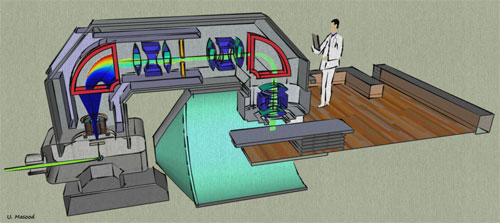
Now, medical physicist Umar Masood and colleagues at the Helmholtz-Zentrum Dresden-Rossendorf (HZDR) and the University of Dresden have published plans for a laser-driven proton-therapy facility.

(more…)

Materials inspired by nature

Materials in nature have undergone millions of years of evolution, so they are often very good indeed at serving their purpose. A research group at Harvard University is taking inspiration from the experience and expertise of nature by developing new materials inspired by biological materials and processes. This video takes you inside the The Aizenberg Biomineralization and Biomimetics Lab based at the university to meet some of the scientists and see the products they are developing.

“Only materials that have exceptional superior properties will survive, and these are the natural structures that we see and study today,” says group leader Joanna Aizenberg. “What I want to do is to create new materials, different materials, not exactly the same as nature has evolved.”

One example of this bio-inspired approach to engineering is a product known as a slippery liquid-infused porous surface, or SLIPS for short. In the film, Aizenberg and her research students explain how SLIPS was inspired by the lubricated surfaces of the Nepenthes pitcher plant, which is slippery in order to trap insects. The SLIPS technology has potential applications such as slippery coatings for pipelines that can transport oil at high speeds and efficiencies.

In this second short film, group member Natalie Koay demonstrates another product known as W-ink. The coating – inspired by the brilliant blue structural colour of the morpho butterfly – can be used in a range of products such as liquid identification in the food and beverage industry, and message encryption. Koay also demonstrates how W-ink could lead to a range of novelty products such as a dipstick for testing the alcoholic strength of a drink.


Capturing science on film

People watching an outdoor screen in Sheffield

By James Dacey, reporting from Sheffield

For the past few days I’ve been back to the place where I grew up: the city of Sheffield in the north of England. It’s famed for its steel production and snooker, but I’ve been in town for what is billed as the world’s most exciting documentary and digital media festival: Sheffield Doc/Fest. There has been an eclectic mix of films and audio documentaries from around the world to enjoy but I’ve been focusing on a strand of the festival dedicated to “Ideas & Science”.

(more…)

Copyright © 2026 by IOP Publishing Ltd and individual contributors