Promoting better science journalism

By Margaret Harris

Some people fear public speaking more than illness or death. I’m not one of them, but I’ll admit to some qualms on Monday morning, when I travelled to the University of Westminster to speak about science to a group of journalism students.

As I rode the Metropolitan Line train up to Westminster’s Harrow campus, I wondered what sort of speaker the students were expecting. I was giving the talk as part of a Royal Statistical Society (RSS) programme to train journalists in basic statistical principles and how science works; however, unlike most of the people involved in the programme, I am neither a professional scientist nor a statistician. Moreover, the official RSS curriculum places a strong emphasis on statistics and scientific practices in medical science, which isn’t exactly my strong suit either. So while I knew the programme was aimed at helping non-specialists understand basic concepts like risk, the scientific method and the role uncertainty plays in science – all topics that I’m fairly comfortable with – I couldn’t help feeling like a bit of an imposter.

(more…)

Space bonanza to land in Manchester

Illustration of starlight reflected in a human eye

Whatever punters make of the Manchester International Festival (MIF) next year, they certainly won’t be able to accuse it of thinking small. Among the first commissions announced today is a “world-first show about the origin of the universe and everything within and without it”.

The Age of Starlight will be presented by the physicist and TV personality Brian Cox, who will tell the story of the unlikely events that have led to our existence. Details of the show are still scarce but we do know that the space bonanza will feature computer-generated imagery created by the Oscar-winner Tim Webber and the special-effects team behind the film Gravity. The event will be brought to life with technologies developed by Magic Leap, a Florida-based IT company that specializes in “magical” computing solutions.

(more…)

We need to talk about quantum mechanics

Along with learning about the most up-to-date and exciting advances in the field, the group discussed everything from the inherent complexity that arises because of the many interpretations of quantum mechanics to helping people discern the actual science from the “quantum woo” to all the good science communication that is already being done.

In this podcast, you will hear from Commissariat and a selection of her fellow boot-campers, including quantum physicist and science-communication enthusiast Raymond Laflamme, director of the Institute for Quantum Computing at the University of Waterloo in Canada; conference organizer, blogger and NORDITA physicist Sabine Hossenfelder, and author, blogger and researcher Chad Orzel. She also chats to journalist and author Michael Brooks; New Scientist features editor Valerie Jamieson and blogger and freelance journalist Sedeer el-Showk about how journalists can crack the code to crafting the perfect quantum tale.

Listen to the podcast to discover their strategies for bringing quantum mechanics out from behind closed laboratory doors and into the mainstay of our everyday lives.

Sun’s magnetic field affects frequency of lightning strikes on Earth

Think back to summer. Long, hot, sultry days, rounded off with a finale of atmospheric fireworks. But sometimes the thunder and lightning fail to materialize, even on the most stifling of summer days, and on other occasions the sky starts to rumble with seemingly no provocation. Now, a study by researchers in the UK shows it is not just conditions down here on Earth that determine how much thunder and lightning we get – the Sun’s magnetic field also has a big influence, more than doubling the number of lightning bolts on some days.

Physics textbooks depict the Earth as having a simple and symmetrical magnetic field, but in fact it is usually skewed, with its poles up to 5° out of line. These kinks are caused by the pull of the Sun’s magnetic field, which fluctuates with sunspot number and the strength of the solar wind. Sometimes the solar magnetic field points towards the Sun and other times it points away.

“Typically, the solar field shifts every 10 to 15 days, meaning that the Earth’s field is usually bent in one direction or the other,” explains Mathew Owens of the University of Reading, who led the study. By studying lightning data gathered by the UK’s Meteorological Office and plotting it against satellite measurements of the solar magnetic field, Owens and his colleagues were able to assess the influence that the solar magnetic field has on electrical storms here on Earth.

Towards the Sun

The team found that from 2001 to 2006, lightning rates over the UK increased by an average of 40–60% when the solar magnetic field was pointing towards the Sun. Thunderstorm activity still occurred on days when the Earth was in an away sector (with the solar field pointing towards Earth) but it was less frequent. For example, during July there was an average of 40 lightning flashes on “away sector” days, but about 90 flashes on “towards sector” days.

Exactly how the solar magnetic field causes these variations in thunderstorm activity is not clear, but Owens and his colleagues suspect that the changes in the shape of the Earth’s magnetic field affect the number of energetic charged particles (cosmic rays) that are channelled into the Earth’s atmosphere from outer space.

“Each time the Earth’s field bends, it exposes different locations to different particle intensities, changing local atmospheric ionization, which makes it harder or easier to trigger lightning,” says Owens.

Latitude and radon

Because geomagnetic variations are more significant at high latitudes, the effect is likely to be greatest in higher-latitude countries such as the UK. But other factors are important too. “It may be that areas with lower atmospheric ionization from ground-level sources such as radon are more sensitive to cosmic-ray variation,” says Owens. “And equatorial regions generally have stronger and more-frequent convection so there is more opportunity for solar modulation to act, even if that modulation is generally weaker.”

Next, the researchers hope to see how the relationship between solar field and lightning holds for other countries, as well as assessing it over time using historical records going back 150 years. Ultimately, Owens and his colleagues hope that their findings could be used to improve lightning forecasts, by incorporating information about the solar magnetic field into numerical weather predictions.

The findings are published in Environmental Research Letters.

Is dark energy eating dark matter?

A tantalizing hint that dark matter could be slowly changing into dark energy has been uncovered by a team of cosmologists in the UK and Italy. While the specific nature of the interaction driving the conversion is not known, the process could be responsible for slowing the growth of galaxies and other large-scale structure in the universe across the past eight billion years. If the conversion continues at the current rate, the universe’s ultimate fate as a cold, dark and empty place could come sooner than expected.

Since the accelerating expansion of the universe was discovered in 1998, the best model of the evolution of the universe involves a cosmological constant (Λ) – which describes the accelerating expansion – along with cold dark matter (CDM). CDM comprises slow-moving particles that do not interact with electromagnetic radiation and are extremely long-lived. The particles account for about 85% of the matter in the universe and therefore their gravitational forces dominate the formation of large-scale structure.

While the ΛCDM model is supported by many different observations, several inconsistencies have come to light recently. Using data on cosmic-microwave-background radiation acquired in 2013 by the Planck space telescope, the ΛCDM model has been used to predict the rate at which large-scale structure should grow across the history of the universe. However, several different studies suggest that the rate at which structure is forming is slower than predicted by Planck/ΛCDM, which could mean that CDM is disappearing from the universe.

Cosmologists have tried to tackle these discrepancies by making slight modifications to the ΛCDM model – allowing Λ to change with time, for example, or having CDM decay into normal matter and energy – but these changes seem to create as many questions as answers.

Now, Valentina Salvatelli, Najla Said and Alessandro Melchiorri at the University of Rome, along with David Wands and Marco Bruni at the University of Portsmouth, have come up with a new way of reconciling these observations. They have extended the ΛCDM model to allow dark matter to decay to create dark energy. To check their model against observations, Wands and colleagues compared the evolution of large-scale structure as predicted by Planck/ΛCDM with large-scale-structure observations derived from measurements of redshift space distortions in galaxy surveys.

The researchers divided the history of the universe into four time bins of roughly equal length, and found that their proposed interaction becomes significant in the third and fourth bins – that is, between about eight billion years ago and the present day.

“It appears that the standard [ΛCDM] model is no longer sufficient to describe all of the data. We think we’ve found a better model of dark energy,” explains Wands.

Although the rate at which CDM appears to be converted into dark energy is very slow, Wands says that if it continues at the current rate, all the CDM in the universe will be gone in about 100 billion years. “If the dark energy is growing and dark matter is evaporating, we will end up with a big, empty, boring universe with almost nothing in it,” explains Wands.

Catherine Heymans of the University of Edinburgh describes the research as “a fascinating result”, and points out that it is part of a larger effort to reconcile discrepancies (or “tensions”) between measurements made by Planck and those from other telescopes. “Other researchers have said that this tension can be resolved if the dark-matter particle is a sterile neutrino,” she explains, adding, “others still are looking at different modified-gravity theories to explain the result.”

Heymans also points out that the tension could be the result of systematic errors in how one or more of the observations are made. “More data and further meticulous analysis of those data and the systematics that might be associated with them are the way to find out if this fascinating theory could be true,” she cautions.

The research is described in Physical Review Letters.

  • There is much more about dark matter and dark energy in this feature-length article by Jeff Forshaw at the University of Manchester: “Theories of the dark side”. This is one of several articles about dark matter and dark energy in the July 2014 issue of Physics World, which focuses on “The dark universe”. You can access the July issue using the Physics World digital app by joining the Institute of Physics as an IOPimember


The journey of innovation

At some point in their working lives, many scientists have an idea for a commercial product inspired by their research. Some even take it to the next stage of launching a spin-off company and developing a working prototype of their product. But there is still a vast gulf between creating a nifty demonstration of a concept and actually finalizing a new product that people will buy. This short film examines the process of taking an idea from the science laboratory to the marketplace by visiting some companies and innovators in the Boston area of the US.

One of the companies featured is MC10, which specializes in developing flexible electronics for health and fitness applications. We examine some of the ingredients that have contributed to the success of MC10, such as the type of people it hired in the early days. The film profiles one of its products – the Reebok CHECKLIGHT – developed in partnership with partnership with US consumer sports giant Reebok. It is essentially a skullcap used in contact sports such as American football to gauge the extent of impacts to the head.

All companies, including MC10, have to pass through a stage in the commercialization process known as the “valley of death”. Precise definitions vary, but this is essentially the stage at which a company has an initial prototype for a product or service but lacks the resources needed to translate this into a fully fledged profitable business. Our film illustrates this concept of a valley of death in a quirky cartoon.

As well as scientists involved in spin-offs, the film also features people perhaps more familiar with the commercial world. One of the interviewees is venture capitalist Stan Reiss of the firm Matrix Partners, who talks about what he looks for when investing in a start-up company. “I’ve met a lot with professors who have a great idea and they want it to happen but they don’t want to do it,” he says. Reiss always ensures that a start-up always has at least one person committed to the cause full time, because commercializing research is often far more laborious than scientists first realise.

This video was produced in connection with the November issue of Physics World, which is a special issue devoted to the process of commercializing physics. Find out how to access the issue in this blog post.

Last chapter in Rosetta’s Philae lander story…for now

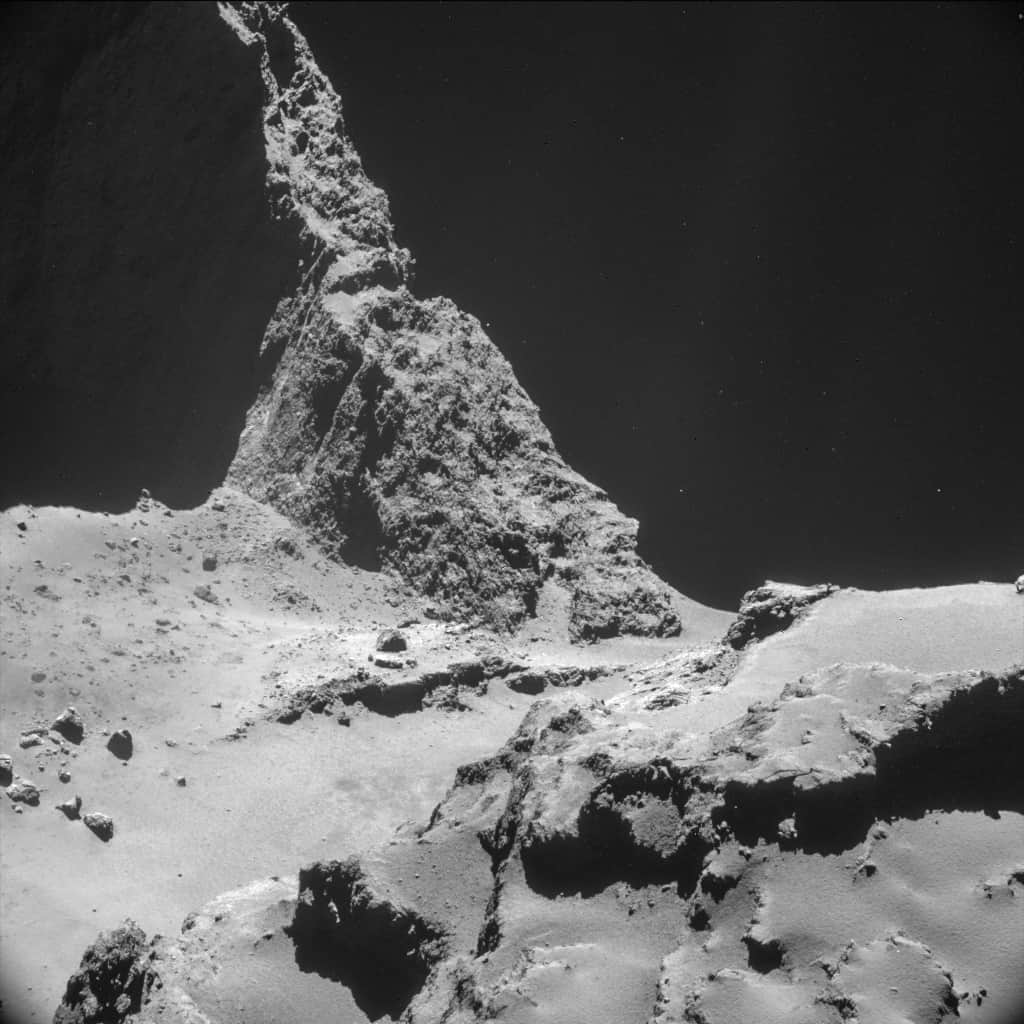
Image of comet 67P taken by Rosetta's NAVCAM from 10 km away

Last week was exciting and exhausting for anyone involved in space exploration and astronomy, after scientists working on the Rosetta mission of the European Space Agency (ESA) made history when their “Philae” module touched down safely on the surface of comet 67P/Churyumov–Gerasimenko. But soon after celebrating Philae’s successful landing, a dramatic story unfolded. With a bumpy triple landing, harpoons that did not fire and tether the probe, as well as a final resting spot that lay in the shadows, which meant its solar panels received very little sunlight, Philae’s tumultuous story captivated the interest of thousands of people across the globe.

In the early hours of Saturday morning, as Philae’s batteries slowly drained of power, thousands mourned. “So much hard work..getting tired…my battery voltage is approaching the limit soon now,” Tweeted the Philae crew, and yet, the lander’s story was ultimately happy and successful. Although it spent only 57 “active” hours on the comet, ESA mission scientists were happy to report that the lander had indeed completed the entirety of its primary science mission.

(more…)

Review breathes life into Yucca Mountain nuclear-waste site

A review by the Nuclear Regulatory Commission (NRC) of the long-term safety of the Yucca Mountain repository for nuclear waste in Nevada has improved the chances that it may go ahead, despite the project being mothballed by the Obama administration back in 2010. The NRC’s “safety evaluation report” concludes that the repository, if built, would “meet the applicable [NRC] performance objectives” for environmental impact once it is permanently closed. However, that report does not actually state whether the NRC should give the green light to the repository being built.

The US Congress originally chose Yucca Mountain as one of five possible central storage sites for nuclear waste in 1986, and designated it as the only choice the following year. By 1997, the Department of Energy (DOE) had tested the site’s suitability for the task by burying metal containers deep underneath the mountain and heating them to simulate the effect of radiation from nuclear waste on the local environment.

Located about 150 km north of Las Vegas, the site was originally intended by the DOE to hold waste safely for 10,000 years after it was sealed. But in 2004 – in response to a case brought by the state of Nevada – a federal-government appeals court ruled that the assurance of safety should last for hundreds of thousands of years, prompting the NRC to begin a review of the site’s safety. However, the election of President Barack Obama in 2008, who had campaigned against the project, seemed to end the matter, and two years later Gregory Jaczko, whom Obama had chosen as chair of the NRC, shut down the review.

Multiple barriers

After a three-year hiatus, the review started up again when another appeals court – responding to a lawsuit bought by states and counties unable to ship their nuclear waste – ordered it to be completed. Released in October, the review approves the repository’s safety standards for individual protection, human intrusion and groundwater protection through the use of multiple barriers to isolate the environment from any radioactivity.

Then five days after the report was published, NRC chair Allison Macfarlane, an opponent of the repository, announced that she will leave the commission at the end of 2014. Macfarlane, who succeeded Jaczko as NRC chair two years ago, was the only geologist on the five-member commission, and frequently appeared in the minority on votes, particularly those involving the safety of nuclear reactors. She will now become director of the Center for International Science and Technology Policy at George Washington University.

Macfarlane’s departure was not the only boost for Yucca Mountain’s proponents. The Republican Party’s capture of the Senate in last month’s US mid-term elections means that Nevada Democrat Harry Reid will lose the leadership of the Senate – a position that had enabled him to block all efforts to advance the repository during the past four years. Republican Cresent Hardy, newly elected to the House of Representatives from the constituency that contains Yucca Mountain, supports the project.

Expensive and time-consuming

Resurrecting Yucca Mountain is, however, likely to be expensive and time-consuming. “To get to the point where we have a licensing decision, we would need to complete a supplement to the environmental-impact statement from the DOE,” NRC spokesperson David McIntyre told Physics World. “We would also have to complete an adjudicatory hearing that would need perhaps two or three years.”

And while the NRC has direct oversight of Yucca Mountain, the DOE – which remains in the hands of Obama-administration appointees – will still decide whether it goes ahead.

Rosetta's Philae starts drilling into comet surface

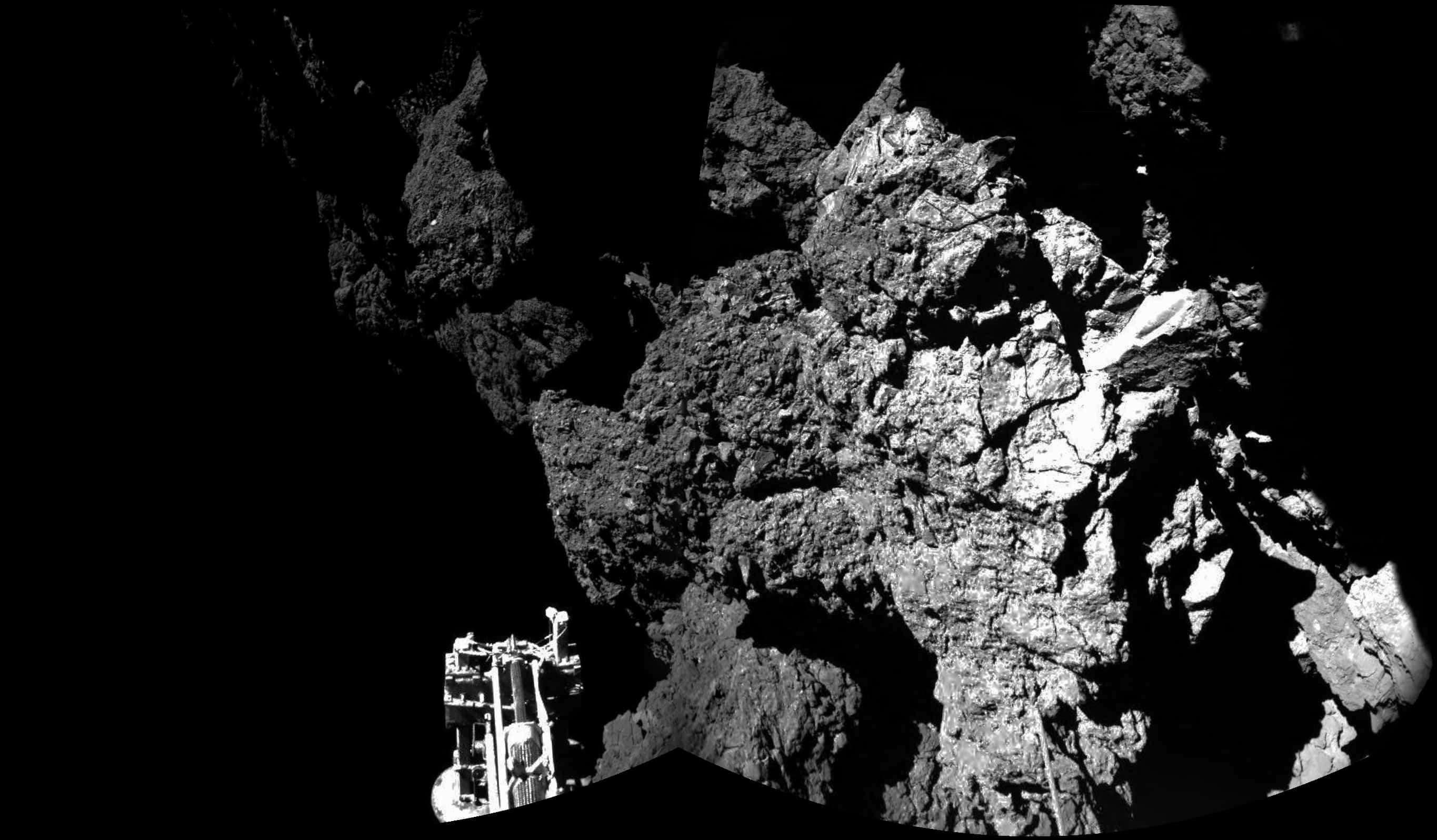
The view from Philae’s final landing spot

It had clearly been a long and busy 24 hours for members of the Rosetta mission at the European Space Agency (ESA) as they gave the latest updates in today’s Google+ Hangout. On Wednesday the mission made history as its “Philae” module touched down safely on the surface of Comet 67P/Churyumov–Gerasimenko. But there has been a great deal of drama and uncertainty since then, as it emerged yesterday that the lander’s final resting spot was more than 1 km away from where it was meant to arrive. Also, Philae is thought to be precariously positioned in the shadows on the far side of a large crater, where its solar panels cannot get enough light to operate as planned. Despite these hurdles, the lander’s many instruments have been functioning well and sending data back to Earth, via the Rosetta orbiter.

(more…)

Creepy comic, Hawking joins Monty Python and that shirt

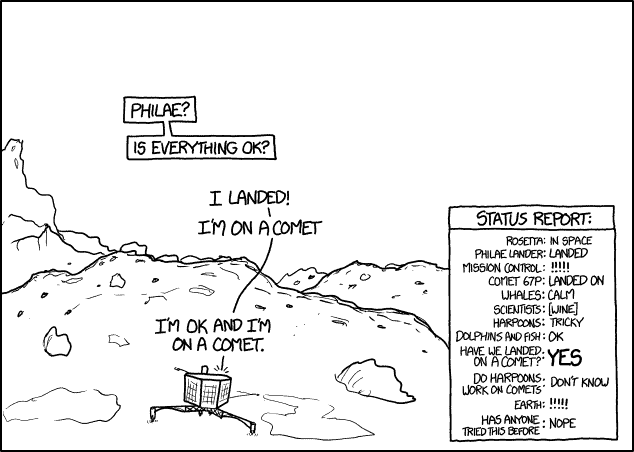
The big story this week is that Rosetta’s Philae lander has touched down on a comet. During the descent, cartoonist and former physicist Randall Munroe captured the event in a series of 142 sketches. You can see the final instalment above, presumably drawn before Philae’s various problems were widely known.

(more…)

Copyright © 2026 by IOP Publishing Ltd and individual contributors