LED firm rejects Nobel laureate’s olive branch

Nobel laureate Shuji Nakamura says that he is not going to try and improve relations with his former employer, which he sued in 2001 over his development of the blue light-emitting diode (LED), after receiving a snub from them earlier this month. Nakamura, who shared this year’s Nobel Prize for Physics for the invention of efficient blue LEDs, offered an olive branch to Nichia by asking to meet with the head of the company, only to be told by the firm to spend his “precious time” on research instead.

Nakamura, who shared this year’s prize with Isamu Akasaki and Hiroshi Amano, originally joined the Japanese LED firm Nichia in 1979 after studying electronics engineering at the University of Tokushima. While at Nichia, he was awarded a PhD in 1994 from Tokushima, before leaving the firm in 2000 to join the University of California, Santa Barbara, in the US.

Lengthy court case

However, in 2001 Nakamura filed a lawsuit against Nichia claiming that he was not rewarded sufficiently for gaining Nichia key patents related to blue LEDs. After a four-year battle in the Japanese courts, in 2004 Nakamura won a one-off payment of ¥20bn ($193m) – much more than the ¥20,000 that Nakamura received from Nichia each time he filed a patent. Nichia then appealed to a higher court, before reaching a settlement to pay Nakamura around ¥843m in 2005.

But following his Nobel win, Nakamura said that he wanted to rebuild ties with Nichia. In a press conference last month in Tokyo after being presented with the Order of Culture by the Japanese government, Nakamura expressed his gratitude to Nichia president Eiji Ogawa and the team of six other researchers who contributed to their work on blue LEDs. Nakamura then offered to visit Tokushima for talks with Ogawa.

I am not going to do anything to improve the relationship with Nichia from my side
Shuji Nakamura, University of California, Santa Barbara

However, in a statement Nichia said that Nakamura’s words of gratitude towards Nichia were enough, and that he should not be spending his “precious time” visiting the company but rather focusing on his research. Nakamura told Physics World that he is “disappointed” that Nichia turned down his request to “mend the relationship”. Indeed, he now says that he will not respond with a further request. “I am not going to do anything to improve the relationship with Nichia from my side,” says Nakamura.

Rosetta mission outlines Philae lander’s predicaments

Yesterday, scientists working on the Rosetta mission of the European Space Agency (ESA) made history when their “Philae” module touched down safely on the surface of comet 67P/Churyumov–Gerasimenko. Since then, the mission scientists have been in communication with the lander and it has emerged that Philae bounced twice, moving nearly 1 km back out into space, and that it touched down on the comet three times before settling at a location nearly 1 km away from the target site. Its current position is precarious and does not provide its solar panels with enough light to operate as planned. Despite its rocky landing, some instruments on Philae are running and the team says it is continuing to receive “great data and images”.

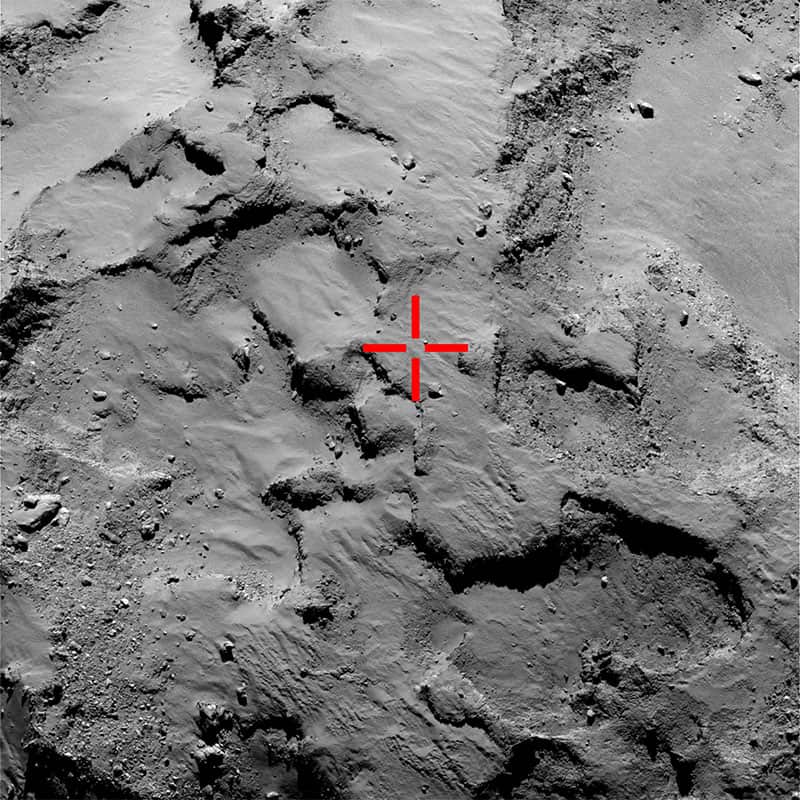
Close-up of a comet's surface with a large red cross showing a landing position

Philae first landed yesterday at 15:33 GMT before it bounced up and touched down again at 17:26 GMT, then bounced up once more, finally coming to rest at 17:33 GMT. It settled on the comet surface at a currently unconfirmed location, about 1 km from its target site. The multiple bounces are likely to have occurred because the lander’s harpoon, which should have anchored Philae onto the surface, did not fire. The lander’s position is also precarious, as initial data and images show that it has settled in the shadow of a cliff. It currently has one of its three feet in “open space”, rather than on the surface. Although Philae’s ultimate location is less than optimal, its first landing spot – seen in the image above that was taken by the OSIRIS instrument on Rosetta from a distance of 30 km in September – was right on target.

Bizarre orientation

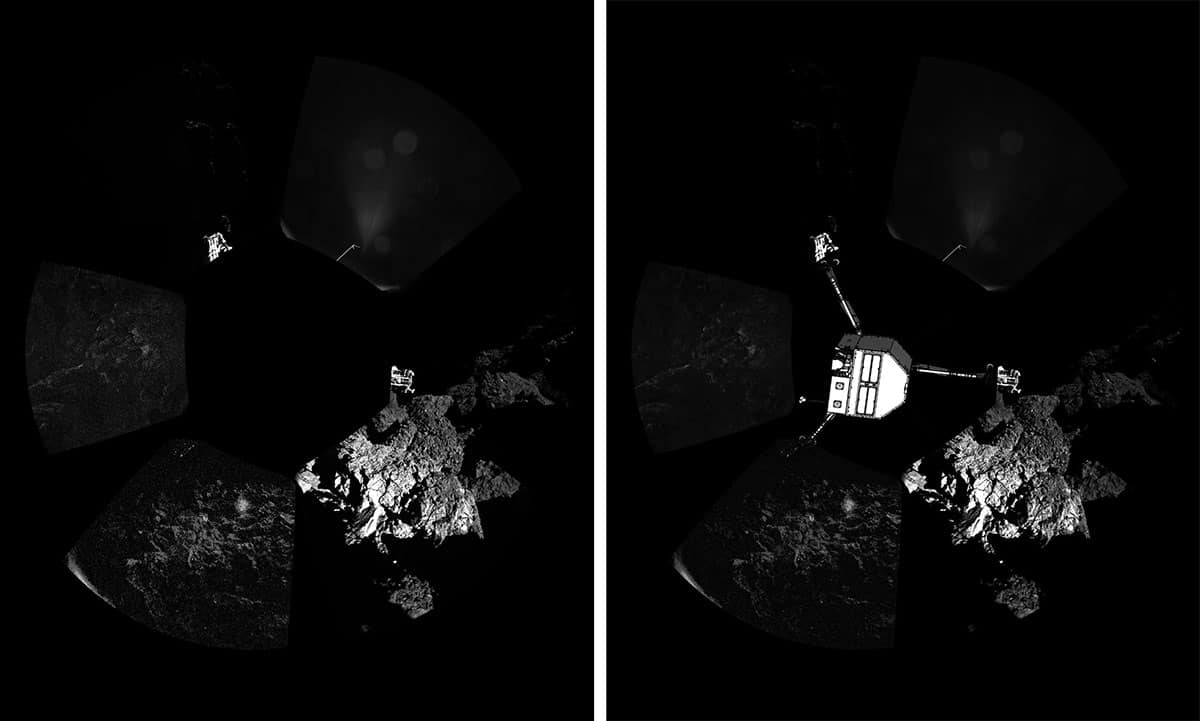
In a press briefing held today, Stephan Ulamec, who is the project manager for the lander, said that panoramic images from Philae suggest that it is on the far side of a large crater in the previously considered but ultimately rejected landing site B. According to Ulamec, this would explain the lander’s “bizarre orientation”. This location also means that Philae’s solar panels are not getting as much solar radiation as anticipated, forcing the module to run on its batteries, which should last for about 60 h. “The lander is relying on solar energy…we’re getting one and half hours of sunlight when we expected six or seven. This has an impact on our energy budget,” said Ulamec.

Although it is currently stable, Philae is not fixed to the surface because of the failure of its harpoons. Trying to “refire” the harpoons at this stage could be an even riskier business as the procedure could throw the lander back out into space.

First panoramic image from Philae

Ulamec also said that the team would have to be wary about carrying out one of its main scientific objectives – drilling into the comet to collect and analyse samples – because this could affect the lander’s stability and tip it over. Thankfully, Philae was designed to achieve this, along with its other key objectives, within its initial 60 h battery life, which will end by Saturday. Jean-Pierre Bibring, who is the chief scientist for the lander, said that studying the organic and isotopic compositions of such samples is key and that there are a few instruments at Philae’s disposal that could achieve that goal.

While Bibring was hopeful that they could get the green light to begin drilling tomorrow, he also cautioned that they “don’t want to start drilling and end the mission”, so it is more likely that the Rosetta scientists will take a chance on drilling towards the end of the 60-hour period.

Close-up image of comet surface taken by ROLIS imager

Despite the many issues that the Rosetta scientists are trying to resolve, Philae is already relaying a wealth of data. It has acquired the magnetic-field measurements of the comet and has been “sniffing” its surroundings. The image above was taken by Philae’s Rosetta Lander Imaging System when it was 40 m above the surface. The close-up shows a loose, dusty surface covered in rocks that range from millimetres to metres in size, according to Stefano Mottola from the Lander Control Centre in Cologne, Germany. He also pointed out the small fuzzy patch near the top right hand corner of the image, saying that it showed an active process on the comet with “the dust being mobilized” near the small rock. Although this initial site showed the “dirty snowball” image we have of comets, Philae’s current spot shows a rather hard, rocky surface, giving the researchers plenty to ponder on.

The next 36 hours will be absolutely crucial to Philae’s mission as the team attempts to carry out all of its main objectives, manoeuvre it out of the shadows and try get its third foot to touch the ground.

‘Anomalous weak values’ are nonclassical, and here is the proof

Last month we reported on a quirky paper in Physical Review Letters entitled “How the result of a single coin toss can turn out to be 100 heads” by Christopher Ferrie of the University of New Mexico and Joshua Combes of the Perimeter Institute for Theoretical Physics in Waterloo, Canada.

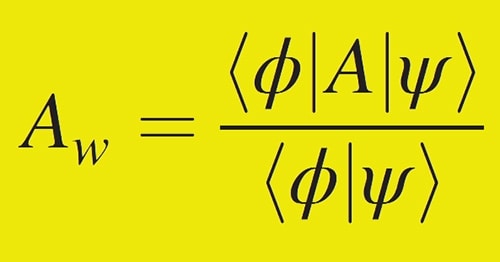
The paper addresses “anomalous weak values” in quantum mechanics, a phenomenon that was first identified in 1988 by Yakir Aharonov, Lev Vaidman and colleagues at Tel Aviv University. A weak value is the result of a weak measurement on a quantum system. This is done by making repeated gentle measurements on the quantum states of identical particles. The result of each measurement only has a tiny correlation to the quantum state of the particle so the wave function of the particle does not collapse into that state. However, by making the measurement on many particles, a weak value providing useful information about the state can be obtained.

(more…)

Secure quantum communications go the distance

A quantum protocol designed to prevent hackers from stealing secret keys has been implemented across a 200 km fibre-optic link – which is four times further than previous incarnations of the scheme. This latest implementation of the “measurement-device-independent quantum-key distribution” (MDIQKD) protocol can also transmit keys more than 500 times faster than previous set-ups.

Quantum cryptography involves two people – Alice and Bob – sharing a secret key that they can use to encode and decode messages. The key is encoded into a string of quantum particles, such as polarized photons, so that any eavesdropper – Eve – attempting to copy the key as it passes from Alice to Bob reveals her presence by virtue of the laws of quantum mechanics – which dictate that the act of measuring affects the system being measured.

While this quantum-key distribution (QKD) is completely secure in principle, imperfections in the equipment used to implement it make QKD vulnerable to hackers. In 2011, for example, physicists in Norway and Singapore showed that the single-photon detector used by Bob can be “blinded” with bright light so that it works as a classical rather than a quantum device. This allows Eve to intercept keys without Bob or Alice noticing.

Bad patches

While commercial QKD systems are now resilient to blinding – and all other weaknesses identified to date – this has involved a number of “patches”, which leave the systems vulnerable to future, unknown attacks. In the latest work, a group from the University of Science and Technology of China in Hefei led by Jian-Wei Pan and Qiang Zhang has demonstrated a QKD protocol that aims for immunity against both known and unknown threats, by taking the detector out of Bob’s hands.

Rather than Alice sending photons to Bob, both send streams of photons to an untrusted third party – who could even be Eve – to carry out a public measurement. Alice and Bob prepare their photons so that they are randomly polarized in one of four possible states – horizontally, vertically, or along one of two opposing diagonals – and Eve then measures the interference from each pair of incoming particles. If she hears a click she knows that Alice’s photon is anti-correlated with Bob’s, but she cannot know what specific states those photons are in, whereas the two senders can work out the state of their partner’s photon simply by knowing the state of their own. Alice and Bob then publically compare a fraction of their bit strings to see how many errors Eve has made – if she has made too many they know that she has been lying.

Splices and interconnectors

The MDIQKD protocol was proposed by Hoi-Kwong Lo of the University of Toronto and colleagues in 2012, and has since been demonstrated by several groups including Lo’s and Pan’s. However, these previous tests involved low transmission rates – up to 0.1 bit/s – and were carried out across just a few tens of kilometres.

Now, Pan and colleagues have upped the bit rate by more than a factor of 500 along a lab-based spooled fibre-optic cable some 200 km long. They also field-tested using a 30 km underground cable-television fibre in Hefei. This only managed 17 bit/s because of losses at cable splices and interconnectors.

To get to higher bit rates, Pan’s group increased the pulse rate of the two transmitting lasers. This was a major challenge because pulses from the two devices must remain indistinguishable, having the same pulse shape and frequency spectrum as well as arriving simultaneously. The group also increased the efficiency of its single-photon detector.

Not all is lost for hackers
Vadim Makarov, University of Waterloo

One of the members of the Singapore/Norway hacking group, Vadim Makarov, now at the University of Waterloo in Canada, believes that the latest demonstration represents an “important technological step” in the development of quantum cryptography. But he says that “not all is lost for hackers”, arguing that while eavesdroppers have been “defeated at the photon detector”, they might still be able to exploit loopholes “lurking in the photon source”.

Zhang agrees, explaining that complete security could be achieved by having Eve send pairs of entangled photons along a lossless channel to perfectly functioning detectors operated by Alice and Bob. However, he says, such high-performance devices would be very difficult to make, and argues that, in any case, photon detectors are far more vulnerable to attack than the sources are, because they must receive whatever a potential eavesdropper can throw at them. “Our scheme is less beautiful than the theoretically perfect one,” he says, “but it is more practical.”

Lower-cost option

Commercializing the scheme will involve further increasing the laser repetition rate and the detector efficiency. But Zhang argues that once a high-enough bit rate has been achieved, MDIQKD should prove ideal for building quantum networks. One important cost benefit of the scheme is that a network would only need one single-photon detector. This is the most expensive component in a QKD system, and existing commercial systems require one detector per receiving Bob.

For Makarov, however, it remains to be seen whether industry adopts the scheme. “It requires more sophisticated parts and finer engineering than today’s commercial products,” he says.

The research is published in Physical Review Letters.

Rosetta scientists land probe on comet for first time

Space scientists are celebrating after successfully landing a probe on a comet for the first time. Members of the Rosetta mission of the European Space Agency (ESA) saw its “Philae” module touch down safely on the surface of comet 67P/Churyumov–Gerasimenko at 15:35 GMT, although the signal was received at 16:03 GMT, because Rosetta’s radio signals take more than 28 minutes to reach ESA’s Space Operations Centre in Darmstadt, Germany.

The landing follows a seven-hour journey for Philae, which separated from the main Rosetta craft this morning at 08:35 GMT, while the confirmation of correct separation was received at 09:03 GMT.

Philae’s landing sequence began last night, when the team initiated a set of three critical “Go/NoGo” decisions to check the lander’s various systems and overall health. During one of the checks, it was discovered that the active descent system, which provides a thrust to prevent Philae from bouncing at the moment of touchdown, could not be activated. In a briefing earlier today, Stephan Ulamec, Philae lander manager at the DLR German Aerospace Centre, said the problem lay with the “cold-gas thruster” on top of the lander, which did not appear to be working.

As Philae touched down on the surface, its landing gear would have absorbed the force of landing, while “ice screws” in each of the probe’s three feet and a harpoon system would have have fired, locking it onto the surface. The faulty thruster was supposed to push the lander down to counteract the impulse of the harpoon in the opposite direction. But despite the potential problem at the moment of touchdown, ESA scientists decided to go ahead with the Philae launch, fully relying instead on the harpoons at touchdown – a decision that appears to have been vindicated. As the ESA operations team studied the first signal from the lander, it was unclear whether or not the harpoon fired as first thought. It later emerged that while the harpoon did fire, it is still unclear if it penetrated the ground and the team is now looking at options to “refire” it.

According to Paolo Ferri, the head of mission operations at ESA, Philae’s communication signal with Rosetta dropped before coming back online – an unexpected occurrence as it should have been a steady signal – and is continuing to do so. The Rosetta team will also be looking into this over the next few hours as they try to resolve these issues.

Up close and personal

Today’s landing is the latest success story for Rosetta scientists. In August this year, the craft drew up alongside 67P/Churyumov–Gerasimenko, becoming the first mission to rendezvous with a comet. Since then, it has come to within barely 10 km of the comet, allowing ESA staff to pick the ideal spot on which to land Philae. The chosen site, dubbed “Agilkia”, was selected on 15 September, and sits at the “head” of the comet.

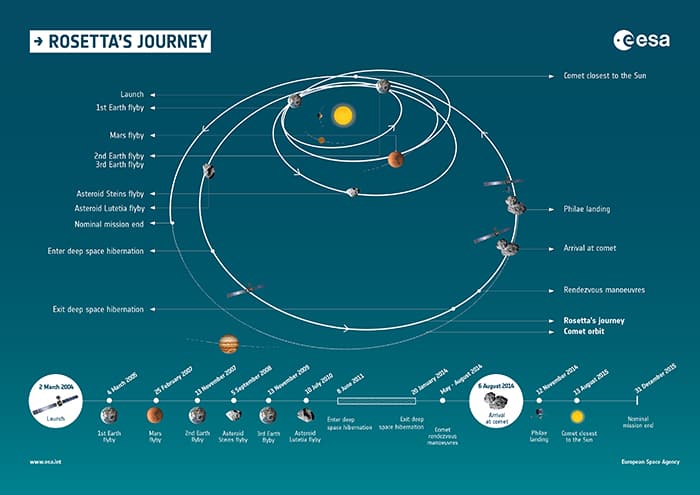
Infographic and timeline summarising the journey of Rosetta

The last three months have also seen a suite of instruments on Rosetta scrutinizing 67P. The surface temperature of the comet has been measured using its Visible and Infrared Thermal Imaging Spectrometer (VIRTIS), revealing that the surface is warmer than expected and made of dusty, porous material. VIRTIS has also detected both water and carbon dioxide in the comet’s coma, obtaining values for their relative abundance.

Using the Rosetta Orbiter Spectrometer for Ion and Neutral Analysis (ROSINA) or the “comet sniffer” on-board, scientists have also detected a variety of molecules in the coma of 67P, including water, carbon monoxide, carbon dioxide, methane, as well as trace amounts of nitrogen and sulphur. The team has even managed to ensnare a handful of grains, with its analysis having shown that at least one of them contains sodium and magnesium.

Long and winding road

First launched in 2004, Rosetta has reached its destination after making three gravity-assisted fly-bys of Earth and one of Mars. During the decade-long journey to 67P, it has also observed and studied two asteroids – Šteins and Lutetia. The craft also spent more than 31 months in hibernation from June 2011 to January 2014, during which time Rosetta was so far from the Sun that there was not enough power to keep all but a few key instruments on the craft alive. From May onwards, when Rosetta was still nearly two-million kilometres from the comet, mission scientists began to nudge it into orbit around 67P by slowly adjusting its speed and trajectories.

Comet 67P/Churyumov–Gerasimenko is currently about 511 million km from Earth (halfway between the orbits of Jupiter and Mars) and is hurtling towards the inner solar system at nearly 55,000 km/h. The comet follows a 6.5-year elliptical orbit around the Sun, and Rosetta will accompany it for more than a year of its journey, as the two swing around the Sun and back out towards Jupiter.

When does mathematics become a commercial product?

Peter Maasse describes a case of how pure mathematical research can turn into commercially available products within a relatively short period of time. The example he gives is software designed to improve the analysis of data gathered using the technique of MALDI imaging.

MALDI imaging is a relatively new form of mass spectrometry that can be used to study biological materials. One of the challenges with the technique is that it produces vast numbers of data that need to be analysed to produce meaningful information for medical professionals. Maasse, a mathematician at the University of Bremen in Germany, explains how pure maths research has led to new software that can help in this process.

Watch more from our 100 Second Science video series.

L’Aquila verdict quashed

Six of the seven scientists and engineers who were controversially found guilty of manslaughter for the role that they played in the 2009 L’Aquila earthquake have been cleared after a month-long appeal trial. However, one expert – seismic engineer Bernardo De Bernardinis, who in 2009 was deputy head of Italy’s Civil Protection Department (DPC) – remains convicted, although his six-year sentence has been reduced to two years.

The earthquake that struck L’Aquila, which is the capital of the Abruzzo region in central Italy, in the early hours of 6 April 2009 left hundreds dead and the city in ruins. A couple of months before the quake hit there was a “swarm” of regular, small quakes with maximum magnitudes of about 2.5. Then on 30 March that year, the tremors suddenly rose in magnitude to 4.1. In response, the then head of Italy’s DPC, Guido Bertolaso, ordered a meeting of the Major Risks Committee (MRC) for the following day.

Present at the MRC meeting were volcanologist Franco Barberi of the University of Rome; geophysicist Enzo Boschi of the Istituto Nazionale di Geofisica e Vulcanologia (INGV); seismic engineer Gian Michele Calvi of the University of Pavia; seismologist Claudio Eva of the University of Genova; seismic engineer Mauro Dolce, director of the DPC’s seismic risk office; seismologist Giulio Selvaggi of the INGV; and De Bernardinis. They reportedly concluded that a swarm did not increase the risk of a major earthquake, and that no action was needed.

Six days later, however, an earthquake of magnitude 6.3 struck, killing more than 300 people, injuring about 1600 and leaving some 40,000 homeless. In August 2009 a number of L’Aquila citizens filed a lawsuit against the seven MRC members who, the prosecution argued, had provided “inaccurate, incomplete and contradictory” information about the threat posed by the preceding tremors. Following a trial that lasted more than a year, in October 2013 the seven MRC members were found guilty of manslaughter and given a six-year sentence – two years longer than those requested by the prosecutor.

In a 943-page document explaining the reasoning for the conviction and the sentences, trial judge Marco Billi stated that the defendants’ “level of guilt [was] particularly high” and that this guilt is accentuated by their “conscious and uncritical” participation in a “media operation” ordered by Bertolaso.

The appeal trial began last month in the L’Aquila courtroom before a three-judge court. The judges reached their verdict yesterday, overturning the initial ruling for the six scientists and reducing the sentence for De Bernardinis from six to two years. It is likely that both verdicts will now be challenged in Italy’s Supreme Court, which may not hear the case until 2016.

“As I read it, the scientists have all been acquitted, while [De Bernardinis] who made the public statements that downplayed any risk was convicted of some counts. This seems to me to be an appropriate criminal outcome,” says Lucy Jones, who is science adviser for risk reduction at the US Geological Survey in California. “The scientists provided an analysis of the seismic hazard that was technically correct, and I see nothing that could be called criminally negligent.”

However, Jones adds that seismologists should not consider the result of the appeal as a vindication of their current procedures. “A technically correct prediction that is not used correctly is not a good prediction. We need to take responsibility for how the information is communicated,” adds Jones. “There is a lot of research going on in disaster communication that we should use to take our uncertain information and make it useful.”

Prizewinning book gives materials science a chance to shine

Materials scientist and first-time popular-science author Mark Miodownik was all smiles last night as his book Stuff Matters scooped one of the UK’s top non-fiction awards, the Royal Society Winton Prize for Science Books. The book, an engaging and often highly personal look at some of the everyday materials that make modern civilization possible, was the unanimous choice of the five-member judging panel, coming top in a strong shortlist that also included a history of general relativity, a memoir about cancer and an analysis of the role played by physicists in Nazi Germany.

Miodownik picked up his award – a rectangular prism that looked like glass but was, he informed us, actually made of acrylic – at the end of a ceremony in which he and four of the other shortlisted authors appeared on stage at the Royal Society’s London headquarters to read passages from their books. Earlier in the evening, there had been an audible buzz in the room as Miodownik read from the introduction of Stuff Matters, in which he describes how, as a teenager, he was slashed with a razor blade during an attempted mugging, and how he became obsessed with materials and their properties afterwards. (He is now a materials engineer at University College London.)

(more…)

‘Quantum reporters’ measure magnetic resonance of one proton

The positions of individual protons on a surface can be pinned down to within 0.1 nm, thanks to a new quantum technique based on nuclear magnetic resonance (NMR) developed by researchers in the US. The method, which works at room temperature, uses an effect that is usually considered a nuisance because it degrades the performance of diamond-based quantum bits (qubits). The researchers say that the technique could be used to study individual proteins or even spins in a superconductor.

At the heart of the new method are crystal defects that occur in diamond when two adjacent carbon atoms are replaced by a nitrogen atom and a vacant site. These “nitrogen-vacancy” (NV) centres have an electronic spin that is very well isolated from its surroundings, which means that they could play a key role in future quantum computers. And because an NV centre can emit just a single photon if excited by a laser, quantum information could be stored for long times in this kind of defect before being read out as a photon.

Bling NMR

While NV centres that lie deep within a diamond are well-isolated, those within a few nanometres of the surface interact strongly with electron spins on the surface. Such centres would not, therefore, be used to make a quantum computer, but physicists have used them to study the properties of electrons on the surface of diamond. Two independent groups have also used NV centres to do NMR studies of molecules on the surface of diamond (see “Diamond downsizes classical MRI and NMR”).

Now, Alex Sushkov and colleagues at Harvard University have developed a new NMR technique that uses the surface electrons as “quantum reporters” to measure the positions of individual protons on the surface of diamond.

In the future we hope that it will be useful for gathering structural information for biomolecules, such as proteins
Alex Sushkov, Harvard University

The first step involves mapping the locations of surface spins that are within a few nanometres of a NV centre, by applying a magnetic field to the diamond and then firing a sequence of radio-frequency pulses (RF) at the sample. Known as double electron–electron resonance (DEER), this is an established technique used to measure the distance between electrons in a molecule. Information is extracted from the system by measuring the final spin state of the NV centre by observing the fluorescent light it emits. By repeating the measurement with the magnetic field in different directions, the team can map the locations of the surface spins nearest to the NV centre (see figure above).

Spin echoes

In an experiment reported in Physical Review Letters, the team was able to locate four surface spins that were within several nanometres of an NV centre, which itself was about 3 nm below the diamond’s surface. The team then focused its efforts on the spin nearest to the NV centre. Using an applied magnetic field and a different sequence of RF pulses, the researchers were able to make a “spin-echo” measurement of the magnetic field near that single “reporter” spin. This measurement is affected by the presence of the nuclear magnetic moments of nearby protons that happen to be stuck to the diamond surface. Two protons were seen to be near to the reporter spin and, by careful analysis of the spin-echo data, the team was able to determine the locations of the protons to within 0.1 nm. This distance is on a par with the spacing between atoms in molecules and solids.

An important practical feature of the technique is that it is sensitive to protons on the surface of diamond, which means that a range of molecules could, in principle, be studied by simply depositing them on diamond. “We are currently working on applying this technique to magnetic structural imaging of simple molecules,” says Sushkov. “In the future, we hope that it will be useful for gathering structural information for biomolecules, such as proteins, that cannot be studied with other techniques.” Sushkov also believes that it could also be possible to use quantum reporters to make time-resolved measurements, which would allow some chemical reactions to be monitored.

With further development, reporter spins could be used to make localized magnetic measurements in solid materials, such as superconductors and topological insulators.

Blockbuster physics, bowling balls and feathers in a vacuum, and more

By Tushna Commissariat

The results of a successful scientific experiment can make scientists very happy. Indeed, in the clip above, taken from the BBC TV series Human Universe, one scientist exclaims “holy mackarel!” when he sees the outcome he was hoping for. In the video, everybody’s favourite physicist Brian Cox carries out an experiment similar to Galileo’s Leaning Tower of Pisa experiment, where he tested that no matter the mass of objects, they fall at the same rate under gravity. In the video above, Cox drops a bunch of feathers and a bowling ball in the world’s biggest vacuum chamber – the Space Simulation Vacuum Chamber at NASA’s Space Power Facility in Ohio, US. In the slow-motion video, you can see with exquisite clarity just how accurate Galileo’s prediction was, as the feathers and ball land at precisely the same time. We came across this video on the Dot Physics blog on the Wired Science network, written by physicist Rhett Allain, where he has worked out some of the maths and pointed out some of the nuances of the above experiment, so make sure you take a look.

(more…)

Copyright © 2026 by IOP Publishing Ltd and individual contributors