Between the lines

Conceptual image of a person’s face and a brain swirling with ideas

Science comes full circle

The belief that scientific disciplines exist on a spectrum of “purity”, with physics and maths at one end and psychology and philosophy at the other, is fairly widespread – especially, it must be said, among physicists and mathematicians. But there is also an alternative view, one that treats science not as a linear spectrum, but as a loop in which the deepest problems in physics turn out to have philosophical roots, and vice versa. This second view is elegantly illustrated in At the Edge of Uncertainty: 11 Discoveries Taking Science by Surprise, which begins with a chapter on philosophy’s most physical problem – human consciousness – and concludes with one on the most philosophical question in physics: the nature of time. In the intervening chapters, author Michael Brooks writes about surprising discoveries in genetics, cosmology and many other fields with the same clarity and verve that made his earlier book in the “unsolved questions” genre, 13 Things That Don’t Make Sense, a bestseller back in 2009. Answers to some of the questions in At the Edge of Uncertainty may be closer than others. In the chapter on human consciousness, Brooks writes that “psychologists and neurologists are, in many ways, like Darwin aboard the Beagle, still gathering specimens and making observations”. On the other hand, he suggests that the Big Bang model of cosmology – or, as he disparagingly calls it, “Big Bang plus inflation plus dark matter plus dark energy” – could collapse under the weight of successive “fixes” in less than 10 years. It’s worth noting that Brooks’ paradigm-shift-o-meter has been faulty before: one of the 13 “nonsensical” things in his earlier book, the so-called “Pioneer anomaly”, has since been explained without the need for a new theory of gravitation. But when you write about cutting-edge science, a few incorrect predictions are probably inevitable – and when you do it as well as Brooks does, they’re forgivable, too.

  • 2014 Profile Books £12.99pb

From the horse’s mouth

When writing about quantum physics for a general audience, most authors still focus on the events and ideas of the 1920s and 1930s, when the likes of Niels Bohr and Werner Heisenberg brought forth a new physics base of ideas about uncertainty and wave-particle duality. By comparison, popular-level explanations of the “second quantum revolution”, which began in the 1960s with John Bell’s work on nonlocality, are often somewhat cursory. Not so for Quantum Chance: Nonlocality, Teleportation and Other Quantum Marvels. Written by Nicolas Gisin, a physicist at the University of Geneva, Switzerland, and a prominent figure in this ongoing second revolution, the book contains few equations. At just over 100 pages, it is also rather short. But brevity and mathematical simplicity can be deceiving, and this is definitely not a book for absolute neophytes. Indeed, even experienced physicists may find that certain passages (such as Gisin’s initial description of why, in the absence of nonlocal interactions, Alice and Bob cannot win a Bell-inspired “game” more than a certain fraction of the time) do not sink in on a first reading, or even a second. However, those who want to deepen their prior understanding of quantum entanglement, cryptography or teleportation should stick with it. For topics as complex and important as these, the rewards of even a limited increase in understanding are significant.

  • 2014 Springer £15.00/$19.99pb 109pp

Cthulhu cosmology, Halloween outfits with a physics twist and more


It’s not often that classical physics and Post-Impressionist painters collide, but when they do the results can be enchanting and intriguing. In one of the latest TEDEd videos, Natalya St Clair has created a short lesson that looks at “The unexpected math behind Van Gogh’s Starry Night.” The video above looks at the enduring mystery that is the turbulence we see in any kind of flows in the natural world and how the human brain can recognize and actually make some kind of sense of the chaotic random patterns turbulence describes.

As pointed out in the video, famous physicists such as Richard Feynman and Werner Heisenberg have noted the complexity of turbulence, with Feynman describing it as “the most important unsolved problem of classical physics” and Heisenberg saying that “when I meet God, I am going to ask him two questions: why relativity? And why turbulence? I really believe he will have an answer for the first”. But is it possible that the undoubted genius and troubled painter that was Van Gogh perceived something more about turbulence in nature and is this most clearly represented in his most famous masterpiece – the evocative painting known as Starry Night? Watch the video to find out.

(more…)

Planet-forming stream found in binary star system

Astronomers using the ALMA array of radio telescopes in Chile are the first to see a streamer of gas and dust flowing towards a single star in a binary system. This material is crucial for sustaining the formation of planets, and the observation could explain how planets can form around single stars in a binary system – something that had puzzled astronomers. This has important implications for astronomers studying planets outside of the solar system, because almost half of the Sun-like stars that we know of were formed in binary systems.

Astronomers have so far discovered more than 1800 planets orbiting stars other than the Sun. One striking thing about these exosolar planets – or exoplanets – is that they exist in a variety of systems, many of which are very different to our own solar system and include binary star systems. Sometimes planets in binary systems orbit both stars, and follow large “circumbinary” orbits. In other cases, planets will orbit tightly around one of the stars in a binary system.

Creation mystery

It is this latter case that has puzzled astronomers, because it is not clear how such planets could form. The mystery is illustrated nicely by the subject of this latest study: a young system called GG Tau A that is 450 light-years away, and actually comprises three stars. Two of the stars orbit each other tightly, and a third star is some distance away. As a result, the third star (called GG Tau Aa) can essentially be thought of as one half of a binary system.

The system is surrounded by a large outer disc of dust and gas that orbits all three of the stars. One of its stars – GG Tau Aa – is also surrounded by its own compact inner disc of dust and gas, with a total mass on par with that of Jupiter. There is very little dust and gas in the large gap between the inner disc and outer disc, because the competing gravitational forces of the stars prevent matter from accumulating in this intermediate region.

Vanishing trick

The inner disc of GG Tau Aa has enough material to form planets, but its existence has puzzled astronomers. The problem is that matter is falling into the star at a very high rate, and therefore the disc should have vanished long ago. One possibility is that gas and dust is streaming in from the outer disc   something that has been predicted by computer simulation, but not yet seen. But now, Anne Dutrey and colleagues at the University of Bordeaux, along with astronomers in Mexico, the US, France and Taiwan, have used ALMA to discover such a stream of gas and dust flowing from the outer disc, and into the inner disc around GG Tau Aa.

“These observations demonstrate that material from the outer disc can sustain the inner disc for a long time,” explains Dutrey. “This has major consequences for potential planet formation.” Indeed, she points out that an Earth-like planet could form within the habitable zone of GG Tau Aa – the region in which life could develop on such a planet. However, Dutrey cautions that the study does not allow the team to conclude that a planet will form around GG Tau Aa, but rather that there is enough material for this to happen.

Common sight

If this streaming process occurs in other star systems, it could mean that planets are a common sight around single stars in binary systems. Team member Emmanuel Di Folco of the University of Bordeaux explains why this is exciting: “Almost half the Sun-like stars were born in binary systems. This means that we have found a mechanism to sustain planet formation that applies to a significant number of stars in the Milky Way.”

The discovery is described in Nature.

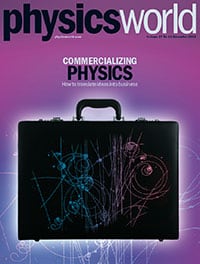
Commercializing physics: how to translate ideas into business

Some physicists can get a bit grumpy if talk turns to the supposedly dirty business of commercialization. They go into physics out of curiosity alone and have an innate dislike of ever having to justify their resarch in terms of potential spin-off benefits. But they can be thankful for the overall health and vitality of physics that some brave souls do risk their money and careers by setting up businesses to commercialize their findings.

The November 2014 issue of Physics World magazine gives a taste of some of the challenges in commercializing physics, as I describe with my colleague Margaret Harris in the video above. We kick off with one common problem for hi-tech start-ups, which is how to bridge the “valley of death” – in other words, what to do when your research funding has dried up but you’re not yet making any money from your product. Jesko von Windheim then examines why physics-based firms have a harder job than ordinary businesses, where succeeding is simply about finding a market and meeting its need, before we look back at some promising technologies tackled in Physics World’s Innovation column to see how they’ve fared. There are also some real-life lessons from Floor van de Pavert — a physicist who’s been at the business coal face — and we see how crowdfunding websites can help researchers get their ideas off the ground.

We’ve also been doing some innovation of your own and if you’re a member of the Institute of Physics (IOP), you can now enjoy immediate access to the new issue with the digital edition of the magazine. If you’re not yet in the IOP, you can join now to get full access to Physics World as well as many other member benefits.

PWNov14cover-200

For the record, here’s a run-down of other highlights of the November issue.

Blue LED research wins Nobel prize – Catch up with the 2014 prize to Isamu Akasaki, Hiroshi Amano and Shuji Nakamura for developing efficient blue light-emitting diodes.

Lost in translation – Asking physicists to tailor their research to deliver specific “impacts” has the potential to distort the scientific method, warns Philip Moriarty.

From hype to hope – Graphene promises a whole host of commercial applications, but Norman Apsley says that business and physics will have to work together to make it happen.

Bell’s theorem still tolls – The famous proof of entanglement by John Bell is half
a century old. Robert P Crease recalls the strange story of its origin and history.

Navigating the valley of death – Taking an innovation from the lab to the market is hard in any discipline, but physics start-ups face some unique challenges crossing the so-called “valley of death”. James Dacey speaks to scientists and business professionals in the Boston area of the US who have dared to take on this journey.

More push than pull – Meeting the demands of the market is usually vital to any new business. But as Jesko von Windheim explains, tech-based firms have it much harder as there might not yet be a market pull for the technology they are trying to push.

• Whatever happened to..? – Each month, Physics World covers commercially relevant breakthroughs in its Innovation column. Tushna Commissariat and Louise Mayor checked in with the physicists behind some of the most interesting and promising innovations we have featured over the years, to find out how they fared.

• The rocky road to success – Doing science involves complex experiments with uncertain outcomes, and starting a company based on innovations from the lab is no different. Floor van de Pavert shares some of the lessons she learned from co-founding her first spin-off company.

• A little help from the crowd – Whether they need start-up capital to fund an innovation or some novel research, physicists the world over are turning to crowdfunding websites to support their next projects, as Jon Cartwright reports.

A lucky, lonely planetDuncan Forgan reviews Lucky Planet: Why Earth is Exceptional – and What That Means for Life in the Universe by David Waltham.

3000 years of questionsJohn Singleton reviews Faith and Wisdom in Science by Tom McLeish.

The view from the VC side – With a PhD in theoretical physics and more than a decade of experience in the investment world, venture capitalist Alexei Andreev has seen his share of innovation successes and failures.

Once a physicist – Meet Jennifer (Jenny) Rollo, a systems biologist who studies Alzheimer’s disease at the University of Sydney, Australia.

E-mail economics – In this month’s Lateral Thoughts column, Michael Hipkins wonders how to stem the deluge of e-mails we all receive each day.

Plasmons convert light into a voltage

Photograph of Caltech's Harry Atwater

A new way of creating a voltage by shining light on a solid has been developed by researchers in the US and Europe. Unlike most photovoltaic devices, the new system does not rely on semiconductors but rather on surface plasmons in tiny metal nanostructures. The team is now working to create new types of devices that convert light into electrical energy.

Surface plasmons are collective excitations of electrons at the surface of a metal that interact very strongly with light. As a result, plasmons are of great technological interest as an interface between photonics and electronics. This interaction is strongest at the plasmon-resonance frequency, which is defined by the size and shape of an object and its charge density. In 2009 Paul Mulvaney and colleagues at the University of Melbourne in Australia applied an electrical potential to gold nanoparticles, and found that they could tune the plasmon-resonance frequency by injecting or removing electrons.

Sweeping laser

In the new work, applied physicist Harry Atwater and colleagues at California Institute of Technology, together with researchers in the Netherlands, show that the reverse can also occur: a surface potential can be induced by using light to modify the charge density of a nanoparticle. The team made its plasmonic material by attaching gold nanorods with a plasmon-resonance wavelength of 550 nm to an indium-tin-oxide substrate. Then the researchers fired a tuneable laser at the structure, and swept the laser wavelength from 480 nm to 650 nm. During illumination, the electric potential on the surface of the material was monitored using the conductive tip of an atomic force microscope.

When the laser was on resonance with the surface plasmon, no voltage was induced. Irradiation either side of the resonant frequency, however, did produce a voltage. When the wavelength was below 550 nm a negative potential was measured on the gold nanorods, while longer-wavelength light created a positive potential. The team found that the magnitude of the potential related to the rate at which the light absorbance changed with respect to the frequency of the light. The largest potential (which was negative) was produced by illumination at 500 nm. Atwater offers a thermodynamic explanation for this observation: “If you shine light on the structure, free-energy minimization will cause the structure to try to adjust its charge density to bring itself into resonance with the exciting light.” The researchers have dubbed this phenomenon the plasmoelectric effect.

Successful model

The team then used this model to predict the frequency at which the maximum potentials should be generated in its set-up, and found broad agreement with its experimental results. The researchers also checked that the model could be applied generally, by testing it in a different type of plasmonic material: a thin gold sheet studded with a periodic pattern of 10 μm holes mounted on a glass substrate. This too showed a plasmoelectric effect, with the peak negative and positive potentials as predicted by the model.

While the devices reported by the team simply produce a potential difference when illuminated, the team is now working on a device that will deliver usable electrical energy and thereby function as a solar cell. Atwater believes that such a device could complement traditional semiconductor photovoltaic cells: “Any given single-material solar cell can only convert power from photons that have energy greater than the band-gap energy,” he says, “[Our device] could potentially be used behind a conventional photovoltaic cell to harvest the infrared part of the spectrum, because I can design a plasmonic structure to have a resonance at pretty much any frequency.”

Fascinating physics

Nano-optics specialist Thomas Ebbesen of the University of Strasbourg, says: “I find it to be very impressive work. If something like this could become efficient as an energy conversion process that would of course be technologically important. But independent of that, I find the underlying physics very interesting just from a thermodynamic point of view.”

Ortwin Hess of Imperial College London is also impressed, and wants to know more: “Thermodynamics seems to be supporting their experimental and simulation work, and I’m really happy about that,” he says. “Nevertheless, from the microscopic perspective, plasmons are made up of electrons, and in the end I would like to see how that works.” The researchers are working on this question, and Atwater says there will be “a forthcoming theory paper in the near future”.

The research is published in Science.

Can the electron wave function be trapped and divided?

Every once in a while we come across a physics story that seems very interesting – but we just don’t know what to make of it. The latest comes in the form of a press release from Brown University in the US and concerns “electron bubbles” in liquid helium.

These bubbles are about 4 nm in diameter and are formed when a free electron moves through liquid helium and repels surrounding atoms. Physicists have been studying these bubbles for decades and in the 1960s they discovered something very strange when firing electrons across a tank of liquid helium and measuring the time it takes the bubbles to reach a detector on the other side.

(more…)

Stalin’s scientists

Although much has been written about the history of Soviet science, in the Western imagination the topic remains opaque, remote and (most importantly) hemmed in by a simplistic dichotomy of good versus evil. Beyond a few touchstones, such as the episode when Stalin’s fondness for the theories of Trofim Lysenko almost destroyed the burgeoning field of genetics, and the Soviet “theft” of the atomic bomb, most Western laypeople have few points of reference to Soviet science. In his emotionally resonant book Buried Glory, Istvan Hargittai, a well-known Hungarian chemist and prolific writer of popular books on science, adds depth to this picture by bringing to light the biographies of more than a dozen Soviet scientists.

Hargittai describes these men (and the scientists he has chosen are all men) as “heroes” – a word that suggests that his narrative will hew to the archetype of the noble scientist struggling against the oppression of the Soviet state. To his credit, however, Hargittai’s complex and often moving biographies of these scientists eschew a hagiographical approach. His stated goal for the book is to humanize the lives of “a select set of Soviet scientists”, and in this he succeeds. A more ambitious objective, to communicate “what it meant to be creating in science under Soviet conditions”, falters slightly, but only because Hargittai focuses on a few elites in lieu of the many thousands who undoubtedly experienced life differently from the famous personalities of this book.

The principal theme of the book – one that is implicit within the individual biographies, but never articulated as such – is the relationship between scientist and state. Through sequential chapters, each typically dedicated to a single person, Hargittai ably weaves together a longer narrative about the ways in which Soviet scientists negotiated their relationship with a repressive state apparatus. Many, including the condensed-matter physicist Peter Kapitza, resisted. Some, like Yulii Khariton, came to a rapprochement of sorts, while others avoided controversy at all costs (Yakov Zel’dovich, for example). As Hargittai shows, the latter approach was very difficult given the enormous importance the Bolsheviks placed on science as a tool of nation-building. To be a scientist, especially one with membership in the hallowed halls of the Academy of Sciences, was to be one of the chosen elite. But the benefits (and there were many material ones) of such an honour were often outweighed by the increased visibility it bestowed. As Hargittai notes, “there was no branch of science where scientists were immune to persecutions”, and this is true not only of the elites but also of several generations of mid-level scientists and engineers.

All of the men profiled here did their primary research in nuclear physics, low-temperature physics or chemistry. Some of their names will be familiar to physicists and chemists in the West: Kapitza, Lev Landau, Nikolai Semenov and Igor Tamm, for example. Most strikingly, almost all of them were involved with the Soviet atomic-bomb programme (and later with the development of thermonuclear weapons) in some way. Echoing the claim made in David Holloway’s magisterial Stalin and the Bomb (1994, Yale University Press), Hargittai shows that working on the bomb frequently insulated top physicists from persecution. Going further, he also demonstrates that this made it possible for them to engender limited forms of democratic activity, especially within the inner workings of the Academy of Sciences, suggesting that scientists were able to cultivate a modest “democratic” culture that was at odds with the larger imperatives of the Communist Party structure. This is not a new notion, however, as other historians of Soviet science (including Alexei Kojev-nikov, Ethan Pollock and Nikolai Krementsov) have also explored the spaces within which Soviet scientists operated and found surprising agency in particular cases, for example in promoting their own careers.

An important thread running through the narrative is one of identity. Many of the men who appear in the book were Jewish, exemplifying the proportionally large number of Russian Jews who were members of the post-revolutionary Intelligentsia, and especially the scientific and technical Intelligentsia. Scientists such as Zel’dovich, the main theoretical physicist behind the Soviet atomic-bomb project, and Khariton, a kind of counterpart to Robert Oppenheimer on the Soviet side, faced many hurdles because of their religious identity. Hargittai also highlights several instances where lesser lights faced severe discrimination as Jews, especially during the late Stalin years when Jewishness was identified with the “evils” of international “cosmopolitanism”. The conundrum, of course, is that many Jewish scientists and engineers (such as the space designer Boris Chertok, who the Russian press have recently been identifying as the “patriarch” of Soviet cosmonautics) remained in high positions throughout the Soviet times, making this part of Hargittai’s story more complicated than simply one of unbridled antisemitism. Soviet industrial managers were often quite willing to suspend their deep prejudices in the service of larger national goals, especially if these goals were related to security.

Perhaps the most well-known scientist in the volume is Andrei Sakharov, a leading light in the Soviet hydrogen-bomb programme who faced enormous adversity in maintaining his commitment to freedom from oppression. Much has been written about him, and Hargittai synthesizes this extant literature, ably reconstructing Sakharov’s evolution from devoted scientist to human-rights activist. Sakharov’s story is interesting not only because it highlights all of the contradictions of Soviet science – brilliant achievements despite (or perhaps because of) a draconian system – but also because his activities were a barometer for how other leading scientists saw their own place within the Soviet system. The infamous 1973 letter signed by 40 Soviet scientists denouncing Sakharov’s actions appears in Hargittai’s narrative as a polarizing milestone that pitted colleague against colleague. Among Westerners, Sakharov has often served as a kind of blank slate upon which to impose binary expectations of the lone hero versus all-encompassing evils of Communism, but historians of Soviet science have shown that such formulations are simplistic at best and misleading at worst. Echoing this earlier work, Hargittai’s book underscores that, despite their reservations about many of the ills of the Soviet regime, most of the scientists profiled here remained genuinely committed to its improvement, not its destruction.

Hargittai’s writing is leavened by a personal touch (he often knew the men in question) that makes Buried Glory eminently readable. The science is rendered in clear language, rarely obfuscated by jargon. The biographies are not simply chronologies of data but rather fully formed representations of the lives of these extraordinary men. There is a hint of tragedy about their lives, with incarcerations, disrupted family lives, “disappeared” relatives, dismissals, exiles and so on, but the tone is one of individuals driven to succeed and animated by the possibilities opened up by modern science. There is no definitive answer on the principal conundrum of whether Soviet science flourished despite the system or because of it, but Hargittai’s work is a worthy popular addition to the literature in English on this rather overlooked topic.

  • 2013 Oxford University Press £22.99/$35.00hb 368pp

Web life: Particle Clicker

So what is the site about?

Particle Clicker is a game that lets players run their own simulated particle-physics experiment. It was created at CERN earlier this year during a 48-hour “hackathon” in which teams of students competed to develop the best computing projects, and it is both simple and addictive. Visitors to the website are greeted with a stylized image of a particle detector. When you click on the detector, it lights up as simulated collisions send showers of particles across the screen. Creating such collisions increases your stockpile of data – something you’ll need in copious amounts if you want to turn your modest collider experiment into a world-leading collaboration.

Is that all you need to do?

Not at all. Clicking over and over again like a demented lab rat will send your data count spiralling upwards, and in the game’s early stages this is the only way you can make progress. But just as in real life, the big bosses in this game (that’s you) don’t have to do their own grunt work for long. Once you’ve made your first scientific discovery (a couple of dozen clicks should get you there), your reputation grows and the grant money starts trickling in. Before long, you’re rich enough to hire your very own PhD students to do the clicking for you. From there, it’s onwards and upwards as you and your growing army of minions work to amass the data, reputation and funding you need to advance the cause of particle physics to unheralded levels of procrasti–er, glory.

Anything else I should know about?

Having an army of PhD students, postdocs and even – gasp! – summer students beavering away on your behalf is fine as far as it goes, but they will work a lot more efficiently if you spend some of your hard-won funding on technical upgrades. Improvements to efficiency and accelerator luminosity will give you more data per click, and bestowing some tongue-in-cheek perks on your workforce (free beer for the PhD students, extra coffee for the postdocs) will make them more productive, too. You can also choose to spend money on public relations, which boosts your reputation and how fast you win funding.

Why you should visit…

Particle Clicker’s developers have made a decent effort to build some science into the game. As well as the information boxes that pop up when you make a new discovery, the gameplay itself parallels the real scientific process in a number of ways. For example, the quantity of data required to make new discoveries increases over time – a fair reflection of the extremely data-intensive nature of modern particle physics. Also, once you have made a discovery, you can choose to investigate it further and thereby boost your reputation. However, each time you do this, the amount of data you need to amass in order to achieve the same reputation boost goes up. This, again, seems realistic: discovering charge–parity (CP) violation led to James Cronin and Val Fitch winning a Nobel Prize for Physics in 1980, but making an equally groundbreaking discovery today about this (now relatively well understood) phenomenon would require a prodigious amount of research.

…and why maybe you shouldn’t

In its early stages, the game is seriously addictive, with scientific discoveries and upgrades appearing thick and fast. After an hour or two, though, it slows to a crawl as hiring new people and performing new experiments becomes prohibitively expensive. After this point, there’s not a great deal you can do except wait around for the Higgs boson to show up, which seems a trifle anticlimactic. But given how much time Particle Clicker can eat up, perhaps a built-in taper is not such a bad thing.

Superconductor finally goes with the FFLO

A long-sought-after phenomenon that allows superconductivity to survive even in very strong magnetic fields has been seen for the first time by an international team of physicists. The “FFLO” phase of superconductivity involves the formation of exotic quantum entities known as Andreev bound states. As well as providing further insight into superconductivity, the discovery could also further our understanding of particle physics and neutron stars, and even lead to better magnetic resonance imaging (MRI) systems.

Superconductivity and magnetism are usually sworn enemies. Superconductors will expel weak magnetic fields that would pass straight through a normal conductor, while a strong enough magnetic field will destroy superconductivity.

Conventional superconductivity occurs when vibrations in a crystal lattice allow electrons to bind together to form Cooper pairs that can flow through the lattice without resistance. The electrons in each pair have opposite values of spin angular momentum – one having spin-up while the other has spin-down. However a strong magnetic field will flip the spins of some electrons, upsetting the balance of up and down spins and so destroying the Cooper pairs and the superconductivity itself.

Mismatched electron pairs

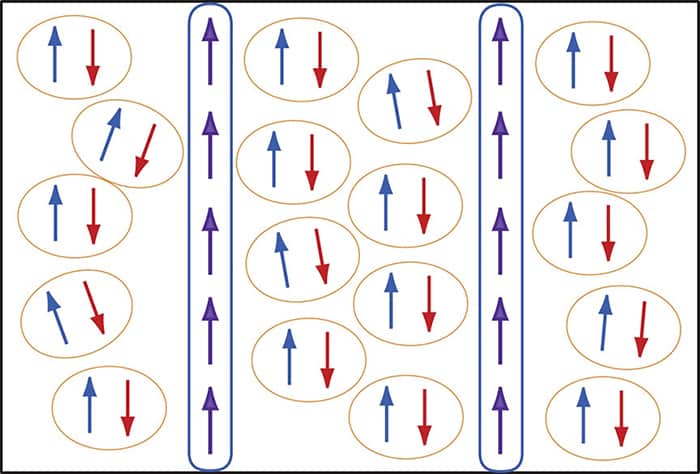
However, in 1964 two pairs of physicists – Peter Fulde and Richard Ferrell, alongside Anatoly Larkin and Yuri Ovchinnikov – predicted that certain materials ought to superconduct, even in the presence of very strong magnetic fields. This “FFLO” state would occur as a result of mismatched electron pairs – having a finite rather than zero net angular momentum – gathering together in bands across the material, outside of which superconducting currents could still flow (see figure “Go with the FFLO: mismatched electrons”).

In the last 50 years many groups have tried to test this idea experimentally, and some have found indirect evidence for FFLO – mainly by measuring macroscopic properties of superconductors to create detailed phase diagrams of the materials. Rolf Lortz of the Hong Kong University of Science and Technology and colleagues, for example, identified a new phase between the superconducting and normal conducting phases in the organic compound κ-(BEDT-TTF)2Cu(NCS)2, which they interpreted to be FFLO and which, they found, pushed the magnetic limit for superconductivity up from 21 T to nearly 30 T.

Diagram showing the FFLO state of superconductivity

In the latest work, Vesna Mitrović of Brown University in the US, and colleagues from Japan and the French National High Magnetic Field Laboratory (LNCMI) in Grenoble, have instead found evidence for FFLO at the microscopic scale. Their research explores the energy spectrum of a superconductor’s unpaired electrons, which have a higher energy than the paired variety. This energy gap has a single value throughout a conventional superconductor, but is predicted to vary from one region to another inside a material in the FFLO phase.

Superconducting quasiparticles

Mitrović and co-workers looked for regions within very thin sheets of κ-(BEDT-TTF)2Cu(NCS)2 where the energy gap goes to zero. These are regions where paired and unpaired electrons have the same energy, and where it is therefore energetically possible for unpaired electrons to exist. These unpaired electrons are best thought of as “quasiparticles”, which exist in complicated quantum superpositions with everything around them, and, unlike normal electrons, can superconduct. Specifically, the researchers looked for quasiparticles known as Andreev bound states, which resemble normal electrons whose spins point in the direction of an applied magnetic field.

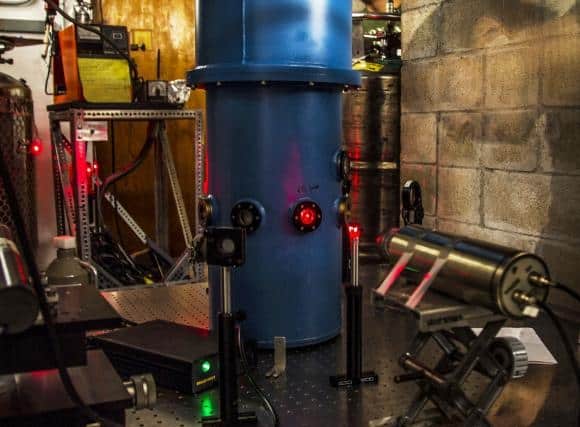
The experiment was carried out at the LNCMI, where nuclear magnetic resonance (NMR) was used to confirm two expected properties of Andreev bound states – and therefore the presence of the FFLO phase. The first, and most important, involved measuring the time that it took for electrons to flip their spin when exposed to powerful magnetic fields, a characteristic that reflects the energy spectrum of electrons across the sample. The second property required measuring the distribution of spins within the material.

“Other groups have carried out impressive and important work, showing that in a high magnetic field you go into a new state,” says Mitrović. “But they could not tell what this state looked like. The purpose of our experiment was to look, and what we see is actually quite striking.” She adds that the work might prove to be important outside of condensed-matter physics, because it could help particle physicists to identify a form of superconductivity that involves quarks with unbalanced flavour, and in astrophysics might explain how neutron stars can exhibit superconductivity while at the same time generating enormous magnetic fields.

Better MRI systems

Lortz says that the research provides “important information of a different kind” to that obtained by his group. He adds that, in principle, it could lead to the creation of more powerful superconducting magnets for MRI systems because the superconducting state persists to higher fields. While κ-(BEDT-TTF)2Cu(NCS)2 is not suitable for making magnets, Lortz adds that the FFLO phase might be observed in more appropriate materials in the future.

Ted Forgan of the University of Birmingham, who has looked for FFLO in the superconductor CeCoIn5, says that the results look “pretty convincing”. But he points out that NMR, while providing microscopic data, does not show spatial variation directly. “Maybe high-field scanning tunnelling microscopy or spectroscopy could show a spatially modulated state,” he says.

The research is described in Nature Physics.

Graphene boosts thermal conductivity of popular plastic

A graphene coating has been used to boost thermal conductivity of the common plastic polyethylene terephthalate (PET) by up to 600 times. This new result from an international team of physicists and engineers could substantially increase the use of PET and other plastics in technologies such as solid-state lighting and electronic chips, where the ability to conduct heat is essential.

PET is a widely used plastic that will be familiar to anyone who has bought a bottle of water or soft drink. It is low-cost, strong, durable and recyclable, and it can be moulded into just about any shape. Fibres of the plastic are also used to make fabrics such as polar fleece. While PET’s low thermal conductivity makes it ideal for warm clothing, its inability to transfer large amounts of heat precludes its use in electronics and other devices where getting rid of heat is important.

Graphene is a sheet of carbon just one atom thick, and has an exceptionally high thermal conductivity of about 2000–5000 W/mK near room temperature – compared with about 0.2 W/mK for PET. Graphene’s thermal conductivity will drop when it is placed on a substrate, because heat-carrying lattice vibrations are scattered by interactions with the substrate. However, the thermal conduction of the graphene layer will still remain high, relative to most other materials.

Graphene flakes

Now a team led by Alexander Balandin at the University of California, Riverside and Konstantin Novoselov at the University of Manchester has used graphene flakes to create films just a few microns thick onto a thin PET substrate. The researchers then showed that the presence of the graphene gives the composite material a much greater thermal conductivity than PET alone.

The researchers used a non-contact optothermal Raman technique for their thermal measurements. In this method, the micro-Raman spectrometer is used as a sort of thermometer to measure temperature changes in the sample, and the laser that performs the Raman measurements is also used to heat the sample. The technique was developed in Balandin’s lab, where it was used to discover the exceptionally high thermal conductivity of graphene in 2008 (see “Graphene continues to amaze”).

Team member Hoda Malekpour, a PhD student in Balandin’s group, was responsible for making Raman measurements. Balandin explains: “Our results reveal that the thermal conductivity of PET increases by up to 600 times when it is coated with the graphene laminate films.” This gives the laminates a similar thermal conductivity to metals such as iron and lead, approaching that of silicon.

Drastic improvement

Balandin adds: “The thermal conductivity of PET on its own is very low – in the 0.15–0.24 W/mK range at room temperature – and other plastic materials are also poor conductors of heat. This drawback prevents plastics from being employed in many applications that could benefit from their low cost, durability and light weight. Our work proves that a few micron-thick graphene layers deposited on plastic films can drastically improve the way they conduct heat, and so now make such applications possible.”

The team, which includes scientists from Riverside, Manchester, Bluestone Global Tech in New York and Moldova State University, used a fairly simple theoretical model in this work to explain how the thermal conductivity of graphene laminates depends on graphene flake size and impurity concentrations. “We would now like to develop a more detailed model based on multi-scale simulations of heat transport in grapheme, to optimize its use as a coating material in thermal management applications,” says Balandin.

The research is described in Nano Letters.

Copyright © 2026 by IOP Publishing Ltd and individual contributors