When waiting for 10 years is just too long

By Matin Durrani

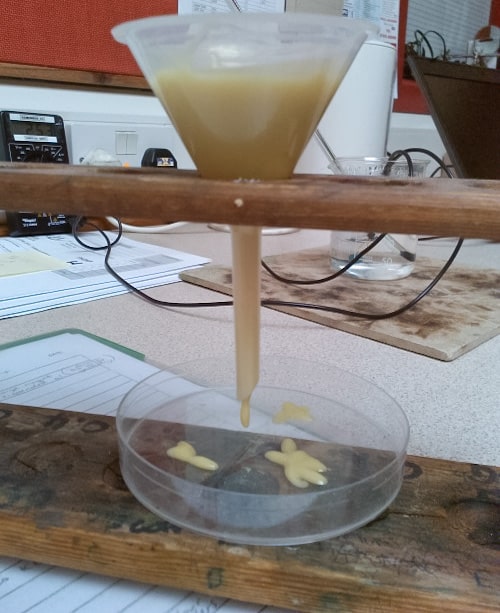
In case you haven’t seen it yet, I do encourage you to read our feature article from the May issue of Physics World about the now-famous pitch-drop experiment at Trinity College Dublin. This simple funnel of pitch shot to fame last year after a drop from it was finally observed falling for the first time – with a video of the dripping drop having so far been viewed more than two million times on YouTube.

Although it was the first time that a drop had been seen to drip from the Dublin funnel, it’s thought that other drops would have fallen about once a decade since the apparatus was set up in 1944. Be that as it may, Trevor Cawthorne from Queen Elizabeth’s Grammar School in Horncastle, Lincolnshire, UK, e-mailed me this morning, pointing out – quite rightly – that “10 years is a long time to wait for the results of an experiment”.

(more…)

What is a gravitational wave?

In less than 100 seconds, Ben Stappers of the University of Manchester in the UK explains how gravitational waves are the astrophysical equivalent of throwing a stone into a pond: they appear as ripples in space–time. He also explains that gravitational waves have been predicted to exist across a range of different wavelengths and that there are various experiments round the world designed to detect them.

Watch more from our 100 Second Science video series.

All alone in the universe?

One of the most basic questions, and one that natural philosophers have pondered for many millennia, concerns humanity’s place in the universe: Are we alone? Although the history of this question dates back to the ancient Greeks, and it was surely asked for many years before that, the first inklings of an answer did not come until a few centuries ago, when Copernicus, Kepler, Galileo and Newton demonstrated that other worlds qualitatively similar to our Earth orbit around the Sun. The intellectual revolution they helped bring about transformed the question of life beyond Earth, moving it beyond philosophical and theological musings and making it a subject of scientific investigation. Within the past century, further technological advances have made it possible to investigate the likelihood of extraterrestrial life afresh, using experimental, observational and quantitative theoretical studies that draw on expertise in both the physical and life sciences.

In his book Five Billion Years of Solitude: the Search for Life Among the Stars, Lee Billings describes the quest for answers to this profound question. The book is, first and foremost, a collection of stories, and one that is at least as much about the journey as it is about the destination. The topics covered are extraordinarily diverse, including both modern events and those that occurred long before humans walked the face of Earth, while the protagonists range from modern-day scientists to great minds of centuries and millennia past.

In researching these topics, Billings spent a lot of time with many active scientists – interviewing them, going to meetings and on research trips with them and getting to know them personally. From the spirit of his writings, he clearly enjoyed these experiences, and he has a very engaging style, one that smoothly transitions between the personal stories of active researchers, ancient Greek philosophers and scientists of the Enlightenment.

The search for life beyond our planet is part of a major new interdisciplinary scientific endeavour known as astrobiology. This field encompasses several forms of direct searches for life elsewhere, including those that look for chemical signposts of life (most likely in the form of distinctive gases that simple microbes would produce in the atmosphere of a planet on which they reside) and those that monitor radio frequencies for transmissions that may be emanating from technologically-advanced civilizations. However, many astrobiologists are also interested in researching such topics as the origin and history of life on Earth; the fundamental requirements of life; the environmental extremes that life can tolerate; the interactions of a biosphere with the planet on which it resides; and the traces, or biosignatures, that life produces.

Billings’ stories include elements of many of these astrobiological topics, but the primary focus of his book is the study of extrasolar planets (exoplanets) and what the deep history of our Earth implies for the potential habitability of such worlds. Over the past quarter century, exoplanetology has been transformed from a fraught and less-than-fully-respectable endeavour into one of the most vibrant and visible branches of astronomy. Yet we still cannot answer many basic questions about whether even the most apparently Earth-like of the planets we have found could be suitable for life. For example, we do not know whether terrestrial planets on which liquid water flows are rare, whether they are the norm for solar-type stars or whether they are intermediate in abundance.

The book also includes stories that stem from other areas of scientific inquiry, including a history of the Earth that begins with the seeds of its formation; various topics in astronomy and sedimentary geology; models of planetary atmospheres around stars of different sizes; the conditions needed for a planet to be a habitable abode; and the Search for Extraterrestrial Intelligence (SETI). Billings takes some interesting side trips, including one that shows how the search for extraterrestrial life is entwined with the geological histories of California and Pennsylvania, the gold rush and the oil/gas booms of the late 19th and early 21st centuries. The gold rush, it seems, played a role in the construction of Lick Observatory, where much of the pioneering work searching for exoplanets was done: its patron, James Lick, was a California pioneer who struck it rich in the real estate boom that followed the discovery of gold. And the oil and gas boom is, of course, one of the contributors to climate change, which is threatening our civilization.

Billings has written neither a textbook nor even a science book for a lay audience. There are more direct ways to learn about exoplanets, the history of our planet or astrobiology. Rather, Five Billion Years of Solitude is an engaging story, filled with anecdotes and (often quite colourful) characters from the past as well as the present. It describes scientists, their motivations and how science interacts with the human world. From the story of Lick Observatory to accounts of the great potential (and great cost) of grand government-financed space-based observatories, Billings takes detours that are entertaining and informative. This is a very pleasurable read, and along the way, you’ll learn some science, too.

  • 2013 Current Books £16.88/$27.95hb 294pp

Web life: Mahalo.ne.Trash

What does ‘Mahalo.ne.Trash’ mean?

Mahalo.ne.Trash is the personal blog of John Asher Johnson, an astronomer at Harvard University in the US who began blogging in 2007, when he was about to begin a postdoctoral fellowship at the University of Hawaii. The site’s name was inspired by Johnson’s realization that the Hawaiian word “mahalo” – which appears on rubbish bins (or “trash cans” in US English) all over the islands – means “thank you”, rather than “trash”. (The “.ne.” part, Johnson adds, is “a form of nerd-speak for ‘not equal to'”.) Despite being initially dubious about writing a blog – in his first post, he claimed to have a “fear of digital commitment” – Johnson took to the medium like a natural, writing more than 100 posts in his first year. And unlike many bloggers, he’s kept up the pace as his career has progressed, taking him first to the California Institute of Technology and then to Harvard, where he has been a professor since 2009.

What are some sample topics?

Johnson is, in his own words, “the first Black professor to attain tenure at Harvard in the physical sciences [sic]” and in recent months, he has often blogged about what it’s like to be an “uber-minority” in astronomy. For example, in one post he recalls being uncomfortable with affirmative action programmes as an undergraduate because “I chafed at the idea that people thought I needed help just because I was Black, and being part of the physics-boy culture, I didn’t want people to see me as weak.” Since then, however, he has become a supporter of affirmative action because he’s seen that “science suffers when only a fraction of the talent pool is in play”. In lighter moments, Johnson also blogs about his family, his research on exoplanets and (during his Hawaiian days) his encounters with giant flying cockroaches, which are apparently one of the few downsides of doing astronomy on a tropical island.

Why should I visit?

In the wake of claims (made by a major UK newspaper) that two British physicists, Maggie Aderin-Pocock and Hiranya Peiris, were only invited to talk about the recent BICEP2 discovery on national television because they are female and not white, Johnson’s candid and robust defences of diversity seem especially pertinent. Like this one from a post on 4 March: “Yes, I was hired in part because I’m Black, and Harvard needs what my unique racial make-up brings with it: namely, excellence. I bring viewpoints that are out of the norm, yet well aligned with the educational needs of an ever more diverse student body. I bring a formidable publication record, unique teaching methods and innovative approaches to all that I do. And I’m determined to see diversification accelerated here. Soon.”

Can you give me a sample quote?

Johnson has a lot of interesting things to say, which makes it difficult to pick out a single quote. But this one from a March post on “The art of argumentation” seems fairly representative: “The over-reliance on politeness is one of the defining characteristics of discourse in astronomy. Wait, let me clarify that. The over-reliance on apparent politeness is one of the defining characteristics of discourse in astronomy. I suspect this dates back to the era when astronomy was run by British gentlemen, and the tendency of the older generation of astronomers to romanticize that period of time. But as an uber-minority in a monochromatic field of science living in a race-obsessed country, I have no inclination to romanticize the past. I can admire the specific accomplishments of past astronomers. But I refuse to deify them, given that they conducted science as part of such an exclusive club…This is probably a major reason why I appear so confrontational to my peers in astronomy. The fact that I don’t respect all points of view is seen as intolerance. But I see it as the result of a critical selection process. If an idea has merit, I’ll respect it. If it lacks merit, then the idea deserves to be dragged out into the light and squished. If that makes the person with the idea feel bad, then go back to the drawing board and try again. It’s the idea that was bad, not necessarily the person who made it.”

Physics World 2014 Focus on Optics & Lasers is out now

Physics World focus issue on optics and lasers 2014It’s time to tuck into the latest focus issue of Physics World, which explores some of the latest research into optics and lasers.

The focus issue, which can be read here free of charge, kicks off with a report from the Centre for Quantum Photonics at the University of Bristol in the UK, which is driving a new approach to quantum computing based on integrated photonic circuits.

Elsewhere in the issue, you can find out from Joel England, a physicist at Stanford University in the US, about the new photonic research that could see particle accelerators shrunk to the scale of microchips.

Meanwhile, the huge potential of the photonics sector in general is underlined in our keynote interview with the chief executive of Jenoptik, Michael Mertin, who is also president of the European Union’s Photonics21 consortium, which seeks to unify the European photonics community and advises the European Commission on photonics research, development and innovation needs.

(more…)

Lattice mismatch opens up a band gap in graphene

A new way of modifying the electronic properties of graphene has been discovered by a team led by Andre Geim and Kostya Novoselov at the University of Manchester. The physicists have shown that when graphene is grown on a hexagonal substrate, a small change in its crystal structure results in a gap opening in the material’s electron energy bands. They also found that graphene grown in this way can exist in an alternative structure in which the band gap is much smaller. The result could point to an exciting new way of controlling the electronic properties of graphene-based devices.

Graphene is a honeycomb lattice of carbon just one atom thick that was first isolated in 2004 by Geim and Novoselov. Graphene is blessed with a wealth of fascinating electronic properties, many of which arise from the fact that it is a semiconductor with a zero-energy gap between its valence and conduction bands. One important consequence of how the bands meet is that conduction electrons travel through graphene at extremely high speeds. This means that the material could be used to create extremely fast electronic devices.

But there is an important snag: electronic devices such as transistors rely on the fact that semiconductors such as silicon have a non-zero band gap. Therefore, the challenge for device developers is to create a modified version of graphene that has a band gap. Several schemes have been explored – including applying an electric field, adding chemical impurities or modifying the structure of graphene – but none have proved ideal.

Moiré superlattices

In this latest study, the Manchester team looked at graphene grown on hexagonal boron nitride (hBN), which has a lattice that is very similar to graphene. When the two lattices are overlaid in certain ways, a moiré superlattice is created (see figure). The periodic potential associated with this superlattice causes a number of new and interesting electronic phenomena to occur in graphene, including Hofstadter’s butterfly (see: “Hofstadter’s butterfly spotted in graphene”).

Now the team has added “the commensurate–incommensurate transition” to the list of interesting phenomenon. In the commensurate state, the distance between carbon atoms in the graphene increases by about 1.8%, so that the lattice exactly matches that of hBN. This occurs when the two lattices are more or less aligned in a moiré structure. However, if this alignment is off by as little as one degree, the structure exists in an incommensurate state in which the graphene adopts its natural atomic spacing.

“Although it is extremely difficult to rotate a graphene sheet on a hBN substrate, we have overcome this problem by making many samples at varying angles and testing each one,” explains the Manchester Condensed Matter Physics Group.

Solitons and strain

The team, which also includes researchers from China, the Netherlands, Russia and Japan, mapped the locations of commensurate and incommensurate states by measuring the strain across the graphene surface. “In the commensurate state, the strain distribution becomes very abrupt,” adds Woods. “This is because there must be a network of domain walls [marked yellow in the figure above], also known as solitons in 1D, between the stretched regions [grey/blue].”

The team then measured the electronic properties of commensurate and incommensurate samples. In the former it found a relatively large band gap, and in the latter a much smaller gap. The team believes that this could explain why previous studies of graphene-on-hBN often resulted in conflicting values for the band gap.

In addition to clearing up the confusion surrounding the value of the band gap, Woods believes that the research has identified a new and exciting way to control and fine-tune the electronic properties of graphene devices.

The research is described in Nature Physics.

Did slippery sand help Egyptians build the pyramids?

Workers building the colossal monuments of ancient Egypt may have added water to the desert sands to make it easier to haul giant sledges. That is the conclusion of an international team of physicists that studied the relationship between friction and water content in a number of different types of sand. The research suggests that the type of sand found in the Egyptian desert becomes particularly slippery when wet – something that might have made it much easier to move the huge stones that were used to build the pyramids.

The study was done by Christian Wagner and colleagues at Saarland University in Germany, along with researchers in the Netherlands, Iran and France. The team was inspired by an ancient Egyptian wall painting showing a huge statue being hauled across the sand on a sledge in about 1800 BC. The painting has a detail that has long puzzled Egyptologists: a worker who appears to be pouring water onto the sand in front of the sledge while others appear to be carrying water to replenish his supply.

Ritual or lubrication?

While some historians believe that the act of pouring a liquid could be some sort of ritual, Wagner and colleagues wondered if it was a practical measure to reduce friction between the sledge and sand. This thought was inspired by work done in 2007 by Wagner, along with his Saarland colleague Jorge Fiscina, who showed that just a small amount of water acts as a lubricant that reduces friction in sand that is being pushed through a tube (see “Wet sand flows better than dry”).

To test their new theory, Wagner, Fiscina and colleagues measured the resistance experienced by a sledge being dragged through different types of sand. The team’s sledge was made from PVC, measured 11 × 7.5 cm and had rounded edges to mimic its ancient counterparts. It was loaded with heavy weights so that it exerted a downward force of about 250 kg/m2, which is on a par with that of a loaded Egyptian sledge. The sledge was pulled by a tensile tester, which measured the force required to move the sledge and allowed the team to calculate the coefficient of dynamic friction. While the researchers found that the addition of water did indeed reduce friction, it was not because the water allowed the sand to flow more freely – indeed, it had the opposite effect.

Concrete-like surface

The team quickly realized that sand piling up in front of the sledge was a major contributor to the friction. When the sand is dry or slightly damp, the grains can move past each other and are easily pushed up into a pile that makes it harder to pull the sledge. As more water is added to the sand, however, the grains begin to stick together and eventually form a stiff concrete-like surface that the sledge can slide across much more easily than across dry sand. This stickiness between grains was also observed in Wagner’s 2007 study, where it impeded the flow of sand.

In the case of one type of sand tested, the coefficient of dynamic friction nearly halved when the water content of the sand reached about 5%. This sand is similar to that found in Egypt, suggesting that wetting the sand would have been a boon to ancient monument builders. The results also indicate that the pyramid builders had luck on their side. Egyptian sand is “polydispersive”, which means that it contains grains of many different sizes. When Wagner and colleagues used sand in which most grains were of a certain size, the drop in friction was much less than that seen in the Egyptian-like sand. This could be because the range of grain sizes in polydispersive sand allows it to pack more tightly than sand where most grains are the same size.

More water does not help

Another important finding by the team is that above 5% water content, friction increased as more water was added. In some cases, friction on sand with 10% water content actually surpassed the value measured for dry sand. Wagner told physicsworld.com that the reason for this increase was not clear because the researchers did not see heaps of wet sand piling up in front of the sledge. Instead, he speculates that wetter sand is softer than the concrete-like sand and so the sledge sinks into it. “Maybe it is a bit like the difference between sliding on concrete and sliding on rubber,” says Wagner. “In any case, this is something we have to investigate in future studies.”

Troy Shinbrot of Rutgers University described the results of the experiment as “compelling” but points out that more work needs to be done to understand the connections between friction and the stiffness of the sand. As for practical applications beyond building pyramids, Shinbrot points out that the research could help us to understand the effects of moisture on processing a range of granular materials from pharmaceuticals to industrial slurries.

The experiments are described in Physical Review Letters.

Sistine Chapel artworks seen in a new light

Its enormous frescos have wowed tens of millions of visitors during the past five centuries, but from autumn this year, the walls and ceilings of the Sistine Chapel in Rome will be revealed as never before. Lighting manufacturer Osram is in the process of installing 7000 LEDs in the famous building, each tuned in intensity and wavelength to provide the best possible viewing experience. Until now, the artworks have been lit via low-level natural light and metal halide lamps diffusing through glass windows to reduce long-term damage.

Based on measurements of the colour spectrum made at 280 points distributed across the chapel’s surface, Osram engineers designed lighting rigs that combine radiation from standard red, blue, green and white LEDs in precisely controlled amounts to match the pigments in individual locations. The team is aiming for a near-perfect “colour-rendering index” – a measure of the quality of a light source relative to a reference such as the Sun – of 98 compared with 80 produced by standard indoor lighting.

Better viewing, less damage

The challenge, explains Osram project leader Mourad Boulouednine, was to improve the viewing experience massively without compromising on conservation. “We have convinced the Vatican that we have the right technology for this iconic project,” he says. “These are big deals – we’re talking about a 500 m2 artwork on the ceiling and other major works such as Michelangelo’s The Last Judgment,” he says.

LEDs emit no ultraviolet (UV) or infrared radiation, which is known to be one of the main causes of damage to pigments. Still, it took some time to convince Vatican conservators to take up the technology. The Osram team carried out stringent stress tests in the Vatican museums by exposing pigments to LED radiation with an illuminance of 200,000 lux – roughly double that produced by direct sunlight – for the equivalent of one year. The results showed that, under normal LED operating conditions of 50 lux or less, the priceless pigments on the chapel’s walls would be safe for at least 1000 years – which addressed the Vatican’s concerns. “First, they saw 3D effects and other details that the artists intended but that have never been seen before,” says Boulouednine. “Then we did the stress test, and now there is not a single doubt.”

Low power, less glare

Despite boosting the illuminance by a factor of five to 10, the new lighting rig is also expected to reduce power consumption for the Sistine Chapel by more than 60%, thanks to the high energy efficiency of LEDs and careful direction of the light to ensure that artworks are uniformly illuminated without glare or light spill. Osram honed the technology last year at the Lenbachhaus Museum in Munich, and is one of several lighting firms keen to get into the museum scene.

Last year, Philips installed some 750,000 individual LEDs in the refurbished Rijksmuseum in Amsterdam, while Toshiba LEDs are being used to illuminate the Mona Lisa and other famous artworks in the Louvre. “LED lighting in particular outlines the visual contrast and relief in the paintings,” says Tim Zeedijk, who is head of exhibitions at the Rijksmuseum, in a statement. “A significant advantage of the new generation of LED lighting is that there is hardly any radiation of heat and no harmful UV being emitted. In addition, LEDs have a longer lifespan and require less maintenance than halogen lighting, which is more commonly used in museums.”

  • This article also appears in the May 2014 Physics World Focus on Optics & Lasers. The magazine is free to view and contains news and feature articles on a range of topics, including 3D printing, photonic quantum circuits and a state-of-the-art satellite camera that is mapping the heavens to extraordinary precision

Winning rock-paper-scissors, meeting a future Nobel laureate, hot new batteries and more

By Hamish Johnston

When I was a PhD student, there was a group of retired professors that shared a tiny office in the physics department. It was whispered that one of them was extremely wealthy thanks to a successful commercial spin-out and we marvelled at the fact that he came in to work every day rather than enjoying the fruits of his labours. However, it wasn’t the wealthy professor who was destined for international fame. In 1994 his officemate Bertram Brockhouse shared the Nobel Prize for Physics, and Brockhouse’s quiet life changed dramatically. Indeed, he got his own office!

I was reminded of this little group when I read ZapperZ’s blog entry about his encounter with Ray Davis before Davis bagged the 2002 Nobel for his work on neutrinos. Sitting next to Davis on a two-hour flight, ZapperZ had an inkling that he was beside an interesting character after their brief chat about physics. But it wasn’t until the Nobel was announced several years later that he realized the opportunity he had missed.

(more…)

How to build a quantum Newton’s cradle

A quantum analogue of the popular “Newton’s cradle” toy has been proposed by a duo of physicists in Italy. Like momentum transferred in the toy, the team argues that it should be possible to achieve the nearly perfect transmission of a quantum wavefunction along a line of ultracold atoms in a 1D Bose–Einstein condensate. According to the pair, the work could help develop quantum-information systems that achieve high-quality wave transmission.

Best described as an “executive desk toy”, a Newton’s cradle is a device that demonstrates the conservation of energy and momentum. It consists of small, identically sized metal balls suspended from two horizontal bars. When a ball is lifted and allowed to fall, it strikes its immediate neighbour and comes to a stop. But its momentum is transferred across the rest of the spheres and propels only the sphere at the opposite end of the line into the air.

Ultracold cradling

Roberto Franzosi of the Quantum Science and Technology Institute in Arcetri and the National Institute of Optics, National Research Council, along with colleague Ruggero Vaia from the National Institute for Complex Systems, National Research Council in Florence, became interested in the quantum Newton’s cradle as part of their work on the unusual dynamics of locally perturbed quantum states. Franzosi points out that they based their design on ultracold atoms because it is one of the most versatile quantum systems from an experimental point of view. “Cold atoms are considered an excellent test bench for a huge variety of quantum phenomena,” says Franzosi, explaining that “with a suitable set-up, it is possible to realize a [quasi]-perfect transmission of the quantum wavefunction.”

Franzosi’s proposal is not the first though – a similar experiment was done in 2006 by a separate group of researchers that also attempted to create a quantum Newton’s cradle. Franzosi says that although that experiment was “a fascinating demonstration of how coherent states are the quantum analogue of classical particles”, it still did not represent a perfect analogue. That is because it was not a 1D system made up of individual quantum systems (an analogue of the rigid spheres) with nearest-neighbour interaction between them (the analogue of collisions between the spheres).

To create a perfect analogue, Franzosi and Vaia propose beginning with a Bose–Einstein condensate of two atomic species – that is, atoms in two excited states. The atoms are trapped in a 1D tube that has a longitudinal optical lattice running through it. Franzosi says that such a confinement can be created using counter-propagating laser beams that form standing waves to trap the atoms, thus developing two macroscopically populated coherent states.

“Fermionized” bosons?

The system would then be kept in a strong “Tonks–Girardeau regime” – a special type of strongly correlated quantum system that was proposed nearly 50 years ago but only experimentally realized in 2004. In such a gas, normally strongly interacting bosons, which have repulsive interactions, are confined in a 1D ensemble. Thanks to the strong repulsion, the bosons do not occupy the same position in space, effectively mimicking the Pauli exclusion principle for fermions to the point where a “fermionized” Bose gas is formed. Such a gas then exhibits many fermionic properties – such as a fermionic density distribution – with the exception of momentum distribution, which does not show ideal fermionic quantum behaviour.

In the Tonks–Girardeau regime, the strong repulsive interactions prevent double occupancy at any lattice site. This ensures that each site contains one atom and that the wavefunction is a superposition of the two hyperfine atomic states. Furthermore, the ensemble retains its characteristic momentum distribution. Once the atoms are arranged in this way, a disturbance of the wavefunction is triggered using a laser pulse coupled with the hyperfine atomic states at a given site.

Graph showing the wavefunction in a simulation of the quantum Newton's cradle

“We have shown that the tunnelling between sites makes the system equivalent to a free-fermion gas on a finite lattice,” says Franzosi. So, a disturbance of the wavefunction begins bouncing back and forth from the ends, just like the outermost two spheres in a Newton’s cradle. The researchers say that the experiment associates the propagation of a wavefunction disturbance with the transmission of mechanical momentum.

While Franzosi believes that the experiment proposed is feasible, “nevertheless, I’m a theoretician and I don’t have the opportunity to carrying it out”, he says. Although both he and Vaia feel that experimentally realizing their quantum cradle would be worthwhile for the “insight it would give into the entangled beauty of quantum mechanics”, they point out that such systems could have future applications in everything from atomic interferometers to quantum memories and even a quantum communications channel. The researchers are now working on an analogue of the Mach–Zehnder interferometer – a device that is used to determine relative variations in the phase shift between two collimated beams that are obtained from a single source – using cold atoms in a similar set-up.

The research is published in Journal of Physics B.

Copyright © 2026 by IOP Publishing Ltd and individual contributors