Today, the Intergovernmental Panel on Climate Change released its Working Group II (WGII) report entitled “Climate Change 2014: Impacts, Adaptation, and Vulnerability“. Over on our sister website environmentalresearchweb.org, editor Liz Kalaugher has written a news-analysis piece about the report that looks at the major risks facing different regions of the globe; who is most vulnerable to change; and why we must build on early efforts to adapt to climate change.
Kalaugher’s piece includes commentary from leading IPCC members, including Vicente Barros, co-chair of working group II. “In many cases, we are not prepared for the climate-related risks that we already face. Investments in better preparation can pay dividends both for the present and for the future,” says Barros.
Chris Field, WGII co-chair, adds “We definitely face challenges, but understanding those challenges and tackling them creatively can make climate-change adaptation an important way to help build a more vibrant world in the near-term and beyond.”
However, the report also warns that adaptation will be very difficult with high levels of warming. In that case, Field says that “even serious, sustained investments in adaptation will face limits”.
Researchers in Austria have made the smallest ever man-made nanomechanical resonator from just four molecules. The oscillating cantilever is not only of interest for fundamental studies in quantum physics, but could also be used to detect single atoms or molecules.
Nanomechanical resonators are tiny vibrating beams that oscillate at very high resonant frequencies – often in the megahertz or gigahertz range. As a result, they can find use in a range of applications including telecommunications and even quantum computing. They can also be used to detect and determine the mass of tiny objects, such as single DNA molecules or viruses. When a small particle is absorbed onto the beam, it alters the frequency at which the beam vibrates and this change can be monitored and used to calculate the mass of the particle.
Tiny resonators
A team led by Stefan Müllegger at the Johannes Kepler University in Linz has now made the tiniest such resonator ever from just four molecules of α,γ-bisdiphenylene-β-phenylallyl (or BDPA). In previous work, the researchers showed that when BDPA molecules are deposited on the (111) crystallographic surface of gold, they segregate into triangular clusters. Some of these clusters then act as nucleation sites and allow a chain of molecules to grow in one direction and form tiny resonating structures. The molecules in these chains are separated by about 0.7 nm.
Now, the same team has succeeded in imaging these molecules by moving a scanning tunnelling microscope (STM) tip across the chain and measuring the small electrical current between the tip and the gold surface. The researchers found that at a temperature of 5 K, the chain appears as a thin line of molecules. However, when the temperature is increased to 20 K or higher, the molecules in the chain look wider the further the tip is moved along the chain from the end that is fixed to the gold surface (see figure). These observations indicate that the chain is vibrating, say Müllegger and colleagues.
Unexpected behaviour
The team points out that the vibration is unexpected because of the nature of the bonds between the molecules, which are relatively weak. In theory, the chains should not resonate as observed because such vibrations were only thought to occur in nanostructures such as graphene and carbon nanotubes, which are held together by stronger chemical bonds.
The team has also come up with a way to measure the frequency of the structure by modifying its STM so that it can detect tunnelling currents in the radio-frequency range. The researchers found that a five-molecule chain resonates at 98 MHz and, just like the strings in musical instruments, these frequencies decrease as the chain length increases. For example, a four-molecule chain was found to resonate at around 127 MHz while a seven-molecule chain resonated at about 51 MHz.
“Our study shows that radio-frequency scanning tunnelling microscopy is a complementary new experimental tool for characterizing dynamic processes at the scale of single molecules in nanoscience and technology,” says Müllegger. “We now hope to study the mechanisms behind a molecular chain’s vibrations and further adapt our modified STM for single-molecule magnetic resonance spectroscopy,” he says.
As part of Physics World’s 25th anniversary celebrations, I’ve been reading through the archive of “Lateral Thoughts”, the magazine’s column of humorous or otherwise off-beat essays about physics. My goal is to get a better feel for the topics that have amused and preoccupiedPhysics World readers over the past quarter-century, and to understand how the community has changed.
While most Lateral Thoughts have focused on the world of physics, the archive shows that every now and then, the wider world intrudes. The results can be fascinating, sobering and sometimes even disturbing. Consider the essay “Soft zlotys for western hardware”, in which the metallurgist Jack Harris describes taking a research trip behind the Iron Curtain to Poland. “In science, as in other areas, I was struck by how little real contact there was with Russia,” Harris wrote. His Lateral Thought was published in July 1989. Two months later, Poland defied its puppet-masters in Moscow by electing its first non-communist government since the Second World War.
In September 1991 another Lateral Thinker, Eric Deeson, also found himself on the front line of history. While visiting Kuwait to help rebuild the country’s scientific infrastructure after the Gulf War, Deeson encountered a nightmarish landscape. “Losing height on the approach to the airport, we flew over the flames and immense clouds of smoke from the burning oil-wells,” Deeson wrote. “Even more than a hundred metres from the well, the roar of the flame was so strong that we had to shout into each other’s ears. The world was truly as dark as night…no classroom television screen will be able to reproduce my visit to Hell.”
A few years later, Eric Voice wrote about a less visible threat in “Postcard from Pripyat”, in which he described travelling to the exclusion zone around the destroyed Chernobyl reactor. There, Voice found a “perfect woodland paradise” filled with wild animals and thriving trees – but also hazardous levels of radiation and a research effort plagued by lack of funds and political turmoil. “The story of the Chernobyl aftermath is a tale of trial and error, of inadequate experience and deficient basic knowledge,” Voice wrote in April 1995. “It will be a tragedy for the world if we cannot learn from a full scientific assessment of that accident, so that we are better able to deal with any future large-scale impact of radioactivity.” A lifelong advocate of nuclear power, it is perhaps fortunate that Voice, who died in 2004, did not live to see some of those errors repeated after the Fukushima meltdown.
But of all the Lateral Thoughts in the archive, the weight of history seems heaviest in Seweryn Chomet’s “A brief life in science” published in July 1996. The essay begins with Chomet blandly observing that “Landau is a common name in physics,” and then explaining that the Landau he remembers best was “born in the late 1920s…and in 1936 attended primary school in Drohobycz, a small town of twenty or thirty thousand inhabitants in what was then south-east Poland”.
A few weeks after this Landau started school, Chomet continues, “Miss Tutelbaum, the local school-teacher, [noted] in the margin of the school register that she had in her class a boy with a striking talent for drawing and arithmetic. He was both clever and well-behaved – an unusual combination in her experience…It became increasingly clear to Miss Tutelbaum that Landau was destined for a scintillating future. His performance at school and his general demeanour were so different from the rest of the class that it sometimes frightened her.”
Soon, Chomet writes, “the entire community sensed that it had a genuine prodigy in its midst”. When, a few years later, a nearby university denied Landau entry because of rampant antisemitism, “a group of local Jewish businessmen clubbed together and collected enough money to send the obviously highly talented young man to university abroad” in Zurich, Switzerland. From there, Landau went from strength to strength. After graduating summa cum laude, “In 1955 he discovered the principle whereby the rate of some chemical reactions can be controlled by magnetic fields by virtue of the spin of the reacting particles…The discovery was well ahead of its time and…it won him the Nobel prize for electrochemistry.” Landau’s later years were spent at the Institute for Advanced Studies at Princeton, and following his death from cancer in 1988, Chomet writes, “he will be widely remembered for his brilliant research work, which was distinguished by an almost unique range and remarkable originality”.
At this point, Chomet sticks the knife in. “And now I must confess that only the beginning of this article is true. Ryszard Landau, born in Drohobycz in the late 1920s, did not go to Zurich because, like many other Jewish children, he was murdered by the SS…Only two members of his class survived the German occupation, and neither reached great academic distinction. His brilliant school record and my memories of him now suggest that Ryszard might well have achieved worldwide eminence in science. This is the only published record of his life.”
If you are a member of the Institute of Physics (IOP), you can read Chomet’s essay (and the others quoted) in full via the Physics Worldarchive. While you’re there, you might want to browse through some of the cheerier Lateral Thoughts as well – they’ll be the subject of the next post in this series.
Members of the Institute can read newly published Lateral Thoughts each month via the digital version of the magazine or by downloading the Physics World app from the App Store or Google Play. If you’re not a member, you can join the Institute as an IOPimember for just £15, €20 or $25 a year. And if you’re feeling inspired, why not try writing your own Lateral Thought? All submissions must be 900–950 words long and may be e-mailed to pwld@iop.org.
But that’s old news, so lettuce move on to this week’s highlights from the Red Folder…
The rocket scientists referred to in the headline are econophysicists, who got a bad rap from Warren Buffet and others during the financial crisis of 2008. Now that the great depression is nearly over, physicist and author Mark Buchanan has a much more upbeat assessment of those who have made the transition from physics to economics in his blog entry “What’s the use of ‘econo-physics’?”.
Posted on The Physics of Finance blog, Buchanan’s piece offers eight important contributions to economics made by physicists. These include the economic implications of “fat-tailed dynamics” and better methods for “risk judgement”.
And it’s not only financiers who could benefit from a little input from the rocket scientists. In another entry this week, Buchanan turns his attention to the cab business in: “Taxis 2.0: Streamlining city transport with graph theory”.
In other interdisciplinary news, Fermilab Today has a lovely article about two families of ironworkers who have worked at the lab near Chicago. The piece profiles Tom Wicks, who is rigging superintendent at Joliet Steel & Construction. Wicks is part of a team that is dismantling much of the huge CDF detector that he and his mother and stepfather helped built. The article is entitled “Particle detector connects two generations of ironworkers” and also features John Wackerlin of the engineering firm Walbridge, who is also working on the CDF decommissioning. John’s father Bob worked underground in the Tevatron tunnel before the junior Wackerlin was born.
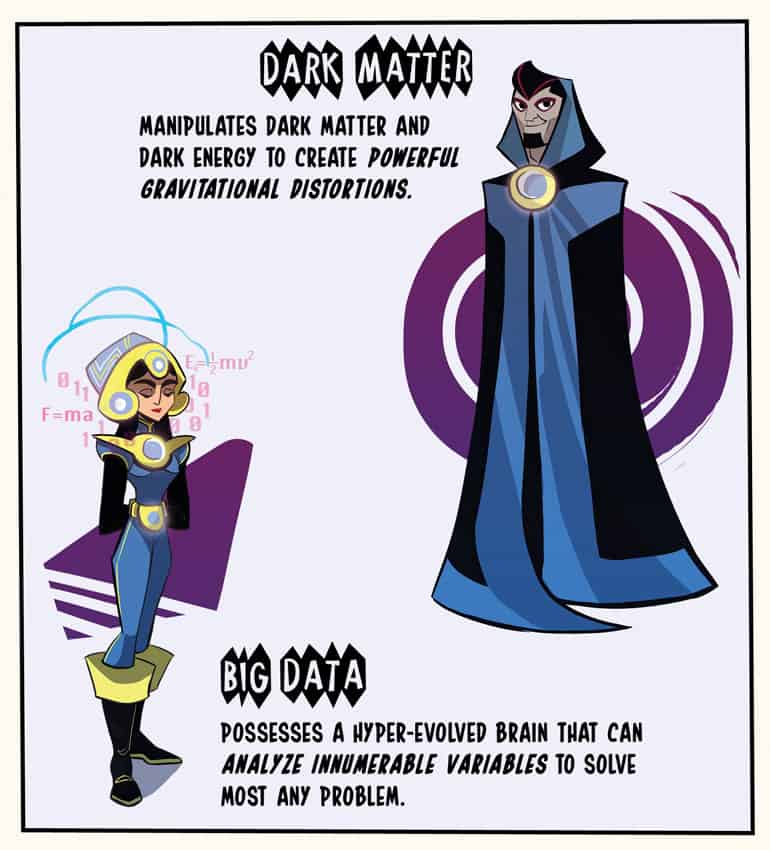
From ironworkers to Iron Man, who features in the opening paragraph of “Superheroes and particle physics: the dynamic duo” by Calla Cofield. The article, which appears in Symmetry magazine, investigates the connections between physics and superheroes. It is illustrated by several fantastic cartoons by Brittney Williams and Josh Elder that describe a pantheon of physics superheroes, including Neutrino, who moves through solid matter at nearly the speed of light and comes in three flavours: boisterous, bold and impetuous. There’s also Big Data, who uses her hyper-evolved brain to solve tough problems, and Positron, who has built-in particle accelerators for zapping villains.
Finally, a Japanese comic artist has published a manga about his time working at the devastated Fukishima nuclear power plant. Entitled 1F: The Labor Diary Of Fukushima Dai-ichi Nuclear Power Plant, the graphic book is by Kazuto Tatsuta, who writes about the painstaking effort of cleaning up the facility while ensuring that no-one is injured by radiation.
The first room-temperature, high-sensitivity infrared photodetector has been designed by a team of researchers in the US. The device is based on the “wonder material” graphene and works across the full infrared spectrum. The detector is thin, flexible and transparent, making it highly suitable for applications including wearable electronics, according to the team. The researchers are currently developing an infrared camera by building an array with their graphene photodetectors.
Graphene is a layer of carbon just one atom thick and since it was first isolated in 2004 its remarkable electronic and mechanical properties have been studied by physicists worldwide. Zhaohui Zhong, Ted Norris and colleagues from the University of Michigan have been developing photodetectors that can take advantage of graphene’s unique material properties, including its ultra-broadband light-absorption capability. As graphene is a semimetal, it is capable of absorbing light across a wide spectrum – from ultraviolet to far infrared. This is unlike conventional photodetectors, which are made from semiconductors that can only absorb light at specific wavelengths.
Across the spectrum
As well as in night-vision goggles, infrared detectors have a variety of other uses: they can detect heat leaks, monitor blood flow and identify certain chemicals in the environment. They can even be used to study paintings, looking through multiple layers of paint to determine older versions of an artwork. However, the detectors require a combination of technologies to accurately detect the whole of the infrared spectrum. Indeed, detecting mid-infrared and far-infrared radiation requires the sensors to operate at very cold temperatures, thus making them impractical for everyday use.
While graphene has been used previously to make photodetectors, these have been limited by their poor sensitivity. With its one-atom thickness, graphene only absorbs about 2.3% of the light incident on it. “The challenge for the current generation of graphene-based detectors is that their sensitivity is typically very poor,” says Zhong. “It’s a hundred to a thousand times lower than what a commercial device would require.” It is this sensitivity that the Michigan researchers’ design has hugely improved upon.
Graphene gain
The device itself is made of two graphene sheets with a thin tunnelling-barrier layer between them. When light hits the top layer of graphene, it creates “hot” electrons and holes with high energy. “By designing the material interfaces properly, the hot electrons will tunnel through the barrier layer into the bottom graphene layer, while leaving behind positively charged holes on the top graphene layer,” explains Zhong. “The positively charged holes can produce an electrostatic gating effect and this affects the current readout of the bottom graphene layer.” Measuring the change in current allows the team to detect the brightness of the light incident on the detector. Rather than trying to directly measure the freed electrons, Zhong and colleagues configured the bottom-layer graphene as a field-effect transistor, which provides an intrinsic gain to amplify the tiny current and so overcomes graphene’s natural low sensitivity.
“We can make the entire design super-thin,” says Zhong. “It can be stacked on a contact lens or integrated with a mobile phone.” It can also be scaled down further, and so the team is currently working on making an infrared camera using an array made up of the detectors – Zhong says the prototype will be ready in a few years. He also foresees the use of their detectors in wearable applications because they could potentially be integrated into contact lenses or electronic eyes. “But for now, there are many fundamental scientific, material and engineering challenges that need to be addressed first. Making an infrared camera will be the first step,” says Zhong.
An essential question for every teacher is “What will my students remember a year after they have taken the final exam?” This question is significant for students specializing in physics, since each course they take will contribute to their understanding of what it means to do physics. But it is perhaps even more critical for students in introductory physics courses, since most will not go on to become professional physicists and are thus unlikely to encounter pure physics in the future.
Traditionally, we, as physics educators, have focused on teaching fundamental physics concepts and the ways that such concepts apply to real-world problems. But in recent years, this focus has shifted. Numerous studies of what makes people successful in the workplace have shown that while understanding scientific concepts is important, the ability to think like a scientist while solving complex problems is equally vital (see, for example, International Journal of Science Education24 661). Specifically, students need to know how to formulate a problem; collect and analyse data; and identify patterns. They also need to know how to test ideas; how to evaluate assumptions and solutions; how to distinguish evidence from inference; how to argue scientifically; and so forth.
Science educators around the world have begun incorporating this new focus into their curricula. For example, the Next Generation Science Standards in the US place scientific “habits of mind” (sometimes called science practices or science competencies) at the centre of science education for all students from kindergarten to the end of high school. On the other side of the Atlantic, a multinational group of physicists involved in a project called Tuning Educational Structures in Europe found that the competencies ranked most highly by physics graduates and employers include problem solving, teamwork and the ability to apply knowledge in practice. With this in mind, the group has produced a guide for academics involved in planning or revising physics degree courses as part of the Bologna process, along with a platform for establishing communication between employers and universities.
Another factor driving the shift in physics education relates to changes in our understanding of how people learn. We now recognize that learning is a process of physical change that occurs in the brain, and possibly in the whole body. A more complete explanation of this “embodied cognition” can be found in the work of Margaret Wilson, a psychologist at the University of California, Santa Cruz. In essence, learning involves rewiring paths to the neuronal connections that students already have when they enter our classrooms, and this process is enhanced when students interact bodily with their environments. This new understanding has important implications for how physics is – or should be – taught.
We now recognize that learning is a process of physical change that occurs in the brain, and possibly in the whole body
Rewiring minds
To understand how the “rewiring” process works, let us consider a simple example. Suppose a child sees something new – a pile of dirt, for example. She wonders what it is, so she searches her brain for existing knowledge that might be relevant. This process produces another question: is dirt like chocolate? If it is, then it should taste like chocolate – and so we see the child putting dirt in her mouth.
Although the result of this “experiment” is that dirt is not like chocolate, this does not mean that the child did not learn anything. On the contrary: she completed what is called a brain learning cycle. Such cycles begin with concrete experiences and simple observations and then proceed to reflections that connect such observations to things they already know. The next step is to produce a hypothesis about this connection, followed by the immediate testing of this hypothesis through an active movement. As James Zull – a biologist at Case Western Reserve University and founder of its University Center for Innovation in Teaching and Education – put it in his book The Art of Changing the Brain (2002), learning takes place when someone is continuously building connections to prior knowledge through interactions with the world and reflective thinking.
More recently, in his book From Brain to Mind: Using Neuroscience to Guide Change in Education, Zull also showed that imagery plays an important role in the learning cycle. Think of an apple. Your understanding of what an apple is will be an amalgam of your perceptual experiences: you may remember the feel of biting into it, the taste, the smell and so on. Even if you have never eaten an apple, you may be able to draw on photographs or other illustrations you have seen. Together, these experiences form a “perceptual symbol” that we can then call “apple”. Shorn of this underlying experience, however, the word “apple” will mean nothing to you, even if you are presented with some kind of textbook definition of it.
Finally, because learning is inherently social, the rewiring process is enhanced when a learner interacts with other people. Interactions with peers allow learners to benefit from each other’s different expertise and encounter different points of view, and they also encourage them to speak about the ideas that they are working on. The mere act of speaking also involves the motor function, which is extremely important for learning.
These ideas – that learning is a physical change; that it takes place in cycles; that images need to precede formal definitions; and that it is a social process – are by no means exhaustive. For us, however, they are the major building blocks in our understanding of how people learn, and they have some important implications for how we teach physics.
The rewiring approach to learning suggests that we should view the knowledge that students bring to our classrooms as a productive resource to build on, rather than as an impediment
One implication is that for rewiring to take place in the brain, learners need to be actively engaged in the instructional process. In other words, passively listening to good explanations – as often happens in traditional physics lecture courses – will not produce the needed change. The rewiring approach to learning also suggests that we should view the knowledge that students bring to our classrooms as a productive resource to build on, rather than as an impediment to future learning. This is true even though students’ prior physics knowledge consists of ideas that often contradict each other. Finally, physical interaction with the world is extremely important.
Another lesson is that learners need opportunities to conduct observations and try to explain them using their existing knowledge – for example, by creating analogies. This process enables learners to extend their knowledge and to test new ideas by doing experiments or by discussing their thoughts with peers. A final lesson is that learners need a perceptual symbol of a concept before a teacher introduces a formal definition. This perceptual symbol could be a real phenomenon with which they have some physical experience, but it could also be a picture or a statement in which they describe the phenomenon in their own words – or even some combination of the three.
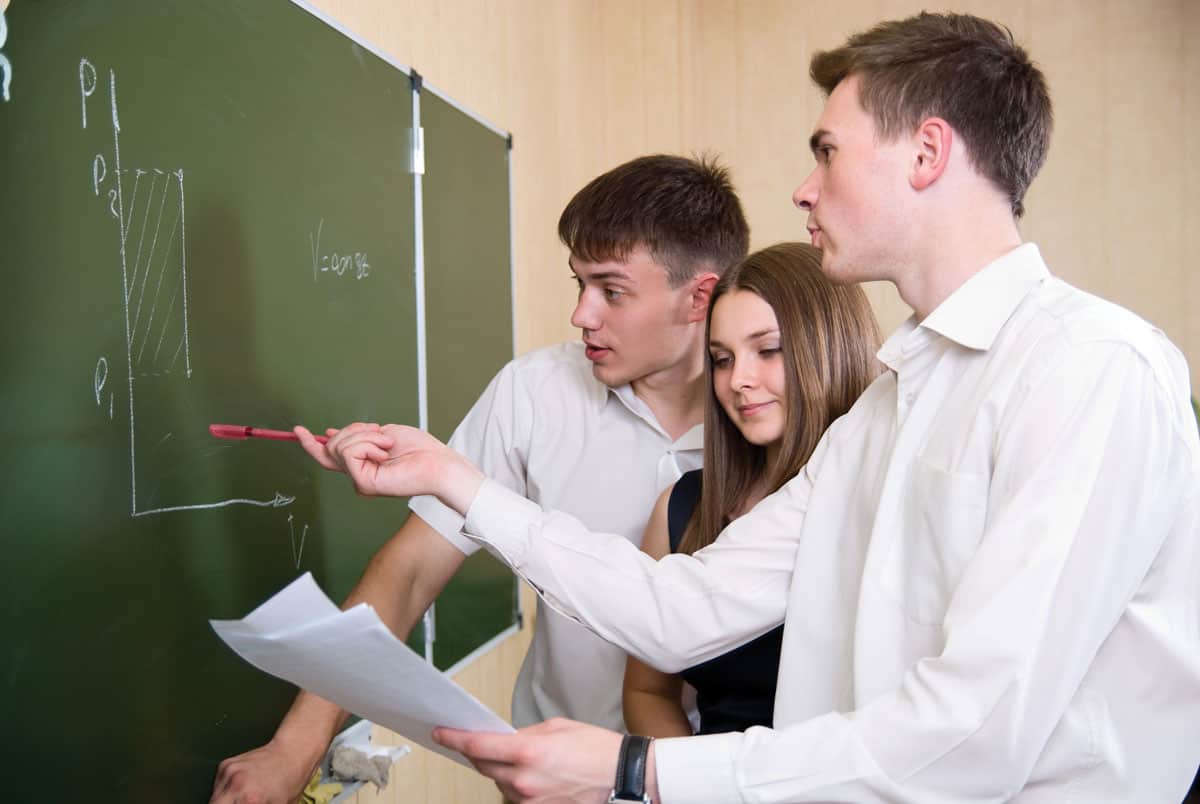
Interaction Encourage groups of students to present their findings back to the class. (Courtesy: Shutterstock/Vadim Ivanov)
Ideas in motion
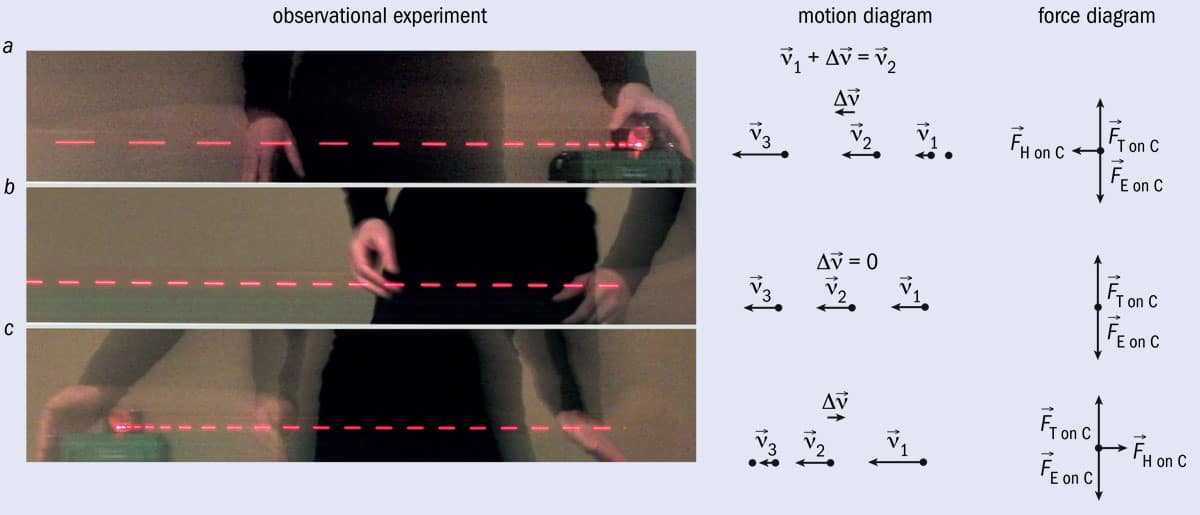
If the discussion so far seems rather abstract, here is an example of a lesson that is both consistent with the ideas above and also geared towards helping students develop scientific habits of mind. The example may seem trivial, but it addresses one of the most difficult concepts in introductory mechanics: when a non-zero sum of forces is exerted on an object, it is the change in the object’s velocity vector (Δν→) that is aligned with the sum of all forces, rather than the velocity vector itself (ν→). This idea forms the qualitative foundation for understanding Newton’s second law. However, the most common experience students have of this law is of an object that is initially at rest and then starts to move. In this case, both Δν→ and ν→ point in the same direction. Because people usually focus on the velocity, this may lead them to think – erroneously – that an object always moves in the direction of the force.
In the lesson described below, we assume the students have already learned that in physics, the word “force” stands for a physical quantity that characterizes the interaction of two objects. We will also assume that they have some experience with the forces most common in mechanics and that they know how to add them as vectors. Note also that the activities we describe will be much more successful if students work together in small groups and present results of the consensus of this group work to the class. Using small boards for students to show their work to the rest of the class is very helpful.
Step 1. Provide students with simple concrete experiences. Use a heavy cart with small wheels on a smooth track. Ask students to push the cart (it is important that the students are pushing, not the teacher), exerting a constant force on it. Students will observe that the cart moves faster and faster. The next experiment is to set the cart in motion and let it coast without touching it. If the surface is smooth, the cart will move at a constant velocity. Finally, when the cart is moving, ask students to exert a force on it in the direction opposite to the direction of motion. The students will observe the cart slowing down in the direction of motion. The heavier the cart, the easier it is for them to see that it does not stop instantly. To increase the perceptual aspect of the three experiments, the students can use a bowling ball instead of the cart and push it with a mallet.
1 Learning in motion
(Courtesy: IOP Publishing/Eugenia Etkina and Gorazd Planinšic)
Photos taken with a blinking LED, motion diagrams and force diagrams for a cart that is (a) speeding up, (b) moving at constant velocity and (c) slowing down. On the motion diagrams the dots represent the positions of the cart at equal time intervals, the ν→ vectors represent the cart’s velocity and Δν→ vectors represent the change in the velocity. On the force diagrams each force exerted on the cart is labelled with two subscripts that indicate two interacting objects: F→E on C is the force exerted by Earth on the cart, F→T on C is the force exerted by the track on the cart and F→H on C is the force that the hand exerts on the cart.
Step 2. Help students construct images of the concept and connect new ideas to what they already know. After doing the experiments described above, students will have a physical feeling for the situation. The next task is to help them build on this. One way is to take a flashing LED light, attach it to the cart and take photos (see figure 1). Independently of the availability of such photos, though, you should ask the students to create graphical images that represent each experiment with a motion diagram and force diagram for the cart (remember, we assume that the students have already learned how to make such diagrams). They should create drawings similar to those in figure 1. The two-subscript notation for the forces addresses the difficulty of identifying forces exerted on an object.
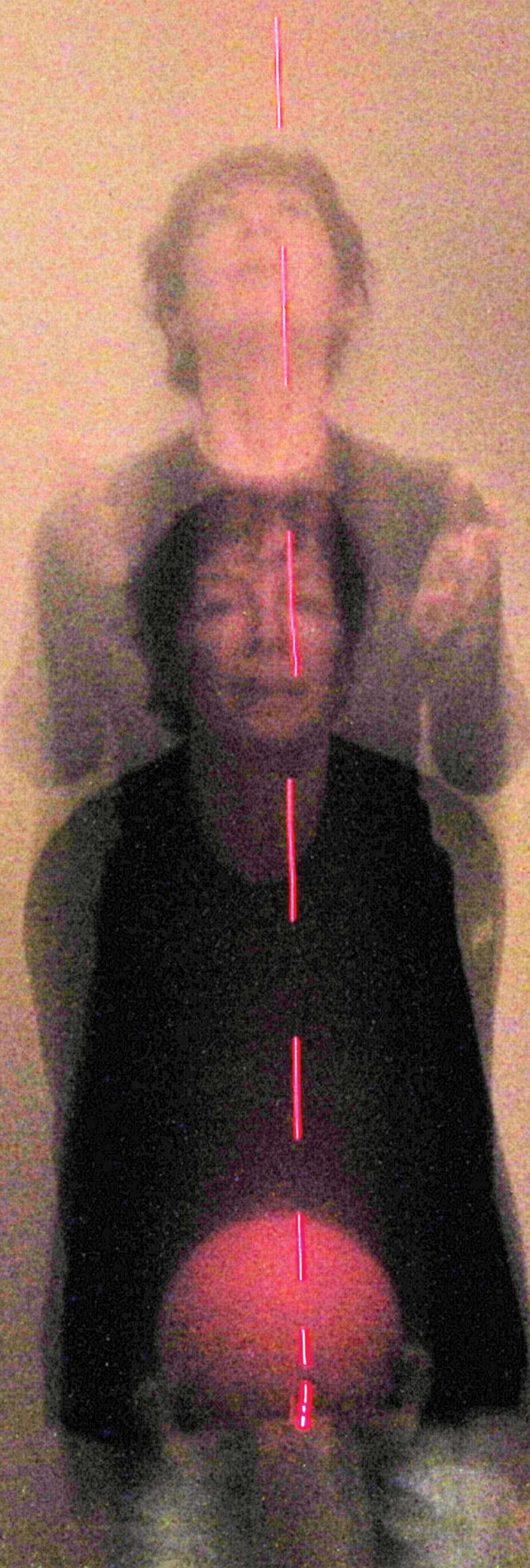
Oof! A person catches a 5 kg medicine ball dropped from about 1 m. A blinking LED shows the time interval of the catch. (Courtesy: Eugenia Etkina and Gorazd Planinšic)
Step 3. Encourage students to identify patterns. Let students discuss the patterns that they see in the sets of diagrams. They will notice that on each diagram the sum of the forces vector is in the same direction as Δν→. You can help them formulate a provisional rule: when the sum of the forces exerted on an object is not zero, the object changes its velocity and the velocity change is in the same direction as the sum of the forces.
Step 4. Engage students in active testing of the rule. Invite students to propose new experiments for which the outcomes can be predicted using the new rule (after doing these activities a few times you will know what equipment your students will request). Here the perceptual aspect of learning can be emphasized again. In addition to trying the experiments that they propose, ask the students to use the new rule to predict what they will feel when catching a heavy medicine ball dropped from above as opposed to holding it. They need to use the motion diagrams and force diagrams to make the prediction and then physically experience how much harder they need to push on the ball to catch it compared to holding it still (the photo left allows students to infer that the person exerts the stopping force over the substantial difference). Thus the experiment also helps the students realize that it is impossible to stop a moving object instantly.
Step 5. Help students reconcile the new rule with their previous experiences. Does this rule make intuitive sense? Encourage students here to come up with examples of different moving objects (such as a ball thrown upwards, a parachutist doing a sky-dive or a sledge coming to a stop after the end of a slope) and analyse them by making motion and force diagrams and co-ordinating between them. Ask the students to come up with three examples when the rule is true in everyday life and three examples when it is not. This discussion will pave the path to the concept of non-inertial reference frames.
Habits for success
This example shows how to help students construct one of the most complex concepts of Newtonian dynamics using our knowledge of how people learn. Specifically, it focuses on a learning sequence in which students start with very simple concrete experiences and construct representations to analyse them. Afterwards, they progress to identifying patterns (and explaining them when possible), actively testing the patterns (or explanations) in new experiments and reconciling them with prior experiences.
This path is non-threatening and gives all students the opportunity to be successful at different points. The new knowledge they gain has not been handed down from an authority figure; instead, it is the result of the students’ own carefully constructed learning experiences, including their analysis of simple experiments. Repeating this path many times during the instruction will allow the students to form the scientific “habits of mind” they need to be successful in the future. We believe this is important because such habits do more than just help our students to succeed in a world that demands creative problem solving; they also make the world a better place, as more of its citizens become capable of making informed decisions.
A new material that filters light according to its direction of travel has been developed by physicists in the US and China. Made of alternating layers of two different transparent materials, the structure is just 8 μm thick and offers a new and extremely simple way of controlling the direction in which light propagates. According to its inventors, the material could be used in a range of applications, from photography to solar energy.
Light, microwaves and other electromagnetic plane waves are characterized by three fundamental properties: polarization, frequency, and direction of propagation. Materials that filter light according to its polarization are commonplace, while photonic crystals can be used to select light according to its frequency. As for selecting light according to its direction of propagation, this is possible using lenses, mirrors and collimators, but miniaturizing such optical components into a practical device is difficult
Transparent, yet reflective
Yichen Shen, Marin Soljačić and colleagues at the Massachusetts Institute of Technology and Zhejiang University have now got round this problem by creating a layered material that is transparent to light incident at a specific angle, but reflects light coming in at all other angles. The operation of the device relies on the fact that light at a specific angle of incidence is transmitted completely through a transparent material. Known as “Brewster’s angle”, it is related to the ratio of refractive indices of the material and the surrounding media.
When light is incident at a different angle, some – but not all – of it will be reflected, and to increase the amount of light that bounces off the material the team created alternating layers of materials with two different indices of refraction. If the separation between layers of similar material is one quarter the wavelength of the light, light reflected from successive layers interferes constructively and nearly all of the light incident at angles other than Brewster’s is reflected.
Nice one, Brewster
While Brewster’s angle does not depend on the wavelength of the light, the constructive interference does vary with that value. To make the device work over a broad spectrum of wavelengths, the team systematically varied the thicknesses of the layers from 70 to 150 nm. The device was created by sputtering 84 alternating layers of silica and tantalum oxide onto a silica substrate. The resulting angular filter is 8 μm thick and has an area of 2 × 4 cm.
The material was then tested while immersed in water, which is necessary because the liquid has the same refractive index as silica. The team fired beams of light at the filter and measured the amount of light transmitted through the filter as a function of the incident angle. They found nearly about 90% transmission for light that falls within 8° of Brewster’s angle, which in this case was 55°. At all other angles, nearly all of the light is reflected and the device functioned in this way over a range of wavelengths, from about 450–700 nm.
Solar cells and filters
Shen and Soljačić told physicsworld.com that one possible application of the filter is in thermal solar-energy systems, which convert sunlight into heat that is then harvested to create electricity. A major problem with these systems is that they tend to radiate infrared light as they heat up, leading to a drop in efficiency. Such devices could be covered in an angular filter that lets the parallel rays of the Sun through but prevents most of the infrared light – which is emitted in random directions – from escaping.
Another possible application, according to the scientists, is camera filters that would only admit light coming directly from the subject and reject light from background sources such as the sky. This could also be particularly useful for both optical and radio astronomy because similar structures could be built to operate at radio and microwave frequencies.
I’ve written a few times recently about the rise of massive open online courses, or “MOOCs” for short. If this trend in education has so far passed you by, MOOCs are online courses generally offered free of charge by some of the leading universities in the world. For example, Massachusetts Institute of Technology offers courses in classical mechanics and electricity & magnetism, and the University of Edinburgh has recently launched a course about the discovery of the Higgs boson.
MOOCs tend to combine video lectures with assignments such as problem sets and extended projects. In many ways, the course formats mirror or complement traditional classroom-based education, incorporating features such as forums where students can discuss the course content amongst themselves. Some of the science courses even include online “practicals” by way of virtual laboratories. But despite the proliferation of MOOCs in the past few years, very little research has been carried out on the way that students are actually engaging with the courses.
Now, a group of researchers in the US has done the first relatively detailed study of student behaviour in the MOOCosphere. The study is described in a paper published on the arXiv preprint server with lead author Ashton Anderson, a computer scientist at Stanford University. Anderson and his team examined the behaviour of the student population in courses offered by Stanford through Coursera, one of the major MOOC providers. The courses were on the topics of machine learning and probabilistic graphical models. After reading the study, it seems to me that the “take away” message is that MOOC students have many different motivations for taking these courses and as a result they behave in an assortment of ways, distinct from classrooms in the real world.
“Rather than think of MOOCs as online analogues of traditional offline university classes, we found that online classes come with their own set of diverse student behaviours,” write the authors.
Five types of student
The study places MOOC students into five distinct categories. There are the “all-rounders” who are essentially the class keen beans who watch most of the video lectures and complete most of the assignments. There are the “viewers” who primarily watch the video lectures but don’t bother handing in many assignments, many of whom may be tuning in for general interest. Conversely, there are the “solvers” who skip most of the lectures but hand in assignments, perhaps because they already know a lot of the course content from previous study. There are the “collecters” who download lots of lectures but don’t hand in many assignments, and finally the “bystanders” who register for the MOOC but don’t bother to show up once the course has started.
The thing that struck me when I saw these categories is that this behaviour does seem to mirror behaviour in traditional classrooms, despite what the authors conclude about the distinct MOOC student behaviour. Anyone who attended a bricks-and-mortar university will surely recognize all of the above personality traits among their peer group. I’m sure you can all recall a few “viewers” who turned up to most lectures but couldn’t be bothered with the homework. Likewise, I’m sure you all remember those annoying “solvers” who skipped most of the lectures but still managed to get top marks on the assignments.
Anything for a shiny badge
One other interesting feature of the study is an analysis of the discussion forums that are available to students taking the courses. Anderson and his team found that students engaged more with these forums when they were offered electronic badges for getting involved with the chats and the content-feedback activities. The researchers say it was clear that students were changing their behaviour once badges were made available: they were putting in the extra effort required to get their hands on these prizes. The study also found that those who were the first to pose queries on the forums tended to perform worse overall in the MOOC than those who were responding to those queries with helpful advice in the same discussion threads.
Again, I would argue that the idea of students putting in the extra effort when the activity is incentivized is a clear mirror of what occurs in the tradition classroom. In my primary school, I used to work extra hard for the shiny gold stars and in secondary school we used to be awarded paper credits for high achievement. Likewise, the idea of the smarter kids helping those who are struggling with the content is also a mirror of a harmonious classroom in the real world. To stretch my argument drastically, I am convinced that for most walks of life, behaviour on the Web is no different from the way we act in the real world. But that would take an entire book to justify, which I won’t bore you with here.
For more information about the rise of MOOCs, you can read my feature article “The MOOC point”, which appears in the March issue of Physics World. This special issue about education is available as a free PDF download. I also produced this short film about a new initiative at the Massachusetts Institute of Technology in which MOOC technologies are being incorporated into the traditional undergraduate physics programme. Take a look at that to discover what the students make of this new form of blended learning.
“Ever heard a child say ‘Yeah, I get it!’? Well, if you do, they’re lying. They’re only saying those words because you’re boring them and they don’t want to listen any more.”
That’s not me telling you – it’s Fran Scott, a BBC science presenter who has spent the last nine years involved in informal children’s science education, most recently working for Children’s BBC and BBC Learning.
Scott, who writes about her experiences in the March issue of Physics World magazine, finds “nothing more frustrating that the lazy communication of science”. And so, to help put things right, she has been involved in “many arms of science outreach”, including scientifically reviewing and advising on science books and also consulting on – and presenting – children’s science on the BBC.
In the article, Scott underlines how hard it is to really engage with children and distils her many years of experience into four golden rules. She advises you to remember them with the acronym “REAP”, claiming that they do reap great results. “I like rules,” says Scott. “They make you put the seemingly obvious into practice.”
Listed below are her four rules and a little bit about what they all mean, but to read the full article follow the links below.
Rule 1: Research – know the whole concept Only by knowing as much as you can about the physics you want to explain can you interpret it and summarize it as a whole.
Rule 2: Extraction – select the key ideas Boil down your knowledge to four to six bullet-pointed aspects, ideas or stories that together explain the whole principle you’ve researched.
Rule 3: Assimilate – boil down the ideas to one “learning outcome” Collate your messages form rule 2 into one main idea that highlights the basis of all these principles.
Rule 4: Present – make your learning outcome engaging Make your presentation entertaining, know what your audience knows, and do not use jargon unless you first explain it.
As Scott explains, if the rules seem obvious, it’s because they are. But they’re not so obvious that everyone adheres to them.
Members of the Institute of Physics (IOP) can read Scott’s full article in the March issue of Physics World magazine.
But remember that to get Physics World each month, simply join the IOP via this link.
As Physics World’s reviews editor, I come across a lot of books that interest me intellectually. But with Kate Brown’s book Plutopia – the subject of this month’s Physics World podcast – my interest is personal, too.
Brown’s book tells the story of two cities, Richland in the US and Ozersk in the former Soviet Union, that were built to house workers at the nearby Hanford and Maiak plutonium plants. Brown calls these cities “plutopias” because high wages and subsidies meant that residents enjoyed a better standard of living than their neighbours outside the secure zones. Such benefits, in turn, fostered an atmosphere of loyalty and solidarity that helped keep the plants’ horrendous environmental records under wraps.
This sounded familiar to me because my childhood had a decidedly “plutopian” flavour. Although I didn’t grow up in an “atomic city” like Richland or Ozersk, my father worked for a defence contractor for 39 years, and his plant’s generous vacation allowance meant that we took longer holidays than most American families. We had good health insurance, too, which may have saved my life as a teenager. But after reading Plutopia and speaking to Brown for the podcast, I found myself wondering whether such benefits were a fair trade for working, as my father and thousands of others did, in a mostly windowless building that was surrounded by razor wire and contaminated with beryllium dust.
Such hazards were, of course, small beer compared with those at Hanford and Maiak, both of which sent at least 200 million curies of radiation into the environment – twice the amount released in the meltdown at Chernobyl – during their 40-plus years of operation. How they managed to do this without anyone speaking out is a fascinating question, and toward the end of the podcast (which you can download or subscribe to via iTunes) you’ll hear Brown talking about the lessons she hopes physicists will learn from reading Plutopia.
Brown has some good recommendations for how physicists can help prevent future nuclear disasters, and I’d encourage you to listen to them. But in my case, her book’s biggest impact has been on how I regard my own family history.