On Tuesday I was feeling particularly pleased with myself over the April Fool’s piece that I penned. It was about a fictitious microwave-oven ban organized by radio astronomers at the UK’s Jodrell Bank Observatory. But now it looks like I might have a bit of microwaved egg on my face because two of my colleagues visited Jodrell Bank this week and guess what? Astronomers there have built a Faraday cage around the microwave in their tearoom to stop it from interfering with their equipment. Louise Mayor took the above photos: click on the image to read the reminder to microwave users.
Moving on to the astronomy of conventional ovens, would you like to bake a cake that is a “scientifically accurate” representation of a planet? Making a moist Jupiter sponge or perhaps an iced Earth should be no trouble at all after reading “How to bake scientifically accurate cake planets”.
Jodrell Bank is operated by the University of Manchester and one of that university’s most famous physicists, Andre Geim, was featured this week on BBC Radio 4’s Desert Island Discs. A British institution, the programme combines a personal interview with a selection of the interviewee’s favourite music. The Nobel laureate spoke of his childhood in the Soviet Union, where he was considered an outsider because both his parents were German. Geim also muses over the scientific process, shares his views on students and explains why he decided to levitate a live frog. You can listen to the interview here. Oh, Geim’s musical tastes range from Bach to Pink Floyd to Red Army marching songs.
Geim is famous for the isolation of graphene in 2004, for which he was awarded the 2010 Nobel Prize for Physics along with his Manchester colleague Kostya Novoselov. Since 2004 thousands of researchers worldwide have been exploring the strange and wonderful properties of the 2D material. Today IOP Publishing, which brings you physicsworld.com, has launched a brand-new journal called 2D Materials. This publishes original research on 2D materials such as graphene across a breadth of disciplines including physics, chemistry, engineering and biology.
The first issue includes a video featuring Tony Heinz (the journal’s regional editor for North America) and Luigi Colombo (editorial board member) talking about the aims and coverage of 2D Materials. You can watch it below.
The European Space Agency (ESA) has launched the first satellite belonging to a dedicated programme that will monitor the Earth in unprecedented detail. Launched yesterday on a Soyuz rocket from Europe’s spaceport in Kourou in French Guiana, Sentinel-1 will, among other things, study sea ice in the Arctic and map land surfaces, including forests, water and soil. It is the first part of the Copernicus programme – a fleet of satellites that will be launched in the coming decade.
Measuring 2.8 m long, 2.5 m wide, 4 m high and weighing 2300 kg, Sentinel-1 will orbit the Earth at an altitude of 693 km. The craft carries a synthetic-aperture radar system that will study the Earth constantly throughout the day and night and in any weather. It is expected to observe the Earth for seven years, by which time the other six Sentinel craft should have launched. These include Sentinel-2, which is expected to launch next year to monitor vegetation, soil and water, and Sentinel-3, which will monitor sea- and land-surface temperatures.
Copernicus was previously known as the Global Monitoring for Environment and Security programme (GMES). Later missions such as Sentinel 4 and 5 – which will both study the atmosphere – will not be individual satellites but rather instruments that piggy-back on weather-monitoring satellites launched by the European Organisation for the Exploitation of Meteorological Satellites.
Free open data distribution
“Sentinel-1 is unique in its capacity to serve the user community with timely information, unprecedented observation frequency and free open data distribution,” Ramón Torres, Sentinel 1’s project manager told Physics World. “Although [previous missions] have facilitated scientific discoveries by thousands of investigators, no other space-borne radar system has ever been able to satisfy the needs for truly operational use in the area of timeliness, revisit rate and affordability.”
Sentinel-1 and its sister satellites build on previous European efforts to monitor the Earth, which were halted when the Envisat satellite, which launched in 2002, failed in orbit in 2012. “The Copernicus programme aims at continuation of the Envisat mission but with an operational approach and a number of smaller, more focused missions,” adds Torres.
In the first 10 hours of its flight, the spacecraft successfully unfolded its 12-m-long radar antenna and its two 10-m-long solar “wings”, which power the mission. First data from Envisat are expected to arrive within a week of launch, after which the craft will undergo two weeks of commissioning before full operation.
There is much more about how satellites are used to monitor the Earth in this video interview with NASA’s Compton Tucker, who studies deforestation using data from space.
Certain carbon-based molecules could be used to trace extreme pressure and temperature environments in the universe that are caused by supernovae or colliding planets, thanks to new research carried out by scientists in the UK. According to the team, studying aromatic hydrocarbons, which are often found in meteorites, could allow us to investigate imprints left on the hydrocarbons caused by violent events in our universe’s past.
Carbon is the fourth most abundant element in the universe after hydrogen, helium and oxygen. The relative ubiquity of carbon means that a variety of carbon-bearing molecules have been observed in comets, asteroids and planets, including the sample of comet material that was returned to Earth in 2006 from NASA’s Stardust mission. “The cosmos is replete with carbonaceous material,” says Wren Montgomery, a postdoctoral researcher at Imperial College London who led the new study. In the past, however, researchers have only been able to study how such molecules are affected by heat. “There are lots of organic markers of temperature in the cosmos but none for pressure,” Montgomery explains.
Now, the researchers have conducted laboratory experiments on how the spectral signatures of aromatic hydrocarbons – molecules that contain benzene rings and characteristically have a sweet odour – change in response to pressure. The researchers used dimethylnaphthalenes – hydrocarbons that are also relatively simple to analyse spectroscopically and that have been shown to exist in carbonaceous dust in the interstellar medium.
Squeezed by diamonds
“Heat is not the only modifier of organic matter in the cosmos. Pressure is also a major agent of change and the variation in pressure in space is extreme,” says Montgomery. Supernovae can reach maximum pressures of 103–106 GPa, hundreds of billions of times higher than terrestrial atmospheric pressure. Such intense pressure environments alter the molecular structure of dimethylnaphthalenes. Montgomery and her team subjected samples of dimethylnaphthalene isomers to pressures ranging from 0.5–21 GPa using a diamond-anvil cell, a device that uses two diamond faces to exert high pressures over a small area (typically a few hundred microns in diameter). The researchers performed mid-infrared spectroscopy using synchrotron light and recorded the wavelengths of characteristic peaks that appeared in the spectra over 9.5–14.0 μm. The experiments were repeated at both the Swiss Light Source in Villigen, Switzerland, and at SOLEIL, the French national synchrotron facility near Paris.
Spectral shifts
The researchers found that the dominant spectroscopic features of the isomers characteristically shifted to bluer wavelengths with increasing pressure. The blueshifts were approximately 0.5–0.75 μm, which the team attributed to increasing energy from the compression of nuclei and electrons. However, one of the dimethylnaphthalene isomers – 1,5-dimethylnaphthalene – showed little change in its spectrum up to pressures of 18.1 GPa. This same isomer shows distinct spectral changes as a function of temperature, which opens up possibilities for using 1,5-dimethylnaphthalene to discriminate between the effects of pressure and temperature. The team says that the observed responses, showing the pressure stability but thermal instability of 1,5-dimethylnaphthalene, could be used as an indicator of organic modification. In the coming months, the team plans on subjecting other types of aromatic hydrocarbons to a range of pressures that are experienced in space, and so will build up a comprehensive catalogue of all aromatic hydrocarbons to understand more about high-pressure zones.
The team proposes that the information contained in the molecular structure of dimethylnaphthalenes can be collected using the existing technology on board roving laboratories, such as the one on the Mars Science Laboratory Mission. Tracing the barometric history of hydrocarbon molecules can shed light on how carbonaceous material was processed to ultimately form planets.
With this year’s FIFA World Cup drawing ever closer, Physics World turns its attention to Brazil – the nation hosting the planet’s biggest sporting event.
We’re not, of course, looking at the country’s footballing prowess or examining the controversial – and staggering – sums being spent on staging the World Cup.
Instead, the latest Physics World Special Report examines the challenges and opportunities for physicists in Brazil – the fifth biggest nation by size and the world’s seventh-largest economy.
Physics in the country is thriving, with the Brazilian government having more than quadrupled the amount of money invested in research and development since the turn of the century.
Our Special Report, which you can read free online, kicks off with an interview with Marco Antonino Raupp, the physicist who spent two years as Brazil’s science minister before being replaced in a government reshuffle on 17 March 2014 – just after we had gone to press. In the interview, Raupp underlines the importance of Brazil taking part “in the world science scene” and adds that the challenge for the country is to improve the quality of Brazilian researchers so as “to increase the impact of Brazil on world science”.
Elsewhere in the Special Report, which was based largely on visits to Brazil by myself and my colleague Susan Curtis, you can find out about construction of the Sirius X-ray synchrotron-radiation source, the opening of the first overseas offshoot of the International Centre for Theoretical Physics, and the impact of Brazil’s National Observatory – the country’s oldest scientific institution. There’s also an interview with Vanderlei Bagnato – head of the innovation agency at the University of São Paulo – and a look at Brazil’s attempts to improve the education and career prospects of Brazilian physicists.
Brazil was a fascinating place to visit and I’d like to thank the many people who hosted visits to the labs and facilities mentioned in the report.
For the record, here is a full list of contents.
• News – Catch up with Brazil’s attempts to join the CERN and the European Southern Observatory, and find out about its plans to build a giant underground lab beneath the Andes and its attempts to send more than 100,000 students abroad.
• Brazil takes centre stage – Our features pages begin with an overview of how the country’s recent investment is transforming Brazil’s physics research base.
• Meet the science minister – Marco Antonio Raupp, Brazil’s outgoing minister of science, technology and innovation, speaks out in an exclusive interview with Physics World.
• Sirius shines brightly for Brazil – Take a tour of the new Sirius facility being built in Campinas, which is not just another synchrotron radiation facility but seeks to be a world-leading laboratory.
• São Paulo realizes Salam’s dream – A profile of the first overseas offshoot of the celebrated International Centre for Theoretical Physics, founded by Nobel-prize-winning physicist Abdus Salam in Trieste, Italy, 50 years ago.
• Promoting innovation – Vanderlei Bagnato, head of the innovation agency at the University of São Paulo, explains why he thinks converting research into practical applications is so vital.
• Nurturing top talent in Brazil – Find out how improving school education, helping university students and boosting international research initiatives are vital to maintain Brazil’s research output.
• Long history, bright future – A look at the National Observatory in Rio de Janeiro – the place where Brazilian research pretty much began way back in 1827.
This Special Report is published by Physics World – the member magazine of the Institute of Physics (IOP) – which appears 12 times a year. If you’d like to read Physics World each month, you can do so via the digital version of the magazine. If you’re not yet in the IOP, you can join as an IOPimember for just £15, €20 or $25 a year to get a full year’s access to Physics World both online and through the apps.
Isaac Newton craved it. So did Albert Einstein. Henry Cavendish and Paul Dirac positively exuded it. Silence, and its companion solitude, seems to be a recurring feature in the history of physics. Yet current research policy, in the UK at least, emphasizes silence’s opposite. From assessing publications and rewarding collaborations, to requirements for public engagement, policy initiatives urge scientists to speak up. There is a danger that in the midst of all this enforced interaction, an important precondition for creativity in physics could be lost. With all these demands to talk, do scientists still have the chance to think?
The ideal of the solitary scholar has a long history in Western society. For all the rhetoric of openness and public demonstration that accompanied the establishment of the Royal Society in the 17th century, natural philosophy also continued to draw on the tradition of the isolated intellectual that had characterized much religious thought. Newton, in particular, cultivated the image of the hermit – dishevelled, shut away in his rooms, thinking about esoteric matters that few others could hope to understand. He published reluctantly, attempting to restrict his audience to only those he thought capable of appreciating his work. Indeed, it was only after much persuasion that he eventually agreed to his Principia being published in full.
A century later, Henry Cavendish was similarly reluctant to publish, with most of his research remaining hidden in his notebooks for decades after his death. Cavendish not only worked in isolation but was also famous for his silence when in company, refusing to speak even to his servants and communicating instead by notes. That did not, however, stop him making great advances in everything from the nature of gravity and electrical forces to thermodynamics and the chemistry of gases.
In the modern era, too, it is not difficult to find physicists whose working style was characterized by silence. Einstein spoke of never having lost “a need for solitude”, while Dirac’s colleagues joked that his name should be given to a unit for the fewest words it was possible to utter while in company, a measure that they put at one word per hour.
The recurring silences of physics tell us that, for many physicists, intellectual progress requires control over the communication networks of which they are a part
Of course, not all physicists are silent types. Niels Bohr, for instance, has been characterized in one biography by historian Robert P Crease and journalist Charles Mann as “The man who talked”. If Einstein preferred “to think in apartness”, as his biographer Abraham Pais put it, Bohr preferred to think through speech, developing his ideas by talking with others so that even the process of finding the right words became something to be pondered out loud. Yet Bohr’s interlocutors also needed time away from all that talk. Werner Heisenberg retreated to the tiny island of Heligoland to escape from hay fever, and it was only then, reflecting on recent discussions with Bohr but not immersed in them, that he laid down the basis of his formulation of quantum mechanics. He was again away from Bohr when he wrote his uncertainty paper.
As Heisenberg’s example suggests, formative silences rarely, if ever, consist of absolute withdrawal. Historians of science have repeatedly shown that even those breakthroughs that seem to come from nowhere emerge from shared learning, external stimulation and networks of support. Even Newton, for all his curmudgeonly ways, corresponded with other natural philosophers, and Cavendish’s excessive shyness did not prevent him from regularly attending scientific meetings. Despite their reclusive tendencies, both men also contributed to public affairs – Newton at the Royal Mint and Cavendish as an active committee member at the Royal Society and the British Museum. The myth of the lone genius has little basis in fact.
Controlling one’s communication
Rather than being mutually incompatible, silence and communication form a delicate balance. As historian Mara Beller has said of Heisenberg’s need to get away from Bohr, Heisenberg was striving not for intellectual isolation but to regain the “proper, uncoerced balance” in his communications. The recurring silences of physics tell us not that individual genius is the sole source of creativity, but that, for many physicists, intellectual progress requires control over the communication networks of which they are a part. Communication, yes, but on the physicist’s own terms, in the manner that suits each individual best.
So how much control do scientists today have over their level of communication? Not much, by some accounts. Peter Higgs has recently claimed that he would not have been able to complete his Nobel-prize-winning work in the current research environment. The peace and quiet that he enjoyed in the 1960s is, he thinks, no longer a possibility.
One example of this shift from a balance between silence and communication to a near-exclusive focus on the latter can be found in the ways in which institutes of advanced study have been conceived. Writing in 1931, Abraham Flexner, founding director of the Institute of Advanced Study in Princeton, envisioned his institute as a place that “should be simple, comfortable, quiet without being monastic or remote”. It would provide “the tranquillity and the time requisite to fundamental inquiry into the unknown”. Located in extensive grounds close to, yet entirely separate from, the university, Flexner’s institute facilitated collaboration within a context of retreat.
The most successful physicists have been able to strike a balance between coming forth and holding back
By contrast, the new generation of advanced study institutes that have appeared in the UK over the last decade sit within universities and emphasize collaboration and social impact over withdrawal and speculative contemplation. Durham University’s Institute of Advanced Study, for instance, aims at “bringing together some of the world’s finest researchers from all disciplines” to work with the university’s own staff. It also “serves as a top-level forum, enabling key decision makers and experts to discuss pressing policy problems”. Likewise, the University of Warwick’s Institute of Advanced Study aims to “promote collaborative research projects”, especially through “international engagement” and “links with the university’s strategic partners”.
These are laudable aims, but it is striking that the need for periods of withdrawal and solitude are no longer acknowledged as a means of facilitating intellectual advances. History shows us that the most successful physicists have been able to strike a balance between coming forth and holding back, between public discussion and private contemplation. Yet reticence and silence seem to have no place in the modern research agenda. Delete the silences from speech, and one is left with incoherent babble. Delete the silences from scientific research and perhaps the result will be nothing but noise.
A micron-sized microbial fuel cell that contains multilayer graphene and works using saliva or other waste liquids has been created by researchers in Saudi Arabia and the US. The device, which is capable of producing nearly 1 µW of power, could be used in some bioelectronics applications such as lab-on-a-chip and point-of-care diagnostics. It might even come in handy as an ovulation test and so help in family planning.
Microbial fuel cells are an up-and-coming technology that relies on bacteria to generate electricity from waste. The bacteria in the device break down organic matter and this process releases electrons that can be collected at an anode. The electrons then travel through an external circuit to the cathode to produce electrical current.
Micron-sized microbial fuel cells usually contain two chambers in which the cathode and anode are separated by a semi-permeable membrane. The problem with this set-up is that the cathode chamber needs to be regularly refilled with fresh electron acceptors, such as ferricyanide, which produce higher power densities than more readily available (and much less toxic) electron acceptors such as oxygen (which has only been employed in larger-scale microbial fuel cells until now).
Multilayer graphene anode
A team of researchers led by Muhammad Hussain at the King Abdullah University of Science and Technology (KAUST) together with colleagues at Pennsylvania State University used multilayer graphene foil as the anode and rubber to make the fuel cell. The device also contains an air cathode – which is a first for such a micron-sized cell. More importantly, the researchers have succeeded in doing away with the membrane altogether – something that greatly simplifies the device design and gets rid of the internal resistance associated with this structure, which invariably reduces current output from the fuel cell.
The researchers cut the graphene-anode foil into a 1 × 1 cm square. They then placed a rubber spacer (1 mm thick) with the same dimensions between the cathode and the anode and then cut out a square hole measuring 5 × 5 mm from the centre of the spacer to make it work as the anode chamber. Syringe tips were then inserted into both sides of the rubber so that saliva could be injected into the device. The fact that it is made of rubber also means that the novel cell is flexible and can be attached to a variety of surfaces with ease, explains Hussain. Also, because it has an air cathode, it does not require any laboratory chemicals to function.
Higher current densities
Although mainly made up of water, saliva also contains inorganic and organic compounds, such as glucose, that bacteria can use as fuel. The researchers found that their device produces higher current densities (1190 A/m3) than any such micron-sized microbial cell to date. The graphene anode, for its part, generates 40 times more power than that possible using an ordinary carbon-cloth anode. This improvement comes thanks to graphene’s exceptional electrical conductivity, which allows electrons generated by the bacteria to be transported extremely quickly to the cathode.
Nearly 1 µW of power
“Our study is the first to show that saliva (and most probably other highly concentrated organic fuels) can be used to power bioelectronics devices,” says Hussain. “By producing nearly 1 µW of power, our micron-sized microbial fuel cell is already good enough to run ultralow-power lab-on-a-chip devices – such as an EEG seizure-detection system, to name but one example.”
Another unexpected application is as an ovulation predictor. “It is well known that around five days before ovulation, saliva’s conductivity decreases sharply – most likely because of a peak in oestrogen levels. The new cell could measure this change in conductivity and so identify when a woman is most fertile. The power generated by the device could also perhaps be harnessed to send the data to a smartphone. Such an application could therefore help in better family planning in a non-invasive, easy-to-use way.”
The team is now looking to improve its device so that it produces power in the mW range. One way of doing this might be to make a more efficient air cathode, says Hussain.
The saliva-powered microbial fuel cell is described in NPG Asia Materials.
A series of nanoscale mechanisms that make a transparent oyster shell resistant to the piercing teeth of predators has been revealed by researchers in the US. The discovery could lead to better transparent protective equipment, such as face guards and bullet-resistant windscreens that stay intact and retain visibility, even after multiple impacts, the researchers say.
The discoveries were made by Christine Ortiz and Ling Li at the Massachusetts Institute of Technology. The pair focused on the shell of the windowpane oyster, Placuna placenta, which lives in waters off the Philippines and other parts of the tropical central Indo-Pacific region. As the only transparent bivalve shell, it might be the toughest see-through material in nature.
Smashed and stabbed
Ortiz first encountered the oyster when she became interested in a US Department of Defense initiative to replace its laminated-glass bullet-resistant windscreens with a material that can retain visibility after multiple hits. During a trip to the Smithsonian Institution in Washington, DC, she and her colleagues counted about 10 animal species with semi-transparent armour. Since bivalve shells are especially tough, the group settled on the calcite-based shell of P. placenta. “We smashed it, and it wouldn’t break,” she says, adding “We stabbed the shell with a knife, and it still wouldn’t break.” This is unlike a sample of the mineral calcite, which “broke into a million pieces”.
Using a variety of electron-microscopy techniques, Ortiz and Li found that unlike in most materials, cracks did not radiate from points of impact on the shell. The studies revealed that the shell’s toughness is a result of how very thin calcite layers respond to being hit. These layers make up about 99% of the mass of the shell and have an average thickness of 300 nm – about 1/300 the thickness of a human hair. The layers comprise elongated, diamond-shaped tiles that are arranged like a mosaic. Between the calcite layers lie much thinner layers of organic material.
Twinning bands
Attempts to break through the shell using a hammer with a micron-sized diamond tip caused narrow bands of atoms within individual calcite crystals to shift into new orientations, a phenomenon known as deformation twinning. The crystal structure in each band behaves like a loosely bolted builder’s scaffold that leans to one side before impact, and then leans the opposite way once struck. The new orientation looks like a mirror image, or twin, of the original crystal structure. Each twinning band was only about 50 nm wide and stops at the top and bottom of the layer. These bands absorbed much of the energy of impact without the crystal cracking.
The team also discovered that twinning triggered other inelastic mechanisms that helped dissipate energy. These include the formation of tiny cracks between and within calcite layers and the stretching of the organic material between calcite layers.
While twinning was also observed in similar experiments on single-crystal mineral calcite, the twinning bands were much wider and propagated throughout the sample. This resulted in cracks that weakened the structure and reduced transparency by scattering light.
Ballistic materials
Although the oyster shell is far from bulletproof, Ortiz suggests that its energy-dissipation mechanisms could be used to develop materials suitable for equipment that could protect soldiers’ eyes and faces, bullet-proof shields, and other protective equipment for combat use. “Our plan is to swap out these organic materials with ballistic materials,” she says. “We have a lot more ceramics that we can use.”
Markus Buehler, also of MIT but not involved in the research, told physicsworld.com “I am quite excited about these findings and think they have the potential to open a new paradigm in armour design.” “The question of how primarily brittle calcites can be transformed into structurally sound and tough materials is a long-standing question, and this work reports an important step towards that goal.” However, “It may be difficult to manufacture synthetic materials of the same hierarchical structure and complexity,” he cautions.
Peter Fratzl of the Max Planck Institute of Colloids and Interfaces in Potsdam, Germany, points out that while practical materials will probably not be made of calcite, the research offers a “blueprint for the multi-scale design of materials, which could be based on engineering ceramics other than calcite, which have genuinely better properties for armours, for example”.
The fact that Albert Einstein won his Nobel prize for explaining the photoelectric effect, and not for his special or general theories of relativity, is often regarded as an anomaly. The usual explanation for the Nobel committee’s decision is that the scientific establishment of the early 20th century was far too conservative to reward a truly revolutionary theory, so instead, it honoured Einstein for work that was both less controversial and less significant. The solid-state physicist A Douglas Stone, however, takes a different view. In his book Einstein and the Quantum, Stone sets out to reclaim Einstein for the other side of modern physics, noting that “for most of us quantum mechanics is the theory of everything”. The result is a remarkable thing: a book about Einstein that feels fresh, focusing as it does on the master’s ideas about statistical mechanics and blackbody radiation rather than, say, space-faring twins and E = mc2. It helps that Stone, a first-time popular science author, is wonderfully quotable, producing such instant gems as “A good experimentalist can also be lucky. A good theorist, on the other hand, has to be right.” But really, it’s the physics of Stone’s book that enchants, as he ushers us through the subtleties of the ultraviolet catastrophe, quantum ideal gases and even Bose–Einstein condensation. Thanks to a few technical passages, the book is probably best suited to readers who are already familiar with the basic principles of late classical and early quantum physics. However, in many cases, Stone’s explanations are better and more intuitive than those found in traditional textbooks; for this reason, Einstein and the Quantum would make excellent “further reading” for undergraduate courses in thermodynamics, modern physics or the history of science. Stone also has a knack for summing up complex ideas in a way that even novices will understand. At one point, he compares Max Planck’s predicament concerning blackbody radiation with that of an undergraduate who turns to the back of their textbook to find a correct answer “but can’t quite figure out how to get that answer based on the principles they are supposed to have learned”.
2013 Princeton University Press £19.95/$29.95hb 344pp
Back to first principles
In any conversation about the philosophy of science, the word “reductionism” is seldom very far from the lips. In the words of Alastair I M Rae, this idea that a system can be understood by “reducing” it to its component parts – and that any physical laws that apply to the parts will also apply to the whole – forms “a central, if often unstated, assumption underlying almost every scientific statement”. Despite its importance, however, the term is probably used more often than it is understood. Rae’s book Reductionism – one of a series of short “beginner’s guides” to topics that range from anarchism to volcanoes – aims to address this deficit. In addition to reductionism itself, the book also covers related ideas such as falsification, Occam’s razor and the principle of emergence. The last of these ideas suggests that complex phenomena (such as the shapes in a painting) “emerge” from simpler ones (such as individual brush strokes), and it is sometimes regarded as a philosophical challenger to reductionism – at least in the colloquial sense that “the whole is greater than the sum of its parts”. Rae, however, is a fully paid-up member of the reductionist fan club, believing that even very complex emergent phenomena, such as human consciousness, can be reduced to basic chemistry and physics, at least in principle. Physicist readers may wish to skim the book’s first few chapters, which tell a familiar (if rather comforting) story about how chemical properties “emerge” from the behaviour of individual atoms and electrons. Later chapters on biology and the application of reductionism to quantum measurement will be of greater interest, and Rae’s decision to conclude by discussing high-temperature superconductivity – an emergent phenomenon dear to his own heart – is a nice touch.
If you’re a busy researcher, you’ll know just how precious time can be. But for many physicists, there’s a growing pressure to communicate, collaborate and interact – often at the expense of having time in silence to sit and think.
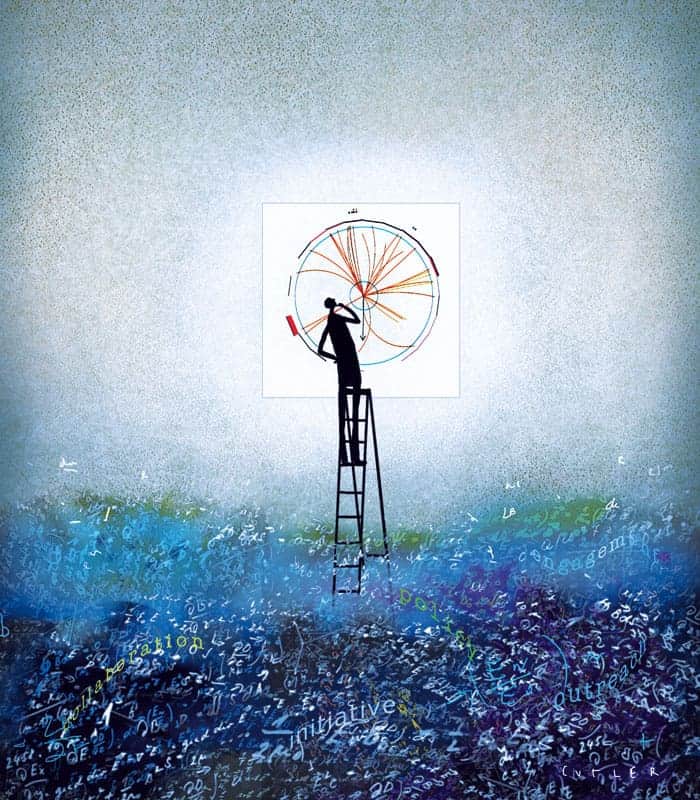
It’s an issue tackled in the cover story of the April issue of Physics World magazine by Felicity Mellor from Imperial College London, who runs a project called “Silences of Science“. The cover of this month’s issue was specially commissioned by us from artist Dave Cutler.
As Mellor puts it, current research policy – in the UK at least – emphasizes silence’s opposite. “From assessing publications and rewarding collaborations, to requirements for public engagement, policy initiatives urge scientists to speak up,” she writes.
Yet there is a danger, Mellor warns, that in the midst of all this enforced interaction, an important precondition for creativity in physics could be lost. “With all these demands to talk, do scientists still have the chance to think?” she wonders.
If you’re a member of the Institute of Physics (IOP), you can read Mellor’s article in the digital edition of the magazine. If you’re not yet in the IOP, you can join now to get full access to Physics World as well as many other member benefits.
The article, which will also be available on this website from 3 April, examines some of the giants of physics who benefited from silence – including Newton, Einstein, Dirac and Cavendish – before ending with this stark observation. “Delete the silences from speech, and one is left with incoherent babble,” Mellor notes. “Delete the silences from scientific research and perhaps the result will be nothing but noise.”
Elsewhere in the April issue, Daniel Clery – author of A Piece of the Sun: the Quest for Fusion Energy – examines a highly critical report into the management of the ITER fusion experiment. You can find out about recent observations suggesting the Milky Way undulates up and down and then take stock of the latest exoplanet discoveries. There’s also a bumper Feedback section, while in this month’s Lateral Thoughts Sidney Perkowitz examines a strange tale about Jackson Pollock.
For the record, here’s a a run-down of the highlights of the issue.
• ITER faces management turmoil – A scathing report into the management of the ITER fusion experiment has thrown the whole project in the spotlight and even calls for the director-general to go, as Daniel Clery reports
• Brazil science minister sets global goals – Marco Antonio Raupp, the mathematical physicist who is now Brazil’s minister of science, technology and innovation, talks to Physics World about the challenges and opportunities for Brazilian research
• Critical Point: Patenting science – Are you aware of cases where patents have hindered or prevented fundamental research? If so, Robert P Crease wants to know
• Penalizing Iranian research – Abbas Ali Saberi calls for an end to sanctions that are hurting physics and physicists in Iran
• Our wobbly galaxy – It is well known that the Milky Way rotates around a supermassive black hole, but researchers have found that our galaxy undulates up and down as well like a giant galactic merry-go-round. Katia Moskvitch reports on this surprising finding
• The power of silence – Collaboration, engagement, outreach – the modern physicist is continually encouraged to keep talking and communicating. Felicity Mellor wonders if it would be better if we simply stayed silent
• Planets galore – With almost 1700 planets beyond our solar system having been discovered, climatologists are beginning to sketch out what these alien worlds might look like, as David Appell reports
• Hunting for neutrinos – Brian Clegg reviews The Neutrino Hunters by Ray Jayawardhana
An international group of astronomers is calling for people to stop using their microwave ovens for 24 hours next April to give scientists a better chance of finding gravitational waves.
The ubiquitous kitchen gadgets broadcast copious amounts of electromagnetic radiation at frequencies around 2.45 GHz – exactly that of the cosmic microwave background, which bears the signature of gravitational waves from the early universe.
The call for a one-day global microwave oven ban comes just a fortnight after scientists detected B-mode polarization from the early universe using the BICEP2 telescope at the South Pole.
That discovery, which was the first evidence that the early universe went through a very rapid period of expansion known as “inflation”, was possible in part because microwave ovens are already banned at the pole.
But to make a definitive detection of primordial gravitational waves, BICEP2’s astronomers need to rule out stray signals from the estimated one billion microwave ovens used in kitchens around the world. These appliances currently interfere with their telescope’s sensitive CMB detectors.
“We are calling for everyone to leave their ready-meal lasagnes in the fridge and keep their microwave ovens firmly turned off for one day next April,” says radio astronomer Amana Range, who is running the “Switch Microwaves Off Now” (S-NOW) initiative from its headquarters in the Jodrell Bank Observatory. “We want people to keep those frozen curries in the freezer.”
Scientists working at the pole already survive for six months a year during the Antarctic winter without microwavable ready meals and Range thinks that for the rest of the world to leave their mirowave silent for a day is a small price to pay in uncovering the secrets of the universe.
In fact, Range, thinks that encouraging people to not ping their microwaves is a great example of a “citizen-science” project in action. The University of Macclesfield astronomer, who admits tucking into the occasional Marks and Spencer microwaveable lamb bhuna during long nights on the radio telescope, is already in talks with UNESCO to make the S-NOW project part of the International Year of Light.
However, not everyone is supporting the campaign. Sir Dixon Curry-Argos, head of the Small Appliance Distribution Organisation (SADO) said that microwave ovens are “a modern hearth for hard-working families”. He added, “I will be starting my day as usual with a bowl of microwaved porridge.”