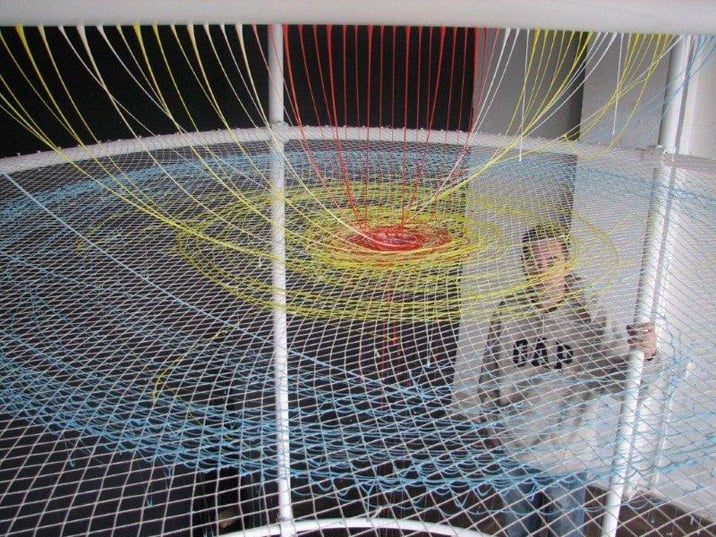
Art, physics and performance painting

Photo of artwork created by Adrian Pritchard

I was in London at the end of last week to attend a meeting on “Communicating physics through the arts” (PDF), which had been organized by the Physics Communicators Group of the Institute of Physics (IOP), which publishes Physics World.

Held at the IOP’s headquarters in London, the idea of the meeting was to “ask artists to explore how they use their knowledge of physics during the development of their work” and to see “how physics could be communicated to the public through their work”.

(more…)

The story of neutrinos

The story of neutrinos began in 1930, when Wolfgang Pauli suggested that an unknown neutral particle could account for some puzzling behaviour in radioactive decay. At the time, the idea was speculative at best, and Pauli knew it, joking to a friend he said “I have done a terrible thing. I have postulated a particle that cannot be detected.” A pair of experimentalists, Clyde Cowan and Frederick Reines, would eventually prove Pauli wrong, but subsequent efforts to study this new particle – which Enrico Fermi dubbed the neutrino, or “little neutral one” – seemed to raise more questions than they answered.

These stories – and others from the neutrino’s rich history – are the subject of Ray Jayawardhana’s book The Neutrino Hunters. Currently an astronomer at the University of Toronto, Jayawardhana is due to join Canada’s York University as Dean of Science in July 2014. In this podcast he talks to reviews editor Margaret Harris about the history of neutrinos, the experiments being done to study them and what we might learn from these “pathologically shy” particles about the nature of our universe.

Extraterrestrial espressos, quantum card-games, misunderstood science and more

Cartoon photo of astronaut enjoying espresso in space

Most of us can’t get our day started without a fortifying cup of coffee and astronauts are just the same. To help those on the International Space Station meet their caffeine cravings, Italian coffee king Lavazza has designed and built an espresso machine that will work in space! Called “ISSpresso” the machine will be blasted off into space in the possession of astronaut Samantha Cristoforetti, who will also be the first Italian woman in space. You can read all about the ISSpresso and its supreme blends on the Wired website.

(more…)

Is D-Wave’s quantum computer actually a quantum computer?

A team of quantum-computing experts in the US and Switzerland has published a paper in Science that casts doubt over the ability of the D-Wave Two quantum processor to perform certain computational tasks. The paper, which first appeared as a preprint earlier this year, concludes that the processor – built by the controversial Canadian firm D-Wave Systems – offers no advantage over a conventional computer when it is used to solve a benchmark computing problem.

While the researchers say that their results do not rule out the possibility that the processor can outperform conventional computers when solving other classes of problems, their work does suggest that evaluating the performance of a quantum computer could be a much trickier task than previously thought. D-Wave has responded by saying that the wrong benchmark problem was used to evaluate its processor, while the US–Swiss team now intends to do more experiments using different benchmarks.

Quantum insights

D-Wave Two is the second generation of quantum processors sold by D-Wave Systems and one of the devices is owned by NASA, Google and the Universities Space Research Association. The company has also sold a system – claimed to be the world’s first commercially available quantum computer – to Lockheed Martin. The tests on D-Wave Two were carried out by Matthias Troyer and colleagues at ETH Zurich, the University of Southern California (USC), the University of California Santa Barbara, Google and Microsoft.

Containing 512 quantum bits (qubits), the D-Wave Two processor was designed specifically to perform a process called “quantum annealing”, which is a technique for finding the global minimum of a complicated mathematical function. Unlike “conventional” quantum computers – which are kept in a fragile quantum state throughout the calculation – quantum annealing involves making a transition from a quantum to classical system. As a result, D-Wave’s approach might be more immune to noise, which can destroy conventional quantum calculations. However, a quantum annealing processor is not a universal computer like a PC and cannot be programmed to perform a range of tasks.

Fiendishly difficult calculation

Troyer’s team tested the processor by using it to solve a particularly difficult task from condensed-matter physics involving “Ising spin glasses”. A spin glass is a magnetic material in which the individual magnetic moments – or spins – interact with each other and are also located randomly throughout the material. This is unlike conventional models of magnetic materials, in which the spins are arranged on a regular lattice and tend to all point in specific directions. Instead, the spin glass has an extremely complicated spin configuration that is fiendishly difficult to calculate for large numbers of spins. “Ising spin-glass problems are the ‘native’ problem that the [D-Wave Two] is designed for,” Troyer explained to physicsworld.com.

To evaluate the performance of D-Wave Two, the team measured how long it took the processor to solve an Ising spin-glass problem and compared this with the time it takes with a conventional, classical computer. This ratio, known as the “quantum speed-up”, is expected to be around one for small problems – meaning classical devices can do the job just as well – but it should grow in size as the problem becomes larger. In its test, the team carried out lots of quantum and classical simulations on different spin glasses, in which the number of spins and the interaction strengths were varied systematically.

No speed-up found

The results, however, reveal no clear evidence of speed-up. While the D-Wave Two processor was sometimes 10 times faster than the classical computer, it was also sometimes more than 100 times slower. Troyer and colleagues put forth several possible explanations for why speed-up was not seen. One is that although D-Wave Two functions as a quantum processor, quantum annealing offers no advantage over classical methods. Another possibility is that noise or other operational problems mean that the device is not operating as a quantum processor.

A third, intriguing prospect put forth by Troyer and colleagues is that speed-up could still be seen when D-Wave Two is used to solve other types of problems, even if it was not observed in the current test. Indeed, D-Wave itself claims that research done by a team led by Helmut Katzgraber at Texas A&M University suggests that Ising spin-glass problems cannot be solved quicker using quantum annealing. Moreover, Jeremy Hilton – D-Wave’s vice-president for processor development – points out more recent work done by Itay Hen of USC and colleagues, which – he says – shows that “a new benchmark has demonstrated better performance of the D-Wave 512 qubit processor over the simulated annealing algorithm developed by Troyer et al.

Better-suited problems

“Katzgraber argues that 3D spin glasses may be better test cases that ‘might’ be better suited,” says Troyer. “We have found a way to implement such problems and are testing it now. Researchers at Google and NASA are also searching if there are problem classes that may show quantum speed-up.”

Troyer adds that the fundamental importance of the work presented in Science is that it describes a method for measuring quantum speed-up for devices with unknown potential, such as the D-Wave devices. With physicists worldwide focused on making larger and more complex quantum processors, such measurement techniques will become increasingly important.

The benchmark testing is described in Science.

Electrons’ magnetic interactions isolated at long last

A measurement of the extremely weak magnetic interaction between two single electrons has been carried out by an international team of physicists. Using experimental techniques first developed for quantum-information and ion-trapping technologies, the team made its measurement despite the presence of magnetic noise, which is a million times stronger than the signal it was seeking. Apart from measuring magnetism at the shortest length scale thus far, the researchers say that their technique could be applied to other measurement scenarios where noise is a dominant factor, such as for quantum-error corrections.

Since the 1920s, researchers have known that the electron possesses an intrinsic angular momentum and an associated magnetic moment – known as its spin magnetic moment. Essentially, each electron acts like a tiny, indivisible magnetic dipole that is affected by magnetic fields. Although researchers have accurately measured the magnetic field of an individual electron, the magnetic interactions between two electrons have proved much more difficult to observe. When two electrons are separated by a very small distance (atomic-scale separations), the magnetic interactions are at their strongest and should be easy to measure. However, in this scenario Pauli’s exclusion principle and Coulomb electrical repulsion dominate the interactions between the electrons, drowning out the magnetic interaction. While these two effects weaken as the electrons move further apart, so does the magnetic interaction, which is then almost completely obscured by ambient magnetic noise.

Isolated interactions

One way of coping with this noise is to completely isolate the electrons from the environment – a technique that is often employed in quantum-information processing. This is the concept that Shlomi Kotler, from the Weizmann Institute of Science, Israel, and colleagues adopted to make their exquisite measurements. Indeed, Kotler says that the team’s measurement was performed at a scale “which is quite exotic – two microns. It is the size of an E. coli bacteria”, meaning that “the most dominant process is not of force between the electrons but of noise”. He further explains that the main tool used by the team to make its measurement was that of “decoherence-free subspaces” – a quantum-computing technique where a system is completely decoupled from its environment to protect information.

Kotler likens the difficulty of this measurement to trying to measure the size of a pea floating in the ocean, with huge waves of noise moving it erratically, across a distance of kilometres. While it would initially seem impossible to make the measurement (thanks to the pea’s constant movement), the trick would be to float alongside the pea. In that case, a wave would have the same effect on the pea and the observer, so that the effect of the waves would be inconsequential. In the researchers’ experiment, one electron is trying to sense the magnetic field of the other. “But that field is riding on top of magnetic noise in the lab, which is a million times bigger,” says Kolter. “The only way to make this measurement possible is to place the two electrons on an equal footing with respect to the ambient magnetic noise. This way, magnetic noise becomes irrelevant.”

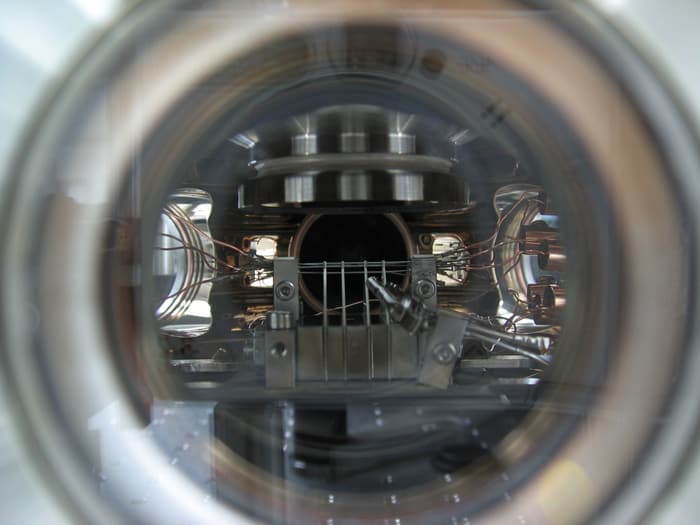
Photograph of the experimental set-up, including the trap

To do so, the team uses two strontium (88Sr+ ) ions, in a vacuum chamber at a fixed distance of 2 μm from one another, held using a Paul ion trap. Each ion has a single ground-state, spin-1/2 valence electron and no nuclear spin. Using lasers tuned to the atomic transition of the ions, the team manipulated the electrons and prepared them in an initial state where the north pole of one electron is facing the north pole of the other. Like a regular bar magnet, the like poles repel each other and would rotate, thereby interacting. But as the magnets in this case are electrons, quantum effects come into play and the electrons become entangled in what Kolter describes as “both a north–north and south–south facing state”.

Elongated entanglement

Even more surprising is that this naturally created entanglement lasts for 15 s – a surprisingly long time for a system to remain in a coherent, quantum state. After that time, the researchers use laser pulses to detect “whether their north poles are facing or anti-facing each other”. By varying the separation between the two ions, they were able to measure the strength of the magnetic interaction as a function of distance – confirming the expected inverse-cubic (1/d3) dependence of the interaction.

Kolter told physicsworld.com that while the result itself was not surprising – current theories say that magnetism behaves similarly at all scales – it was how long the electrons were entangled for that was unexpected. “Our main surprise was the coherence – the fact that the electrons behaved quantum-mechanically for a ‘human-scale duration’ (15 s and more) and that the tiny forces of magnetism are still strong enough to entangle the two particles over this time. In many respects this is unprecedented.” Conventionally, quantum mechanics is thought to work for tiny systems at short time scales. The team’s system was rather large – 2 µm and so, almost macroscopic – and it still preserved the quantum-mechanical property of entanglement for an extremely long time.

Kolter points out that, nearly 20 years ago, quantum-computation experiments adapted advanced spectroscopic tools to generate entanglement between massive particles, and spectroscopy has been a driving force in experimental quantum computing ever since. Now, Kolter’s research has turned this around by using quantum-computing tools to “do a very sensitive spectroscopy experiment. We believe that this trend will continue to be fruitful in the near future”, he says. Beyond validating the behaviour of the magnetic force at the micron scale, the team’s system could be used to set a bound on “anomalous spin forces” that might come into play beyond Standard Model physics. But it could also be generalized and applied to other scenarios, such as for quantum-error correction protocols.

The research was published in Nature.

A network analysis of the FIFA World Cup

(Courtesy: Paolo Cintia and Luca Pappalardo)

By James Dacey

The FIFA World Cup is under way in Brazil as the national teams from 32 nations battle it out on the pitch for the most prestigious prize in football. It is also an exciting month for football fans across the world as everyone suddenly becomes an expert on the game. Offices, bars and cafes around the world echo with the sound of post-match analysis.

This post-match dissection has now been taken to another level by a pair of computer scientists at the University of Pisa in Italy. At the request of Physics World, Paolo Cintia and Luca Pappalardo have carried out a network analysis of the opening match of the tournament, which saw the hosts Brazil defeat Croatia by three goals to one. Cintia and Pappalardo have viewed the match as if it were an evolving network where players represent nodes that interact by passing the ball to each other along “edges”.

(more…)

Women Rock Science author bags new student-science award

The photo above shows me presenting the inaugural Student Science Publication Award, sponsored by the Institute of Physics and IOP Publishing, which publishes Physics World, to Hadiza Mohammed of the online magazine Women Rock Science. She is a working civil engineer currently doing a Master’s in advanced environmental and energy studies.

The award, which was launched this year, recognizes student journalists who produce a regular science publication and seeks in part to nurture the next generation of science writers. It forms part of the annual awards given by the Association of British Science Writers and was presented at a reception held at the Royal Society in London as the culmination of this year’s UK Conference of Science Journalists.

(more…)

Good scientists and honest people

In early 1948, less than three years after the end of the Second World War in Europe, Werner Heisenberg – the Nobel laureate and physicist leader of the failed German atomic bomb project – was invited to the UK as part of an attempt to repair relations between British and German physicists. While in Oxford, Heisenberg spent some time at the house of Francis (formerly Franz) Simon, a low-temperature physicist and one of the many German-Jewish scientists who had left Germany for the UK soon after Hitler came to power in 1933.

Like almost all German Jews, Simon had lost numerous members of his family, not to mention some scientist colleagues, in Nazi death camps. He had also worked enthusiastically in the British “Tube Alloys” programme to build an atomic bomb, and is credited with suggesting, in 1940, the basic process of separating fissionable uranium-235 from the more stable uranium-238 via gaseous diffusion of uranium hexafluoride through a porous barrier. (Initially, his wife’s kitchen sieve, hammered flat, served as the barrier.) This technique was subsequently adopted by the American-led Manhattan Project and further developed between 1942 and 1945, with some advice from Simon during his visits to the US.

In short, Simon was well acquainted with the difficulty of building an atomic bomb, and was under no illusions about what Hitler would have done with one if Heisenberg’s project had succeeded. As such, the conversation that took place between Simon and Heisenberg during the latter’s visit to Oxford must have been little short of surreal.

We know about this conversation because of a fascinating letter Simon wrote afterwards – a letter that is unfamiliar to biographers of Heisenberg, and is reproduced, apparently for the first time, in Nuclear Dawn, Kenneth McRae’s biography of Simon. The letter was written as a report to Simon’s colleague and friend Michael Perrin, a deputy director of Tube Alloys who had played a key role in corralling the chief German nuclear scientists at Farm Hall, Cambridgeshire, in mid-1945. During their enforced stay at the hall, British intelligence secretly recorded their revelatory private conversations – including Heisenberg’s incredulous and discombobulated reaction to a BBC radio report about the atomic bombing of Hiroshima on 6 August.

By the time he visited Oxford, however, Heisenberg’s attitude had changed. “Heisenberg claims that German scientists had no other wish than to prevent Hitler from getting the bomb,” Simon reported in his letter to Perrin. According to Heisenberg, he added, “They knew about everything, including the fast neutron reaction and the possibility of using plutonium, but all their actions were determined by their aim to mislead Hitler and the ‘high ups’ about the possibilities of a bomb. [Heisenberg] said that if he had gone to Hitler at the beginning of the war and told him what he knew, then he was quite sure that Germany could have developed the atomic bomb just like the Allies!”

When Simon openly doubted this account – without giving away his inside knowledge of the Farm Hall recordings – Heisenberg insisted on its truth. Simon’s analysis of the situation is astute: “I am quite sure that Heisenberg, like many other Germans, is a strictly honest person in his private life,” he wrote, “but as soon as the greater glory of the ‘fatherland’ is involved – and perhaps also his glory as a scientist – it is quite a different matter. Whether he now deliberately tells these falsehoods I cannot say. It is quite possible that … he has so persuaded himself that this picture is correct that he now seriously believes in it.”

Although Nuclear Dawn is the first book to include this letter, it is not the first biography of Simon. In 1966, 10 years after his premature death, Simon’s former secretary at Oxford’s Clarendon Laboratory, Nancy Arms, published a brief but exceptionally vivid portrait of him called A Prophet in Two Countries. Arms had the full support of Simon’s widow Lotte, who gave her access to his extensive personal papers (including his wartime diaries while advising the Manhattan Project), and Richard Rhodes drew on Arms’ account in his classic history The Making of the Atomic Bomb. Nuclear Dawn is similarly well informed: the author, McRae, is Lotte’s son-in-law, and he quotes from Simon’s diaries in great detail.

McRae is a retired political scientist, rather than a historian of science or a biographer. Accordingly, the strongest parts of his book are the sections about politics, especially those dealing with Simon’s dedicated but abortive attempts to encourage the British occupation authorities to de-Nazify German academe after 1945. Heisenberg’s arrogance and self-deception were, in Simon’s view, tolerable because of his brilliance, but he abhorred the retrograde reappointment of mediocre scientists known to have behaved opportunistically (or worse) before and during the war. In objecting to a proposal to invite an openly Nazi physicist, Eduard Justi, to the UK at the same time as Heisenberg, Simon argued to an unconvinced Nevill Mott: “What the world needs now are not so much good scientists – there are plenty of them – as honest people.” Simon always refused to accept the idea that science and politics belong in separate realms, which was the main excuse of his former German physics colleagues for their passivity in the Third Reich – as discussed in Philip Ball’s recent history Serving the Reich (see our review).

The weakest aspect of Nuclear Dawn is that it is neither a full-fledged biography nor a full study of the projects to build an atomic bomb in Britain, Germany, Japan, the Soviet Union and the US. Simon’s childhood and youth are virtually omitted, for example, and in a lengthy (if insightful) chapter comparing and contrasting the five national bomb projects, he entirely vanishes from view. A shorter book concentrating only on Simon would have worked better, and could perhaps have told us more about his other achievements, which included a British knighthood (added to the German Iron Cross, First Class he won for gallantry in the First World War) and his role in establishing what would eventually become the world’s most distinguished group in low-temperature physics. As the one-time head of the Clarendon Laboratory, Frederick Lindemann (Lord Cherwell) wrote of Simon in an obituary: “Not only was he supreme in experimental research; he had a clearer and more fundamental understanding of the basis of thermodynamics with statistical mechanics than any man since Einstein.” Despite its gaps, however, Nuclear Dawn is an invaluable source for historians of the Anglo–American atomic bomb project, especially as it concerns the life of a physicist who deserves to be more clearly remembered.

  • 2014 Oxford University Press £35.00hb 284pp

Web life: Excursion Set

So what is this site about?

Excursion Set is a blog written by Richard Easther, a theoretical cosmologist at the University of Auckland, New Zealand. “To a mathematician or an astrophysicist, the phrase ‘excursion set’ is a term of art,” he explains. “But it also suggests a series of adventures, and on my blog I make excursions into cosmology, astrophysics, particle physics, science news and scientific perspectives on everyday life.”

What are some of the topics covered?

As the above explanation suggests, it is common for Easther’s blog posts to begin with one subject and then lead, via a pleasant and logical path, to a different one. A blog post on “The angle of repose”, for example, begins with an account of Easther’s research-related visit to the Yukawa Institute for Theoretical Physics in Kyoto, Japan. Pretty soon, however, he takes an excursion to a nearby temple, and before you know it, he’s into the physics of Zen sand-gardening and the difficulties of maintaining the temple’s beautiful, UNESCO-listed sandcastle. At the end, he concludes that “playing with sand provides work for physicists as well as for gardening monks”. In another post, he declares that “making up stories about the material world seems to be one of the few universal human activities”, and then deftly turns an explanation of his recent work on N-body simulations into a romantic comedy of gravitational attraction.

Anything else?

Bad or over-hyped science reporting is another common theme. Unusually, though, he seems to think this is partly the fault of specialist science bloggers, and not just mainstream journalists. Bloggers and Tweeters are, he notes, “key consumers of the media releases cranked out by Nature and university media people, and come largely from the same demographic as the scientists who complain about pressure to sex [their research] up for Nature. If Nature didn’t exist, would we have needed to invent it?”

Why should I visit?

Easther is a good science communicator, and although his blog isn’t updated all that often (about twice a month on average), he’s had some interesting things to say when big science stories have emerged. In March 2013, for example, he live-blogged the release of data from the Planck team, and earlier this year he was one of many contributors to online discussions of the BICEP2 results. This debate, he points out, is a great example of “open science” in action, with hundreds or even thousands of scientists worldwide scrutinizing the results to determine whether they really constitute evidence for cosmic inflation. And contrary to the idea that nobody would eat sausage if they could see it being made, he argues, “a sausage factory with a window is more likely to be a sausage factory that is spotlessly clean and uses top-quality raw materials”.

Can you give me a sample quote?

From a post about BICEP2 on 17 April: “For theoretical physicists, ambulance chasing involves getting papers out quickly after a major data release. Some ambulance chasers make significant contributions, some are just trying to draw attention to their earlier work, while others are banging out insubstantial papers in the hope that they will be cited by their slower colleagues. But whatever their motives, cosmologists have certainly been busy: the BICEP2 discovery paper has been cited 188 times on arXiv, all in preprints written within a month of the original announcement. I am pretty sure this is a world record, and you can always check the current tally. In fairness, though, cosmologists were so giddy about BICEP2 it wouldn’t have surprised me if someone had stolen an ambulance and driven it in circles, flashing the lights and letting rip with the siren.”

Entangled clocks could provide accurate world time standard

Plans for a global network of atomic clocks that are synchronized using quantum entanglement have been unveiled by physicists in the US. The resulting universal time standard would be more accurate than is currently possible with individual atomic clocks, and the network could also be used to do a range of fundamental and applied research, such as mapping the Earth’s gravitational field or even testing new theories of gravity. While some of the technologies needed to build the network already exist, other elements still need further development.

Atomic clocks have revolutionized the world in ways that were unimaginable when the first atomic clock was built in 1949. The Global Positioning System (GPS), for example, uses atomic clocks to measure the travel time of signals from four satellites to a GPS receiver almost anywhere on Earth. As clocks have become more accurate, researchers have proposed ever-more-exotic applications such as relativistic geodesy, in which the strength of gravity at various points, and therefore the local density of the Earth, could be mapped by measuring variations in the rates of clocks at different locations. Scientists have also suggested that ultra-accurate atomic clocks placed in outer space could detect gravitational waves.

The ultimate limits on the stability of a single atomic clock are determined by Heisenberg’s uncertainty principle, which limits how precisely a system’s oscillations can be measured. This has been drastically reduced in recent years with the invention of optical lattice clocks containing thousands of particles, allowing the quantum uncertainty to be reduced by averaging. In the new research, Mikhail Lukin’s quantum-optics group at Harvard University has teamed up with Jun Ye’s quantum-metrology group at the National Institute for Standards and Technology (NIST), the JILA Lab and the University of Colorado. Ye’s team holds the current world record for clock accuracy, and now the two groups have come up with a way to make an even better timekeeper by effectively combining several atomic clocks into one.

Entangled super clock

Their plan involves many clocks, all stationed in different countries and connected by both classical and quantum links. In each cycle of the synchronization process, one clock (the “central clock”) sends out one photon from an entangled pair to each of the other clocks, via the quantum link. This allows the clocks to prepare a single, collective entangled state and to transfer this entangled state on to the atoms in the clocks. Each clock then measures this collective entangled state and, after doing so, it uses the classical link to send both its own laser frequency and the phase difference it measures between this laser frequency and the atoms to the central clock. The central clock can then calculate the average phase difference and use it to calculate the correction that needs to be applied to the frequency to bring all the clocks back into phase. The clocks thereby reduce their uncertainty by collectively averaging over all the atoms in all the clocks, effectively behaving as a single, super-accurate atomic clock.

This distributed set-up would provide all the participating parties with access to the ultra-precise time signal at any time, creating a universal time standard. The network would also be more secure against physical attack because, even if one of the systems were disabled, each party could fall back on its own atomic clock. Finally, it might be possible to use changes in the rate of individual clocks to detect gravitational waves or even to test new theories of gravity. “If you have this very good reference, and there is a local node that doesn’t follow this reference, then that’s a signal,” explains Lukin. It could either mean that the clock is not working properly, he says, or it might represent something more fundamental. In principle, one of the clocks could be taken out of the Earth’s gravitational field to make non-local tests of fundamental physics, for example, although the engineering challenges would be severe.

Far-fetched but well-reasoned

Eugene Polzik, a quantum-optics expert whose team at the Niels Bohr Institute in Copenhagen built the first atomic clock containing entangled atoms, describes the proposal as “very interesting and important”. He says, however, that before the scheme can be realized, two main technical hurdles must be overcome. First, scientists must successfully generate the giant quantum state containing far more atoms than has so far been achieved, and second, quantum repeaters will have to be developed to allow entanglement distribution around the world. “We have to dream,” he concludes. “And it’s always good to have a far-fetched proposal, which is backed up by reason, and that’s exactly what this paper is doing.”

The proposal is described in Nature Physics.

Copyright © 2026 by IOP Publishing Ltd and individual contributors