Physicists in Austria have shown that the static electricity acquired by identical material samples can evolve differently over time, based on each samples’ history of contact with other samples. Led by Juan Carlos Sobarzo and Scott Waitukaitis at the Institute of Science and Technology Austria, the team hope that their experimental results could provide new insights into one of the oldest mysteries in physics.
Static electricity – also known as contact electrification or triboelectrification — has been studied for centuries. However, physicists still do not understand some aspects of how it works.
“It’s a seemingly simple effect,” Sobarzo explains. “Take two materials, make them touch and separate them, and they will have exchanged electric charge. Yet, the experiments are plagued by unpredictability.”
This mystery is epitomized by an early experiment carried out by the German-Swedish physicist Johan Wilcke in 1757. When glass was touched to paper, Wilcke found that glass gained a positive charge – while when paper was touched to sulphur, it would itself become positively charged.
Triboelectric series
Wilcke concluded that glass will become positively charged when touched to sulphur. This concept formed the basis of the triboelectric series, which ranks materials according to the charge they acquire when touched to another material.
Yet in the intervening centuries, the triboelectric series has proven to be notoriously inconsistent. Despite our vastly improved knowledge of material properties since the time of Wilcke’s experiments, even the latest attempts at ordering materials into triboelectric series have repeatedly failed to hold up to experimental scrutiny.
According to Sobarzo’s and colleagues, this problem has been confounded by the diverse array of variables associated with a material’s contact electrification. These include its electronic properties, pH, hydrophobicity, and mechanochemistry, to name just a few.
In their new study, the team approached the problem from a new perspective. “In order to reduce the number of variables, we decided to use identical materials,” Sobarzo describes. “Our samples are made of a soft polymer (PDMS) that I fabricate myself in the lab, cut from a single piece of material.”
Starting from scratch
For these identical materials, the team proposed that triboelectric properties could evolve over time as the samples were brought into contact with other, initially identical samples. If this were the case, it would allow the team to build a triboelectric series from scratch.
At first, the results seemed as unpredictable as ever. However, as the same set of samples underwent repeated contacts, the team found that their charging behaviour became more consistent, gradually forming a clear triboelectric series.
Initially, the researchers attempted to uncover correlations between this evolution and variations in the parameters of each sample – with no conclusive results. This led them to consider whether the triboelectric behaviour of each sample was affected by the act of contact itself.
Contact history
“Once we started to keep track of the contact history of our samples – that is, the number of times each sample has been contacted to others–the unpredictability we saw initially started to make sense,” Sobarzo explains. “The more contacts samples would have in their history, the more predictable they would behave. Not only that, but a sample with more contacts in its history will consistently charge negative against a sample with less contacts in its history.”
To explain the origins of this history-dependent behaviour, the team used a variety of techniques to analyse differences between the surfaces of uncontacted samples, and those which had already been contacted several times. Their measurements revealed just one difference between samples at different positions on the triboelectric series. This was their nanoscale surface roughness, which smoothed out as the samples experienced more contacts.
“I think the main take away is the importance of contact history and how it can subvert the widespread unpredictability observed in tribocharging,” Sobarzo says. “Contact is necessary for the effect to happen, it’s part of the name ‘contact electrification’, and yet it’s been widely overlooked.”
The team is still uncertain of how surface roughness could be affecting their samples’ place within the triboelectric series. However, their results could now provide the first steps towards a comprehensive model that can predict a material’s triboelectric properties based on its contact-induced surface roughness.
Sobarzo and colleagues are hopeful that such a model could enable robust methods for predicting the charges which any given pair of materials will acquire as they touch each other and separate. In turn, it may finally help to provide a solution to one of the most long-standing mysteries in physics.
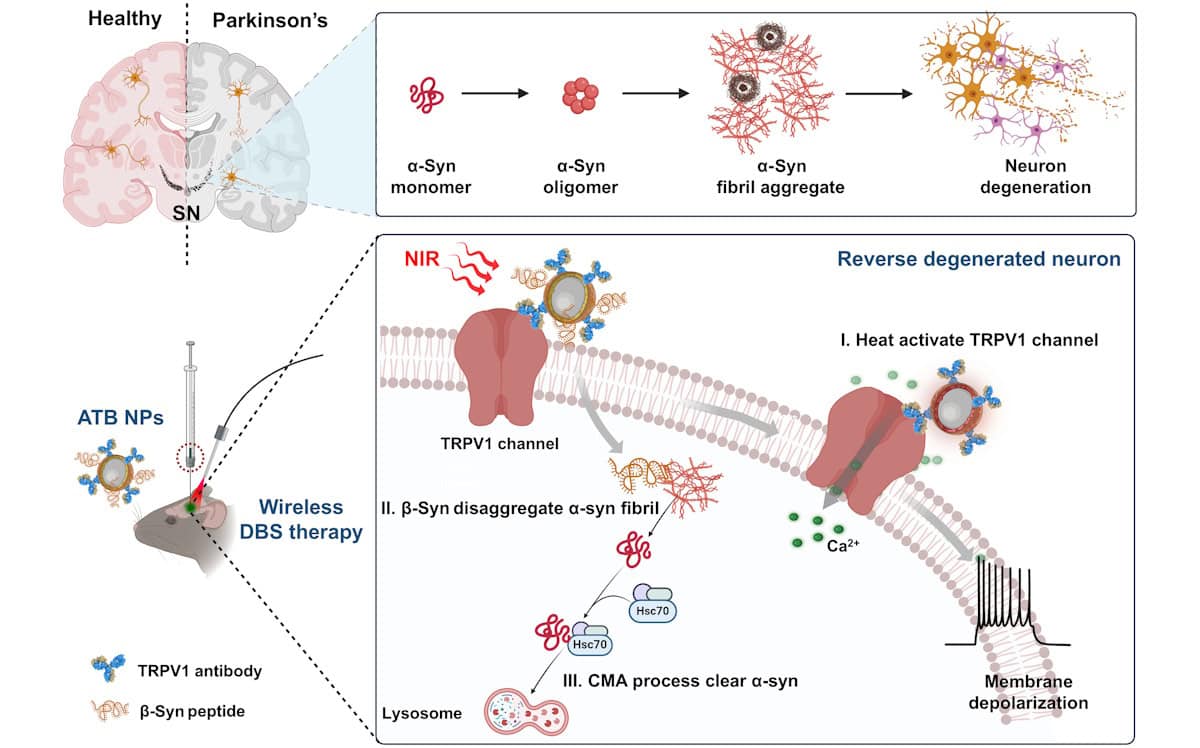
Nanoparticle-mediated DBS (I) Pulsed NIR irradiation triggers the thermal activation of TRPV1 channels. (II, III) NIR-induced β-syn peptide release into neurons disaggregates α-syn fibrils and thermally activates autophagy to clear the fibrils. This therapy effectively reverses the symptoms of Parkinson’s disease. Created using BioRender.com. (Courtesy: CC BY-NC/Science Advances 10.1126/sciadv.ado4927)
A photothermal, nanoparticle-based deep brain stimulation (DBS) system has successfully reversed the symptoms of Parkinson’s disease in laboratory mice. Under development by researchers in Beijing, China, the injectable, wireless DBS not only reversed neuron degeneration, but also boosted dopamine levels by clearing out the buildup of harmful fibrils around dopamine neurons. Following DBS treatment, diseased mice exhibited near comparable locomotive behaviour to that of healthy control mice.
Parkinson’s disease is a chronic brain disorder characterized by the degeneration of dopamine-producing neurons and the subsequent loss of dopamine in regions of the brain. Current DBS treatments focus on amplifying dopamine signalling and production, and may require permanent implantation of electrodes in the brain. Another approach under investigation is optogenetics, which involves gene modification. Both techniques increase dopamine levels and reduce Parkinsonian motor symptoms, but they do not restore degenerated neurons to stop disease progression.
Team leader Chunying Chen from the National Center for Nanoscience and Technology. (Courtesy: Chunying Chen)
The research team, at the National Center for Nanoscience and Technology of the Chinese Academy of Sciences, hypothesized that the heat-sensitive receptor TRPV1, which is highly expressed in dopamine neurons, could serve as a modulatory target to activate dopamine neurons in the substantia nigra of the midbrain. This region contains a large concentration of dopamine neurons and plays a crucial role in how the brain controls bodily movement.
Previous studies have shown that neuron degeneration is mainly driven by α-synuclein (α-syn) fibrils aggregating in the substantia nigra. Successful treatment, therefore, relies on removing this build up, which requires restarting of the intracellular autophagic process (in which a cell breaks down and removes unnecessary or dysfunctional components).
As such, principal investigator Chunying Chen and colleagues aimed to develop a therapeutic system that could reduce α-syn accumulation by simultaneously disaggregating α-syn fibrils and initiating the autophagic process. Their three-component DBS nanosystem, named ATB (Au@TRPV1@β-syn), combines photothermal gold nanoparticles, dopamine neuron-activating TRPV1 antibodies, and β-synuclein (β-syn) peptides that break down α-syn fibrils.
The ATB nanoparticles anchor to dopamine neurons through the TRPV1 receptor then, acting as nanoantennae, convert pulsed near-infrared (NIR) irradiation into heat. This activates the heat-sensitive TRPV1 receptor and restores degenerated dopamine neurons. At the same time, the nanoparticles release β-syn peptides that clear out α-syn fibril buildup and stimulate intracellular autophagy.
The researchers first tested the system in vitro in cellular models of Parkinson’s disease. They verified that under NIR laser irradiation, ATB nanoparticles activate neurons through photothermal stimulation by acting on the TRPV1 receptor, and that the nanoparticles successfully counteracted the α-syn preformed fibril (PFF)-induced death of dopamine neurons. In cell viability assays, neuron death was reduced from 68% to zero following ATB nanoparticle treatment.
Next, Chen and colleagues investigated mice with PFF-induced Parkinson’s disease. The DBS treatment begins with stereotactic injection of the ATB nanoparticles directly into the substantia nigra. They selected this approach over systemic administration because it provides precise targeting, avoids the blood–brain barrier and achieves a high local nanoparticle concentration with a low dose – potentially boosting treatment effectiveness.
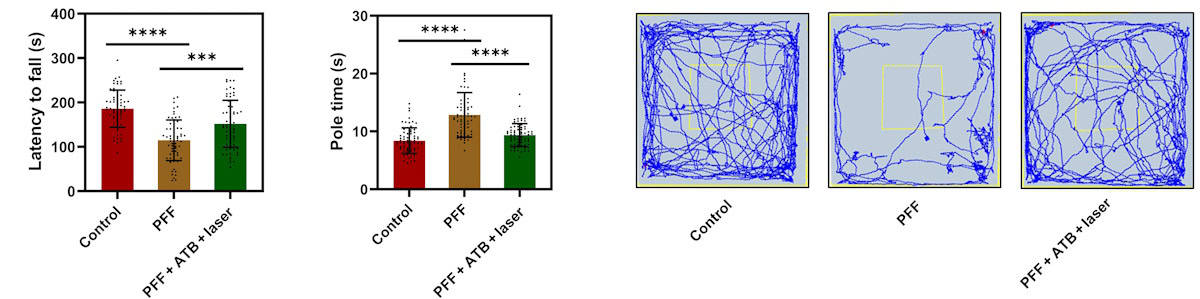
Following injection of either nanoparticles or saline, the mice underwent pulsed NIR irradiation once a week for five weeks. The team then performed a series of tests to assess the animals’ motor abilities (after a week of training), comparing the performance of treated and untreated PFF mice, as well as healthy control mice. This included the rotarod test, which measures the time until the animal falls from a rotating rod that accelerates from 5 to 50 rpm over 5 min, and the pole test, which records the time for mice to crawl down a 75 cm-long pole.
Motor tests Results of (left to right) rotarod, pole and open field tests, for control mice, mice with PFF-induced Parkinson’s disease, and PFF mice treated with ATB nanoparticles and NIR laser irradiation. (Courtesy: CC BY-NC/Science Advances 10.1126/sciadv.ado4927)
The team also performed an open field test to evaluate locomotive activity and exploratory behaviour. Here, mice are free to move around a 50 x 50 cm area, while their movement paths and the number of times they cross a central square are recorded. In all tests, mice treated with nanoparticles and irradiation significantly outperformed untreated controls, with near comparable performance to that of healthy mice.
Visualizing the dopamine neurons via immunohistochemistry revealed a reduction in neurons in PFF-treated mice compared with controls. This loss was reversed following nanoparticle treatment. Safety assessments determined that the treatment did not cause biochemical toxicity and that the heat generated by the NIR-irradiated ATB nanoparticles did not cause any considerable damage to the dopamine neurons.
Eight weeks after treatment, none of the mice experienced any toxicities. The ATB nanoparticles remained stable in the substantia nigra, with only a few particles migrating to cerebrospinal fluid. The researchers also report that the particles did not migrate to the heart, liver, spleen, lung or kidney and were not found in blood, urine or faeces.
Chen tells Physics World that having discovered the neuroprotective properties of gold clusters in Parkinson’s disease models, the researchers are now investigating therapeutic strategies based on gold clusters. Their current research focuses on engineering multifunctional gold cluster nanocomposites capable of simultaneously targeting α-syn aggregation, mitigating oxidative stress and promoting dopamine neuron regeneration.
Three decades ago – in May 1995 – the British-born mathematical physicist Freeman Dyson published an article in the New York Review of Books. Entitled “The scientist as rebel”, it described how all scientists have one thing in common. No matter what their background or era, they are rebelling against the restrictions imposed by the culture in which they live.
“For the great Arab mathematician and astronomer Omar Khayyam, science was a rebellion against the intellectual constraints of Islam,” Dyson wrote. Leading Indian physicists in the 20th century, he added, were rebelling against their British colonial rulers and the “fatalistic ethic of Hinduism”. Even Dyson traced his interest in science as an act of rebellion against the drudgery of compulsory Latin and football at school.
“Science is an alliance of free spirits in all cultures rebelling against the local tyranny that each culture imposes,” he wrote. Through those acts of rebellion, scientists expose “oppressive and misguided conceptions of the world”. The discovery of evolution and of DNA changed our sense of what it means to be human, he said, while black holes and Gödel’s theorem gave us new views of the universe and the nature of mathematics.
But Dyson feared that this view of science was being occluded. Writing in the 1990s, which was a time of furious academic debate about the “social construction of science”, he feared that science’s liberating role was becoming hidden by a cabal of sociologists and philosophers who viewed scientists as like any other humans, governed by social, psychological and political motives. Dyson didn’t disagree with that view, but underlined that nature is the ultimate arbiter of what’s important.
Today’s rebels
One wonders what Dyson, who died in 2020, would make of current events were he alive today. It’s no longer just a small band of academics disputing science. Its opponents also include powerful and highly placed politicians, who are tarring scientists and scientific findings for lacking objectivity and being politically motivated. Science, they say, is politics by other means. They then use that charge to justify ignoring or openly rejecting scientific findings when creating regulations and making decisions.
Thousands of researchers, for instance, contribute to efforts by the United Nations Intergovernmental Panel on Climate Change (IPCC) to measure the impact and consequences of the rising amounts of carbon dioxide in the atmosphere. Yet US President Donald Trump –speaking after Hurricane Helene left a trail of destruction across the south-east US last year – called climate change “one of the great scams”. Meanwhile, US chief justice John Roberts once rejected using mathematics to quantify the partisan effects of gerrymandering, calling it “sociological gobbledygook”.
In the current superheated US political climate, many scientific findings are charged with being agenda-driven rather than the outcomes of checked and peer-reviewed investigations
These attitudes are not only anti-science but also undermine democracy by sidelining experts and dissenting voices, curtailing real debate, scapegoating and harming citizens.
A worrying precedent for how things may play out in the Trump administration occurred in 2012 when North Carolina’s legislators passed House Bill 819. By prohibiting the use of models of sea-level rise to protect people living near the coast from flooding, the bill damaged the ability of state officials to protect its coastline, resources and citizens. It also prevented other officials from fulfilling their duty to advise and protect people against threats to life and property.
In the current superheated US political climate, many scientific findings are charged with being agenda-driven rather than the outcomes of checked and peer-reviewed investigations. In the first Trump administration, bills were introduced in the US Congress to stop politicians from using science produced by the Department of Energy in policies to avoid admitting the reality of climate change.
We can expect more anti-scientific efforts, if the first Trump administration is anything to go by. Dyson’s rebel alliance, it seems, now faces not just posturing academics but a Galactic Empire.
The critical point
In his 1995 essay, Dyson described how scientists can be liberators by abstaining from political activity rather than militantly engaging in it. But how might he have seen them meeting this moment? Dyson would surely not see them turning away from their work to become politicians themselves. After all, it’s abstaining from politics that empowers scientists to be “in rebellion against the restrictions” in the first place. But Dyson would also see them as aware that science is not the driving force in creating policies; political implementation of scientific findings ultimately depends on politicians appreciating the authority and independence of these findings.
One of Trump’s most audacious “Presidential Actions”, made in the first week of his presidency, was to define sex. The action makes a female “a person belonging, at conception, to the sex that produces the large reproductive cell” and a male “a person belonging, at conception, to the sex that produces the small reproductive cell”. Trump ordered the government to use this “fundamental and incontrovertible reality” in all regulations.
An editorial in Nature (563 5) said that this “has no basis in science”, while cynics, citing certain biological interpretations that all human zygotes and embryos are initially effectively female, gleefully insisted that the order makes all of us female, including the new US president. For me and other Americans, Trump’s action restructures the world as it has been since Genesis.
Still, I imagine that Dyson would still see his rebels as hopeful, knowing that politicians don’t have the last word on what they are doing. For, while politicians can create legislation, they cannot legislate creation.
In the teeth of the Arctic winter, polar-bear fur always remains free of ice – but how? Researchers in Ireland and Norway say they now have the answer, and it could have applications far beyond wildlife biology. Having traced the fur’s ice-shedding properties to a substance produced by glands near the root of each hair, the researchers suggest that chemicals found in this substance could form the basis of environmentally-friendly new anti-icing surfaces and lubricants.
The substance in the bear’s fur is called sebum, and team member Julian Carolan, a PhD candidate at Trinity College Dublin and the AMBER Research Ireland Centre, explains that it contains three major components: cholesterol, diacylglycerols and anteisomethyl-branched fatty acids. These chemicals have a similar ice adsorption profile to that of perfluoroalkyl (PFAS) polymers, which are commonly employed in anti-icing applications.
“While PFAS are very effective, they can be damaging to the environment and have been dubbed ‘forever chemicals’,” explains Carolan, the lead author of a Science Advances paper on the findings. “Our results suggest that we could replace these fluorinated substances with these sebum components.”
With and without sebum
Carolan and colleagues obtained these results by comparing polar bear hairs naturally coated with sebum to hairs where the sebum had been removed using a surfactant found in washing-up liquid. Their experiment involved forming a 2 x 2 x 2 cm block of ice on the samples and placing them in a cold chamber. Once the ice was in place, the team used a force gauge on a track to push it off. By measuring the maximum force needed to remove the ice and dividing this by the area of the sample, they obtained ice adhesion strengths for the washed and unwashed fur.
This experiment showed that the ice adhesion of unwashed polar bear fur is exceptionally low. While the often-accepted threshold for “icephobicity” is around 100 kPa, the unwashed fur measured as little as 50 kPa. In contrast, the ice adhesion of washed (sebum-free) fur is much higher, coming in at least 100 kPa greater than the unwashed fur.
What is responsible for the low ice adhesion?
Guided by this evidence of sebum’s role in keeping the bears ice-free, the researchers’ next task was to determine its exact composition. They did this using a combination of techniques, including gas chromatography, mass spectrometry, liquid chromatography-mass spectrometry and nuclear magnetic resonance spectroscopy. They then used density functional theory methods to calculate the adsorption energy of the major components of the sebum. “In this way, we were able to identify which elements were responsible for the low ice adhesion we had identified,” Carolan tells Physics World.
This is not the first time that researchers have investigated animals’ anti-icing properties. A team led by Anne-Marie Kietzig at Canada’s McGill University, for example, previously found that penguin feathers also boast an impressively low ice adhesion. Team leader Bodil Holst says that she was inspired to study polar bear fur by a nature documentary that depicted the bears entering and leaving water to hunt, rolling around in the snow and sliding down hills – all while remaining ice-free. She and her colleagues collaborated with Jon Aars and Magnus Andersen of the Norwegian Polar Institute, which carries out a yearly polar bear monitoring campaign in Svalbard, Norway, to collect their samples.
Insights into human technology
As well as solving an ecological mystery and, perhaps, inspiring more sustainable new anti-icing lubricants, Carolan says the team’s work is also yielding insights into technologies developed by humans living in the Arctic. “Inuit people have long used polar bear fur for hunting stools (nikorfautaq) and sandals (tuterissat),” he explains. “It is notable that traditional preparation methods protect the sebum on the fur by not washing the hair-covered side of the skin. This maintains its low ice adhesion property while allowing for quiet movement on the ice – essential for still hunting.”
The researchers now plan to explore whether it is possible to apply the sebum components they identified to surfaces as lubricants. Another potential extension, they say, would be to pursue questions about the ice-free properties of other Arctic mammals such as reindeer, the arctic fox and wolverine. “It would be interesting to discover if these animals share similar anti-icing properties,” Carolan says. “For example, wolverine fur is used in parka ruffs by Canadian Inuit as frost formed on it can easily be brushed off.”
For the first time, inverse design has been used to engineer specific functionalities into a universal spin-wave-based device. It was created by Andrii Chumak and colleagues at Austria’s University of Vienna, who hope that their magnonic device could pave the way for substantial improvements to the energy efficiency of data processing techniques.
Inverse design is a fast-growing technique for developing new materials and devices that are specialized for highly specific uses. Starting from a desired functionality, inverse-design algorithms work backwards to find the best system or structure to achieve that functionality.
“Inverse design has a lot of potential because all we have to do is create a highly reconfigurable medium, and give it control over a computer,” Chumak explains. “It will use algorithms to get any functionality we want with the same device.”
One area where inverse design could be useful is creating systems for encoding and processing data using quantized spin waves called magnons. These quasiparticles are collective excitations that propagate in magnetic materials. Information can be encoded in the amplitude, phase, and frequency of magnons – which interact with radio-frequency (RF) signals.
Collective rotation
A magnon propagates by the collective rotation of stationary spins (no particles move) so it offers a highly energy-efficient way to transfer and process information. So far, however, such magnonics has been limited by existing approaches to the design of RF devices.
“Usually we use direct design – where we know how the spin waves behave in each component, and put the components together to get a working device,” Chumak explains. “But this sometimes takes years, and only works for one functionality.”
Recently, two theoretical studies considered how inverse design could be used to create magnonic devices. These took the physics of magnetic materials as a starting point to engineer a neural-network device.
Building on these results, Chumak’s team set out to show how that approach could be realized in the lab using a 7×7 array of independently-controlled current loops, each generating a small magnetic field.
Thin magnetic film
The team attached the array to a thin magnetic film of yttrium iron garnet. As RF spin waves propagated through the film, differences in the strengths of magnetic fields generated by the loops induced a variety of effects: including phase shifts, interference, and scattering. This in turn created complex patterns that could be tuned in real time by adjusting the current in each individual loop.
To make these adjustments, the researchers developed a pair of feedback-loop algorithms. These took a desired functionality as an input, and iteratively adjusted the current in each loop to optimize the spin wave propagation in the film for specific tasks.
This approach enabled them to engineer two specific signal-processing functionalities in their device. These are a notch filter, which blocks a specific range of frequencies while allowing others to pass through; and a demultiplexer, which separates a combined signal into its distinct component signals. “These RF applications could potentially be used for applications including cellular communications, WiFi, and GPS,” says Chumak.
While the device is a success in terms of functionality, it has several drawbacks, explains Chumak. “The demonstrator is big and consumes a lot of energy, but it was important to understand whether this idea works or not. And we proved that it did.”
Through their future research, the team will now aim to reduce these energy requirements, and will also explore how inverse design could be applied more universally – perhaps paving the way for ultra-efficient magnonic logic gates.
A tense particle-physics showdown will reach new heights in 2025. Over the past 25 years researchers have seen a persistent and growing discrepancy between the theoretical predictions and experimental measurements of an inherent property of the muon – its anomalous magnetic moment. Known as the “muon g-2”, this property serves as a robust test of our understanding of particle physics.
Theoretical predictions of the muon g-2 are based on the Standard Model of particle physics (SM). This is our current best theory of fundamental forces and particles, but it does not agree with everything observed in the universe. While the tensions between g-2 theory and experiment have challenged the foundations of particle physics and potentially offer a tantalizing glimpse of new physics beyond the SM, it turns out that there is more than one way to make SM predictions.
In recent years, a new SM prediction of the muon g-2 has emerged that questions whether the discrepancy exists at all, suggesting that there is no new physics in the muon g-2. For the particle-physics community, the stakes are higher than ever.
Rising to the occasion?
To understand how this discrepancy in the value of the muon g-2 arises, imagine you’re baking some cupcakes. A well-known and trusted recipe tells you that by accurately weighing the ingredients using your kitchen scales you will make enough batter to give you 10 identical cupcakes of a given size. However, to your surprise, after portioning out the batter, you end up with 11 cakes of the expected size instead of 10.
What has happened? Maybe your scales are imprecise. You check and find that you’re confident that your measurements are accurate to 1%. This means each of your 10 cupcakes could be 1% larger than they should be, or you could have enough leftover mixture to make 1/10th of an extra cupcake, but there’s no way you should have a whole extra cupcake.
You repeat the process several times, always with the same outcome. The recipe clearly states that you should have batter for 10 cupcakes, but you always end up with 11. Not only do you now have a worrying number of cupcakes to eat but, thanks to all your repeated experiments, you’re more confident that you are following all the steps and measurements accurately. You start to wonder whether something is missing from the recipe itself.
Before you jump to conclusions, it’s worth checking that there isn’t something systematically wrong with your scales. You ask several friends to follow the same recipe using their own scales. Amazingly, when each friend follows the recipe, they all end up with 11 cupcakes. You are more sure than ever that the cupcake recipe isn’t quite right.
You’re really excited now, as you have corroborating evidence that something is amiss. This is unprecedented, as the recipe is considered sacrosanct. Cupcakes have never been made differently and if this recipe is incomplete there could be other, larger implications. What if all cake recipes are incomplete? These claims are causing a stir, and people are starting to take notice.
Food for thought Just as a trusted cake recipe can be relied on to produce reliable results, so the Standard Model has been incredibly successful at predicting the behaviour of fundamental particles and forces. However, there are instances where the Standard Model breaks down, prompting scientists to hunt for new physics that will explain this mystery. (Courtesy: iStock/Shutter2U)
Then, a new friend comes along and explains that they checked the recipe by simulating baking the cupcakes using a computer. This approach doesn’t need physical scales, but it uses the same recipe. To your shock, the simulation produces 11 cupcakes of the expected size, with a precision as good as when you baked them for real.
There is no explaining this. You were certain that the recipe was missing something crucial, but now a computer simulation is telling you that the recipe has always predicted 11 cupcakes.
Of course, one extra cupcake isn’t going to change the world. But what if instead of cake, the recipe was particle physics’ best and most-tested theory of everything, and the ingredients were the known particles and forces? And what if the number of cupcakes was a measurable outcome of those particles interacting, one hurtling towards a pivotal bake-off between theory and experiment?
What is the muon g-2?
Muons are an elementary particle in the SM that have a half-integer spin, and are similar to electrons, but are some 207 times heavier. Muons interact directly with other SM particles via electromagnetism (photons) and the weak force (W and Z bosons, and the Higgs particle). All quarks and leptons – such as electrons and muons – have a magnetic moment due to their intrinsic angular momentum or “spin”. Quantum theory dictates that the magnetic moment is related to the spin by a quantity known as the “g-factor”. Initially, this value was predicted to be at g = 2 for both the electron and the muon.
However, these calculations did not take into account the effects of “radiative corrections” – the continuous emission and re-absorption of short-lived “virtual particles” (see box) by the electron or muon – which increases g by about 0.1%. This seemingly minute difference is referred to as “anomalous g-factor”, aµ = (g – 2)/2. As well as the electromagnetic and weak interactions, the muon’s magnetic moment also receives contributions from the strong force, even though the muon does not itself participate in strong interactions. The strong contributions arise through the muon’s interaction with the photon, which in turn interacts with quarks. The quarks then themselves interact via the strong-force mediator, the gluon.
This effect, and any discrepancies, are of particular interest to physicists because the g-factor acts as a probe of the existence of other particles – both known particles such as electrons and photons, and other, as yet undiscovered, particles that are not part of the SM.
“Virtual” particles
(Courtesy: CERN)
The Standard Model of particle physics (SM) describes the basic building blocks – the particles and forces – of our universe. It includes the elementary particles – quarks and leptons – that make up all known matter as well as the force-carrying particles, or bosons, that influence the quarks and leptons. The SM also explains three of the four fundamental forces that govern the universe –electromagnetism, the strong force and the weak force. Gravity, however, is not adequately explained within the model.
“Virtual” particles arise from the universe’s underlying, non-zero background energy, known as the vacuum energy. Heisenberg’s uncertainty principle states that it is impossible to simultaneously measure both the position and momentum of a particle. A non-zero energy always exists for “something” to arise from “nothing” if the “something” returns to “nothing” in a very short interval – before it can be observed. Therefore, at every point in space and time, virtual particles are rapidly created and annihilated.
The “g-factor” in muon g-2 represents the total value of the magnetic moment of the muon, including all corrections from the vacuum. If there were no virtual interactions, the muon’s g-factor would be exactly g = 2. The first confirmation of g > 2 came in 1948 when Julian Schwinger calculated the simplest contribution from a virtual photon interacting with an electron (Phys. Rev.73 416). His famous result explained a measurement from the same year that found the electron’s g-factor to be slightly larger than 2 (Phys. Rev.74 250). This confirmed the existence of virtual particles and paved the way for the invention of relativistic quantum field theories like the SM.
The muon, the (lighter) electron and the (heavier) tau lepton all have an anomalous magnetic moment. However, because the muon is heavier than the electron, the impact of heavy new particles on the muon g-2 is amplified. While tau leptons are even heavier than muons, tau leptons are extremely short-lived (muons have a lifetime of 2.2 μs, while the lifetime of tau leptons is 0.29 ns), making measurements impracticable with current technologies. Neither too light nor too heavy, the muon is the perfect tool to search for new physics.
New physics beyond the Standard Model (commonly known as BSM physics) is sorely needed because, despite its many successes, the SM does not provide the answers to all that we observe in the universe, such as the existence of dark matter. “We know there is something beyond the predictions of the Standard Model, we just don’t know where,” says Patrick Koppenburg, a physicist at the Dutch National Institute for Subatomic Physics (Nikhef) in the Netherlands, who works on the LHCb Experiment at CERN and on future collider experiments. “This new physics will provide new particles that we haven’t observed yet. The LHC collider experiments are actively searching for such particles but haven’t found anything to date.”
Testing the Standard Model: experiment vs theory
In 2021 the Muon g-2 experiment at Fermilab in the US captured the world’s attention with the release of its first result (Phys. Rev. Lett.126 141801). It had directly measured the muon g-2 to an unprecedented precision of 460 parts per billion (ppb). While the LHC experiments attempt to produce and detect BSM particles directly, the Muon g-2 experiment takes a different, complementary approach – it compares precision measurements of particles with SM predictions to expose discrepancies that could be due to new physics. In the Muon g-2 experiment, muons travel round and round a circular ring, confined by a strong magnetic field. In this field, the muons precess like spinning tops (see image at the top of this article). The frequency of this precession is the anomalous magnetic moment and it can be extracted by detecting where and when the muons decay.
Magnetic muons The Muon g-2 experiment at the Fermi National Accelerator Laboratory. (Courtesy: Reidar Hahn/Fermilab, US Department of Energy)
Having led the experiment as manager and run co-ordinator, Muon g-2 is an awe-inspiring feature of science and engineering, involving more than 200 scientists from 35 institutions in seven countries. I have been involved in both the operation of the experiment and the analysis of results. “A lot of my favourite memories from g-2 are ‘firsts’,” says Saskia Charity, a researcher at the University of Liverpool in the UK and a principal analyser of the Muon g-2 experiment’s results. “The first time we powered the magnet; the first time we stored muons and saw particles in the detectors; and the first time we released a result in 2021.”
The Muon g-2 result turned heads because the measured value was significantly higher than the best SM prediction (at that time) of the muon g-2 (Phys. Rep.887 1). This SM prediction was the culmination of years of collaborative work by the Muon g-2 Theory Initiative, an international consortium of roughly 200 theoretical physicists (myself among them). In 2020 the collaboration published one community-approved number for the muon g-2. This value had a precision comparable to the Fermilab experiment – resulting in a deviation between the two that has a chance of 1 in 40,000 of being a statistical fluke– making the discrepancy all the more intriguing.
While much of the SM prediction, including contributions from virtual photons and leptons, can be calculated from first principles alone, the strong force contributions involving quarks and gluons are more difficult. However, there is a mathematical link between the strong force contributions to muon g-2 and the probability of experimentally producing hadrons (composite particles made of quarks) from electron–positron annihilation. These so-called “hadronic processes” are something we can observe with existing particle colliders; much like weighing cupcake ingredients, these measurements determine how much each hadronic process contributes to the SM correction to the muon g-2. This is the approach used to calculate the 2020 result, producing what is called a “data-driven” prediction.
Measurements were performed at many experiments, including the BaBar Experiment at the Stanford Linear Accelerator Center (SLAC) in the US, the BESIII Experiment at the Beijing Electron–Positron Collider II in China, the KLOE Experiment at DAFNE Collider in Italy, and the SND and CMD-2 experiments at the VEPP-2000 electron–positron collider in Russia. These different experiments measured a complete catalogue of hadronic processes in different ways over several decades. Myself and other members of the Muon g-2 Theory Initiative combined these findings to produce the data-driven SM prediction of the muon g-2. There was (and still is) strong, corroborating evidence that this SM prediction is reliable.
This discrepancy strongly indicates, to a very high level of confidence, the existence of new physics. It seemed more likely than ever that BSM physics had finally been detected in a laboratory.
1 Eyes on the prize
(Courtesy: Muon g-2 collaboration/IOP Publishing)
Over the last two decades, direct experimental measurements of the muon g-2 have become much more precise. The predecessor to the Fermilab experiment was based at Brookhaven National Laboratory in the US, and when that experiment ended, the magnetic ring in which the muons are confined was transported to its current home at Fermilab.
That was until the release of the first SM prediction of the muon g-2 using an alternative method called lattice QCD (Nature593 51). Like the data-driven prediction, lattice QCD is a way to tackle the tricky hadronic contributions, but it doesn’t use experimental results as a basis for the calculation. Instead, it treats the universe as a finite box containing a grid of points (a lattice) that represent points in space and time. Virtual quarks and gluons are simulated inside this box, and the results are extrapolated to a universe of infinite size and continuous space and time. This method requires a huge amount of computer power to arrive at an accurate, physical result but it is a powerful tool that directly simulates the strong-force contributions to the muon g-2.
The researchers who published this new result are also part of the Muon g-2 Theory Initiative. Several other groups within the consortium have since published QCD calculations, producing values for g-2 that are in good agreement with each other and the experiment at Fermilab. “Striking agreement, to better than 1%, is seen between results from multiple groups,” says Christine Davis of the University of Glasgow in the UK, a member of the High-precision lattice QCD (HPQCD) collaboration within the Muon g-2 Theory Initiative. “A range of methods have been developed to improve control of uncertainties meaning further, more complete, lattice QCD calculations are now appearing. The aim is for several results with 0.5% uncertainty in the near future.”
If these lattice QCD predictions are the true SM value, there is no muon g-2 discrepancy between experiment and theory. However, this would conflict with the decades of experimental measurements of hadronic processes that were used to produce the data-driven SM prediction.
To make the situation even more confusing, a new experimental measurement of the muon g-2’s dominant hadronic process was released in 2023 by the CMD-3 experiment (Phys. Rev. D 109 112002). This result is significantly larger than all the other, older measurements of the same process, including its own predecessor experiment, CMD-2 (Phys. Lett. B 648 28). With this new value, the data-driven SM prediction of aµ = (g – 2)/2 is in agreement with the Muon g-2 experiment and lattice QCD. Over the last few years, the CMD-3 measurements (and all older measurements) have been scrutinized in great detail, but the source of the difference between the measurements remains unknown.
2 Which Standard Model?
(Courtesy: Alex Keshavarzi/IOP Publishing)
Summary of the four values of the anomalous magnetic moment of the muon aμ that have been obtained from different experiments and models. The 2020 and CMD-3 predictions were both obtained using a data-driven approach. The lattice QCD value is a theoretical prediction and the Muon g-2 experiment value was measured at Fermilab in the US. The positions of the points with respect to the y axis have been chosen for clarity only.
Since then, the Muon g-2 experiment at Fermilab has confirmed and improved on that first result to a precision of 200 ppb (Phys. Rev. Lett. 131 161802). “Our second result based on the data from 2019 and 2020 has been the first step in increasing the precision of the magnetic anomaly measurement,” says Peter Winter of Argonne National Laboratory in the US and co-spokesperson for the Muon g-2 experiment.
The new result is in full agreement with the SM predictions from lattice QCD and the data-driven prediction based on CMD-3’s measurement. However, with the increased precision, it now disagrees with the 2020 SM prediction by even more than in 2021.
The community therefore faces a conundrum. The muon g-2 either exhibits a much-needed discovery of BSM physics or a remarkable, multi-method confirmation of the Standard Model.
On your marks, get set, bake!
In 2025 the Muon g-2 experiment at Fermilab will release its final result. “It will be exciting to see our final result for g-2 in 2025 that will lead to the ultimate precision of 140 parts-per-billion,” says Winter. “This measurement of g-2 will be a benchmark result for years to come for any extension to the Standard Model of particle physics.” Assuming this agrees with the previous results, it will further widen the discrepancy with the 2020 data-driven SM prediction.
For the lattice QCD SM prediction, the many groups calculating the muon’s anomalous magnetic moment have since corroborated and improved the precision of the first lattice QCD result. Their next task is to combine the results from the various lattice QCD predictions to arrive at one SM prediction from lattice QCD. While this is not a trivial task, the agreement between the groups means a single lattice QCD result with improved precision is likely within the next year, increasing the tension with the 2020 data-driven SM prediction.
New, robust experimental measurements of the muon g-2’s dominant hadronic processes are also expected over the next couple of years. The previous experiments will update their measurements with more precise results and a newcomer measurement is expected from the Belle-II experiment in Japan. It is hoped that they will confirm either the catalogue of older hadronic measurements or the newer CMD-3 result. Should they confirm the older data, the potential for new physics in the muon g-2 lives on, but the discrepancy with the lattice QCD predictions will still need to be investigated. If the CMD-3 measurement is confirmed, it is likely the older data will be superseded, and the muon g-2 will have once again confirmed the Standard Model as the best and most resilient description of the fundamental nature of our universe.
International consensus The Muon g-2 Theory Initiative pictured at their seventh annual plenary workshop at the KEK Laboratory, Japan in September 2024. (Courtesy: KEK-IPNS)
The task before the Muon g-2 Theory Initiative is to solve these dilemmas and update the 2020 data-driven SM prediction. Two new publications are planned. The first will be released in 2025 (to coincide with the new experimental result from Fermilab). This will describe the current status and ongoing body of work, but a full, updated SM prediction will have to wait for the second paper, likely to be published several years later.
It’s going to be an exciting few years. Being part of both the experiment and the theory means I have been privileged to see the process from both sides. For the SM prediction, much work is still to be done but science with this much at stake cannot be rushed and it will be fascinating work. I’m looking forward to the journey just as much as the outcome.
Treatment with low-temperature plasma is emerging as a novel cancer therapy. Previous studies have shown that plasma can deactivate cancer cells in vitro, suppress tumour growth in vivo and potentially induce anti-tumour immunity. Researchers at the University of Tokyo are investigating another promising application – the use of plasma to inhibit tumour recurrence after surgery.
Lead author Ryo Ono and colleagues demonstrated that treating cancer resection sites with streamer discharge – a type of low-temperature atmospheric plasma – significantly reduced the recurrence rate of melanoma tumours in mice.
“We believe that plasma is more effective when used as an adjuvant therapy rather than as a standalone treatment, which led us to focus on post-surgical treatment in this study,” says Ono.
In vivo experiments
To create the streamer discharge, the team applied a high-voltage pulse (25 kV, 20 ns, 100 pulse/s) to a 3 mm-diameter rod electrode with a hemispherical tip. The rod was placed in a quartz tube with a 4 mm inner diameter, and the working gas – humid oxygen mixed with ambient air – was flowed through the tube. As electrons in the plasma collide with molecules in the gas, the mixture generates cytotoxic reactive oxygen and nitrogen species.
The researchers performed three experiments on mice with melanoma, a skin cancer with a local recurrence rate of up to 10%. In the first experiment, they injected 11 mice with mouse melanoma cells, resecting the resulting tumours eight days later. They then treated five of the mice with streamer discharge for 10 min, with the mouse placed on a grounded plate and the electrode tip 10 mm above the resection site.
Experimental setup Streamer discharge generation and treatment. (Courtesy: J. Phys. D: Appl. Phys. 10.1088/1361-6463/ada98c)
Tumour recurrence occurred in five of the six control mice (no plasma treatment) and two of the five plasma-treated mice, corresponding to recurrence rates of 83% and 40%, respectively. In a second experiment with the same parameters, recurrence rates were 44% in nine control mice and 25% in eight plasma-treated mice.
In a third experiment, the researchers delayed the surgery until 12 days after cell injection, increasing the size of the tumour before resection. This led to a 100% recurrence rate in the control group of five mice. Only one recurrence was seen in five plasma-treated mice, although one mouse that died of unknown causes was counted as a recurrence, resulting in a recurrence rate of 40%.
All of the experiments showed that plasma treatment reduced the recurrence rate by roughly 50%. The researchers note that the plasma treatment did not affect the animals’ overall health.
Cytotoxic mechanisms
To further confirm the cytotoxicity of streamer discharge, Ono and colleagues treated cultured melanoma cells for between 0 and 250 s, at an electrode–surface distance of 10 mm. The cells were then incubated for 3, 6 or 24 h. Following plasma treatments of up to 100 s, most cells were still viable 24 h later. But between 100 and 150 s of treatment, the cell survival rate decreased rapidly.
The experiment also revealed a rapid transition from apoptosis (natural programmed cell death) to late apoptosis/necrosis (cell death due to external toxins) between 3 and 24 h post-treatment. Indeed, 24 h after a 150 s plasma treatment, 95% of the dead cells were in the late stages of apoptosis/necrosis. This finding suggests that the observed cytotoxicity may arise from direct induction of apoptosis and necrosis, combined with inhibition of cell growth at extended time points.
In a previous experiment, the researchers used streamer discharge to treat tumours in mice before resection. This treatment delayed tumour regrowth by at least six days, but all mice still experienced local recurrence. In contrast, in the current study, plasma treatment reduced the recurrence rate.
The difference may be due to different mechanisms by which plasma inhibits tumour recurrence: cytotoxic reactive species killing residual cancer cells at the resection site; or reactive species triggering immunogenic cell death. The team note that either or both of these mechanisms may be occurring in the current study.
“Initially, we considered streamer discharge as the main contributor to the therapeutic effect, as it is the primary source of highly reactive short-lived species,” explains Ono. “However, recent experiments suggest that the discharge within the quartz tube also generates a significant amount of long-lived reactive species (with lifetimes typically exceeding 0.1 s), which may contribute to the therapeutic effect.”
One advantage of the streamer discharge device is that it uses only room air and oxygen, without requiring the noble gases employed in other cold atmospheric plasmas. “Additionally, since different plasma types generate different reactive species, we hypothesized that streamer discharge could produce a unique therapeutic effect,” says Ono. “Conducting in vivo experiments with different plasma sources will be an important direction for future research.”
Looking ahead to use in the clinic, Ono believes that the low cost of the device and its operation should make it feasible to use plasma treatment immediately after tumour resection to reduce recurrence risk. “Currently, we have only obtained preliminary results in mice,” he tells Physics World. “Clinical application remains a long-term goal.”
Using an observatory located deep beneath the Mediterranean Sea, an international team has detected an ultrahigh-energy cosmic neutrino with an energy greater than 100 PeV, which is well above the previous record. Made by the KM3NeT neutrino observatory, such detections could enhance our understanding of cosmic neutrino sources or reveal new physics.
“We expect neutrinos to originate from very powerful cosmic accelerators that also accelerate other particles, but which have never been clearly identified in the sky. Neutrinos may provide the opportunity to identify these sources,” explains Paul de Jong, a professor at the University of Amsterdam and spokesperson for the KM3NeT collaboration. “Apart from that, the properties of neutrinos themselves have not been studied as well as those of other particles, and further studies of neutrinos could open up possibilities to detect new physics beyond the Standard Model.”
Neutrinos are subatomic particles with masses less than a millionth of that of electrons. They are electrically neutral and interact rarely with matter via the weak force. As a result, neutrinos can travel vast cosmic distances without being deflected by magnetic fields or being absorbed by interstellar material. “[This] makes them very good probes for the study of energetic processes far away in our universe,” de Jong explains.
Scientists expect high-energy neutrinos to come from powerful astrophysical accelerators – objects that are also expected to produce high-energy cosmic rays and gamma rays. These objects include active galactic nuclei powered by supermassive black holes, gamma-ray bursts, and other extreme cosmic events. However, pinpointing such accelerators remains challenging because their cosmic rays are deflected by magnetic fields as they travel to Earth, while their gamma rays can be absorbed on their journey. Neutrinos, however, move in straight lines and this makes them unique messengers that could point back to astrophysical accelerators.
Underwater detection
Because they rarely interact, neutrinos are studied using large-volume detectors. The largest observatories use natural environments such as deep water or ice, which are shielded from most background noise including cosmic rays.
The KM3NeT observatory is situated on the Mediterranean seabed, with detectors more than 2000 m below the surface. Occasionally, a high-energy neutrino will collide with a water molecule, producing a secondary charged particle. This particle moves faster than the speed of light in water, creating a faint flash of Cherenkov radiation. The detector’s array of optical sensors capture these flashes, allowing researchers to reconstruct the neutrino’s direction and energy.
KM3NeT has already identified many high-energy neutrinos, but in 2023 it detected a neutrino with an energy far in excess of any previously detected cosmic neutrino. Now, analysis by de Jong and colleagues puts this neutrino’s energy at about 30 times higher than that of the previous record-holder, which was spotted by the IceCube observatory at the South Pole. “It is a surprising and unexpected event,” he says.
Scientists suspect that such a neutrino could originate from the most powerful cosmic accelerators, such as blazars. The neutrino could also be cosmogenic, being produced when ultra-high-energy cosmic rays interact with the cosmic microwave background radiation.
New class of astrophysical messengers
While this single neutrino has not been traced back to a specific source, it opens the possibility of studying ultrahigh-energy neutrinos as a new class of astrophysical messengers. “Regardless of what the source is, our event is spectacular: it tells us that either there are cosmic accelerators that result in these extreme energies, or this could be the first cosmogenic neutrino detected,” de Jong noted.
Neutrino experts not associated with KM3NeT agree on the significance of the observation. Elisa Resconi at the Technical University of Munich tells Physics World, “This discovery confirms that cosmic neutrinos extend to unprecedented energies, suggesting that somewhere in the universe, extreme astrophysical processes – or even exotic phenomena like decaying dark matter – could be producing them.”
Francis Halzen at the University of Wisconsin-Madison, who is IceCube’s principal investigator, adds, “Observing neutrinos with a million times the energy of those produced at Fermilab (ten million for the KM3NeT event!) is a great opportunity to reveal the physics beyond the Standard Model associated with neutrino mass.”
With ongoing upgrades to KM3NeT and other neutrino observatories, scientists hope to detect more of these rare but highly informative particles, bringing them closer to answering fundamental questions in astrophysics.
Resconi explains, “With a global network of neutrino telescopes, we will detect more of these ultrahigh-energy neutrinos, map the sky in neutrinos, and identify their sources. Once we do, we will be able to use these cosmic messengers to probe fundamental physics in energy regimes far beyond what is possible on Earth.”
Volcanoes are awe-inspiring beasts. They spew molten rivers, towering ash plumes, and – in rarer cases – delicate glassy formations known as Pele’s hair and Pele’s tears. These volcanic materials, named after the Hawaiian goddess of volcanoes and fire, are the focus of the latestPhysics World Storiespodcast, featuring volcanologists Kenna Rubin (University of Rhode Island) and Tamsin Mather (University of Oxford).
Pele’s hair is striking: fine, golden filaments of volcanic glass that shimmer like spider silk in the sunlight. Formed when lava is ejected explosively and rapidly stretched into thin strands, these fragile fibres range from 1 to 300 µm thick – similar to human hair. Meanwhile, Pele’s tears – small, smooth droplets of solidified lava – can preserve tiny bubbles of volcanic gases within themselves, trapped in cavities.
These materials are more than just geological curiosities. By studying their structure and chemistry, researchers can infer crucial details about past eruptions. Understanding these “fossil” samples provides insights into the history of volcanic activity and its role in shaping planetary environments.
Rubin and Mather describe what it’s like working in extreme volcanic landscapes. One day, you might be near the molten slopes of active craters, and then on another trip you could be exploring the murky depths of underwater eruptions via deep-sea research submersibles like Alvin.
For a deeper dive into Pele’s hair and tears, listen to the podcast and explore our recentPhysics Worldfeature on the subject.
Researchers led by Denis Bartolo, a physicist at the École Normale Supérieure (ENS) of Lyon, France, have constructed a theoretical model that forecasts the movements of confined, densely packed crowds. The study could help predict potentially life-threatening crowd behaviour in confined environments.
To investigate what makes some confined crowds safe and others dangerous, Bartolo and colleagues – also from the Université Claude Bernard Lyon 1 in France and the Universidad de Navarra in Pamplona, Spain – studied the Chupinazo opening ceremony of the San Fermín Festival in Pamplona in four different years (2019, 2022, 2023 and 2024).
The team analysed high-resolution video captured from two locations above the gathering of around 5000 people as the crowd grew in the 50 x 20 m city plaza: swelling from two to six people per square metre, and ultimately peaking at local densities of nine per square metre. A machine-learning algorithm enabled automated detection of the position of each person’s head; from which localized crowd density was then calculated.
“The Chupinazo is an ideal experimental platform to study the spontaneous motion of crowds, as it repeats from one year to the next with approximately the same amount of people, and the geometry of the plaza remains the same,” says theoretical physicist Benjamin Guiselin, a study co-author formerly from ENS Lyon and now at the Université de Montpellier.
In a first for crowd studies, the researchers treated the densely packed crowd as a continuum like water, and “constructed a mechanics theory for the crowd movement without making any behavioural assumptions on the motion of individuals,” Guiselin tells Physics World.
Their studies, recently described in Nature, revealed a change in behaviour akin to a phase change when the crowd density passed a critical threshold of four individuals per square metre. Below this density the crowd remained relatively inactive. But above that threshold it started moving, exhibiting localized oscillations that were periodic over about 18 s, and occurred without any external guiding such as corralling.
Unlike a back-and-forth oscillation, this motion – which involves hundreds of people moving over several metres – has an almost circular trajectory that shows chirality (or handedness) and a 50:50 chance of turning to either the right or left. “Our model captures the fact that the chirality is not fixed. Instead it emerges in the dynamics: the crowd spontaneously decides between clockwise or counter-clockwise circular motion,” explains Guiselin, who worked on the mathematical modelling.
“The dynamics is complicated because if the crowd is pushed, then it will react by creating a propulsion force in the direction in which it is pushed: we’ve called this the windsock effect. But the crowd also has a resistance mechanism, a counter-reactive effect, which is a propulsive force opposite to the direction of motion: what we have called the weathercock effect,” continues Guiselin, adding that it is these two competing mechanisms in conjunction with the confined situation that gives rise to the circular oscillations.
The team observed similar oscillations in footage of the 2010 tragedy at the Love Parade music festival in Duisburg, Germany, in which 21 people died and several hundred were injured during a crush.
Early results suggest that the oscillation period for such crowds is proportional to the size of the space they are confined in. But the team want to test their theory at other events, and learn more about both the circular oscillations and the compression waves they observed when people started pushing their way into the already crowded square at the Chupinazo.
If their model is proven to work for all densely packed, confined crowds, it could in principle form the basis for a crowd management protocol. “You could monitor crowd motion with a camera, and as soon as you detect these oscillations emerging try to evacuate the space, because we see these oscillations well before larger amplitude motions set in,” Guiselin explains.