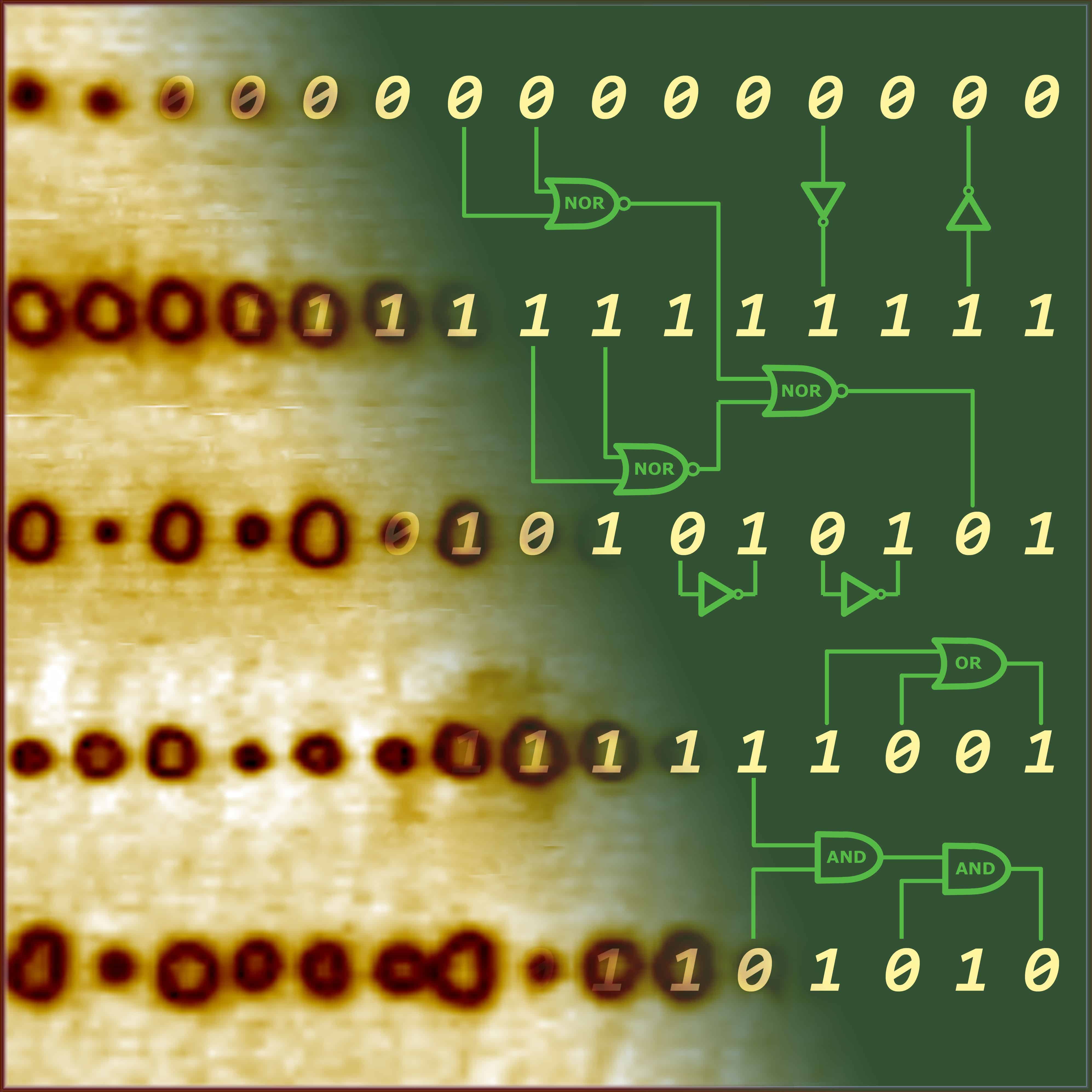
How to build a "memcomputer"

Is this a nascent memcomputer? (Courtesy: Oak Ridge National Laboratory)

By Hamish Johnston

There is a fascinating paper this week in Nature Physics about chaotic behaviour that has been spotted in a ferroelectric material. It’s an unexpected discovery that the researchers claim could lead to the development of computers that resemble the human brain.

The story begins with Anton Ievlev and colleagues at Oak Ridge National Lab in the US using the tip of a scanning probe microscope (SPM) to draw patterns on the surface of a ferroelectric material. Ferroelectrics have a spontaneous electric polarization, the direction of which can be reversed by applying an electric field.

(more…)

NASA launches MAVEN probe to Mars

NASA has launched a mission to Mars that will investigate how the planet lost its liquid water and how solar radiation is slowly eroding its atmosphere. The mission – Mars Atmosphere and Volatile Evolution (MAVEN) – was launched from Cape Canaveral Air Force Station in Florida by an Atlas V Centaur rocket at 13:28 local time yesterday.

Costing $671m, MAVEN will spend the next 10 months travelling to Mars, arriving at the red planet in September 2014. When the probe gets there, it will then be put in a highly elliptical orbit in the Martian atmosphere, being 100 km from the planet’s surface at its closest approach and 80,000 km away at its most distant. MAVEN, which took 10 years to design and build, will carry eight instruments including a spectrometer, a magnetometer and a spectrograph.

Mars has an atmosphere that is composed mainly of carbon dioxide (95%) together with argon (2%), nitrogen (1.9%) and oxygen (0.14%). MAVEN will use its instruments to measure the current rate of atmospheric loss – a process that began about four billion years ago when Mars’s protective magnetic field mysteriously disappeared – to understand how the planet transitioned from a warm, wet planet to a dry desert. The information gathered by MAVEN is also expected to help scientists grasp when conditions on Mars might have been most suitable for life to evolve.

“MAVEN joins our orbiters and rovers already at Mars to explore yet another facet of the red planet and prepare for human missions there by the 2030s,” NASA Administrator Charles Bolden said after the launch. “This mission is part of an integrated and strategic exploration programme that is uncovering the mysteries of the solar system and enabling us to reach farther destinations.”

Working in tandem

MAVEN’s launch comes just 13 days after the Indian Space Research Organisation sent its country’s first craft to Mars; it will also study’s the red planet’s atmosphere. Dubbed Mangalyaan, the probe will arrive at the red planet in September 2014, just two days after MAVEN.

“Some of the measurements that [Mangalyaan will] make are similar to those that Maven will carry out and that’s not a bad thing,” Jeffrey Plescia, a Mars researcher at Johns Hopkins University in the US, told physicsworld.com. “The interaction between the solar wind and the Martian exosphere is a dynamic system that varies in both space and time. Having two spacecraft at different locations will provide a much better 3D perspective on the processes and rates.”

How do you make a pear-shaped nucleus?

In less than 100 seconds, Peter Butler explains that, contrary to popular belief, most nuclei are not spherical but instead take on deformed shapes. Usually these shapes are high symmetry, because of the quantum-mechanical interactions between protons and neutrons inside the nucleus, but in rare cases these interactions can lead to more asymmetric forms, as was demonstrated recently as the REX-ISOLDE facility at CERN, where researchers created pear-shaped nuclei.

Watch more from our 100 Second Science video series.

Physicists reveal a quantum Cheshire cat

“It’s the most curious thing I ever saw in my life!” Alice thought to herself when she saw a Cheshire cat disappear and leave only its grin behind. It is not only in Wonderland, however, that properties of objects can exist independently of the objects themselves. That is the conclusion of a group of physicists from Israel and the UK, which has shown how the strange laws of quantum mechanics permit a photon to be in one place and its circular polarization in another.

This counterintuitive result was achieved thanks to the quantum-mechanical concept of post-selection. In classical physics, the initial conditions of a set of particles and the rules governing the behaviour of those particles are in principle enough to determine the properties of the particles at any arbitrary point in the future. That is not the case in quantum mechanics, in which a particle’s evolution is inherently probabilistic. So while the results of a measurement carried out on a set of particles will have a known probability distribution, individual results cannot be predicted.

Post-selection, pioneered by Yakir Aharonov of Tel Aviv University, involves preparing a group of particles in some initial state, measuring each of the particles at a certain point in time, and then making a second set of measurements at a slightly later time. The results of the intermediate measurements will, on average, imply certain results for the later measurements but will not determine them. If the group is then split into sub-groups according to these later results, the identity of the members of those various sub-groups is information that can only be obtained after the final measurements, and not before.

Superposition of paths

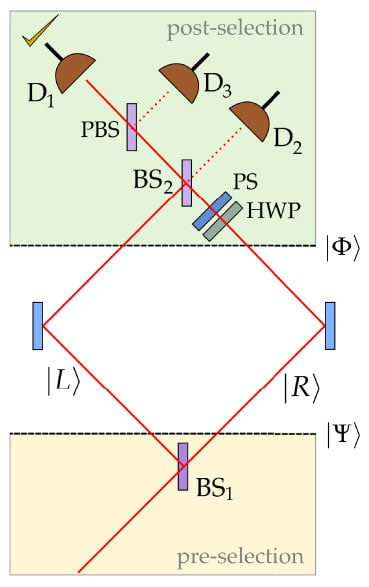
In the latest work, Aharonov has teamed up with Sandu Popescu of the University of Bristol, Daniel Rohrlich of Ben Gurion University and Paul Skrzypczyk, then at Cambridge University. The group has devised an experiment, which it says can be implemented with current technology, in which individual horizontally polarized photons pass through a beamsplitter and then traverse a series of optical devices before being registered in one of three detectors. When leaving the beamsplitter, each photon is in some kind of superposition of two different paths that it can take to reach the other devices, the two paths representing the two arms of an interferometer (see figure “An optical Cheshire cat”).

Schematic of the proposed Cheshire-cat experiment

The devices are chosen and arranged so that the first of the detectors only clicks when the photon is in a specific superposition state, and it is this state that is post-selected. The researchers then consider what happens to the photon – the Cheshire cat – and its polarization – the grin – in that post-selected state. They find that while any photon detector would reveal the photon to always travel along the left-hand arm, a polarization detector would occasionally measure angular momentum in the right-hand one. “We seem to see what Alice saw,” the researchers write, “a grin without a cat!”

The researchers point out that this analysis falls down because it relies on the two kinds of detector being used at different times, and that if they were to be used simultaneously, the detectors would always show the photon and its polarization together in the same arm. But Aharonov and colleagues argue that they can “regain the paradox” by carrying out what are known as “weak measurements”, which do not provide definitive values of particle parameters but do have the virtue of not completely destroying a particle’s quantum state, as usually happens during the measurement process.

Making weak measurements

The researchers say that weak measurements can be made of the photons’ trajectory by replacing the first detector in their hypothetical experiment with a CCD camera and by placing a sheet of glass in one of the arms. Deflection by the glass – which reveals photons to have travelled down that arm and which would be registered by the camera – is made deliberately much smaller than the width of the photon beam, with the resulting uncertainty then reduced via multiple measurements. Analogously, polarization is measured by placing a suitable optical element in one of the arms and recording a deflection at right angles to that caused by the glass sheet.

The crucial point about this revised set-up, explains the Israeli–UK team, is that it can be used to measure different parameters at the same time. As such, the researchers claim, putting both the glass and the optical element in the right arm of the interferometer would prove that the polarization could exist independently of its photon. Which would mean, the researchers write, that they had “finally found [the] Cheshire cat”.

“Beyond the mainstream”

Having had to wait for a 21 months between posting its proposal on the arXiv preprint server and seeing it published in New Journal of Physics, Popescu acknowledges that his group’s scheme was not well received by all of the referees who reviewed it. “It is beyond the mainstream,” he says. “But quantum mechanics has been around for almost 100 years and people still don’t understand it profoundly. Discovering effects like this, which expose the weirdness of quantum mechanics, may help.”

Popescu says that the Cheshire-cat effect is quite general – that there is nothing in principle to prevent the separation of, say, an electron’s spin and charge, or an atom from its internal energy. Indeed, an alternative to the current experimental proposal would involve cutting off a group of electrons from its own magnetic field. Being a group phenomenon, he points out, this would have the advantage of revealing the Cheshire cat unambiguously at a single instant in time rather than as the average of a series of repeated measurements, but would, he says, require experimental techniques beyond the realm of current technology.

Antonio Di Lorenzo of the Federal University of Uberlandia in Brazil agrees that the experiment proposed by Aharonov and co-workers could be used to find quantum Cheshire cats. But he says they are mistaken in the criterion that they use to identify their quarry. Rather than consider the outputs of the “cat detector” and “smile detector” separately, he argues, they should instead establish the product of these two outputs. A non-zero answer, he says, would reveal the cat.

  • Find out much more about weak measurement in “In praise of weakness” by Aephraim Steinberg, Amir Feizpour, Lee Rozema, Dylan Mahler and Alex Hayat

Colliding exhibits, influential researchers, edible particle-detectors and more

Collider exhibition at London's Science Museum (Courtesy: Nick Rochowski for the Science Museum)


By Matin Durrani and Tushna Commissariat

If you’re in the tiny minority of people whose job title says “particle physicist”, chances are you’ll have been to CERN at least once in your career to help build a detector, analyse some collision data or muse in the cafeteria over supersymmetry (or the apparent lack of it so far). But for the rest of the world, going to the Geneva lab is simply not on the agenda, which is one reason why the Science Museum in London has this week unveiled a big new exhibition devoted to CERN’s Large Hadron Collider. Entitled simply Collider, the exhibition “blends theatre, video and sound art with real artefacts from CERN” that will, say organizers, “recreate a visit to the famous particle-physics laboratory”.

(more…)

Four quarks for Muster Mark?

Family of four? (Courtesy: Shutterstock/paul_june)

By Tushna Commissariat

In June we reported that physicists working on the BESIII experiment in Beijing and the Belle experiment in Tsukuba, Japan found evidence for a new “charged charmonium” called Zc(3900). A “charged charmonium” is a particle that is made of four quarks – something that had never been seen before. Since that discovery, the BESIII collaboration says it has made “a rapid string of related discoveries” of four-quark particles. “While quarks have long been known to bind together in groups of twos or threes, these new results seem to be quickly opening the door to a previously elusive type of four-quark matter,” says Frederick Harris, spokesman for the BESIII experiment. “The unique data sample collected by the BESIII collaboration has continued to yield a stream of clues about the nature of multi-quark objects.”

(more…)

Quantum state endures for 39 minutes at room temperature

Quantum states have been shown to endure in a room-temperature solid-state device for a whopping 39 minutes, shattering the previous record of 2 s. The feat was achieved by physicists in Canada, the UK and Germany, who used phosphorus atoms in silicon as their quantum bits – or qubits. The breakthrough offers hope that normally fragile quantum states could be made robust enough to be used in practical quantum computers or even in “quantum money”.

Quantum computers are designed to exploit the counterintuitive idea that tiny objects can exist in more than one state at the same time. Rather than processing bits – which are either 0 or 1 – such devices instead manipulate qubits, which can be 0 and 1 simultaneously. Vast numbers of operations could therefore, in principle, be carried out in parallel and rendering these devices far quicker than classical computers.

But anyone trying to build a working quantum computer has to deal with the fact that qubits tend to be incredibly fragile, which means the quantum information they hold is rapidly destroyed by external noise. One way of getting around this problem is to cool the qubit to near absolute zero to minimize its exposure to thermal noise. But working at such low temperatures is not particularly practical, which is why researchers are keen on find qubits that can operate at room temperature.

Record breakers

The new record-breaking system has been created by Mike Thewalt of Simon Fraser University and colleagues, by storing quantum information in the nuclear spins of phosphorous atoms in a silicon crystal. The idea of using these nuclear spins is not new and the system has already been shown to retain quantum information for long times at extremely low temperatures. But even at 10 K, this “coherence time” drops precipitously to just a few milliseconds.

To get around this problem, Thewalt and colleagues took advantage of the fact that phosphorous atoms in silicon at room temperature tend to give up their electrons and become positive ions. Removing the electrons eliminates an important link between the nuclear spins and surrounding electrical noise. Nuclear spins can therefore retain quantum information for much longer than those in neutral phosphorous.

The downside is that removing the electrons makes the nuclear spins so well isolated that they cannot be “read” or “written” to. So to get around this problem, the team first cooled its crystal to 4.2 K and used laser and radio frequency (RF) pulses to put neutral phosphorous atoms into specific quantum states. A laser pulse then ionized the atoms before the crystal was warmed up to room temperature (298 K).

Under these conditions, RF pulses were used to perform a “spin echo” measurement of the coherence time, which was found to be 39 minutes. The crystal was then cooled back down to 4.2 K and another laser pulse was used to neutralize the phosphorus ions before the quantum information was read out using a sequence of laser and RF pulses.

Walking round the lab

Although measurements reveal that the coherence time at room temperature is 39 minutes, team member John Morton from University College London says that under these conditions, it would be possible in principle to remove the crystal from the cryostat and carry it around the lab while the spins maintain their coherence. What’s more, repeating the experiment with the sample at 4.3 K revealed a coherence time of as long as three hours.

Stephanie Simmons from the University of Oxford, who is also part of the team, says that while 39 minutes “may not seem very long”, it takes just 10 microseconds to flip the nuclear spin of a phosphorus ion – the type of operation used to run quantum calculations. “In theory, over 20 million operations could be applied in the time it takes for the superposition to naturally decay by 1%,” she says.

On the money

Morton adds that it is unlikely that anyone would build a quantum computer that is cycled between 4.2 and 298 K and so qubits based on phosphorous ions would probably be operated at cold temperatures where their even longer coherence time would be an asset. However, he points out that such a system could be used to create “quantum money”, which in principle would be impossible to counterfeit.

The serial number of a “banknote” could, for example, be encoded into the nuclear spins at 4.2 K before the system is heated to room temperate and carried about until it is “spent” by cooling it down. The serial number could then be read out, but a counterfeiter trying to copy the quantum serial number would be thwarted by the “no-cloning” theorem of quantum mechanics, which prevents an unknown quantum state to be copied.

Although the team has shown that ionized phosphorous qubits can endure for very long times, there is more work to be done before the nuclear spins could be used in a quantum computer or quantum money. The measurements were made simultaneously on a collection of about 10 billion ions and physicists must now work out how to read and write information to an individual ion – and also how to get two or more ions to interact with each other to create quantum-logic devices.

Thewalt told physicsworld.com that physicists at the University of New South Wales in Australia have already worked out a way of reading and writing information to individual ions – albeit at low temperatures – and are now looking at how they could be entangled. Meanwhile, Thewalt’s team is now looking at other atoms in silicon, including arsenic, antimony and bismuth.

The research is described in Science.

In pictures: the opinions of Physics World readers

By James Dacey

Love it, or love to hate it, one thing that social media has undoubtedly achieved is to break down some of the barriers between professional journalists and their readers. Gone are the days when we had to rely almost exclusively on guesswork and intuition when it came to picking the issues that matter the most to our readers. Of course, we have always received “proper” letters in the days and weeks following the publication of Physics World to inform us when readers were pleased (or slightly less approving!) of the words they had read. But these days, the feedback starts pouring in almost as soon as our online articles are published, courtesy of our 170,000 Facebook fans and 50,000 Twitter followers. If our readers’ hackles are raised by certain articles and issues, then believe me – we know about it very quickly.

(more…)

Search for electron’s electric dipole moment narrows

Physicists in the US and Canada have put the smallest limit yet on the size of the electric dipole moment (EDM) of the electron. By making precise measurements on a slow-moving beam of thorium-oxide molecules, the team has shown that the electron EDM is at most one-12th of the previous upper limit set by a different experiment in 2011. Constraining the value of the EDM provides important information to those developing new theories of particle physics such as supersymmetry, whereas actually measuring a non-zero EDM would be a major breakthrough in physics.

The simplest take on the Standard Model prohibits the electron from having a permanent EDM. This is because the combination of an EDM with the electron’s well-known spin magnetic moment would violate time-reversal symmetry, which says that physical interactions should look the same if the direction of the flow of time is reversed (see figure “Incompatible moments”). While more-sophisticated versions of the Standard Model do allow for an EDM, they nevertheless suggest it would be much too small to measure in the lab. However, theories of physics that go beyond the Standard Model – such as those invoking supersymmetry – do predict much larger values of the EDM that could be determined experimentally.

In 2011 Jony Hudson and colleagues at Imperial College London found the EDM to be less than 10.5 × 10–28 e cm. While this is still much larger than the upper limit allowed by the Standard Model (about 10–39 e cm), it does begin to rule out certain theories that go beyond the Standard Model (see figure “Less room for new physics”).

Shrinking EDM

Now, physicists working on the Advanced Cold Molecule EDM Experiment (ACME) in the US have improved on this limit by a factor of 12, setting the upper limit on the EDM at 8.7 × 10–29 e cm. ACME is a collaboration of physicists at several universities in the US and Canada – with the main players at Yale and Harvard.

The experiment begins by creating a relatively slow-moving pulse of very cold thorium-oxide (ThO) molecules, which is sent through a region where parallel electric and magnetic fields run perpendicular to the beam. Laser pulses are used to put the molecules into specific states in which the spin magnetic moment of an excited electron (and its EDM, if it has one) is perpendicular to the applied fields. The molecules then travel about 22 cm through the parallel fields, causing the spins (and EDMs) to rotate about the field direction. This precession angle is then measured precisely using a spectroscopic technique.

Figure showing EDM predictions of several physics models

If the electron has an EDM, its presence will contribute to the precession angle by an amount proportional to the electric field in the region of the electron. This is where the ACME team uses a clever trick. ThO is a polar molecule that has an extremely large electric dipole moment. This creates a huge “effective electric field” in the vicinity of the electron – much larger than could be applied externally in the lab. The molecules are prepared such that the effective electric field is either parallel or antiparallel to the applied fields. These configurations shift the precession angle in opposite directions. By measuring the difference in the precession angle between both of these configurations, the team is able to determine the EDM.

“Significant step forward”

The ACME experiment measured the EDM to be zero to within very small experimental uncertainties. As a result, it was able to put the most stringent upper limit on its value so far: 8.7 × 10–29 e cm with a 90% confidence. “This is a significant step forward, the biggest improvement in EDM measurements in a decade or so, and the researchers haven’t exhausted the potential of the system,” says Chad Orzel of Union College in the US, who was not involved in the research.

Orzel points out that the measurement is the first result to come from ACME and he believes that the team will be able to improve on it. “This is basically the first real run of the experiment, and people can always find ways to improve the initial systematic uncertainties,” he says. Indeed, Orzel believes that the team should be able to improve its initial result by an order of magnitude.

On a par with the LHC

Time-reversal symmetry is related to another important symmetry of physics: charge–parity (CP) symmetry. As a result, measurements of the electron EDM also provide a constraint on CP violation, which occurs in many physics theories that go beyond the Standard Model. Testing these models is the current focus of particle-physics experiments around the world, including those at the Large Hadron Collider (LHC) at CERN. The ACME team says that its experiment has constrained CP violation at energies on a par with those accessible at the LHC.

Orzel says that some of ACME’s success can be attributed to the fact that it is a collaboration of three leading atomic-physics groups, headed by David DeMille at Yale, John Doyle at Harvard, and Gerald Gabrielse at Harvard. “ACME has really only been going for something like three to four years, and they’ve already produced a great measurement,” Orzel says. “This shows something of the power of the ‘particle physics’ sort of model they’re using, combining several high-power groups together in a bigger collaboration than you usually see in [atomic, molecular and optical] physics, so as to bring greater resources to bear on the problem.”

The research is described in a preprint on arXiv.

Politics or physics?

In late May 1944 Niels Bohr met Winston Churchill to discuss the atom bomb. Certain that the new weapon – when it arrived – would completely transform great-power politics, Bohr wanted to alert Churchill to the hazards ahead. Churchill, who resented being lectured on international affairs by a scientist, rudely told Bohr to mind his own business. “What is he talking about, politics or physics?”, Churchill asked his science adviser, Frederick Lindemann. “This new bomb is just going to be bigger than our present bombs and involves no difference in the principles of war.”

Bohr did not perceive a dividing line between politics and physics; they were simply two interlocking elements in his comprehensive world view. Churchill, however, insisted that the two could, and should, be kept separate, which explains why he was reluctant to accept political advice from a scientist, unless (as was the case with Lindemann) the scientist’s opinions mirrored his own. Leaving that aside, Churchill’s retort to Bohr seems incredibly obtuse, especially from a man noted for his acute sensitivity to the wider implications of technology. As Graham Farmelo reveals in his intriguing book Churchill’s Bomb, Britain’s wartime prime minister was uncharacteristically myopic when it came to the bomb. Furthermore, his myopia probably proved costly for Britain – both in politics and in physics.

Before the war, the US lagged far behind Europe in atomic physics. The great strides were made in Cambridge, in Heidelberg and at Bohr’s laboratory in Copenhagen. When attention turned to the possibility of an atom bomb, the British were the early leaders, in part because of the contributions of refugee scientists from Central and Eastern Europe. The Frisch–Peierls Memorandum of 1940, which was drafted by two such émigrés, was the first practical exposition of an atom bomb and, significantly, an astute exploration of its political and military implications. That progress was confirmed the following year when the MAUD Committee, commissioned to explore the possibility of a British bomb, effectively provided a blueprint for one.

Progress up to this stage was, however, confined to theory. When the problem of the bomb morphed from theoretical to practical, the British encountered a technological challenge beyond their capacity in wartime. At this stage, American strengths became predominant, especially so when the US entered the war after the Japanese attack on Pearl Harbor. America alone had the natural resources, labour force and money to turn the theoretical bomb into an actual weapon.

At this point, British science and American technology might have been brought together in perfect harmony. Unfortunately, as Farmelo shows, Churchill squandered golden opportunities to derive maximum benefit from the early lead the British had enjoyed. In particular, he waited two months to reply to US president Franklin Roosevelt’s offer of partnership, made in the autumn of 1941. By the time he responded, Pearl Harbor had occurred, the American war machine was in top gear and Roosevelt no longer worried about keeping the British sweet. What might have been an Anglo-American project became instead an exclusively American one in which British scientists were individually offered jobs, if their expertise warranted. More importantly, it was made patently clear that the end result would be an American bomb, over which the British would have no control. This meant that if the British wanted a bomb of their own, they would have to start from scratch after the war.

Churchill’s failure to exploit the opportunities offered by the bomb appears strange in a man who was so keen to preserve British power past its logical shelf life. His clumsy handling of the bomb seems especially bizarre given his fascination with atomic power before the war, as evidenced by his friendships with Lindemann and H G Wells and by his musings in the popular press. It is refreshing to read a book so critical of Churchill, given the worship he customarily receives. Churchill’s Bomb is a story of abject failure by the man widely considered to be the greatest Briton ever to have lived. While there is nothing particularly new in this book, its brilliance lies in the way the story is told, for it is a tale not just of physics or politics but also, more importantly, of people.

Farmelo exposes the abundant errors Churchill made in formulating nuclear policy. However, he is less adept at explaining those failures. Why, in other words, did the man best situated to exploit the new weapon fail to do so? It would be easy to argue that Churchill was distracted by the war: the real threat of invasion might have caused him to ignore theoretical possibilities like the bomb. Such an excuse would, however, be too charitable given that Churchill frequently allowed himself to be diverted by far less important abstractions, like bizarre suggestions for new weapons that were physically impossible. The explanation in part lies with Lindemann, a distinctly average physicist who had far too much influence over the prime minister. J Robert Oppenheimer was one of many physicists to be amazed by the limits of what Lindemann understood. Yet, in this case, the fault lies with Churchill for choosing an adviser who would echo his views rather than challenge them.

In my view, the best explanation for Churchill’s failure to exploit British atomic expertise lies in his inability to understand the modern world and the role of the Americans within it. The qualities that made him a brilliant war leader also rendered him incapable of coming to terms with the future. His romantic conceptions of British greatness were perfectly suited to the heroic struggle he presided over in the first three years of the war. They proved an impediment, however, when it came to carving out a role for Britain in the age of the atom.

The American version of this book is subtitled How the United States Overtook Britain in the First Nuclear Arms Race. The difference in subtitles speaks volumes about how the division of power in the atomic age played out. In truth, the opportunities for Britain to take a larger role – which Farmelo effectively implies – might never have existed. Roosevelt and his successor, Harry Truman, were fully aware of the implications of American might, especially now that her supremacy was punctuated with atomic weapons. Churchill thought that British prestige would trump American power. He was wrong – disastrously so – since the Americans didn’t give a fig for how great the British had once been. While Churchill undoubtedly mishandled nuclear politics, no British leader, no matter how perceptive, could have stopped the Americans from strutting on the atomic stage.

  • 2013 Faber & Faber/Basic Books £25.00/$29.99hb 576pp

Copyright © 2026 by IOP Publishing Ltd and individual contributors