The electrical human

The image of God extending his hand towards a newly created Adam forms the centrepiece of the Sistine Chapel ceiling. It is a familiar image, and probably one that comes to mind for many people when they hear the phrase “the spark of life”. Yet Michelangelo’s fresco predates the serious study of electricity, so there is no animating spark passing between the famous outstretched fingers. In the 400 years since the artwork was completed, our view of electricity has changed dramatically, and from our current vantage point we know that it is vital (literally!) to the functioning of every living system on the planet. It is not, however, some mysterious and unknown life force. Rather, it is open to careful and quantitative study, and the aim of The Spark of Life is to take us on an exciting tour of the roles that bio-electricity plays in the human body.

The book’s author, Frances Ashcroft, is a University of Oxford physiologist who is well known for her work on ion channels – the remarkable molecules that regulate the flow of ions (in other words, electric current) across otherwise impermeable cell membranes. As gatekeepers to the cell’s interior, ion channels mediate the “spark of life”, and the story of their structure, their function and the consequences of their malfunction is the unifying theme of her book.

The opening chapter provides a short history of the generation and storage of electric charge, and how in the 18th century various new and exciting electrical “toys” were used to induce the contraction of frogs’ legs and give the illusion of re-animating corpses. Subsequent chapters move on to describe ion channels and the role they play in our nervous system, muscles, heart, sense organs and even our consciousness. Along the way there are diversions describing how certain species of fish use their electric organs to generate high voltages, and the ways that electricity has been used both to heal and to harm the human body.

This book is aimed at a general readership, and is written in a lively, accessible and engaging style, with plenty of anecdotes to entertain the reader while also conveying the science. Much of the complexity of living systems arises from interactions across length and time scales that range from microns and microseconds to metres and lifetimes, and Ashcroft does not shrink from dealing with this intricacy. Rather than reducing all bio-electric phenomena to the activities of ion channels, she instead uses ion channels as the jumping-off point to explain them.

There are significant differences between electricity in a living system and in conventional electric circuits

One example is her discussion of diabetes, a disease which, like many that affect the whole person, results from the abnormal behaviour of ion channels. Diabetes is the focus of Ashcroft’s scientific interest, and she vividly relates her excitement at the discovery of a molecular-scale explanation for it: in some people who – thanks to a genetic mutation – are born with diabetes, an ion-channel malfunction prevents the release of the hormone insulin (required to regulate the level of glucose in the bloodstream) from cells in the pancreas. The integrative link across spatial scales from molecule to patient is explored further with a detailed discussion of the active mechanisms of certain drugs used to treat patients born with diabetes. On the flip side, various types of lethal poison also act by interfering with ion-channel operation, and the book is enlivened by thoughtful and occasionally gruesome anecdotes.

Another strength of the book lies in its clear and inspiring accounts of the scientific process. One that stands out is the story of the sustained effort made by the Nobel-prize-winning University of Cambridge physiologists Alan Hodgkin and Andrew Huxley in figuring out the mechanism by which impulses travel along nerve fibres. Despite the sheer difficulty of their experiments, the interruption of the Second World War and competition from across the Atlantic, the eventual outcome was not only a mechanistic explanation of the nerve impulse, but also a mathematical model that articulated it.

Physicists will find much of interest in this material. Living systems, of course, operate according to physical laws, and so in principle are amenable to systematic and quantitative description. In nerve and muscle cells, the potential difference across the cell membrane varies by around 100 mV. Given that a cell membrane is about 10 nm thick, the electric field in which the ion channel operates is enormous; it is hardly surprising that the changes in molecular structure that cause ion channel pores to open and close are regulated by membrane voltage. In the heart, cells are connected so that electrical impulses are rapidly conducted from one cell to its neighbours, enabling electricity to initiate and synchronize contraction. In the brain, these connections are, of course, much more intricate.

There are, however, some traps for unwary physicist readers. Early on, Ashcroft makes an important point when she notes that there are significant differences between electricity in a living system and in conventional electric circuits. For example, in the human body it is ions rather than electrons that carry electrical current, and these ions move in solution and across membranes rather than through wires and other components. This is of more than trivial importance, because the conductance of a membrane may depend not only on the ion channel’s conductance, but also on both the ability of ion channels to distinguish between ionic species and the concentration of ions inside and outside the cell. For many interdisciplinary scientists, the complexity and intricacy of living things is precisely what makes them so appealing, and this book is a good way in for those wishing to dip a toe in the water.

This is a popular-science book, so its coverage is broad rather than deep. The Spark of Life does not tell the whole story of electricity in the human body; there are, for example, no equations. However, it does provide a superb and entertaining introduction to this area from the perspective of a physiologist, and makes valuable background reading for the increasing number of physicists who are developing an interest in the physics of life.

  • 2012 Allen Lane/W W Norton £20.00/$28.95hb 352pp
Why some galaxies age before their time

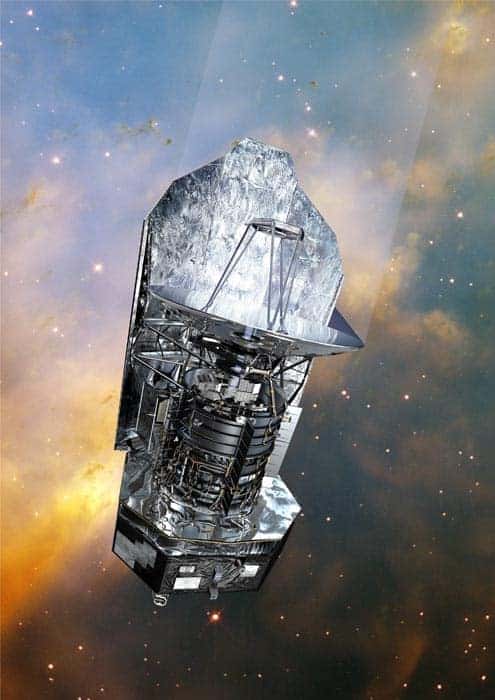
Composite image of the European Space Agency's Herschel space telescope

Like reckless rock stars, some galaxies live fast and get old long before their time. Now an international team of astronomers is watching this metamorphosis as it occurred billions of light-years away. Two distant galaxies are crashing together, turning all their gas into stars so rapidly that they will soon appear to be much older than they really are.

In the modern universe, giant galaxies – those that emit about as much light as the Milky Way – come in two main types: spiral and elliptical. Spiral galaxies are graceful, having formed their stars little by little over time, so they harbour stars from young to old. In contrast, giant elliptical galaxies converted all of their gas into stars long ago, so today they consist only of old stars with little or no gas to make new stars.

When astronomers gaze into space billions of light-years away, they witness the universe as it was billions of years ago. Yet they still see giant elliptical galaxies that consist of old stars – even as far away as 10 billion light-years from Earth. However, at that time the universe was less than four-billion years old, giving giant elliptical galaxies little time to form.

Astronomers have long been puzzled by this age problem – but now Hai Fu of the University of California at Irvine and colleagues think they may have the answer. The team has discovered a collision between two spiral galaxies 11 billion light-years away in the constellation Cetus.

Violent transition

“We believe that this object is a transitional object between a spiral galaxy and an elliptical galaxy,” he says. “Because these transitions happen so dramatically and violently, over a very short period of time, it’s really hard to actually catch them in action.”

The two galaxies are only about 62,000 light-years apart – slightly more than twice the Sun’s distance from the Milky Way’s centre – and have torn material out of each other, a sign they are colliding and will merge. As gas clouds in one galaxy smash into those in the other, they spawn lots of new stars.

Called HXMM-01, the system is bright at submillimetre wavelengths, because dust in the gas absorbs starlight and re-emits it at infrared and submillimetre wavelengths. In fact, Fu’s team says the collision is the most luminous and gas-rich merger of submillimetre bright galaxies ever seen. It emits 10 trillion times more infrared energy than the Sun does over all wavelengths. In a single hour, the system produces as much energy as the Sun will during the next two billion years.

“The star formation is really intense,” says Fu. From the high infrared luminosity, his team deduces that the collision is converting about 2000 solar masses of gas into stars each year, roughly 1000 times greater than the Milky Way’s rate.

Prolific star creation

The galaxies possess a lot of gas. They have as much mass in gas as in stars. But their prolific creation of new stars will use all the gas up in just 200 million years. The end result will be a giant elliptical galaxy with roughly 10 trillion solar masses – about 10 times more massive than the Milky Way. If we could see the galaxy as it is today, 11 billion years later, it would consist solely of old stars.

“This is an extremely rare galaxy – if the interpretation is correct,” says Abraham Loeb, who chairs the astronomy department at Harvard University. “It’s an unusual animal in the zoo of galaxies.”

But Loeb cautions that conditions may be less extreme than they seem if the collision is funnelling gas into a supermassive black hole at either galaxy’s centre. Then the black hole would heat the gas and spark a quasar, an object that emits far more light than the Milky Way but from a region as small as the solar system.

“We know that mergers usually trigger activity in the centre of a galaxy,” Loeb says. “So we would be seeing a quasar being born.”

Buried quasar?

In this case, though, the quasar is enshrouded in thick dust that blocks its intense light. The dust would heat up, emitting infrared radiation. Since Fu’s team used the immense infrared luminosity to derive the high star formation rate, Loeb says the presence of a buried quasar that produced most of the radiation would imply a more modest rate of star formation.

Fortunately, there’s a way to discern even a dust-enshrouded quasar, because quasars emit high-energy X-rays that penetrate the dust. Fu’s team is hoping to conduct such observations later this year. Meanwhile, Fu says he finds no sign of a quasar: quasars normally have hot dust, and he sees none in this object.

The research is described in Nature.

Hangout with Physics World

By James Dacey

This year Physics World is celebrating its 25th birthday. The first issue of the magazine was published in October 1988, so for October this year we are producing a special anniversary issue. It will celebrate the big physics stories from the first quarter of a century of our existence, but it will also have a strong focus on the exciting new physics that await us in the near future. To discuss our plans, I joined editor of Physics World Matin Durrani in this Google Hangout, recorded yesterday.

It was the first time we had attempted one of these fancy new hangouts; this was something of a pilot run. But with the likes of Barack Obama, CERN and the BBC all attempting this new, accessible way of video broadcasting, I reckon we’re in good company.

South Korea – day one

By Matin Durrani

Flag of South Korea

Hello from South Korea, where I’m on a week-long tour with Physics World news editor Michael Banks. We’re here to visit a series of top physics institutes and research organizations in a trip that’s taken several months of careful planning to arrange.

There are three main reasons for coming here. The first is to gather material for a Physics World special report on physics in South Korea, which will be published in September. This report will follow on from our previous special reports on India, Japan and China.

(more…)

What do plastic bags have in common with metal?

In less than 100 seconds, Adrian Sutton explains why metals and plastic bags deform in different but related ways.

Watch more from our 100 Second Science video series.

Magnetic dipoles line up

The interaction of nanoscale magnetic dipoles has been observed for the first time by researchers in Germany. Unexpectedly, the dipoles were seen to form chains, rather than the zigzag pattern expected from simple dipole interaction. The team believes this surprising outcome may be caused by higher-order interactions between the dipoles – a result that may have implications for the development of future hard-disk drives.

To set up their array of nanomagnets, the researchers, led by Hartmut Zabel, a physicist at the Ruhr-Universität Bochum, cut a regular square lattice from a thin magnetic iron-palladium film using electron beam lithography. The lattice was made up of circular islands, each a mere 150 nm in diameter. This alloy was chosen for its soft nature, as well as the potential to tune its Curie temperature – the temperature below which it becomes ferromagnetic – with varying iron concentrations. Ion beam sputtering was then used to remove the unwanted material from between the islands.

Straight lines or zigzags?

Above certain temperatures, thermal movements interfere with the interactions between small-scale magnetic dipoles. The experiments were therefore conducted at low temperatures, at which the orientation of the magnetic islands was based entirely on the interaction between each dipole. This allowed each of the islands to assume the most favourable orientation in terms of energy, a condition called the “ground state”. The researchers were able to observe the resulting pattern of dipole orientations using a photon emission electron microscope at the BESSY II electron synchrotron, at the Helmholtz-Zentrum Geesthach in Berlin. This machine uses X-ray photons to stimulate specific electrons within the target material, which provides information on the orientation of the dipoles being examined.

The team observed that the dipole islands formed a series of parallel and antiparallel chains – with adjacent islands’ north and south poles aligning to form the links in the chain – a result that was not anticipated. With each island having four neighbours to which it could have potentially aligned itself, one might expect a more random-looking zigzag pattern to result – as would be the case in purely simple dipole interactions.

“A magnetic dipole is an ideal mathematical construct working for point-like objects…It is also the dominant interaction in the far field,” says Zabel, adding that in the team’s case, “this type of ordering can only be understood via higher-pole interaction.” He explains that with closely spaced magnetic islands, higher-order relationships – such as quadrupolar and octopolar interactions – must become more important.

Next-generation drives

The results of this study are of great technical relevance to the development of next-generation hard-disk drives. Hard disks store digital data as a pattern of binary digits or bits. Today’s disks are made up of thin ferromagnetic films with opposing directions of magnetization used to encode the two bit states, “0” and “1”. Future disks, however, may use the orientation of tiny magnetic dipoles, similar to the ones examined in this study. To maximize the physical storage density, the ideal disk will use the smallest possible dipoles that can assume the two-bit-state orientations independently of each other. “Switching of the bits should be independent, but with [higher-order] interaction this may not be the case. Therefore it is important to study the magnetic interaction in regular patterns,” Zabel told physicsworld.com.

“[This] study aims at answering an important, fundamental question: how strong is the interaction between neighbouring nanomagnets and what is the nature of their interaction?” explains Axel Enders, an associate professor and nanostructure expert at the University of Nebraska, who was not involved in the work. “It turns out that simple textbook models based on dipolar interactions are insufficient to describe their experimental observations, calling for refinements of theoretical models and, of course, more experiments on the subject.”

While the team has now moved on to other areas of nanomagnetic research, Zabel also notes the great potential for continued study in this area. “There are many parameters to vary,” he comments, citing such possible variables as the island size and periodicity, iron concentration, which affects the Curie temperature, and the symmetry of the base lattice.

The work is published in Physical Review Letters.

Heinrich Rohrer: 1933–2013

The Swiss condensed-matter physicist Heinrich Rohrer who shared the 1986 Nobel Prize for Physics died last week at the age of 79.

Rohrer won the Nobel prize for inventing the scanning tunnelling microscope (STM) at IBM’s Zürich Research Laboratory. Rohrer shared one half of the prize with his IBM colleague Gerd Binnig, while the other half went to Ernst Ruska for his invention of the electron microscope.

Rohrer was born on 6 June 1933 in the small town of Buchs in the Swiss canton of St Gallen. The family moved to Zürich in 1949 and Rohrer studied physics at ETH Zürich where he was taught as an undergraduate by Wolfgang Pauli and Paul Scherrer. He stayed on to do a PhD on the mechanical properties of superconductors and he continued working on superconductors at Rutgers University in the US.

Surface defects

In 1963 Rohrer joined IBM Zürich, where he worked initially on magnetic materials. He encouraged Binning to join the lab in 1978 and the pair studied tiny defects on the surface of silicon – which at the time were hindering the miniaturization of electronic devices. To gain a better understanding of these defects, Rohrer and Binning built the first STM in 1981.

An STM creates an image of the surface of a sample by scanning an atomically sharp tip over its surface. The tip is held less than one nanometre from the surface and a voltage is applied so that electrons can undergo quantum-mechanical tunnelling between tip and surface. The tunnelling current is strongly dependent on the tip–surface separation and this is used in a feedback loop to keep the tip the same distance from the surface. An image is obtained by scanning the tip across the surface to create a topographical map in which individual atoms can be seen.

Important technology

The STM has become an important instrument for surface physics and materials science. A number of related microscopy techniques have since been developed in labs worldwide – including atomic force microscopy.

Rohrer became an IBM Fellow in 1986 and he headed-up the physics department at IBM Zürich in 1986–1988. The Binnig and Rohrer Nanotechnology Center was opened at IBM Zürich in 2011 in honour of the two laureates.

Rohrer died on 16 May in Wollerau, Switzerland.

Is there a difference between climate scepticism and climate denial?

In less than 100 seconds, Simon Buckle tries to disentangle what he believes are two distinctly different approaches to climate science.

Watch more from our 100 Second Science video series.

Flipping spins spread like wildfire

New research into how local heating sets off a chain reaction of magnetic domain reversal could provide important insights into how wildfires spread. That is the conclusion of scientists in the US and Spain, who have pinpointed with greater precision than ever before the conditions under which such a magnetic deflagration will occur. The results could provide insights into runaway chemical reactions and even forest fires.

When a magnetic domain flips from a higher-energy metastable state to a lower-energy stable state, energy is released as heat. If enough energy is released, the temperature of the surrounding domains will rise to the point that they also flip, releasing more heat. This can spark a chain reaction that rapidly causes the magnetization of the entire material to reverse direction.

Magnetic deflagration can, in principle, be observed in any material with a metastable magnetic state. Molecular nanomagnets such as Mn12 acetate are particularly suitable. Each molecule of this crystal has a large-net-spin magnetic moment that is energetically constrained to point in one of two opposite directions. Ordinarily, these two states have the same energy; but if an external magnetic field is applied along the magnetic axis, the antiparallel spins are raised in energy relative to those parallel to the field. However, both the antiparallel and the parallel orientations have a lower energy than an intermediate orientation. This means that spins in the antiparallel direction will not flip unless they are given an activation energy, which can be delivered in the form of heat.

Experiment and theory

In the new work, Andy Kent and scientists at New York University and colleagues at the University of Barcelona, City College of New York and the University of Florida have used experimental results to create a model describing what happens next. They mounted a single crystal of Mn12-acetate cooled to a temperature of 0.4 K, with all its spins aligned in one direction, on an array of uniformly spaced magnetic-field sensors. They then applied a magnetic field in the opposite direction to the polarization of the spins in the crystal, leaving the spins in the metastable antiparallel state. Finally, they applied heat to one end of the crystal.

The energy released when a spin changes from an antiparallel to a parallel orientation depends on the external magnetic field. If the field is weak, the energy is small and the heat simply dissipates. In this case, the spins reverse gradually over a period of about 80 ms as the heat from the applied heat pulse thermally diffuses along the crystal. Above a critical field, however, the energy released by one spin flipping provides enough activation energy to flip adjacent spins. In this case, the magnetic-field sensors detected a wave of spin flips propagating through the material at a constant speed, reversing all the spins in about 100 μs – nearly 1000 times faster than thermal diffusion.

Under control

Based on their observations, the researchers derived a criterion for whether or not such a reversal will ignite. The criterion depends on several properties of the magnetic material: the activation energy of the spin-reversal process; the amount of energy released when a spin reverses; and the rate at which heat diffuses through the material. If heat diffuses away relatively slowly, the energy of adjacent magnetic domains will be raised higher by a neighbouring spin flip. The criterion, the team finds, agrees broadly with previous results from other researchers. Kent explains that, in the new work, the onset of deflagration is more precisely controlled than in previous experiments. “People were able to trigger these processes,” he says, “but not to see this crossover behaviour and how the actual instability is generated. In this work we can control it and that allows us to study it.”

Carley Paulsen of the Neel Institute in Grenoble was involved in the first observation of sudden spin reversal in 1994. He says that although these latest results are “not surprising”, the novel experimental set-up allows new insight into the abrupt crossover from diffusion to deflagration.

In 2005 two of Kent’s co-workers – Myriam Sarachik of City College and George Christou of the University of Florida – were part of a team that argued magnetic deflagration could be understood by analogy to the advancing flame front in a burning chemical. Kent now hopes that the magnetic model may help generate and test models of macroscopic fires and other exothermic chemical reactions that can take off in a similar way. “One thing that makes it really nice from the experimental point of view is that we can study these reactions and then reset the system,” he says. We’re not really burning anything so we don’t have to throw away the ash and start again.”

The research is described in Physical Review Letters.

People, not information, want to be free

By Margaret Harris

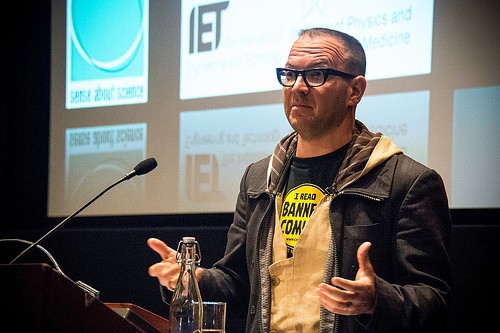
I’ve never been a fan of the slogan “Information wants to be free”.  As a journalist and former scientist, I know that the process of creating and disseminating information is definitely not free, and I’m sceptical about the economic alchemy that would supposedly make it that way.  So when I saw that this year’s Sense About Science lecture was entitled “We Get to Choose: How to Demand an Internet That Sets Us Free”, I nearly stayed away.

As it turns out, a more accurate title for the London-based charity’s annual bash would have been “Why Digital Rights Management is Bad and Why You Should Care”, and by the end, the speaker – science-fiction author and blogger Cory Doctorow – had pretty much won me over.

(more…)

Copyright © 2026 by IOP Publishing Ltd and individual contributors