Blazars help measure extragalactic background light

An international group of researchers has developed a new way to measure accurately the extragalactic background light (EBL) that fills the universe. The technique involves measuring the attenuation of high-energy gamma rays from distant blazars and it could improve our understanding of how galaxies form and evolve, as well as how the universe has expanded since the Big Bang.

The EBL is made up of all the ultraviolet, optical and infrared photons ever emitted by all galaxies in the universe and, like the cosmic microwave background, is expected to contain a wealth of information about how the universe has evolved. However, measuring the totality of all of the light in the universe is no mean feat. One major problem is that the solar system itself nestles within the Milky Way – a bright galaxy – making it difficult to distinguish between the local galactic light and the much fainter background light. Indeed, most current ground-based and space telescopes have failed to do so reliably enough, while sending a spacecraft out of the galaxy to detect the EBL is clearly impossible.

Across the universe

Instead, astronomers use other, more indirect, methods to detect the EBL. One of these involves using galaxy surveys to estimate the total number of photons produced from the observed population. Once more, the issue here is that the surveys could easily be missing the faintest of galaxies; if these are large in number, they might contribute a lot of light to the EBL, so not factoring in these and any other potential sources would mean that the results are incorrect.

The second method involves blazars. These are compact quasars – supermassive black holes that sit at the heart of active galaxies – with relativistic jets of plasma pointing in the general direction of the Earth. These jets produce extremely energetic gamma rays. According to Alberto Domínguez, a postdoctoral researcher at the University of California, Riverside and lead researcher of the new study, these gamma rays are attenuated as they travel, colliding with EBL photons en route. “There is an effect called pair-production, where two photons that satisfy certain energy conditions interact to produce an electron and a positron. This interaction happens between gamma-ray and EBL photons, producing an attenuation in the gamma-ray flux that we observe from blazars,” says Domínguez. “If we could somehow figure out the intrinsic gamma-ray flux, then we could compare it with the observed flux,” he explains, saying that the comparison could give an estimate of the EBL.

But the team faced some challenges with the new method, the main one being how to figure out the intrinsic gamma-ray flux, which is not known initially. Domínguez says that other groups have tried to estimate this flux by using rather simplistic assumptions. “We have a more elaborated technique that uses data taken from X-ray satellites [NASA’s X-ray satellites Swift and the Rossi X-ray Timing Explorer] and the Fermi Space Telescope, which detect photons at lower energies that are not EBL attenuated,” explains Domínguez.

Then, using standard models of blazar photon emission from observations of nearby blazars, the team inferred the expected intrinsic gamma-ray flux at higher energies and compared it with actual observations from Cerenkov telescopes on the ground. “A comparison between the predicted un-attenuated gamma-ray brightness at energies greater than 30 GeV and the detected attenuated brightness at energies greater than 30 GeV by the Cerenkov telescopes allows us to estimate the cosmic gamma-ray horizon that is directly related to EBL attenuation,” says Justin Finke of the US Naval Research Laboratory, Washington DC, who is also a member of the team.

More distant blazars

By applying their technique to blazars located at different distances (or different ages of the universe), Domínguez and colleagues measured the EBL out to five billion light-years away – the location of the most distant blazar observed when the team began its study. According to the researchers, they can now study more distant blazars that are being detected with the current generation of Cerenkov telescopes, as well as those that will be detected in the future with the next generation of Cerenkov telescopes, namely the Cherenkov Telescope Array.

Domínguez has used both of the methods discussed to measure the EBL and he points out that, interestingly, both give similar results. This helped in setting essential limits on the light from faint galaxies missed in current galaxies surveys and also on any other potential contribution to the EBL not coming from galaxies. “What this means is that the sort of galaxies that we are observing now, with our surveys, are actually responsible for most of the EBL,” he says. The researchers also plan to extend their work to more blazars both at the same distances that they have already tested to confirm their results and also those further away.

Because the EBL is intrinsically linked to the star-formation history of the universe, efficiently measuring it is essential. Other research from Domínguez that looks into measuring the expansion rate of the universe from the attenuation will be published in the months to come.

The research is published on the arXiv preprint server.
South Korea – day six

By Michael Banks

The first thing Kyung-Ho Shin, vice president of international affairs at the Korean Institute of Science and Technology (KIST), passed me when we met in the lobby of my hotel today was an umbrella.

Today Seoul has had a very good watering, but after the recent warm weather the change could be seen as being welcome.

In the morning’s pouring rain, I visited KIST, which was created in 1966 to help commercialize basic research. The 2000 or so researchers based at KIST carry out work in areas from neuroscience and fuel cells to robotics and medicine.

(more…)

South Korea – day five

By Michael Banks

Today I was traveling back from Pohang where I spent the weekend after an busy few days in Daejeon.

Daejeon is certainly an impressive place to do science, being home to no fewer than 60 research centres. Unfortunately, in the limited time I had I could only visit a couple, including the Korean Research Institute of Standards and Science and the National Fusion Research Institute (NFRI).

(more…)

South Korea – day four

By Matin Durrani

Being a Saturday, the fourth day of the Physics World tour of South Korea was – to adopt cricketing parlance – a rest day. But don’t worry, I haven’t been slumped in front of my television in the hotel bedroom wolfing down South Korean style pot noodles and cups of tepid green tea all day. Oh no, that was just what I did in the morning.

(more…)

South Korea – day three

By Matin Durrani

Day three for the Physics World editorial visit to South Korea saw news editor Michael Banks spend the day at the KSTAR fusion facility while I was at atomic-force microscope (AFM) manufacturer Park Systems in Suwon.

South Korea is, of course, a key player in fusion science, being a long-standing member of the ITER experiment being built in the south of France. But as Michael is now in the south of the country – in Pohang to be precise – I haven’t had full details of how his visit to KSTAR went. He did, however, e-mail me to say that he’d asked his contact at the lab whether they’d ever had any other visits from journalists. She said they hadn’t, but there was once this very famous scientist who had taken a tour of KSTAR – step forward none other than the physicist who’s on just about every UK TV science show at the moment: Brian Cox.

(more…)

Quantum magnetism simulated using ultracold fermions

Quantum magnetism has been mimicked – or simulated – using ultracold fermionic atoms for the first time. Researchers in Switzerland and France placed atoms on a 2D square lattice created by criss-crossing laser beams. By controlling the interactions between atoms, the team put pairs of atoms into antiferromagnetic configurations. While quantum magnetism plays an important role in a range of solid-state phenomena, it can be difficult to calculate its effect on materials such as high-temperature superconductors. As a result, quantum simulations should lead to better theoretical models of a range of solids.

Quantum magnetism involves a subtle effect called the exchange interaction. This is a quantum interaction between pairs of identical fermions – such as electrons – that tends to prevent neighbouring fermions from having their spin magnetic moments pointing in the same direction. As well as being responsible for the magnetic properties of everyday materials such as iron, quantum magnetism is also believed to play an important role in high-temperature superconductivity and other exotic states of matter such as spin liquids.

Criss-crossing laser beams

Quantum simulations using ultracold atoms allow physicists to create artificial materials in which the atoms play the role of electrons in a solid. However, unlike real materials, where it can be difficult to vary the interactions between electrons, the forces between atoms in a quantum simulator can be fine-tuned by adjusting lasers and magnetic field.

These latest simulations were done by Tilman Esslinger and colleagues at ETH Zürich and the University of Bordeaux. The team began with an ultracold cloud of potassium-40 atoms, which are fermions. The cloud is a mixture in which half of the atoms are in the –9/2 spin state and the other half in the –7/2 state. This two-state system simulates –1/2 and 1/2 spin states of the electron. The criss-crossing laser beams are then switched on, creating a 2D square lattice wherein each lattice site contains one potassium-40 atom. The exchange interaction is then simulated by applying a magnetic field to the lattice, which makes atoms with the same spin repel each other.

The next experimental step involves solving a thermodynamics problem. Even at the extremely low lattice temperatures there is too much entropy – or disorder – for quantum magnetism to emerge. To get round this problem, Esslinger and colleagues came up with a way of “stashing” entropy at the edges of the lattice so that quantum magnetism could emerge in the centre.

This is done by tweaking the properties of the optical lattice so that the interactions between nearest-neighbour atoms alternate between strong and weak in the x and y directions. An atom with a strong interaction with a nearest neighbour will form a pair (or dimer) in which the spins point in opposite directions – and the lattice of 5000 atoms becomes a collection of antiferromagnetic dimers.

Merging dimers

Ideally, the next step would be to measure the spin of each atom in the lattice to confirm that antiferromagnetic dimers have formed; however, this would be extremely difficult to do. Instead, the team uses an indirect measurement technique that involves applying a magnetic-field gradient and merging each dimer into one lattice site. The team can then measure the number of lattice sites that contain two atoms and this information can be used to calculate the number of antiferromagnetic dimers that were present in the original lattice. When the strong and weak interactions were created, a strong majority of the atom pairs were antiferromagnetic dimers.

According to Esslinger, one feature of the quantum simulation is that its parameters are in a region where it is possible to perform calculations – and the team is collaborating with theorists with the aim of improving models of quantum magnetism. Esslinger also hopes that his team can address the entropy problem by creating an optical lattice with two layers and stashing entropy in the second layer.

“One of our next goals is to address unsolved questions in the context of spin liquids,” says Esslinger.

The research is reported in Science.

‘Quantum microscope’ peers into the hydrogen atom

The first direct observation of the orbital structure of an excited hydrogen atom has been made by an international team of researchers. The observation was made using a newly developed “quantum microscope”, which uses photoionization microscopy to visualize the structure directly. The team’s demonstration proves that “photoionization microscopy”, which was first proposed more than 30 years ago, can be experimentally realized and can serve as a tool to explore the subtleties of quantum mechanics.

Information flow

The wavefunction is a central tenet of quantum theory – put simply, it contains the maximum knowledge that is available about the state of a quantum system. More specifically, the wavefunction is the solution to the Schrödinger equation. The square of the wavefunction describes the probability of where exactly a particle might be located at a given time. Although it features prominently in quantum theory, directly measuring or observing the wavefunction is no easy task, as any direct observation destroys the wavefunction before it can be fully observed.

In the past, “Rydberg wavepacket” experiments have tried to observe the wavefunction using ultrafast laser pulses. In these experiments, the atoms are in a superposition of their highly excited “Rydberg states”. These experiments show that the periodic electron orbitals around nuclei are described by coherent superpositions of quantum-mechanical stationary states. The wavefunction of each of these states is a standing wave with a nodal pattern (a “node” is where there is zero probability of finding an electron) that reflects the quantum numbers of the state. While previous experiments have attempted to capture the elusive wavefunction or the nodal patterns, the methods used were not successful. Direct observation of the nodal structure of a single atom being most difficult to achieve.

Plotting waves

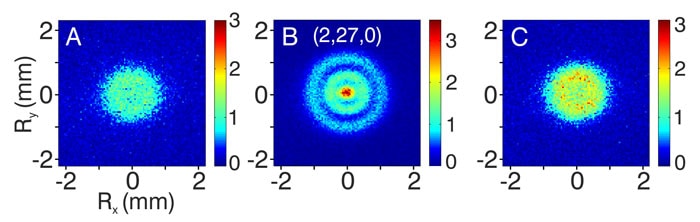
In the new work, Aneta Stodolna, of the FOM Institute for Atomic and Molecular Physics in the Netherlands, along with Marc Vrakking at the Max-Born-Institute in Berlin, Germany, and other colleagues in Europe and the US have shown that photoionization microscopy can directly obtain the nodal structure of the electronic orbital of a hydrogen atom placed in a static electric field. In the experiment, the hydrogen atom is placed in the electric field E and is excited by laser pulses. The ionized electron escapes from the atom and follows a particular trajectory to the detector – a dual microchannel plate (MCP) detector – that is perpendicular to the field itself. Given that there are many such trajectories that reach the same point on the detector, interference patterns can be observed, which the team magnify by a factor of more than 20,000 using an electrostatic zoom lens. The interference pattern directly reflects the nodal structure of the wavefunction. The experiments were carried out with both resonant ionization involving a Rydberg state and non-resonant ionization.

The team chose the hydrogen atom thanks to its unique properties. “These [hydrogen atoms] are very peculiar…as hydrogen has only one electron, which interacts with the nucleus via a purely Coulombic interaction, it has a particular structure when we place it in a DC electric field,” says Vrakking. He goes on to explain that thanks to its single-electron status, hydrogen’s wavefunction can be written as the product of two wavefunctions, which describe how it changes as a function of two coordinates – the so-called parabolic coordinates. That is, the Hamiltonian of the hydrogen atom (in an external electric field) describes a splitting of its energy levels, which is known as the “Stark effect”. More importantly, though, this “Stark Hamiltonian” is exactly separable in terms of the two parabolic coordinates, which are linear combinations of the distance of the electron from the hydrogen nucleus r and the displacement of the electron along the electric-field axis z.

Vrakking told physicsworld.com that the shape of the two parabolic wavefunctions is therefore “completely independent of the strength of the field, and so it is invariable – it stays the same as the electron travels for more than half a metre in the experiment – all the way from where the ionization occurs up to the 2D detector”. This, he explains, is crucial to scaling up the spatial distribution to magnify the nodal patterns to millimetre-scale dimensions, where they can be observed with the naked eye on the 2D detector and recorded with a camera system. “What you see on the detector is what exists in the atom,” he says. The group observed several hundreds of thousands of ionization events to obtain the results, with the same preparation of the wavefunction for each.

What lies within

The figure at the top of this article shows the team’s main result – the raw camera data for four measurements, where the hydrogen atoms were excited to states with zero, one, two and three nodes in the wavefunction for one of the parabolic coordinates. “If you look at the measured projections on the detector, you can easily recognize the nodes, and see their radial, ring-like structure,” says Vrakking.

Three charts comparing resonant and non-resonant nodes

He also points out the “striking difference” between images recorded following resonant excitation and images recorded following non-resonant excitation – this is seen in the image to the right, where a comparison is given between a measurement taken for one resonant and two non-resonant nodes. Images (A) and (C) were taken after non-resonant ionization, while for the central image, (B), the laser was tuned to a resonance with two nodes in the wavefunction. For the resonant ionization, the outermost ring extends significantly further radially, compared with the other two images – something that could be explained by a special kind of tunnelling effect taking place.

Vrakking says that the ultimate goal of the research was to study and visualize the hydrogen atom. Future experiments may look at how the atom would react within a magnetic field, study time-resolved electron dynamics, investigate holographic interference microscopy and perhaps even observe molecules using photoionization microscopy.

Helium under the microscope

Currently, however, the researchers are studying and analysing a helium atom using photoionization microscopy, and a paper on this will be published in the coming months. “As there are two electrons in a helium atom, we are getting some very interesting information,” says Vrakking. He says that while in some aspects the responses of the helium atom are very similar to that of hydrogen, there are also some major differences. “Although one of the helium electrons is very tightly bound to the nucleus, and the other one is very highly excited, we can see that the electrons know of each other’s existence and that they ‘talk to each other’,” says Vrakking, explaining that this could allow the team to “see” entanglement of the electrons.

The research is published in Physical Review Letters.

South Korea – day two

The physics department at KAIST

By Matin Durrani

Today was the first full day in South Korea for myself and Physics World news editor Michael Banks and it saw us head off by car from our hotel in downtown Daejeon to the massive science and technology zone in the north of the city. Home to more than 1000 research institutes, universities and start-ups, the zone is called Daedeok Innopolis; it’s a kind of putative Silicon Valley, if you like.

(more…)

Which Nobel-prize-winning physics invention has had the most profound impact on society?

By James Dacey

Lightbulb and fibre optics

Earlier this week my colleague reported the death of Heinrich Rohrer, the Swiss condensed-matter physicist who shared the 1986 Nobel Prize for Physics for the invention of the scanning tunnelling microscope (STM) at IBM’s Zürich Research Laboratory. Rohrer shared one half of the prize with his IBM colleague Gerd Binnig, while the other half went to the West German Ernst Ruska for his invention of the electron microscope (EM).

By bringing into view the atomic world, EMs and STMs have undoubtedly had a huge impact on science. Before their invention, optical microscopy had been a truly transformative technology. But it had been fundamentally limited to seeing things that are (roughly speaking) larger than the wavelength of the light used to produce the image. And since the wavelength of visible light is some 10,000 times larger than the typical distance between two atoms, we could not see individual atoms.

(more…)

Can we see the motion of electrons on the atomic scale?

In less than 100 seconds, Amelle Zair provides a brief introduction to the field of attosecond science.

Watch more from our 100 Second Science video series.

Copyright © 2026 by IOP Publishing Ltd and individual contributors