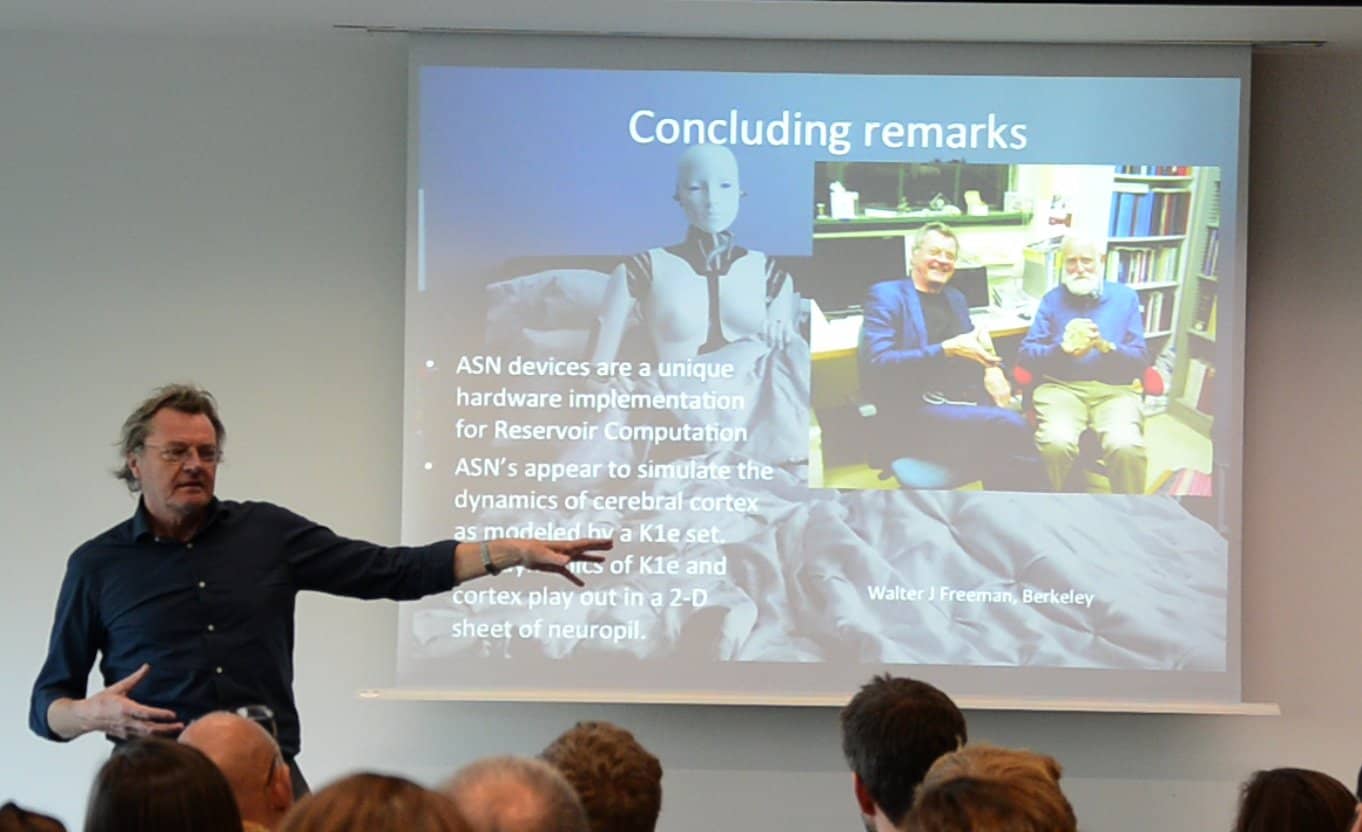
Jim Gimzewski speaking about art and science at IOP Publishing.
By Hamish Johnston
Yesterday Jim Gimzewski, who is professor of chemistry and biochemistry at UCLA, paid a visit to IOP Publishing – which publishes Physics World. Gimzewski was here to give a lecture about his two professional passions: art and science. He spoke about his involvement in a travelling art installation that was inspired by butterfly metamorphosis and also about his work in synaptic electronics
Astronomers will gather on Monday at the NASA Ames Research Center in Mountain View, California for a controversial conference on the Kepler space mission that had been threatened with a planned boycott. NASA averted the boycott of the international meeting by reversing an order to exclude Chinese participants from the event.
Scientists were dismayed in September when NASA refused to register half a dozen Chinese postdocs for the meeting. The agency cited a US law passed in 2011 that excluded citizens of China and certain other nations from visiting NASA's facilities.
The Second Kepler Science Conference, to take place in Mountain View on 4–8 November, will focus on the achievements of the telescope, which has so far detected hundreds of planets orbiting other stars. But attendees had threatened to quit the conference after NASA refused entry for the six Chinese researchers. A Chinese government spokesperson reacted by warning that such meetings "should not be politicized".
'Negative impact'
Members of the conference's organizing committee then wrote to NASA objecting to the "deplorable" bans. "Had we been aware of this possibility...alternative venues to NASA/Ames would have been pursued," they wrote. "The policies that led to this exclusion have had a negative impact on open scientific enquiry."
The ban was overturned by NASA administrator Charles Bolden after Frank Wolf, a Republican Congressman from Virginia, wrote to him saying that the legislation "places no restrictions on activities involving individual Chinese nationals unless those nationals are acting as official representatives of the Chinese government". Wolf had played a major role in the original legislation cited by NASA to reject the Chinese participants. Bolden also said that the Ames administrators had "acted without consulting NASA HQ".
Potential boycotters welcomed the reverse. "I'm so happy," says Yale University astronomer Debra Fischer, who had threatened to pull her team from the conference after she learned that administrators had initially refused the application of her Chinese postdoc Ji Wang to attend the meeting. Another exoplanet expert who will now attend after threatening to boycott it is Geoffrey Marcy of the University of California, Berkeley.
Kepler astronomer Alan Boss of the Carnegie Institution in Washington spoke to Physics World about exoplanets and Kepler's role in their discovery. You can listen to that conversation in this audio clip:
Physicists in Brazil, Switzerland and the US have predicted the onset of extreme events in a chaotic electronic circuit and then worked out a way of preventing the events from happening. The team believes that its work could provide important insights into how to prevent "dragon kings", which are extreme events such as earthquakes and financial crashes that can occur with devastating effect in complex systems.
Researchers who study extreme events such as stock-market crashes and earthquakes use the term "dragon king" to describe an extreme event that is predictable – at least in principle – and not a random "act of God". The term was coined by Didier Sornette of ETH Zürich, who cites the emergence of "megacities" such as Paris as a further example of dragon kings.
When a log–log graph of the populations of French cities versus the population rankings of those cities is plotted, all the points fall on a straight line with the exception of Paris. The French capital has a much greater population than is predicted by the log–log "Zipf plot" and it is therefore a dragon king. However, if all the information regarding the development of Paris was available, the reason for the city's vast size could be deduced.
Now Sornette has joined forces with Hugo Cavalcante and Marcos Oriá at the Universidade Federal da Paraíba, Edward Ott of the University of Maryland and Daniel Gauthier of Duke University to create an electronic system that exhibits dragon kings.
Coupled chaos
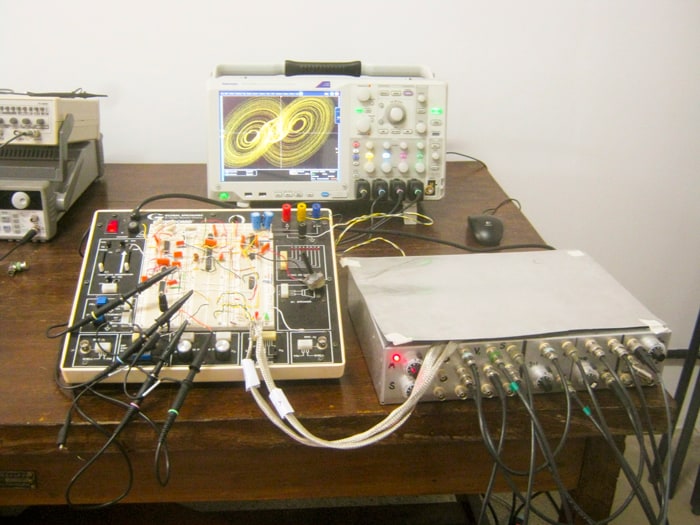
The system comprises two electronic circuits that both undergo chaotic oscillations. The circuits are coupled so that one circuit is free to oscillate as the master, while the other responds as the slave. The circuits were chosen so that they are normally synchronized with each other: their voltages and currents having about the same values. However, the circuits will also occasionally fall out of synch for brief periods of time and such out-of-synch events are called "bubbles".
A real-life dragon king: the experimental set-up used by Hugo Cavalcante and colleagues to create dragon kings and control them. The control circuit is on the board at the left of the image, while the coupled chaotic circuits are in the box at the right. The oscilloscope shows a voltage in the circuit. (Courtesy: Hugo Cavalcante)
For each bubble, the team measured how far out-of-synch the voltages and currents of the master and slave had become. When the researchers made a log–log plot of the magnitude of an event versus how many times such an event occurred, they found a clear linear relationship with larger events being much less likely to occur than smaller events.
However, there was one noticeable exception to this rule. Every once in a while a large bubble occurs. As well as being much larger than any of the "normal" excursions, these large bubbles were all about the same magnitude.
Rapid divergence
The team identified these large bubbles as dragon kings and then looked carefully at the conditions from which they emerged. According to Cavalcante, the dragon kings occur when the parameters of the master oscillator approach a region where it is very unstable. When this happens, the parameters of the master and slave diverge rapidly.
Cavalcante and colleagues then looked for ways of averting these extreme events. Their solution is to turn on a second, stronger coupling between the two circuits whenever the master circuit approaches the region of instability.
While the connection between events such as financial crashes and coupled chaotic oscillators may not be obvious, Cavalcante points out that similar behaviour is seen in financial markets. Indeed, the equations used to model markets are similar to those that describe the oscillators used in the experiment. As a result, techniques developed to predict and prevent dragon kings in the lab could someday be used to ensure market stability by intervening only when the conditions suggest a dragon king is about to occur.
Did anyone out there manage to bag the whole set? See where you rank by entering all five answers, in sequential order and as a single string of text with no spaces, in the box below.
However you do, we sincerely hope you enjoy trying the puzzles.
For any frustrated puzzlers out there who are at the end of their tether and want to know the answers, do not fret: the solutions will be revealed in the January 2014 issue of Physics World.
This question consists of a list of 55 words, plus one lone word. You have to work out where the lone word slots into the list. Each of the 56 words can be associated with another word and this second set of 56 words are in alphabetical order. The second set of 56 words divide up into seven sets of eight words, with the seven sets representing seven methods of pairing. The list reads from left to right, top to bottom.
Where does FLOW slot into the following list?
METEOR POSITRON PRINCIPLE MARS
NUMBER MODEL COINCIDENCE BORDA
DISH NEUTRON UNIVERSE EFFECT
MOON LANE DAY MAN
LINES HOLOGRAPHY KLEIN NAMAKA
KING SUN GIBBS INDUCTANCE
FREQUENCY TIME WATER ENERGY
IO MASS CYCLOTRON LANDAU
PHOBOS WELL LEVY FERRIMAGNETISM
TRITON TON RESISTANCE PRESSURE
ROSE GROSS CONSTANT CHARON
ARGON NEUTRINO FORD TITAN
CONDUCTANCE FRICTION MIRANDA FORCE
POWER DARCY MODULUS
The answer needs to be entered as three words, in this order: the associated word of the listed word that precedes FLOW, FLOW’s associated word, and the associated word of the listed word that follows FLOW. The three words should be entered as a single string of text with no spaces.
The elusive Hofstadter's butterfly could soon be spotted in lattices of ultracold atoms, now that two groups of researchers have independently created the conditions required for a spectacular fractal pattern to emerge from the energy spectra of ultracold rubidium atoms held in optical lattices. Although neither team has directly observed the fractal pattern, they have created physical systems with the right conditions for Hofstadter's butterfly to emerge. The research could also lead to the development of new ways to simulate quantum systems with exotic electric properties.
In 1976 the American physicist Douglas Hofstadter – famous for the 1979 book Gödel, Escher, Bach – first outlined the concept of the butterfly that bears his name. He predicted that stunning self-similar patterns now known as "fractals" would arise in the energy spectrum of electrons in crystalline solids exposed to extremely large magnetic fields. Due to the periodic nature of the electric fields in a crystal, the electrons are restricted to series of energy bands. When a magnetic field is applied to electrons inside a crystal, their motion is modified by the Lorentz force and they move around in circles. Hofstadter calculated that as the magnetic field becomes stronger, the energy bands split again and again, producing a butterfly-like energy spectrum.
Theoretical curiosity
The concept made an unexpected and exciting link between quantum mechanics and mathematics. However, impractically large magnetic fields are required to see the effect in conventional solids, so for years the butterfly was a theoretical curiosity.
Then in 1998 Ulrich Kuhl and Hans-Jürgen Stöckmann of the University of Marburg in Germany designed a microwave experiment that simulated the conditions required for Hofstadter's butterfly to emerge. The approach that they took is known as quantum simulation, whereby the physics experienced by electrons in a solid is mimicked using another physical system. Then in May 2013, the fractal pattern was measured experimentally for the first time in a real solid – graphene on a boron-nitride surface.
The two latest studies are also quantum simulations but mimic electrons in a solid using ultracold neutral rubidium atoms trapped in a lattice made of criss-crossing laser light. Both teams begin their experiments by cooling a cloud of rubidium atoms to a chilly 100 nK. This creates a Bose–Einstein condensate (BEC) in which all the particles behave as a single particle. "Then we load these particles into an optical lattice, which is simply a periodic structure of bright and dark areas created by the interference of counter-propagating laser beams," says Monika Aidelsburger, a member of the team led by Immanuel Bloch at the Ludwig-Maximilians-Universität Munich and Max-Planck Institute of Quantum Optics in Germany. "As a result, the system of neutral atoms in the optical lattice simulates a real material: the neutral atoms behave as electrons and the optical lattice mimics the periodic crystal structure."
Giving atoms a kick
To simulate the effect of a magnetic field, the team used a pair of criss-crossed laser beams that "kicked" the atoms as they move across the lattice, making them tunnel from one lattice site to another. "If the atoms move from left to right, they get a kick in one direction, but if they move from right to left they get a kick in the opposite direction," Aidelsburger explains. "These kicks resemble the Lorentz force felt by electrons when moving with positive or negative velocity, and therefore allow for the simulation of a real magnetic field."
"Our atoms behave as electrons in a real material under the effect of a magnetic field, with the difference that we do not apply a real magnetic field," says Julio Barreiro, who is also a member of Bloch's team.
The other team, led by the Nobel laureate Wolfgang Ketterle at the Massachusetts Institute of Technology in the US, has obtained exactly the same results. "The real fundamental quantity is the quantum mechanical phase the wavefunction accumulates as it moves around in the system, so by imprinting this phase onto our atoms we can simulate the effect of magnetic fields unattainable in conventional condensed matter systems," says Ketterle's colleague Colin Kennedy.
Studies of real materials
The results may pave the way towards solving quantum mechanical problems with many interacting particles by using quantum simulation, says Kennedy. "Our work provides a crucial step toward simulating the physics of charged electrons in a magnetic field, which constitute real materials."
An important feature of the technique is that the synthetic magnetic field can be easily adjusted. As a result the method "will offer the possibility to investigate the physics hidden in the fractal butterfly in a unique and very controllable way," explains Nathan Goldman of Laboratoire Kastler-Brossel in France, who was not involved in the studies.
Anatoli Polkovnikov and Claudio Chamon of Boston University say that both experiments also offer a new way of simulating strong magnetic fields. "One can imagine that these fields can be made time-dependent generating artificial electro-magnetism, which was never studied before," they say. "It is hard to anticipate all applications from exploring new, not very well understood regimes – very likely there is potential for unexpected discoveries."
This week, the Red Folder seemed filled to bursting with amusing and captivating news stories from around the web about physics. To start off, this rather hilarious and candid account of the Apollo 7 mission on the Discovery News website. I will not give too much away and let you read the story yourself, but suffice to say that having a rather bad cold while in space sounds dreadful and is bound to make the best of us quite grumpy – and I am sure the Apollo 7 crew would agree with me!
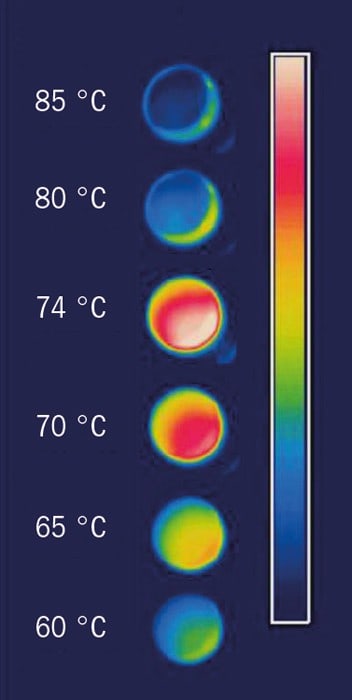
Hot and cold: a novel coating intrinsically conceals its own temperature to thermal cameras. The image shows the vanadium oxide film being heated and looking cool at 80 °C. (Courtesy: Mikhail Kats, Harvard SEAS)
A special coating that can hide its own temperature from thermal cameras has been developed by researchers from the US. The technology relies on the temperature-dependant reflective properties of vanadium oxide, a material that undergoes extreme electronic changes at a specific temperature. When heated from room temperature to 80 °C, the material's thermal radiation rises normally up until 74 °C, before suddenly appearing to drop to around 20 °C colder than in reality. The rather surprising result could have potential military applications, including camouflage, be used in communication systems and help with future metamaterial research.
When heated up from room temperature, vanadium oxide undergoes a transition from an insulating to a conductive, metallic state. At the same time, the material also changes from being almost transparent to infrared light to being reflective. This transition, however, does not occur instantaneously – and between these two end points, vanadium oxide behaves as a highly absorbing dielectric.
Thin films
Given this, when a thin film of vanadium oxide is placed on a highly reflecting substrate (for specific infrared wavelengths) such as sapphire, the film creates a combined structure that is either very absorbing or reflecting, dependant on the temperature. As these properties control the object's thermal output, the structure therefore also has an emissivity that varies considerably with temperature. As a consequence, when the vanadium oxide transitions with increased temperature, the structure undergoes a sudden decrease in emissivity – looking colder to infrared cameras than it really is.
"Almost any known object emits light when it is heated. This 'thermal radiation' is responsible for the glow from a hot stovetop or light given off by an incandescent light bulb," explains Mikhail Kats, who is a member of Federico Capasso's group at Harvard University in the US. "We [have] demonstrated a structure that emits less light as it is heated over a certain temperature range – a very counter-intuitive effect," he says.
Andrea Alù, an engineer at the University of Texas at Austin, who was not involved in the research, says that the technology "offers exciting possibilities to locally manipulate the emissivity of an object, in ways that we are not used to". He also finds it "quite interesting that they achieved this effect without the need of patterning the layer or creating ad-hoc nanostructures but by simply using a thin uniform layer of a special phase-transition material".
Applications galore
With their current research acting as a proof-of-concept, Capasso, Kats and colleagues believe that with minor modifications, potential applications for their new technology will be manifold. By varying the substrate materials to indium tin oxide, as one possibility, and modifying the vanadium oxide coating using doping, straining and other such processes, the researchers are hoping to be able to alter the wavelengths and temperature ranges at which the thermal effects are observed.
The team also rather fortuitously discovered that nanoscale structures that appear naturally in the transition region of vanadium oxide can be used to achieve a certain level of tunability, which in turn suppresses thermal radiation as the temperature rises. The team refers to such a spontaneously structured material as a "natural, disordered metamaterial". Capasso points out that artificially creating such nanostructures within a material can be extremely difficult. "Here, nature is giving us what we want for free. By taking these natural metamaterials and manipulating them to have all the properties we want, we are opening up a new area of research, a completely new direction of work. We can engineer new devices from the bottom up," says Capasso.
Doping the coating with tungsten, for example, would bring down the effect's thermal range to room temperature. Such an altered coating could be used to passively camouflage a vehicle against thermal imaging cameras. Alternatively, different coatings could be used to create specific thermal beacons, for communication, more sensitive remote measurements with infra-red thermometers, or even surfaces on which "secret" messages could be left, like an infrared blackboard, by using a hot or cold probe to locally alter the emissivity.
Furthermore, as thermal emissions carry heat away from objects, the coating's radiative properties could be used to deliberately speed up or slow down cooling – which could be used in a variety of structures from homes to space satellites. Kats and his colleagues are hoping to be able to develop prototypes to demonstrate some of these potential applications in the near future.
Last night, the Nobel Laureate Andre Geim gave a talk in Bristol – hosted by Physics World – in which he told a lovely anecdote about the difference between fundamental research and the development of new technologies. Geim, who shared his Nobel in 2010 for his experiments with graphene, described an occasion during a holiday when he took a boat tour to watch dolphins. To the joy of Geim and the crew, these graceful animals glided up alongside the boat as if they were pining for human interaction. The physicist joined the others in reaching over the side of the boat to touch these magnificent beasts, and for a few minutes everyone delighted in the moment. Then suddenly the paradise was lost. To his shock, Geim heard the voice of a little boy behind him: “Mum, can we eat them?”
The point Geim was making was that, for him, it is enough to marvel at the wonder of graphene without necessarily “eating it” by turning it into commercial products. Geim does appreciate, however, that every so often a fundamental discovery does come along (as in the case of graphene) where the potential spin-offs are simply too delicious to resist. The tale of the boy and the dolphin was Geim’s poetic way of saying that he is going to stick with the pure physics, while it is the job of others to speculate about the potential technological uses of his research.
An international team of researchers has found that tiny boomerang-shaped colloidal particles suspended in a fluid move in a particular direction, for a short time. The team's findings may increase our understanding of the diffusion of complex biomolecules and improve drug delivery techniques.
Brownian motion – first explained by Albert Einstein in 1905 – describes the random, erratic motion of tiny particles dispersed in a fluid, collectively called a colloid. It is caused by the many small "kicks" that are a result of the thermal motion of the fluid, where the particles are jostled in all directions with equal probability. This applies to spherical particles as well as ellipsoids – thanks to their overall symmetry – and the particles do not travel in any particular direction. Therefore, if the same particle starts from the same start point multiple times, it will follow a completely different, random path each time and the average displacement for all of these paths – the "mean displacement" – will be zero, as predicted by Einstein. This applies to both spherical and ellipsoidal particles.
Particular paths
Now however, Qi-Huo Wei and Jonathan Selinger of Kent State University in Ohio and colleagues have found that particles that are clearly non-spherical – such as a boomerang-shaped particle – do show a preferred direction of motion, at least initially. Wei told physicsworld.com that his group has had a long-term interest in using colloidal systems as models for mimicking atomic and molecular systems because their motion can be observed using optical microscopes. The group's initial interest in boomerang-shaped colloidal particles was piqued thanks to "intriguing liquid-crystal phases exhibited by boomerang shaped molecular systems", says Wei. Also, Selinger and his group at Kent State's Liquid Crystal Institute have been working on theoretical descriptions of liquid crystals of boomerang-shaped molecules for a while, so it was "kind of natural that his group and my group team up for this project. Studying the Brownian motion of boomerang particles is the first step of our long-term objective", says Wei.
Wei, Selinger and colleagues used photolithography – a method that uses ultraviolet light to make a pattern on a photoresist material – to make their polymeric boomerangs that are right-angled at the apex. Each boomerang arm is 2.1 μm long and 0.51 μm thick and the particles were suspended in water and trapped between two glass plates, confining their random movements to 2D.
The researchers then observed their Brownian motion using a video camera. "We have developed a high-precision image-processing algorithm to determine the position and orientation of a particle in each video frame," says Wei. He explains that they analysed thousands of frames for each particle, amounting to over 150 videos of the motion trajectory of a single boomerang particle. "From that, we can calculate the mean particle displacements and the mean square displacements. So the experimental findings are obtained through extensive averaging," explains Wei.
Random rotation
The video observations showed that for the first minute, each of the boomerangs moved in the direction of the line bisecting its arms – that is, their random movements occur in nearly the same direction each time and so they have a non-zero mean displacement. Then there is a transition to completely random movements only after about one minute – the time it takes the particle to rotate about 180°, according to Wei. After a minute the random impacts rotate the particle and it deviates from its initial path and its motion is completely random.
Apart from improving our understanding of how complex geometric shapes of particles affect their Brownian motion, Wei says that the new findings will allow us to better control the motion of such particles used in various applications.
Wei also points out research done by another group earlier this year, where it demonstrated that self-propelled particles with a shape similar to boomerangs can be made to move in circular trajectories. "One can imagine that, by using different geometric shapes, more complex trajectories can be designed, and such nanoswimmers may be useful someday, for example, for increasing the efficiencies of drug delivery," he says. Other potential applications include new ways to sort and separate particles or biological macromolecules, based on their different geometric shapes.