New ‘leviton’ quasiparticle spotted by physicists

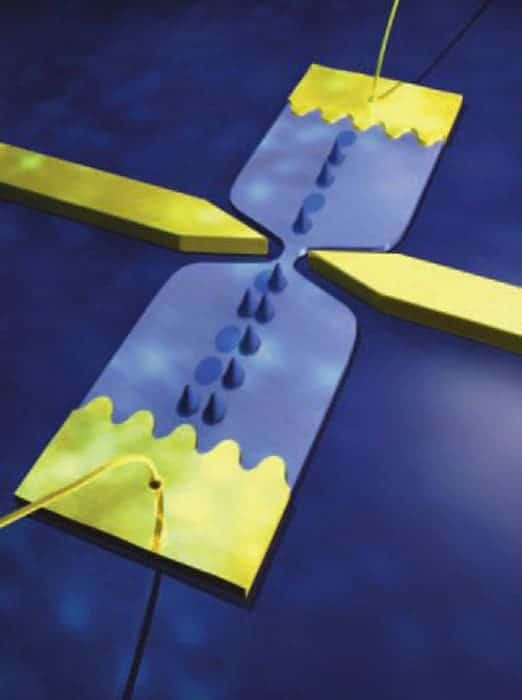
Schematic of the device used to create and detect levitons

A new type of quasiparticle – dubbed the “leviton” – has been seen by physicists in France and Switzerland. First predicted in 1996 by a team led by Leonid Levitov, the phenomenon involves the excitation of as few as one electron to create a wave that propagates coherently through a metal. The ability to make levitons on demand could lead to the creation of quantum-electronics circuits that involve sending single electrons through tiny circuits.

Electrons in a metal or semiconductor can be thought of as a “Fermi sea” of particles, with the highest-energy electrons at the surface. Normally, if an electron receives an extra kick of energy it pops out of the Fermi sea, creating a “hole” – which is itself a quasiparticle. However, under special circumstances an electron (or a few electrons) can rise out of the Fermi sea without creating a hole – much like a wave rising out of the ocean. This excitation could then propagate through the material like a tiny particle that obeys quantum mechanics – a quasiparticle.

Searching, searching, searching

After this type of excitation was first suggested by Levitov and colleagues, it immediately inspired another physicist, Christian Glattli, who has been trying to devise experiments to create levitons ever since. Working at CEA Saclay near Paris, Glattli’s team – along with physicists at the University of Paris Diderot and ETH Zürich – has now succeeded in creating levitons and confirming their existence using several different techniques.

Their experiments were carried out on a metal film that is so thin that its electrons behave like a 2D gas. Levitons are created at one end of the device using an electrode that applies an electrical pulse with a specific temporal shape – the familiar Lorentzian distribution. The levitons then travel through a quantum point constriction (QPC) that is created in a narrow gap between two electrodes that are halfway along the device (see figure). When an appropriate gate voltage is applied to these electrodes, the gap becomes a 1D channel for electrons. After negotiating the QPC, the charge carried by the levitons is detected using a fourth electrode at the far end of the device.

Listen to the noise

While the arrival of an electron pulse can be measured at the fourth electrode, the researchers cannot tell if it was carried by a leviton or via a more conventional electron–hole excitation. So to confirm that levitons are created, the team used a technique called noise spectroscopy, which involves cooling the device to a chilly 35 mK and measuring the electronic noise in the sample.

Theory says that there should be more noise in the sample when electron–hole excitations are present than when levitons are there. The team therefore measured the noise when Lorentzian pulses are applied to the device. Measurements were also made using square and sinusoidal pulses because these are more likely to produce electron–hole excitations, rather than levitons. Sure enough, there was significantly less noise when Lorentzian pulses were used, compared to square and sinusoidal pulses.

Electron anti-bunching

To further confirm that the levitons are indeed quasiparticles that obey the rules of quantum mechanics, the team did a “Hong–Ou–Mandel experiment” whereby two levitons are fired at a beam splitter at the same time from opposite ends of the device. The QPC acts as the beam splitter and, because levitons obey Fermi–Dirac statistics, two levitons will always follow different paths through the beam splitter. This is a quantum-mechanical effect called anti-bunching.

Again, Glattli and colleagues used noise spectroscopy to look for evidence of anti-bunching. It turns out that when anti-bunching occurs, the noise associated with the levitons should vanish. The team confirmed this by adjusting the time delay between the levitons reaching the beam splitter and measuring the noise. As the time delay went through zero, anti-bunching occurred and the noise decreased significantly, just as expected for levitons.

According to Glattli, the levitons have the same effective mass as electrons and interact with electromagnetic fields in the same way. As a result, the leviton source can be thought of as a source of single electrons that operates on demand – rather than emitting electrons at random times. Such sources have proven to be difficult to build and could have important applications in quantum computing and quantum metrology that use single electrons in much the same way that quantum optics systems use single photons.

‘Significant step forward’

JT Janssen, who develops quantum-metrology techniques at the UK’s National Physical Laboratory (NPL), described the work as “a significant step forward”. He highlights the fact that Glattli and colleagues were able to show that the levitons remained coherent over a distance as great as 100 μm – something that is important for practical applications.

Leonid Levitov told physicsworld.com that Glattli’s work is “complete and convincing”, adding that the detection technique is similar to that outlined by Levitov and colleagues in a paper published in 2006. Levitov, who works at the Massachusetts Institute of Technology, said that he is proud of the work that he did in the 1990s and is pleased that it has been confirmed in the lab. “As for the playful name, I think it’s alright as long as it helps to convey the message, which it probably does.”

As for Glattli, he is currently working with a group that specializes in creating ultracold gasses of fermionic atoms to see if levitons can be created in such systems.

The research is described in Nature.

Building the perfect lens with metamaterials

In principle a “perfect lens” could be created that opens up a brave new world of scientific investigation, particularly in nanotechnology and the biosciences. The key requirement of these instruments is to devise a cunning way of getting around the diffraction limit, which restricts the resolution of images produced with optical light. This film takes you to Imperial College London to investigate one promising route to a perfect lens that uses artificial structures known as metamaterials.

Light is, of course, a wonderful thing as it can be guided and focused using simple lenses and fibres, capturing images of objects that are either too small or too far away to be seen with the naked eye. Moreover, many atomic and molecular transitions occur at optical wavelengths, which is why light – from the infrared to the ultraviolet – lies at the heart of a vast range of spectroscopic techniques. But there is one major drawback to light as a probe of atoms and molecules: light of a certain wavelength cannot be used to discern an object smaller than about half that wavelength. Even for ultraviolet light, this “diffraction limit” is about 50 nm, or roughly the size of a large protein molecule.

One promising route around the diffraction limit is to create a lens using so-called metamaterials, which contain structures that are smaller than the wavelength of light. “By arranging those structures in certain ways you can amplify light waves and get them to diffract the wrong way and you can see images you wouldn’t normally be able to see, on a much smaller scale,” explains science communicator Chris Clarke. The idea of creating a perfect lens using metamaterials was first proposed in 2000 by Sir John Pendry of Imperial College London and the basic principles have already been demonstrated experimentally.

Today at Imperial College, bioscientists are starting to speculate about how they might use such a sophisticated imaging tool in their research. “What these high-resolution microscopies are beginning to reveal is that there are a lot of exceedingly small structures down to the level of ten of nanometres or less. And these structures are critical to the way cells talk to each other,” explains Iain Dunlop, a biomaterials scientist. “When your immune system decides if it’s going to attack something, there are spatial structures at that size which are helping to mediate that decision. So the ability to image those is vital to understanding that.”

This film is one of a three-part series exploring some of the most promising technologies that are emerging from physics research. You can read about other physics spin-offs by downloading the special 25th anniversary issue of Physics World as a free PDF.

What is time?

The problem of time is one of the oldest conundrums we have, and the fact that our lives are finite makes it the most intimate and personally pressing “deep” mystery about reality. Physicists from Newton onward have, in some cases, directly addressed issues concerning time that were once the domain of philosophers. But the science of physics – charged as it is with embracing the whole of physical reality – has added its own perspectives (and paradoxes) to questions about time, its structure and its fundamental reality. The result is that there is no single problem of time in our science. Instead, there are many interwoven problems that may require more than one conceptual revolution to resolve.

The poles of debate over time in western thinking were laid down by two Greek philosophers, Parmenides and Heraclitus, around the 5th century BC. The tradition established by Parmenides claimed that time, as a measure of change, is an illusion, and that reality, at its most fundamental level, is timeless and eternal. In contrast, Heraclitus and his followers claimed that nothing exists beyond time and that change – relentless in its advance – is the only fixed feature of reality. Debate about the fundamental nature of time in physics takes place within the shadow of these ancient distinctions. Even today, you will find physicists at both the Parmenidean and Heraclitan ends of the spectrum – and pretty much everywhere in-between.

One early proponent of a “middle way” between Parmenides and Heraclitus was Isaac Newton. The development of Newtonian mechanics established the modern paradigm for scientific inquiry and in doing so split the difference, in some sense, between the two ancient views on time. While the differential equations of Newton’s dynamics treat time as a parameter that flows at a constant rate everywhere in the universe, these equations represent laws that are themselves eternal and exist outside of time. After Newton, the prospect of discovering additional timeless “laws of Nature” became a siren call of inspiration for all of science, marking its special place among the modes of human inquiry.

Newton’s own laws were, of course, found to be valid only in the limits that speeds are less than that of light and length scales are larger than those associated with quantization. But however much the rise of relativity and quantum mechanics changed our views of Newton’s universe, their development did not alter his essential idea that at least one aspect of reality – the laws of physics – exists beyond time.

Within our search for timeless laws, physics has brought us to a number of essential realizations (and open questions) about temporality. One of the most obvious and still unresolved of these questions is the famous “arrow of time”. All established fundamental laws governing the dynamics of particles – the most elementary of physical objects – are time-reversible. Nothing in Newton’s equations of point-mass dynamics or Schrödinger’s equations for the wave function can tell us which direction the hands on the clock should turn. The macroscopic world, however, brooks no such indecision. Scrambling eggs and stirring cream into coffee make it clear that an arrow of time from past to future is an essential component of reality.

Back to the beginning

As a physical principle, questions concerning the “arrow of time” appear in the language of dynamical (differential) equations that govern physical processes. As such, it is not something the Greeks would have recognized. It was only with the advance of thermodynamics (and, later, statistical mechanics) that this dilemma was resolved, after a fashion, by averaging over the micro-states associated with each macro-state of many particles. Thus a new quantity associated with large systems – entropy – entered the lexicon as a stand-in for time in the macroscopic world.

Thinking in terms of entropy, however, only pushes the problem of time’s arrow backward. Once the entropy (in other words, disorder) is maximized, a system reaches equilibrium and each moment will look, essentially, like the next – bar the occasional fluctuation. Thus physicists must become cosmologists to ask why we live in a universe where entropy was initially low enough to allow evolution, and therefore change, to continue. The discovery that our universe began in a Big Bang meant that this cosmological arrow of time had to be pushed back to a question of cosmic initial conditions. But as Roger Penrose, Sean Carroll and other theorists have argued, low-entropy initial conditions within the classic Big Bang scenario are extremely unlikely.

Research at the frontiers of physics embraces an astonishing range of possible natures of time, which demonstrates both how far we’ve come and how far we still have to go

Questions about the universe’s initial conditions bring us to the search for that most fundamental of fundamental theories: quantum gravity. Efforts to quantize the classical space–time of general relativity are discussed elsewhere in this issue (see pp42–43), but one important consequence of such research has been to push theorists to new frontiers in our understanding of time. For example, consider the troubling fact that when you cast Schrödinger’s equation in a form appropriate to the space–time of general relativity, you end up with an equation in which time does not appear. This time-free expression is known as the Wheeler–DeWitt equation, and it presents us with a set of “cosmological” quantum states for the universe without any way of evolving between those states.

Does the Wheeler–DeWitt equation mean that Parmenides was right, and time is merely an illusion? The question is far from settled, but many of those working on quantum gravity argue that the time and space we are familiar with cannot be fundamental. Instead, they insist that time and space must be built from something more essential – something with quite different properties from our usual notions of locality and temporal progression. In its modern setting, the question “Is time real?” is phrased in terms of time emerging from some deeper set of principles.

For other researchers, however, the paths taken in the search for quantum gravity pose troubling questions. Andreas Albrecht, for example, has noted that moving from the Wheeler–DeWitt equations to the time-bound world we experience introduces a new puzzle, which he terms the “clock ambiguity”. As Albrecht has demonstrated, there is no straightforward way to choose which part of the new quantum-compatible theory should act as a clock, and which should be called “space”. Making such a choice, in effect, de-unifies space–time, and Albrecht has found that different, arbitrary, choices for what plays the role of a clock can lead to entirely different sets of physical laws.

A plea for time’s reality

An even more strident criticism of current approaches comes from Lee Smolin, who has argued that the centuries-old emphasis on timeless laws represents a conceptual stumbling block. In Smolin’s view, the drive for eternal laws to describe reality as a whole has backed fundamental physics into a corner where it is forced to consider “potential” realities, as is the case for multiverse theories and their infinite and possibly unobservable other universes, rather than the one we experience. Smolin also takes a bold step into the Heraclitan domain by arguing that time is the bedrock of reality and cannot be considered emergent. According to this argument, even physical laws must be bound within time and can, therefore, change.

Research at the frontiers of physics embraces an astonishing range of possible natures of time, which demonstrates both how far we’ve come and how far we still have to go. Time has proven to be a remarkably durable mystery in physics. We should expect it to remain so, just as we should expect it to continue provoking our most creative scientific responses – at least for the time being.

Farthest confirmed galaxy is a prolific star creator

Hubble Space Telescope image of z8_GND_5296

Astronomers in the US have measured the distance of the farthest known galaxy, finding that its light took 13.1 billion years to reach Earth – which means the light was emitted just 700 million years after the Big Bang. Although the galaxy is much smaller than the Milky Way, it is forming stars at a much faster rate. The discovery provides important new information about the epoch of reionization, the ancient era when the neutral gas between galaxies became ionized.

To observe the farthest galaxies, astronomers exploit the universe’s expansion, which stretches – or redshifts – the light waves of distant objects to longer, or redder, wavelengths. But dust can also redden light, so a red colour alone does not guarantee that a galaxy lies at the edge of the observable universe.

“The problem had been, over the previous few years, [that] people have been trying to confirm these really distant galaxies – and for the most part coming up empty,” says Steven Finkelstein, an astronomer at the University of Texas at Austin who was involved in the discovery.

Seeking faint spectra

Confirmation of a far-off galaxy’s distance requires measuring the redshift of lines in the spectrum of light that it emits. This means that astronomers face the challenge of obtaining the spectrum of a faint object. So for two nights in April, Finkelstein took aim at 43 red objects in the constellation Ursa Major with one of the largest telescopes in the world, the 10-metre Keck I telescope atop Mauna Kea in Hawaii. A year earlier, this telescope had received a more sensitive spectrograph, which made Finkelstein’s observations possible.

Finkelstein searched the spectra for a line from Lyman-alpha emission. This radiation arises when an electron falls from the n = 2 to the n = 1 state of hydrogen, which is the most abundant element in the cosmos. This spectral line normally emits far-ultraviolet radiation at a wavelength of 1216 Å (121.6 nm), but because of the hoped-for redshifts, Finkelstein obtained his spectra at near-infrared wavelengths instead.

Disappointment, then discovery

In 42 of the 43 spectra, Finkelstein saw no lines. “I was disappointed, I think – until I figured out the redshift of the one we did see and realized it was the most distant one.” That galaxy, bearing the unwieldy name z8_GND_5296, has a Lyman-alpha line at a wavelength of 10,343 Å (1.0343 μm), a 751% increase over the rest wavelength, which means that the galaxy’s redshift is 7.51. It is 40 million light-years more remote than the previous record holder, at redshift 7.215.

It’s a significant step in terms of distance and it’s a very unusual galaxy
Dominik Riechers, an astronomer at Cornell University

“That alone is remarkable,” says Dominik Riechers, an astronomer at Cornell University in Ithaca, New York, who was not part of the research team. “It’s a significant step in terms of distance, and it’s a very unusual galaxy.”

Because of its great distance, we see the galaxy as it was just 700 million years after the Big Bang. At that time galaxies were small because they had yet to grow larger. All the galaxy’s stars put together weigh only a billion times more than the Sun, a fraction of the Milky Way’s stellar mass.

But the galaxy is growing up fast. Its stars have already enriched it with heavy elements. Furthermore, it is undergoing a “starburst”: Finkelstein and his colleagues calculate that the galaxy converts about 330 solar masses of gas into stars each year – roughly 100 times the Milky Way’s rate. At that pace, the galaxy could have created all of its stars in only three million years.

Much too fast?

That’s much too fast for Abraham Loeb, who chairs the astronomy department at Harvard University. “The thing that makes me worried is that you really need the entire galaxy to be dense and synchronized” in order for it to make all its stars so quickly. Loeb says a group of galaxies might lie in front of the galaxy and gravitationally amplify its light, making it seem more prolific than it really is.

But Finkelstein says another distant galaxy, at redshift 7.21, is also a vigorous star creator. “We think that finding two of these in a relatively small region of the sky is telling us that in the early universe there are more sites of very intense star formation than we had previously thought possible,” he says.

In any event, the galaxy yields insight into the ancient universe. In particular, 700 million years after the Big Bang, at least some of the gas between the galaxies must have made the transition from neutral to ionized. Otherwise, Finkelstein would not have detected the galaxy’s Lyman-alpha radiation, because neutral hydrogen gas scatters it away. Indeed, that may be why he failed to find this radiation from other distant galaxies, some of which may be even farther away.

Alternatively, the galaxies themselves may be to blame. They may harbour so much neutral hydrogen gas that it traps all the Lyman-alpha radiation they generate. The starburst in the one galaxy whose distance Finkelstein measured might have blasted holes in the gas, so Lyman-alpha radiation could escape the galaxy and reach telescopes on Earth.

The astronomers report their discovery today in Nature.

From the dark universe to graphene

By James Dacey

In just over an hour’s time, I’ll be hopping on my bike and cycling to the top of a steep hill where the Nobel laureate Andre Geim will be found practising his lines. Sir Andre Geim is delivering a talk at the University of Bristol as part of a series of lectures to celebrate the 25th anniversary of Physics World. In Random Walk to Stockholm, Geim is going to be discussing his work on graphene that led to him sharing the 2010 Nobel prize with Konstantin Novoselov. He will also try to explain why this “wonder material” is attracting so much attention today.

For the small percentage of you who live close to Bristol, there are still tickets left for the event, which starts at 18:00 local time (by rippstein). I am planning to publish an audio recording of the lecture on this website after the event, for those of you who cannot attend tonight.

(more…)

Higgs MOOC sees spike in interest after Nobel

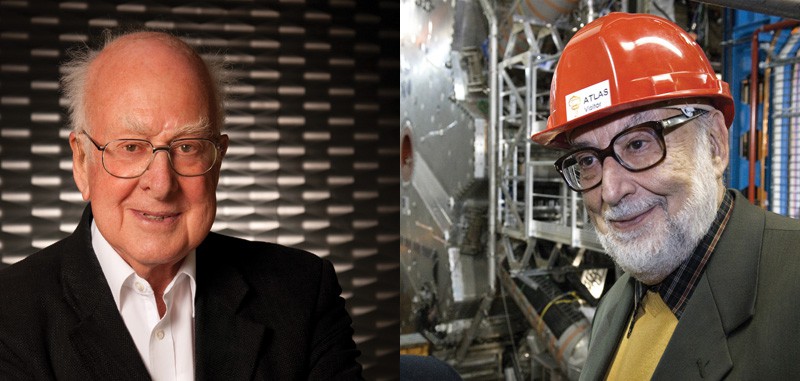
Peter Higgs and François Englert,

By James Dacey

The story goes that on the morning of this year’s Nobel Prize for Physics announcement, Peter Higgs had popped out for a leisurely lunch at a local pub without telling his colleagues at the University of Edinburgh. It meant that the Nobel prize committee in Stockholm was left scrabbling around trying to contact Higgs on several numbers, to no avail. We heard from François Englert in the slightly awkward phone conversation that customarily follows the prize announcement. But there was still no sign of the elusive Prof. Higgs.

Well fear not, because we will finally get to hear from the man behind the boson about his crowning achievement, via a free online course offered by the University of Edinburgh. The Discovery of the Higgs Boson is a seven-week course “about developments at the Large Hadron Collider, particle physics and understanding the universe”. Registration is already open for the massive open online course (MOOC), which starts on 10 February. It will feature interviews with Higgs himself and filmed lectures by a team of particle physicists at the University of Edinburgh, along with additional material including notes and further videos for more advanced students.

(more…)

CERN physicist picked for new UN panel

Four physicists have been appointed to a newly created panel that will advise the United Nations (UN) on scientific matters. The UN’s scientific advisory board – appointed by the UN secretary-general Ban Ki-moon – will feature 26 eminent scientists, including CERN particle physicist Fabiola Gianotti, who is the former spokesperson for the ATLAS experiment.

The idea for a science board originated from a recommendation in a January 2012 UN report – Resilient People, Resilient Planet: A Future Worth Choosing – that called for a “major global scientific initiative to strengthen the interface between policy and science”. The new board, which will offer expertise in a range of areas from medicine and plant breeding to engineering, is expected to provide advice on science, technology and innovation to the UN secretary-general and to the leaders of UN organizations. The UN Educational, Scientific and Cultural Organization (UNESCO) will host the secretariat for the board.

In a statement, UNESCO says that the new body will aim to “ensure that up-to-date and rigorous science is appropriately reflected in high-level policy discussions in the UN system” and will provide recommendations and advice on up-to-date scientific issues including on informing on issues related to the “public visibility and understanding of science”.

Joining the club

Three other physicists will join Gianotti on the panel. They include Susan Avery, president and director of the Woods Hole Oceanographic Institution in the US, Vladimir Fortov, who is president of the Russian Academy of Sciences, and nuclear physicist Dong-Pil Min from Seoul National University.

The 26-member panel also features two Nobel laureates including Ahmed Zewail from the California Institute of Technology, who won the 1999 Nobel Prize for Chemistry for his work in femtosecond spectroscopy. Zewail is joined by Ada Yonath, director of the Helen and Milton A Kimmelman Centre for Biomolecular Structure and Assembly at the Weizmann Institute of Sciences, who shared the 2009 Nobel Prize for Chemistry for her work on the structure and function of the ribosome – a key biological particle for the synthesis of proteins.

“It brings together scientists of international stature and will serve as a global reference point to improve links between science and public policies,” adds UNESCO director-general Irina Bokova.

Members of the UN science advisory board will be expected to act in their “personal capacity and will provide advice on a strictly independent basis”. The board members will serve for two years, with the possibility of renewal for one further two-year term. Gianotti told physicsworld.com that the role will be unpaid. “I don’t think these tasks should be remunerated,” she says.

The first meeting of the newly established board will take place at the start of 2014.

Pushy bacteria could shed light on tumour growth

Bacteria can colonize a vast number of surfaces in everyday life, from water pipes to teeth, spreading harmful disease in the process. Scientists had assumed that the growth of such colonies relies on bacteria being able to propel themselves towards sources of food, but a group of physicists in Scotland has now shown that colonies expand using nothing more than the simple mechanical repulsion between bacteria that takes place when they grow and bump into one another. This insight could improve our understanding of antibiotic resistance, say the researchers, and may even help in the fight against cancer.

Scientists use computer models of bacterial colonies to better understand a number of key characteristics of these ubiquitous structures. One parameter of great interest is a colony’s speed of growth because this determines how quickly disease can spread. Another important characteristic is a colony’s shape. Bacteria reproduce rapidly, which increases the possibility that they will mutate and acquire resistance to antibiotics. But reproduction requires nutrition and it is possible that the newly formed bacterium will be beaten by neighbouring cells in the race to reach the nutrients that are more abundant on the edge of the colony. The shape of the colony can dictate the outcome of that race.

According to existing models, which are based on a theory developed by biologist Ronald Fisher and mathematician Andrey Kolmogorov in the 1930s, the growth rate and shape of bacterial colonies depend on both a Brownian-motion-like diffusion of nutrients and a random but active motion on the part of the bacteria. However, these models fail to describe the behaviour of colonies growing on a surface, where bacteria are often unable to propel themselves.

Bacteria as ‘active matter’

In the latest work, Fred Farrell and colleagues at the University of Edinburgh, working with Oskar Hallatschek of the Max Planck Institute for Dynamics and Self-Organization in Göttingen, Germany, set out to establish the importance of mechanical forces in the growth of dense colonies of bacteria on solid substrates. Part of a growing number of physicists investigating “active matter” that exists far from thermal equilibrium, the team was also motivated by recent research showing that mechanical pressure can affect the growth and death rate of cells, including cancer cells.

The researchers model the evolution of non-self-propelling single-celled bacteria, starting with a single cell or a row of cells, which are surrounded by nutrients that they gradually deplete to grow and divide. Each bacterium is considered to be an elastic rod that grows along its length and which splits into two when it reaches a certain size. As it expands, the bacterium pushes against its nearest neighbours, creating movement by virtue of the elastic force between it and them.

The researchers found that this mechanical force pushes the colony outwards, allowing it to overcome surface friction. An increase in the strength of the pushing force leads to a faster growing colony. They also discovered that the shape the colony takes on as it expands depends on the ratio of the cells’ growth rate to the amount of nutrients available. When nutrition levels are low the colony forms branches to find more food, whereas with bountiful supplies the colony becomes circular, as is observed experimentally.

No diffusion needed

Contrary to the Fisher–Kolmogorov models, this behaviour was achieved without the diffusion of the bacteria and it also relied little on diffusion of the nutrients. Farrell’s colleague Bartek Waclaw points out that the results from the new model could be tested experimentally by confining a bacterial colony to 2D inside a microfluidic array and then imaging it to see how quickly it grows. Whereas the older models predict that the growth should be linear, the new one says it should either be slower than linear or exponential.

Having only two dimensions, however, the model’s utility will be limited, according to Waclaw. Although he adds that a basic 3D extension of the model does reproduce the main results. He explains that newly formed bacterial colonies can exist briefly as a single layer of cells, but colonies quickly build up successive layers. In addition, he points out, many bacteria exchange chemicals to communicate with each other and such signals are not incorporated in the current model. He says, however, that the model could mimic what happens at the early stages of the skin-cancer melanoma, which, he explains, starts out as an essentially flat colony of cells.

Looking at mutations

Waclaw adds that the group is now working on an extended version of the model that allows them to investigate directly how the mechanical properties of bacteria affect the rate of production of potentially antibiotic-resistant mutations. To do so the researchers assume that a certain fraction of the bacteria are mutant varieties and that these cells can grow a little faster than the rest. They then calculate the probability that a drug-resistant mutant cell can reach the nutrients ahead of its rivals and form a critical mass of cells.

A long-term aim of this research, says Waclaw, is to develop drugs that can control the mechanical properties of cells to lower the odds of those cells acquiring antibiotic resistance. “This is just a hypothesis,” he cautions, “but the ultimate hope is that it will one day be possible to modify mechanical interactions by applying a drug.”

The research is published in Physical Review Letters.

Physics World at 25: Puzzle 4

By Louise Mayor

Prepare to be perplexed by the fourth and penultimate brainteaser in the Physics World at 25 Puzzle. #PW25puzzle


Which food is, unusually, mentioned in the third of these well-known laws of physics?

KEPLcRS FIddT iAW ecYc hHec adu OrBug ey hVbit PLsNgm oS ff fjagnhf WenH bbg iUq sg Odh cF fme dfCv

egmyffa kijpNd vql DffmqszgS doW kHd garbtnpgmvbd dF kx nBJdCe xdLjcpe co uic McaS knD jHe FjRcE ACgecG ON IT

THE mmIRD LAW OF THERMODYNAMwCS GIVst xHe kNoRxPY iF nqsnx Ay kjMsivmTUio jjPnOACHlS ZERO

Surface plasmons reveal grain boundaries in graphene

Researchers in the US, Germany, Singapore and Spain have developed a new technique to obtain images of grain-boundary defects in graphene by analysing the behaviour of surface plasmons. Their study reveals that the defects act as electronic barriers and are responsible for the low electron mobility seen in some samples of graphene. The team also says that these barriers could find use as tuneable “plasmon reflectors” and “phase retarders” in plasmonic circuits of the future.

Graphene is a single atomic layer of carbon atoms that are arranged in a honeycomb lattice. It shows great promise for making electronic devices of the future thanks to its unique electronic and mechanical properties – which include extremely high electrical conductivity and exceptional strength.

A patchwork quilt

Defect-free graphene has the best mechanical and electronic properties but techniques for creating large, pristine graphene samples are limited by the emergence of grain-boundary defects. Much like the seams in a patchwork quilt, these defects form the boundaries between areas of perfect graphene. They are also notoriously difficult to characterize using conventional techniques such as transmission electron microscopy or optical microscopy.

The new nano-imaging technique developed by Dimitri Basov of the University of California at San Diego and colleagues was used to study graphene created by chemical vapour deposition (CVD) – a standard technique for making the material that suffers from grain-boundary problems.

Rippling across the surface

Surface plasmons are coherent wave-like oscillations of electrons that ripple across the surface of graphene and some other materials. In Basov’s experiment the plasmons are created by a nanoscale antenna – the metallic probe of an atomic force microscope – that is placed near the graphene surface and excited by infrared light (see figure). The plasmon waves are reflected and scattered by the graphene grain boundaries, creating interference patterns.

“By recording and analysing these interference patterns, we can map grain boundaries for large-area CVD films and probe the electronic and optical properties of individual grain boundaries at the same time,” explains team member Zhe Fei.

Charged line defects

The analyses show that grain boundaries in CVD-grown graphene are “charged line defects” that act as obstacles to both charge transport and plasmon propagation, he says. This discovery goes some way towards explaining why electrons travel slower in such graphene than in defect-free samples. On the other hand, grain boundaries might be exploited as plasmon reflectors and phase retarders – which are essential components for future graphene-based plasmonic circuits. Indeed, the team says that it is already looking at making such circuits by creating charge barriers in graphene that are similar in structure to grain boundaries.

Plasmon reflectors are used to change the path of plasmon waves in a material, in analogy to a mirror (or a beam splitter) in optics, explains Fei. Plasmon phase retarders are used to add phase delay to the plasmon waves, in analogy to an optical waveplate. “Our experiments indicate that the graphene electronic barriers themselves are plasmon reflectors and phase retarders and so can be used to reflect plasmon waves and also to add phase delay to the reflected waves.”

Shrinking optics

Controlling plasmons in this way could be particularly useful for shrinking the size of optical devices. This is because light can interact with surface plasmons to create waves called surface plasmon polaritons (SPPs), which have much shorter wavelengths than the original light. As a result, devices controlling SPPs can be much smaller than their optical counterparts.

The nano-imaging technique might also be used to analyse a variety of other materials in which plasmon waves exist, he adds. Such materials include metals, superconductors and topological insulators. It might even be extended to structures that support surface phonons waves (vibrations of the crystal lattice), such as dielectric materials, for example.

“The electronic properties of a grain boundary are largely related to its atomic structure so we will now be correlating our technique with an atomic-scale method such as scanning tunnelling microscopy, to study grain boundaries,” says Fei. “Such studies will help us better understand the exact relationship between structure and properties of these defects.”

The research is reported in Nature Nanotechnology 10.1038/nnano.2013.197.

Copyright © 2026 by IOP Publishing Ltd and individual contributors