Hofstadter’s butterfly spotted in graphene

Hofstadter’s butterfly – a stunning fractal pattern that describes the behaviour of electrons in a magnetic field – has been measured experimentally for the first time. The breakthrough has been made by three research groups that looked at the electronic properties of graphene placed on a boron-nitride surface. As well as confirming a theoretical prediction made nearly 40 years ago, the results could find use in electronic and optoelectronic devices.

The concept of Hofstadter’s butterfly dates back to 1976 when the American physicist Douglas Hofstadter – best known for his Pulitzer-prize-winning book Gödel, Escher, Bach – calculated the energy levels of electrons exposed to a magnetic field in a 2D lattice. He treated the electrons as idealized “Bloch electrons”, which means they do not interact with one another and move in a periodic electric potential commensurate with the lattice. This approach seemed sensible as it had proved a good way of describing the electronic properties of many metals and semiconductors.

Unfortunately, Hofstadter encountered a difficulty when considering electrons exposed to a magnetic field while moving in a 2D lattice. The problem lies in the fact that electrons respond to an applied magnetic field by swimming in circles at the cyclotron frequency. However, the orbital motion of the electrons is quantized in terms of a frequency that is defined by the properties of the crystal lattice. The presence of these two, often incommensurate, frequencies means that Hofstadter’s calculation of electron energy levels yielded some bizarre results.

Hofstadter tried to make sense of this difficulty by plotting the wavefunction of the electron versus a parameter related to the ratio of the two frequencies. The plot produced a stunning fractal pattern that looks like a butterfly. But since Hofstadter’s prediction, physicists have struggled to observe his butterfly in the lab. The main problem is that the crystal frequencies of conventional lattices – where atoms are separated by less than a nanometre – are relatively high, which means that unfeasibly strong magnetic fields way beyond current capabilities would be needed to see the butterfly pattern. Physicists have also tried looking for the Hofstadter butterfly in artificial lattices with separations of hundreds of nanometres, which would require much smaller magnetic fields, but the effect is washed out by disorder in the system.

2D superlattices

Now, however, three research groups have got round this problem by combining two conventional 2D lattices to create superlattices with periodicities on the order of tens of nanometres. One team involved physicists at Columbia University, the City College of New York, the University of Central Florida – all in the US – and Tohoku University and the National Institute for Material Sciences in Japan. The second group included researchers at the universities of Manchester and Lancaster in the UK, France’s National Lab for High Magnetic Fields in Grenoble and the Institute of Materials Science in Madrid, Spain. The third group involved researchers from the Massachusetts Institute of Technology (MIT) who teamed up with the same Japanese researchers involved in the Columbia team.
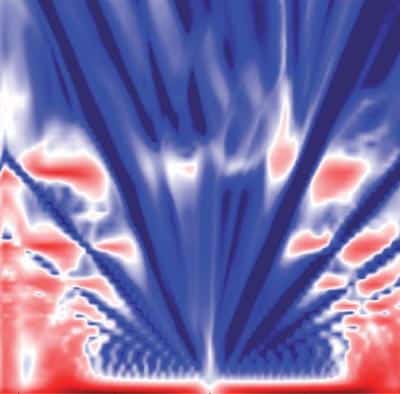
Experimental data showing Hofstadter's butterfly

What the teams did was place graphene – a layer of carbon just one atom thick – on an extremely flat surface of a boron-nitride crystal. As both materials have similar hexagonal structures, the researchers observed “Moiré patterns”, which are regular patterns created whenever two similar 2D lattices are overlaid. (The Manchester and MIT groups used single-layer graphene, while the Columbia-led experiment involved bilayer graphene.) By tweaking the relative orientation of the two lattices, the teams were able to create superlattices with appropriate spacing.

The teams then determined the energy spectrum of their superlattice by measuring its electrical conductivity in strong magnetic fields – up to about 35 T at Columbia, 17 T at Manchester and 43 T at MIT. When they plotted electron density (an observable property of the wavefunction) versus magnetic field strength, the teams saw the long-sought-after Hofstadter butterflies.

‘Rare and tremendously exciting’

“The opportunity to confirm a 40-year-old prediction in physics that lies at the core of most of our understanding of low-dimensional material systems is rare, and tremendously exciting,” says Cory Dean of City College of New York. “Our confirmation of this fractal structure opens the door for new studies of the interplay between complexity at the atomic level in physical systems and the emergence of new phenomenon arising from complexity.”

As well as confirming an important theoretical prediction, the studies provide further verification that the electronic properties of graphene can be controlled by placing the material next to another crystalline structure. This could prove useful because although graphene has several technologically useful properties – such as being brilliant at conducting electricity – it lacks key features, notably an electronic band gap, which would make it useful for creating practical transistors or optical detectors.

New materials

The Hofstadter butterfly observation is the latest in a long line of fascinating new findings involving graphene, which was first isolated by Andre Geim and Kostya Novoselov from the University of Manchester in 2004. “Of course, it is nice to catch the beautiful ‘butterfly’ whose elusiveness tormented physicists for generations,” says Geim, “[but] more importantly, this work shows that we are now able to build up a principally new kind of material by stacking individual atomic planes in a desired sequence.”

Geim’s colleague Roman Gorbachev even thinks such superlattices could have practical applications. “Such artificial crystals would have been science fiction a few years ago [but] now they are reality in our lab. One day you might find these structures in your gadgets.”

The Columbia and Manchester experiments are described in Nature (here and here) and a preprint of the MIT result is on arXiv.

  • Physics World learns how to make graphene at the University of Manchester
Atmosphere agitated by breaking waves

Ocean waves breaking far from shore impart a greater portion of their energy to the air than they do to the surrounding water. That is the claim of scientists in Italy and Australia who are the first to model the dynamics of the air directly over breaking waves. Although it has not been verified experimentally, the result challenges the previously held belief that most of a breaking wave’s energy remains in the water. If verified, the finding could have important implications for our understanding of cloud formation, climate modelling, oceanic circulation, and wave and weather forecasting.

While most waves do not break until they reach shallow water, particularly strong winds can cause them to do so out at sea – picture a classic storm with an ocean whipped full of whitecaps. But wind is not the only contributor to offshore breaking; modulation instability is a process by which small perturbations cause one or two waves within a set to grow unchecked. These waves draw energy from their neighbours until they reach a certain steepness threshold, when they break.

Current estimates suggest that 1–3% of all waves break at sea via this mechanism but until now it had been assumed that the energy released in the process was returned to the water. Indeed, our theoretical knowledge of what really goes on has been limited because calculations involve solving the nonlinear Schrödinger (NLS) equation. This involves making a number of significant approximations, including ignoring viscosity, vortex formation and, crucially, all air–water interactions. “The NLS equation can give you some ideas, but if you want to make one-to-one comparisons, you just don’t get good results,” explains Miguel Onorato, a physicist at the University of Turin who was involved in this latest work.

Tangled vortices

Onorato spent years studying modulation instability with the NLS equation but was eager to push the simulations to tell him more about the real world. To do so he turned to the Navier–Stokes (NS) equations – the central tenets of fluid mechanics, which incorporate all the complex forces and exchanges that the NLS equation willingly overlooks. However, solving the NS equations is famously difficult to do – both numerically and mathematically.

Onorato and colleagues used the NS equations to simulate wave breaking in two dimensions, by approximating the air and water as one single fluid with density and viscosity smoothly varying across the interface. The complexity of their model meant that each simulation took weeks to complete – unlike standard NLS models, which take minutes. But the investment was worth it: “It turns out there’s a lot going on in the air,” says Onorato.

The simulations showed that right before a wave breaks, it accelerates and its crest becomes sharp. As it breaks, the airflow on top of the wave suddenly separates from the crest and forms a vortex behind it – much like the vortices that form behind a spoon pulled through a cup of coffee. When the vortex makes contact with the water surface, it kicks up a second vortex of opposite sign, and the two tangle together in a capsule of counter-rotating air known as a dipole, and get thrown upwards into the atmosphere.

New perspective

When the scientists investigated just how much of a breaker’s energy is lost to this newly recognized dissipation route, they were staggered to find that up to three times more energy is transmitted to the air as is returned to the water. Onorato is careful to point out that this figure relates only to particularly steep waves, but the fact of the energies being comparable in order of magnitude is noteworthy.

Roger Grimshaw, a mathematician and wave expert at Loughborough University, who was not involved in the work, saw Onorato present the work at a workshop in Toronto last week. The talk “attracted a lot of interest”, he says, adding that the work “opens up a new perspective on air–sea interaction, which I believe has not previously been recognized, or indeed seen, either in numerical simulations, as here, or in observations”.

Climate contribution

Alex Babanin, an oceanographer at Swinburne University of Technology and co-author of the study, says “The implications for air–sea interactions, including weather and climate modelling, are significant but the large-scale models don’t simulate waves at all.” Instead, wind speed is used as a proxy for air–sea fluxes, but this can introduce errors of “hundreds of per cent” in the case of breakers resulting from modulation instability.

Although the team’s results are not immediately applicable in today’s climate models, a combination of scaling up the newly recognized contribution from breaking waves and improving the resolution of climate models should see a much more accurate picture of the interplay unfold. Babanin says “We now have a joint project with the Australian Bureau of Meteorology to do exactly that.”

Elsewhere, the team has already performed wave-tank experiments to confirm its computational results. Using a technique called particle image velocimetry, the team used a sheet laser and camera to reconstruct the velocity field of a smoky layer of air as waves broke underneath it. This new work is yet to be published but, says Onorato, “Visually, my collaborators could see those vortices in the air. Of course, there was no wind. The next step will be to add wind.”

The research is published in Physical Review Letters.

Sounding out the Sun

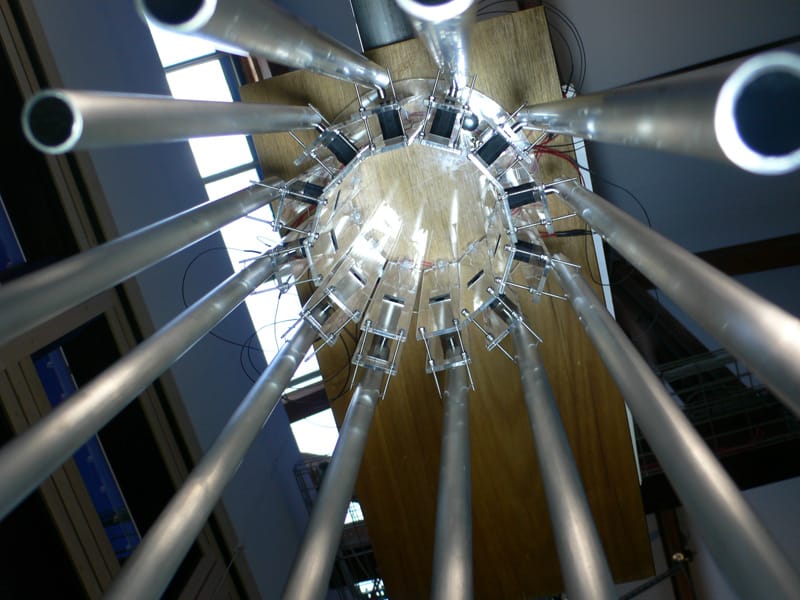
The “solar wind chime” is the work of Helen White, a designer with an interest in enhancing spaces by blending different media. In this interview, White talks to Physics World journalist James Dacey about her inspiration for the work and the challenges she has faced along the way.

Solar noises

White has developed her solar wind chime in Bristol, UK, as part of a communicating science residency supported by IOP Publishing, which publishes Physics World.

A solar wind chime

Is Canada giving up on science?

By Hamish Johnston

The good old days. Nobel laureate Bert Brockhouse won his prize for work done at a federally-funded research reactor. (Courtesy: NRC)

I am Canadian by birth and lived in that country for more than 30 years until the mid-1990s. For the past decade I have noticed a disturbing trend in the Canadian government of turning away from the outside world and becoming increasingly parochial in its outlook on important issues. I find this sad because I think the country is a thoroughly decent place that, despite its shortcomings, could provide inspiration for those living under less salubrious social and political systems.

(more…)

Cosmic flashes could herald birth of black holes

The birth of a black hole may be signalled by a characteristic cosmic flash, according to researchers in the US. It was previously thought that only the most massive of black holes would produce gamma-ray bursts – narrow beams of electromagnetic radiation that shoot out of the poles of the collapsing star – when they form. But other dying stars were thought to produce a black hole without any kind of flash – seemingly disappearing from the visible sky in an event known as an "unnova". The US researchers' work suggests that unnovae might also have their own characteristic flash, allowing astronomers to witness the birth of stellar- and intermediate-mass black holes.

"Although we know that black holes exist, we know very little about the observable signal that heralds the moment they first form," says Tony Piro, an astrophysicist at the California Institute of Technology and one of the lead researchers of the new study. As a massive star reaches the end of its life it undergoes core collapse, with its component protons and electrons merging to form neutrons. Before it completes its collapse into a black hole, the star momentarily becomes a super-dense object known as a neutron star.

Telltale flash

A by-product of this collapse is the release of neutrinos, which represents a significant loss of energy/mass from the core that causes a corresponding, sudden decrease in the gravitational pull of the star. This loss of attraction has an effect on the core's surrounding gaseous layers – which are mostly composed of hydrogen – causing them to rush outwards, forming an expanding shockwave that travels at more than three million kilometres per hour.

In a previous study from the University of California, Santa Cruz, astronomers Elizabeth Lovegrove and Stan Woosley had predicted that this shockwave would heat up the gaseous envelope, producing a characteristic glow that would shine for around a year and acting as a potential signal of the birth of such a black hole. Even though this effect would be a million times brighter than the Sun, it would still be dim in comparison with other stars. "It would be hard to see, even in galaxies that are relatively close to us," Piro explains.

One size fits all

However, in his recent study, Piro has identified another signal that should be easier to detect from the Earth – an initial flash generated by the shockwave as it hits the star's outer layers. For a red supergiant progenitor star, this breakout flash should be 10–100 times brighter than the glow predicted in Lovegrove and Woosley's study – with peak wavelengths in the ultraviolet and visible spectrum – and would be observable in nearby galaxies. Piro tells physicsworld.com that if the new flash in detected, it will reveal "the formation of black holes of all masses, offering a new approach from which to study these extraordinary gravitational phenomena".

Chris Reynolds, a professor of astronomy at the University of Maryland who was not involved in this study, says that there is currently "a huge degree of uncertainty about black-hole formation, both in terms of the kind of stars that will form black holes, as well as the nature of the formation event – gamma-ray burst versus supernova versus unnova". He says that theoretical work such as this paper is invaluable in honing our searches across the night sky, explaining that "it's always easier to look for something new if you have an idea what it will look like – for example, how luminous it will be and the timescale on which it will occur".

New window

"We used to think that gamma-ray bursts were the best signals of stellar-mass black-hole formation – however, those mighty explosions are rare and beamed, so only a lucky one in a hundred observers can enjoy them," says Re'em Sari, a professor of astrophysics at the Hebrew University of Jerusalem who was also not involved in this study. "[According to this research], a more frequent and isotropic signal marking the birth of black holes is the shock breakout from the progenitor – a weak but characteristic signal." Sari explains that if we can detect such events, this will open a new window through which we might study black holes.

The challenge now is to actually observe such breakout flashes. According to Piro, we should be able to see at least one of these each year. Wide-field surveys that watch the sky for temporary flashes of light are ideally suited to this task. One such survey is Caltech's Palomar Transient Factory, which Piro is collaborating with in the search for his predicted phenomena. On the theoretical front, Piro is also attempting to simulate the flashes in more detail, using more advanced computer models.

The work is published in Astrophysical Journal Letters.

The fantastic Mr Feynman

By Hamish Johnston

If you can't get enough of Richard Feynman, the BBC has released the second part of its television tribute to the late Nobel laureate.

(more…)

Solar ‘sandwich’ could cover a variety of surfaces

Ultrathin and flexible solar cells could be one step closer thanks to an international team of researchers that has made photovoltaics from 2D crystals called semiconducting transition-metal dichalcogenides (TMDCs). These devices could someday coat any surface exposed to sunlight to produce electricity – something that has proved difficult to do with current solar-cell technologies, which are thick, heavy and brittle.

TMDCs are layered materials with each layer comprising three atomic planes. The outer two planes are triangular lattices of atoms from the chalcogen group of elements – sulphur, selenium, tellurium – that sandwich an inner triangular lattice of transition-metal atoms. TDMCs show great promise for solar-cell applications because electrons within the material interact exceptionally strongly with light. This means that even though these materials are just a few atoms thick, a large portion of the absorbed photons can be used to produce electric current.

"If this technology is developed further, it has a chance of becoming a game-changer in the area of solar energy," says team member Antonio Helio Castro Neto of the National University of Singapore. The group also included Andre Geim and Kostya S Novoselov from the University of Manchester in the UK and researchers in Portugal, South Korea and Germany.

"Hi-tech sandwich"

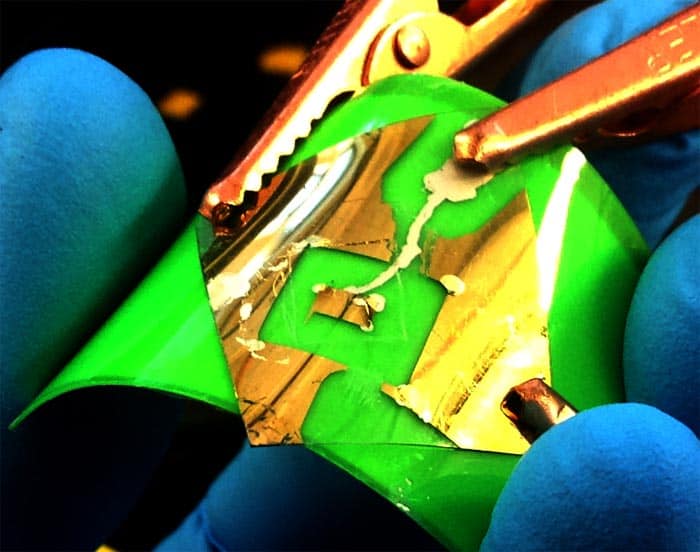
Castro Neto and colleagues made a heterostructure, or "hi-tech sandwich" as they call it, containing atomically thin materials, each with a well-defined role. The first component, boron nitride, is a one-atom-thick transparent insulator and it encapsulates the entire ensemble. As such, it is described as the "bread" in the sandwich. Next is graphene, a 2D sheet of conducting carbon that plays the role of the "lettuce". It is used to collect the electrons produced by the TMDCs (which are the "meat" in the sandwich).

"We also employed gold nanoparticles, which you can think of as the 'pepper'," explains Castro Neto. "Although not strictly needed, these particles do 'spice' things up by increasing the amount of light absorbed by the structure thanks to a phenomenon called plasmonics."

The various materials in the sandwich structure all have different electronic properties. "Separately, they are not particularly good for photovoltaic applications but put them all together in a certain combination and you get a very 'juicy' photovoltaic device," says Castro Neto.

Photo of the photovoltaic device being flexed

As a case in point, the researchers succeeded in fabricating extremely efficient flexible devices with a photoresponsivity above 0.1 A/W, which is equivalent to an external quantum efficiency of above 30%. The latter means that more than 30% of the light that falls on the cell is converted to an electric current – and it is an important parameter that determines the overall efficiency of how a device converts solar energy to electrical energy.

Extremely sensitive electrons

According to the team, it is so-called Van Hove singularities in the TMDCs that allow for enhanced light–matter interactions. These are named after the Belgian physicist Léon van Hove, who in 1953 discovered that electrons travelling freely through certain crystals could come to a standstill at specific wave frequencies and wavelengths. The electrons essentially "freeze" and their speed reduces to zero. "In this standstill state, the electrons become extremely sensitive to any kind of external stimulus," says Castro Neto. This results in improved photon absorption and more electron–hole pairs (or excitons) being created in the device. These excitons are responsible for producing electricity – when the electrons and holes separate.

"When light with the right frequency then hits electrons in this unique Van Hove state, they respond massively. This is what we observed in our experiments and we exploited the singularity to boost light absorption and create electric current," says Castro Neto.

The researchers say that they are now busy looking for materials with stronger Van Hove singularities so that they can increase light absorption even further and improve overall quantum efficiencies. "We are also keen to produce such materials artificially," reveals Castro Neto. "At the moment, we extract the atomically thin layers from 3D crystals, but we know that there are ways to grow 2D layers artificially and this will be fundamental for technological applications."

"This is a field that is very much in its infancy," he adds. "If the graphene field is young – less than 10 years – then this new one is even younger. There is much to do and explore," he says.

The research is described in Science.

Why humour matters: physics’ tradition of thoughtful joke-telling

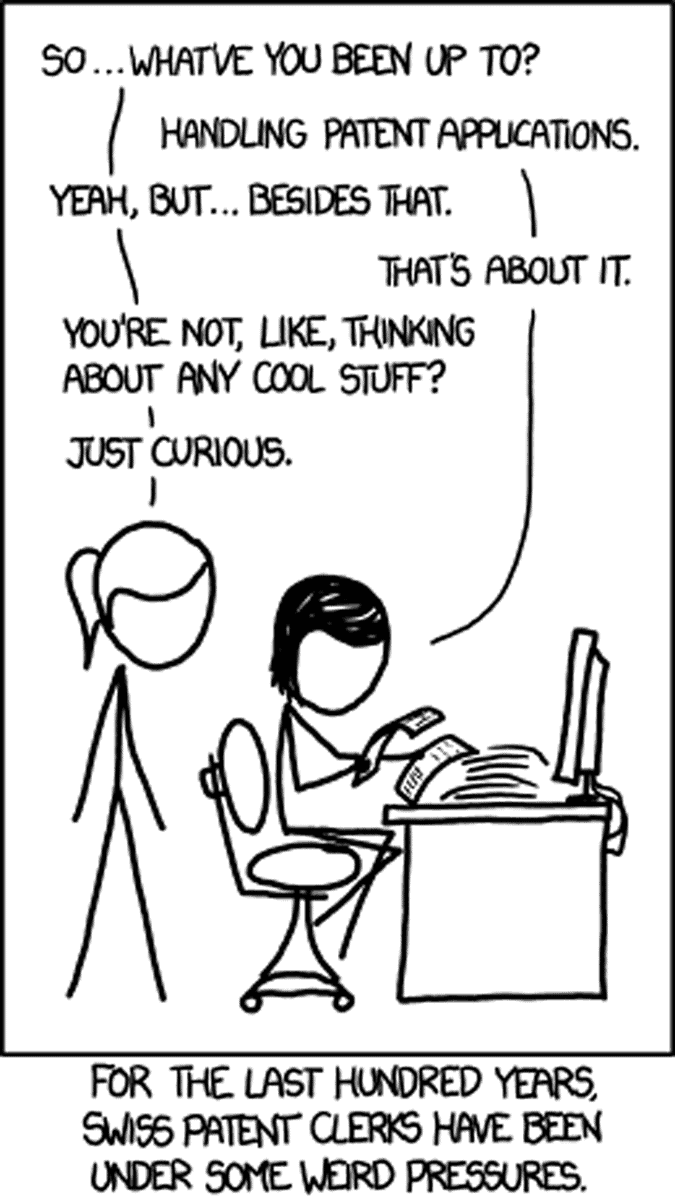
Comic of two stick people in an office. A supervisor is speaking to a person sat at a desk. The caption reads "For the last hundred years Swiss patent clerks have been under some weird pressures"

If you only laugh at jokes, then you’re not taking them seriously enough. Jokes have functions. “I don’t suffer from insanity – I enjoy every minute of it!” (That’s releasing stress.) “Mixed emotions is watching your mother-in-law drive off the cliff in your new Mercedes.” (That’s releasing feelings.) “Schrödinger’s cat walks into a bar – and doesn’t.” (That’s dumbing down a complex image.)

I’m not dissing such humour. Joke-telling helps us to cope. If we can laugh at something, we don’t have to feel, engage or understand it. Physics, however, has a tradition of thoughtful joke-telling that uses humorous tales inquisitively – to deepen appreciation of a person, of the world, or of both.

Jokes revealing personal characteristics have covered everything from Albert Einstein’s childlike personality and Niels Bohr’s mystique to Wolfgang Pauli’s famously brutal putdowns. Abraham Pais, for example, heard Paul Dirac enthusiastically tell (on several different occasions) a joke about a priest who is newly appointed to serve a village and is doing the rounds to get to know his parishioners. Calling on one modest home, the priest notices that the woman’s house is full of children, and asks how many children she’s got. “10 – five pairs of twins”, comes the reply. “You mean you always had twins?” asks the astonished priest. “No, Father, sometimes we had nothing.” As Pais put it: “Precision at that level had an immense appeal to Dirac.”

Too serious not to laugh

Among the jokes that reveal aspects of the world is what – or so I’m told – was the favourite piece of humour of the mathematical physicist John von Neumann. It takes place in the main square of Budapest, where a man cries out “The emperor is an idiot! The emperor is an idiot!” He is promptly arrested and carried to prison by two police officers. As they drag him away, the man begins to defend himself: “This is a mistake! I didn’t mean our emperor, I meant the Prussian emperor!” The police officers are having none of it. As the jail door clinks shut they go: “You can’t fool us! We know which emperor is the idiot!”

As for jokes that reveal both character and situation, I would include the one about the rabbinical student who goes to hear a series of three speeches by a famous and revered rabbi. When his friends ask the student what he thought about the speeches, he replies: “The first talk was brilliant, clear and simple. I understood every word. The second was even better, deep and subtle. I didn’t understand much, but the rabbi understood all of it. The third was by far the finest, a great and unforgettable experience. I understood nothing and the rabbi didn’t understand much either.” Okay it might not be a side-splitter – but according to Pais it was one of Bohr’s favourites.

Indeed, humour was never far away at Bohr’s own Institute for Theoretical Physics in Copenhagen, as Paul Halpern – a physicist from the University of the Sciences in Philadelphia – pointed out last year (Physics in Perspective 14 279). The institute hosted, for example, annual skits – the best known of which was the Blegdamsvej Faust, named after the street in front of the institute. This play was mentioned in George Gamow’s book Thirty Years That Shook Physics and was the subject of Gino Segrè’s 2007 book Faust in Copenhagen (November 2007 pp44–45).

In his article, Halpern also discusses the lesser-known Journal of Jocular Physics, compiled for Bohr’s 50th, 60th and 70th birthdays. A recurrent topic in its three volumes is complementarity – Bohr’s name for one of the most mysterious aspects of quantum behaviour – which, Halpern argues, often shares with humour itself “absurd aspects of contradictions”.

In trying to explain why members of the Copenhagen institute liked humour, Halpern says it was because jokes quite simply “spiced [up] breaks from calculation”. But are there deeper reasons? As Pais, quoting Bohr, once put it, “Some subjects are so serious that one can only joke about them.” (Having said that, I am not sure what Bohr would have said after the 2005 controversy surrounding publication, by the Danish newspaper Jyllands-Posten, of cartoons mocking the prophet Muhammad.)

The critical point

Jokes today tend to be short, visual and readily digestible. Type “science jokes” into Google and you’re apt to find witticisms like the one about two pieces of coal (clearly a mother and child) and a diamond, with a speech bubble from the mother saying: “Your dad’s been under a lot of pressure lately!”. That kind of joke will get a sure-fire laugh, but it passes in and out of your mind quickly without altering anything.

Once upon a time, however, science jokes were more discursive and more interesting – even in publications. In Pais’s 1988 book Inward Bound, he mentions a “Note on the quantum theory of absolute zero”, which is a paragraph-long parody of numerological attempts to derive the fine-structure constant (1/137) from the temperature of absolute zero (–273 °C). It was concocted in 1931 by three postdocs at the Cavendish Laboratory, Cambridge (Guido Beck, Hans Bethe and Wolfgang Riezler), who managed to sneak it past the editors of Naturwissen­schaften (19 37); the editors were not amused when they eventually found out and published a correction.

Pais called this story “arguably the best physics joke ever to slip by an editor of a first-rate physics journal”. Really? Still the best in a physics journal? (Alan Sokal’s 1996 parody “Transgressing the boundaries: towards a transformative hermeneutics of quantum gravity” was good, but it targeted a social-science – not a science – journal.) For that matter, why are the best-known examples of thoughtful humour from the era of quantum mechanics, and not from the age of string theory, dark matter and M-branes? Has big science killed deep jokes?

Please send me your suggestions of more recent humorous stories – peer-reviewed or not – to the e-mail below and I will discuss them in a future column. (But no ha-ha jokes please!)

Getting to the bottom of foamy physics

Researchers in the US have created a new mathematical model to describe the complex evolution of foamy bubbles – something that has proved fiendishly difficult to model thanks to the hugely varying length and time scales involved. Their computed results closely match theoretical models as well as lab-based observations of foamy bubbles. The team hopes the underlying equations could have a variety of applications, including helping to make better metal and plastic foams, developing lightweight crash-absorbent materials and also to model a number of biological processes such as the growth of cell clusters.

Heady maths

Foams are all around us: from the froth on a cappuccino or beer to the soapy suds in a bubble bath. However, scientists have found it difficult to describe exactly how such clusters of bubbles coalesce, grow and change shape over time – before they ultimately go pop. An early attempt at understanding the structure of soapy foams is encapsulated in "Plateau's laws" – formulated by 19th-century Belgian physicist Joseph Plateau. Then Lord Kelvin developed his theory of an "ideal foam" of equal-sized bubbles in 1887, an accurate version of which was finally made in the lab in 2012 by a team at Trinity College, Dublin. But a more general set of equations describing bubbles on varying length and time scales remained elusive, until now. The challenge is to create mathematical models that describe how interfaces between bubbles move and how they "meet" in complicated phases.

Key phases

Now, James Sethian and Robert Saye of the University of California, Berkeley have separated the various processes that determine a foam's evolution according to the different length and time scales at which they occur – and have created a model for bulk foam dynamics. The researchers say that the model accurately describes how fluid moves within a bubble and how the individual cells form and how their junctions (or borders) are rearranged as individual bubbles within the foam burst.

To do this, Sethian and Saye identified three distinct regimes or phases of foam evolution. "We identified and separated the three phases – the drainage of liquid from a bubble's membrane, the rupture of the drained bubble and the macroscopic rearrangement of the bubbles within the foam – to simulate the system," explains Sethian.

The first set of equations describes how the liquid drains from a bubble wall, thanks to gravity, so that the wall eventually becomes so thin that it ruptures. The next set of equations explains the liquid flow at the junctions between bubble membranes; while the third set considers how the entire foam rearranges to move closer to equilibrium, a motion that happens on a macroscopic scale.

Beach bubbles

Sethian and Saye tested their formulae on bubble clusters of different sizes and found that they could accurately predict the interactions of gases and liquids in these foamy materials. They also developed a fourth set of equations that allowed them to simulate a movie that shows how light would reflect off a small foam sample as its bubbles rearrange. The researchers picked a beach scene for the simulation, so that they could "visualize and see how well the model captures what you would see in real life, while still accurately showing how the light would reflect", as Sethian explains.

These processes are all influenced by a variety of factors, including viscosity, surface tension, gravity and other terms of fluid dynamics. Some of these factors can be modified in the current model, but others, such as evaporation, that are currently not included can be added quite easily, according to the researchers.

Sethian points out that it took the team five days to solve the full set of equations of motion using a supercomputer to get the most refined solution of the algorithms. He says that the entire mathematical formulation and codes will be available to anyone who is interested in running similar simulations at whatever scales they wish, for any applications, including industrial ones.

While a large part of the aim of this work was to develop a fundamental model, the researchers claim that it could have other applications. When it comes to biological modelling, Sethian says the equations could help to understand highly complex systems, such as cell cluster growth, that may go from being organized to unorganized systems. According to him, the models might help "to better understand how cells group together and aggregate...and to study the kind of physical forces involved – such as adhesion between cell boundaries, fluid dynamics, etc – as well as the mechanisms involved in how cell cluster grow from clusters of 5 to 10 cells to those of hundreds to thousands of cells".

Take a look at the video below of a collapsing soap-bubble cluster, shown with thin-film interference and computed using Sethian and Saye's multiscale model.

The research is published in Science.

Research galore in Singapore

By James Dacey

Despite its modest size, the city-state of Singapore is clearly an ambitious nation, boasting a leading financial centre and one of the world's busiest ports. During a recent visit to Boston I met a man called Lim Tze Min who works for a government agency called Contact Singapore, which exists to try and attract skilled people to live and work in Singapore. I wanted to know why a physicist might consider relocating to the country. Listen to our conversation here.

Tze Min talks about research facilities including the Centre for Quantum Technologies (CQT), the founding director of which is the Polish-born physicist Artur Ekert, who is also affiliated with the University of Oxford in the UK.  According to Tze Min, one of the major bonuses of being a researcher in Singapore is the small amount of bureaucracy invovled, which allows scientists to get on with just doing the science. Give it a listen and decide for yourself whether it sounds like a place where you could imagine yourself working.

Copyright © 2026 by IOP Publishing Ltd and individual contributors