Magnetic resonance imaging (MRI) at spatial resolutions of just 10 nm has been achieved for the first time. Developed by researchers at the University of Illinois at Urbana-Champaign in the US, the technique could be particularly useful for imaging biological samples. If further improved, it could even be used to image viruses and protein macromolecules.
MRI is based on nuclear magnetic resonance (NMR) and is a powerful tool that allows scientists to study the chemical composition of many different materials. This includes living tissue and as a result MRI has become a powerful diagnostic tool in medicine. The technique works by measuring the response of the nuclear magnetic moments – or spins – of a sample to external magnetic fields and electromagnetic radiation. But because the individual nuclear moments are tiny, MRI signals from small samples are weak and can be easily swamped by noise. As a result it has proven to be difficult to do MRI at spatial resolutions of less than about 1 mm, except under special circumstances.
This latest work was done by Raffi Budakian and colleagues, who attached the sample to be analysed – a tiny piece of polystyrene – to the tip of a silicon nanowire mechanical resonator. This is a small plank of silicon roughly 15 µm long and 50 nm wide. They then place this nanowire over a metal constriction 240 nm wide and 100 nm thick. By passing high-frequency electric currents through the constriction, they are able to generate the intense magnetic fields needed to do MRI.
Tiny vibrations
The team then oscillates this electric current through the constriction to generate a magnetic-field gradient that alternates at the same frequency as the nanowire vibrates. The interaction between the magnetic moments in the sample and the alternating inhomogeneous magnetic field produces tiny vibrations of the nanowire that can then be measured using an optical interferometer included in the set-up.
The Illinois team was able to successfully image hydrogen nuclear spins in the polystyrene sample using its method and obtained a 2D projection of the hydrogen density in the material with a spatial resolution as small as 10 nm.
“Another important result of our research is that we have demonstrated a new magnetic resonance protocol that allows us to apply NMR techniques to encode so-called spin noise,” explains Budakian. “That is, we encode information in the statistical fluctuations of all the nuclear spins in a sample rather than in their thermal spin polarization – as is usually the case.”
“Our technique in fact uses well established methods in MRI,” Budakian says. “Fourier-transform imaging is routinely used in MRI and is a very efficient sample-imaging technique, but the main difference in our new method is that we encode information in the spin noise rather than in the thermal polarization.”
According to the researchers, the technique could come in handy for imaging biological samples. “Our near-term goal is to achieve even higher spatial resolution and begin imaging virus particles,” adds Budakian. “We would ideally like to tomographically image virus particles in 3D and, with sufficient improvement, might even be able to image macromolecules such as proteins in the future.”
When Will Reeves embarked on a PhD in fibre optics at the University of Bath in 1999, his career path seemed assured. The communications industry was booming, companies around the world were eagerly hoovering up graduates with relevant skills, and with a telecoms-friendly PhD to add to his undergraduate degree in physics, Reeves figured it would be easy to find a job in industrial research at a large firm such as Nortel Networks. The economy, however, had other ideas. By the time he completed his PhD in 2003, the telecoms industry had gone into free fall, shedding thousands of jobs in the UK alone. “Companies were making loads of redundancies and there weren’t any jobs at all in what I’d trained for,” he recalls.
Fortunately, Reeves had a plan B. As an undergraduate at Bath, he had done a year’s industrial placement at Sharp Laboratories of Europe, where he worked on liquid-crystal displays and learned some basic clean-room techniques. On the strength of that experience, he says, he got an interview in 2003 at a small but fast-growing firm called Plastic Logic, which had been founded a little over two years earlier by researchers from the University of Cambridge’s Cavendish Laboratory. At the time, Plastic Logic was still trying to transform its founders’ novel work on plastic electronics into a marketable device, and Reeves was initially hired to develop techniques for measuring the performance of different components. A decade on, however, both the company and Reeves’ role within it have transformed almost beyond recognition. “It’s been quite a rollercoaster, and there have been times when we have been close to closing,” he says. “But I think actually [the telecoms crash] was a blessing in disguise because I’ve enjoyed this more than I would have enjoyed working in fibre optics.”
The physics of spin
Companies like Plastic Logic, which are founded in order to commercialize university-based research, are known as “spin-outs”, and they offer many different kinds of benefits. For physicists like Reeves, whose interests include both pure and commercial research, they are an attractive career option. For their academic founders, they are a way of getting good ideas out of the lab by drawing on resources and expertise from the commercial sphere. And of course, for universities and the sceptical politicians who fund them, spin-outs are a welcome sign that money spent on research can produce tangible benefits in the form of new products and jobs.
Spin-out firms are an attractive career option and a way of getting good ideas out of the lab
But as Reeves and others involved in spin-outs emphasize, such companies are not suited to everyone. Joining a young, untested company is risky, especially in the early years, when spin-outs are always in danger of running out of cash unless they can raise more money. As Kevin Arthur, chief executive of the solar-technology spin-out Oxford PV (see case study below) observes, “That’s something that really focuses your mind, and you’ve got to like that level of risk.” On the academic side, too, the spin-out route does not always make sense. “We all think from time to time that we have good ideas, but there are some pretty harsh things that go on commercially that have nothing to do with the goodness of the idea,” says Graham Cross, a physicist at Durham University whose spin-out firm, Farfield, initially struggled to turn a promising technology into a marketable product.
Physicists interested in working at spin-outs (or founding them) may also be at a disadvantage due to the simple fact that physics departments do not spawn as many spin-outs as their counterparts in the life sciences or engineering. And with some notable exceptions – including Oxford Instruments, which was spun out in 1959 and is now part of the FTSE 250 index of large UK companies – not many physics spin-outs grow big enough to employ large numbers of people. In 2009 Junfu Zhang, an economist at Clark University in Massachusetts, US, studied 903 academic entrepreneurs who had received funding from venture-capital companies, which invest in spin-outs with a strong potential for growth (see box). Of these high-growth spin-outs, Zhang found that fewer than 5% had founders who identified themselves as members of a physics department. In contrast, 45% came from engineering departments, while another 40% worked in the medical or biological sciences.
Start me up: three ways of funding a spin-out
Sales
(Courtesy: iStockphoto)
Companies that make high-value, low-sales-volume goods, such as scientific instruments, can sometimes grow “organically” by using the profits from each sale to develop new products and refine existing ones. This allows founders to maintain control over their company and its future direction, but it is unlikely to provide enough money for the company to do everything it wants to do or hire everyone it wants to hire. “I made some small profit out of it [the first microscope I sold], but I was working like a dog,” says Ahmet Oral, a physicist at Turkey’s Sabancı University and founder of the Anglo-Turkish firm NanoMagnetics Instruments. After finishing his “day job”, he says, “I was going back home and working until two, three, even four in the morning, nonstop, for about six months or so. It was hard.”
Seed money
(Courtesy: iStockphoto)
A variety of organizations, including governments, private philanthropic groups and international bodies such as the EU provide small-to-medium-sized grants for spin-outs and other early-stage companies. Although the application process for such grants is competitive, and the funds available are generally not on the same scale as business-angel or venture-capital funding (see below), they can be vital in a spin-out’s earliest stages and come with fewer strings attached. Examples in the UK include the Technology Strategy Board, the Royal Society Enterprise Fund, university-based groups such as the University Challenge Seed Fund and so-called “translational” research grants from the Engineering and Physical Sciences Research Council, although each of these organizations has different goals and rules for how monies are used. A spin-out’s parent university can also be an important source of early support by offering cheap lab space within the department or at a separate “business incubator” and by funding patent applications via the technology-transfer office.
Business angels and venture capital
(Courtesy: iStockphoto)
At the deep-pocketed end of the funding spectrum, business angels and venture capital (VC) firms provide money in exchange for a share of the business and – especially in the case of venture capital – a say in how it is run. The principal difference between them is that angels are investing their own money, while VC firms are managing funds from a large pool of investors. However, business angels also tend to invest in businesses earlier and to provide smaller amounts of money, typically around £100,000, to help a spin-out get through the difficult early period. In contrast, “most venture capitalists, even early-stage ones, won’t come in at less than a £1–1.5m equity investment”, says Brian Tanner, dean of knowledge transfer at Durham University. “The cost of due diligence [for their investors] is sufficiently high that they want to put in cash of that sort of quantum to make it worth their while.” In order to attract that kind of money, Tanner adds, companies need a proper management team as well as an idea or product with a strong potential for growth.
Russell Cowburn, a physicist who has founded spin-outs at both Durham and Cambridge universities, says that the low number of physics spin-outs is partly due to the nature of the field. “Quite often what physicists come up with is a new type of device, and then you’re immediately hitting this problem of scale where it can only be brought to market if you sell a billion of them,” he explains. Many biotech spin-outs, he adds, avoid this problem by developing a new treatment or process and then licensing it to a larger firm.
Another possible reason for physics’ low profile in the spin-out world is that there used to be a stigma associated with getting involved in commercial ventures. Brian Tanner, a Durham physicist who founded a company called Bede Scientific Instruments in 1978, remembers his university’s then-vice-chancellor telling him, “Well, if you really want to do this, young man, that’s okay – but we thought you had a good career ahead of you.” Such official discouragement is rare to non-existent these days, but Henry Snaith, the academic founder of Oxford PV, believes that in some quarters, old attitudes die hard. “There’s a certain branch of academic scientists – physicists, mathematicians, chemists – who consider that interacting with industry is inferior to doing pure science,” he says. “They think we should just be concentrating on finding out new phenomena and understanding things, and not be so worried about real-world problems.”
Lingering traces of anti-industry sentiment aside, however, the raw statistics probably give a misleading impression of physicists’ entrepreneurial opportunities. Because physics can be applied to many different areas, physicists are often involved in firms that do not, on the face of it, appear to have a strong connection to the subject. A good example is Sphere Fluidics, which was spun out of Cambridge’s chemistry department in 2010. The company was founded to commercialize a technique for rapidly analysing single cells encased within tiny droplets and, in June 2013, it won the life-sciences category of a pan-European spin-out competition. However, the firm’s chairman Andrew Mackintosh – a physicist by training, and a former chief executive of Oxford Instruments – argues that Sphere Fluidics actually has a strong link to physics. Although the firm employs chemists to create the microdroplets and biochemists to understand the processes taking place within them, the technique for manipulating and measuring the droplets relies on optical instrumentation – and that, Mackintosh says, requires physicists. “You have to put really sophisticated teams together very early on in the life of these companies,” he says. “In many, many spin-outs, there’ll be a lot of physics underneath, because it’s about measurement and instrumentation.”
Case study: Oxford PV
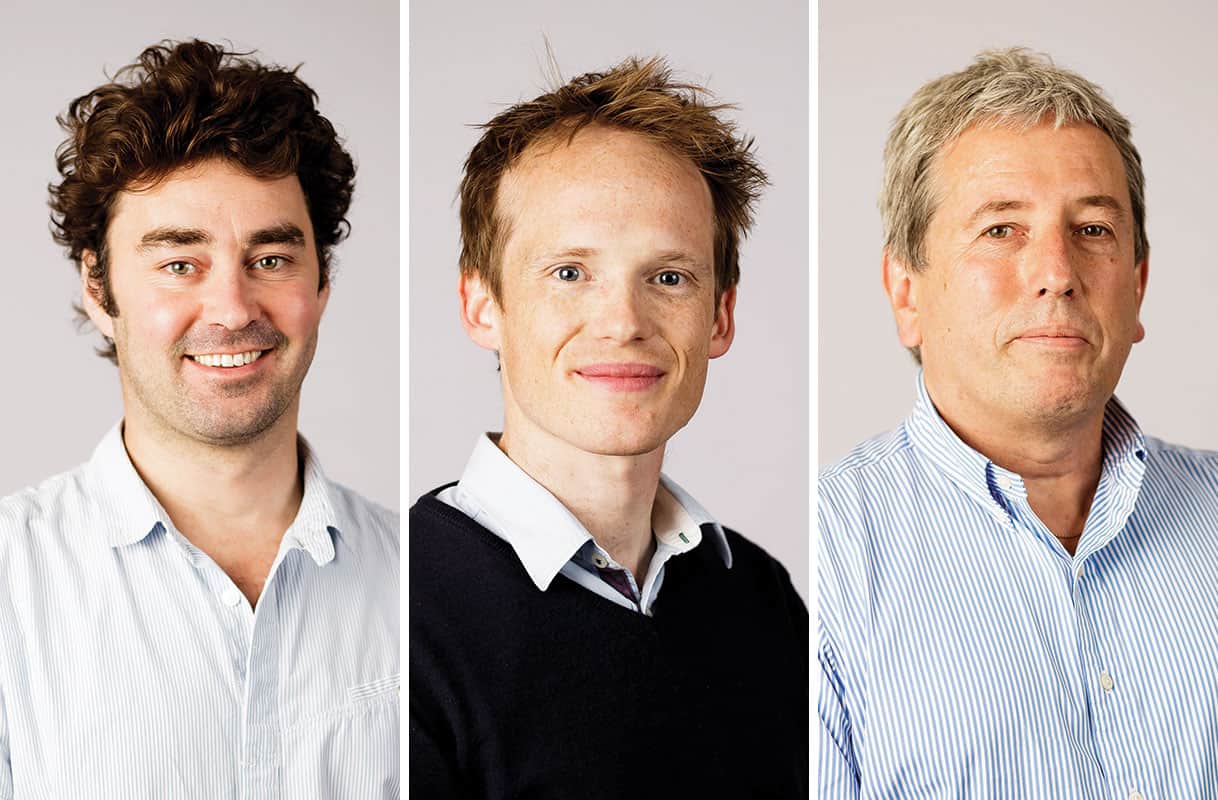
From left: Henry Snaith, Ed Crossland, Kevin Arthur (Courtesy: Douglas Fry)
While there is no such thing as a “typical” spin-out, the story (so far) of Oxford PV nevertheless includes some characteristic features. Based on research performed by University of Oxford physicist Henry Snaith, the firm’s core product is a type of solar photovoltaic (PV) cell that can be printed onto glass. It was spun out of Oxford in 2010 with the help of the university’s technology-transfer company, Isis Innovation, which funded its initial round of patents and brought in an experienced chief executive, Kevin Arthur, from the semiconductor industry.
Since then, the firm has raised more than £4m, including a total of £350,000 from the Technology Strategy Board (an organization funded by the UK government) and £3.45m from investment syndicates, including venture capital. Currently, scientists and technicians at its premises in a university-linked “business incubator” north of Oxford are working to improve the efficiency of the underlying solar-cell technology and to demonstrate that durable solar-PV glass can be produced on a commercial scale. One of Snaith’s former postdocs, Ed Crossland, joined the firm earlier this year as a senior research scientist, and the company plans to hire five new technologists before the end of 2013. In the future, Oxford PV hopes to license its product to manufacturers that can incorporate its energy-generating glass into the windows of skyscrapers, making it a ubiquitous feature of modern “green” architecture.
“I do solar-cell research because I believe that it’s the source of energy we need for the future. In some sense, it doesn’t matter which PV technology is successful as long as one of them is, but if no-one tries to push it, it’s not going to happen. My motivation is to try to get the technology out there.” Henry Snaith, physicist and chief scientific officer
“With a technical staff of 10–15 there’s not enough hands to do everything we want to do, so I’m still in the lab pretty much every day, whether it’s with my hands wet in the fume hoods or just overseeing what’s going on.” Ed Crossland, senior research scientist
“I really feel with this company we’re in the right place at the right time with the right technology. We’re constantly announcing updates to Henry’s technology and we’re just pushing at an open door with the construction industry, because they really want to have an energy-generating coating that they can apply to their existing materials.” Kevin Arthur, chief executive
Risks and rewards
This need for a physicist’s skills is a positive sign for students and recent graduates interested in joining a spin-out firm. There are, however, some caveats. At their inception, spin-outs are usually little more than one- or two-person operations, and slower-growing, revenue-funded firms often remain so for years. During this earliest phase, therefore, companies will only hire new employees to do work that the founders cannot. Moreover, employment contracts are likely to be short-term, stretching only as far as the spin-out’s current round of funding permits. Marcus Swann, a former postdoctoral researcher in Cross’s group at Durham, notes ruefully that when he joined Farfield as its fourth employee, he imagined that working there might offer more long-term stability than the “serial postdoc” phase of early-career academia. In the event, he says, “I’ve been employed for 13 years now but there hasn’t been any certainty over it. At a spin-out you’ve got no idea what’s going to happen – there’s absolutely no guarantee it’s going to last more than a year.”
Yet there are rewards in getting involved early. While life at a spin-out is not, in Tanner’s words, “just a matter of swanning off with a million quid and becoming very rich”, early employees of successful spin-outs can nevertheless make a fair amount of money. To attract talent, many spin-outs offer early employees a stake in the company, and someone who helps transform a company from a start-up to a major player usually ends up with what Cowburn delicately terms “very interesting share options”.
But even spin-outs with more modest outcomes have their attractions. Farfield was sold to a Swedish instrumentation company in 2010, and the future of its core technology is now uncertain. Nevertheless, Swann says that working there has given him a huge range of experiences that he would not have had if he had stayed in academia or gone to work for a bigger firm. In addition to scientific tasks such as computer modelling and developing measurement techniques, he says, he has also been involved in product development, customer support, sales and marketing, and participated in scientific collaborations with researchers in the petroleum and pharmaceutical industries. “There’s no area of the company’s existence where I haven’t had some good visibility,” he says. “From that point of view, it’s been a tremendous learning experience. I don’t feel constrained by my scientific background any more.” Tanner, whose first spin-out fell victim to the credit crunch of 2008 and was subsequently sold to a larger company, agrees. “I don’t know of anyone who’s been in that early-stage business environment being out of work for long,” he says.
What it takes
All of the people interviewed for this article agreed that working at a spin-out requires a love of variety. For example, on the day that Reeves spoke to Physics World about his work at Plastic Logic, he had spent the morning repairing a laser cutting machine, but said that other typical tasks include computer programming, meeting clients and even creative work such as designing sample content for the company’s electronic displays.
Another thing that came up frequently was an appetite – or at least a tolerance – for responsibility as well as risk. “If you join a spin-out, you are by definition going to be a key player in that company,” says Swann. “It’s difficult to say ‘no’ because you know that if you don’t do it, it doesn’t get done.” Scientists at a spin-out also have a responsibility to stay focused on the company’s product rather than pursuing interesting tangents, says Ed Crossland, who did a postdoc in Snaith’s group at the University of Oxford and is now a senior research scientist at Oxford PV.
Scientific skills are important, too, and for that reason, opportunities at spin-outs are more extensive for those with physics PhDs than they are for BSc graduates. “To any graduate thinking of doing research in a start-up company, I’d say they should do it with the mind of working for one or two years to gain experience,” says Snaith. “But if they really want to progress in research in industry, they should then come back [to university] and do a PhD.” Cowburn suggests that undergraduates who want to get some spin-out experience should approach companies about doing a specific piece of work, such as software programming or designing a circuit, rather than seeking a traditional, training-based internship.
Regardless of their level of experience, however, prospective employees should emphasize that they have certain skills because they are a quick learner, not because it is the only thing they can do. “Being attractive to an employer means you’re smart – you’re not just an expert in doing one particular thing,” says Crossland. “You need to be a problem solver who can apply your skills and talents to whatever problem the company might have.”
Ultimately, Mackintosh believes that spin-outs are exciting places for physicists to work. “If you’re prepared for a lively ride, you have no idea where that company can go,” says Mackintosh. “Even if that company folds, the experience you gain allows you to go do the same thing in another company – probably a lot better than you did it the first time.”
The task was simple but painstaking: to identify the shapes of over a million galaxies from images taken from the Sloan Digital Sky Survey. To help with the arduous task, in 2007 the astronomer Chris Lintott – together with astrophysicist Kevin Schawinski, both from the University of Oxford – set up a website called Galaxy Zoo that presented users with images of galaxies to classify. The pair hoped to initially get around 50 local amateur astronomers to help out, calculating that it could take around five years to trawl through the complete data set.
It took just three weeks – not because the amateur astronomers were unexpectedly quick but because thousands of people from all over the world flocked to the site to offer their help as extra pairs of eyes. At its peak, more than 70,000 galaxies were being analysed per hour, and in the first year of the site 50 million galaxies were classified by 150,000 people, who together made Galaxy Zoo the world’s largest database of galaxy shapes.
The instant success of Galaxy Zoo led to a plethora of similar “citizen-science” initiatives and Lintott is the driving force behind the resulting “Zooniverse”. Set up in 2009, this collection of online citizen science now boasts around 20 separate projects with tasks that range from searching for planets outside our solar system by analysing data from NASA’s Kepler spacecraft to helping marine scientists better understand whale communication. “I am surprised by how successful it has all been,” Lintott told Physics World. “And how many other people can say they have discovered a new planet in their spare time?”
The citizen scientist
Modern citizen science dates back to the late 1990s when the University of California, Berkeley released SETI@home – a computer program that analysed radio signals from the Arecibo radio telescope in Puerto Rico to look for signs of intelligent life in the universe. The program ran in the background on idle computers using each machine’s processing power when it was not needed. However, SETI@home only involved users installing the software; they did not analyse any data.
That all changed in August 2006 when NASA set up Stardust@home, which allowed volunteers to examine images taken by the space agency’s Stardust probe for evidence of tiny interstellar dust impacts in a set of aerogel blocks that the probe exposed in space. At its peak, some 20,000 users participated in Stardust@home and it was this project that inspired Lintott to set up a similar endeavour to analyse galaxy types, recognizing that in both tasks humans can easily outpace computer algorithms, which find it difficult to recognize patterns. So, in Galaxy Zoo’s case, when it comes to deciding whether a galaxy is elliptical or spiral – and, if spiral, whether it is rotating in a clockwise or anticlockwise direction – there is nothing better than the human eye.
If you have a pile of data, work with us and get people to help out
Four years on from its first project, Zooniverse is now a roaring success, with more than 860,000 volunteers taking part and more than 50 published papers – all based on the work of Zooniverse’s users, or “zooites”. In many cases, Lintott says that Zooniverse projects stemmed from requests from other scientists about how to get the public to help them analyse their data. Although he admits that such crowdsourcing fits some areas of science better than others, Lintott says that more scientists should think about how their research can be used as part of a citizen science project. “If you have a pile of data, work with us and get people to help out,” adds Lintott, who in February became the main presenter of the BBC TV programme The Sky at Night following the death of the show’s long-running presenter Patrick Moore.
Demystifying science
Someone who has adopted Lintott’s approach is Michael Doser, a particle physicist at CERN, who is working on an experiment called AEgIS that investigates how hydrogen and antihydrogen respond to gravity. The experiment works by plotting the trajectory of particles on a photographic emulsion plate, and it is currently only operating with protons and antiprotons, which are too light to measure the effect of gravity. Doser has just created software to test whether crowdsourcing could benefit the experiment by letting users – rather than computer algorithms – trace the direction of particle tracks. “I have been following Zooniverse with envy and admiration,” says Doser. “The Zooniverse projects not only share the fascination of doing science, but also unlock the deep desire to participate in science of many people who do not have the chance to do so in their daily work.”
Doser adds that such projects have helped to “demystify” science. “Contrary to conventional outreach, citizen science treats the public as an equal partner,” he says. “Involving citizens seems to me a powerful route to increasing scientific literacy.” More than that, citizen science is also making scientists rethink how they work with their data and fostering a new class of budding amateur scientists. “You find that people get really drawn in, start analysing the results and even reading new papers that come up on arXiv,” says Lintott. “You could say they have a career as a citizen scientist.”
One evening a week, Leonard Susskind goes back to basics. In a lecture theatre at Stanford University in California, US, he talks about classical mechanics, quantum theory, relativity and various other topics typical of degree-level physics. But the 100 or so people in the audience do not want a qualification – they are there simply because they enjoy learning.
“I thought I would try it out,” says Susskind, speaking on the phone in his easy New York accent. “And I found it a lot of fun, very stimulating, and very different from teaching a regular university class. People have no interest in degrees, no interest in getting a grade, no interest in getting tested. It’s a very nice way to teach people.”
At 73, Susskind has enjoyed a long career at the forefront of theoretical physics. He is famous for his work on black holes – particularly his “war” with the British theorist Stephen Hawking over the fate of information contained inside them – and for his pioneering work on string theory. Today, as director of the Stanford Institute for Theoretical Physics, he is still very active in research, but that has not deterred him from a burgeoning side project: teaching physics to lay-people.
Of course, outreach is a popular occupation among physicists, as the proliferation of science-as-entertainment events and pop-science books testifies. But Susskind’s project is more formal and has a slightly different purpose. In fact, he says his idea came from meeting people who are frustrated to find that the level of physics explanation in pop-science media often falls short of their expectations. “There’s a subset of people who have enough technical background to know that they’re not understanding,” says Susskind. “They have no venue for learning physics in a real way. Textbooks are dry, textbooks are boring, and to learn completely by themselves is not fun.”
Come one, come all
Seeing room for a new type of physics teaching, Susskind started delivering courses he called the Theoretical Minimum. The “minimum” should not imply that the courses are easy. Rather, the term means that Susskind spends the minimum amount of time on a certain topic (for example, classical mechanics) to proceed to the next (for example, quantum mechanics).
“You know, a lot of people from my generation learned quantum field theory from a little skinny book by a [German] gentleman named [Franz] Mandl,” Susskind explains. “It was the only way to get into the subject at the time, because there were no good textbooks. And I have a very distinct memory of having learned easily and quickly from that. I always wanted to try to reproduce that in other subjects, where you really reduce it to the bare minimum.”
Material in the Theoretical Minimum courses was first published in a well-received book of the same name this year, but undoubtedly most students are learning from videos of the lectures. These are available to watch free online via the course website and on YouTube, where the first lecture on classical mechanics has garnered more than 100,000 views so far.
In the sheer number of people it reaches, Susskind’s project is part of a growing trend for so-called massive open online courses, or MOOCs. Similar to distance-learning courses in decades gone by, MOOCs offer university-level education online to those who might otherwise have no access to it. In recent years, MOOC enrollees have skyrocketed. EdX, a MOOC provider run between Harvard University and the Massachusetts Institute of Technology in the US, has registered more than 1.1 million users since it started up last year. “You have simply a better selection and variety of courses for people to take, and definitely there are more people taking them,” says Dan O’Connell, associate director of communications at EdX.
Many universities are looking to further their reach by offering MOOCs through companies such as EdX. But they have not been without criticism. Opponents of MOOCs point to the very high drop-out rates, and believe that they can encourage students to forgo university itself in favour of a (usually) free and flexible online-learning programme. O’Connell, however, points out that data collected through MOOCs can help improve actual university courses.
Making connections
Susskind is largely oblivious to these arguments – indeed, he did not know what a MOOC was until Physics World contacted him for an interview – although he agrees that there is no substitute for on-campus learning. He has no particular goal for the Theoretical Minimum courses, explaining that he simply finds it fun teaching physics to a diverse set of people, who, he claims, are “more responsive” than those studying for degrees. “Some of these people become my friends,” he adds.
I get huge amounts of e-mail, mostly from outside the US
The most gratifying aspect of the project, though, is the response he has had from those watching his courses online. “Once I put the lectures out there, I started getting huge amounts of e-mail, most from outside the US,” he says. “Pakistan, Iran, China.”
“Every time I open my e-mail there’s another five messages thanking me for putting [the videos] out there, telling me about themselves,” he continues. “Lots of kids telling me they’re 15 or 16 years old and they want to be physicists. They don’t have anybody that can teach them.”
Albert-László Barabási wants to set the record straight. “I consider myself a physicist,” he says, and it is easy to see why. Born in Transylvania to a Hungarian family, he studied physics at the University of Bucharest in Romania and is now a professor of physics at Northeastern University in Boston, US. But at the same time, the versatile Barabási is also a lecturer at Harvard Medical School, and holds appointments in Northeastern’s biology department and its College of Computer and Information Science. “I may have chosen my topics of enquiry a bit more freely from the traditional physics canon,” he admits.
Barabási made his name in 1999 when, with Réka Albert of Pennsylvania State University, he used tools from statistical mechanics to develop a theory describing the origins of “scale-free networks” (Science286 509). These are networks that are held together by a few highly connected nodes, called hubs, like Google on the Web or very popular individuals in social networks. Since then, Barabási has continued to develop and apply these techniques to networks in fields as diverse as biology, computer science, economics and human behaviour. Gene Stanley, a physicist at Boston University who has made major contributions to complexity research, says that showing that many networks in the real world can be described as scale-free – and recognizing that this property is ubiquitous – is Barabási’s biggest accomplishment. But Stanley adds that Barabási has “done something which some people do not do. He’s stuck with it – he’s stayed with the field he helped to develop”.
Beyond tradition
Barabási has, for example, set up a collaboration between Northeastern’s Center for Complex Network Research, which he directs, and Harvard Medical School. One focus of the group’s work is to treat the cell not just as a bag of genes that have a mutation, but as a bag of interacting components. In Barabási’s eyes, this gene network is the kind of complex problem that Ludwig Boltzmann faced in the 1870s and 1880s when he developed thermodynamics from statistical principles, translating microscopic randomness into macroscopic behaviour.
In Barabási’s view, being a physicist means using the techniques of physics to inquire into the world around us – and while that world is made up of stars and subatomic particles, it also includes social and biological systems. In the past, Barabási explains, there have not been enough data for physicists to apply their tools to these complex systems. However, “big data” now offers a deluge of information about the real-time behaviour of many complex systems, and these resources can enrich physics. Indeed, Barabási is critical of the concept of “traditional physics”. “Traditional physics is the physics that isn’t worth studying, isn’t it?” he asks with a glint in his eye. “Because it is already traditional and we know everything about it.”
Branching out into research areas untouched by “traditional physics” does have its pitfalls, however. Although Barabási’s work on human behaviour and mobility is arguably among his most interesting to date, he recently pulled the plug on it after becoming uneasy with the way certain organizations, such as the US National Security Agency, have used his findings. He refuses to be drawn on specifics, but says that, in general, scientists “occasionally have to step back and ask ourselves why we do certain things and whether there are proper safeguards for how the research is being applied”. Barabási believes that in this particular case, the safeguards have failed. “My personal answer was to scale back that part of research and also to think a bit deeper about what our responsibilities as scientists are in this domain,” he says.
The need for change
Despite these risks, Barabási thinks it is essential for the boundaries of physics to change. In the past, he notes, the subject suffered when it failed to accommodate new directions of research. “For a long time, physics departments short-sightedly believed that astrophysics and astronomy were not physics,” he says. “They are struggling to bring astrophysicists back now that they are becoming very exciting and making major discoveries.”
It is essential for the boundaries of physics to change
Barabási’s affinity with these outcast astronomers of the past triggered in him some mixed feelings earlier this year when one of his papers knocked the astronomer Subrahmanyan Chandrasekhar off his perch as the author of the most-cited paper in Reviews of Modern Physics. “I have always been a fan of Chandrasekhar who himself was actually an outsider in physics,” he says. “Had there been any person that I would not want to dethrone, it would have been him.”
Barabási believes that physics still has a tendency to exclude those who are perceived as outsiders. When he and his colleagues in the other departments hire someone, he says, they do not ask that person whether they have a PhD in that subject. “[Instead] we ask them what they can bring to the department and how exciting their research is.” In contrast, he adds, “I can’t remember one single hiring in a physics department that didn’t ask, ‘Is this candidate a physicist?’ ” If physics does not adapt, it risks becoming “an insular enterprise” that will be left behind by other fields, Barabási warns.
Two decades ago, the US physics and astronomy communities looked pretty similar: about 10% of faculty members were female, and almost everyone was white. Since then, the picture has changed – but only in astronomy, and only for women, who now make up around 15% of tenured faculty and, by some estimates, nearly 40% of new hires in US astronomy departments. Physics, meanwhile, is stuck at around 10%, and in both fields the figures for under-represented minorities have barely budged.
This asymmetric pattern of change is both troubling and galvanizing for Meg Urry, the Yale University astrophysicist and incoming president of the American Astronomical Society (AAS). Following her election in February this year, Urry – a longtime advocate for women in science – announced that increasing participation among minorities would be a major goal of her presidency. “In the past two decades we’ve seen a revolution in the participation of women in astronomy,” she wrote. “We have yet to see comparable gains in the participation of under-represented minorities, or the sense among all members that they are fully welcome. This has been a priority for the AAS for some time, and I intend to add my voice to this issue.”
Urry’s voice matters not only because of her role in astronomy’s gender “revolution” but also because of her status as a researcher. Until recently, she was the chair of Yale’s physics department, having become its first ever tenured female faculty member when she was hired in 2001. Before that, she spent 14 years at the Space Telescope Science Institute (STScI) in Maryland, US, where her achievements included a study of active galactic nuclei that has been cited nearly 2000 times.
Urry’s scientific accomplishments have boosted what she calls her “second career” as a proponent of women’s participation in science. This career began in earnest in 1992, when Urry and an STScI colleague, Laura Danly, organized the first Women in Astronomy conference. One outcome of it was the Baltimore Charter, which identified problems such as sexual harassment and discriminatory hiring in astronomy and recommended ways of addressing them. But the conference also did something that Urry believes was even more important: it brought 150 women astronomers together in the same room. “We all were looking around and going, ‘Oh my God, I didn’t realize there were so many!’,” she recalls. “It created networks, it created a sense that we were well beyond critical mass and I think all those things combined to create a community where everyone lifted everyone else.”
Fixing the leaky pipe
Urry acknowledges that boosting the participation of minorities in physics and astronomy is “a slightly different problem”. One reason is that whereas women are under-represented in these fields by “factors of a few”, for some minority groups, she says, “it’s an order of magnitude problem”. African-Americans and Latinos, for example, receive fewer than 3% of the physics PhDs awarded in the US each year despite making up almost 30% of the population. Being part of such a small group can be isolating, says Hakeem Oluseyi, an astrophysicist at the Florida Institute of Technology and an officer of the National Society of Black Physicists. “You feel like your entire race is going to be judged on your behaviour,” he says. To combat that perception, Oluseyi adds, “You need a critical mass. If you accept students one or two at a time, you’ll have people dropping out.”
Efforts to achieve critical mass often focus on the education “pipeline” that takes students from secondary school up to PhD level. Jenni Dyer, who leads the diversity programme at the Institute of Physics, which publishes Physics World, says that in the UK, the percentage of black science students is extremely low even at secondary school. For that reason, she says, her team concentrates on getting students interested early in their education. But in the US, Urry says, the pipeline for African-Americans and Latinos also has a significant “leak” at the end of their undergraduate years, since many aspiring minority scientists attend poorly funded (often formerly all-black) institutions that do not prepare them well for postgraduate study. Oluseyi, who graduated from Mississippi’s historically black Tougaloo College, recalls that he faced a steep learning curve when he went to Stanford University for his PhD. He credits his success in part to his African-American PhD supervisor, the late Art Walker, and to a Stanford programme that accepted students like him and let them catch up by taking advanced undergraduate courses.
By excluding people from physics we have dumbed it down
Supporting programmes like that might be one way for the AAS to help boost minority participation, Urry speculates. But whichever part of the pipeline she decides to tackle, she believes that fixing the leaks is vital. “Personally, I am driven by the issue of justice and fairness,” she says. “But there is also no evidence whatsoever to believe that women or people of colour or gay people or handicapped people are less competent at physics. So, on the assumption that everyone has a similar distribution of ability, by excluding these people from the profession we have dumbed it down.” And that, Urry concludes, is “something that in the modern day, when so many problems are technical and scientific in nature, we just can’t afford to do”.
For the cosmologist Neil Turok, Africa represents “the world’s greatest untapped pool of scientific and technical talent”. He should know: the director of Canada’s Perimeter Institute for Theoretical Physics was born in South Africa, and credits his political-activist parents with giving him a “very strong sense of commitment and obligation” to improving education for people across the continent. Indeed, Turok’s parents convinced him to found the African Institute for Mathematical Sciences (AIMS), which has trained some 460 postgraduates in advanced mathematics since its inception in 2003.
Each year, AIMS brings 50–60 postgraduates from more than two dozen African countries to its campuses in South Africa, Ghana and Senegal to learn how mathematics can be used to solve scientific problems. The year-long MSc programme begins by boosting students’ skills and filling in the sometimes huge gaps in their previous education. “These are bright people but they have not always been through good universities,” Turok explains, adding that AIMS seeks to “shock” students out of what he calls an “undergraduate way of thinking”.
Rather than sitting through conventional lectures, AIMS students learn to think on their feet. This is not easy, Turok says, with some students becoming “very unhappy” and questioning why they are there. “But after about two months, they get it – ‘this is about me thinking’,” he says.
AIMS students are also exposed to a wide range of cutting-edge research via three-week survey courses. The idea is to help students make an informed decision about topics they want to pursue in their PhDs.
Morenikeji Deborah Akinlotan from Nigeria is about to embark on a PhD in biomathematics because of her experience at AIMS: “I discovered that mathematics is not only extremely useful in all spheres of life, but also that I can actually apply mathematics in medical-related projects.”
Of course, African students are not the only ones who need to shed their “undergraduate thinking” and Turok believes that every university in the world ought to run similar year-long programmes. He argues that they let students think about what they want to specialize in rather than just plunging into a PhD. Governments have also become short-sighted, he adds, concentrating only on economically relevant science and engineering. “The focus should be on developing students as independent and innovative thinkers – that is the most valuable thing a university can do.”
Africa is the ideal place to reinvent advanced education
“My experience in founding AIMS has convinced me that Africa is the ideal place to reinvent advanced education. The students are more motivated than anywhere else because they have such adversity in their lives. They are also more diverse, and the energy you get from students in Africa is quite extraordinary.” When Turok arrived at the Perimeter Institute in 2008 he set up the Perimeter Scholars International MSc programme, which, much like AIMS, exposes students to a wide range of theoretical physics.
Turok says that although AIMS is only a decade old, it has already benefited Africa. While about 30% of its alumni have chosen to pursue further study or careers outside of Africa, others are taking leading academic, industrial and government roles across the continent and all have made a strong commitment to contribute to its prosperity. The institute is also expanding, with new facilities planned for Cameroon, Tanzania and Benin.
So far, AIMS has succeeded in attracting both funding and volunteer lecturers. However, Turok believes that AIMS’s ultimate success will be in changing cultural attitudes about Africa. Before AIMS was established, he says, “the international development community had overlooked advanced training in Africa, mostly focusing on primary school”. But Turok thinks it is vital to have people in government who can think for themselves and plan and structure an economy. “Above all, you need role models,” he says. “You have to create a situation where the brightest African students are succeeding in higher education and getting advanced degrees.”
Trust Chibawara, who is from Zimbabwe and attended AIMS in 2007, was one such student. “I was far better equipped for making my future decisions after AIMS,”he says. “AIMS taught me, most importantly, that I can learn, that I can attempt anything I put my mind to and be very successful.”
In 2008 Turok said that he wanted the next Einstein to be African, and the goal of creating 15 campuses across the continent is an important part of the AIMS Next Einstein Initiative. “Theoretical physics has always been the pinnacle of human achievement and seeing Africans do theoretical physics will do much to undermine racism,” he says. “An individual can do incredible things.”
Predicting the future is a mug’s game, which is why most physicists prefer not to shout too loudly about the possible benefits of their research, even if there is a growing demand from funding agencies to do so. Grandiose, utopian predictions that never materialize always look faintly ridiculous in years to come – have you seen anyone recently flying to work on a nuclear-powered jet-pack?
But with this being the 25th anniversary of Physics World, it is only right that we should set ourselves up for a fall by picking the five physics spin-offs we expect to make the biggest difference to humanity over the next few decades. And while there are plenty of spin-offs that will aid science, our five choices are those that will, we feel, do most to improve the everyday lives of ordinary people around the world.
Of course, we expect to get a few of them wrong. And there are bound to be one or two seemingly mundane discoveries that we have missed, yet will catapult to fame and fortune in the next few years. So without further ado, let’s begin with our first choice – a medical treatment that today can only be done at 40 or so facilities worldwide but that, we reckon, will soon be found at every major hospital around the globe.
A better beam
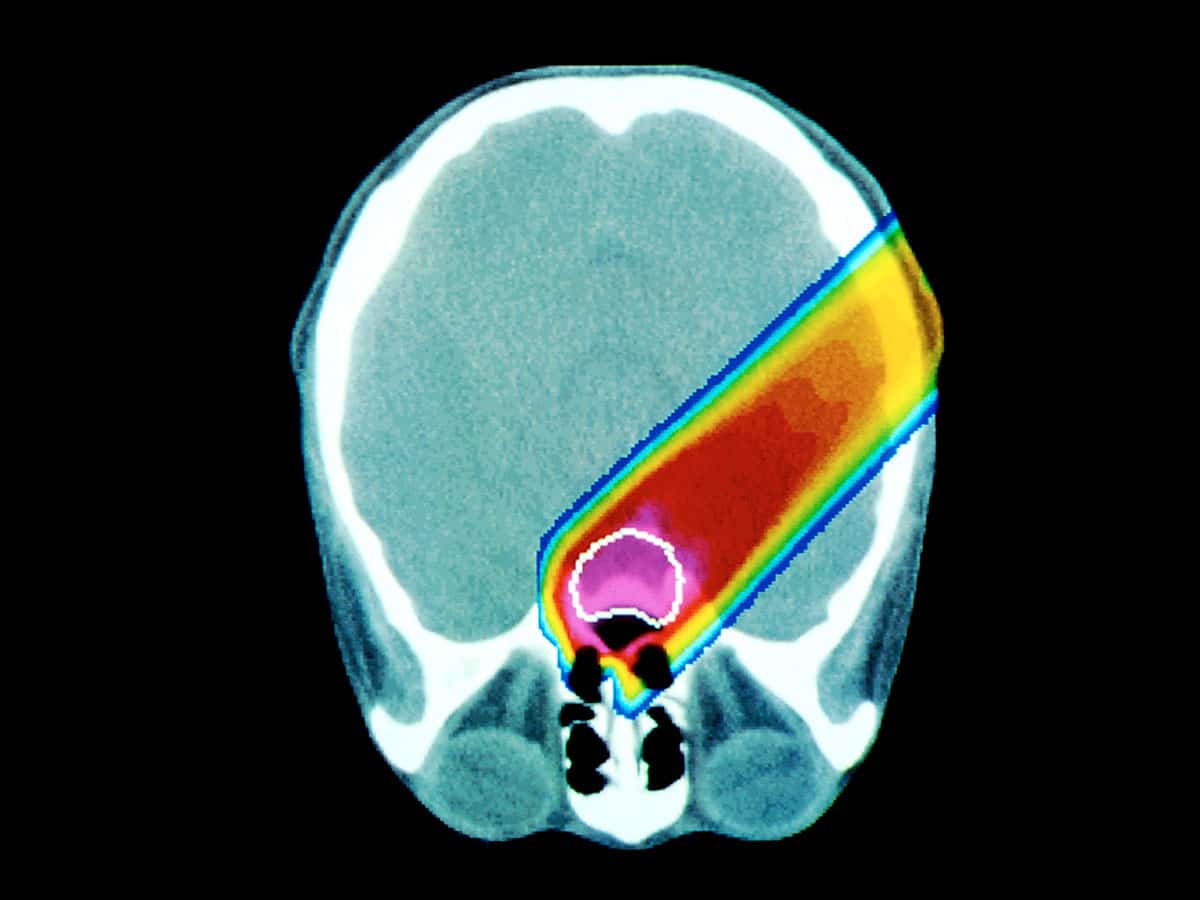
Opportunity knocks A beam of protons irradiating a tumour. (Courtesy: National Cancer Institute/Science Photo Library)
That treatment is hadron therapy, which exploits the fact that beams of protons and other hadrons can almost magically penetrate human tissue before releasing their energy at a well-defined depth. Hadron beams can therefore kill tumour cells while sparing healthy tissue, making them ideal for treating certain cancers – notably the potentially lethal eye cancer ocular melanoma – because the patient suffers less and the success rate is higher. Gamma rays, X-rays or electrons, in contrast, tend to dump their energy over a much greater volume.
Particle therapy has emerged as a by-product of high-energy physics – in fact, the first treatment took place at the Lawrence Berkeley National Laboratory in 1954 – but making it more widely available is a challenge. The snag is that the accelerators currently used to create beams of protons and other heavy ions are large and expensive, and the gantries that steer the beam across a tumour are the size of a small house. But one solution that could put particle therapy within the reach of most hospitals is laser-driven acceleration, which involves firing a very short yet intense laser pulse into a jet of gas, thin foil or thicker target.
Particle therapy has emerged as a by-product of high-energy physics, but making it more widely available is challenging
As the intense pulse travels through the target, it rips nearby electrons away from the positive nuclei, thus creating a huge electric field gradient in its wake. This field has a large accelerating potential that can be thousands of times that of a conventional accelerator. A laser-driven hadron accelerator can therefore, in principle, be relatively compact. Table-top lasers have already been used to accelerate protons to tens of mega-electron-volts, approaching the 70 MeV needed to treat ocular cancer. However, we need to find ways of boosting their energy to 200–300 MeV to kill tumours lying deeper within the body.
Physics for all Compact laser-driven accelerators will improve cancer treatment. (Courtesy: SuperStock)
Commercially available laser systems that can deliver such energies should be available in about 10 years, although it will probably take a further decade or so before they become routinely used to treat patients in hospitals. One problem with laser acceleration is that it delivers particles in pulses, rather than as a continuous beam. Techniques will therefore have to be devised to ensure the pulses are intense and numerous enough that patients get enough of a dose without having to lie perfectly still for long periods. In fact, the pulses could be a virtue as the magnets needed to scan the proton beam across a treatment area would then not have to be as big.
And if lasers do not bring hadron therapy to every hospital, there are other options, such as fixed-field alternating gradient accelerators. They are being developed at Daresbury Laboratory and elsewhere,and could also lead to compact devices suitable for cancer treatment.
Some like it thin
Opportunity knocks A graphene water filter. (Courtesy: University of Manchester)
While laser-driven hadron therapy is likely to be of most benefit to people in rich nations, our next spin-off could have massive implications for those in the developing world. It involves a material that was first isolated just nine years ago by Andre Geim and Konstantin Novoselov at the University of Manchester. That substance is, of course, graphene. Much of the hype surrounding this 2D honeycomb of carbon atoms has focused on its extraordinary electronic properties – who could resist the lure of an ultrathin bendable smartphone? But we think that another of graphene’s physical properties could be more important still. It turns out that despite being just one atom thick graphene appears to be completely impervious to almost every liquid and gas. By drilling holes of the appropriate size in graphene – or creating membranes of graphene flakes stuck together with just the right sized gaps between flakes – the material can be used as a selective filter.
In 2012 Geim and colleagues found that membranes made from millions of flakes of graphene oxide that had been stuck together allow water to easily pass through – yet the membranes are impervious to every other liquid or gas tested. Indeed, water was found to flow through the membrane 10 billion times faster than helium, which itself is rather good at diffusing through solids.
The application of such graphene membranes is obvious: they could be the ultimate water purifiers and could someday create drinking water from the sea. But such graphene-based membranes could have other applications as well, such as separating molecular species in a mixture, shielding people from dangerous toxins or making more efficient electricity-generating fuel cells.
Physics for all Graphene filters will extend access to clean water. (Courtesy: iStockphoto)
But while cheap and effective water purification could be an early spin-off from research into graphene, this “wonder material” could have many other applications in biology and medicine too. One promising idea is to read the base sequences of DNA by drawing these protein chains through tiny nanometre-sized holes drilled into graphene, the electrical properties of which change depending on which base happens to be in the pore at any one time. Such graphene “nanopores” could even be engineered to mimic the plethora of pores inside living cells or to craft artificial systems that recreate the incredible filtering abilities of the cell wall.
Being strong, flexible and – as far as we know – biocompatible, graphene could also be used as the basis of new kinds of prosthetic limbs. Earlier this year, for example, physicists in Germany showed that graphene transistors can generate an electrical signal in response to changes in the concentrations of ions that occur when cultured nerve cells fire. Work like this could help us to build artificial limbs that are wired directly into the human nervous system using graphene electronics as the interface.
Quantum calculations
Physics for all Superlenses will allow us to watch the chemistry of life in action. (Courtesy: Laguna Design/Science Photo Library)
Strengthening the links between complicated, messy biology and the neat reductionist world of physics is the basis for our next revolutionary spin-off. For the past decade or so, the new discipline of quantum information has grown by leaps and bounds. Ultra-secure quantum-cryptography systems are already being used by banks and other institutions keen on secrecy. Physicists can transmit quantum information a hundred or so kilometres through the air, and there are serious proposals to make a quantum link between ground and satellites in space.
The possibilities of quantum computers, however, are even more intriguing. Such devices, which would exploit superposition, entanglement and other quantum phenomena to perform super-fast calculations, have the potential for some amazing feats. But there is one particular thing that a quantum computer can do much better than a conventional computer – and that is to solve the Schrödinger equation for systems as large as a molecule, without resorting to the messy approximations that are usually needed to describe even the simplest molecules.
This would involve taking a collection of quantum bits, or “qubits” – say trapped ions – and manipulating both their internal properties and the interactions between them to simulate the atoms, and the forces between them, in a molecule. In the case of ions, this manipulation could be done by adjusting electric and magnetic fields applied to the ions or by shining laser light on them. Researchers would need about 100 qubits to do quantum simulations that can compete with today’s supercomputers. Although today’s best systems have tens of qubits, our control over the quantum world is improving so rapidly that working “quantum simulators” could be with us in a decade or so.
Algorithms for such simulators have, in fact, already been developed for calculating chemical reaction rates and how proteins fold. If put into practice, they could help with the design of new drugs by allowing chemists to calculate more accurately the properties of candidate molecules and slash the time it takes to determine which would work best. Quantum simulators could also be used to understand the process by which DNA protects itself from the gene-damaging glare of sunlight, which could help prevent skin and other cancers.
Simulators could even help us to understand how photosynthesis occurs and thereby let us build artificial systems that mimic the efficient energy harvesting of plants or serve as new sources of sustainable energy. Quantum simulations would also help chemists get a better handle on how enzymes work, which could be a boon to the chemical industry. Indeed, quantum simulation looks set to be one of the most important tools that physicists have created for the rest of science.
Seeing more clearly
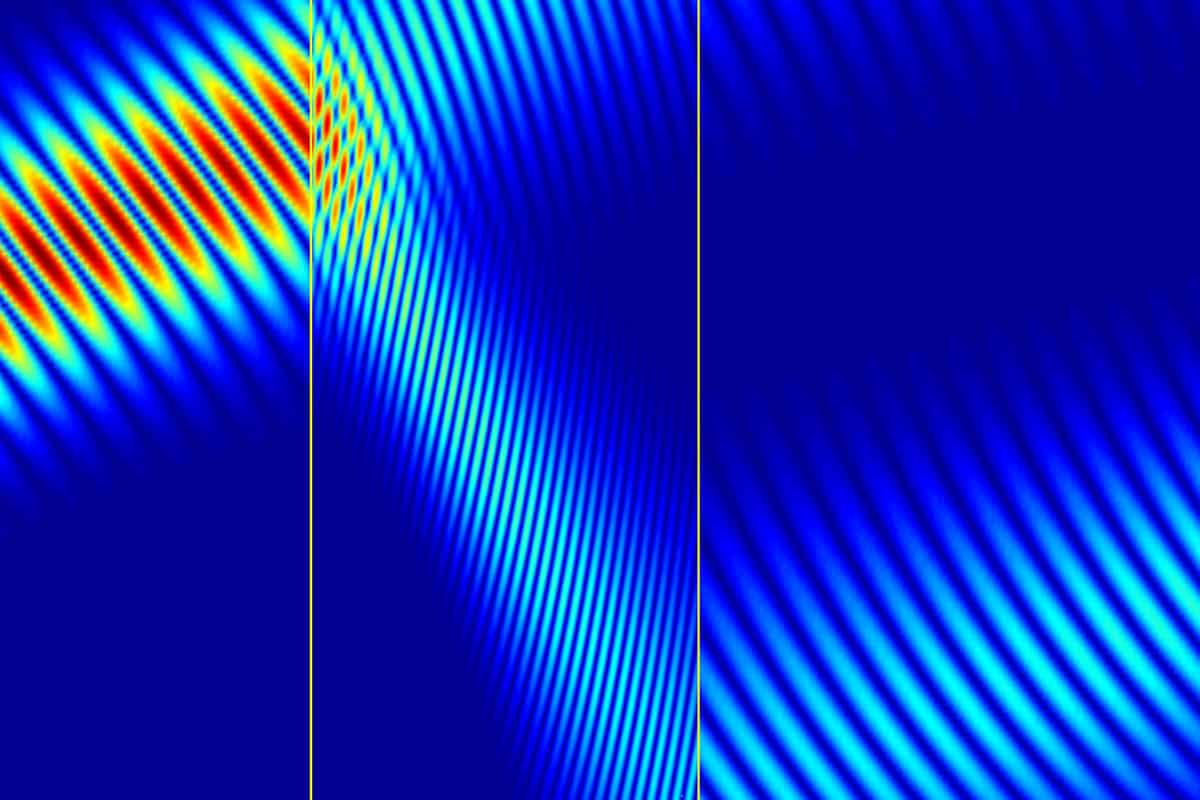
Opportunity knocks A computer simulation of a superlens material. (Courtesy: I Shadrivov/New J. Phys.7 220)
Our next big spin-off could also boost our understanding of biological processes by giving us a new way of seeing with light. Light is, of course, a wonderful thing as it can be guided and focused using simple lenses and fibres, capturing images of objects that are either too small or too far away to be seen with the naked eye. Moreover, many atomic and molecular transitions occur at optical wavelengths, which is why light – from the infrared to the ultraviolet – lies at the heart of a vast range of spectroscopic techniques.
But there is one major drawback to light as a probe of atoms and molecules: light of a certain wavelength cannot be used to discern an object smaller than about half that wavelength. Even for ultraviolet light, this “diffraction limit” is about 50 nm, or roughly the size of a large protein molecule. Electron microscopy can get round this resolution problem because the wavelengths of electrons can be much shorter than light. But it usually requires samples to be prepared in a way that can alter them, which is a problem for fragile biological systems.
Over the past decade or so, however, physicists have devised a way of getting around the diffraction limit and obtaining images of objects that are much smaller than optical wavelengths. The technique does not involve the familiar “far-field” light that is scattered or transmitted by an object and observed some distance away from it. Instead, it exploits the “near-field” or “evanescent” light that contains detailed sub-wavelength information about an object.
Physics for all Quantum simulators will help us harness the Sun’s energy by mimicking photosynthesis. (Courtesy: iStockphoto)
This light, which decays exponentially over a distance shorter than the wavelength of the light itself, cannot be gathered and focused using conventional optics. But in 2000 John Pendry of Imperial College London predicted that artificially engineered metamaterials with a refractive index of less than zero could be used to create a “superlens” that could gather and focus the evanescent light before combining it with the far-field light to create an image of the object. If the lens were “perfect” and gathered all the light, it could be used to create an image with infinite resolution. But even if only some of the light were captured, a superlens could still probe distances significantly below the diffraction limit.
Superlens-powered “nanoscopes” look set to fundamentally alter how we view the very small
The challenge with making negative-index metamaterials is that the index of refraction has both an electric and a magnetic component, both of which have to be less than zero. And, while the first rudimentary superlens-powered “nanoscopes” have already been made using metamaterials with the appropriate electrical components, making a material with the right magnetic response seems to have stalled over the past few years. Still, we think such nanoscopes look set to fundamentally alter how we view the very small – from protein folding and DNA replication to seeing how viruses invade healthy cells. So perhaps the superlens will find a cure for the common cold at last.
Power on the go
Opportunity knocks A triboelectric generator. (Courtesy: Georgia Institute of Technology)
Our final spin-off concerns energy – and specifically the stuff that powers the growing number of smartphones, tablets and other portable devices that we use while on the move in our daily lives. These are mostly run by lithium-ion batteries, but boosting battery capacity has proven very difficult. If we are moving, however, why not harvest some of that kinetic energy to power all our gadgets? Harvesting is most efficient when it harnesses repetitive motion such as walking, and the best estimate for the maximum rate at which mechanical energy can be converted to electrical energy – without impeding the walker – is 11 W. That, coincidentally, is about the same as today’s ubiquitous USB charger.
Researchers have already made a device – designed to be fitted into a shoe – that can fully charge a mobile phone in about 10 hours. While most of us do not regularly walk for such long periods, aphone user could at the very least keep their phone battery topped up using such a system. The “shoe charger” has been built by a team led by Zhong Lin Wang at the Georgia Institute of Technology, who is an advocate of energy harvesting from triboelectricity – commonly known as static electricity.
Normally the bane of engineers working in fields as diverse as aeronautics, microelectronics and textiles, triboelectricity is generated when two different materials (one electron-loving and the other electron-repelling) are rubbed together and then moved apart. The result is two oppositely-charged surfaces that create a voltage that drives a current. But triboelectric generators do not just have to be fitted into shoes. A jacket, for example, could produce 10–20 W from human motion – while a triboelectric flag flapping in the breeze could harvest 30–50 W.
Physics for all Energy harvesting will keep our electronic gadgets working while we are on the go. (Courtesy: Shutterstock)
But who would want a triboelectric flag and clothes? The most immediate beneficiaries are sure to be infantry soldiers, who are currently burdened by massive battery packs weighing up to 10 kg that they need to power a myriad of electronic devices from night-vision goggles to GPS and communications systems. Triboelectric systems could also be used to power the growing number of medical implants and prosthetics that currently run only on batteries.
While all of these innovations have come from blue-sky research, they will probably come to fruition in very different ways. Laser-driven proton therapy will be developed by large teams of physicists, cancer specialists and medical-equipment makers, whereas the first commercial shoe charger could be created in someone’s garage. And to make a difference in our lives, all of these concepts must survive the “valley of death”: the gap between making a scientific discovery and turning it into a practical product. We are confident that at least some of our top five will make it across.
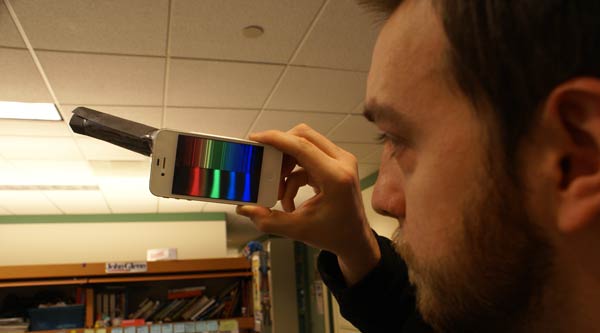
APS Outreach Specialist James Roche shows off SpectraSnapp. (Courtesy: Mike Lucibella/APS)
By Hamish Johnston and Tushna Commissariat
This was Nobel week, and physicists had two prizes to celebrate this year. Of course there was the prize for physics, which this year went to Peter Higgs and François Englert for their theoretical prediction of the Higgs boson in 1964.
Shortly after the physics-prize announcement, Englert was on the phone to Stockholm, but the Nobel officials couldn’t seem to find Higgs. Early rumours were that he had retreated to the Highlands of Scotland to avoid the media glare, but a few hours later he was photographed outside his Edinburgh home by The Scotsman newspaper.
Later, the BBC reported that Higgs was told about his Nobel win by a passer-by on an Edinburgh street, who stopped her car when she spotted the physics laureate on the pavement. “She congratulated me on the news and I said ‘Oh, what news?’,” Higgs is quoted as saying.