

In less than 100 seconds, astrophysicist Daniel Mortlock describes what he believes will happen to the universe in the end.
Watch more from our 100 Second Science video series.
In less than 100 seconds, astrophysicist Daniel Mortlock describes what he believes will happen to the universe in the end.
Watch more from our 100 Second Science video series.
After discovering the Higgs boson last year, researchers at the Large Hadron Collider are now trawling through the data as the collider undergoes an 18-month shutdown for repairs and upgrades. The goal is to discover hints of physics beyond the Standard Model of particle physics – but tantalizing glimpses of new physics have been harder to spot than many physicists had expected.
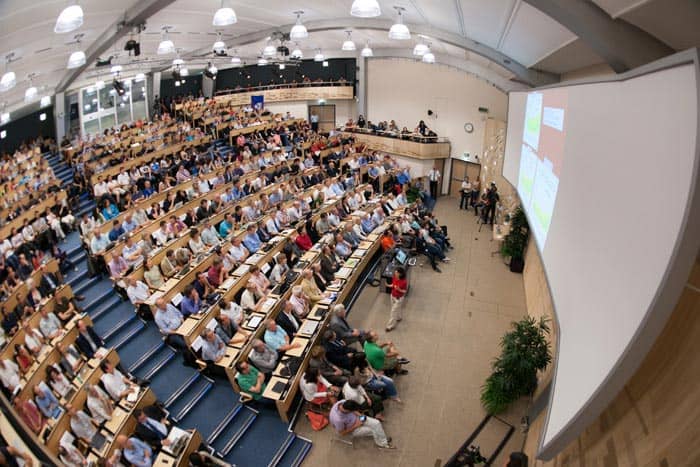
Three years, eight-quadrillion particle collisions and the discovery of the most infamous particle of them all: the Higgs boson. With such achievements under their belt, you might think that physicists working on the Large Hadron Collider (LHC) at CERN, near Geneva, would be taking a well-earned break. But the current shutdown – a two-year period of repairs and upgrades that began in February – is affording them no holiday. “This is actually the most intense period we’ve ever had,” says Joseph Incandela, spokesperson for the LHC’s CMS experiment. “The schedule is so tight there’s almost no contingency to prepare for the next run. It’s a bit insane.”
Since starting up in October 2008 – and following a major malfunction a few weeks afterwards that took a year to fix – the LHC has rarely been out of the headlines. The focus of news has been on the search for the Higgs boson, the last piece in the Standard Model puzzle of elementary particles and forces. Strong hints of the Higgs’s existence came last July, when CERN announced the discovery of a new particle, the mass and production rate of which appeared close to Higgs parameters in Standard Model predictions. By March this year, other measured properties, such as zero spin and positive parity, had led the laboratory to claim that the new particle was a Higgs almost without any doubt.
But while the public has largely taken the discovery of the Higgs boson as mission accomplished for the €3.8bn collider, many particle physicists have been shaking their heads in disappointment. Since it started collecting data, the LHC has exposed few – if any – traces of physics beyond the Standard Model, a framework that is now some 40 years old. There has been no solid evidence for dark matter, supersymmetry, miniature black holes, extra dimensions or any of the other exotic phenomena that theorists excitedly talked about prior to the machine’s switch-on. If there is new physics still waiting to be found, the question is: where? And will it turn up in the current shutdown period from an analysis of existing data or in the next, higher energy run?
Those waiting for new physics can take comfort in the fact that the LHC has achieved far more than the discovery of the Higgs over its three-year operation. A year before the Higgs’s detection, for instance, the ATLAS experiment found another new boson: the so-called Chi-b(3P) quark-antiquark pair. That was followed by the discovery last year of a new excited Xi(b) baryon by CMS. Although not elementary particles like the Higgs is thought to be, Chi-b(3P) and Xi(b) have helped tie up some of the Standard Model’s loose ends by confirming the nature of the strong force, which binds quarks together.
Perhaps more important than these particle discoveries, however, have been the LHC’s precise measurements of existing Standard Model phenomena. Some of these are quantities that cannot be accurately predicted, such as the high-energy structure of the photon that is being studied by the ALICE experiment. But other measurements can put the latest theories to the test. These include the energy distribution of particle jets (which are produced when quarks collide), and the production rate of pairs of heavyweight elementary particles such as W and Z bosons (which carry the weak force, responsible for radioactive decay) and top quarks. “Those calculations have been taken now to a higher degree of precision,” says Incandela. “We have a very good match between our data and our simulations, which tells you that our calculations are very good.”
Testing the Standard Model in this way is not merely an excuse for self-congratulation; it allows theorists to figure out which of their more speculative hypotheses are worth pursuing. In 2008, for instance, the CDF and D0 experiments at the Tevatron collider at Fermilab in the US accumulated evidence for an unexpected asymmetry in the production of top- and antitop-quark pairs, such that more of the top quarks seemed to fly in the direction of the collider’s proton beam than ought to, given Standard Model predictions. Theorists rushed to explain the effect, invoking extra dimensions, supersymmetry and other new physics.
The problem was that the top quark was so heavy – more than 180 times as massive as the proton – that the Tevatron could not generate it in sufficient quantities to give reliable statistics. Conversely, the LHC, which collides protons at record-breaking energies of 7 TeV, has been able to generate millions of top-quark pairs. Although CERN’s collider has not been able to shed light directly on the Tevatron’s measured asymmetry, it has managed to show, via measurements of a related top-quark asymmetry at ATLAS, that most of those theories proposed to explain it must be wrong (arXiv:1203.4211).
Besides the discovery of the Higgs, then, one of the main achievements of the LHC to date has been in ruling out new-physics theories, or at least restricting the elbow room, or “parameter space”, in which they can operate. Top among all of these theories was always supersymmetry, the idea that every known elementary particle has one or more heavier partners, known as sparticles. Supersymmetry potentially offers a solution to the “hierarchy problem” – why the weak force is 1032 times stronger than gravity – and presents candidates for dark matter, the mysterious substance thought to make up 26.8% of the universe’s total mass–energy content. According to particle theorist Ben Allanach at the University of Cambridge in the UK, data taken at the LHC have excluded roughly half of supersymmetry’s parameter space.
If supersymmetry doesn’t crop up, I’ll then be getting pretty depressed
Ben Allanach, University of Cambridge
Much of the data from the LHC’s first run has not yet been analysed – the CMS collaboration, for instance, still has to comb through 40% of the 4.7 billion events it recorded last year. Allanach thinks there is a chance that hints of new physics, such as supersymmetry, will crop up in the data analysed during the shutdown period, but he thinks that any big discoveries will have to wait until 2015 when the accelerator restarts at the higher collision energy of 13 TeV. “My hopes are pinned on the next run,” he says. “The energy jump now is going to make the big difference. And if supersymmetry is the correct theory of nature, I would be expecting to see a big signal within the first month. If it doesn’t crop up, I’ll then be getting pretty depressed.”
Others are not so optimistic. Last year, the Latvian theoretical physicist Mikhail Shifman posted an essay on the arXiv preprint server claiming that supersymmetry had failed its basic experimental tests, and that theorists should “stop blindly scanning the parameter space and start thinking and developing new ideas” (arXiv:1211.0004v1). But despite growing pessimism, there may already be signs of supersymmetry in current data. It may even arise out of the recently discovered Higgs boson. Its 125 GeV/c2 mass, combined with its production and decay rate, might fit well with Standard Model predictions, but it might also point to the lightest of several Higgs particles predicted to exist in the simplest versions of supersymmetry.
Null results are hard to sell to newspapers, but they are really important to scientific progress
Bill Murray, ATLAS
Bill Murray, deputy physics co-ordinator of the ATLAS collaboration – which, together with CMS, made the Higgs discovery – says that a supersymmetric Higgs would require a supersymmetric partner for the top quark, the “stop”, to be found at masses below 1000 GeV/c2. “That is a region we’re testing enthusiastically,” he says. But he stresses that he is open to the possibility of finding no evidence for supersymmetry. “Proving [supersymmetry] wrong would be as important as proving it right,” he says. “Null results are hard to sell to newspapers, but they are really important to scientific progress.”
Many physicists have latched onto the Higgs discovery, hoping to find out whether it really does fit Standard Model predictions or whether, over the next few years, they will find hints of a more exotic nature. Even if the Higgs is not supersymmetric, there is the possibility that it is not elementary but a composite of smaller particles, or that its existence stretches over higher dimensions.
Theorist John Ellis of King’s College London is doubtful whether these more exotic possibilities will be correct, given, he says, that the Higgs’s properties are already known to agree with Standard Model predictions to within some 10% on average. But he thinks the next two years of shutdown could offer news on supersymmetry, as the rest of the first run’s data is analysed. “Experiments have looked under the most obvious lampposts for supersymmetric signatures,” he says. “Now, they’ve got two years during which all the graduate students can fan out and look under the many other possible lampposts. If we’re lucky, something might be lurking underneath one.”
By Hamish Johnston
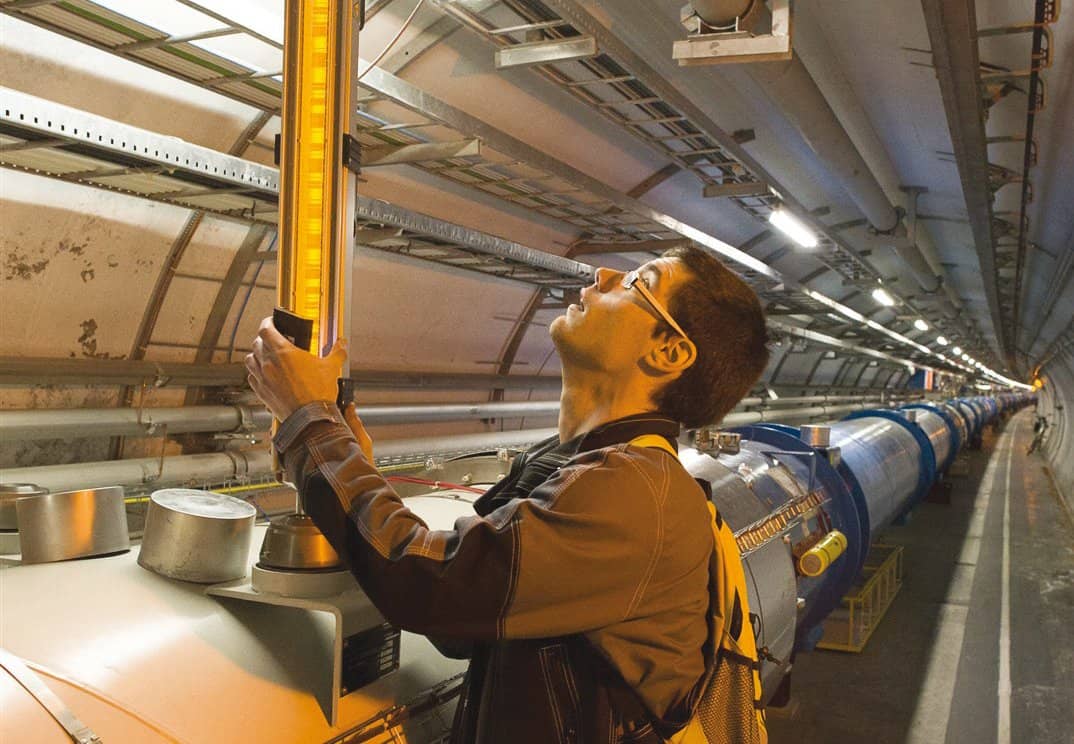
Recently I had the pleasure of speaking to CERN’s Steve Myers who is supervising the herculean task of upgrading the superconducting magnets that guide protons around the Large Hadron Collider (LHC).
Scientists in California have proposed a new type of gravitational-wave detector that is immune to laser noise – a problem that adds to the expense of current detector designs. The researchers believe that their proposal – a modified form of an atom interferometer – would be cheaper and easier to implement in space than current laser interferometers.
Gravitational waves are tiny perturbations in the curvature of space–time that arise from accelerating masses – according to Einstein’s general theory of relativity. The first hint that the waves exist was spotted in 1974 as a gradual decrease of the orbital period of the pulsar PSR B1913+16, which circles a neutron star. However, no-one has directly detected a gravitational wave. Such a discovery would provide confirmation of general relativity and also open a new field of gravitational-wave astronomy, in which distant objects could be studied by the waves they emit.
The conventional way to try to detect gravitational waves involves a long-baseline laser interferometer. A passing gravitational wave should cause the pathlengths of the two beams to change slightly, causing a shift in the interference fringes when the beams are recombined. None of these detectors have yet succeeded in detecting a gravitational wave; so to increase sensitivity, astronomers need to put detectors in space. Constructing a traditional L-shaped interferometer in outer space would require three satellites, which poses severe technological and financial challenges. The proposed Laser Interferometer Space Antenna (LISA) project, originally scheduled for launch in 2015, has been revised because of its high cost.
A single-baseline interferometer, which measures the change in length of a single path by interfering the emitted and reflected waves in a mirror cavity, would require just two satellites. But in this set-up it would be difficult to distinguish changes in pathlength from random fluctuations in the frequency of the laser – a phenomenon called phase noise.
Atom interferometers were proposed in the late 1980s and first built in the early 1990s by physicists including Mark Kasevich and Steven Chu at Stanford University. Instead of measuring the difference in phase between two beams of light, an atom interferometer measures the change in the phase of a matter wave made of atoms in a superposition of quantum states. An atom interferometer can be created by repeatedly exciting and de-exciting one half of the wavefunction using a laser while holding the other half in the ground state. The wavelength of an atom shortens when the atom is in its excited state, creating a phase shift between the two halves of the wavefunction that depends on how long the first half has spent in the excited state.
Each atom cloud is like a stopwatch
Mark Kasevich, Stanford University
In this latest work, Kasevich and colleagues, led by theoretical physicist Peter Graham at Stanford University, propose placing two atom interferometers a long distance apart and using the same pulsed lasers – one originating at one interferometer, one at the other – to excite and de-excite the atoms in both interferometers. The time each atom spends in the excited state depends on the travel time of the laser pulses between the two atom interferometers. “Each atom cloud is like a stopwatch,” explains Kasevich. “When the laser pulse comes from one direction, it starts the clock. When it comes from the other direction, it stops it.”
If the length of the baseline between the interferometers is constant, the atoms at both interferometers will accumulate the same phase shift. But if one interferometer accelerates relative to the other, the time between excitation and de-excitation of half the wavefunction will differ at the two locations and the atoms will accumulate a different relative phase shift. The same laser pulses excite and de-excite the atoms in both interferometers, so the laser-phase noise affects both atoms in the same way and does not affect the difference between the phase shifts detected at the two interferometers. “The light is just acting as the gate to turn off and on the clock,” says Kasevich. “The atom is doing all the hard work.”
Gravitational-wave expert B S Sathyaprakash of Cardiff University is cautiously optimistic. “The scheme is obviously very exciting,” he says. “But I think the big question is what kind of technology is required in space to run this thing for three to five years? I’m not saying anything negative or positive, but I would like to see numbers.” In an attempt to provide these, the Stanford team is currently planning to build a prototype in the laboratory to ascertain whether or not there are any unforeseen technical challenges with the proposal.
The research is published in Physical Review Letters.
In less than 100 seconds, Kenneth Long describes neutrinos in the context of quantum mechanics, explaining how they can oscillate between varieties.
Watch more from our 100 Second Science video series.
By Hamish Johnston
I think it’s safe to say that Peter Woit was never going to like Gordon Kane’s latest book about string theory. Woit, who is at Columbia University, is a prolific anti-string-theory blogger and author of Not Even Wrong: The Failure of String Theory and the Continuing Challenge to Unify the Laws of Physics, whereas Kane is a leading string theorist who is based at the University of Michigan.
Kane’s latest tome is called Supersymmetry and Beyond: From the Higgs Boson to the New Physics and it will be published later this month by Basic Books. On his blog – also called Not Even Wrong – Woit compares the new book with Kane’s previous effort Supersymmetry: Unveiling The Ultimate Laws Of Nature, which was published in 2000.
Woit makes the controversial claim that about 75% of Supersymmetry and Beyond is a simply a rehash of the 2000 book. To make his point, Woit focuses on several examples of how Kane has updated the text to paper over the fact that little experimental evidence for supersymmetry has been found over the past 13 years.
They are the bane of car owners worldwide: star-shaped cracks that spread out from a tiny chip until they cover the entire windscreen. So, to find out more about how these common but little-understood cracks grow, a group of physicists in France has carried out a series of simple experiments using brittle plates of both plastic and glass. The researchers found a scaling law that describes the cracking process in terms of several fundamental parameters – a finding that could have a wide range of applications from forensics to planetary science.
The impact experiments were done by Nicolas Vandenberghe, Romain Vermorel and Emmanuel Villermaux from Aix-Marseille University, who used an airgun to fire steel and ceramic projectiles at plates of either glass or poly(methyl methacrylate) – better known as PMMA, Plexiglas or Perspex – that were no more than 3 mm thick. The resulting cracking process was monitored using a high-speed camera for about half a second, which is the time it takes the initial shock wave to reach the edges of the plates. After the wave reaches the plate edge it reflects back to the centre and complicates the cracking process.
Each individual experiment involved firing a projectile at a speed of between 5 m s–1 and 100 m s–1 at a plate and counting the number of cracks that emanate from the point of impact. Vandenberghe and colleagues found that, for both materials, the number of cracks increased in proportion to the square-root of a dimensionless impact velocity that is based on the material properties of the glass or the PMMA. This relationship was true for glass that was just 0.15 mm thick as well as PMMA plates varying in thickness from 0.5–3.0 mm.
The existence of a universal law, which was successfully able to describe all the data collected in the study, was based on calculations that express the number of radial cracks in terms of the velocity of the projectile and the thickness of the plate. Also considered were the material’s speed of sound, its Young’s modulus (stiffness) and fracture energy – the latter being the minimum energy required for a crack to form in a material.
The team also examined what happens when the projectiles are fired so fast that they travel at speeds beyond the point where just simple star-shaped cracks are seen. The researchers found that, as the velocity increases, circular cracks surrounding the point of impact also appear. For a given PMMA plate thickness, the radius of the first circular crack was found not to vary with projectile speed, but the velocity at which the first such crack appeared obeyed a scaling law that involved the thickness of the plate. The team was also able to calculate this relationship from the material properties of the plates.
Vandenberghe told physicsworld.com that the main goal of the study was to get a better understanding of the fragmentation that occurs when an object strikes a thin material. This is crucial in forensics and archaeology, where shattered glass and other materials can provide important clues about past events. Further afield, it could also help planetary scientists gain better insights into the composition of planetary and lunar surfaces by studying how these materials crack when struck by meteorites.
In particular, Jupiter’s moon Europa is covered in cracks – leading scientists to believe that its surface is a thin layer of ice floating on a liquid sea. So far, Vandenberghe and colleagues have not had much success relating Europa’s cracks to the material properties of its surface. However, the researchers are now planning to do experiments on the cracking of plates floating on liquid to see if they can gain further insights.
The study is described in Physical Review Letters.
By James Dacey
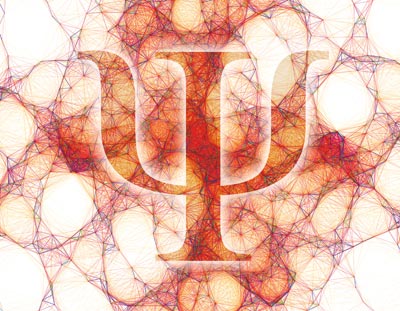
In the May issue of Physics World, science writer Jon Cartwright explores some of the most profound questions about the nature of reality. His feature, “The life of psi”, engages with an apparently simple question: what are quantum wavefunctions? Of course, like many of the most interesting questions in physics, the answer to the question is far from elementary. In fact, it is a question that goes right to the heart of quantum mechanics and philosophy, and one that has puzzled some of the greatest minds for the best part of a century.
Just as copper wires transport electric currents, so a new device designed and built by physicists in Spain and Germany can transmit magnetic fields over arbitrarily long distances. The “magnetic hose”, consisting of a ferromagnet wrapped in a superconductor, could be used to create a variety of circuits and suggests a new way of addressing qubits inside a quantum computer, say the researchers.
In our hi-tech world we make great use of the fact that electromagnetic waves can be transmitted vast distances, just as electricity can. But the same is not true for static electric and magnetic fields, the magnitudes of which decay rapidly with distance. The furthest that magnetic fields have been transmitted is a few metres, such as inside the cores of transformers.
To see if they could do any better, Alvaro Sanchez and two colleagues at the Autonomous University of Barcelona looked to transformation optics. This relatively new technique involves altering the trajectory of electromagnetic waves in unusual ways by mathematically transforming the waves’ constituent electric and magnetic fields, as has famously been done to create “invisibility cloaks” that can shield objects at certain wavelengths. The aim of the Barcelona group, having got together with Ignacio Cirac and Oriol Romero-Isart at the Max Planck Institute for Quantum Optics in Garching near Munich, was to apply transformation optics to static fields in order to couple two quantum systems magnetically.
The researchers’ first step was to model an infinitely wide slab of material with infinite magnetic permeability along its thickness (height) and zero magnetic permeability along its width. They found, as they had hoped, that any magnetic field at the slab’s lower surface would simply be shifted to its upper surface. Next they investigated whether or not the properties of this idealized system could be approximated in a real object. They found that a cylindrical piece of the same material, with a finite diameter, would do the job almost as well. But that still left the problem of mimicking the material’s extreme anisotropy.
The answer, they found, was to build up cylinders using concentric rings of a ferromagnet and a superconductor. They calculated that 20 such layers would transmit more than 90% of a magnetic field from the cylinder’s base to its top, and showed that even with just two layers – a ferromagnetic core and a superconducting shell – such a device could transport as much of 75% of the field. The researchers then went on to show how such a cylinder could be extended and shaped to create closed circuits.
John Pendry of Imperial College in London, who pioneered transformation optics, describes the scheme as “a rather novel idea”. He points out that ferromagnets conduct magnetic fields much worse than most metals conduct electricity, but says that the latest work shows they can become efficient magnetic conductors when enclosed inside a superconductor. “A superconductor expels all magnetic fields and can therefore be regarded as a perfect magnetic insulator, keeping the fields bottled up and preventing them from spilling all over the place,” he explains.
Such is the simplicity of the bilayer device that the Spanish/German collaboration, made up entirely of theorists, built one in the laboratory. But being theorists, they did not have fantastic equipment at their disposal, and had to make do with a bismuth-based high-temperature superconductor that was shorter than the cobalt–iron ferromagnet that they used. To get round this problem they measured the magnetic field strength, because of the presence of a direct-current coil at one end, at various points along the length of the cylinder rather than at the cylinder’s opposite end.
The researchers found that, as expected, the field was, on average, smaller than it was with either no device at all or with just the ferromagnet. Crucially, they also observed that with the full magnetic hose in place, the field strength spiked about halfway along the cylinder, and they noticed that there was a barely visible crack in the superconductor at that point. They took this as convincing evidence that the field was being efficiently guided by the device.
Tie Jun Cui, an electrical engineer at Southeast University in China, is enthusiastic about the latest research. He describes it as “very important work”, agreeing that the magnetic hose would be analogous to a metal wire. “Rather than electric circuits, this proposal would give us magnetic circuits,” he says.
Sanchez and colleagues explain that the static field transmitted by the hose can be regarded as having an infinite wavelength and that as a result the field can be used to carry out tasks on any length scale – be it 20 m or 20 nm. Looking ahead, they believe the new device could be used to manipulate quantum information at the nanoscale, for example via the isolated spins of defects in small crystals of diamond known as nitrogen vacancies. To function as bits inside a quantum computer, these spins should be independently addressable with magnetic fields, something that could be achieved with nano-sized magnetic hoses, they say. Such nano hoses, they add, might also be used to couple the spins.
A preprint describing the research appears on the arXiv server.
Thanks to the Internet, millions of people across the globe have had the chance to gawk at spectacular images of the aurora borealis, or Northern Lights, shimmering in the sky. For many of them, seeing this magical sight in person is high on their “bucket list” of things to do before they die. This large community of would-be aurora gazers forms the primary audience for Pål Brekke and Fredrik Broms’ handy, informative and – of course – visually stunning book Northern Lights: a Guide. Brekke, a solar physicist from the University of Oslo, is the driving force behind the book’s scientific side. Broms, a marine biologist and photographer who specializes in photographing the Northern Lights, is responsible for the stunning pictures that appear on most of its pages. Together, they have created a perfect companion for trip-planning or simply learning more about the science behind the spectacle. The book is divided into five sections, including an introduction; a short history of the myths and the science that surround the phenomenon; the solar effects that cause the aurora borealis to dance across the skies; suggestions for observing the lights; and, of course, the all-important topic of how to photograph them. The myths section contains the intriguing fact that the Inuit people in Greenland “believed that the lights represented the souls of stillborn children who were playing ball with a walrus skull”. This chapter also examines some of the earliest scientific literature about the lights, up to the early 1900s when the Norwegian scientist Kristian Birkeland finally proved that the “solar wind” of magnetic particles was responsible for the surreal displays. The photography section is particularly informative, beginning with how to use a simple compact digital camera to capture the lights, then tackling the possibilities of using more advanced digital SLR and video cameras. Other tips include how to use photographic equipment in cold climates, how to best compose images and how to deal with ambient light. So if you want to get a good taste of the science behind the Northern Lights and also find out about the practicalities of organizing a trip to see them in person, then this is the book for you.