Look! Up in the sky!

Thanks to the Internet, millions of people across the globe have had the chance to gawk at spectacular images of the aurora borealis, or Northern Lights, shimmering in the sky. For many of them, seeing this magical sight in person is high on their “bucket list” of things to do before they die. This large community of would-be aurora gazers forms the primary audience for Pål Brekke and Fredrik Broms’ handy, informative and – of course – visually stunning book Northern Lights: a Guide. Brekke, a solar physicist from the University of Oslo, is the driving force behind the book’s scientific side. Broms, a marine biologist and photographer who specializes in photographing the Northern Lights, is responsible for the stunning pictures that appear on most of its pages. Together, they have created a perfect companion for trip-planning or simply learning more about the science behind the spectacle. The book is divided into five sections, including an introduction; a short history of the myths and the science that surround the phenomenon; the solar effects that cause the aurora borealis to dance across the skies; suggestions for observing the lights; and, of course, the all-important topic of how to photograph them. The myths section contains the intriguing fact that the Inuit people in Greenland “believed that the lights represented the souls of stillborn children who were playing ball with a walrus skull”. This chapter also examines some of the earliest scientific literature about the lights, up to the early 1900s when the Norwegian scientist Kristian Birkeland finally proved that the “solar wind” of magnetic particles was responsible for the surreal displays. The photography section is particularly informative, beginning with how to use a simple compact digital camera to capture the lights, then tackling the possibilities of using more advanced digital SLR and video cameras. Other tips include how to use photographic equipment in cold climates, how to best compose images and how to deal with ambient light. So if you want to get a good taste of the science behind the Northern Lights and also find out about the practicalities of organizing a trip to see them in person, then this is the book for you.

  • 2013 Forlaget Press £35.00hb 120pp

It’s a wonderful life

In the wake of his barnstorming televised tours of the cosmos (Wonders of the Universe) and our own little piece of it (Wonders of the Solar System), fans of the über science communicator Brian Cox must have wondered what the University of Manchester physicist would do next. The answer arrived in February this year, when the BBC broadcast a follow-up series called Wonders of Life, focusing on the physical, biochemical and evolutionary principles that make terrestrial life possible and are responsible for its tremendous diversity. Cox is a particle physicist, so it is no surprise to find in the eponymous “book of the series” that he is a reductionist at heart, devoted to the idea that the best way of understanding things is to break them down into their smallest pieces. As Cox and co-author Andrew Cohen put it in the book’s introduction, the entire science of biology is pretty much just the study of “how life can be fully explained by the laws of physics and chemistry, as it surely must be”. This sort of thinking may raise hackles among biologists, and even some physicists may quibble with his later description of human consciousness as an “illusion”. Fortunately, the rest of the book largely ignores such philosophical pitfalls in favour of much more interesting subjects such as adenosine triphosphate (ATP), the so-called “battery of life” that cells use to store energy. Your reviewer rather warmed to the book at this point, since the study of ATP and the related Krebs cycle was a highlight of her first (and so far only) formal course in biology. It is always gratifying to find an author who shares one’s passion for a subject – although naturally, ATP is far from the only thing that sends Cox into full-on enthusiast mode. Elsewhere in the book, he gushes about subjects as diverse as water-striding insects, methane-gobbling organisms that dwell near deep-sea vents and even kangaroos, which are apparently the only large animal that gets around by hopping. And the book, like the television programme, is rather beautiful to look at, with hundreds of full-colour photos of animals, plants, molecules and (yes) a certain floppy-haired scientist. The only question that remains is whether, having covered life and the universe already, Cox’s next TV series will be a Douglas Adams tribute called Wonders of Everything.

  • 2013 Collins/Harper Design £25.00/$29.99hb 288pp

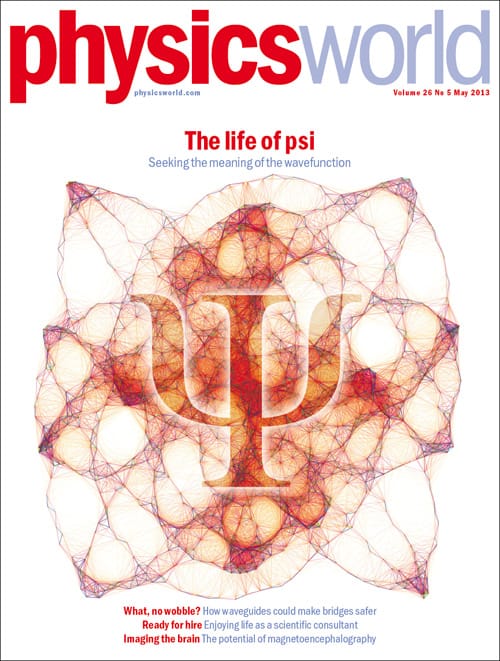
The May 2013 issue of Physics World is now live

By Matin Durrani

We’re sometimes accused here at Physics World of being hopelessly in awe of supposedly esoteric science such as the Higgs boson or quantum entanglement. In fact, as if to prove the point, the lead news story and the lead feature in the May issue of Physics World are on those very topics!

However, the new issue of the magazine – which you can read online and via our apps – also contains some very down-to-Earth physics in the form of an article that describes how special “wave bypass” structures could enable bridges to cope with potentially damaging vibrations. The most famous example of such destruction was the Tacoma Narrows Bridge – the falling-apart of which you can watch in our archive video clip on page 33 of the digital magazine.

Elsewhere in the issue, we look at the exciting potential of the brain-imaging technique of magnetoencephalography, while we have a great careers article this month outlining the benefits of a career as a scientific consultant.

(more…)

How nanocrystals squeeze through nanotubes

Researchers in the US have made a remarkable discovery about how an iron nanocrystal moves through a carbon nanotube that does not have a uniform diameter. They found that if the crystal meets a constriction in the tube, the crystal reforms, atom by atom, to fit through the constriction, without undergoing any melting or compression. According to the researchers, this behaviour could have many applications in nanomechanics and could possibly be used to synthesize small nanoparticles.

Scientists already knew that metallic nanocrystals can be made to travel through carbon nanotubes (CNTs) if a current is applied to the tube. The crystal moves in the direction of the electron flow and can easily be made to move back and forth by switching the polarity of the current, while the speed of the movement depends on the current magnitude. Indeed, this has been tested with numerous metallic nanocrystals including copper, tungsten and gallium. This is of particular interest to those developing nanoscale actuators or memory devices, and for the removal of minute impurities from within the metal crystal. Previously, most of the CNTs used to study this “electromigration” were smooth and had a constant inner-diameter hollow core. But if for some reason the CNT narrowed down at some point, such that the nanocrystal was now bigger than the tube itself, it was assumed that the crystal would block the tube until it melts and flows through as a liquid.

Slipping through

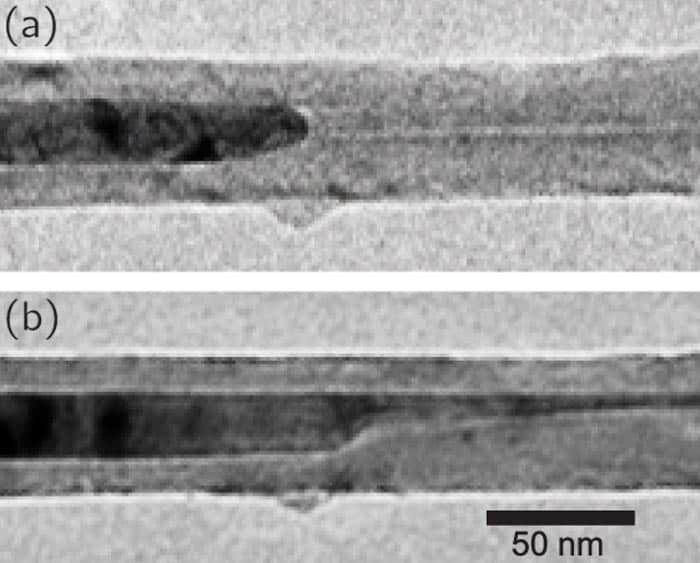
Surprisingly, what Sinisa Coh and colleagues from the University of California, Berkeley, and Lawrence Berkeley National Laboratory found was very different. The metallic nanocrystals, while remaining solid and crystalline, somehow managed to slip through the narrow passage while not being deformed. Rather, the researchers found the crystal deconstructing and reforming within the narrow passage, at the atomic scale. The team watched the movement of iron nanocrystals with a high-resolution electron microscope. Electron diffraction measurements verified that the crystals did not melt or experience compression.

TEM image of the iron nanocrystal moving through the CNT

The team used CNTs that had an inner diameter of 20 nm, filling them with the iron nanocrystal. Halfway along the axis of the CNT, a constriction was created, where the width of the CNT narrowed down to about 5 nm. When the current was passed across the tube, the crystal managed to squeeze through the much smaller passage.

Rebuilding crystals

Coh and colleagues use their atom-by-atom reconstruction theory to explain this transport, saying that “at the ‘contact region’ [where the crystal is in contact with the inner wall of the CNT], surface atoms from the far end of the crystal are transported along to the front, where they then remain stationary”. Coh explains that once an atom has diffused from the back and has migrated to the front of the crystal, it quickly gets covered by more incoming atoms and so becomes part of the bulk and remains stationary. This effectively allows the entire crystal to re-assemble within the confines of the constriction with its bulk remaining essentially stationary, so long as the current is applied.

Coh points out that their theory is simple as the entire motion of the nanocrystal is modelled only on two parameters – the diffusion barrier height B and the period L – regardless of the length, area or temperature of the CNT or the magnitude of the electromigration force. “The crystal always moves at the same speed, however long or short it is, so long as you provide the current,” he says.

Coh told physicsworld.com that this type of atomic-scale reassembly could prove very useful to either synthesize certain metal crystals within CNTs or to purify them. “It might be possible to coat one metallic crystal with another and then deposit only one within a CNT if you are building a nanoacale device…or you could get rid of defects by removing slower-migrating contaminants from a crystal as the surface-atom movement is dependent on the type of atom,” he says. He also says that the theory could be used to put multiple metallic species into the same CNT, or into CNTs that have complex, undulating geometries.

The research is published in Physical Review Letters.

Animated film made with single atoms

By Hamish Johnston

Billed as the world’s smallest movie, an animated film made using single atoms has been released by scientists working at IBM’s Almaden Research Center in the US. Called A Boy and his Atom, the production was made using a scanning tunnelling microscope tip to push individual atoms around on a surface – a technology that was invented at IBM in 1981.

(more…)

ALPHA weighs in on antimatter

Physicists at the ALPHA experiment at CERN have taken an important first step towards measuring the gravitational mass of antihydrogen, which consists of a positron surrounding an antiproton. Although they did not see any evidence that anti-atoms respond to gravity differently than atoms, the possibility that antimatter responds much more strongly to gravity than matter was ruled out. The work involved measuring how long it takes atoms of antihydrogen to reach the edges of a magnetic trap after it was switched off.

While anti-atoms may sound like the stuff of science fiction, they were first detected at CERN in 1995 and the Geneva lab currently has several experiments investigating their properties.

Despite a large body of theoretical and experimental work suggesting that gravity acts in exactly the same way on antimatter as it does on matter, there has been no direct measurement of how gravity affects falling antimatter. But finding even the tiniest of differences between the behaviour of matter and antimatter is important as it could shed light on mysteries such as why there is so little antimatter in the universe – and the precise nature of dark matter and dark energy.

Such experiments are tricky, to say the least. As well as collecting enough anti-atoms to carry out an experiment, which has until recently been very hard, physicists also must ensure that the anti-atoms are moving very slowly when they are released. If they have large amounts of thermal motion when dropped, then any subtle differences in how anti-atoms fall would be washed out by this random motion. Therefore the atoms have to be massively cooled to reduce their random thermal motion.

Looking at old data

Physicists on the ALPHA antihydrogen experiment at CERN have now analysed data from the 2010–2011 run of the experiment to see if anything could be gleaned about the gravitational properties of antihydrogen. ALPHA was designed primarily to trap and hold large numbers of antihydrogen anti-atoms, which are made by combining positrons from a radioactive source with antiprotons produced by CERN’s Antiproton Decelerator facility. The ultimate goal of the experiment is to carry out spectroscopy on antihydrogen and see whether its energy levels mirror that of hydrogen.

When ALPHA’s magnetic trap is turned off, the cloud of antihydrogen starts to expand outward. When an anti-atom reaches the solid interior surface of the trap it annihilates, producing a flash of radiation that can be detected. The team recorded the position of each annihilation and the time when it occurred – telling the researchers the trajectory followed by each atom. The team began with data describing 434 anti-atoms but found that only 23 were moving slowly enough to make the gravity analysis significant.

Gravity or antigravity

As a result of its analysis, the team has been able to put the first direct limit on the ratio between the gravitational mass and the inertial mass of antihydrogen. Normal matter has a ratio of one – anything greater than one would mean that gravity acts more strongly on antihydrogen and that it would fall further than matter. More intriguing is a negative value of the ratio, which would indicate a force acting in the direction opposite to gravity – or in other words antigravity.

In its analysis, the team was able to rule out ratios less than about –65 and greater than about +110. While such extreme ratios were not expected, the spokesperson of the experiment, Jeffrey Hangst, told physicsworld.com that the work is a “proof of principle” that a magnetic trap could be used to measure the gravitational mass of antihydrogen.

What physicists really want to do is look at ratio values in the –1 to 1 range – in other words, to allow them first to rule out antigravity entirely and then look for a tiny deviation from 1. Hangst says that the team believes that it should be able to focus on the –1 to 1 range when experimental work starts up again at CERN in 2015. This will be possible, in part, thanks to improvements in how the measurement is done. In addition, the next generation of the experiment, ALPHA-2, is designed to trap larger amounts of cold antihydrogen, which should also improve the measurement.

Purpose-built trap?

While the ALPHA team gets its gravitational-mass data “free” because the other experiments also involve switching off the trap, it may not be possible to fully optimize the measurement because this could have a detrimental effect on other aspects of the experimental programme. Looking further into the future, Hangst says that the team could consider a purpose-built trap to study the gravitational mass of antihydrogen.

ALPHA researchers are not the only people at CERN looking to rule antigravity in or out. In particular, the AEGIS experiment seeks to measure the gravitational mass of antihydrogen. Instead of trapping anti-atoms, it will send a horizontal pulsed beam of cold antihydrogen through a “Moiré deflectomer”, which will only pass anti-atoms within a very narrow range of velocities. As it travels, the beam is expected to fall 20 μm under the influence of gravity and the team will look for any tiny deviations from this drop. AEGIS spokesperson Michael Doser says his collaboration welcomes the “healthy competition” and adds that “maybe ALPHA can do it”.

If either team manages to find a difference in the gravitational masses of hydrogen and antihydrogen it would come as an unexpected boon to physicists trying to work out why nearly all of the antimatter created in the Big Bang has since vanished. “There is something fishy about gravity,” muses Doser, who points out that important mysteries such as the nature of dark matter and dark energy also seem to be related to the force.

The analysis is described in Nature Communications.

  • In less than 100 seconds, Helen Heath explains why some particles have equal but opposite partners.

Getting into shape

By Tushna Commissariat

Just think how handy it would be if your mobile phone could transform into different shapes depending on what you are using it for – nice and compact if you want to, say, securely enter a password in a public space or a broad console when playing a video game. That vision has moved one step closer to reality thanks to a prototype ultra-flexible mobile device unveiled yesterday by a group of researchers from the Department of Computer Science at Bristol University in the UK.

(more…)

Signs of Anderson localization spotted in 3D optical material

Researchers in the UK say they have observed behaviour that is very close to an optical version of “Anderson localization” in a mat of gallium-phosphide nanowires – a material that is a strong scatterer of light. As well as shedding light on a fundamental principle of condensed-matter physics, the finding might help make better light-emitting diodes (LEDs) and solar cells, says the team.

Thanks to its wave-like properties, light can produce complex interference patterns when it interacts with materials. For many years, scientists have been trying to produce materials that interact so strongly with light that they modify its flow. Examples of such materials are photonic crystals, which are periodic structures that affect the motion of light in much the same way as crystalline solids affect the flow of electrons.

For disordered structures, random light scattering and interference can produce an effect called localization, in which a light wave becomes “stuck” in closed paths inside the material, bouncing back and forth in complex looping paths called “modes”. Photons cannot easily escape but instead travel around in circles inside the medium.

This effect should occur for all types of waves, be they light, sound or the wavefunctions of electrons or atoms. It was predicted in 1958 by Philip Anderson, who bagged the 1977 Nobel Prize for Physics for his discovery. If Anderson localization could be made to occur inside a device that works by absorbing photons (a solar cell, for example), then the cell could be more efficient at converting light into electricity. In LEDs the opposite effect would be seen – photons would build up in the device and lasing would be seen in certain regions as the photons started interacting with each other. This would reduce the threshold for light emission, thereby leading to better LEDs, explains team leader Otto Muskens of the University of Southampton.

Critical threshold

Observing the effects of Anderson localization in real experiments is no easy task, however. In metals, interactions between electrons have so far made it impossible to isolate a distinctive signature of the effect. Researchers have enjoyed more luck studying localization effects in the laboratory using acoustic and matter waves.

Light shows great promise for observing Anderson localization because, unlike electrons, photons do not interact significantly with each other; however, there are challenges. “For light waves in 3D materials, we can only analyse the light that ‘leaks out’ of a material,” says Muskens, “but in our new experiments we have clearly seen some of the predicted interference patterns near a so-called critical threshold for Anderson localization. Such observations are exciting in themselves because they show that we are very close to seeing the real Anderson-localization regime.”

The Southampton team studied a mat of gallium phosphide (GaP) semiconductor nanowires, made with the help of colleagues at the University of Eindhoven and Philips Research Laboratories in Germany. GaP is one of the strongest 3D light-scattering materials known and the researchers were able to convert a coherent laser beam into random light by passing the beam through the nanowire structure.

Strongly correlated transport

“By using methods from statistical optics, we were able to show that the laser light becomes ‘grainy’ after passing through the GaP mat,” Muskens explains. “We collected several thousand different snapshots of these grainy light patterns leaking out of different places on the sample, something that allowed us to compare our results with theoretical predictions.”

It turns out that the light transported through the nanowires does not become completely random but still remains strongly correlated. Light waves interact inside the nanostructure thanks to an effect called mesoscopic interference. Such strongly correlated transport invalidates conventional light-diffusion models for describing photon transport and emission in certain nanostructures, like these light-scattering nanowire mats, says Muskens.

“More is different”

In this experiment, mesoscopic refers to a length scale between that of the individual nanowires and the macroscopic scale of the sample, Muskens explains. “In practice, mesoscopic effects become important on a scale of 10–100 times the diameter of the nanowires, but it is important for us to be able to distinguish collective effects from the effects caused by single nanowires,” he says. “Anderson himself once said that ‘more is different’ (the title of one of his papers), implying that when you increase the complexity and scale of a system, new physics will emerge. It is not just the simple sum of the individual building blocks (nanowires in our case) that is important, but how the blocks are arranged. A good example of this principle is high-temperature superconductivity, but in photonics an emergent phenomenon is wave localization.”

Because arrays of nanowires are increasingly being used in technologies such as LEDs and solar cells, such mesoscopic effects might be exploited to improve these applications. “It is particularly tempting to think about how increased light trapping might enhance nanowire photovoltaics. For example, the effect of trapped light travelling in circles could be used to increase light absorption in thin-film devices. We might even be able to improve LED performance by coupling to the light looping modes, but much more research is still needed before we can say this with any certainty,” says Muskens.

The current work is published in Nature Photonics.

Scientists recreate pressures and temperatures found deep within the Earth

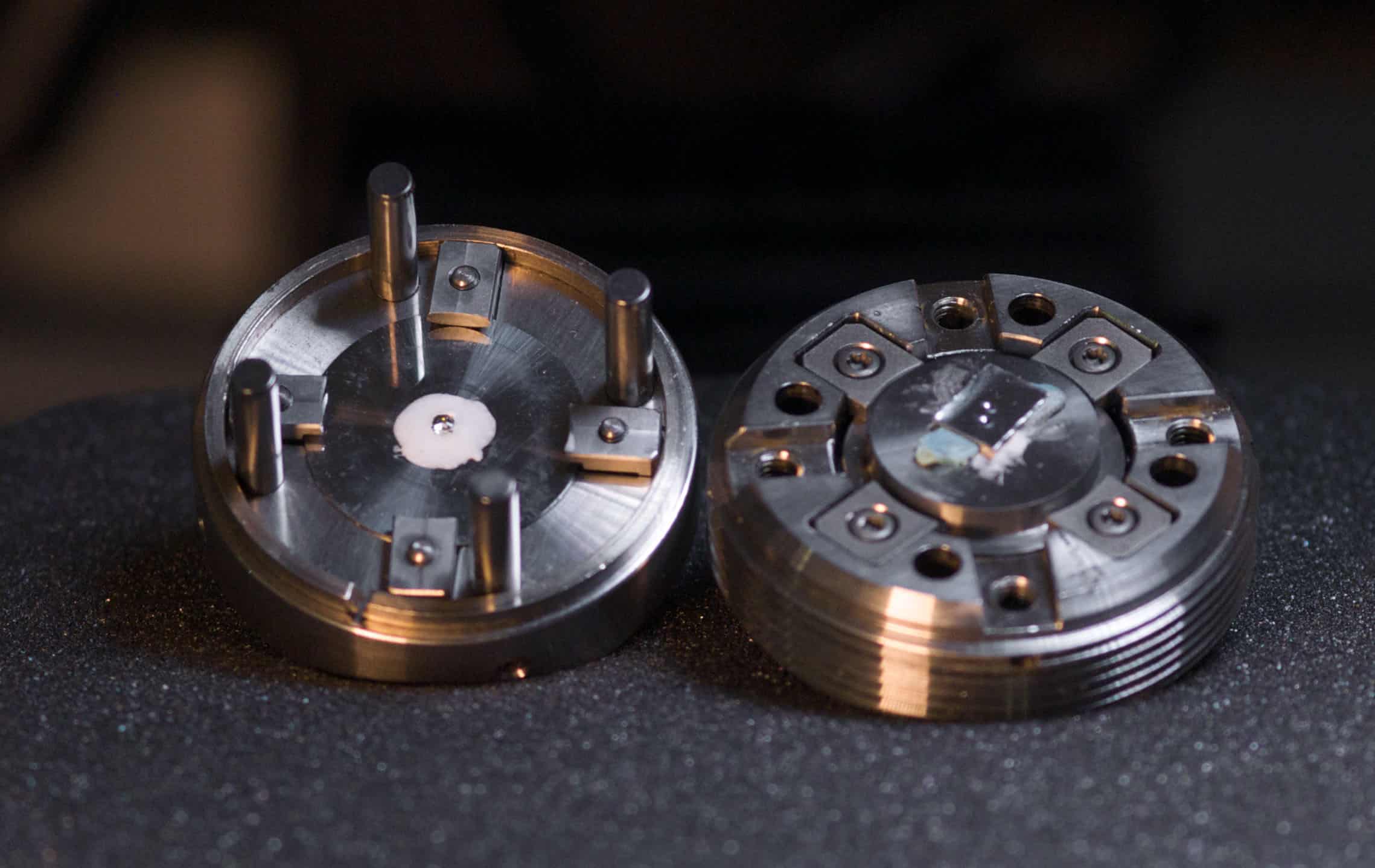
An opened diamond anvil cell.

By Ian Randall 

We owe our existence to the liquid nature of the Earth’s outer core. Without its internal convection our planet would have no magnetic field to shield us and solar winds would rip away most of our atmosphere. Indeed, this is probably what happened to our neighbour Mars. Despite its importance, however, we don’t know that much about conditions within the core. This is why a recent high-pressure experiment is so important.

(more…)

Nanowire transistor array as touch-sensitive as human skin

A team of engineers in the US has fabricated flexible, skin-like arrays of nanowire transistors that convert mechanical motion into electronic signals and are as sensitive as a human fingertip, according to the researchers. This means that the arrays could help robots to adjust intuitively the force they use to grasp things, be used in human prosthetics, as well as offer new ways for us to interface with a variety of electronic devices.

Reproducing a human sense of proprioceptive touch with electronics has proved difficult for roboticists. Existing tactile sensors tend to be made of materials with a resistivity that changes characteristically when touched, but the devices have frustratingly low resolutions – pixels of around 1 mm. The Georgia Institute of Technology team, led by Zhong Lin Wang, reduced the pixel size drastically, to 20–50 µm, and improved on resistive sensitivities by a factor of at least 30 by exploiting a unique physical phenomenon – the piezoelectric effect.

When a piezoelectric semiconductor is subject to mechanical strain, the symmetry of its component crystals gets distorted, creating a polarization charge along the length of the material. Wang used this principle a few years ago to create a new electrical component from bundles of zinc-oxide nanowires held vertically between electrodes: the piezoelectric transistor. Unlike conventional field-effect transistors – that have a current source, a drain and a gate electrode that controls the flow between them – the piezoelectric transistor comprises only source and drain electrodes. The internal piezoelectric polarization of the material acts as the gate, thus modulating the current by dominating how electrons flow at each end of the wire.

Rolling out the taxels

In the new work, Wang’s team fabricated a functional array of more than 8400 touch-sensitive transistors that the researchers dubbed “taxels”, for tactile pixels. Beginning with a thin, transparent substrate, the team laid parallel strips of indium tin oxide as the bottom electrode. These were spotted with contacts of gold – one spot for each nanowire to be constructed – before the nanowires themselves were synthesized vertically upward using a low-temperature hydrothermal chemical-growth technique. Last, gold contacts and the top electrode – strips laid crosswise to the bottom electrode – were added before the whole array was coated with a polymer to seal and protect it from moisture and corrosion.

Each transistor comprises a bundle of approximately 1500 nanowires, with each nanowire measuring about 500 nm in diameter. The sensors could detect pressure changes as small as 10 KPa – similar to a gentle touch such as typing on a keyboard. The finished “piezotronic transistor chip” may cover a modest area of less than a square centimetre but producing such an integrated array was a key step in transforming the concept into practical applications.

As well as offering robots a more adaptive sense of touch, the technology could improve the functional capability of human prosthetics and offer new ways for us to interact with electronics, for example with improved electronic-signature mapping. “When you sign your name, we can use these arrays to record the graphics, the force or pressure applied as you write your name, and also the speed with which you write it,” explains Wang. “This will make your signature much more functional, much more dimensional and much more secure.”

Mind-feeling

Kuniharu Takei, an engineer at Osaka Prefecture University in Japan who was not involved in the study, points out that the sensitivity of Wang’s array is on a par with the very best tactile-pressure sensors. Nevertheless, he considers it a “breakthrough” for human interactive electronics because the researchers managed to build a macro-scale device that is transparent and flexible. “With this device, it should be possible to design a touchscreen that really feels your mind, since it can feel the strength of tactile pressure,” he ventures. “If you’re angry or irritated, you may press the screen strongly; if you’re happy, you might touch the screen rhythmically.”

Zhenan Bao, a materials scientist at Stanford University, agrees that “the level of integration in this work is impressive”. In terms of mimicking the human sense of touch, though, she feels the device would benefit from a broader pressure-sensing range.

Wang identifies the team’s next goal as building higher-density, higher-sensitivity transistor chips. “We will also interface piezotronic transistors with silicon electronics and with biology,” he says. “I anticipate that in five years, we should see some very cool and novel applications.”

The research is published online in Science.

Copyright © 2026 by IOP Publishing Ltd and individual contributors