Entangling tiny drum’s beat with microwaves

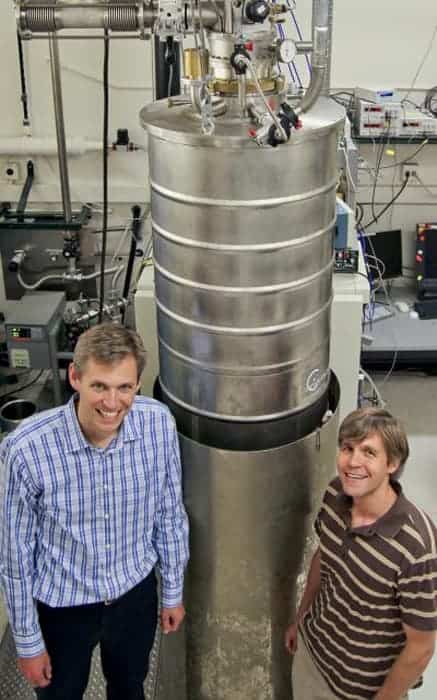
Lehnert and Palomaki at their laboratory at JILA

Researchers in the US have entangled the motion of a tiny mechanical drum with a microwave field. This is the first time that a macroscopic oscillator has been entangled and the work extends the observation of quantum behaviour to larger objects than before. The researchers hope to apply their results in the creation of a quantum computing circuit.

Cool beats

In early 2010, researchers at the University of California in the US were the first to have observed true quantum behaviour in a macroscopic object that was cooled down to its quantum ground state. Then, in 2011, Konrad Lehnert and colleagues at JILA – a joint institute of the University of Colorado at Boulder and the National Institute of Standards and Technology (NIST) – followed on from that work and cooled a similar microdrum down to the ground state with a technique known as “sideband cooling”, which uses microwaves instead of laser light. They cooled the drum to below 400 μK, steadily lowering its energy to just one-third of one quantum.

Then in March this year, Lehnert’s group was the first to store and retrieve quantum information from their oscillator by connecting it to a microwave circuit. In that experiment, the researchers transferred the states of a microwave field into their mechanical oscillator and then converted the state of the oscillator back into a microwave field. Now, Lehnert, along with his postdoctoral researcher Tauno Palomaki and colleagues have extended this by creating an entangled state between the oscillator and a microwave field by exciting the circuit above its resonance frequency. “During the entanglement process a microwave pulse emerges from the circuit but unlike the previous work, it’s not a state that was stored in the mechanical oscillator. That pulse is generated spontaneously by the entanglement process,” explains Lehnert. The microwave field that emerges from the circuit as a result of their experiment is known as the “pulse”, while the microwave field that they impose on the electromechanical circuit is known as the “pump”.

Perfect tuning

Lehnert tells physicsworld.com that if the pump is tuned above the circuit’s resonance frequency, a spontaneous process creates a pulse and places the mechanical oscillator in a state that is correlated with that pulse. “If the mechanical oscillator is near its ground state when that pump is applied, the oscillator and pulse won’t just be correlated, they should be entangled,” explains Lehnert.

In the experiment, the first pump is tuned below the circuit’s resonance, transferring the thermal state of the oscillator into a pulse that removes the thermal energy from the drum, cooling it to near its ground state. The second pump tone is tuned above the circuit’s resonance and this creates a pulse that is entangled with the oscillator. The third and final pump is, once more, tuned below resonance and it converts the state of the oscillator into a third pulse. During this process, a train of three pulses emerges from the circuit. The first contains the thermal state of the oscillator but it is the second and third pulses that are of interest to the researchers. “We show that the second and third pulses are entangled and because we know that the third pulse contains the state of the oscillator immediately after the entanglement was generated, the oscillator must have been entangled with the second pulse,” says Lehnert.

Subtly entangled

Lehnert is clear that that there is, undoubtedly, some subtlety when it comes to a demonstration of entanglement itself. “Evidence of entanglement comes from asking how well we can anticipate the measurement of the third pulse, based on our measurement of the second. That’s a good operational notion of correlation,” he says. If the pulses are indeed entangled, a measurement of the second pulse should allow the team to anticipate the outcome of the measurement of the third, with an uncertainty that is smaller than the fluctuations associated with the quantum vacuum fluctuations (a temporary change in the amount of energy in a point in space that comes about due to Heisenberg’s uncertainty principle).

Lehnert explains that the subtlety comes into play because the state of a pulse is specified by two numbers – the real and imaginary components. These two numbers obey the uncertainty principle – either can be measured with arbitrary precision but if both are measured simultaneously, the measurement itself introduces noise that is at least as large as the vacuum fluctuations. But for a demonstration of entanglement, the team must measure the correlations both in the real part and in the imaginary parts and it did so by measuring both simultaneously. “As such we must carefully characterize the noise added by the measurement itself. Having done so, we can show that the second and third pulses are entangled,” says Lehnert. According to him, the team has a high degree of confidence that the oscillator and the microwave pulse are entangled each time the experiment is carried out.

The US researchers are now looking to combine their circuit with superconducting qubits to store and retrieve a qubit state from the oscillator, as their work demonstrates an essential requirement for using compact and low-loss micromechanical oscillators for quantum processor. “In addition, we’d also like to use devices of this type to build quantum-enhanced force sensors. That is, we’d like to show that we can use entanglement to circumvent the quantum noise that would otherwise limit the sensitivity of a force measurement,” says Lehnert.

The research is published in Science Express.

Etched glass could create table-top particle accelerators

Two independent teams of physicists have used small pieces of glass etched with tiny gratings to accelerate electrons through enormous electric-field gradients. One team boosted the kinetic energy of the electrons at about the same rate as a conventional particle accelerator, while the other achieved 10 times that rate. The technology could one day be used to build table-top accelerators that are much smaller than conventional devices, bringing the benefits of particle-beam therapy to a wider range of cancer patients.

Laser-driven particle acceleration has been the subject of intense research over the past two decades, having been used to accelerate electrons, protons and other charged particles. Although several different techniques can be used, they all involve firing an intense pulse of laser light at a target. The intense electric field of the pulse separates electrons from the positively charged nuclei, creating a very strong electric field that can then be used to accelerate charged particles.

This latest breakthrough was made independently by two groups: one in the US and the other in Germany. The US team was led by Robert Byer of Stanford University and included physicists at the SLAC National Accelerator Laboratory, the University of California, Los Angeles and the Tech-X Corporation. In their set-up, a beam of electrons is first accelerated to a kinetic energy of about 60 MeV moving at near to the speed of light using the Next Linear Collider Test Accelerator Facility at SLAC. The other team was led by John Breuer and Peter Hommelhoff of the Max Planck Institute of Quantum Optics in Garching, whose device works for much less energetic 28 keV electrons travelling at about one-third the speed of light.

Pillars and trenches

In the US experiment, the laser acceleration is carried out by first firing the electrons into a 500-μm-long device made from silica glass. The electrons travel along a narrow channel, the two opposing walls of which are covered by gratings of pillars and trenches (see figure above). As the electrons zoom down this channel, a pulse of intense 800 nm infrared light is fired at the gratings – twice the wavelength of the gratings themselves. The pulse interacts with the gratings such that the phase of its electric field is rotated by 180° as the light passes a grating pillar. The strength of the electric field is also enhanced in a similar periodic manner.

Schematic showing a cross-section of the device created by the team at Stanford University

Some electrons enter the channel at just the right moment to experience a strong electric field that accelerates them in the forward direction. And because they are travelling at very nearly the speed of light, these electrons are synchronized with the pulse as it travels through the device – and therefore they enjoy maximum acceleration throughout their journey. The US team calculates that the electrons encounter an acceleration gradient of about 300 MV/m in the device – which is more than 10 times higher than that achieved in today’s conventional accelerators.

Non-relativistic challenges

The German device, in contrast, works for much slower electrons that travel a shorter distance in one oscillation cycle of the light pulse. This means that the grating spacing in the chip should be about 250 nm. As this was too small for the team to achieve, Breuer and Hommelhoff settled on a 750 nm spacing, which meant that the electrons got an accelerating kick once every three cycles. Furthermore, because the initial speed of the electrons is much lower than the speed of light, their speed will increase significantly when accelerated. So to be effective, the grating spacing must increase as the electron travels along the device.

Despite these problems, Breuer and Hommelhoff were able to create an acceleration gradient of about 25 MV/m, which is on a par with conventional accelerators. While these accelerators-on-a-chip could lead to compact sources of high-energy electrons for scientific, commercial and medical use, there are still challenges. In particular, the Stanford device works extremely well but requires a source of relativistic electrons – which is large and expensive. While Breuer and Hommelhoff have shown that it is possible to accelerate non-relativistic electrons, much more work would be needed to create a practical system that uses lasers to make a truly compact high-energy source.

However, that has not deterred Byer. “Our ultimate goal for this structure is 1 GV/m, and we are already one-third of the way there in our first experiment,” he says.

The work by Byer and colleagues is reported in Nature and Breuer and Hommelhoff describe their research in Physical Review Letters.

Physics World at 25: Puzzle 1

By Louise Mayor

Physics World at 25 Puzzle

This month is the 25th anniversary of Physics World – the member magazine of the Institute of Physics – and in addition to a special celebratory issue, we’ve decided to set you a challenge.

In fact, we have teamed up with GCHQ – one of the UK’s three Intelligence Agencies and home to some of the country’s hottest code-breaking talent – to create with us a set of five physics-themed puzzles. The puzzles have been devised by three GCHQ members of staff, who today we still know only as Colin, Nick and Pete. (Thank you, guys!)

Below is Puzzle 1, the first of the five. The rest will be released on successive Tuesdays throughout October on this blog. The first is the easiest – they only get harder from here on in!

(more…)

Celebrating 25 years of Physics World

By Matin Durrani

Today marks the 25th anniversary of Physics World – the member magazine of the Institute of Physics (IOP) – which launched in October 1988. And to celebrate that fact, we’ve created a fantastic special issue of Physics World in which we look back at some of the highlights in physics of the last 25 years and also forward to where the subject is going next.

All members of the IOP can access the entire new issue right now via the digital version of the magazine or by downloading the free Physics World app onto your iPhone or iPad or Android device, available from the App Store and Google Play, respectively. The issue includes a stack of bonus audio and video content, including three short films we’ve specially made about some of the top spin-offs from physics.

We’ve split the bulk of the issue into five sections, each with five items (five times five being 25, of course):

• Find out our choice of the top five discoveries in fundamental physics over the last 25 years.

• See what five leading researchers have to say about Physics World‘s choice of the five biggest unanswered questions in physics right now.

• Enjoy our pick of the five top images from the last 25 years that have let us “see” a physical phenomenon or effect.

• Learn more about the five people who are changing the way physics is done.

• Gaze into the future as we disclose the five most promising spin-offs from physics.

We also have a set of fiendish physics-themed puzzles devised for you by staff at the UK’s Government Communications Headquarters (GCHQ) – the first is revealed in the special issue and on our blog, with the rest to be unveiled on physicsworld.com throughout October.

(more…)

What is the nature of the dark universe?

This year the Planck space mission released exquisite observations of the early universe, providing the strongest evidence yet that the universe we live in is very dark indeed. Its precise results show that our universe is composed of 26.8% dark matter and 68.3% dark energy, while less than 5% is made up of the stuff we are familiar with on Earth. With their long-standing quest to make these precision measurements essentially now concluded, cosmologists are rapidly turning their attention to a much bigger and further-reaching question: what is the exact nature of this dark universe?

Dark matter is exactly what it says on the tin: it is dark and comprised of a mysterious substance that does not emit or absorb light. We only know it exists because of its gravitational effects on the normal matter that we can see. Dark energy is less well described by its label, being an invisible source of energy that drives the post-Big-Bang expansion of the universe to mysteriously accelerate. Together, these two dark entities play out a cosmic battle of epic proportions. While the gravity of dark matter slowly pulls structures in the universe together, dark energy fuels the universe’s accelerating expansion, making it ever harder for those dark-matter structures to grow.

It is widely believed that to truly understand the dark universe, we will need to invoke some new physics that will forever change our cosmic view. As the conclusion of this dark quest could be so far reaching, astronomers are approaching the task with care, using a series of independent and meticulous observations. Efforts include the Canada–France–Hawaii Telescope Lensing Survey, which has directly mapped out the invisible cosmic web of dark matter by observing how its mass bends space and time, lensing the light of very distant galaxies. Projects such as the Sloan Digital Sky Survey are accurately charting the locations of billions of galaxies, which closely trace the distribution of dark matter because this gravitationally attractive substance dictates where and when galaxies form. Galaxies also carry with them a signal imprinted in the distribution of normal matter just after the Big Bang that can be seen in how galaxies cluster in the cosmos today.

Capturing dark matter

Astronomers have put their theories of dark matter to the test, finding that a very wide variety of observations all agree with a single theory, termed the “concordant cosmology”. This overwhelming body of evidence supports the theory that dark matter is made up of weakly interacting matter particles (WIMPs), and the challenge is now on for particle physicists to go out and catch or create one.

Several attempts have already been made to trap a dark-matter particle, but any hints of success have so far been controversial and open to interpretation. The next major leap in the search for a fleeting glimpse of a dark-matter particle in flight is taking shape not in space but nearly 1.5 km under the Black Hills of South Dakota. The LUX-ZEPLIN experiment will use nine tonnes of liquid xenon as its dark butterfly net. The hope is that a few of the trillions of WIMPs that pass through the Earth every second will be caught crashing into some of the xenon particles. How successful this new experiment will be in its quest to uncover the nature of dark matter will depend on just how much of a wimp the dark-matter particle turns out to be. An unquestionable direct detection of a dark-matter particle would be one of the most significant discoveries of this century, finally confirming Fritz Zwicky’s theory, which was ridiculed when he proposed it in 1933.

Exposing dark energy

While the astronomical community is now fairly united in postulating the existence of an invisible dark-matter particle, the same cannot be said about its support for the simplest explanation for dark energy. Observations that the expansion of our universe is accelerating are most easily explained by considering the extra energy associated with the vacuum that permeates the universe. According to quantum theory, empty space is filled with a swarm of virtual particles with a wide range of masses that can briefly pop in and out of existence. As mass and energy are equivalent, the growing vacuum within an expanding universe acts like a bank of unlimited energy, inflating the whole universe at an accelerated speed.

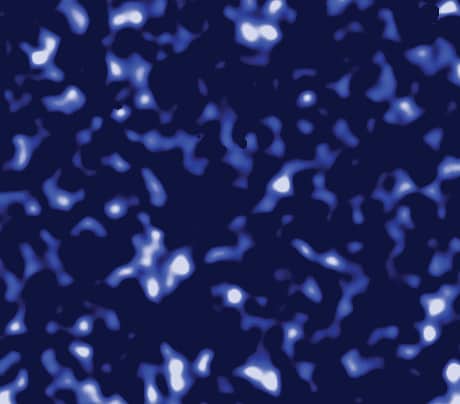
A dark-blue background featuring paler-blue amorphous blobs, some of which are so pale as to look white in places

Unfortunately, there is a problem with this simple and elegant vacuum solution to the nature of dark energy. Particle physicists can make a theoretical estimate for the energy of a vacuum and they find that it is 120 orders of magnitude larger than the dark energy that the Planck results show. This wild discrepancy has opened up a wide range of exciting new dark-energy theories including exotic models such as a multiverse that resembles the middle of an Aero chocolate bar. Perhaps our universe is one Aero bubble being pulled by our neighbouring Aero-bubble universe?

Many cosmologists believe that the dark-energy phenomenon indicates that we need to look beyond Einstein’s theory of general relativity. By observing how dark-matter structures change over cosmic time, we can investigate how dark energy evolves and test gravity for the first time on cosmological scales. Just as Einstein revolutionized our understanding of Newtonian gravity, confirmed through observations of the solar system, so new observations of gravity on cosmological scales may bring about another revolution in our understanding of gravity.

Two major new international projects will lead our quest to discover what the dark-matter particle is and why the expansion of our universe is apparently accelerating. The Euclid satellite, due to launch in 2020, will image the full dark sky from above the Earth, while the Large Synoptic Survey Telescope, due to see first light in 2019, will image the full Southern sky from a mountain top in Chile. Both of these projects will chart the distant universe with exquisite precision, utilizing a diverse range of cosmological tools to map out the evolution of dark-matter structures and document the expansion and curvature of space and time from 10 billion years ago to the present day. Exciting times are ahead for our understanding of the fundamental physics that govern the dark side of the universe.

New ‘wagon-wheel’ molecules could make better OLEDs

A new giant organic molecule that is shaped like rotelle or wagon-wheel pasta has been created by an international group of researchers. The molecule is known as a “pi-conjugated spoked-wheel macrocycle” and emits light that has no overall polarization, according to the team. This feature could be useful for making more efficient organic light-emitting diodes (OLEDs) – however, the researchers say that much more work has to be done before there are any practical applications.

Currently, OLEDs are used in energy-saving light bulbs and as displays in televisions and mobile phones. They offer high pixel brightness, wide viewing angle, very high contrast ratio, fast response times and low power consumption. OLEDs have the potential to be even better but scientists have struggled to further boost their performance because of losses caused by the polarization of light as it passes through the devices.

Polarized loss

The problem is related to the difference in the refractive indices of the organic layer of an OLED and the adjacent glass layer. The result is a waveguide effect in the organic layer that prevents much of the light from escaping. This effect depends on the polarization of the light and this inspired John Lupton and colleagues at the University of Utah in the US along with other researchers in Germany to create wheel-shaped molecules to depolarize the light.

It’s just the beauty of making a perfectly symmetrical system and then watching how the symmetry is broken spontaneously
John Lupton, University of Utah

Lupton explains that current OLEDs are made up of spaghetti-shaped chain polymers that tend to emit polarized light. As a result, nearly 80% of the light generated remains trapped within the organic layer. In the spaghetti-shaped chain polymers, polarized light is produced by electrons that can only oscillate by moving up and down the chain. However, in the new wagon-wheel-shaped polymers the electrons can oscillate in all directions, creating light that is not polarized, reducing the losses associated with wave-guiding.

Perfect wagon wheels

The molecules were made by team member Sigurd Höger from Bonn University in Germany. Lupton told physicsworld.com that the polymers were challenging to make because they are so large – each one is 6 nm wide. He adds that the molecules retain their shape over time and there are no isomers. Indeed, it is their perfectly symmetrical shape that scrambles the polarization of the light. Lupton likens it to balancing a perfectly sharp pencil tip – in an ideal experiment, the pencil will fall in a different direction every time. “Every time you excite the ring, a photon is emitted from a different, random segment of the ring,” he explains.

The team then carried out single-molecule experiments, where it shone ultraviolet light on ring molecules to generate visible light photons. The photons had a “scrambled” polarization – one that changes randomly from photon to photon. The large ring-shaped molecules can “catch” other molecules, making them effective biological sensors. They also have potential use in solar cells and switches, according to the team.

Lupton is quick to point out that the new work is purely basic research so far – the team has only made the new ring-like molecules and has not yet tested them in an OLED. “The polarization scrambling is at present more of an academic curiosity. We cannot really claim whether this is terribly useful or not,” says Lupton. “It’s just the beauty of making a perfectly symmetrical system and then watching how the symmetry is broken spontaneously.”

The research is published in Nature Chemistry.

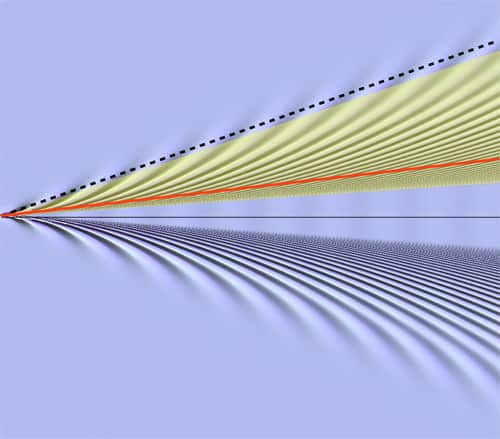
Reawakening the Kelvin wake

By Hamish Johnston

Loyal readers may recall that earlier this year we published a news article entitled “Physicists rethink celebrated Kelvin wake pattern for ships” that reported on work done by two French physicists. While looking at Google Earth images of ships moving through the sea, Marc Rabaud and Frédéric Moisy noticed that some of the wakes did not conform to a prediction made years ago by Lord Kelvin, the renowned Victorian physicist, engineer and entrepreneur.

(more…)

NASA badly hit by government shutdown

NASA headquarters

US citizens woke up this morning to the unbelievable news that their federal government would be shutting down all its “non-essential” services after the two houses of Congress failed to reach an agreement on a new budget. What this means in practice is that hundreds of thousands of federal employees will now face unpaid leave – and NASA’s workforce is among the most badly affected.

A staggering 97% of NASA’s 18,134 employees have been granted leave of absence, according to the Office of Management and Budget, quoted in the New York Times. This is the highest percentage of all the federal departments and agencies to be affected by the shutdown. Other federal workers affected include 94% of the 16,205 employees of the Environmental Protection Agency, along with 69% of the 13,814 working within energy.

“Due to the gov’t shutdown, all public NASA activities/events are cancelled or postponed until further notice. Sorry for the inconvenience,” read a rather understated tweet from NASA earlier today. Within the past few hours, the NASA website has also shutdown indefinitely.

(more…)

Do ultracold neutrons get a kick from nanoparticles?

Physicists in France and Russia claim to have evidence that explains why so-called ultracold neutrons (UCNs) escape their traps. The evidence suggests that the neutrons are being kicked out of the traps by collisions with floating nanoparticles and could help explain discrepancies in measurements of the neutron lifetime. However, not all scientists in the field find the evidence compelling.

UCNs are neutrons that have been cooled to less than 2 mK above absolute zero. At these temperatures the neutrons are moving so slowly that they would easily be overtaken by someone running at a moderate pace. UCNs bounce off most surfaces they come into contact with, regardless of their angle of incidence. This has allowed physicists to trap large numbers of UCNs in oversized “bottles” made of materials such as copper or stainless steel – where the neutrons can be studied. Neutrons experience all four forces – electromagnetism, the weak force, the strong force and gravity – which make them a comprehensive laboratory for tests of the Standard Model of particle physics.

One quantity of great interest is the lifetime of the neutron, which is determined by the weak force. Although neutrons last for billions of years when bound within nuclei, free neutrons are known to decay into protons (with the emission of an electron and an electron-antineutrino) with a half-life of about 10 minutes. A precise value of the half-life is obtained by trapping UCNs in bottles and then counting how many of the particles are left after a certain time interval. Such measurements have been done by several different research groups and their results currently differ by about one second.

Vibrating nanoparticles

Some of the discrepancy could be caused by UCNs leaking from the rims of their bottles. The problem with this explanation is that once inside a bottle, a UCN should not be travelling fast enough to escape the downward pull of gravity. In 1999 physicist Valery Nesvizhevsky at the Institut Laue-Langevin (ILL) in Grenoble, France and colleagues suggested that the UCNs could collide with nanoparticles that are floating within a bottle and vibrating nanoparticles that stuck to the inner surfaces of the bottles. Unlike most collisions with the bottle surfaces, these collisions could give the neutrons enough energy to rise out of the bottle.

Now Nesvizhevsky and colleagues believe they have evidence that this is really the case. The researchers developed a theoretical model to predict the spectrum of UCN energies that would be generated if nanoparticles of different sizes were indeed supplying an extra kick at some surface collisions. Then the researchers looked to confirm their model by doing experiments at ILL, which produces UCNs. The experiment involves a 2-m-tall copper bottle that the team coated on the inside with nanoparticles of a known size distribution. The UCN energy spectra from these experiments appeared to match the theoretical predictions.

“This is indeed an interesting new idea for a possible loss mechanism of UCNs on the surfaces of material traps,” says experimental nuclear physicist Mike Snow at Indiana University Bloomington in the US. He believes Nesvizhevsky and colleagues’ mechanism might need to be taken into account in bottle experiments, although he points out that newer neutron-lifetime experiments are employing magnetic-field traps. These would probably be less susceptible to the mechanism, he says.

Does water do the same?

But not all UCN experts agree that Nesvizhevsky and colleagues’ mechanism is convincing. Stephan Paul and Erwin Gutsmiedl at the Technical University of Munich in Germany told physicsworld.com that they have estimated that water on the bottle walls could also reproduce the findings. “The feeling at present is that there’s no proof the scenario Nesvizhevsky proposes for his observation is the correct one,” says Paul.

Robert Golub at North Carolina State University in Raleigh, US agrees. He points out several potential issues, including that scientists routinely clean the surfaces of their bottles prior to performing experiments, a procedure that would remove any freely floating nanoparticles. If the nanoparticles are being generated on-site, he says, then Nesvichevski and colleagues would have to explain how they are generated. “The hypothesis that surfaces of materials are covered by a 2D gas of floating nanoparticles seems highly unlikely to say the least,” he adds.

The research is published in Crystallography Reports 58 743.

Physics World 2013 Focus on Big Science is out now

By Michael Banks

All eyes will be on Stockholm next week as the 2013 Nobel Prize for Physics is announced. One of the frontrunners for the prize in the minds of the Royal Swedish Academy of Sciences will surely be the discovery last year of the Higgs boson at CERN’s Large Hadron Collider (LHC).

But the LHC story is far from over and in the latest Physics World focus issue on “big science” find out how the LHC will hunt for new particles beyond the Higgs boson once the collider restarts in 2015 following an 18-month repair and upgrade programme at the Geneva-based lab.

All full members of the Institute of Physics will receive a print edition of the focus issue along with their copy of the October issue of Physics World, but everyone can access a free digital edition. The focus issue also looks at how particle physicists are already thinking about what could come after the LHC, with bold plans for a 80–100 km proton–proton collider. There are even plans for a collider based on lasers, with an international team looking at creating an array of “fibre lasers” to be used as a future “Higgs factory”.

(more…)

Copyright © 2026 by IOP Publishing Ltd and individual contributors