

Physicists claim microwave-imaging ‘breakthrough’

Physicists in China say they have made a breakthrough in thermoacoustic imaging that could enable it to be used in hospitals within five years. The technique, which involves firing microwaves at tissue, had previously been considered too dangerous to use on humans, but the researchers have now employed what they say is a safer, nanosecond microwave source.

Thermoacoustic imaging was invented in the early 1980s. The idea is to expose tissue to a microwave pulse, which travels into the tissue until it is absorbed. Exactly how the pulse is absorbed depends on the type of tissue present. When the pulse is absorbed, it does not heat the tissue significantly because it is very short. The energy instead generates a moving deformation, which is an acoustic wave. The profile of this acoustic wave is detected using an array of transducers, and these data are used to create an image of the tissue through which the microwave pulse has passed.

The technique is considered attractive for certain patients, such as those at risk of breast cancer, because it has a higher contrast and is more penetrative than, for example, photoacoustic imaging. However, it has suffered from comparatively poor resolution, and the microwave doses employed hitherto have been considered unsafe for humans. For these reasons the technique has not yet been taken up by medicine.

Shorter, safer pulses boost resolution

Da Xing and colleagues at the South China Normal University in Guangzhou believe that thermoacoustic imaging could be a safe, high-resolution technique with the use of nanosecond microwave pulses. Theory suggests that the shorter the microwave pulse, the shorter the wavelength of the generated acoustic wave, and the higher the resolution. In addition, a shorter pulse reduces the exposure of tissue to harmful microwaves. The researchers’ breakthrough is to have developed such a nanosecond microwave source and apply it to thermoacoustics.

It’s great to see new applications of microwave technology finding their way to the biomedical-research community
Russell Witte, University of Arizona

“One obstacle in this area has been the difficulty getting access to cutting-edge pulsed-microwave technology, which has either been very expensive or highly classified in the US for many years,” says biomedical engineer Russell Witte at the University of Arizona at Tucson, US, who was not involved with the work. “So, it’s great to see new applications of microwave technology finding their way to the biomedical-research community.”

Xing and colleagues’ microwave source is based around a Tesla coil – a type of electrical transformer that can generate a high-voltage discharge. The researchers collect this discharge at a coiled antenna, which generates a microwave pulse of just a few nanoseconds’ duration. The subsequent microwave dosage, the researchers claim, is some 100 times lower than the safety standards set by the American National Standards Institute.

Tested on gelatin

The Chinese group tested the microwave source on samples consisting of copper wires, and rings made of gelatin. They found that they could image the samples at a resolution of 100 μm, which is five times better than previous thermoacoustic imaging devices. “Our device opens up exciting opportunities for non-invasive, high-resolution clinical thermoacoustic imaging,” says Xing.

Group member Cunguang Lou adds that, with suitable transducers for detection, the source could allow thermoacoustic imaging to be performed in real time, which has not been done before. “We can predict that thermoacoustic imaging will be used to image actual patients within five years,” he says.

“The scarcity of short-pulsed microwave sources has been a major bottleneck in the development of microwave-induced thermoacoustic tomography, which has the potential to image human bodies without using harmful X-rays or other ionizing radiation,” says biomedical engineer Lihong Wang at Washington University in St Louis, Missouri. He adds: “The development of this new microwave source will propel the growth of microwave-induced thermoacoustic tomography, especially toward microscopic imaging.”

The research is published in Physical Review Letters.
Cosmology, particle physics – and love

The LHCb team

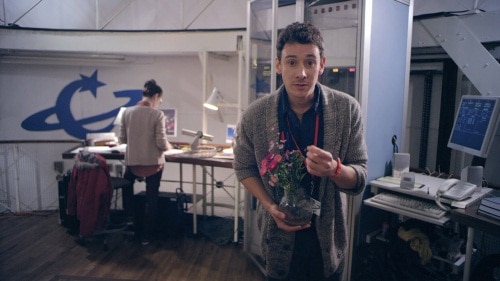
Still from the upcoming short film The Theory of Everything. (Courtesy: Catsnake)

By Matin Durrani

The e-mail arrived out of the blue last week. Did I want to attend a “private screening” in Covent Garden, London, of a new short film about cosmology, particle physics and love?

It sounded interesting, particularly when writer/producer Stephen Follows from Catsnake said that he had made the film with “some of the world’s leading dark-matter physicists, both at Imperial College and at CERN”.

I was even more intrigued when Follows added that the film had been funded by the Lovestruck dating agency as a promotional tool – apparently, the company was happy for him to make any film he liked, so long as it featured love somewhere along the line.

Follows took for inspiration the book The 4% Universe by the US science writer Richard Panek, which he had just been reading and which incidentally was second in Physics World‘s top 10 books of 2011. The title refers to the fact that “normal” matter makes up only 4% of the universe – the rest being dark matter (23%) and dark energy (73%).

What intrigued me was how exactly love could be brought into a story about cosmology.

Entitled The Theory of Everything, the film will be released online in early December so I won’t spoil the plot, such as it is. But suffice to say, the five-minute professionally produced film draws a parallel between the search for love and the search for dark matter. You know both are there even if you can’t see either for real. Love affects everyone just as dark matter and dark energy affect the universe.

If you think that sounds cheesy, well it could have been – in the wrong hands – but I was impressed with the film. It packs in a surprising amount of “real” science, which was accurate too, thanks to Imperial cosmologist Roberto Trotta, who acted as informal script adviser.

Visually, I liked the way the film tried to explain the expanding universe through the main character – an astronomer – dropping a jar of chocolate Smarties onto a table and showing them scatter in all directions. There’s also a nice touch where he uses the stem of a bunch of flowers as a measuring stick, snipping off the final 4% of the tip to illustrate just how small a fraction of the universe we really understand.

Both Follows and Trotta hope the film, which was made at an observatory in Mill Hill, London, reveals the human side of science. As Trotta told the audience before the screening, “There’s so much more to science and to creativity in science than meets the eye.”

Follows envisages the film being just the first in a series of projects carried out in partnership with Imperial. It will be released on YouTube and promoted on the London Underground and Facebook.

If you want some cosmic action before then, do check out our own film about a group of students trying to detect cosmic rays on a hot-air balloon.

Ultralight fractal structures could bear heavy loads

A team of researchers in Europe has shown that the density of large structures can be dramatically reduced, if they are designed using a fractal pattern. The researchers have worked out a way to calculate an optimal “hierarchal structure” built from a certain material so that it can withstand a given load. They claim that using such techniques could help in building highly efficient load-bearing structures that could be used in solar sails, cranes or other lightweight-yet-strong constructs.

A fractal is an object or a structure that is self-similar on all length scales. Fractal patterns are seen in nature at all scales – everything from a single fern leaf that resembles the entire plant, to clouds, snowflakes, blood vessels and cauliflowers shows a fractal pattern. A particular example that inspired this latest work is trabecular bone – the “spongy” bone that is found near joints in the human body. This bone has a sponge-like network of fibres that have a pseudo-fractal pattern, whereby the pattern is almost self-similar across a few scales. This makes the bone strong but light and capable of providing the necessary strength and stiffness.

Build and repeat

A hierarchical pattern – where the same base structure is repeatedly used at different length scales – is already used in architecture to build many large-scale structures. The Eiffel tower or large cranes are good examples of such structures, but such fractal patterns are used in architecture in a rather ad hoc manner, according to the researchers. Now, Yong Mao of the University of Nottingham, UK and colleagues have developed a theoretical framework for building structures where the optimal hierarchical order of the structure depends on the load it needs to withstand. Using this technique, the team constructed such a structure – a simple frame – from a polymeric resin, using a “rapid prototyping technique” – which is an advanced form of 3D printing.

For the first element in their structure, Mao and colleagues simply construct a hollow beam, which they refer to as the “generation-0” element. Different values of thickness and radii of the beam are considered, so that the strongest beam can be built, with the least amount of material. The robustness of this beam is then tested by applying a load along its length and along its axis, to see if it fails across either. “We do this to analyse the failure modes at each local level, so that the structure is not unnecessarily strong at each level…we optimize for what properties are necessary,” says Mao. He explains this further by saying that if a 50 kg table balanced on hollow steel legs it would be about 10 times lighter than one with solid steel legs and just as robust.

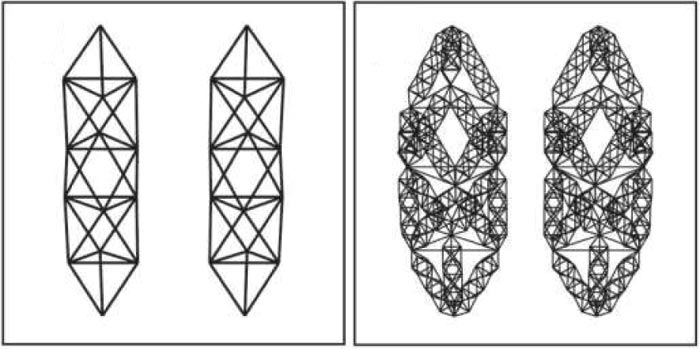
The next step, or “generation-1” structure, is a similar beam on a larger length scale. It is made up of the individual generation-0 beams in a triangular framework (see figure above, left). The generation-2 structure is then made by replacing each beam in the generation-1 structure with a full-scale version of itself, all assembled into a larger triangular frame. This can be repeated for one more level – a generation-3 element – and calculations show that the more hierarchical levels used, the less material that is needed to support a given load.

Strong structures

The team designed a number of different structures. It found, for example, that a crane boom made from generation-1 structures would be 100 times lighter than one made from solid steel. Another more fanciful application would be to use the technique to build the boom of a solar sail. These are large-scale structures in space that, in the future, could harvest solar radiation. The theoretical design for such sails involves booms that would be almost 100 m in length, but only need to be strong enough to withstand solar-radiation pressure. In this case, a steel generation-3 structure would be 10,000 times lighter than a solid beam.

3D printing

A drawback of this kind of fabrication is that imperfections could cause serious problems. “Even a small imperfection at a local scale could have a large impact as there is no extra material that could take the added stress and maybe that is why this kind of fabrication has not been practical to date,” explains Mao, who says that the team is also studying its models to better allow for such errors. But he is convinced that commercial techniques will improve over the coming year, providing the necessary precision tools. Mao also feels that the recently commercialized technique of 3D printing could really benefit the fabrication of these structures. “We could just upload our deferent designs to a program and people could download and print off the structures at home,” he says.

“In theory, a fractal would involve infinite number of generations…but that said, the same kind of complexity could be achieved in the future by assembling more and more generations,” says Mario Castro from Comillas Pontifical University in Spain, who was not involved with the work. “It would have been very intriguing if they had found a way in which these multiple-scale structures would have assembled by self-organization, as it happens in nature, but I think the work is really interesting.”

The work is published in Physical Review Letters.
Prize-worthy books, part 1

By Margaret Harris

Last night’s awards ceremony for the 2012 Royal Society Winton Prize for Science Books highlighted the diversity of modern science writing, with six very different books competing for the prestigious £10,000 award.

Two of the shortlisted authors, James Gleick and Brian Greene, are well known in the physics community thanks to their earlier bestsellers on (respectively) chaos theory and string theory. However, they were not the only heavyweights competing, with Gleick’s book The Information and Greene’s The Hidden Reality up against Joshua Foer’s Moonwalking With Einstein; Lone Frank’s My Beautiful Genome; Stephen Pinker’s The Better Angels of Our Nature; and Nathan Wolfe’s The Viral Storm. For those of you keeping track, that’s one book about information theory; one about multiple universes; one about the science of memory; one about genomics; one on the psychology of conflict; and one on emerging infectious diseases. Whew!

The ceremony’s host, comedian Ben Miller, began by riffing on some of the year’s big scientific events, including the summer’s (probable) discovery of the Higgs boson at CERN and the recent (rumoured) discovery of methane on Mars. The biggest laugh of the evening came later, though, when Miller was interviewing Dame Jocelyn Bell Burnell, one of five judges for the award. After Miller complained that studying science at school hadn’t offered him much in the way of “social lubrication”, Bell Burnell’s response was a deadpan, “Try being a female physicist!”

The bulk of the evening, however, belonged to the shortlisted authors themselves. After reading brief passages from their books, five of the authors (Wolfe was unable to attend) joined Miller onstage for a panel discussion, fielding questions about their books and the role of science communication. For me, this was a highlight of the evening; aside from The Hidden Reality, which was on Physics World‘s list of the “best physics books of 2011”, I hadn’t read any of the shortlisted books, so it was great to learn a little more about each of them.

In his speech announcing the prize, Royal Society president Sir Paul Nurse hailed the recent “renaissance” in science writing, adding that the shortlisted books were “all great contributions to that tradition”. But there could only be one winner – and it was James Gleick’s The Information, which the judges praised as an “audacious book” offering “remarkable insight” into how information is used, transmitted and stored. Gleick seemed genuinely surprised, thanking “all the very smart people who have helped me over the years” before being bundled into a live TV interview with Channel Four News.

(more…)

Quantum-dot photodetector offers short cut for electrons

A new type of ultrafast and highly efficient photodetector containing quantum-dot junctions has been developed by researchers at Delft University in the Netherlands. The device dispenses with the conventional thin-film architecture currently employed in such photodetectors and could come in handy for a range of applications, including biological imaging and perhaps even photovoltaic cells.

Quantum dots are promising materials for making photodetectors because they are strong absorbers of light. Thin films of quantum dots can be readily manufactured from solution – a non-negligible advantage in creating low-cost devices. In a conventional quantum-dot photodetector, light is absorbed in such thin films to create free charges that then must reach electrodes in the device to produce a signal.

The problem is that the film of nanometre-sized particles is a very granular structure that contains numerous barriers and defects. These barriers slow down charge carriers in the device, so reducing the response time of the detector. The charge carriers can also become trapped at the barriers, something that greatly reduces the efficiency of the device.

Carefully placed dots

A team led by Herre van der Zant may now have come up with an answer to this problem – by getting rid of the thin-film-based architecture altogether. The researchers instead place each quantum dot in the device in direct contact with both source and drain electrodes so that the charges can then be extracted directly and quickly.

The main challenge in this work, explains team member Ferry Prins, was to create planar electrodes that were separated by only a few nanometres – a distance small enough for single quantum dots to bridge. The researchers achieved this using a technique called self-alignment.

“The trick was to use a natural oxide layer a few nanometres thick to ‘protect’ the first electrode,” he says. “Next, we deposited the second electrode directly against the first and selectively removed the oxide layer with an etchant, so exposing the nanometre-sized gap between the two electrodes.” The last step simply involved dipping the device into a solution of quantum dots followed by a brief chemical treatment to ensure good contact between the nanodots and the electrodes. Placing the dots in direct contact with the electrodes greatly speeds up charge extraction in the device, according to Prins.

Good signals

Despite its small size, the photodetector is still able to generate very good signals. This means that it can be integrated into devices with a much higher density than can thin-film detectors. “One potential application for the device is ultrahigh-density CCDs,” adds Prins, “and the extremely fast response time of the detector will also allow for shorter acquisition times, which is something that could be important for biological-imaging applications.”

In addition to photodetection, quantum-dot devices are showing promising results as photovoltaic cells. This is because single, high-energy photons hitting such a photovoltaic material can produce excited electrons or holes that have energies at least equal to or greater than the band gap of the quantum dot. Electrons with an energy exceeding twice the band gap can transfer their excess energy to one or more valence electrons and excite them across the quantum dots’ band gap, which leads to several excitons (electron–hole pairs) being produced for every photon absorbed. This process could help significantly increase the power conversion of solar cells.

“If our device was able to generate power at the nanoscale, this would be of great importance,” says Prins. “Creating a built-in potential in such nanodevices will be a technical challenge, but we already have some ideas that might work,” he reveals.

The device is described in Nano Letters.

Tiny sensor measures mass and temperature

A new type of thin-film acoustic-wave resonator that is capable of simultaneously measuring mass as well as temperature has been unveiled by an international team of researchers. It allows users to correct for temperature changes that affect the sensor as it measures mass – something that has prevented acoustic-wave sensors from being used as practical mass sensors outside of controlled laboratory conditions. The new device has applications in healthcare, environmental monitoring and the telecommunications industry, according to the team.

Over the past few years, researchers have been keen to develop microresonators, especially for gravimetric sensing to measure changes in mass in a system. Microscale sensors that are built from high-frequency bulk-acoustic-wave (BAW) resonators consist of a piezoelectric layer sandwiched between two electrodes, to which a variable-frequency signal is applied. The resonator vibrates at a given frequency, and the properties of the resulting acoustic wave allow researchers to determine what is occurring in the environment – a change in the acoustic wave being measured denotes a change of mass that occurs when an object of interest is absorbed into the resonant surface.

Sense and sensitivity

But the major hurdle in using BAWs for these commercial applications is that they are very sensitive to temperature. A change in temperature causes a change in the acoustic wave and it is impossible to work out if the change is a response to the mass actually being measured or a temperature variation. Because of this, the sensors are currently only used in the laboratory, where all conditions, including temperature, can be strictly monitored and controlled.

In the past, many research groups have tried to eliminate the effect that a change in temperature has on the sensor, but have failed. The changes are nonlinear and so can only be minimized and never completely eliminated, explains Luis Garcia-Gancedo of Cambridge University in the UK. Instead, what Garcia-Gancedo and colleagues have done is to live with the changes in temperature and account for them. “We decided to measure both the mass and the temperature each time we measure the mass, so that we can then eliminate the effects of the temperature if we wish,” explains Garcia-Gancedo.

Resonances and responses

The team designed a new type of thin-film bulk-acoustic-wave resonator that allows simultaneous measurement of temperature and mass-loading measurements in a single device. The new sensor is a multilayered device that has two fundamental frequencies of resonance, which react differently to mass and temperature changes. An extra layer of passive material is added underneath the piezoelectric material and this passive layer generates the second resonance.

Garcia-Gancedo explains that if only a change in mass occurs, then both resonances remain passive and only the mass is measured. But, if a change in temperature occurs as well as a change in mass, one resonance shows a positive frequency shift with a temperature rise, while the second shows a negative frequency shift for the same temperature variation. Simply put, one resonance increases while the other decreases. So, by simultaneously measuring both resonances, any change in frequency can be expressed as a combination of a mass-load component and a temperature-change component.

“This has two consequences,” says Garcia-Gancedo. “First, we are able to eliminate the effects of temperature completely, regardless of its nonlinearity. Second, we are able to measure mass and temperature with extremely high sensitivity at exactly the same location, which we have not been able to do before.” He explains that this proved to be useful, as many biological interactions are temperature dependent and having the extra information about the temperature measurement is therefore an added bonus.

Detecting viruses

Garcia-Gancedo also points out that the new device is not bulky and has the same electronics as most existing sensors. As a result, it can easily be integrated with existing technologies. While the researchers have not done this yet, they have successfully used the resonator as a biosensor to detect proteins in a sample at a very low concentration, thereby proving its sensitivity.

In the future, the team hopes to use its device specifically for biological systems and physical sensing. Because of their sensitivity and size, the resonators could play a crucial part in the healthcare industry or in environmental monitoring. The microresonator can be easily embedded into small medical devices and can detect masses as small as 10–15 grams – the approximate mass of a virus. It could also detect contaminated water or measure air quality. The researchers, along with commercialization specialists Cambridge Enterprise, are currently seeking commercial partners to develop these technologies.

The research is published in Biosensors and Bioelectronics.

Physicists riff on the Hadron Collider Physics conference

By Hamish Johnston

In the spirit of a post-match analysis down the pub, this video features particle physicists Aidan Randle-Conde and Seth Zenz discussing the latest Higgs results that were presented last week at the Hadron Collider Physics conference in Kyoto, Japan.

The video looks as if it was filmed on a particularly gloomy day in Geneva and also features a chirping bird, the occasional aeroplane and somebody talking on their mobile phone. It’s 19 minutes long and jam-packed with analysis of all the relevant Higgs decay channels – so pop the headphones on and enjoy.

Smart cloak deforms to keep objects invisible

An adaptable “invisibility cloak” that hides objects even as they change shape has been unveiled by researchers in the US and South Korea. The metamaterial-based design works within a range of microwave frequencies and remains insensitive to changes in shape of up to 8 mm. This marks a significant departure from traditional cloaks, which have to be redesigned to compensate for even small changes in the shape of an object. In addition, the new device covers a larger relative range of frequencies than has been achieved with previous cloaks.

Most invisibility cloaks take advantage of the strange properties of metamaterials – collections of structures that are assembled so that they interact with electromagnetic radiation in very specific ways. One useful property of some metamaterials is that they can be used to guide radiation smoothly around an object in much the same way that water flows around a stone in the middle of a river. For a cloak working in the visible portion of the electromagnetic spectrum, our eyes would only detect light that appears to have travelled in a straight line from the space behind the cloaked object, rather than as having travelled around it. Therefore the object would appear invisible.

The practical challenge is designing a cloak with optical properties that change as a function of position so that the device guides a ray of light in precisely the correct way. To do this, physicists have developed a mathematical tool called transformation optics, which “transforms” space in such a way as to make an object disappear in a manner analogous to the coordinate transformations that occur under gravity in general relativity. Using transformation optics and metamaterials, scientists have made real cloaks the work under certain conditions – and mostly in the microwave part of the electromagnetic spectrum.

Shape-shifting design

Existing cloaks are designed to hide an object with a specific shape. If the shape changes, then the coordinate transformation – and therefore the electromagnetic properties – of the cloak must also change. One solution to this problem is to make a “smart” metamaterial that changes its electromagnetic properties in just the right way when its shape changes. That is just what researchers at Yonsei University in Seoul and Duke University in North Carolina have done.

The team’s elastic metamaterial deforms around the object to be cloaked and alters its electromagnetic properties so that even if the object changed shape slightly, it would still remain cloaked. This imposes an extra constraint on the metamaterial – in addition to having the appropriate electromagnetic properties, it must also have favourable mechanical properties.

Computer modelling done by the team revealed that the ideal material would have a negative Poisson’s ratio, which would mean that it gets thicker instead of thinner when stretched. However, “such materials are very rare”, explains team member Kyoungsik Kim. Indeed, the researchers were not able to create the ideal metamaterial with the requisite mechanical and electromagnetic properties.

Elegant compromise

Kim and colleagues did, however, find an elegant compromise. They fabricated a lattice of flexible silicon rubber tubes filled with air. The tubes had outer diameters of 10 mm and walls 1 mm thick, and they were closely packed to form a square-lattice structure. The team found that this metamaterial came very close to having the desired properties and was able to cloak objects from microwaves in the 10–12 GHz frequency range. In addition, such a structure would be cheap to produce on a large scale.

Ortwin Hess at Imperial College London is impressed, commenting that the broadband nature of the cloak alone would be newsworthy. “The fact that one has a broadband cloak is a very remarkable and good demonstration,” he says. “Recently there have been some demonstrations that are more broadband than the initial ones, but here the bandwidth [10–12 GHz] is quite remarkable. The second remarkable element is the fact that the cloaking was achieved while moving the structure.”

Kim’s group is hoping to try to use the innovations to develop a more broadband, flexible cloak for optical frequencies. He says, however, that he is under no illusions that this will be easy.

The research is published in Nature Communications.

Paul Frampton hit by 56-month drugs sentence

Paul Frampton, the particle physicist from the University of North Carolina (UNC), has been sentenced to four years and eight months in detention after being found guilty of drug-smuggling charges. Frampton, 68, was arrested at Buenos Aires airport on 23 January after authorities found 2 kg of cocaine in his checked luggage – drugs that he insists were not his. He was convicted on 21 November by a judge at a court in Buenos Aires after three days of hearings.

Frampton, a British-born US citizen with a DPhil from the University of Oxford, got into trouble after flying from North Carolina to Bolivia where he was expecting to meet 32-year-old Czech-born lingerie model Denise Milani, who he thought he had been chatting with on the internet. Frampton says he was instead met by a man who asked him to take what was supposedly Milani’s suitcase to Buenos Aires, where she would then meet him.

When Milani did not turn up – and there has been no suggestion that she knew her persona was being used – Frampton then tried to board a plane back to the US but was arrested after airport-security officials discovered the cocaine inside a false lining of the suitcase. Frampton claimed that he was innocent of the drug-smuggling charges, which carry a maximum sentence of 16 years, insisting that the cocaine was built into the luggage without his knowledge.

State of shock

After his arrest, Frampton spent 282 days languishing in Buenos Aires’ notorious Villa Devoto prison. Despite facing health issues while locked up, he continued to supervise his two current PhD students by phone and even posted preprints on arXiv – adding “University Center of Devoto” to his affiliation – and refereed journal articles. By the end of October, there was a sliver of hope as Frampton was released from jail early and placed under house arrest after his lawyers persuaded a judge that his respiratory condition was worsening.

Now that he has been convicted it is not clear whether Frampton will spend the remaining sentence in prison or under house arrest. “As you might imagine I am in a state of shock and disbelief,” Frampton told the North Carolina News & Observer after the conviction. “This is a gross miscarriage of justice. If this had happened in the US a jury would have obviously acquitted me.”

According to the News & Observer, during the three-day trial, a prosecutor showed the court calculations – made in Frampton’s handwriting – of the drugs’ value. The prosecution also presented texts and e-mails Frampton thought he was sending to Milani the day before his arrest, which apparently said he was “worried about the sniffer dogs” and that he was “looking after [the] special little suitcase”.

Coming out in support

Earlier this year a group of physicists set up a website – helppaulframpton.org– to support Frampton’s case and raise money for lawyer fees. Around a dozen physicists also submitted separate character references for Frampton and more than 80 people, including Nobel laureate Sheldon Glashow, signed an open letter to the UNC faculty in support of Frampton and the reinstating of his $106,835 salary, which has been stopped by the university. Indeed, a few weeks before he was sentenced, Frampton had claimed that his salary should be doubled based on his citation record and how much fellow highly cited physicists are remunerated.

It is not clear whether Frampton will appeal the sentence or what action the UNC will now take. Frampton will have the option of applying for deportation back to the US in 2014.

Students take cosmic-ray balloon challenge

Everyone talks about the importance of getting young people interested in physics, but there can be no better way of doing this than to give school students a real project with a real deadline. So well done to David Cussans, a particle physicist at the University of Bristol in the UK, who encouraged a group of local school pupils to build an instrument than can detect cosmic rays – and then challenged the students to have their kit ready to fly aboard a hot-air balloon at this year’s Bristol International Balloon Fiesta. The event marked the centenary of Victor Hess’s discovery of cosmic rays, in a balloon, in 1912.

To find out if the students pulled off the challenge, Physics World went along to the fiesta with a film crew to record what happened as the balloons took off.

Copyright © 2026 by IOP Publishing Ltd and individual contributors