Between the lines: Christmas special

Cartoon of poor communication and photo of magpie

Geeks of the Earth, unite

Are you bothered by misleading science stories in the media? Annoyed when political leaders confuse particle physicists and physicians (ahem, David Cameron)? Irate at ministers who select policies, then cast about for “evidence” to support them? Then according to Mark Henderson, it is time you stopped shouting at the television and started doing something. With The Geek Manifesto, Henderson – a former science editor at The Times newspaper – has produced a rare beast: a polemical book that offers solutions as well as rhetoric. One of the book’s main arguments is that scientists should take it upon themselves to become more engaged in the political process. As one of Henderson’s interviewees puts it in the book, “Scientists tend to feel that politics is something that happens to them, not something they can influence.” In fact, if scientists are prepared to make the first move, they may find politicians more receptive than they had assumed. Henderson does not, however, advocate asking politicians point-blank questions about science and using their replies as a “litmus test” for geek support. In a statement sure to provoke spluttering fury among a few Physics World readers, he suggests that a politician who can answer the question “What have you been wrong about?” may have a better understanding of science than one who can remember Newton’s laws of motion. A minister who reconsiders policies in light of new evidence, and abandons ones that fail, Henderson argues, is following the scientific method. For that, they deserve a bit of geek support, even if they lack formal scientific training. The book has a heavily British slant, and it certainly seems to have struck a chord among the nation’s geeks. Last summer, a campaign to send The Geek Manifesto to MPs raised enough money to buy copies for all 650 members of the House of Commons – though it helped that Henderson’s publisher, recognizing a golden publicity opportunity, stumped up some matching funds. Still, “geek power” remains a limited force, as demonstrated by the fate of Eureka magazine, which Henderson helped to launch as a monthly science supplement to The Times back in 2009. In the book, Henderson often touts Eureka as evidence of growing geek power, noting that the magazine is “chock-full of high-value advertisers who want to reach its readers”. Unfortunately, Eureka was canned in October – apparently due to, erm, poor advertising revenues. The geek movement, it appears, still has a long way to go.

  • 2012 Bantam Press £18.99hb 336pp

Into the magpie’s nest

As its name suggests, The Science Magpie is a panoply of scientific curiosities, plucked from the length and breadth of contemporary science as if by a curious and acquisitive bird. The “bird”, in this case, is a publisher-turned-trainee-teacher called Simon Flynn, who has gathered anecdotes, poems, jokes, facts and the odd diary entry or letter-to-the-editor, and put them together in no particular order to form a delightful little compendium of science oddities. The book includes some fairly well-known science trivia, including tales about Euler’s identity, Occam’s razor, Faraday’s Christmas lectures, Tom Lehrer’s song about “The Elements” and the Large Hadron Collider rap. But Flynn has also found some more obscure gems. A good example is Darwin’s diary entry, written when he was 29 years old, on the pros and cons of marriage. “Less money for books” was one particularly amusing “con”, while “charms of music and female chit-chat” was a “pro”. Another fascinating but gruesome story features the young Isaac Newton suffering for his science. As Flynn writes, during Newton’s studies of colour, “he talks of inserting a bodkin (like a cross between an arrow and a needle) between his eye and his socket as near to the back of the eye as possible. He would then press so as to change the retina’s curvature resulting in his seeing ‘white and darke and coloured circles’ as he continued to vary the pressure and movement”. Also in the book are questions from an 1858 Cambridge science exam for 15 year olds, mnemonics for remembering the geological timescale and the planets of our solar system, a little refresher on determining prime numbers and a handy list of the “10 greatest ever equations”. There is even a list containing the Scrabble scores of some common scientific words. On the whole, The Science Magpie is an easy and enjoyable read, and it will surely give you a host of new jokes and tales for the pub.

  • 2012 Icon Books £12.99hb 278pp
Photo of woman with ponytail and photo of many light bulbs

Improbable fun

Most readers will have heard of the Ig Nobel Prizes, which are given annually to honour research that, in the words of Ig impresario Marc Abrahams, “first makes people laugh, and then makes them think”. This year’s physics Ig Nobel, for example, honoured an Anglo-American trio of researchers who calculated the balance of forces in human ponytails (March p3). Ceremonies for Ig Nobel winners have been held every year since 1991, and Abrahams has been publishing other examples of semi-silly science in his magazine, the Annals of Improbable Research, since 1995. But oddly enough, he has never grouped these tales together in book form – until now. This is Improbable: Cheese String Theory, Magnetic Chickens, and other WTF Research rehashes a number of past Ig Nobel citations, but delightfully, it also shows that such prize-winning research is the tip of an enormous iceberg. The economics of piracy, the lavatory habits of Antarctic researchers and the anti-skid benefits of wearing socks over shoes – all are described in glorious detail, with copious references to the original papers. As one might expect, many of these papers were published in obscure journals, but there are some surprising exceptions: the aforementioned ponytail research appeared in Physical Review Letters, while the case of a biologist who accidentally incubated more than 70 insects in his left sinus was published in Science. Maybe that one should have been billed as research that “first makes you laugh, and then makes you wince”.

  • 2012 Oneworld £10.99/$15.95pb 320pp

Stand-up science

Actor and comedian Ben Miller is best known for being half of the comic duo “Armstrong and Miller” and for his other roles in film and television. What many do not realize, though, is that Miller was working on a physics PhD at Cambridge when, in his words, he “accidentally became a comedian”. In his new book It’s Not Rocket Science, Miller makes a partial return to his roots by focusing on the exciting bits of science, while avoiding complex maths and calculations. “If you want to build a Large Hadron Collider, you’d better hunker down and get a physics postdoc,” he writes. “If you want to gawp at one and imagine how cool it would be if one blew up…Well, you’ve come to the right place.” In the book, Miller covers a wide, if rather random-seeming, range of contemporary science ideas and subjects. After visiting CERN and whizzing through the Standard Model, he trips along the Milky Way while telling the reader that we are “slowly falling into an enormous black hole” that resides at the centre of our galaxy. He then dips into Darwin and evolution, and follows that thread to the intriguing science of genetics and DNA. A surprising chapter looks into cookery and the chemistry behind it – including the history of food and taste – and also contains a deeper examination of enzymes and molecular interactions that give distinct flavours. The book touches as well on the changing environment of Earth, weather prediction and the complex beast that is climate change, before ending with a look at the dynamics of heavenly bodies, space travel and – of course – aliens. If you are looking for a complete, in-depth view of contemporary science, this is not the book for you, since It’s Not Rocket Science was written mainly to entertain, not to inform. As Miller puts it, “This is not a science lesson. It’s a science orgy.” Still, you might learn something new along the way, without even trying.

  • 2012 Sphere £12.99pb 280pp

The puzzles of daily life

We all know that everyday physical intuition is essentially useless for predicting the workings of the quantum-mechanical world. But as it turns out, intuition is not necessarily reliable even when it is applied to objects on a more familiar, macroscopic scale. Between 2003 and 2011 physicist Jo Hermans explored the complex and often counterintuitive nature of ordinary things via a series of columns in Europhysics News, the magazine of the European Physical Society. Now, these “Physics in Daily Life” columns have been published together in a book of the same name, complete with charming cartoon illustrations by Wiebke Drenckhan. Many of the collected columns begin with an incorrect “layman’s view” of a question. A good example is number 22, in which Hermans asks how many lights could be switched on with the energy required for a nice relaxing hot bath. The answer turns out to be around 1000 – far more than a physics-ignorant guesser might assume, although it doesn’t help that Hermans never specifies how long those lights could stay on. In other chapters, though, the much-abused “layman” turns out to be right. For instance, dark-coloured doors really do get hotter in sunlight than light-painted ones (number 15), even though a more sophisticated (but ultimately incorrect) reasoner might suggest that colour ought not to matter because “a surface that absorbs well must also emit well”. Hermans does a fair job of untangling all these conflicting assumptions and fragments of intuition, and the resulting clear, concise explanations are well worth reading.

  • 2012 EDP Sciences €18pb 112pp

Light bends itself round corners

Five years ago physicists showed that certain kinds of laser beam can follow curved trajectories in free space. Such counterintuitive behaviour could have a number of applications, from manipulating nanoparticles to destroying hard-to-reach tumours. But before this bizarre effect could be put to good use, researchers were faced with the challenge of how to bend the light through large enough angles to be useful. Now, two independent teams have solved this problem – and claim that the bending of sound and other kinds of waves could be next.

The concept of self-bending light was inspired by quantum mechanics and the realization in 1979 by Michael Berry and Nandor Balazs that the Schrödinger equation could support “Airy” wavepackets of particles, which accelerate without an external force. Then in 2007, Demetrios Christodoulides and colleagues at the University of Central Florida created the optical equivalent of an Airy wavepacket. This is possible because the equation describing paraxial beams – beams in which the constituent rays all travel almost parallel to the direction of the beam’s propagation – is mathematically identical to the Schrödinger equation once several parameters are interchanged, such as mass and refractive index.

The Florida team generated a specially shaped laser beam that could self-accelerate, or bend, sideways. The researchers did not bend the laser beam as a whole but rather the high-intensity regions within it. To do this they passed a centimetre-wide ordinary laser beam through a device known as a spatial light modulator that adjusted the phase of the beam at thousands of points across its width. Rather than acting like a lens and focusing all of the beam’s constituent rays to a single point, the modulator instead changed the relative phase of the rays such that their interference produced a region of maximum intensity that curved sideways in the shape of a gentle parabola across the beam as it propagated forward, along with a number of fainter regions on one side.

Intriguing characteristics

In addition to this self-bending, the beam’s intensity pattern also has a couple of other intriguing characteristics. One is that it is non-diffracting, which means that the width of each intensity region does not appreciably increase as the beam travels forwards. This is unlike a normal beam – even a tightly collimated laser beam – which spreads as it propagates. The other unusual property is that of self-healing. This means that if part of the beam is blocked by opaque objects, then any disruptions to the beam’s intensity pattern could gradually recover as the beam travels forward.

A limitation of the Florida work, however, is that Airy beams can only be bent through relatively small angles up to about 15 degrees. This means that they cannot provide the sharp turns needed for manipulation on the micron or nanometre scale.

But then in April this year, Mordechai Segev and colleagues at the Technion-Israel Institute of Technology derived a set of general solutions to Maxwell’s equations showing that a non-diffracting non-paraxial beam should exist and that it should accelerate in a circle. A month later, two teams produced such beams in the lab – each bending light a 60-degree arc. One team was led by Xiang Zhang of the University of California, Berkeley in the US and the other by John Dudley of the University of Franche-Comte in France.

Not just circular motion

Now, two independent teams have shown, both theoretically and experimentally, that non-paraxial acceleration along trajectories other than a circle is possible. One group is led by Berkeley’s Zhang and it studied both elliptical and parabolic motions via analytical and numerical 2D scalar analysis. The other team is led by Florida’s Christodoulides and it considered elliptical motion using numerical 3D vector analysis. In the experiments, both groups used continuous-wave lasers, with a wavelength of 532 nm for Zhang’s group and 633 nm for Christodoulides’ group, shining them through spatial light modulators with phase variation calculated using special computer programs. In both cases, the groups were also able to bend the light through about 60 degrees.

According to Berkeley group member Peng Zhang, these latest studies could lead to a number of practical applications. These include particle manipulation and the burning of curved channels through air to guide plasmas for remote sensing. He also says they could be useful in medicine, allowing doctors, for example, to image or destroy a tumour behind an organ without destroying that organ. “The self-healing of the beam would be very useful,” he adds, “because it would allow you to send energy deep into tissue even with obstacles in the way.”

In addition, Xiang Zhang says that the approach can be generalized to any other kind of wave system, such as matter waves, electron waves or acoustics. In fact, he points out, his group is investigating the bending of sound waves. He believes that it should be possible to transport sound energy around corners by manipulating the phase of acoustic waves with a device equivalent to a spatial light modulator.

Ingenious, but not new?

Jérôme Kasparian of the University of Geneva in Switzerland, who was not involved in the latest work, is enthusiastic, explaining that the two groups have “elaborated a general framework to describe and therefore predict” large-angle bending of light. However, Michael Berry of Bristol University in the UK, is less so. He believes that the authors do not make it clear that in their experiments they are not bending light rays themselves but the rays’ envelopes, or “caustics”. “The technical details in these papers are ingenious and interesting to specialists, and I hope the renewed emphasis will lead to applications,” he says. “But while the papers are technically interesting, they are unsurprising because they contain no fundamental new idea.”

The research is described in two papers published in Physical Review Letters.

Complex 3D nanostructures built using DNA bricks

A new technique to make highly complex 3D nanostructures by assembling together synthetic DNA “bricks” has been developed by researchers at Harvard University in the US. The bricks, which are like tiny pieces of LEGO, can be assembled into a wide variety of shapes and configurations, meaning that they can be used to build elaborately designed nanostructures. The resulting structures might find use in a wide variety of applications, including smart medical devices for targeted drug delivery in the body, programmable imaging probes and even in the manufacture of speedier and more powerful computer-chip circuits.

DNA nanotechnology has now been around for nearly 30 years, but it really took off with the advent of a technique called DNA “origami”. This technique, named after the ancient Japanese art of paper folding and first developed in 2006 by Paul Rothemund at the California Institute of Technology, involves folding long strands of DNA into a wide range of predetermined shapes. The resulting nanostructures can be used as scaffolding or as miniature circuit boards for precisely assembling components such as carbon nanotubes and nanowires.

Powerful though it is for making both 2D and 3D shapes, DNA origami has its limitations. To fold the DNA, several hundred “staples” must be added to the regions surrounding the single DNA strands, and each type of new nanostructure desired requires a new set of staples. Moreover, the DNA structures tend to arrange themselves randomly onto a substrate surface, which makes it difficult to integrate them into electronic circuits afterwards.

Building bricks

A team led by Peng Yin at Harvard first put forward its DNA-brick self-assembly technique earlier this year. Rather than starting with long DNA strands, the researchers succeeded in interlocking short, synthetic strands of DNA together to make larger structures. In fact, they managed to arrange the short strands into a “molecular canvas” by controlling the local interactions between the strands. The technique, like any DNA self-assembly method, works by exploiting the fact that the four base pairs in DNA – adenosine, thymine, cytosine and guanine – are naturally programmed to join up in specific ways: A only binds to T, while C only binds to G. So, the team was able to fabricate a collection of 2D structures using its technique by stacking one DNA brick that was 42 bases long upon another brick.

3D shapes

Now, Yin and colleagues have extended their technique to 3D. The researchers begin with an even smaller DNA-brick strand – only 32 bases long – that contains four regions than can bind to four neighbouring DNA-brick strands. The bricks are connected through 90° and so can be built out in all three directions – up, down, and out – to create a solid “master” DNA molecular-canvas cube containing hundreds of bricks. Compared with hand-assembled LEGO structures, each DNA structure self-assembles thanks to the fact that every brick is encoded with an individual sequence that determines its final position in the nanostructure. Each sequence will only be attracted to one other complementary sequence, which means that specific shapes can be created through the selection of different sequences.

The biggest advantage of the new DNA-brick technique is that any number of structures can effortlessly be made from the same master cube by simply selecting subsets of specific DNA bricks, according to the team. “We have already made more than 100 different shapes in this way (with some containing intricate cavities, surface features and channels), all of which are more complex than any 3D DNA structure constructed in the last decade. What is more, additional DNA bricks can be added, removed or modified independently without affecting other parts of the structure,” says Yin.

Complex structures

The researchers claim that the complex structures that can be made using their DNA-brick assembly technique will help advance existing DNA nanotechnology applications. “We can for example, arrange technologically relevant guest molecules into functional devices that might serve as programmable molecular probes, instruments for biological imaging and drug-delivery vehicles,” Yin tells physicsworld.com. “The structures can also be used to fabricate high-throughput complex inorganic devices for electronics and photonics applications.”

The DNA-brick structures are also entirely synthetic, whereas DNA origami is half biological. This expands the range of potential applications even further, Yin adds. “For instance, by using synthetic polymers rather than the natural form of DNA, we might be able to create functional structures that are stable in a wider variety of different environments.” The team is now busy improving its brick technique by looking more closely at DNA structure and sequence design, enzymatic synthesis for higher-quality strands and optimizing processing conditions. “We would also like to better understand the kinetic pathways involved in DNA assembly,” says Yin.

The work is published in Science.

Quiz of the year 2012 goes interactive

By Margaret Harris

A quiz of the year’s events has been a regular feature of Physics World‘s print edition since 2004, and in some years we’ve posted it on physicsworld.com as well. This year, however, we’re doing something different. For the first time, we’ve created a fully interactive version of the quiz, dragging it kicking and screaming into the Web 2.0 era.

The 2012 quiz can be found here and you’ll be able to check your score once you’ve gone through all of the 24 questions. Each question is based on an event or story that Physics World magazine has reported on this year, although it’s fair to say that some stories (such as the probable discovery of the Higgs boson) got more publicity than others (such as the version of Monopoly based on the life of a certain UK scientist).

Sadly, there is no prize except the “bragging rights” of getting a higher score than your friends and colleagues, but we hope you enjoy taking part.

The December 2012 issue of Physics World is out now

By Matin Durrani

PWDec12cover-200.jpg

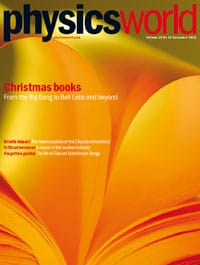
If you’re a member of the Institute of Physics, it’s time to tuck into the December 2012 issue of Physics World, which contains a bumper reviews section with our pick of the best books for Christmas, including an extended Between the Lines.

We also take stock of the recent six-year jail sentences given to the seven Italian scientists and engineers who were members of the risk committee that gave advice to the public before the devastating 2009 L’Aquila earthquake.

If you’re a member of the Institute of Physics (IOP) you can access the entire new issue online through the digital version of the magazine by following this link or by downloading the Physics World app onto your iPhone or iPad or Android device, available from the App Store and Google Play, respectively.

For the record, here’s a rundown of highlights of the issue:

Jail terms rock seismologyJon Cartwright examines the fallout from the case of the seven earthquake experts who were recently jailed for making apparently misleading statements before a devastating earthquake hit the Italian city of L’Aquila in 2009

Putting science on trialWarner Marzocchi warns that the decision to sentence seven earthquake experts to six years in prison during the recent trial in L’Aquila could set a dangerous precedent for science

Physics and paintingRobert P Crease looks at several books that examine how physics influenced artistic movements

Unknown genius – A visionary who saw far ahead of his contemporaries, Edward Hutchinson Synge has been largely overlooked by the academic world, from which he worked in isolation before he was confined to a mental hospital at the age of 46. Denis Weaire, John F Donegan and Petros S Florides uncover his remarkable story

Voyager – a mission for life – There may be no such thing as a “job for life” these days, but NASA’s Voyager mission to Jupiter, Saturn and beyond has kept hundreds of scientists busy for as much as 35 years. Mark Williamson reveals how researchers stay motivated and scientifically productive during such a long-term project

Vital forcesRichard Jones reviews Life’s Ratchet: How Molecular Machines Extract Order from Chaos by Peter M Hoffmann

What made Bell Labs specialAndrew Gelman reviews The Idea Factory: Bell Labs and the Great Age of American Innovation by Jon Gertner

The why and how of it allTim Maudlin reviews Why Does the World Exist: an Existential Detective Story by Jim Holt and A Universe from Nothing: Why There is Something Rather than Nothing by Lawrence Krauss

Forming a critical mass of experts Geoff Vaughan reviews The Neutron’s Children: Nuclear Engineers and the Shaping of Identity by Sean F Johnston

Von Neumann’s computerMartin Campbell-Kelly reviews Turing’s Cathedral: the Origins of the Digital Universe by George Dyson

New beginnings for nuclearJeroen Veenstra describes how his enthusiasm for nuclear energy led him to a new country, a new language and a role in developing the energy future

Once a physicist – Meet Nick Dunbar – a financial journalist and editor of the Bloomberg Risk newsletter

If you’re not yet a member, you can join the IOP as an imember for just £15, €20 or $25 a year via this link. Being an imember gives you a full year’s access to Physics World both online and through the apps.

Table-top test targets quantum foam

One of the biggest challenges in physics – finding evidence for quantum gravity – could be tackled using a simple table-top experiment, according to Jacob Bekenstein from the Hebrew University of Jerusalem. Bekenstein, who is best known for studying the thermal properties of black holes, has come up with an interesting new proposal for using single photons to probe what is known as “quantum foam”. The foam, which was introduced in 1955 by the US physicist John Wheeler, is believed to exist on length scales so small that quantum fluctuations affect space–time.

Bekenstein’s proposal is the latest effort in the quest to understand how quantum mechanics can be unified with Einstein’s general theory of relativity – a problem that has eluded physicists since they first began to understand the quantum and relativistic worlds in the early 20th century. One of the main reasons why physicists have struggled with developing a theory of quantum gravity is a complete lack of experimental evidence. The problem is that the effects of quantum gravity are only expected to be measurable over extremely small distances.

Some theories of quantum gravity suggest that experiments must probe distances smaller than the Planck length, which is 1.61 × 10–35 m. Probing this scale using an accelerator would involve colliding particles at enormous energies of more than 1016 TeV. This would be well beyond the capabilities of the Large Hadron Collider, which has a maximum collision energy of 14 TeV, or indeed of any conceivable future collider. Bekenstein’s proposal, in contrast, is much more modest; he says it could be done in a small physics lab mostly using existing equipment.

Photons at the ready

The experiment would involve firing single photons at a piece of glass or crystal, suspended by a tiny thread. When the photon moves from the vacuum into the material, it loses speed because the material has a higher refractive index than that of the vacuum. The result is that a tiny amount of momentum is transferred to the material, causing it to move an extremely small distance. In the case of a blue photon with a wavelength of 445 nm, Bekenstein says it would cause a 150 mg piece of high-lead glass to deflect by about 2 × 10–35 m, which is on a par with the Planck length.

The bottom line is that if a photon is detected on the other side of the material, it means the mass was deflected by a distance greater than the Planck length. But if the energy of the photon is reduced (or alternatively the mass of the glass increased) until the deflection becomes equal to or smaller than the Planck length, then quantum gravity will affect how the glass responds to each photon.

In particular, Bekenstein believes that the presence of the foam would prevent the glass from recoiling in exactly the same way when struck by a succession of identical photons. Just as electromagnetic fluctuations can have measurable effects on much larger objects – an example being the Casimir force – space–time fluctuations should also affect how an object moves extremely small distances. In the case of Bekeinstein’s proposed experiment, photons would not be able to travel through the glass, which would be observed as a drop in the number of photons detected on the other side.

The experiment is challenging but not beyond what experimental physicists can do today
Jacob Bekenstein, Hebrew University of Jerusalem

Bekenstein admits that the experiment is “challenging”, but claims it “is not beyond what experimental physicists can do today”. Indeed, creating and detecting single photons is a routine part of quantum-optics experiments that are done in many labs around the world. Minimizing the effects of thermal noise will also be a challenge, with Bekenstein calculating that the apparatus must be cooled to about 1 K and operated in an ultrahigh vacuum of about 10–10 Pa – both of which are achievable using existing technology.

Other table-top schemes

Bekenstein is not the only physicist to have proposed a table-top probe of quantum gravity. Earlier this year, for example, Igor Pikovski and colleagues at the University of Vienna and Imperial College London described a way of making optical measurements on a mechanical oscillator with a mass close to the Planck mass (about 22 μm). Indeed, Pikovski told physicsworld.com that Bekenstein’s plan seems feasible. “A big advantage is that physicists can control single photons very well and detect them extremely efficiently,” he says.

Pikovski also points out that the technique could prove very useful even if experimental issues prevent it from probing distances down to 10–35 m. This is because some theories of quantum gravity predict that quantum foam or some other effect of quantum gravity could emerge at length scales as great as 10–25 m.

While it is still not clear whether the table-top experiments proposed by Bekenstein, Pikovski or others will succeed, Pikovski believes that laboratory measurements will provide important information about quantum gravity within a decade or so.

The research is described in a preprint on arXiv and Pikovski’s proposal was published earlier this year in Nature Physics.

Prize-worthy books, part 2

By Margaret Harris

Well-written. Scientifically interesting. Novel.
Book-of-the-year-2012-200x200.jpg

These are the criteria we established in 2009 when Physics World started picking the year’s best physics books; and thanks to the current renaissance in science writing, we’ve never had trouble finding books that qualify.

In fact, the magazine reviewed so many good books in 2012 that we’ve decided not to rank them in a rigid top 10 list this year. Instead, we’ve drawn up a 10-strong shortlist (see below). Over the next few weeks, my colleagues and I will be trying to decide which of these outstanding books should be Physics World‘s Book of the Year for 2012.

We’ll announce the winner on 18 December during our regular books podcast, in which the genially impartial James Dacey will moderate while Physics World editor Matin Durrani and I champion a few of the books we like best.

In the meantime, though, we would love to hear your views on the shortlist. Is there a book that stands head-and-shoulders above the rest? Did we leave out your favourite among the books that Physics World reviewed this year? If so, let us know by e-mail at pwld@iop.org or vote for your favourite book from the shortlist below via our latest Facebook poll.

The shortlist for Physics World‘s Book of the Year 2012 (including brief descriptions and links to reviews).

A Hole at the Bottom of the Sea: The Race to Kill the BP Oil Gusher
After BP’s Macondo well blew out on 20 April 2010, company experts, government scientists and a “brain trust” of physicists assembled by US Energy Secretary Steve Chu spent months desperately trying to stem the flow of oil into the Gulf of Mexico. Joel Achenbach’s book about the disaster is a fast-paced and even-handed account of how things went wrong and who did what to fix them.

The Science Magpie: A Hoard of Fascinating Facts
Books of science trivia are a dime a dozen here at Physics World‘s reviews desk. Really good books of science trivia aren’t nearly as common. Simon Flynn’s grab-bag of stories from all branches of science exudes enthusiasm, breathing fresh life into a venerable format.

The Idea Factory: Bell Labs and the Great Age of American Innovation
In its heyday Bell Labs produced some of the most important and ubiquitous inventions of the modern era, from transistors and gas lasers to CCDs and wireless networks. Jon Gertner’s history of this “idea factory” describes what made Bell Labs special, and why none of today’s technological giants has replicated its success.

Erwin Schrödinger and the Quantum Revolution
Acclaimed science writer John Gribbin has written about Schrödinger’s physics several times before, beginning in 1984 with In Search of Schrödinger’s Cat. Now Gribbin is back with a biography of the man himself, skilfully combining Schrödinger’s scientific contributions with the quantum pioneer’s often complicated personal life and his legacy for both physicists and biologists.

The Geek Manifesto: Why Science Matters
In this polemical book, science journalist Mark Henderson argues passionately that science and critical thinking should be at the heart of public life, and he urges readers not to wait for someone else to make it happen. His book offers plenty of concrete suggestions on ways that so-called geeks can make their views count.

Life’s Ratchet: How Molecular Machines Extract Order from Chaos
Biophysics has mostly been left out of the boom in popular-physics writing, so we’re pleased to have Peter Hoffmann’s clearly written book about molecular motors and other nanoscale structures on our shortlist this year. Though not an easy read (particularly for physicists who haven’t studied biology since their schooldays), it does a very good job of capturing the excitement driving current research on this increasingly important topic.

How the Hippies Saved Physics: Science, Counterculture and the Quantum Revival
Quantum physics has always included some pretty trippy ideas, but its mind-blowing tendencies really came to the fore in the 1970s, thanks to a loose-knit group of physicists with a passion for Bell’s inequality and (in some cases) a penchant for psychedelic drugs. David Kaiser’s fascinating history of this unlikely bunch of insider-outsiders explains how they helped revive interest in the foundations of quantum mechanics.

How to Teach Relativity to Your Dog
Chad Orzel’s first book, How to Teach Quantum Physics to Your Dog, made it to No 2 on our list of 2010’s best physics books, thanks to its mixture of solid physics and gentle doggy humour. So it’s no surprise that its sequel has bounded into this year’s shortlist, ears cocked and positively slobbering with excitement at the prospect of a walk through Einstein’s special and general theories of relativity.

Pricing the Future: Finance, Physics and the 300-Year Journey to the Black–Scholes Equation
In the wake of the financial crisis, physicists on Wall Street have been harshly criticized, with no less an authority than Warren Buffet inveighing against “geeks bearing gifts” and the “financial weapons of mass destruction” they created. But how did physicists get into the financial industry in the first place? George Szpiro’s book brings the colourful history of econophysics to life.

Physics on the Fringe: Smoke Rings, Circlons, and Alternative Theories of Everything
Margaret Wertheim’s sociological study of physics crackpots is one of the year’s most thought-provoking books. Well argued and suffused with dry wit, this book asks important questions about what constitutes science and who gets to participate in it.

Vital forces

In many people’s minds, the primary focus of physics is on the very large (black holes, the distant universe and the problems of cosmology) or the very small (the Higgs boson and the other subatomic particles of high-energy physics). But there are some deep, unsolved mysteries of science that appear at scales much closer to our everyday experience. Of these, surely the most profound question is this: what distinguishes living from non-living matter? Ultimately, a naturalistic explanation of life must start with the blind forces of physics, but from these blind forces emerges the apparently purposeful action of living organisms, including ourselves. So what can physics contribute to the solution of this conundrum?

It is this question that physicist Peter Hoffmann attempts to answer in his book Life’s Ratchet: How Molecular Machines Extract Order from Chaos. Earlier generations thought that a so-called “vital force” had a literal and distinct existence, and by the early 19th century this force was beginning to be identified with the newly discovered and still mysterious phenomenon of electricity. But for Hoffmann, the road to understanding the vital force leads through statistical mechanics and his own experimental field: single-molecule biophysics.

Hoffmann covers this ground with an engaging mixture of historical sketches, homely analogies and personal anecdotes from his own experience as someone who trained as a condensed-matter physicist before striking out into new territory at the frontier between physics and molecular biology. The early part of the book contains some reiteration of familiar but important material on the subtleties of entropy. Thought experiments such as Maxwell’s demon get careful discussion, and Hoffmann gives due emphasis to the crucial point that requiring a global increase in entropy does not preclude local ordering, as demonstrated by the many self-assembly processes that occur at equilibrium.

The central image we are left with in this discussion is the “molecular storm” – the maelstrom of Brownian motion in which any biological nanoscale structure or mechanism has to exist, buffeted by the random thermal activity of the molecules around it. This is an unpromising environment, but such are the conditions under which the sophisticated nanoscale machines of cell biology must work. And as Hoffmann’s descriptions of various experiments demonstrate, these marvellously intricate molecular motors do not just work, they work astonishingly effectively and efficiently, and their collective action performs the familiar contraction of our muscles. This discussion brings us right up to date with current experiments and controversies in single-molecule biophysics.

The conceptual breakthrough that allows us to understand how a molecular machine can not only function in a Brownian environment, but even exploit its random motion, takes us back to an image familiar to many physicists from Richard Feynman’s famous lectures. Feynman’s “ratchet and pawl” argument illustrates that one cannot, without further input of energy, extract useful work from Brownian motion – as per the second law of thermodynamics. However, with an input of energy, you can rectify Brownian motion, using the forces generated by the random collisions of solvent molecules to generate directed motion. And it is this directed motion at the molecular level that, integrated to a large scale, leads to the purposeful motion of organisms. This idea is captured in a simple model by the French physicists Armand Ajdari and Jacques Prost: the Brownian ratchet. It is this concept that provides the “life’s ratchet” of the title.

Hoffman explains action but only begins to question purpose

As soon as one gets into the details of how any individual biological motor works, controversy starts, with the key question being “How applicable is this toy model to the particularity of that biological system?” Hoffmann’s coverage of the debate between proponents of “tightly coupled” motors and their opponents who favour “loosely coupled” models gives a flavour of the excitement associated with a field that is very much still developing. But ultimately, as Hoffmann correctly argues, these debates are about the details – fundamentally, all molecular motors are driven by the molecular storm of Brownian motion, whether or not the mapping to simple models is straightforward and easy to see.

In biology, details are important, and Hoffman does give us some of these by describing a variety of biological motors and what organisms use them for. The biology here is very rich, and as they skim past ATP synthase, helicases and RNA polymerase, some physicist readers may get the sense of rather too much biology being packed into too small a space. But we also learn about the physics details, such as what forces these molecules exert, and how these forces are measured through beautiful techniques such as force spectroscopy and optical tweezers.

Many things remain to be worked out, but Hoffmann makes clear that we are getting close to understanding part of what characterizes living matter. Such matter is capable of autonomous motion driven by molecular motors, which use an input of chemical energy to rectify the Brownian motion of the nanoscale environment. Hoffmann summarizes this view with the statement that “the force that drives life is chaos”. But there is still something missing here if we are trying to understand the purposeful action of living things: while Hoffmann explains the action, he only begins to address the question of purpose.

When we talk about the purpose of an organism, we can mean more than one thing. It is tempting to think that there is a purpose to an organism, one that is signalled by its design – but we know from Darwin’s arguments against the argument from design that this is treacherous ground. But organisms themselves have their own purposes. A bacterium swims away from a toxin or towards food because these actions might fulfil its purpose of maximizing its well-being. And Peter Hoffmann writes a book because this might fulfil his purpose of convincing other people that physics might be able explain some fundamental problems in biology. To provide a naturalistic explanation of how purpose, in this sense, arises remains a challenge that Hoffmann’s book only skirts around. Organisms process and integrate information about their environment, and depending on the outcome of that information processing, they act in one way rather than another. Underlying that act of “choice” must surely be the apparatus of signalling networks and gene regulation, and of the coupling of molecular shape change with the catalytic activity of enzymes that leads to chemical computing. And these most profound of scientific problems, too, must surely be susceptible to the insights and experimental techniques of physicists like Hoffmann.

What made Bell Labs special?

Bell Labs was a legendary place, an industrial lab in the outer suburbs of New York where thousands of scientists, working nine to five, changed the world’s technological history. Their inventions included the transistor, cellular communication networks and the theory of information, but amazingly, these were only a few of the major contributions to applied science and engineering that occurred in this set of famously close-packed labs. Year after year, Bell Labs scientists refined existing products and developed entirely new technologies. Those of us who spend time programming are familiar with Bell Labs as the home of C, Unix and the statistical package S (forerunner of the current open-source standard, R). And perhaps the most celebrated Bell Labs achievement in pure science was the 1963 discovery of cosmic microwave background radiation by Arno Penzias and Robert Wilson.

Coming up with the occasional breakthrough is one thing, but reliably producing innovation – that’s something special. It gets even cooler when you realize that so much was done at Bell Labs, and for so long, that the aforementioned discovery of Big Bang radiation – along with C, Unix, S and various fundamental, Nobel-prize-winning contributions to physics – go unmentioned in a new history of the labs called The Idea Factory. I say this not at all as a criticism of its author, the journalist Jon Gertner; rather, there was just so much going on at Bell that it cannot all fit in one volume.

Perhaps the most impressive part of the Bell Labs story is the workaday nature of its successes. Apart from Claude Shannon, inventor of information theory, the labs had no transcendent geniuses. True, William Shockley was a notable figure and, sure, John Bardeen is the only person to have received two Nobel prizes in physics. But they were not legendary minds on the scale of Fermi, Feynman or Von Neumann. Hence the fascination of Bell Labs as an idea factory where the institution gets as much credit as the scientists for the discoveries they made.

So what made Bell Labs special? To start with, it was well run, with managers who typically had strong technical track records of their own, appreciated scientific work and paid their staff enough to live comfortably – but not so much that they could just take their millions and quit. And as Gertner shows, Bell did benefit from some special circumstances. Monopoly profits meant the company could afford to hire top scientists and engineers, and with university jobs not paying very well and few get-rich-quick opportunities such as we have seen in Silicon Valley in recent years, the high pay and excellent working conditions at Bell Labs attracted many who might look elsewhere today.

Second, there was nothing to do at the labs all day but work. I have known lots of middle-aged professors who don’t spend much time teaching but don’t do any research either. At Bell Labs it was harder to be deadwood. Located as it was in the middle of nowhere, the Murray Hill campus was not a place to relax, and if you were going into the lab every weekday anyhow, you might as well work – there was nothing better to do. Several researchers, including Shannon and Shockley, had sharp mid-career productivity declines – but after they left Murray Hill.

In my own experience working at Bell Labs for three summers during the 1980s, I vividly recall a general feeling of comfort and well-being, along with the low-level intensity that comes from working eight-hour days, week after week after week. I did the research underlying my most-cited paper while working in complete freedom for six weeks at Bell Labs during the summer after completing my PhD. So maybe being stuck in the lab until 5 p.m. every day isn’t such a bad thing – though it might be impossible to replicate this sort of distraction-free workplace in the Internet era.

In its heyday from the 1940s to the 1970s, a Bell Labs job was said to be just like working at a research university, except the pay was better, the equipment was more up-to-date, the machine shop was available for all your needs and you didn’t have to spend time teaching or applying for research grants. At a university, research grants can be distorting – and mediocre researchers who happen to be good at getting them can stay on and on and on. At Bell, the financial motive was not grants but contributing to the company’s product lines. This seems reasonable to me, both because telephone service is a public good and because, as Gertner notes, the challenges of improving phone service motivated technical advances that benefited other areas as well. Although not mentioned in the book, Penzias and Wilson’s discovery is a good example, since it came as part of an effort to get cleaner telephone signals. There is, however, an irony here: as Gertner points out, Bell Labs scientists spent decades scrubbing the noise out of local and long-distance telephone calls, but the modern era of cell phones reveals that most customers prize convenience and connectivity ahead of sound quality.

In his concluding chapter, Gertner gives what I see as his book’s overriding message. “It is now received wisdom that innovation and competitiveness are closely linked,” he writes. “But Bell Labs’ history demonstrates that the truth is actually far more complicated…creative environments that foster a rich exchange of ideas are far more important in eliciting new insights than are the forces of competition.” Although competition has been “superb” at bringing “incremental and appealing improvements”, Gertner argues, “that does not mean it has been good at prompting huge advances (such as those at Bell Labs, as well as those that allowed for the creation of the Internet, for instance, or even earlier, antibiotics)”. This all sounds reasonable.

Gertner concludes that modern corporate labs do not allow the same combination of freedom and long-term thinking associated with Bell’s glory days. But perhaps, rather than asking where the next Bell Labs will come from, we as a society should be looking to create and support the next Massachusetts Institute of Technology. Gertner includes a tantalizing story of a proposal in the 1960s to create “Summit University,” a research institute in New Jersey that would have been closely connected to Bell and several other nearby industrial labs. The project was not carried out because the estimated $16m cost was deemed too high. In retrospect that decision seems unfortunate.

Italy cancels €1bn SuperB collider

Physics World can confirm rumours that the Italian government is to withdraw €250m from the €1bn SuperB particle accelerator, which was set to be built at the University of Tor Vergata on the outskirts of Rome. The decision, which effectively cancels the project, was made yesterday when Fernando Ferroni, president of the National Institute for Nuclear Physics (INFN), met Italian science minister Francesco Profumo to discuss funding for the project. “Given the difficult economic conditions of the country, the government is willing to confirm the contribution of €250m but not [for] the project,” says a government statement, which was released today and seen by Physics World.

As outlined in the statement, the INFN, which was set to build SuperB, will keep the €250m but will now spend the money on other projects. The INFN has already appointed two committees to look at what options it has, which includes converting SuperB into a scaled down “tau-charm factory” (called SuperC) or using the money elsewhere. The committees will report by 20 December, with a decision set for early January. Rumours of the funding cancellation first emerged on the blog A Quantum Diaries Survivor, which is written by the CERN-based researcher Tommaso Dorigo.

Mystery of antimatter

SuperB was designed to produce beams of electrons and positrons inside a linear accelerator to an energy of 6.7 GeV before injecting them into two rings each more than 1 km in circumference, where they would have then been collided to allow the decay of particles such as B mesons. The accelerator was expected to study the subtle differences in how particles and their antiparticles decay and could help shed light on the mystery of why there is so much more matter than antimatter in the universe.

One of the first things physicists were planning to look for is “charged lepton flavour violation” such as a tau lepton decaying into three muons without producing any neutrinos. The observation of such decays would point to new physics beyond the Standard Model. Indeed, earlier this year, physicists announced plans to add a free-electron laser to the facility, which would allow a range of research in materials science, biology and medicine, at a cost of around €75m.

Thumbs up?

Adrian Bevan from Queen Mary University of London – who is part of the UK’s SuperB contingent – told Physics World that the funding and construction plans for the project had only just undergone an independent review, which seemed to have given the project the thumbs up. Theoretical physicist Giorgio Parisi from the Laboratori Nazionali di Frascati, Rome, who has been a supporter of the project, told Physics World that he was “very disappointed” by the news.

SuperB was set to be built at a new site at the University of Tor Vergata called the Cabibbo Laboratory in honour of Italian particle physicist Nicola Cabibbo, who died in August 2010. The project would have been a competitor to Japan’s SuperKEKB – an upgrade to the existing KEKB collider – that is expected to come online by 2014 and will be able to produce more than 50 billion pairs of B mesons.

Copyright © 2026 by IOP Publishing Ltd and individual contributors