A strange cat in Dublin

Not many life stories in physics involve Nazis, illicit sex, a strange cat and the genetic code. Thus, a new biography of the great Austrian physicist Erwin Schrödinger is always of interest, and with Erwin Schrödinger and the Quantum Revolution, veteran science writer John Gribbin does not disappoint.

Many Physics World readers will be aware of Walter Moore’s 1992 biography Schrödinger: Life and Thought, which remains the definitive text on this colourful quantum pioneer. In fact, Moore also published an edited (and sadly neglected) version of his book for a popular audience, and Gribbin’s book is pitched more at this level. The new biography offers little new historical material, but Gribbin’s lucid style makes for an excellent introduction to this intriguing scientist and, indeed, to the world of quantum physics.

Gribbin sets the stage with a brief introduction to classical physics, followed by a description of the first quantum revolution. The work of Planck, Einstein and Bohr is described accurately yet succinctly in the author’s characteristic clear prose. The story continues with a description of the second quantum revolution, from Louis de Broglie’s hypothesis of wave–particle duality to Schrödinger’s brilliant wave mechanics (with Heisenberg’s matrix mechanics along the way). This is a familiar story for physicists, but one we never tire of reading.

The debate concerning the philosophical implications of the new theory is explained carefully, with a clear description of what became known as the “Copenhagen” interpretation. Einstein’s distrust of this interpretation is well known, but it is often forgotten that Schrödinger shared his views. As Gribbin points out, it is interesting that the father of wave mechanics had no faith in the idea of a wavefunction that collapses on observation, as posited by the Copenhagen camp. This objection is best exemplified by Schrödinger’s famous thought experiment of a cat that is neither dead nor alive before observation. Gribbin has written on Schrödinger’s interpretation of the quantum wavefunction many times before, notably in In Search of Schrödinger’s Cat (Bantam 1984) and Schrödinger’s Kittens and the Search for Reality (Phoenix 1996). Still, the wavefunction pioneer’s objection to the Copenhagen interpretation is worth restating.

The fascinating story of Schrödinger’s life and career is skilfully interspersed with the science. This is no easy task, given that he spent chunks of his career in Vienna, Jena, Zurich, Berlin, Oxford, Graz and Dublin, but Gribbin manages to maintain the reader’s interest throughout these sojourns without sacrificing accuracy. A good example is Gribbin’s description of the infamous Graz episode, when – having unwisely returned to Austria from Oxford in 1936 – Schrödinger penned a cringeworthy letter of apology to the Nazis, who had come to power in Austria following the Anschluss with Germany. As Gribbin explains, the publication of this letter damaged Schrödinger’s reputation abroad, while doing little to allay the Nazis’ suspicions of him.

Einstein’s distrust of the Copenhagen interpretation is well known, but it is often forgotten that Schrödinger shared his views

Into this crisis came a life-saving offer from neutral Ireland. Impressed by the Institute of Advanced Studies in Princeton, the Irish premier Éamon de Valera had decided to set up a similar institute in Dublin, with Schrödinger at the helm. The peripatetic professor accepted with alacrity and with the help of De Valera, he arrived safely in Dublin in October 1939.

He and his ménage, that is. Schrödinger set up house in Dublin with his wife Anna, his mistress Hilde and Ruth, his daughter by Hilde. As Gribbin points out, this arrangement was quite unusual in holy Catholic Ireland, yet it is a curious fact that the Schrödingers felt much more at home in Ireland than they had in Oxford. Gribbin offers the explanation that in Ireland “there was a marked contrast between what was officially approved and what people actually did”, which I think is about right. In any event, Schrödinger indulged in numerous romantic affairs in Dublin without sanction, producing two further children out of wedlock.

The description of Schrödinger’s years in Dublin is the most enjoyable part of Gribbin’s story and there are many moments of humour. For example, Gribbin describes how, in its early years, the Dublin Institute for Advanced Studies attracted the attention of the Irish Times satirist Myles na Gopaleen, who caused a stir when he observed that “Professor Schrödinger has been proving lately that you cannot establish a first cause. The first fruit of the institute, therefore, has been to show that there is no God.” The institute’s authorities were furious; Schrödinger himself was unperturbed. At the same time, Gribbin is careful not to underestimate the work Schrödinger did in Dublin, from his research in general relativity to his attempts at a unified field theory, from his work on the interpretation of quantum theory to his speculations in molecular biology.

The fact that the Dublin institute became a leading centre for the study of relativity forms an important part of Schrödinger’s legacy, but it is his work on molecular biology that is surely the most extraordinary aspect of his career. In 1943 Schrödinger gave a series of public lectures in Dublin in which he asked how hereditary information might be encoded in living cells. While much of the work he spoke about was not original, a book based on the lectures –- called What is Life? – went on to be a major influence in the field of genetics.

In the last chapter of the book, Gribbin considers Schrödinger’s interpretation of quantum theory from a modern perspective. He reviews several important developments of the past half-century, from the theoretical work of David Bohm and John Bell to the experiments of Alain Aspect and Anton Zeilinger. He then introduces the “many-worlds” interpretation and draws an intriguing connection between it and Schrödinger’s philosophy. There is an interesting point here, but the discussion is coloured by Gribbin’s own dislike of the Copenhagen interpretation.

This is a lucid biography of a brilliant scientist whose life and philosophy continues to intrigue. Although it contains little new historical material (apart from some lovely photographs and a nice surprise in the epilogue), Erwin Schrödinger and the Quantum Revolution is a cracking good read that will be enjoyed by physicists and non-physicists alike.

Web life

So what is the site about?

Ask Nature is a site devoted to biomimicry, an interdisciplinary field in which practitioners study how animals and plants solve problems, and then use those solutions to develop better human technologies. The site lists many instances of technology imitating life, including a surgical bandage inspired by gecko feet, a fog-harvesting mesh inspired by a desert beetle and a ceiling fan inspired by the seed pod of a sycamore tree. In total, there are nearly 200 examples of actual bio-motivated inventions described on the site, but they are just the tip of an iceberg of possibilities. Ask Nature also contains an astoundingly large catalogue of animal and plant strategies that might inspire solutions to human technological problems. Known as the “Biomimicry Taxonomy”, this catalogue contains around 1500 entries.

Can you give me some examples?

The Morpho butterfly keeps itself dry and clean in its rainforest environment thanks to nanostructures on its wings that make them both extremely hydrophobic and self-cleaning. Such structures have inspired new types of paint, textiles and glass that require less labour and fewer chemicals to keep clean. Another rainforest denizen – a medium-sized bird called a toucan – has an outsized beak that can be up to a third of its length, while making up only 5% of its weight thanks to the beak’s foam-like interior structure and thin outer layer. This light-but-strong construction might prove useful in ultralight aircraft components, or perhaps the panels in cars that protect people from injury during crashes. Not all of the taxonomy’s entries are rainforest species, but the richness and sheer biodiversity of these areas does seem to promote the development of novel adaptations. Yet another reason, if one were needed, to be concerned about their disappearance.

How is the taxonomy organized?

Each entry in the Biomimicry Taxonomy is assigned to one of eight “function groups”, which are in turn divided into 30 sub-groups and 162 separate functions. For example, the high-level function group “move or stay put” is split into two sub-groups, called “attach” and “move”. Attachment is further divided between permanent and temporary stickiness, while movement is grouped by travel that takes place in (or on) gases, liquids and solids. This seems sensible enough, but taxonomy is not always an exact science, and the system used in Ask Nature occasionally throws up a few anomalies. For instance, it seems odd that the hairy footpads of the fennec fox (which help it move over desert sand without slipping) are classed under “movement”, while the cloven hooves of the mountain goat (which help it move over rocky terrain without slipping) are categorized as “attachment”.

How should I use the site?

If your interest in animal science has been piqued by this special issue of Physics World, the Ask Nature site is a great place to learn more about the amazing adaptations that animals (and plants) rely on to survive. For casual browsers, the two dozen or so “featured strategies” on the site are a good place to start. These entries are more complete than most others, with detailed explanations, references and photos as well as basic explanations of strategies and their possible applications to human technologies. If you are looking for inspiration on a particular design challenge, though, you would be better off using the site’s extensive search function. To get the best results, you may need to do some lateral thinking. As the site puts it, you might want to ask “How would nature reduce drag?” or “How does nature move through air?” rather than something more direct, such as “How would nature design an efficient wind turbine blade?” In the process, you might even find that merely looking at the problem in a different way helps lead to a solution.

Quantum dots entangled with single photons

Two independent teams of physicists are the first to have entangled a single photon with a single electron spin held in a quantum dot. Thanks to the ease with which quantum dots can be fabricated and controlled, the breakthrough could lead to practical quantum computers and quantum communication systems.

Entanglement is a quantum effect that allows particles such as photons and electrons to have a closer relationship than predicted by classical physics. For instance, a photon–electron pair can be created experimentally such that if the photon polarization is measured to be in the vertical direction, a measurement of the electron spin would find its spin pointing in the same direction. This occurs in spite of the fact that a measurement on the photon (or electron) alone will reveal a random value.

This close relationship could be put to use in quantum computers, which could in principle outperform today’s classical computers. Photons are expected to play an important role in quantum computation because they can carry bits of quantum information (qubits) over long distances. However, photons cannot by their very nature stand still and stationary qubits such as quantum dots are needed to store quantum information. While researchers have already shown that trapped ions and defects in diamond crystals can be entangled with single photons, these systems can be difficult to work with on a practical level.

Colour or polarization

One research team included Kristiaan de Greve and colleagues at Stanford University and focused on quantum information stored in the polarization of the photons. The other team, headed by Atac Imamoglu at ETH Zurich, took a different approach that involves information stored in the wavelength of photons.

Quantum dots are tiny pieces of semiconductor that are compatible with conventional electronics and therefore offer a practical way forward. Both teams used quantum dots formed at the interface between two different semiconductors. A single electron can become trapped in the dot – and because the dot is so small, the electron inhabits a set of atom-like energy levels.

Quantum information can be stored in the spin of the electron – with “0” corresponding to spin up and “1” to spin down for example. In both the Stanford and ETH experiments the value of the qubit was set to the spin-up state by firing a “pump” laser pulse at the dots. Then, a second laser pulse is fired at the dot, which pops the electron into a higher energy state. This state can then decay to either a spin-up state with the emission of a “blue” vertically polarized photon or a spin-down state and a “red” photon that is horizontally polarized. Red and blue simply refer to the wavelengths of the photons, with the latter shorter than the former.

Too much entanglement

The process leaves the quantum dot entangled with both the colour and polarization of the photon. For the entangled states to be useful for quantum computing applications, it must involve only one property of the photon. Therefore an important challenge for both teams is how to destroy one type of entanglement without affecting the other.

De Greve and colleagues addressed this by lowering the energy of the photon in a process called “down conversion”. This is done by sending the photon through a special crystal that is pumped by an infrared laser. This process has the effect of “smearing together” the two colour states of the photon and removing that aspect of the entanglement – while preserving the polarization. An added benefit of the down-conversion process is that the photon emerges at a wavelength compatible with optical telecommunications systems

Meanwhile in Switzerland, Imamoglu’s team faced the opposite problem of erasing the polarization entanglement while sparing the colour. To do this they relied on the fact that a plane-polarized photon – with horizontal or vertical polarization – can be expressed as a superposition of circularly polarized photon states (clockwise and anticlockwise). The team passed their photon through a polarizing filter puts all photons into an anticlockwise state erasing the polarization entanglement. The laser pulses used to drive the entanglement process were set to have circular polarization, which means that the polarizing filter also prevented this light from swamping the detection of single entangled photons.

Measuring spin

In both set-ups the spin of the quantum dot is measured by firing a second laser pulse at the quantum dot. The result involves the emission of a photon with a polarization that is related to the spin state of the quantum dot. By measuring the correlations between the spin-measurement photon and either the colour or polarization of the qubit photon, both teams were able to prove entanglement.

Physicists have already shown that photons can remain entangled after travelling distances of over 100 km in air and therefore this latest development could offer a way to link quantum computers over large distances. Because entangled states are destroyed if an eavesdropper tries to intercept a message, the quantum-dot system could also find use in quantum encryption systems.

Both experiments are described in Nature.

Vibrating molecule drives a motor

A single hydrogen molecule has been used to “push” an object much more massive than itself. So say researchers in Germany and Spain who have used a phenomenon called stochastic resonance to extract useful energy from “noise”. Their experiments involve using an atomic force microscope tip mounted on a flexible, spring-like cantilever and the processes at play might be exploited to power up nanometre-sized machines – or even much larger devices.

Stochastic – or random – resonance is well known in a range of complex systems, especially in living organisms, and is responsible for processes such as energy pumping. It allows weak periodic signals to be strengthened by surrounding noisy signals that arise from random fluctuations in the system. These ubiquitous fluctuations can come from temperature changes or from the movement of electrons and photons. The resonance occurs when random peaks in the noisy signal coincide with regular peaks in the periodic signal.

Scientists would like to mimic this ability that nature has of harvesting energy from random noise. Now, Jose Ignacio Pascual and colleagues at the Freie Universität Berlin and CIC nanoGUNE in San Sebastian have made some headway towards this goal by showing that the stochastic motion of vibrating hydrogen molecules can be used to move a mechanical cantilever.

Random switching

The researchers use the sensor of an atomic force microscope – a tip mounted onto a flexible, spring-like cantilever made of quartz. They then trap a single hydrogen molecule between the tip and a copper surface. A small voltage (of around 0.1 V) applied between the tip and the copper causes the hydrogen atom to switch randomly between two positional states and the cantilever begins to oscillate.

“We believe that the cantilever moves thanks to stochastic resonance, which uses the concerted motion of random hydrogen fluctuations and the well defined periodic motion of the mechanical oscillator, to amplify energy transfer from the molecule to the oscillator,” says Pascual. “The random motion of the hydrogen molecule effectively exerts nanoscale forces against the microscope tip, thus making it oscillate.”

In these experiments, the hydrogen molecule is made to move by applying a voltage through the molecule, continues Pascual. “There is nothing to say, however, that the effect could not occur for molecular fluctuations induced by other sources of energy, like light, for example.”

Rotation from noise

According to the team, the processes observed could be exploited to help design artificial molecular motors. “Energy from noisy environments could be extracted to drive the rotation of the motor, for instance,” says team member Felix van Oppen, who was responsible for developing theoretical models to help interpret the experimental results.

“Our work shows that the smallest possible molecule, hydrogen, is capable of ‘pushing’ an oscillator 1019 times bigger than itself,” adds Pascual, “This is a result that will spur us on to search for other sources of molecular noise, like electrical or magnetic fluctuations, which might even lead to more efficient energy transfer to a mechanical oscillator,” he says.

Hope for SUSY fades at 8 TeV

The LHCb team

Still looking for SUSY: the LHCb detector and its team of physicists. (Courtesy: CERN)

By Hamish Johnston

After the historic announcement of the Higgs discovery in July, things have gone very quiet at the Large Hadron Collider (LHC). Although the facility in Geneva has been colliding protons like gangbusters, there is very little buzz about what the next big discovery will be.

I was hoping that this would change this week at the Hadron Collider Conference in Kyoto, where the latest results are being discussed. However, a big disappointment – at least for fans of supersymmetry (SUSY) – came on Monday, when physicists working on the LHCb experiment announced that they have measured a rare decay of the Bs particle.

There was a hope that the decay of the Bs to a muon and antimuon would point towards SUSY – a collection of theories that go beyond the Standard Model of particle physics. SUSY is an attractive concept because it offers a solution to the “hierarchy problem” of particle physics, provides a way of unifying the strong and electroweak forces, and even contains a dark-matter particle.

But alas, the Bs decay seems to be best described by the Standard Model and SUSY remains as elusive as ever. Indeed, it looks like we might have to wait until the collision energy at the LHC is boosted from the current 8 TeV to 14 TeV – which will occur when the collider is shut down over 2013–2014.

The LHCb team has uploaded a preprint of its Bs paper to arXiv.

Bloggers are also chattering about the result. Peter Woit puts SUSY in intensive care, whereas Gordon Kane argues that the measurements are still compatible with some types of SUSY. Meanwhile, Matt Strassler can always be relied upon to take a more measured approach.

And what about the Higgs? The lack of gossip on this front seems to suggest that the new data are showing that the LHC’s Higgs particle is also best described by the Standard Model – more to come from Kyoto tomorrow on that front.

Fifty shades of purple

US election map

Cartogram of 2012 US presidential election results. (Courtesy: Mark Newman)

By James Dacey

In the world of political punditry, the US election results are usually represented by a map of the nation with each of the 50 states coloured either blue for a Democrat victory or red for a Republican victory. The resulting map – this year, at least – can appear at odds with the overall election result, as large swathes of the sparsely populated centre were Republican red, whereas the geographically smaller but densely populated west coast and north-east regions were Democrat blue.

A more nuanced view has been offered up by Mark Newman, a physicist at the Center for the Study of Complex Systems at the University of Michigan. In this cartogram he has broken down the regions into counties rather than states, and the shade of purple represents the balance between Republican and Democrat. The size of individual counties is proportional to its population, and subsequently its influence on the “electoral college” vote, which ultimately determines the outcome of the election.

You can see several other visualizations of the election result on Newman’s web page.

How Earth’s wandering poles return home

A number of times over the past one billion years, the Earth’s surface has “wandered” relative to its rotational axis – before returning to its original position. Now, a team of geophysicists from the US and Canada says it has developed a theory that explains this curious phenomenon of “oscillatory true polar wander”. Understanding the mechanics behind polar wander is crucial, as a shift could tip the Earth over by as far as 50° over a period of 10–100 million years and this would cause profound global environmental and geological changes.

True polar wander (TPW) can be defined as the relative movement between the mantle (and so the surface of the Earth) and the Earth’s spin axis or its rotational axis. Incredibly, researchers believe that over the past one billion years, the Earth’s surface has “tipped over” and then returned to its original location six times along the same axis – this is the process of “oscillatory true polar wander”. Scientists have worked this out by studying magnetism in rocks – a discipline known as “paleomagnetism”. If a rock cools in a magnetic field, it records the magnetic properties of the field and these can be decoded in the lab millions of years later. So, by measuring changes in the orientation of the Earth’s magnetic field that are stored in ancient rocks, scientists can “see” the effects of the oscillatory TPW.

Extreme shifts

“Someone sitting on the Earth would have seen the pole shift up to 50° and then turn around and return close to its original location, all in tens of millions of years,” explains geophysicist Jerry Mitrovica of the Earth and Planetary Science Department at Harvard University. “But an observer floating in space would actually see the rotational axis stay relatively vertical and the Earth’s surface tip over and then back.” Unsurprisingly, these rather extreme and dramatic shifts can be linked to global changes in all large-scale Earth systems such as the carbon cycle, climate and even evolution. “After all, if it happened today, a shift of 50° one way might put Boston [Massachusetts] near the north pole, while a shift in the opposite direction would bring Boston near the equator,” says Mitrovica.

But this in itself is not news – earth scientists have known for a while that TPW does occur and they even know why. They believe that the initial shift of the pole – or the Earth tipping over – is caused by large-scale flows in the Earth’s interior known as “mantle convection”, involving thermal convection currents that carry heat from the Earth’s core to the surface. This is the same process that drives continental drift and plate tectonics. So, mantle convection disturbs the rotational equilibrium of the Earth and the result is a shift in the relative orientation of the Earth’s solid surface and its rotational axis.

There and back again

What has eluded researchers is a theory that clearly explains how and why the pole returns to its original location, or the “oscillatory true polar wander”. In the new work, graduate student Jessica Creveling, also of the Earth and Planetary Science Department at Harvard, along with Mitrovica and colleagues, provides an explanation. The researchers, using computer simulations and modelling, say that a combination of two mechanisms brings the “wandering” pole back to its original location.

The first mechanism relates to the Earth’s equatorial bulge. The Earth is not a perfect sphere – rather it is an oblate spheroid, as it is flattened at the poles and bulges at the equator. So there is a difference in the radius of the Earth as measured from the centre to the equator compared with the poles – it is approximately 20 km greater at the equator. This band of excess mass forms because the Earth is rotating, which causes the equator to bulge outwards. “But the Earth’s bulge is generally a bit larger than it should be…which is true even today. And this extra bulge, or fatness, acts to stabilize the Earth’s rotation,” explains Mitrovica. He likens this to the heavy weight that is placed at the bottom of a plastic punching-bag toy, which acts to bring the bag back to being vertical if it is punched sideways. In a similar manner, if the Earth, with its bulging equator, tips over, it prefers to right itself again. “So, this girdle of excess mass actually has a very stabilizing effect, acting as a self-righting mechanism for the Earth’s rotation,” he says.

The second mechanism relates to the strength of the tectonic plates. If the Earth’s surface tips over relative to the rotational axis, the 12 larger tectonic plates all get deformed to a small extent, like elastic bands. In a similar way to a stretched elastic band, the plates want to go back to their original size, and these stabilizing elastic stresses also play a role in the oscillatory return of the pole. A clue that this might be the case is the fact that past polar-oscillation events seem to have happened when the Earth’s continents were gathered together into one “supercontinent”, a process that has repeated a number of times in Earth’s history. The last supercontinent, known as Pangea, was formed 200 million years ago.

Efficiency of combined effects

Mitrovica points out that while Creveling was running her simulation, neither single mechanism could cause the pole to return – it was only a combination of both effects that did it. “What also really surprised me was the efficiency of the effects to pull and push the poles during a period of about 10 million years,” says Mitrovica. “This paper made a believer out of me and I was a sceptic.” He explains that other researchers might remain sceptical about the theory and that only more evidence gathered based on paleomagnetic field studies will provide the necessary evidence. The team also hopes to better determine how common or rare these events are. “Every rock cooling at the time of a tilt will show the evidence of it and we need to find that,” says Mitrovica.

The team is also keen to determine just how drastic the effects of a shift are. It is believed that a shift would cause a significant change in the climate of every place on Earth, as well as changes in the sea level and the carbon cycle. Mitrovica believes that the consequences of these large-scale events would have left their own mark on the Earth’s systems and they too should be studied in the future.

The research was published in Nature.

The awesome lack of modern physics in US schools

By Hamish Johnston

If you can get beyond the overuse of “awesome” and its derivatives, this video asks some important questions about how physics is taught in US schools – and in many other countries around the world.

Presented as a “letter” to President Barack Obama, the video claims that no physics developed after 1865 is included in standard curricula taught in American high schools. I say curricula, because education is the domain of the individual US states and not the responsibility of the president – but that’s a moot point.

Why 1865? The video doesn’t say, but my guess is that’s the year that James Clerk Maxwell published the first version of his famous equations.

The narrator points out that in other disciplines it would be ridiculous not to cover modern breakthroughs. Imagine a biology curriculum without DNA or geology without plate tectonics, for example.

The video rubbishes the idea that topics such as quantum mechanics and relativity cannot be taught without university-level mathematics. This, I agree with. Indeed, high-school students are taught aspects of quantum mechanics when they learn about chemical bonding without the need for advanced mathematics.

It also argues that pupils are missing out on making important connections between modern technology and modern physics – something that makes studying physics exciting and relevant.

Of course, if more high-school time is devoted to modern physics, then less will be spent on the “fundamentals”. This could lead to complaints from university educators that students are not prepared. But maybe that’s a price worth paying for more balanced and much more interesting high-school physics classes.

The physics of sport – readers’ pictures

In an exciting year for sport we asked readers to submit images to our Flickr group that encompass the physics and technology of sport, for the latest Physics World photo challenge.

Readers were encouraged to look through the July issue of Physics World, which looked at some of the challenges in the “physics of sport”, including the physics of the prosthetic devices that are leading disabled athletes to success, and how gymnasts, divers and long jumpers are all unconscious masters of manipulating the law of conservation of angular momentum. Thank you to everybody who took part and here is a selection of the images we received.

This image, showing the path of a ball on a pool table, is almost a pictorial representation of classical physics in action. Various forces and vectors, Newton’s laws of motion, the transfer of energy – all of these concepts come into play in each pool game. FuzzyKryton, who took this image of himself playing pool, used a remote to trigger a timer so that he didn’t have to run around the table. “I had to time the blinking of the timer light to when I needed to shoot the ball,” he told us.

Coming over the top

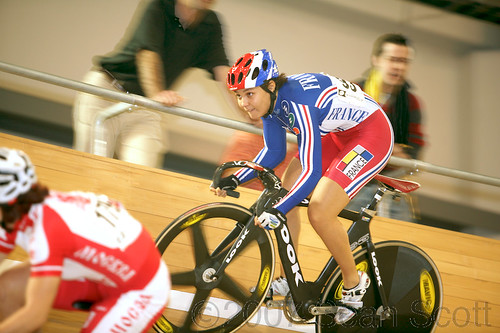
Taken at the 2007 World Cup of Track Cycling in Los Angeles, US, this picture shows a match sprint, an event that usually involves two to four riders competing. As photographer .s.e.a.n. writes, “Match sprinting is all about physics and tactics. This French rider is about to teach her Russian counterpart a lesson in how to translate the potential energy of her higher position on the banking into kinetic energy, as she accelerates past her towards victory.”

Hoppç

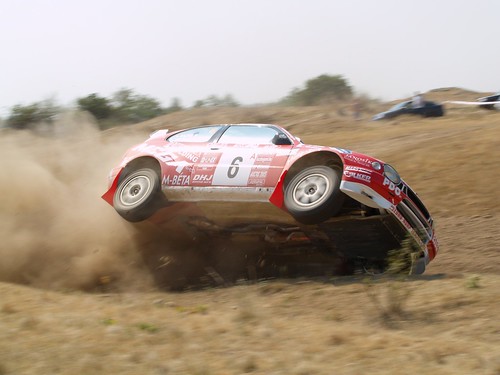
In this exciting image, taken by sebgutkopf, a race-car driver is doing his best not to flip the car over, conserving its angular momentum, at a turn. While your everyday drive to work may not be half as exciting, most people experience many fundamentals laws of mechanics each time they climb into the driver’s seat – from conservation of momentum and velocity, to experiencing g-force and even friction as tyres adhere to the road, physics plays an important role.

IMG_9545

Photographer Phil Peterson has captured these roller derby skaters as they fight to achieve speed and momentum, while not letting centripetal force skew them off their course.

Dana, Hop Bars

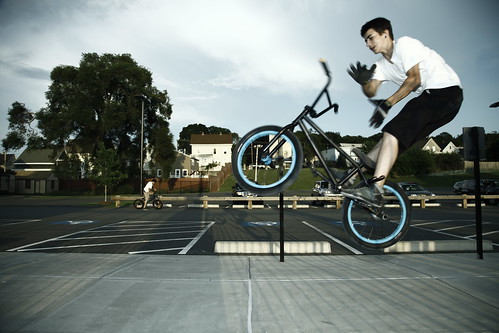
Captured in the middle of a BMX stunt by photographer RV Henretty-Jornales, this urban athlete seems quite at ease as he levitates several feet off the ground. But behind that impressive stunt lies some complex physics. Apart from knowing when to accelerate and how to move relative to their centre of mass, the cyclists also rotate their bikes around multiple axes and know how to land from a free-fall so that they do not injure themselves as a result of the gravitational force acting on them.

174/365 [Running with only myself for company]

Photographer The Hamster Factor took this picture showing the motion of running using the self-timer function on his Nikon D90 camera. He took multiple shots and then cloned them together using Photoshop Elements. You can take a look at this Physics World video to learn all about the physics of running.

Ski jump by DualD FlipFlop

As this skier sails through the air, he is calculating the many forces bearing down on him, including the frictional drag in conjunction to his mass, the radius of a curve at which he may turn and the speed at which he won’t topple over. The picture was taken by DualD FlipFlop in California, US, in January.

Paragliders by mars73

The physics of flight has intrigued humans since Leonardo Da Vinci studied the flight of birds and tried to explain the mechanics behind it to build his own flying apparatus. Many fundamental physics forces come into play in all forms of flight, including drag, lift, thrust and gravity. The paragliders in this image, taken by mars73, seem to have found the perfect combination of all of these.

Wind and water

The man in this image is not quite flying himself, but using a sail to drag him along the water. Photographer DocJ96 writes, “The horizontal rate of change of momentum of air on the sail is matched by drag in the water and momentum change, as spray is ejected from the board under his feet,” referring to the opposing forces exerted by the wind and the water.

Run on the Crack of the Bat

It seems that San Francisco Giants player Buster Posey may have underestimated the force of his swing, as his baseball bat splintered upon impact with the ball. Photographer Phil McGrew captured this image at a game in San Fransisco, US, in May.

Thank you to everyone who submitted photographs and you can see all the images in our Flickr group, Physics World photo challenge.

The November issue of Physics World reveals the extraordinary physics of animals from the everyday – such as how cats and dogs drink – to the otherworldly, such as the super shrimp that can fracture aquarium glass with its clubs. So, the theme for our next photo challenge is “animal physics”. As always, we encourage you to be creative in the way you interpret the theme. But if you are looking for inspiration you might want to think about some of the animal behaviour that has dazzled and intrigued scientists over the years. For instance, how the peacock’s feathers have structures that produce beautiful shimmering colours to attract female mates, or how pond skaters can skip so effortlessly across water.

To take part please upload your images to our Flickr group by 1 December, and after this date we will showcase a selection of the best animal physics photos on physicsworld.com. Happy snapping!

Nanocrystals produce hydrogen using sunlight

Researchers in the US have made hydrogen fuel using just sunlight, nanocrystals and a cheap nickel catalyst. The new artificial photosynthesis process is the first of its kind to continually produce fuel for several weeks without slowing down. As a result it could be important for green-energy applications and also for certain industrial processes such as those for producing ammonia.

During photosynthesis, plants harness solar radiation and convert it into energy. Most artificial photosynthesis systems try to mimic this natural process by exploiting light-absorbing dye molecules called chromophores to split water into hydrogen and oxygen. The hydrogen is produced in the reductive side of the reaction and the oxygen in the oxidative side. These so-called half-reactions are part of the process that converts light into energy, but the problem is that such technologies are inefficient and short-lived because the Sun’s rays damage and destroy the light-absorbing dyes in just a few hours.

Now, a team of researchers led by Todd Krauss, Patrick Holland and Richard Eisenberg at the University of Rochester has developed a new photochemical hydrogen-generating system made of cadmium–selenide (CdSe) quantum dots, nickel salt catalysts and ascorbic acid (vitamin C). The system lasts for several weeks rather than just hours and, in water, has an quantum efficiency of 36% – for every 100 photons absorbed, 36 hydrogen molecules are produced. If the surrounding solution is a mix of water and ethanol, this efficiency increases to 66%. Such high values have never yet been observed for such all-solution-based systems. The only snag is that the vitamin C (which acts as an electron donor) gets used up and regularly needs to be replenished during each hydrogen production cycle.

How it works

The CdSe quantum dots absorb two photons of light and transfer two electrons to the nickel catalyst. The two remaining protons combine to produce a hydrogen molecule, explains Krauss. “Our work is different from most other previous research in that the catalyst is formed in situ from the quantum-dot ligands,” he says. “Most other solution-based systems produce hydrogen for just hours, or at most a day, because the chromophores degrade, so our long-lived system is rather unusual.”

The researchers say that their catalyst–nanocrystal pairs are better than previous artificial photosynthesis nanoparticle systems because they are more stable to sunlight, but admit that they do not yet know why this is the case.

“This new system will also certainly help us better understand the reductive side of artificial photosynthesis – something that may one day help lead to more effective and efficient water splitting,” adds Krauss, “Our work is an important step in that direction.”

Making ammonia

According to the team, such a clean source of hydrogen could not only find applications in green energy, but also in industry, for example in the Haber process for producing ammonia.

The Rochester team is now looking at other nanoparticle systems to try out. “We are also investigating other less-expensive catalysts and hope to find a way to replace the sacrificial vitamin C molecule with electrons, say from a circuit. Such experiments could be the next step towards a true artificial photosynthesis system, but we are still a far cry from that since we have only performed half of the full reaction,” says Krauss.

The work is described in Science.

Copyright © 2026 by IOP Publishing Ltd and individual contributors