Guilty verdict for Italian earthquake scientists

Seven scientists have been found guilty of the manslaughter of some 308 people following the 6.3-magnitude earthquake that struck the city of L’Aquila in Italy on 6 April 2009. All seven have been sentenced to six years in prison for issuing false reassurances that a major quake would not necessarily follow the weaker tremors that the region had been experiencing.

The verdict comes after a year-long trial in the Italian city – about 100 km north-east of Rome – that ended last month. The scientists are members of a committee that provides a risk assessment of potential natural disasters and include Enzo Boschi, president of Italy’s National Institute of Geophysics and Volcanology, as well as Claudio Eva, an earth scientist at the University of Genoa.

Stayed indoors

The researchers were accused of incorrectly assessing the likelihood that a major quake could happen in L’Aquila given the large numbers of tremors in the region in the months before the deadly event. As a result of this assessment, argued the prosecutor Fabio Picuti, residents and officials failed to take steps that could have saved lives. In particular, he said that some residents remained indoors on the night of 5 April when the tremors returned – followed by the early-morning earthquake.

The ruling comes in spite of an open letter to the Italian president from 5000 international scientists saying that the charges are unfounded.

Academics and the other 96%

Climbing the academic pyramid

By Margaret Harris

Like most physics students, I initially thought that getting a PhD would lead me to a career in academia. But also like most physics students, that isn’t how it worked out. In fact, data collected by the Royal Society in 2010 show that more than 96% of PhD-qualified scientists pursue careers outside academic research, with most finding work in the wider, non-research economy, while a significant minority are employed in government labs or industrial R&D.

The implications of that 96% figure – including how it affects the prospects and plans of early-career researchers; what it says about advice and training for PhD students; and its likely effects on science as a whole – are the subject of an in-depth article in this month’s Physics World graduate careers focus. You can also download an entire special section on graduate careers (including more than 10 pages of adverts for jobs both inside and outside the university environment).

As I learned while researching the article, the real problem with that 96% figure is that it conflicts so sharply with another statistic: 46% of new physics PhD students want to work in a university. Put those two numbers together, and they add up to a lot of disappointed and frustrated early-career physicists. And let’s be absolutely clear: these are not, by and large, people who “couldn’t cut it” in a research environment; it’s just that, statistically, not everyone can climb to the top of the academic pyramid.

Opinions are, naturally, divided over what (if anything) should be done about the apparent oversupply of PhD physicists relative to the number of long-term jobs in academic physics. If you have suggestions or if you want to share your experiences, please do so via the article’s comments area.

Chip puts a twist on light

Physicists in the UK and China have produced silicon devices measuring just a few thousandths of a millimetre across that can endow light beams with a twistedness associated with orbital angular momentum. The researchers say that by varying this property over a range of values, such devices could increase the amount of bandwidth available for telecommunications and underpin extremely powerful quantum computers.

A light beam’s “spin angular momentum” is a familiar property associated with its polarization, the direction in which its electric field vibrates. But light can also possess orbital angular momentum (OAM), which causes a beam’s wavefront to change direction in time. Whereas an ordinary collimated beam has a wavefront that remains fixed at right angles to its direction of propagation, a beam with OAM will see its wavefront rotate around the propagation axis, creating a spiral or vortex. The greater the orbital angular momentum, the tighter the spiral.

Generating OAM involves varying a beam’s phase across a plane at right angles to its path. In contrast, a collimated beam has a uniform phase across this plane. Physicists have come up with a number of ways of doing this, such as placing asymmetric lenses or holograms in the path of a laser beam. This latter approach, pioneered by Miles Padgett at Glasgow University in the UK, involves using a computer to create a grating with many columns of pixels that split into a pitchfork shape at the centre of the grating.

Useful but bulky

These techniques have led to a number of specialized applications, such as using laser beams to rotate particles in devices known as optical spanners. But the components involved – such as lenses or hologram plates – are bulky. Greater exploitation of OAM will probably require smaller devices that can be integrated into chips, since many proposed applications require the generation of large numbers of closely packed vortices. Last year Christopher Doerr and Lawrence Buhl at Bell Laboratories in the US reported making a silicon-chip-based system containing a spoke-like arrangement of waveguides, with the phase between neighbouring waveguides offset slightly in order to emit light with OAM. But measuring 1.0 × 1.4 mm, the device was large by the standards of modern integrated circuits.

In the latest work, Siyuan Yu of Bristol University and colleagues have made silicon devices consisting of straight waveguides connected to modified micro-ring resonators. These resonators usually trap light in the same way that the whispering gallery in St Paul’s Cathedral in London confines sound waves. But Yu’s group carved out a series of tiny bumps on the inside surface of the rings, so creating circular diffraction gratings that allow light to escape the rings. Crucially, the researchers realized that by adjusting the distance between bumps, they could give light a twist. With that distance equal to the light’s wavelength, all the light rays should be emitted at right angles to the plane of the rings, so creating a planar wavefront. But if there is a mismatch, they reasoned, the emission angle should vary along the rings’ circumference, which creates the unevenness of phase needed for OAM.

To show they could in fact generate light with OAM, the researchers merged the light from a 15-μm diameter ring with a circularly polarized reference beam. The resulting interference pattern showed the hoped-for signature – a spiral pattern with the right number of arms, given the amount of OAM added to the light. “These spirals are exactly what theory predicts should be seen, so there is no ambiguity at all in our result,” says Yu.

The team then hooked up three such rings to a single waveguide and found that each ring produced spiral emissions with the same number of arms. This simultaneous emission is important, says Yu, because it shows that the rings are reproducible and can therefore potentially be made in large quantities.

“A very clever idea”

Padgett is enthusiastic about the work. He says that it “opens the way for OAM to be an integral part of integrated optics”. Doerr, who is now at the US company Acacia Communications, is also complimentary about the new device, describing its underlying principle as “a very clever idea”. He believes that the device’s compactness might make it suitable for 2D imaging of objects, such as biological cells, which can alter the OAM value of light passing through them. But he argues that, unlike his group’s chip, the Bristol design will not lead to a significant increase in optical-communication bandwidth because each OAM state would require a different wavelength.

Yu is addressing this shortcoming and says that he and his colleagues are working on changing the OAM values associated with a particular wavelength by varying the refractive index of the rings electrically. Indeed, he says that they aim to produce devices that can emit different OAM values at the same time. This, he claims, could enhance telecommunication bandwidth, by increasing the number of channels available, and boost the power of quantum computers – devices, still under development, that promise much faster data crunching by processing multiple quantum states simultaneously. “Currently, quantum computers rely on electron spin or photon spin, which only have two states, whereas OAM has many states,” he explains.

The new device is described in Science.

Stamping across the solar system

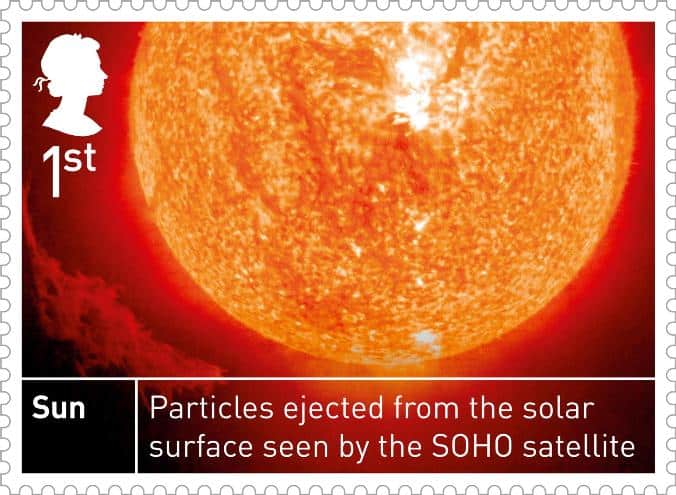
Royal Mail Stamps: Sun

By Tushna Commissariat

Earlier this week, the UK’s Royal Mail issued a set of six special stamps to celebrate the 50th anniversary of Britain’s first satellite – Ariel 1 – that was launched on 26 April 1962. While the Royal Mail has issued stamps with space images on them in the past, the new set “takes the theme forward, exploring the solar system in greater depth than ever before”, according to the company.

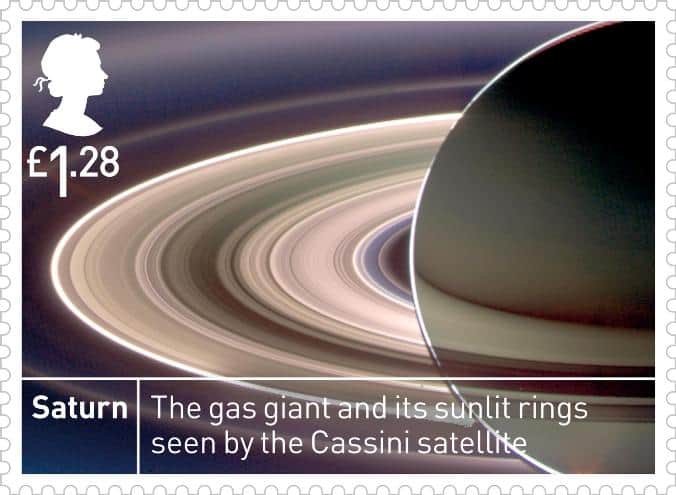
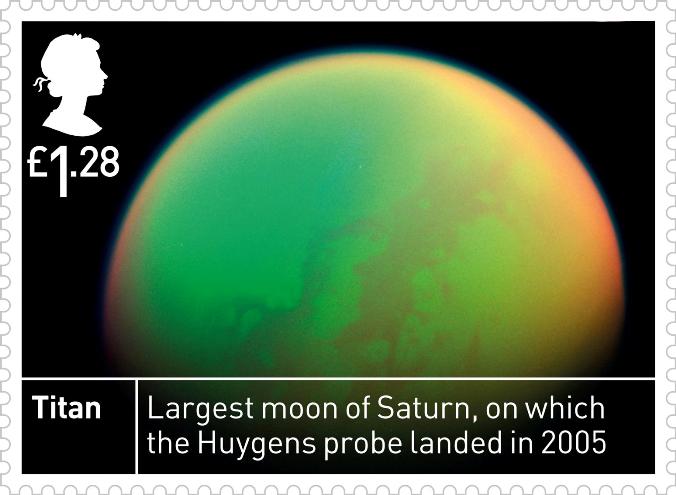
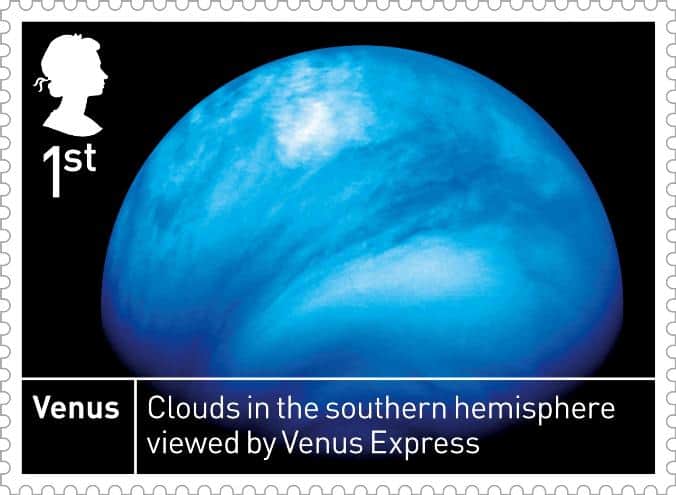
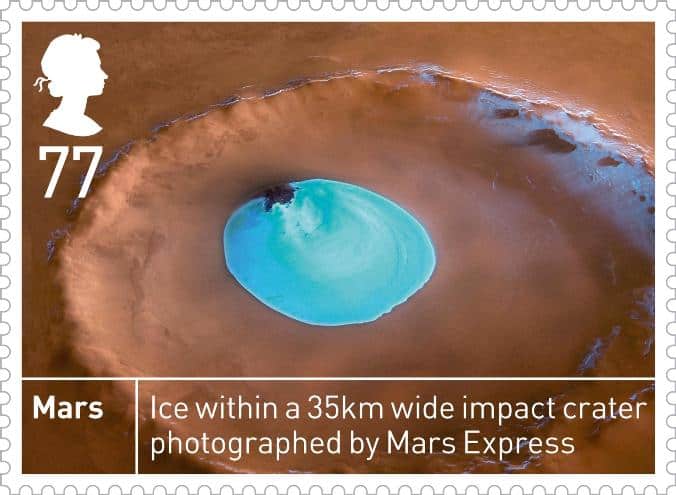
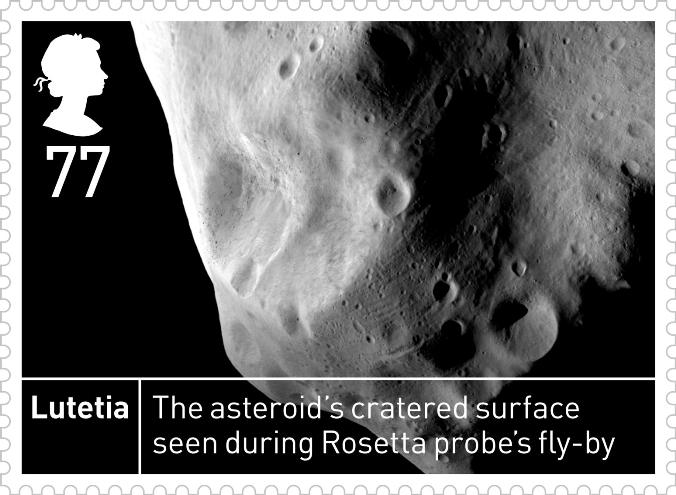
All six images are taken from missions conducted by the European Space Agency (ESA) and include the cavernous craters of Mars, the dizzying rings of Saturn, a close-up image of the Sun and a filament, a green-tinged picture of Titan – Saturn’s largest moon, the Lutetia asteroid and a shimmery picture of the south pole of Venus. Andrew Hammond, the Royal Mail stamps spokesperson, said “Britain has played an important role in space exploration over the last half a century and our Space Science issue is a fitting tribute.”

You can buy the set at the Royal Mail website.

Royal Mail Stamps: Saturn

Royal Mail Stamps: Titan

Royal Mail Stamps: Venus

Royal Mail Stamps: Mars

Royal Mail Stamps: Lutetia

Will the L'Aquila trial discourage scientists from being involved in public safety decisions?

Facebook poll

By James Dacey

On Tuesday 23 October a single judge in Italy is expected to decide the fate of seven men who have been charged in relation to the risk assessment that preceded the 2009 earthquake in L’Aquila that left 300 dead. On trial are four scientists, two engineers and a government official, who were all part of an expert panel affiliated with Italy’s Civil Protection Department.

This panel had met six days before the quake to discuss the level of risk posed by a recent cluster of seismic tremors. Following the meeting, two members of the commission gave a press conference during which – the prosecutors say – the accused gave false reassurances to the public that a major earthquake would not occur.

The seven commission members are not accused of failing to predict the earthquake. More specifically, they are charged with negligence regarding the risk assessment, as well as falsely reassuring the public that it was safe for people to remain in their homes because an earthquake would not occur. As part of their defence, the accused make it clear that it is incredibly difficult to predict precisely when and where an earthquake will strike.

If found guilty, they could each face up to four years in prison. You can read about the L’Aquila case as well as some of the latest research in latest in earthquake forecasting in this article published earlier this year in Physics World.

Clearly, the L’Aquila case is an incredibly complex mesh of science, politics and communication issues. It would be foolish to jump to any hasty conclusions before the verdict is announced, particularly without an in-depth knowledge of the cultures of both seismology and this small city perched on a hill in the Abruzzo region of central Italy.

But we want to know what effect this trial might have on scientists around the world, regardless of the outcome. In this week’s Facebook poll we want you to respond to the following question:

Will the L’Aquila trial discourage scientists from being involved in public safety decisions?

Yes
No

Please feel free to accompany your response with a comment to explain your answer.

In last week’s poll we asked if you agreed with the decision to award this year’s Nobel Prize for Physics to Serge Haroche and David Wineland for their experimental work on trapping and manipulating quantum systems. The outcome was that 87% of respondents do agree with the decision while the remaining 13% do not. A resounding seal of approval for the Nobel Committee. Thanks for all your responses and we hope you take part in this week’s poll.

Nanolayers make a coating of many colours

Researchers at Harvard University in the US have made a new type of optical coating that appears to change colour when its thickness is varied by just a few nanometres. The film, which is less than 20 nm thick, could be used to customize the colour of metal surfaces – a phenomenon that could not only be exploited to make pretty jewellery, but also a host of technologically advanced devices, including ultrathin light detectors and filters, displays, modulators and even solar cells.

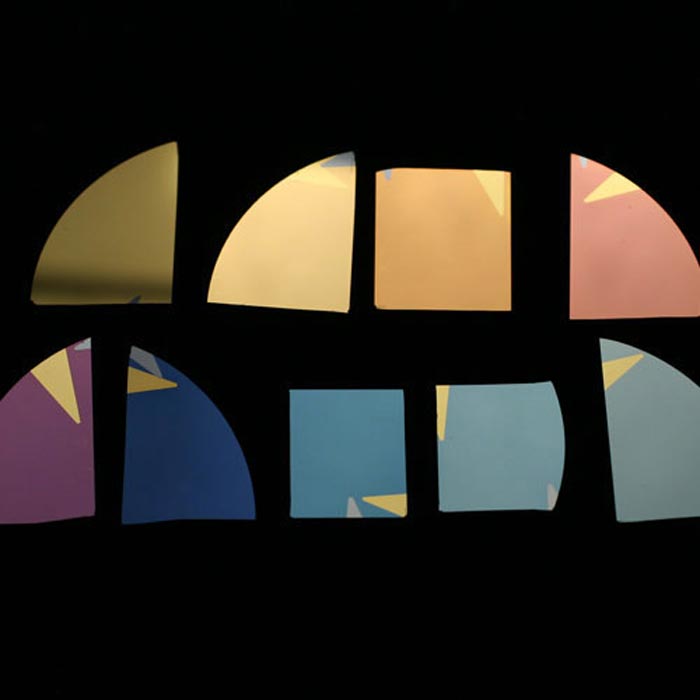
Conventional dielectric optical coatings, which are a key component of almost every optical device, are typically made of layers of transparent (or “lossless”) material, with each layer being at least a quarter wavelength of light in thickness. The new ultrathin optical coatings made by Federico Capasso’s team are different in that they comprise nanometre-thick, and nearly opaque, highly light-absorbing dielectric materials, such as semiconductors. The researchers have shown, for example, that adding a 7 nm layer of germanium to the surface of a gold sample changes its colour from gold to pink. Adding another 4 nm layer makes it violet, and another 4 nm turns the coating dark blue (4 nm is less than 15 atoms thick).

The effect is similar to what we see when there is a thin film of oil of the road on a wet day and we see many different colours, explains Capasso. The colours appear thanks to interfering light waves as they pass through the oil into the water below and then are reflected back up. Some wavelengths of incident and reflected light constructively interfere with one another and are “boosted”, while others destructively interfere and are absorbed.

Dramatic colour shifts

“In our case, the oil layer is ‘replaced’ by the light-absorbing germanium coating,” Capasso says, but astonishingly a difference of only a few atoms’ thickness across the coating is enough to produce the dramatic colour shifts we observed. “By changing the thickness of the films we change the interference conditions and thus can control which wavelengths will end up reflected and which will end up absorbed in the thin layer. As a result, the colour of the coating changes.”

The researchers have also already tried applying the germanium coating to a silver surface, which then appears gold at certain thicknesses as well as a range of pastel colours.

Exploring their artistic side

“While we plan to continue exploring the artistic side of this work – producing brilliant colours, rainbows and so forth – we are most excited about the potential technology applications,” team member Mikhail Kats says. “There is a whole host of device applications that employ light-absorbing semiconductor layers, including light detectors, displays, modulators and solar cells. If we could make any of these devices much thinner and more efficient, that would be very good news indeed.”

The team has filed a patent application for its coating process, which is itself fairly simple – involving standard lithography and physical vapour-deposition techniques – and is now looking to commercialize the new technology.

The work is described in Nature Materials.

Negative friction surprises researchers

If you press your finger gently on a table and slide it across the surface, you will find that it glides fairly easily. If you press harder, it becomes more difficult to slide it as the firmer contact generates more friction. But now, researchers in the US and China have shown that if you do the same experiment with an atomic-force-microscope tip on a graphite surface, then you can see the exact opposite effect – friction decreases the harder you push.

For large objects such as fingers and tables, the friction between two surfaces results from surface roughness, impurities, oxide layers and numerous other effects. On the nanometre scale, however, individual atomic interactions become relevant. As a result, the laws of nanotribology – the study of nanoscale friction – can be very different from the friction we experience in the macroscopic world. For example, friction can sometimes vary periodically with the atomic lattice as an atomic force microscope (AFM) needle moves across a surface. Nanotribology is becoming increasingly important as scientists and engineers develop tiny nanomachines for a range of potential applications from assembling circuits to targeted drug delivery.

The coefficient of friction measures how friction changes as a function of load. It can be highly variable at the nanoscale, with friction increasing nonlinearly with load. However, it had never been known to be negative – that is, that friction increases as an object is pulled away from a surface.

Routine measurements

But that is exactly what Rachel Cannara, Zhao Deng and colleagues at the National Institute of Standards and Technology (NIST) in Maryland and Tsinghua University in Beijing have found. The unexpected discovery was made by Deng while measuring the friction between a diamond microscope tip and a graphite surface as a function of tip load – a routine measurement made by novice nanotribologists who are learning the tricks of the trade. “We were looking at various behaviours that are known to occur and repeating what has been shown in the literature,” explains Cannara.

When Deng increased the load on the needle, he found, as expected, that the friction increased. When he reduced the load again, however, there was a surprise. Instead of returning to its original value, the friction continued to rise. This would be similar to finding that the lighter you pressed on the table, the harder it became to slide your finger across it. This defied all theoretical predictions and is the first recorded instance of a material showing a negative frictional coefficient. The increase in friction continued as the load was reduced until the needle was completely detached from the surface.

So what was going on? Previous research has demonstrated that materials such as graphite that have a layered atomic structure generate more friction with the needle of an AFM when they are only a few atoms thick. This is thought to be because thinner materials are more flexible. When an atomically thin material touches an AFM tip, therefore, it deforms more than its thicker counterpart would, thus increasing the contact area and generating more friction.

A sticky surface?

Cannara’s group was working with bulk graphite, but the researchers suspect that when the needle was pressed into the surface of the material, the intermolecular attraction of the top few atomic layers towards the diamond tip was sufficient that when the load was reduced, these layers were lifted slightly away from the bulk graphite, sticking to the tip and generating friction. Only when the tip was removed completely did the graphite return to its initial state. Two different computer simulations showed that the hypothesis was plausible, although technical differences between the results still need to be resolved, says Cannara.

Robert Carpick, whose laboratory at the University of Pennsylvania in Philadelphia was part of the team that originally discovered the increase in friction at atomic thicknesses, is impressed by the findings of Cannara’s group. “I think the paper is quite solid,” he says, “They show the result is robust and they associate it quite convincingly with the adhesiveness of the surface.” Carpick’s original paper looked at four different materials, all with the same layered structure and yet otherwise radically different, and found that the relationship between thickness and friction exists in all of them.

Carpick would now like to see whether Cannara’s analysis applies to other minerals, such as molybdenum sulphide, with the same layered structure. “I would bet that it does,” he says. “Because our group and others have seen that these thin, 2D, exfoliative layers share quite a bit of common behaviour, although of course they are made of different atoms and so the chemical energies of interaction with the tip will be different.”

The research is published in Nature Materials.

Hans Bethe’s early life

In 1937, two years after he moved to the US to escape Nazi persecution, the physicist Hans Bethe sent a letter to his mother in Germany. In it, he wrote, “I think I am about the leading theoretician in America. [Eugene] Wigner is certainly better and [Robert] Oppenheimer and [Edward] Teller probably just as good. But I do more and talk more and that counts too.”

Four decades after Bethe sent that letter, I decided to try to write a profile of him for the New Yorker. I had been writing about science for the magazine for nearly 20 years, and I thought that Bethe would make an excellent subject. By then he was perhaps no longer the “leading theoretician in America”, but his body of work was extraordinary, and it spread over many branches of physics. Bethe had played a leading role in building both the atomic bomb during the Second World War and the hydrogen bomb after it. However, he had subsequently turned his efforts towards stopping the proliferation of these weapons, and attempting to stop the construction of an anti-missile system that he was sure would not work. His work on the sources of stellar energy, which won him the Nobel Prize for Physics in 1967, was almost a sideline. And by the late 1970s he was devoting much time to trying to solve what he saw as an impending energy crisis.

All of these seemed like very good reasons for doing a profile, but there were two problems. One was that I had never met Bethe. The other was that the New Yorker‘s editor at the time, William Shawn, had an absolute loathing for nuclear energy, which Bethe insisted had to be part of the mix. I decided that the best course was to try to write a more personal profile in which the energy question could play a part. I wrote to Bethe and he agreed, but he warned that his personal life was not “terribly interesting”.

On that rather shaky basis, I conducted a series of interviews with him on and off for two years, then wrote a long article. It was scheduled for publication in the beginning of 1979, but then came the partial meltdown at Three Mile Island, which seemed to confirm everything that Shawn believed about nuclear energy. He cancelled my article after it was already in galley stage. In the end, the article was published, but only after I threw a tantrum – the first and last I ever threw while I was at the New Yorker.

I was reminded of all of this as I read a remarkable biographical study of the first 40 years of Bethe’s life. Nuclear Forces: the Making of the Physicist Hans Bethe is written by the physicist and historian of science Silvan Schweber, who actually worked with Bethe at Cornell and got to know him and his family well. Bethe died on 6 March 2005 at the age of 98, and his passing has allowed Schweber to tell us things that I would not have had the courage to tell in 1979, even if I had known them – which in many cases I did not.

Bethe was born on 2 July 1906 in Strasbourg in Alsace-Lorraine, then part of Germany. His father was a distinguished physiologist who came from a Protestant family. His mother was Jewish and her father, a physician, was one of the few Jews to hold a university position. Bethe, however, never thought of himself as a Jew until the Nazi racial laws designated him as one in 1933, forcing him out of his job at the University of Tübingen and out of the country.

When Schweber asked Bethe what he might have done if he had not been Jewish, Bethe replied that he might have done war research in Germany to escape military service. He added that unlike Werner Heisenberg, he would not have wished for a German victory. I wish that Schweber had gone on to ask if Bethe would have joined Heisenberg in his attempt to make a nuclear weapon.

Bethe told me that his parents had gotten divorced and that his father, who remained in Germany, had remarried. But that was about all. Schweber, however, has gone deeply into Bethe’s relationship with his mother, which was – and this is the only way I can think to describe it – deeply neurotic. Well into his 30s, Bethe was writing letters to his mother about the details of his romantic life and seeking her approval. Once, Bethe got engaged to a woman, but broke off the engagement shortly before the wedding because of his mother’s influence. It is remarkable that he was able to marry the woman he finally did marry, Rose Ewald, and perhaps even more remarkable that they did not get divorced when Bethe’s mother came over from Germany to move in with them. If she had not been persuaded to move out, the marriage might have been wrecked.

I did not know this when I wrote my profile, and in a way, I am glad – not because I would have been tempted to put any of it in, but because I would have felt that it was something I did not need to know. Schweber, however, is writing a real biography and details like this must be part of it.

Schweber also describes the close friendship that Bethe had with Edward Teller and with Teller’s wife, Mici. They had much in common. Teller and Bethe were intellectual equals, and all three were Jewish refugees finding their way in a new country. They did all sorts of things together, and when Bethe married Rose, the four of them continued. The friendship started to unravel at Los Alamos when the head of the Manhattan Project, Robert Oppenheimer, made Bethe instead of Teller head of the theoretical division. Teller resented this for the rest of his life and more or less refused to do work for the division. The friendship finally ended after Bethe tried unsuccessfully to persuade Teller not to testify against Oppenheimer during the latter’s security trial. Teller’s testimony was devastating, and he became something of a pariah in the physics community.

There is little of this in Schweber’s book, though, as it stops just before the war. Hence there is almost nothing about Los Alamos or the postwar physics in which Bethe played a very important role. What Schweber has written, however, is done with such care and in such detail that one hopes there will be a sequel of some kind.

Solar wind most likely source of water on the Moon

Scientists in the US claim that water on the Moon’s surface could have originated from the solar wind. Their experiments on lunar samples reveal the presence of significant amounts of hydroxyl inside glasses formed in the lunar regolith by micrometeorite impacts.

Although the possibility of water existing on the Moon has been debated since the 1970s, it was only in 2008 that the exact amount of water was confirmed thanks to technological developments. The following year NASA’s Lunar Crater Observation and Sensing satellite (LCROSS) crashed into a permanently shadowed lunar crater and ejected a plume of material that proved to be surprisingly rich in water ice. Water and other hydrogen compounds (OH, CH or H2) have also been detected in the lunar regolith – the layer of fine powder and rock fragments that coats the lunar surface.

Two years ago, LCROSS once again detected water in the lunar regolith in the form of ice, which made it clear that water exists on the Moon. But to help answer the question of how that water got there, researchers considered different ways in which the surface water could have formed on the Moon, including from the solar wind, a comet striking the lunar surface or volcanic degassing. Although lab simulations of solar-wind bombardment successfully produced hydroxyl compounds – which consist of one atom of hydrogen and one of oxygen – in lunar soils, the exact origin and storage of hydrogen in lunar soils remained unknown.

Looking at grains

In this new work, however, lead author Yang Liu of the University of Tennessee, along with colleagues of the University of Michigan and the California Institute of Technology, have measured hydroxyl in soil grains in Apollo samples. They then used the techniques of Fourier transform infrared spectroscopy and secondary-ion mass spectrometry to determine the chemical form of the hydrogen in a substance, as well as its abundance and its isotopic composition.

“With the infrared spectroscopy, conducted in the Youxue Zhang’s lab at the University Michigan, we can tell the form of ‘water’ – whether it is OH, H2O or CH,” explains Lui. With the secondary ion-mass spectrometry, conducted at Caltech, the team measured the amount of hydrogen and its chemical make-up. “We found that the ‘water’ component – the hydroxyl – in the lunar regolith is mostly from solar-wind implantation of protons, which locally combined with oxygen to form hydroxyls that moved into the interior of glasses by impact melting,” says Zhang.

Tracing the origins

The solar wind is a constant flow of charged particles from the sun and Liu says that its energy is enough to damage the surface of a grain but is low enough to be embedded and bound with oxygen on the surface. “During later impact melting of lunar soils, some of the hydrogen was transferred and stored in the glass formed by the impacts,” she says. Liu adds that without the protection of an atmosphere or a permanent magnetic field, solar wind has bombarded the surface of the Moon and other airless bodies for billions of years, delivering the necessary ingredient for making the hydroxyl.

“All previous studies of lunar samples were not able to determine the chemical form of hydrogen, but now, we have determined that the hydrogen in lunar soils exists as hydroxyl in the glass,” says Lui. Because of a combination of lab-based simulation and remote sensing, the team believes that it has robust evidence for solar-wind origin for some of the lunar surface water. For lunar polar ice, Liu’s finding suggests a possible source from solar wind in addition to comet impacts. These findings also suggest that water could exist on Mercury and on asteroids such as Vesta or Eros, further within our solar system. Although these bodies have very different environments, Lui believes that they all have the potential to produce water.

“Lunar regolith is everywhere on the lunar surface, and glasses make up about half of lunar regolith,” she says. “So our work shows that the ‘water’ component, the hydroxyl, is widespread in lunar materials, although not in the form of ice or liquid water that can easily be used in a future manned lunar base.”

$25,000 per pint

The researchers also point out that their findings show that there is a volumetrically large reservoir for water available on the Moon and that it is a valuable resource. “With the cost of $25,000 for taking one pint of water to the Moon, it is essential that we develop processes of producing water from the materials on the Moon. This is paramount to human settlement of the Moon in the near future,” says Lui.

This water would be of most value as rocket fuel – in the form of liquid hydrogen and liquid oxygen – she explains, adding that it has been suggested by others that water ice from the lunar North Pole alone could be converted to fuels equivalent to a space-shuttle launch every day for 2200 years. “Now we have ready sources of water that can be consumed by plants and humans but also dissociated into its constituent elements – O2 and H2. Thus, the Moon is a good candidate as a jump board for missions to Mars and beyond.” In the future, the researchers are keen to examine more lunar samples to come up with a good estimate of the “water budget” on the Moon.

The work was published in Nature Geoscience.

Moses Chan backtracks on search for supersolids

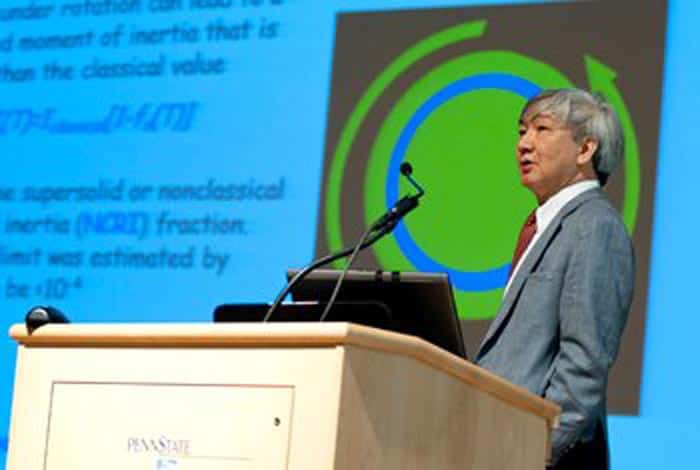
In 2004 Moses Chan and his graduate student Eun-Seong Kim thought that they had made one of the most exciting condensed-matter discoveries of the new century. It was the supersolid – a mysterious substance that could float through ordinary solids, like a ghost through walls. Now the Penn State University physicist has published a paper arguing that his initial interpretation was wrong – a mundane materials effect rather than supersolidity was the cause of their anomalous experimental results. “It would have been nice if the supersolid [interpretation] was correct,” he says, “but Mother Nature had her own way.”

The paper comes after Chan and others struggled for eight years to produce conclusive evidence for the effect. Although the experiments have been a disappointment, they were not done on a whim. The supersolid concept has a long history and theoretical physicists – including Nobel laureate Philip Anderson – have developed compelling arguments for its existence.

The saga began in 1969, when Russian theorists Alexander Andreev and Ilya Liftshitz predicted that, at very low temperatures, any vacancies left in an atomic lattice would “condense” into the lowest quantum state, forming a single entity. Since atomic vacancies are normally created by thermal energy, most solids are vacancy free at low temperature. But this might not be true of helium-4, in which atoms are so weakly bound that they can be knocked out of place by tiny quantum fluctuations. In principle, this collective state of condensed vacancies would flow through the solid unimpeded. This motion could be detected as an unimpeded superfluid-like flow of atoms in the opposite direction – hence a supersolid.

Strong, positive results

Chan and Kim were not the first to test Andreev and Liftshitz’s idea in the lab, but they were the first to get strong, positive results. Beginning in 1999, the physicists created a “torsional oscillator” – a fat, hollow cylinder hung on a twisting rod – which they filled with porous glass. Through the rod they injected helium-4 into the glass, and monitored the frequency of the cylinder’s oscillations as they brought down the temperature to absolute zero. At 175 mK, they noticed a sudden drop in the oscillation period. Kim and Chan interpreted this as a sign that some of the helium-4 had formed a supersolid, detaching itself from the oscillations as it passed effortlessly through the rest of the helium lattice.

The results were published in a 2004 letter to Nature entitled “Probable observation of a supersolid helium phase” and provoked a storm of interest. Many physicists struggled to understand the new phase of matter – and in particular, why it seemed to occur in some experiments but not others. Then in 2007 John Beamish and James Day, a pair of experimentalists at the University of Alberta in Canada, fired a bombshell: what if the reported signals had nothing to do with supersolidity, but basic material science? According to the Alberta researchers, a period drop could also be caused by a low-temperature stiffening of “dislocation lines” in bulk helium.

At first, Chan calculated that the contribution of the stiffening effect should be relatively small. But in time he realized that he had underestimated: rather than existing in isolation, the helium glued the whole cell together, and any stiffening would extend throughout. Last year, Chan and colleagues from Penn State and the University of Delaware designed a new, stiffer oscillator that would not be affected so much by elastic changes in the helium. In that experiment, the period drop was very small – the same order of magnitude as predicted by helium stiffening alone.

Worrying result

It was a worrying result, but it still left open the possibility that there was a combined effect of stiffening and supersolidity. Chan went back to his original 2004 experiment, and considered all the places where stiffening could occur. The way the helium was injected into the cell required a thin gap above the porous glass; here, bulk helium – and dislocations – could exist. This year, Chan and his postdoc Duk Kim redesigned the oscillator again, removing the gap. The result: no period drop, and no supersolidity.

I’ve been worrying about [stiffening] since 2007!
Moses Chan, Penn State University

“We didn’t realize that the [stiffening] could have such a dramatic effect at low temperature,” says Chan. “That’s the thing that took us so long – that is, in a way, embarrassing.” Yet despite the embarrassment, Chan shows signs of relief. “It’s not as dramatic as you might think,” he laughs. “I’ve been worrying about it since 2007!”

Not everyone is convinced that the story is over. Anderson believes supersolidity must exist from a theoretical point of view, although it may be that the phenomenon is too subtle for current instruments. And he is not the only hold-out: Chan’s ex-student Eun-Seong Kim, who now heads the Center for Supersolid and Quantum Matter Research at the Korea Advanced Institute of Science and Technology, insists that some results cannot be explained by the stiffening hypothesis.

Chan does not like to comment on his former student’s position. “We are very friendly with each other,” he says. “He is frustrated with me, but I suppose – well, we had to report what we see.”

Supersolid research has been a good example of how science works
John Beamish, University of Alberta

Other condensed-matter physicists – some of whom have also performed experiments to discredit the original supersolid interpretation – are supportive of Chan. Beamish describes how the Penn State researcher pursued the science with “amazing energy, even when his new experiments disagreed with his interpretation of his initial experiments.” Supersolid research, says Beamish, “has been a good example of how science works.”

Chan agrees. Like a detective novel, he says, the culprit is not always the most exciting part; it is the chase that provides the excitement. But does this mean he has lost all hope of finding supersolidity? Not quite: “Let me put it precisely,” he says. “Any supersolids greater than two or three parts in 10 to the minus five do not exist.”

Chan’s latest paper on supersolids is published in Physical Review Letters.

Copyright © 2026 by IOP Publishing Ltd and individual contributors