Gossamer ‘nanoweb’ blocks light

Can a transparent material with large holes in it block light? Normally the answer would be no, but researchers in France have now shown that a web-like structure made up of an array of evenly spaced nanorods appears to block almost 100% of light at a specific wavelength. The counter-intuitive “photonic nanoweb” might be used to make a new generation of optical devices, including light filters and sensors.

The nanoweb was made by Stéphane Collin’s team at the Laboratory for Photonics and Nanostructures in Marcoussis, France. Its ability to block light confirms a theoretical prediction made several years ago: that a structure resembling a type of diffraction grating made of nanorods regularly ordered in a 2D array would perfectly reflect light of a specific wavelength.

The array consists of transparent freestanding dielectric silicon-nitride nanorods around 500 nm thick that are lined up in a single layer of rows 3 µm apart (see figure). The rods only cover 15% of the surface area and the rest of the structure is empty space. Despite this simplicity, its construction was a significant challenge, according to the team.

From transparent to opaque

The 2D array allows a broad range of light wavelengths to pass through it, as expected, but infrared light that has a wavelength of exactly 3.2 µm is almost totally reflected from the material. “We found that the optical response of the nanoweb changes in a very narrow spectral range and that the structure goes from being transparent to opaque in this range,” explains Collin. “Light with a wavelength of 3 µm is transmitted through the web but the light transmission signal drops sharply at 3.2 µm.”

Although the nanoweb resembles a very sparse diffraction grating, it actually behaves more like a crystal with the rods acting like a monolayer of atoms that multiply scattered light. “The incident light is first scattered by each nanorod and then some of this scattered light impinges on the other nanorods and is scattered again,” says team member Petru Ghenuche. “A constructive interference of light waves builds up from this multiple scattering process in the plane of the scatterers and, finally, the sum of the scattered light is emitted in both the forward and backward directions.”

In the forward direction, the light waves scattered by the rods and transmitted through the rods are cancelled out by destructive interference, leading to perfect optical extinction and 100% light reflection, he explains.

Bragg diffraction, but not quite

The effect is similar to the better-known Bragg diffraction, which occurs in 3D crystal lattices, and both phenomena take place thanks to scatterers with a small cross-sectional area. The difference, however, is that the constructive interference in Bragg diffraction involves a large number of planes, while in the nanoweb almost 100% of photons interact with the scatterers in just a single lattice plane, explains Collin.

Until now, research on nanostructures that interact strongly with light in this way was confined to metallic nanostructures, such as gold nanoparticles. In such nanostructures, collective oscillations of surface electrons – called surface plasmons – strongly absorb or scatter light. The new study shows that these strong interactions can also be produced by a periodic arrangement of freestanding dielectric structures, like silicon-nitride nanorods.

“A huge advantage of our nanoweb structure is that the interaction with light can easily be tuned by varying the period between the nanorods and/or their diameter and is thus not restricted to the range of frequencies of specific plasmons in a given metallic nanostructure,” says Collin. “Being able to block light at visible frequencies, rather than just those in the infrared, is clearly a short-term goal of ours and we are also busy working on nanoweb designs that might be used in light-sensing applications.”

The current work is detailed in Physical Review Letters.

Mavericks, outsiders and cranks

Wertheim is a science journalist, originally from Australia but now based in Los Angeles, who has talked to a whole range of cranks and outsiders to find out what makes them tick for her book Physics on the Fringe. Their motivations might seem relatively benign, but as Wertheim reveals in the podcast, since writing the book she has found their reactions to it to be far from pleasant.

Kaiser, meanwhile, is a historian of science at the Massachusetts Institute of Technology. How the Hippies Saved Physics is about a loose collection of physicists on the west coast of America that made important contributions to quantum-information theory back in the 1970s. At the time these physicists were into some pretty weird stuff, including ESP and occultism, which meant that their work was largely ignored.

Interestingly, however, one piece of work that these researchers did suggested that quantum entanglement could be used for faster-than-light communication. Although this was later proved to be incorrect, finding the flaw in the work led other scientists to develop the “no-cloning theorem”, which states that you cannot create identical copies of arbitrary unknown quantum states. That theorem is now at the heart of quantum cryptography – the idea that you can send messages with absolute secrecy.

Listen to the podcast now to find out more about just why it is so hard to draw the line between science that is crazy enough to be true and science that is just plain crazy.

Shine on, you crazy diamond

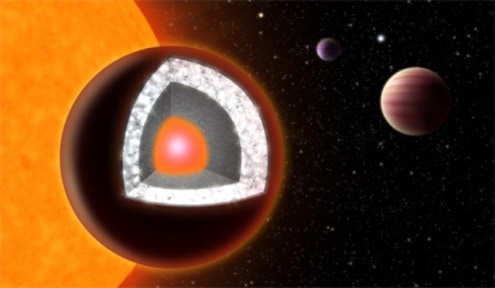
Artist's impression of 55 Cancri e


Artist’s impression of 55 Cancri e – graphite surrounding diamond, then silicon and a molten iron core. (Courtesy: Haven Giguere, Yale University)

By Tushna Commissariat

There’s nothing quite like a planet made mostly of diamond to get everybody’s attention, and that is what a team of astronomers from Yale says it might have found. The researchers say that 55 Cancri e, a rocky super-Earth, is mainly made of carbon – in the form of diamond and graphite.

This is not the first time a “diamond planet” has hit the headlines. Last year an international team of researchers found a pulsar, with an orbiting planet about the mass of Jupiter, that seemed to be made entirely of diamond. Further research revealed that “the planet” was, in fact, the pulsar’s companion star – an ultralow-mass carbon white dwarf that just about survived being completely destroyed by the pulsar. The core of the remnant would mostly be carbon and some oxygen, but thanks to the near-Jupiter mass of the companion star, its own gravity could crystallize it to form diamond – just how carbon is transformed into diamond deep within the Earth. You can take a look at the paper about that research here.

This time, astronomers seem much more certain that what they are dealing with is indeed a planet. 55 Cancri e belongs to the 55 Cancri star system, which is a mere hop, skip and jump away from Earth in astronomical terms at a distance of 41 light-years. Indeed, the system – with five known planets that orbit a parent star – can be seen with the naked eye on a clear, dark night. Interestingly, 55 Cancri e is the closest planet to its parent star, with a dizzying 18-hour orbit – the shortest orbit known for an exoplanet – and is tidally locked, so one side always faces the star. Until now, it was thought to have a substantial amount of super-heated water on its surface and was believed to have a similar chemical composition to Earth.

However, new data and research have shown that the planet contains no water at all, and appears to be composed primarily of carbon, iron, silicon carbide and, possibly, some silicates. The study, led by Yale postdoctoral researcher Nikku Madhusudhan and colleagues, estimates that at least a third of the planet’s mass – the equivalent of about three Earth masses – could be diamond.

“This is our first glimpse of a rocky world with a fundamentally different chemistry from Earth,” says Madhusudhan. “The surface of this planet is likely covered in graphite and diamond rather than water and granite.” In 2011 Madhusudhan revealed the first discovery of a carbon-rich atmosphere in a distant gas-giant planet, opening the possibility of long-theorized carbon-rich rocky planets or “diamond planets”.

The conformation of this carbon-rich super-Earth now means that the many rocky exoplanets thought to exist can no longer be assumed to have chemical constituents, interiors, atmospheres or biologies similar to those of Earth, according to Madhusudhan. A carbon-rich composition could influence the planet’s thermal evolution and plate tectonics, for example, with implications for volcanism, seismic activity and mountain formation.

This is the first time astronomers have identified a likely diamond planet around a Sun-like star and specified its chemical make-up. Further spectroscopic analysis of the planet’s atmosphere and its parent star’s composition will be necessary to ascertain 55 Cancri e’s “priceless” composition.

A paper on the work has been accepted for publication in the journal Astrophysical Journal Letters and an arXiv preprint is available here.

Meteorite points to asteroid Vesta’s dynamo

A team of scientists in the US says that the asteroid Vesta probably had a rotating liquid core in its early history. This, the researchers say, created a dynamo that produced a magnetic field strong enough to magnetize the rocks on its surface. As it was previously thought that only larger planets, such as Earth, had dynamos, the work suggests that protoplanets, like asteroids, may be more planet-like than previously thought. The findings could help researchers better understand the early history of the formation of the solar system.

Vesta is one of the most massive asteroids in the solar system, second only to the dwarf planet Ceres. The Dawn mission to study both Vesta and Ceres was launched by NASA in 2007. It entered orbit around Vesta on 16 July 2011 then on 5 September this year it left orbit and it is currently en route to Ceres, where it is scheduled to arrive in February 2015. Vesta is known to have lost about 1% of its mass in a collision that is thought to have occurred a billion years ago. This left a massive impact crater occupying much of Vesta’s southern hemisphere and debris from this event has fallen to Earth as howardite–eucrite–diogenite (HED) meteorites. These have been traced back to the asteroid by matching the unique oxygen-isotope “fingerprints”, which prove that the meteorites originated from Vesta.

Active cores

It is samples of one of these meteorites – an eucrite meteorite ALHA81001, found in Antartica – that Roger Fu and colleagues from the Paleomagnetism Laboratory at the Massachusetts Institute of Technology in the US have studied. “Our group studies magnetism in rocks – terrestrial rocks, lunar rocks and, now, we have been studying meteorites from Vesta,” explains Fu. He points out that the Dawn spacecraft does not have a magnetometer on-board, so the magnetic properties of the asteroid must be inferred from the HED meteorites that are being tested in the lab.

Vesta has a metallic core, which consists of 5–25% of its total planetary mass and is thought to have formed sometime within the first 1–4 million years of the solar system’s existence. Via remote sensing, Dawn has made the most accurate measurement yet of Vesta’s current size, and has approximated Vesta’s core to be about 107–113 km in radius.

Fu and colleagues now say that Vesta’s liquid metallic core once had a dynamo. This is the means by which a planetary body creates and maintains a magnetic field via a rotating, convecting and electrically conducting fluid at its core. “If a rock cools in a magnetic field, it records the magnetic properties of the field; so by studying it in the lab, we can deduce the strength of the field,” explains Fu. The team did other studies using argon–argon dating and concluded that the meteorite acquired its magnetic signature about 3.69 billion years ago from a surface magnetic field large enough to have been created by an ancient core dynamo. Because this period of magnetization was well before the impact in which the meteorite was created, the team can conclude that the magnetization could not have been induced as a result of the meteorite re-heating on Earth. “When the meteorite formed 3.7 billion years ago, Vesta did not have an active core dynamo. So, this means that there had to be a considerable surface magnetic field on Vesta – to induced magnetism in the rocks – that remained even after the core was not active,” says Fu.

Magnetic sunscreen?

In addition, other data show that the surface of Vesta seems to be less space-weathered than expected. If a sample of the Vesta meteorite is exposed to an ionized beam – representing ionized solar wind that causes weathering – the sample changes colour and mineralogical changes are seen too. “But what we actually see on Vesta is different – it is not as weathered. Something is preventing the solar wind from eroding it as much, and there is a good chance that it is the magnetic-field remnant that is doing so,” says Fu. He says that the strength of the field required to shield the Vestian surface from the solar wind matches that of the actual field strength deduced from the meteorite. “There is a linear relation between the strength of magnetism in the rocks and the strength of the field they were formed in, so we can calculate it. And the strength of the magnetic field corresponds to the size of the core dynamo, which depends on how big the core is, so it is all linked,” says Fu. These findings, combined with the Dawn data, have also provided the final evidence necessary to say that the HED meteorites do originate from Vesta. “There is no lingering doubt now,” explains Fu.

In the future, Fu and colleagues will consider magnetism in the early solar system; indeed, they hope to study magnetic fields in protoplanetary discs. “Theorists have not modelled magnetic fields in nebulae in decades, and we would like to do that,” says Fu.

The research is published in Science.

Carbon dioxide ‘corrodes’ ice, say scientists

The amount of carbon dioxide in the atmosphere has risen from roughly 280 ppm shortly before the industrial revolution to about 390 ppm today. Now researchers in the US have done atom-level simulations that suggest that increased concentrations of the gas causes ice to become more brittle, and so more likely to break up or crack. Although the work focussed on tiny “nanocrystals” of ice, the team believes that it could improve our understanding of cracking in much larger structures such as glaciers and ice caps.

“This result suggests that the chemical composition of the atmosphere can be critical to mediating the motion and/or melting of large volumes of ice, beyond the effect of global temperature,” Markus Buehler of the Massachusetts Institute of Technology (MIT) explains. “In some sense the fracture of ice due to carbon dioxide is similar to the breakdown of materials due to corrosion, e.g. the structure of a car, building or power plant where chemical agents ‘gnaw’ at the materials, which slowly deteriorate. In the case of ice, carbon dioxide can play the role of a corroding agent and lead to a destabilization of the structure.”

Glaciers and ice caps cover 7% of the Earth, an area greater than Europe and North America. They reflect 80–90% of incoming solar radiation and act as a carbon sink – this means that significant melting could create a feedback loop and boost warming further.

Breaking bonds

“Similarly to other materials, the fracture process of bulk ice, for example glaciers, is usually initiated by single cracks propagating in ice crystals by breaking the hydrogen bonds between water molecules,” says Buehler. “These cracks eventually grow and break down the entire glacier by propagating and branching over large distances. Very large-scale ice fractures occurred recently close to Pine Island Glacier [in Antarctica], which generated an iceberg with an area the same size as the city of Berlin.”

Buehler and colleague Zhao Qin used atomic simulations to examine the effect of carbon dioxide on crack growth in ice. They calculated that ice containing 2% carbon dioxide was less strong than pure ice and 38% less tough, with a fracture toughness of 12.0 kPam1/2 rather than 19.4 kPam1/2.

“It is difficult for experiments alone to directly measure the nanoscale properties of ice as a function of carbon-dioxide concentration,” says Buehler. “That is why we decided to use a series of first-principles-based atomistic-level computer simulations to investigate the very detailed mechanisms.”

Molecules move towards crack tip

The team found that carbon dioxide disrupts the hydrogen bonds between water molecules in the ice, since the oxygen atoms in the gas have a partial negative-charge and are attracted to the positively charged hydrogen atoms of the water. In the simulations, carbon-dioxide molecules attached to the crack surface and moved towards the crack tip, breaking hydrogen bonds between water molecules as they went.

“If ice caps and glaciers were to continue to crack and break into pieces, the surface area that is exposed to air would be significantly increased, which could lead to accelerated melting and much reduced coverage area on the Earth,” says Buehler. “The consequences of these changes remain to be explored by the experts, but they might contribute to changes of the global climate.”

Buehler says that the technique used in the study has also been applied to study the mechanical properties of protein materials and polymers, whose structures are typically stabilized by hydrogen bonds. “For these structures, we found that the chemical conditions, for example, pH, ion concentration and ion type, are very important in affecting the material structures and mechanical functions,” he says. “Our current result, which shows that carbon dioxide decreases the hydrogen-bond strength at the crack tip, agrees with the findings from our former work but makes an important contribution to the understanding of one of the most critical, and abundant, materials for our planet’s climate – frozen water, or ice.”

Buehler and Qin report their work in Journal of Physics D: Applied Physics. They say that more work is needed to link their microscopic insight to larger-scale properties of ice, glaciers and other geologically relevant structures.

Do you agree with this year's Nobel decision?

Facebook poll

By James Dacey

So another year goes by and we have two new Nobel physics laureates who join the pantheon of scientific idols. Just in case you have been confined in the Utah desert in some kind of Mars-simulation experiment for the past couple of days, this year’s prize went to Serge Haroche and David Wineland for their nifty experimental work on trapping and manipulating quantum systems.

What do you make of the choice? Let us know by visiting our Facebook page and taking part in our poll.

In truth, the decision of the Nobel committee has proved largely uncontroversial in the physics community, with tributes to the pair flying in from all quarters. Among the congratulators was Sir Peter Knight, president of the UK Institute of Physics, who hailed Haroche and Wineland for bringing “tremendous advances in our understanding of quantum entanglement, with beautiful experiments to show how atomic systems can be manipulated to exhibit the most extraordinary coherence properties”.

The only murmuring of a controversy is the suggestion that the Caltech researcher Jeff Kimble was overlooked as a third recipient of the prize. Kimble was one of the pioneers of cavity quantum electrodynamics (CQED) – a technique whereby the properties of an atom are controlled by placing it in an optical or microwave cavity. It was for developing the field of CQED that Haroche won his half of this year’s prize.

Interestingly, there has been no official congratulation from CERN on either its homepage or Twitter feed. Some people, including the editor of physicsworld.com Hamish Johnston, had argued that the confirmed discovery of a new boson at the LHC was enough to secure this year’s Nobel prize. That was also the sentiment of Physics World readers who took part in last week’s poll, with 63% of them selecting the discovery of the Higgs boson as their choice for the prize.

In fairness, though, Wineland and Haroche’s work on quantum optics was not one of the options in our poll. In customary style, the Nobel committee managed to identify a perfectly sensible choice of winner that had not been widely predicted beforehand.

So let us know what you think of this year’s prize by taking part in this week’s poll.

Cornering the Higgs boson

In one sense, the Large Electron–Positron (LEP) collider at CERN could have been considered a failure. Although LEP had cost about a billion Swiss francs (CHF) to build, and even more than that to operate from 1989 to 2000, researchers did not discover a single new elementary particle using it. Sure, they made tremendous refinements of the properties of the massive W and Z bosons – the weak-force-bearing particles that had been discovered at CERN in the early 1980s – as well as precision measurements of other important parameters of the Standard Model of particle physics. But during that 12-year period, only Fermilab could claim a fundamental particle discovery – of the top quark in 1995.

In another sense, however, LEP was a major success. For physicists had excluded a huge range of masses in which any Higgs bosons would have been almost impossible to discover by experiments at proton colliders. A particle that remotely resembled the Higgs boson predicted by the Standard Model should have appeared in electron-positron collisions at LEP had its mass been up to as high as 114 billion electron volts (114 GeV), according to a combined analysis of the four LEP experiments published in 2003 (Phys. Lett. B 565 61). But nothing new had cropped up in this range. And the precision LEP measurements, taken together with the top-quark mass as determined at Fermilab, required that any Standard Model Higgs boson had to show up at a mass below 193 GeV (at a confidence level of 95%). As nobody could have said anything much about its mass before 1989, LEP researchers had thus taken a giant step on the long road to cornering the Higgs boson.

And many physicists on the ALEPH experiment at LEP, which had recorded the most telling candidate events, argued that they had witnessed good evidence for it at 115 GeV. In December 2000 they published a paper entitled “Observation of an excess in the search for the Standard Model Higgs boson at ALEPH” (Phys. Lett. B 495 1), claiming a 3σ excess of Higgs-like events at this energy. But the other three LEP experiments did not confirm these results. Therefore the combined analysis allowed only that such a signal might have occurred – in other words, the signal-plus-background hypothesis fitted all the data better than no signal at all, but not by much. In late 2000 CERN finally shut LEP down after a heated debate and began construction of the Large Hadron Collider (LHC).

Focus on Fermilab

As the new century dawned, physicists at Fermilab could look forward to more than five fruitful years during which they had no competition at all in the Higgs search. It would take at least that long (and as it turned out, much longer) to build and install the LHC in the 27?km LEP tunnel. Boasting a collision energy of almost 2 × 10¹² eV (2 TeV), Fermilab’s Tevatron proton–antiproton collider was then the most powerful machine on Earth – and the only one able to generate exotic new particles with masses above 100 GeV. But would it have a sufficiently high collision rate, or luminosity, to create enough of the expectedly rare Higgs events?

A daunting problem with hadron colliders such as the Tevatron or the LHC is that they also produce lots of extraneous debris because protons and antiprotons are not elementary but composite particles made of quarks and gluons. Indeed, Caltech theorist Richard Feynman once compared proton collisions to “smashing garbage cans into garbage cans”. A lot of garbage comes bursting out, some of it looking a lot like the expected decay products of Higgs bosons. At LEP this was not a problem because it collided electrons and positrons, which are essentially point particles with well-understood electromagnetic interactions. Its candidate Higgs events had only two or four tightly packed “jets” of hadrons, corresponding to emerging quarks, and little else. These events could be recognized rather easily.

But at the Tevatron and the LHC, such Higgs-like signals would be swamped by the immense backgrounds of ordinary hadron events. It is not unlike trying to detect a fire-fighter smoking a cigarette in the midst of a forest fire from the two different smoke patterns emitted. If you happen to have a strong, distinctive signal, digging it out from such backgrounds is easier. But if not, experimenters must try to accumulate a tremendous number of events to be certain they can convincingly extract a meaningful signal from the smothering background. And that takes luminosity or time. Or both.

At the lower masses where the Higgs boson was thought most likely to lurk after the LEP shutdown, from 115 GeV to 193 GeV, there was one possible strong, distinctive signal – at just above 155 GeV, where a Standard Model Higgs boson should often decay into an obvious pair of W bosons. Below that it had a bewildering variety of pathways by which to break up. And at masses of less than 135 GeV, it should disintegrate preferentially into pairs of bottom quarks, the next-heaviest link in the great elementary chain of being, as well as gluons and tau leptons. But what these kinds of particles themselves transform into looks much like all the other debris clobbering the detectors. And when an individual W or tau decay involves an easy-to-identify electron or muon, it must also produce a neutrino that exits the detector leaving no track or energy deposit, which makes it more difficult to establish the mass and hence identity of the parent particle. Even if a Higgs boson actually existed at 115 GeV, as the ALEPH experiment had seemed to suggest, it was going to be a long, hard slog to hunt it down amidst such a mess. Finding the Higgs boson at Fermilab was not going to be a piece of cake.

While the Tevatron had plenty of time, it attained insufficient luminosity, especially during the first half a decade. Due to construction and commissioning delays, the LHC experiments did not in fact begin logging data until 2010; the big CDF and D0 experiments at the Tevatron therefore had almost the entire decade all to themselves. A brief flurry of excitement erupted in early 2007 when a group of CDF researchers reportedly observed a small surfeit of events around 160 GeV, disintegrating into tau leptons rather than W bosons. Some interpreted the bump in the graphs of data as evidence of a Higgs boson as predicted by supersymmetric theories, which would decay preferentially in this manner. But interest faded a month later, after the D0 experiment could find nothing similar. And as the data continued trickling in at CDF that year, the intriguing excess withered away – as had so many others.

When the two experiments reported combined results in September 2011, just before the aging, 26-year-old Tevatron was to be shut down forever, there were only small, barely 1σ excesses of Higgs-like events at masses between 115 GeV and 155 GeV – not nearly enough to claim anything significant. Above that level they found too few events decaying via W pairs, so Fermilab could at least take satisfaction in ruling out any Higgs bosons between 156 GeV and 177 GeV. But that was little to show for 10 years of difficult, frustrating research. And it was not enough to convince Fermilab director Pier Oddone to grant the Tevatron a brief stay of execution. As CDF researcher John Conway of the University of California, Davis, lamented, “We’ve gone a very long time with no truly new discovery in particle physics, no observation that truly changes the paradigm.”

Ups and downs at CERN

Fermilab had enjoyed extra time all to itself in the Higgs search due to teething problems at the LHC, the construction of which was delayed by two years because of cost overruns and schedule stretch-outs. In September 2001 CERN director-general Luciano Maiani dropped a bombshell in its council meeting, announcing that the LHC costs were going to grow by almost 20% to CHF 3.34bn, including detector costs. And another CHF 120m would be needed for computing infrastructure. Further cost overruns and delays came later in the decade as a result of problems with the superconducting magnet systems, which had to be cooled with truckloads of liquid helium to just 1.9 K, or –271 ° . When all the expenses were totalled up in 2006, including materials and labour, the final LHC price tag came to about CHF 6bn, more than double its initial advertised cost. Contributions from Canada, China, India, Japan, Russia and the US – the Americans alone having supplied more than half a billion dollars’ worth of equipment – helped ease these financial growing pains. But everything finally seemed to be coming together. On 10 September 2008, with the whole world listening and watching via the BBC, CERN accelerator physicists successfully circulated twin 450 GeV proton beams in both directions through the huge machine without incident. Corks popped. Champagne flowed.

But nine days later, LHC project manager Lyn Evans took a panicky phone call from the control room telling him to come quickly. When he arrived, flashing alarms warned that many magnets had failed and helium gas was filling the tunnel. Later analyses indicated that an electrical splice between two of its 1232 dipole magnets had warmed and “gone normal”, losing superconducting properties. After it melted, an intense spark surged through the magnet vessel, puncturing it and releasing tonnes of helium. When workers later entered the tunnel, they found dozens of magnets damaged, some ripped from their mounts. Soot covered the carnage. Evans called the disaster “a real kick in the teeth for everyone”.

It took more than a year and over CHF 100m to get the LHC back on its feet, and then it was only hobbling. Many splices were found to have additional flaws and would have to be replaced, as did several superconducting dipole magnets. It would be impossible to run the LHC at its design energy of 14 TeV until all the defective splices could be fixed, but that would only happen a few years later. Physicists began to lament that perhaps – after this disaster and the death of the Superconducting Super Collider – God did not want her particle to be discovered, after all.

Cue the collisions

The LHC finally collided protons at 900 GeV on 23 November 2009, with two detectors – ATLAS and CMS – recording the initial events. Four months later, operators gingerly ramped beam energies up to 3.5 TeV, achieving collisions at 7 TeV – but at low intensity. Chastened by the 2008 disaster, researchers became resigned to logging data at only half the original LHC design energy. “It was time to do some physics,” reflected the new director-general Rolf-Dieter Heuer, and making the needed repairs all at once would delay the start of research for at least another year. Wary of a second disaster, CERN accelerator physicists and engineers led by Steve Myers concentrated on improving the collider’s reliability and preparing it for the 2011 run.

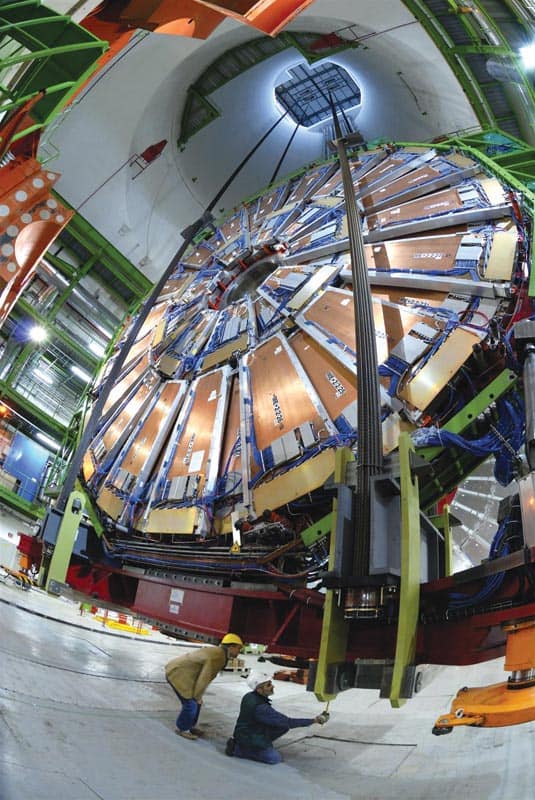
The immense, cathedral-sized 7000 tonne ATLAS detector and 12,500 tonne CMS detector had been thoroughly checked out and were ready to begin taking data in their vast underground caverns. It had been a long wait for both 3000-member collaborations – especially the PhD students and postdoctoral researchers, for many of whom this was to be their first experience of a real live particle-physics experiment. These two general-purpose detectors were optimized to be especially sensitive to weighty particles such as a Higgs boson and others expected to occur in supersymmetric theories. They both have excellent energy and momentum resolution (about 1–2%) for electrons, muons and photons. Although a Higgs boson was expected to decay predominantly into pairs of bottom quarks or W bosons, most of which would affect the detectors as jets of hadrons, these decay modes would likely be buried under suffocating backgrounds billions of times larger – and thus nearly impossible to dig out. By concentrating on rare decays in which these leptons or photons appeared, researchers had much better hopes of discerning a signal.

Serious data-taking began in 2011, as operators nudged the luminosity steadily upwards, and proton collisions began rolling in. There were the usual false alarms and overreactions of bloggers, reporters and other scoop chasers who were hovering over the action the entire year. Sau Lan Wu’s group at the University of Wisconsin, for example, circulated an excited internal report in late April of a potential 115 GeV Higgs boson (reminiscent of the final 2000 ALEPH events) decaying into a duo of high-energy photons; it quickly found its way into the blogosphere and went viral, forcing researchers to cancel their Easter vacations to check it out. This “Easter bump”, recalled then CMS spokesperson Guido Tonelli, helped focus his colleagues’ attention on this rare but (soon-to-be) important decay channel. However, the effect proved to be a random fluctuation that withered away in early May after more data came in.

Rumours flew that candidate Higgs boson events might be revealed at the summer 2011 physics conferences. The ATLAS and CMS experiments showed modest excesses of events between 115 and 145 GeV but little else worthy of a press release. CERN could rule out Higgs masses down to 145 GeV and beyond 177 GeV, improving significantly upon the existing Fermilab limits. The Higgs boson was running out of places to hide. If it indeed existed, it now had to be confined to a narrowing range of possible masses between 114 GeV and 145 GeV.

Data deluge

That autumn LHC operators steadily prodded its luminosity to new heights. By the end of the 2011 runs, both experiments had accumulated almost half of what the Fermilab experiments had managed over the previous decade – and at 3.5 times the energy. Events flooded in almost too fast to be recorded. And a small fraction of them looked just as expected for a Higgs boson with a mass close to 125 GeV. In a proton collider such as the LHC, the dominant production mechanism for such a particle is “gluon fusion”, in which gluons in two colliding protons merge to create a Higgs boson, which should quickly break up mainly into two bottom quarks, the most massive final state readily accessible. But that signal would be buried under a huge, burdensome mountain of noise; it is thus very difficult to extract, due to the detectors’ poor energy resolution for hadron jets.

ATLAS and CMS Higgs hunters therefore focused instead on final states with two photons or four charged leptons (electrons or muons), for which they did have good energy resolution and could observe all of the decay products. Although these are rare decay modes, occurring much less than 1% of the time, the narrow peaks that result from plotting such events versus their total energy (or, more accurately, invariant mass) should jut up above the smooth continua of two-photon and four-lepton background events. And that indeed seemed to be the case – especially for the two-photon final state, for which both experiments witnessed more than 70 excess events near 125 GeV. In addition, ATLAS physicists unearthed a few extra four-lepton events at the same energy, while CMS found a similar surfeit near 120 GeV. Something new and Higgs-like was happening in this vicinity.

CERN went cautiously public with these preliminary results in a dual seminar on 13 December 2011, viewed on webcast by thousands of particle physicists and science reporters around the globe. Expectations were high, as rumours of a discovery had been percolating for over a week. But nobody (except some in the press) claimed a discovery. “We have restricted the most likely mass region for the Higgs boson to 116–130 GeV, and over the last few weeks we have started to see an intriguing excess around 125 GeV,” noted ATLAS spokesperson Fabiola Gianotti. Tonelli agreed with her assessment, admitting that CMS physicists “cannot exclude the presence of the Standard Model Higgs between 115 and 127 GeV because of a modest excess of events in this mass region”.

What was new and strikingly different this time was how ATLAS and CMS corroborated one another, revealing intriguing peaks beginning to emerge near 125 GeV. In addition, the CMS experiment had found Higgs-like events in a few other decay modes at about the expected rates. When the combined analyses of these two experiments were published the following February, both the ATLAS and CMS experiments claimed to be observing better than 3σ effects near 125 GeV. But after further data analysis, the statistical significance fell below that level in results presented at the March 2012 Moriond Conference in La Thuile, Italy, considered the principal winter gathering for particle physics. And when the “look-elsewhere effect” (see Physics World August p26) was included, the significance dropped to just above 2σ. These were not yet robust results.

Down but not out, CDF and D0 physicists – many of whom also worked in the ATLAS and CMS experiments – were preparing their comeback. Using sophisticated techniques, they reanalysed both of their full data sets, struggling to wring out every possible Higgs boson event. The Tevatron should have been particularly effective at generating “associated production” events in which a quark within a proton merges with an antiquark from a colliding antiproton to yield a W or Z particle plus a Higgs boson. CDF and D0 physicists sought events in which the W or Z decayed into an easily identified lepton pair and the Higgs boson into two bottom-quark jets; in such events they had much better chances of discerning a Higgs-like signal from noise. And indeed, they succeeded.

At the Moriond conference, both Tevatron experiments revealed new data with broad bumps between 110 GeV and 140 GeV. Combined into a single result, the CDF and D0 data had a bulging 2.2σ excess between 115 GeV and 135 GeV (figure 1), much as expected for a 125 GeV Higgs boson disintegrating into bottom quarks; but the events were spread out over a much wider mass range as a result of the detectors’ poor energy resolution for hadron jets. These Fermilab data clearly reinforced the 2011 CERN results.

Endgame in sight

It looked like the elusive Higgs boson had finally been cornered. While none of the individual results was convincing by itself, four separate experiments had witnessed intriguing excesses in the vicinity of 125 GeV. And the decays of whatever it might turn out to be accorded pretty well with the Standard Model prescriptions for a Higgs boson (but at only moderate significance). Moreover, the indirect limits on such a particle based on precision measurements had long suggested that a lower-mass Higgs boson should in fact exist.

Some theorists were already convinced it had indeed been discovered. “I’m willing to bet a year’s salary!” exclaimed Nima Arkani-Hamed of the Institute for Advanced Study in Princeton, New Jersey, in a panel discussion in March. Gordon Kane, a co-author of the 1990s classic book, The Higgs Hunter’s Guide, thought so, too. “When you have four independent signals, they almost never go away,” he argued at a press conference in April, suggesting that one could get a 5σ result just by combining all the data from the four experiments. But Kane had an obvious theoretical axe to hone, too, having co-authored a paper the previous December, only days before the CERN seminar, predicting a 122–129 GeV Higgs boson based on considerations of supersymmetry and string theory.

Cautious experimenters, wary of getting too far ahead of the data, however suggested everybody take a deep breath and sit tight until after this year’s LHC runs, which began in April with protons colliding at 8 TeV and machine operators aiming to double the luminosity. By the end of 2012, predicted CERN officials, ATLAS and CMS physicists should have the final answer – and be able to put an end to Peter Higgs’ long, long wait.

And his wait turned out to be shorter, as the official discovery of a Higgs-like particle near 125 GeV was announced on 4 July (see “CERN discovers Higgs-like boson”). The decades-long search for a Higgs boson was finally over.


Neil Turok looks forward to living a quantum life

Neil Turok


An analogue Neil Turok dreams of a quantum life. (Courtesy: Perimeter Institute)

By Hamish Johnston

Years ago when I lived in Canada I used to love listening to a CBC radio programme called Ideas, which devotes one hour to the in-depth discussion of a concept, event or idea. Incredibly, there are five episodes a week and the show has been running for 47 years – and still hasn’t run out of ideas!

Recently, the programme’s host Paul Kennedy was at the Perimeter Institute for Theoretical Physics in Waterloo, Ontario to chat with its director, the mathematical physicist Neil Turok.

Turok has just written a book called The Universe Within: From Quantum to Cosmos, which is based on his series of Massey Lectures that form part of the Ideas schedule (if you are in the UK, think Reith Lectures).

You can watch Kennedy and Turok talk about the book here – and find out why he thinks we can look forward to living a quantum life.

And stay tuned for a review of The Universe Within in our upcoming Christmas books special.

A Casimir force for life

The Casimir effect is perhaps best known as a quantum phenomenon, in which vacuum fluctuations can give rise to an attractive force between two parallel mirrors. But there is also a thermodynamic equivalent, caused by fluctuations in the composition of a fluid close to its critical point. New research by physicists in the US suggests that these “critical Casimir” forces act on the proteins inside cellular membranes, allowing proteins to communicate with one another and stimulating cells’ responses to allergens such as pollen.

All cells are surrounded by a membrane that controls the flow of substances into and out of the organism. Membranes are made up of molecules called lipids within which proteins are embedded. They were once thought to be essentially uniform, but a number of experiments starting in the 1970s and 1980s indicated that the lipids in fact cluster to form distinct structures tens or hundreds of times larger than the lipid molecules themselves. Scientists did not understand, however, where the energy needed to maintain such structures came from.

In 2008 biophysicist Sarah Veatch at Cornell University in upstate New York and colleagues found a solution. It was known that above 25 °C membranes isolated from live mammal cells exist in a single liquid phase, whereas below that temperature they separate out into two distinct phases, composed of different kinds of lipids and proteins – a bit like oil and water refusing to mix when brought together. What Veatch’s group discovered was that as they lowered the temperature of the membranes close to that at which the phases separate out, known as the critical point, small fluctuating patches of the second phase started to appear. Such fluctuations – which measured several microns across and were visible in an optical microscope – do not require large amounts of energy to form.

Critical look at criticality

Veatch has since moved to the University of Michigan but for the current research teamed up with two physicists back at Cornell, Benjamin Machta and James Sethna, to understand the purpose of this criticality. The researchers reckoned that certain kinds of proteins are attracted to one of the phases while other kinds are attracted to the second phase, so tending to draw like proteins together and separate out unlike proteins. As Veatch explains, these interacting proteins would form “signalling cascades” to transmit information regarding the identity of compounds in a cell’s vicinity from receptor proteins in the membrane to the inside of the cell. Such information could be used, for example, to decide whether it is a good time to divide or whether it is safe to crawl towards food. “We think that one reason cell membranes contain critical fluctuations is to help facilitate some of the early steps in these signalling pathways,” she says.

To calculate the strength and form of the Casimir forces between proteins, Machta used mathematics developed originally for string theory. He found that, as expected, the forces are attractive for like proteins and repulsive for unlike ones, and that they yield a potential energy several times that of the proteins’ thermal energy, over distances of tens of nanometres. Much stronger electrostatic interactions, he explains, are limited to ranges of about a nanometre by the screening effects of ions inside the cell. “We have found that by tuning close to criticality, cells have arranged for a long-ranged force to act between proteins,” he says.

Sethna adds a broader perspective. “It is amazing how many reactions in cells all involve energies of the same size as thermal fluctuations,” he says. “We think that it is the cell being economical – why pay more?”

Something to sneeze at

The researchers suspect that the existence of these critical Casimir forces explains why cells low on cholesterol do not function as they should – the removal of the cholesterol, they reckon, taking the membrane away from its critical point. They also speculate that the forces are involved in the sneezing process. Sethna explains that when the receptor proteins in immune cells detect an allergen such as pollen they cluster together, and this clustering somehow triggers the histamines that cause sneezing. He says that perhaps an allergen simply changes the preference of the receptor proteins for one of the two liquid phases in the membrane, hence drawing them together.

The team is hopeful that its work could lead to medical applications. Veatch explains that defects in lipids are thought to contribute to a large number of diseases, including cancer, auto-immunity diseases, and inflammation. “This work may shed light on how lipids could impact some aspects of these diseases,” she says. “In the future, I can imagine drugs that specifically target lipids to regulate interactions between proteins in order to treat human disease.”

Sethna adds, however, that the time scale for such applications is likely to be long. “Our work is more like figuring out how to make better concrete to build the subbasement of the skyscraper that eventually would house the penthouse of health applications,” he says.

Theory explains behaviour

But in addition to any future applications, Sethna argues that the existence of criticality within cells lessens the reliance on purely evolutionary mechanisms when trying to understand how cells operate. “There are lots of things about cells that biologists assume happen because ‘evolution made it so’,” he says. “Here, I guess, evolution allowed the cell to find this critical point. But once the cell is at the critical point, we can use systematic, cool theory to explain lots of the behaviour, without repeatedly accounting for everything using evolution.”

However, some independent experts feel that Veatch’s experimental results must be treated with caution because they were not obtained using intact cells. One, who asked to remain anonymous, argues that the separation of the membrane from the rest of the cell might have removed certain relevant components from the membrane and that the body of the cell itself might influence the critical fluctuations in some way. “I am not yet convinced that the theory presented is applicable to in vivo biological membranes,” he says. “I therefore think that much more experimental work has to be done to investigate this phenomenon.”

The research is described in Physical Review Letters.

Keeping ahead: a look at physics in Japan

With a string of new high-profile international research facilities, Japan is maintaining its world-leading status in physics and astronomy. Yet there remain both challenges and opportunities for physicists from abroad to go and work in Japan or to collaborate with Japanese researchers.

In this lecture, Adarsh Sandhu, who has worked in the country for more than 25 years, gives his personal take on physics in Japan.

Date: Wednesday 10 October 2012

Speaker: Adarsh Sandhu, Toyohashi University of Technology, Japan
Professor Adarsh Sandhu has been a faculty member of the Quantum Nanoelectronics Research Centre at Tokyo Institute of Technology since 2002, and director of research at the Advanced Interdisciplinary Electronics Research Institute, Toyohashi University of Technology since April 2010. His research activities include scanning Hall probe microscopy and the development of biosensors based on magnetic labels for rapid medical diagnosis. He is also a visiting professor at Tsinghua University in Beijing and IIT Delhi.

Moderator: Dr Michael Banks, news editor, Physics World

Copyright © 2026 by IOP Publishing Ltd and individual contributors