‘Fano switch’ for colour displays

Researchers in the US have created the first “plasmonic Fano switch” made from tiny gold nanoparticles and liquid crystals. The device might be used as an active filter that reflects/transmits light of a certain wavelength and would be ideal in applications such as colour displays because it is more stable than traditionally employed organic chromophores.

Nanoplasmonics is a new and upcoming field of research that focuses on using metallic nanostructures to make tiny optoelectronics devices. Tiny metallic structures show great promise because they interact strongly with light via localized surface plasmons, which are collective oscillations of electrons on a metal’s surface.

The plasmonic Fano switch was developed by a team led by Naomi Halas and Stephan Link at Rice University in Texas. The device consists of a specifically designed cluster of gold nanoparticles fabricated using electron-beam lithography. The cluster comprises a large hemi-circular disc surrounded by seven smaller nanodiscs. Interactions between localized surface-plasmon resonances of the individual nanoparticles within a cluster lead to a so-called Fano resonance. This resonance comes about thanks to near-field coupling between collective “bright” and “dark” plasmon modes of the cluster.

Symmetry breaking

“By breaking the symmetry of the nanoparticle cluster through the hemi-circular centre disc, the Fano resonance is polarized and can only be observed for one polarization of incident light,” explains Link. As a result, no Fano resonance appears in the light spectrum, for incident light that is polarized at 90° to this direction.

The nanoparticle clusters are incorporated into liquid crystals in which the molecules at the device interface can be rotated in plane by 90° when an AC voltage of about 6 V is applied. The field creates a twist in the overall alignment direction of the crystals, which leads to a “homogenous nematic” (voltage off) to a “twisted nematic” (voltage on) phase transition.

Fano-resonance switching

“Thanks to the birefringence of the liquid crystal, the voltage-induced phase transition causes an orthogonal rotation of the scattered light from the plasmonic clusters as it travels through the device,” Link says. “This results in switching between the optical response with and without the Fano resonance, so we are thus able to switch the Fano resonance on and off in a voltage-dependent manner.” The presence or absence of Fano resonance affects how light is transmitted through the device and therefore the system could be used as an optical switch.

The device might be used as an active filter that reflects/transmits light of a certain wavelength and that could then be turned on or off by applying an external voltage, he adds. It could be ideal for use in colour displays because plasmonic nanostructures are much more stable than the organic chromophores typically employed as colour pigments today. Replacing these organic molecules, which photobleach over time, with plasmonic nanostructures could thus dramatically increase the lifetime and brightness of colour displays.

The Rice team says that it is now working on Fano-switch devices that operate at lower voltages. “We are also further optimizing the cluster geometry to manipulate the polarized Fano resonances so that we can achieve a larger contrast of the on–off modulation for a narrow spectral range,” says Link.

The current work is detailed in Nano Letters.

How many water molecules does it take to make ice?

How many water molecules does it take to make the smallest possible ice crystal? Around 275: that is the conclusion of researchers in Germany and the Czech Republic, who have developed the first-ever technique for probing large clusters of water molecules. Their findings could help to shed light on the formation of ice high in the atmosphere.

Water clusters are assemblies of water molecules that are held together by intermolecular hydrogen bonds. Until now, most studies have focused on small clusters with 12 molecules or less and the structure of these objects bears little resemblance to bulk ice. In the past few years, researchers in Japan have developed a spectroscopy-based technique to probe water clusters containing up to 50 molecules. However, detailed structural analysis of clusters with 100–1000 molecules, where ice crystallization was thought to occur, was beyond the reach of these studies.

The main difficulty in analysing large water clusters is knowing exactly how many molecules they contain. This is done by mass spectrometry, which involves ionizing the clusters by hitting them with high-energy radiation, which can smash the delicate clusters into fragments. Furthermore, researchers would rather study neutral than charged water clusters because these are involved in most of the ice-crystallization processes in nature.

Doped water clusters

Now, researchers including Thomas Zeuch at the Institut für Physikalische Chemie in Göttingen, Germany, have found a way to analyse neutral water clusters containing hundreds of molecules. Their success lies in two clever tricks. First, each water cluster is doped with a single sodium atom. Using this highly reactive metal means that the doped water clusters are ionized more easily than pure clusters and ensures that the electron is liberated from the sodium atom rather than the neutral water cluster.

Second, before being ionized, the doped clusters are excited with infrared radiation. This increases their temperature, thereby altering their structure in such a way that further lowers their ionization potential. The clusters can then be ionized with a 390 nm ultraviolet laser, which has low-enough energy to avoid fragmentation. The sizes of these ionized water clusters are determined using time-of-flight (TOF) mass spectrometry.

Then, in order to probe their structure, the infrared spectra of the water clusters are calculated. Infrared radiation with wavenumbers between 2800 and 3800  cm–1 is used, corresponding to the vibrational (stretching) frequencies of oxygen–hydrogen bonds. This vibrational spectroscopy provides an insight into the arrangement of water molecules inside the cluster. For instance, it is known that crystalline ice has an absorption maximum at wavenumbers around 3200 cm–1, whereas amorphous ice and liquid water have maxima at approximately 3400 cm–1.

Turning water into ice

Zeuch and colleagues obtained infrared spectra for cluster sizes ranging from 85 to 475 molecules. As expected, there was a shift in the spectrum maxima towards lower wavenumbers as cluster size increased. The transition from 3400 to 3200 cm–1 began at around 275 molecules, with the first crystalline ice occurring in the centre of the cluster, forming a ring of six hydrogen-bonded water molecules in a tetrahedral configuration.

As the cluster size increased further, the crystalline core gradually grew. By 475 molecules, the infrared spectrum was dominated by the ice structure: the formation of the ice crystal was all but complete. This behaviour matched theoretical predictions made by a different group of researchers in 2004.

“It’s not such a surprise that water crystallizes when you bring together a certain number of water molecules,” says Zeuch. “But the question was ‘Where does this happen?’ We’ve now developed a technique that pinpoints the size range where crystallization takes place.”

Going stratospheric

This new technique could help scientists to understand cloud-formation processes in the Earth’s atmosphere. “There are regions in the stratosphere without any nucleation sites where ice crystals are formed directly from water molecules,” says Zeuch. “The dynamics of this process could now be modelled in more detail.”

“These are really exciting results,” says Francesco Paesani, a chemist at the University of California, San Diego, who studies water clusters. “Nanometre-sized water particles play an important role in the atmosphere and ice crystals can be found in many types of clouds. Therefore, understanding how water clusters crystallize provides fundamental insights into cloud formation and properties, which in turn influence the Earth’s radiation budget and climate.”

Zeuch also believes that the research will help scientists to better model the interactions between water clusters in molecular-dynamics simulations. Understanding exactly how these water clusters behave in bulk water is one of the key goals of these models and one of the great unsolved problems in chemistry.

The research is described in Science.

India's innovators of tomorrow

Students at IISER, Pune, India


Post-dinner discussions.

By James Dacey, reporting from India

One of the most interesting visits I made during my time in Maharashtra was to the Indian Institute of Science Education and Research (IISER) in Pune. This is one of five such institutes set up in the past few years by the Indian government in an attempt to generate more interest among students in pursuing careers in fundamental research.

I met the dean of research, L S Shashidhara, who told me that students can enrol on a five-year integrated Master’s programme designed to provide a broad scientific education including a wide exposure to research. In the first two years, students take modules and lab work in physics, biology and chemistry, before having the choice to specialize in their third and fourth years. Then students have the entire final year to carry out a research project of their choice. This could be at the university facilities or it could be in industry, and it could even be in science policy.

Shashidhara, a bioscientist who studied for his doctorate at Cambridge University in the UK, told me that the government is pouring a lot of resources into the institution because it recognizes the need for more innovation. “The current problem of the pharma-industry, automotive industry and IT industry is they do not have sufficient numbers of people trained to do R&D work,” he says. “So, for example, they are happy to manufacture any number of cars in this country but to design a new car they don’t have the people available with sufficient knowledge.”

India’s focus on engineering education at the expense of the fundamental sciences is a topic that will be explored in the podcast I am producing on physics education in India, to appear on physicsworld.com in the next couple of months. In recording interviews for this podcast, I also met a number of the students at IISER, including the ones in the photograph above with whom I went for dinner. They seem to be thriving on the flexibility they have been allowed during their studies and have even found time to produce a college magazine. Though one of them did joke that when he tells his friends that he is studying science, a common reaction he gets is “Why didn’t you get engineering?” Unperturbed, he already knows he wants a career in physics research.

Ganesha galore!

A Ganesha idol in Pune, India


A colourful Ganesha in Pune.

By James Dacey, reporting from India

Earlier this week was the first day of the Hindu festival Ganesh Chaturthi and the city of Pune was a spectacular sight as a multitude of colourful Ganesha idols cropped up in temples across town. This 11-day festival takes place each year in honour of Ganesha, the elephant-headed god who is said to remove obstacles from the lives of those who worship him. I had been staying in Pune at the Inter-University Centre for Astronomy and Astrophysics (IUCAA). I think various people were concerned (quite rightly) that if I went to see the idols alone, then I would get horribly lost among the throngs of people. So Shruti, one of the astrophysics PhD students, kindly offered to join me on a rickshaw tour of some of the temples.

Shruti told me a version of the story of how Ganesha came to possess his unforgettable elephant head at the hands of his father Shiva, the god of gods. The story goes that Shiva’s wife Parvati had created the boy Ganesha out of earth and asked him to guard a room in her home, forbidding anyone to enter. When Shiva returned to find his path blocked by Ganesha, he was furious, so he chopped off the boy’s head. Parvati was distraught at sight of her headless son; so to appease his wife, Shiva went to fetch a new head, the first one he could find.

These days, Ganesha is celebrated by Hindus as a god of the people and Ganesh Chaturthi is one of the most significant festivals in his honour. During Ganesh Chaturthi, families and communities create decorative Ganesh idols out of clay and erect them in permanent and pop-up temples, returning each day to pray to the idol and share offerings. The festival comes to a close with “Immersion”, when idols are released into large bodies of water, commonly the sea or lakes. In fact, I’ve noticed several articles in the local papers about efforts this year to keep the Ganesha decorations environmentally friendly by using things like non-toxic paints.

On my fly-by tour today, things were still warming up; but there were still throngs of people and some fantastic idols on show, including the one pictured above. I also learned from a local that Pune is of particular importance because it is the home of the modern form of the festival, which began in the late 19th century. The man told me that small local celebrations got the support of the nationalist politician Lokmanya Tilak, who promoted the festival as a means of bringing people together of different castes and Hindu faiths to create unity against the British rule. He assured me that there are no hard feelings today!

From my experiences talking with Indian physicists and engineers, it has been fascinating to hear them describe Hindu traditions in the same academic way that they describe their work. For instance, it was funny yesterday during my temple tour when Shruti was telling us about the “logic” of the Ganesha-losing-his-head story. “It shows that you should always listen to your parents,” she joked. I was also given a more serious lesson about the meaning of Ganesh Chaturthi by a group of astronomers a couple of days ago when I visited the Giant Metre Wave Telescope about 80 km north of Pune. Over lunch they were talking about how Hindu stories often involve the concepts of renewal and cycles, and that this could explain the idea behind the immersion at the end of the festival.

One problem with the Ganesh idols, however, is that they are often coated with toxic paints that dissolve in the water to create environmental hazards. There have been attempts by the authorities to persuade people to buy eco-friendly alternatives, as this article in the Times of India explains, but other reports suggest that sales of the traditional version – being cheaper – remain stubbornly high.

Yesterday I said farewell to Pune and headed back to Mumbai, where I’m sure plenty more Ganesha madness awaits!

The physics of cancer

A new point of view

Sykes is based at the Curie Institute in Paris – an interdisciplinary research hub including laboratories and a hospital. In addition to her own research, Sykes has recently been involved in the formation of a special collection of academic articles for New Journal of Physics. Further contributions will be added to this collection throughout this year and next.

Should the convention for awarding the Nobel Prize for Physics be changed so that it can be given to a large collaboration?

By Hamish Johnston
Facebook poll

Four years ago Physics World's Jon Cartwright asked "Who will get a Nobel if the Higgs is discovered?" – and pointed out that under the current convention, the Nobel Prize for Physics is awarded to a maximum of three people.

Back then, this was a purely hypothetical question. But now the Royal Swedish Academy of Sciences (RSAS) will have to decide what to do about recognizing the discovery of a particle that some say was predicted by more than three people – and discovered by thousands working on the LHC.

In his piece four years ago, Jon pointed out that the RSAS could, in principle, choose to award the prize to an institution or collaboration – it just hasn't done so since the first prize was announced in 1900.

Could a Higgs Nobel be the first awarded to a large group? Back in 2008 Jon spoke to the physicist Anders Bárány, who is senior curator at the Nobel Museum and was secretary of the Nobel Committee for Physics for 14 years, and he said he was willing to put money on it.

"If Ladbrokes was taking bets on whether the RSAS will give the prize to 'an institution or a society' such as the LHC, I would bet a considerable sum on it...Physics has changed so much since the RSAS discussed this issue in 1900 that it would really be a limitation on the prize if it continued to be given only to individuals."

This week's Facebook poll is inspired by Bárány's wager:

Should the convention for awarding the Nobel Prize for Physics be changed so that it can be given to a large collaboration?

Yes
No

Have your say by visiting our Facebook page, and please feel free to explain your response by posting a comment below the poll.

Last week we asked "Which scientific issue should be of greatest importance to politicians?" The most popular response was "science education" with nearly 40% of the vote. The runner-up was "science's role in economic growth" with about 23% and "climate change and energy security" at 16%. The least popular of the six options was "space exploration" with only 3% of the vote.

Philip Gibbs was one who didn't vote for education and he explained why: "Scientists are very mobile so if you support education but not research you will just educate people who go abroad. On the other hand, if you support research you will have experts coming here to form good science departments."

Does noise improve a bird’s spin-based compass?

According to the "radical pair" model, some migratory birds exploit the quantum phenomenon of electron spin to navigate using the Earth's magnetic field. This idea has now been bolstered by a new study from physicists in Singapore, who have shown that the spin-based process and the dynamics of a proposed "compass" molecule take place over similar timescales. The team also shows that the sensitivity of the avian compass can be enhanced, rather than degraded, by environmental noise. Others in the field, however, take issue with the latest results.

Many birds are believed to navigate long distances using the Earth's magnetic field. Some species, such as the European robin, are thought not to exploit the geomagnetic-field's polarity but instead its orientation relative to the horizontal, from which the directions north and south can be derived. It is believed that these birds' magnetic sense organ is embedded in their eyes.

The radical-pair hypothesis says that incoming photons excite molecules in the birds' retinas, causing an electron to transfer between two adjacent molecules and leave each of those molecules with an unpaired electron spin. The tendency for those spins to point in either the same or opposite directions while the molecules remain excited – states known as triplets and singlets, respectively – depends on the orientation of those molecules to an external magnetic field.

Singlets and triplets

Molecules lying along the field lines tend to favour the singlet state. A bird can therefore determine the orientation of the geomagnetic field by comparing the effect of the field on molecules arranged at different angles across the retina. According to one popular version of the hypothesis, singlets and triplets yield different chemical messengers that travel to the bird's brain.

Last year, Erik Gauger and colleagues at the University of Oxford and the National University of Singapore calculated how long these pairs of molecules typically remain excited, using data from behavioural studies that showed how oscillating magnetic fields can disrupt the sense of direction of European robins. Taking the value for the smallest field strength shown to disable orientation, Gauger's group worked out the minimum "radical-pair lifetime" to be around 100 μs and, taking into account possible sources of environmental noise, found that the quantum states generated by the excited molecules should persist for around the same length of time (Phys. Rev. Lett. 106 040503). The researchers pointed out that this exceeded the longevity of quantum states achieved in the laboratory and, as they saw it, weakened the view that life is too "warm and wet" to sustain delicate quantum phenomena.

However, in the new research (Phys. Rev. Lett. 109 110502), Dagomir Kaszlikowski and colleagues at the National University of Singapore argue that this earlier work falls down because it fails to take into account another behavioural study that considered the effect of an artificial static field on European robins' orientation. That study showed that the birds become disorientated when they experience a total field strength at least a third larger or smaller than the natural geomagnetic field. Kaszlikowski's group argues that when this study is taken into account, the radical-pair lifetime is just 5–7 μs.

The shorter the better

The researchers say that this figure agrees well with the excitation time of cryptochrome, the pigment molecule that is believed to generate the radical pairs within the retinas of European robins, according to independent experimental data. Kaszlikowski and colleagues also show theoretically that the robin's compass can, under certain circumstances, be made more sensitive to changes in the relative orientation of the Earth's magnetic field when there is environmental noise compared with when there is none. As a result, they conclude, longer-lasting quantum states may sometimes impede navigation.

Responding to the latest research, Gauger and his colleague Simon Benjamin of the University of Oxford say that the new figure for the radical-pair lifetime is not reliable, arguing that Kaszlikowski and his co-workers have carried out their analysis using a "pick and mix" of data points. Had the rival group selected its data differently, Gauger and Benjamin maintain, its figure "would have not have been very different from ours".

Important unanswered question

Benjamin says that in any case the result does not alter what he considers to be an important unanswered question: why do the robins take so long to get their magnetic reading? He argues that the field orientation could be established in just tens or hundreds of nanoseconds, rather than in microseconds, and that it is not in the birds' interest to take any longer, since a quicker process means more information, and therefore a better signal, in any given time interval.

The answer, he believes, might lie in a mechanism based on physics rather than chemistry. Describing a model that he and others developed with the recently deceased Marshall Stoneham, he explains that each pair of molecules excited by an incoming photon acts as a tiny electrical dipole, so the many molecules in the eye collectively generate an electric field. Such fields can directly affect normal vision, leading to darker or lighter patches. Triplet states generate more fields since they last longer. "A longer excitation time would lead to a stronger visual effect, improving the compass rather than making it worse," he says. "This seems to provide a clearer evolutionary path."

Exhibition will showcase the latest vacuum technologies


Encompassing nanotechnology, big science and lots in between – Vacuum Expo is coming to the Ricoh Arena in Coventry, UK, on 17–18 October. The only event of its kind in the UK, this year's exhibition includes the 3rd Vacuum Symposium, which includes scientific and technical sessions along with practical courses on vacuum technology.

The symposium will feature three technical programmes, one running on Wednesday and the other two on Thursday. The Wednesday programme is entitled "Vacuum and plasmas for Industry – essential ingredients for manufacturing success". It will offer presentations on a range of industrial process including a discussion of freeze-drying by Kevin Ward of Biopharma Technology. The use of vacuum technology in the large-area coating of glass will be covered by John Oldfield of the Pilkington Technology Centre, while Niall Macgearailt of Intel Ireland will talk about plasma process control in the semiconductor industry.

Big science on the agenda

One programme running on the Thursday will look at various aspects of vacuum technology for "big science". Speakers include CERN's Giulia Lanza, who will discuss the vacuum system of the Large Hadron Collider (LHC). She will cover everything from its design to how the system is performing under the exacting conditions of the particle-physics experiments done at the Geneva-based facility. Other accelerator-related presentations include one by Dimo Yosifov of TRIUMF in Canada, who will provide an update on the facility's cyclotron vacuum system.

Paul Flower of the Culham Centre for Fusion Energy in the UK will talk about the significant demands that fusion reactors put on their vacuum systems. The vacuum requirements of experiments done in extreme conditions using super-intense lasers will be covered by Steve Blake of the Central Laser Facility in Harwell, UK, and Matthew Cox of the Diamond Light Source – also in Harwell – will talk about the not-insignificant demands of running the vacuum system of a major synchrotron facility.

Also on Thursday is a programme that will focus on the use of vacuum technology in the creation of nanostructured metal-oxide thin films. Divided into three sessions, the first part of this programme will look at the techniques used for the fabrication and characterization of thin films. The second session focuses on optical films and includes an invited talk by Alfons Zöller of Leybold Optics in Germany, who will discuss the use of plasma-assisted reactive magnetron sputtering to manufacture high-performance interference filters.

Industrial processing

The final session of the thin-film programme will cover industrial processing and will begin with an invited talk entitled "Traceable measurements of water-vapour transmission rate for high-performance barrier layers" by Paul Brewer of the UK's National Physical Laboratory.

Delegates can also take part two training courses. On Wednesday and Thursday mornings, Austin Chambers of the University of York will teach a half-day course on "Basic vacuum principles". This course will begin with a basic description of a typical vacuum system and then move on to the discussion of specific topics including how a vacuum is specified, a comparison of the fluidic and molecular description of gases, and the fundamentals of pumping.

An afternoon course called "Creating and measuring vacuum" will also run on both days. Led by Ron Reid of Daresbury Laboratory, this session will look at the various techniques for creating and maintaining a vacuum – and how to determine its pressure.

Meet the experts

The Vacuum Symposium event is co-located with Vacuum Expo, which is organized by Xmark Media and will include representatives from many of the vacuum industry's leading companies. As well as having ready access to an extensive pool of vacuum knowledge, delegates will also get a close look at a wide range of new technologies at the exhibition. On display will be surface-engineering equipment such as plasma-enhanced chemical-vapour-deposition sources and sputtering systems. Visitors will also be able to see a variety of pumping technologies, including ion, turbomolecular, rotary-vane and root-pumping systems.

A wide range of vacuum-related equipment will be on show, including sample-handling systems, isolation valves and analytical instruments such as mass spectrometers and residual gas analysers. Power supplies and other electronics systems for vacuum systems will also be on display.

Vacuum Expo is held alongside the Photonex exhibition, which is the UK's largest event dedicated to optics, photonics and vision technologies. This year, biomedical and biophotonic applications of optical technologies will be a highlight of the event, which will include a one-day meeting on biomedical sensing on Thursday 18 October.

On the podcast trail in India

James Dacey in Mumbai


A quiet Saturday afternoon in Mumbai.

By James Dacey in India

For the past week I have been roaming around the Indian state of Maharashtra meeting students, researchers and teachers to learn about their experiences of physics education. I have also been recording lots of audio interviews, which will form part of a podcast to appear on physicsworld.com within the next couple of months. I don't want to give away too much just yet but let's just say that India is a brilliant and noisy place, so you can also expect to hear the sounds of the subcontinent, from sitars to Mumbai's unbelievable traffic.

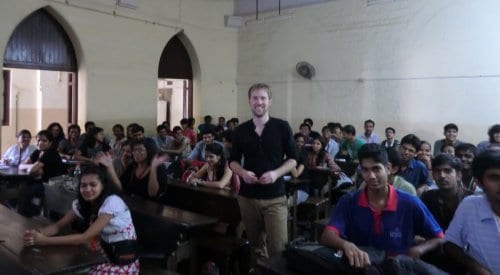
This photograph was taken at Mumbai's St Xavier's College, which I visited on Saturday to give a talk about science journalism to some of the undergraduate students. I was a bit concerned when I heard that the talk would be held on a Saturday afternoon – surely no student would turn up on the weekend! Well, they certainly did, with about 70 arriving after attending a morning of mandatory lectures. I was also unsure whether everyone would understand my accent. They assured me they did and following the talk there were many great questions. Among my favourites were "How much do you earn?" and "How much do you suffer as a journalist?" I gave diplomatic answers to both.

I arrived in Mumbai last Wednesday along with the editor of Physics World, Matin Durrani. Matin and I have been visiting research institutions to learn about physics in India – its current state, its history and the interconnected social, political and economic issues. Naturally, in the space of a week you can only see a tiny area of this vast country, but we have managed to squeeze in a fair number of visits. We took a divide and conquer approach and my visits in Mumbai included the Bhaba Atomic Research Centre (BARC) and St Xavier's College. On Saturday, Matin and I went our separate ways as I came south to the city of Pune and he veered south west to Bangalore.

When we return to the UK, we will be writing articles for a special report about physics in India, which will be available to read online.

Science in a dictatorship

At the turn of the 20th century, German scientists led the world. Four decades later, their nation's reputation in the field was only a husk of what it had been. The cause of this transformation was the Nazi rise to power in 1933, which went on to precipitate one of the biggest intellectual migrations in history. Many hundreds of scientists, most of them Jewish, fled Germany in the years that followed. As well as diminishing German science, their departure also shifted the focus of world science westwards across the Atlantic.

The contributions of these émigré scientists to intellectual life in their new homes (and to the Allied war effort) have been well documented (see "When physics was 'made in the USA' "). The fate of the scientific community they left behind, however, is less well known in the English-speaking world. The new English translation of The German Physical Society in the Third Reich helps fill this gap. Edited by Dieter Hoffmann and Mark Walker, this dense volume contains 11 scholarly essays (including an introduction) that together provide an incisive and sometimes poignant snapshot of the German physics community during the most tempestuous period of its history. They also display vividly how science can suffer under dictatorships, and how the society's unpredictable fortunes mirrored the tumult inside Germany.

The most famous member of the German Physical Society (DPG) and its one-time president, Albert Einstein, had presciently left Germany before the Nazis came to power, but for the rest of academia, the Third Reich truly began in April 1933, when the Law for the Restoration of the Civil Service came into effect. Under this new law, state employees of "non-Aryan – particularly Jewish" descent lost their jobs. Even those who were not directly affected had to join the party or sign up for political education. This thunderclap was soon followed by the crushing Nuremberg decrees, which relegated Jews to marginal citizenship and further accelerated the move to migrate.

In his essay "Marginalization and expulsion of physicists", Stefan Wolff of the Deutsches Museum shows that there was little public protest at these actions. This reaction – or rather non-reaction – was mirrored by the DPG, which at this early stage was still trying to remain aloof from politics. Although the society was not initially forced to purge itself of its Jewish members (it waited until 1938 to expel them formally), many chose to leave of their own accord. The results were stark: as an illustration in the book shows, in some cases the list of editors displayed on the masthead of leading journals shrank by up to 90%. Many of the 100 or so DPG members who resigned because of racial or political discrimination emigrated, while others found niches in industrial research or simply retired. An appendix lists their names and their eventual fates; in some cases, terse statements such as "murdered in USSR" or "survived Buchenwald" invite further research.

The book contains many examples of how the Third Reich politicized science. One authoritative chapter, written by Deutsches Museum historian Michael Eckert, describes how the wretched cult of "Aryan physics" rejected the supposedly "Jewish" sciences of relativity and quantum mechanics, to the obvious detriment of the country's scientific establishment. Among those affected was Werner Heisenberg, who was stigmatized as a "white Jew" because of his involvement in quantum mechanics. Heisenberg was long thought to be an automatic choice to succeed Arnold Sommerfeld as head of the theoretical physics school in Munich, but after tortuous deliberation by the authorities in Berlin, the position went to a less worthy figure. With such lamentable decisions, the reputation of German physics crumbled.

It was not until war had begun that DPG members, notably Wolfgang Finkelnburg, realized that their rejection of modern physics had led them to an impasse, and tried as best they could to backtrack. At the same time, the society was gradually moving towards a policy of appeasement, a process acknowledged in the book's subtitle, "Physicists Between Autonomy and Accommodation". By 1942 the DPG was urging the nation to mobilize its scientific abilities, particularly in the nuclear sector. But this was too little, too late, and it prompted much soul-searching post-1945 – hence the title of the final chapter, "Cleanliness among our circle of colleagues". "Cleanliness" in this context implies intellectual objectivity rather than "name and shame" denunciation.

The Nazis deemed Nobel awards inappropriate for Aryans

The overriding impression is of a weak and ineffectual society unwilling or unable to put up much resistance against the Nazis' unilateral decisions. Like the doyen of German physics, Max Planck, the DPG swayed in the face of them like a tree in the wind. A few individual scientists did, however, make a stand. Among them was Fritz Haber, the 1918 Nobel laureate in chemistry. Although Haber was Jewish, he was technically exempt from the Civil Service Law because of his war service (he had pioneered the use of poison gas as a weapon during the First World War) and his stature in the scientific community, and thus could have remained in his position as director of Berlin's Kaiser Wilhelm Institute for Physical Chemistry. Instead, he resigned and left Germany.

Haber's efforts to find a new position abroad were snubbed by those who remembered his work with chemical weapons and he died in 1934 before he could find another scientific post. The first anniversary of his death was commemorated with a memorial meeting organized by Planck, who boldly went ahead despite stern political admonition from government officials. Admirers and critics of Haber openly expressed strong feelings about having such a meeting. An astonishing example of such criticism came from Haber's son Hermann, who apparently wrote "One has no right to celebrate a person dead whom one would not tolerate alive."

Another source of conflict between the DPG and officials of the Third Reich was the premier DPG award, the Max Planck Medal. First given to Einstein in 1929, subsequent awards went to Niels Bohr, Sommerfeld, Planck himself, Max von Laue and Heisenberg – all of whom had been openly criticized by the Nazis. Awarding of the medal was put on hold during the first few years of Nazi rule, but when it resumed in 1937, the winner was Erwin Schrödinger, who had quit Berlin in disgust in 1933. This did little to enamour the DPG to the Nazis, and in 1938 the society bowed to the political winds again, awarding its medal to the politically neutral figure of Louis de Broglie after Enrico Fermi had been deemed unsuitable because of his Jewish connections. What went on here behind the scenes was more illuminating than the event itself.

At the same time, equally bizarre events were going on in the German Chemical Society and in the Mathematical Association. With its strong ties to industry, German chemistry quickly toed the party line. One of the most prominent examples was Richard Kuhn, who had inherited Haber's mantle, and who extended Germany's poison gas armoury from chlorine and mustard gas to sarin and tabun. In 1938 Kuhn, who signed all his letters with "Heil Hitler" and had earlier weaselled on Jewish colleagues, refused the Nobel Prize for Chemistry. By this time, the Nazis had deemed Nobel awards inappropriate for Aryans.

This book holds up a mirror to German science in the Third Reich, but the received image, magnified by the subjective lens of the German Physical Society, is a distorted one. Trying to comprehend science in the Nazi era by focusing on a single learned society is a bit like trying to understand the Eurozone crisis by looking at items in a French supermarket. The signs are there, but you have to look hard. A more complete overall picture emerged in Alan Beyerchen's 1977 book Scientists Under Hitler: Politics and the Physics Community in the Third Reich.


Copyright © 2026 by IOP Publishing Ltd and individual contributors