Construction has begun in the Tunka Valley near Lake Baikal in Siberia, Russia, on one of the world’s largest cosmic-ray observatories. The first prototypes for the $46m Hundred Square-km Cosmic Origin Explorer (HiSCORE) are now being installed and when complete by the end of the decade the facility will consist of an array of up to 1000 detectors spread over 100 square kilometres. HiSCORE will aim to solve the 100-year-old mystery surrounding the origins of cosmic rays – particles that originate in outer space and are accelerated to energies higher than those achieved in even the largest man-made particle accelerators.
HiSCORE is a collaboration between three institutes in Russia – the Institute for Nuclear Research of the Russian Academy of Sciences in Moscow, Irkutsk State University in Siberia and Lomonosov Moscow State University – as well as DESY, the University of Hamburg and the Karlsruhe Institute of Technology, all in Germany. The unprecedented size of the array will allow scientists to investigate cosmic rays within an energy range of 100 TeV to 1 EeV – a relatively unexplored region.
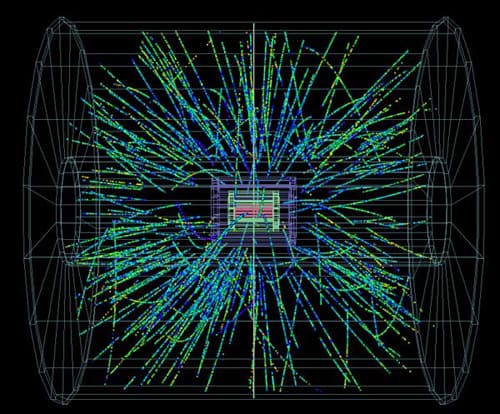
HiSCORE’s detectors are designed to observe the radiation created when cosmic rays hit the Earth’s upper atmosphere. This causes a shower of secondary particles that travel faster than the speed of light in air, producing Cherenkov radiation in the process that can be picked up by HiSCORE’s photomultiplier tubes. This radiation can be used to determine the source and intensity of cosmic rays as well as to investigate the properties of high-energy astronomical objects that emit gamma rays, such as supernova remnants and blazars. “We are especially interested in galactic objects that accelerate cosmic rays to energies around peta-electron-volts – or pevatrons – that have yet to be discovered,” Martin Tluczykont from the University of Hamburg, who is co-ordinating the project, told Physics World. “They are crucial to a solution of the origin of cosmic rays.'”
With its remote location, Lake Baikal is rapidly becoming a hotbed for cosmic-ray research. It already hosts the Tunka-133 cosmic-ray observatory, which has been in operation since 2009, and is also home to the Baikal Deep Underwater Neutrino Telescope (BDUNT), which is located 1.1 km below the surface of the lake and observes the Cherenkov radiation produced by high-energy neutrinos. The BDUNT is set to be replaced by the Gigaton Volume Detector, which will be one of the world’s largest neutrino telescopes when it is complete later this decade.
Here’s a fun exercise – take a piece of paper and use a compass to draw two concentric circles that define a ring. Then replace the pencil in the compass with a hard tip to indent a concentric crease in the paper halfway between the inner and outer edge of the ring. Cut out the ring and then fold along the crease all the way along its circumference – and if you are careful you will have created a 3D saddle such as the one in the photograph above.
This is a simple example of “curved-crease origami”, the mechanics of which have been studied in detail for the first time by physicists in the US.
Originating in Japan, origami is the art of creating 3D objects by folding paper. Origami can transform a lightweight flat material into a strong and flexible 3D object and as a result its principles have been adopted by engineers to design everything from vehicle airbags to satellite components.
Practical 3D materials
Curved creases are sometimes used in origami – a practical example being the French-fry box used in fast food restaurants. However, little is understood about the mechanics of such structures. Now, Marcelo Dias, Christian Santangelo and colleagues at the University of Massachusetts, Amherst and Harvard University are the first to develop a set of equations to describe the physics of curved-crease structures. As well as providing a better understanding of origami, the team hopes that the work will lead to practical 3D materials that are both strong and flexible.
Santangelo and colleagues focused on a ring because it is a relatively simple example of how a 2D structure can be transformed into 3D object by creating a curved crease. To gain a basic understanding of the physics, the team built a few origami saddles out of paper – from which they deduced which physical properties are key to understanding the mechanics of the curved crease.
At the heart of the transition from a 2D sheet to a 3D object are the planar stresses created in the ring when it is folded. These stresses are relieved by the sheet wrapping around itself to create a saddle-like structure. If the ring is cut, then the stresses are relieved and the saddle will collapse to a ring that will lie flat – albeit with a smaller radius (see image above).
Stiff creases
The team’s mathematical description is based on several parameters, including the ratio of the width of the ring being folded to the radius of the ring. The angle of the crease is also important, along with the “stiffness” of the crease – the latter being a measure of how difficult it is to change the angle of the fold. Another important parameter is the stiffness of the material itself – a measure of how difficult it is to bend the sheet from which the ring is made of.
The team derived an equation for the total energy of a creased ring in terms of these parameters and then calculated the energy using several analytical and numerical techniques. In addition to the angle of the crease, the results suggest that two ratios play an important role in the shape of the 3D structure – the ratio of width of the ring to its radius and the ratio of the stiffness of the crease to the bending stiffness of the material.
When the ratio of the crease stiffness to the bending stiffness is relatively high, the angle of the crease will not change – and the structure will respond to the stresses by bending to create a 3D shape.
In the case of the relative width of the ring, the team found that the wider the ring the more rigid the 3D structure – something that Santangelo believes could be exploited to make strong, flexible yet lightweight 3D structures. The team also extended the model to describe rings with multiple creases, which results in more complicated 3D structures.
The research is described in Physical Review Letters.
Physicists in the US have made the first ultrathin flat lens. Thanks to its flatness, the device eliminates optical aberrations that occur in conventional lenses with spherical surfaces. As a result, the focusing power of the lens also approaches the ultimate physical limit set by the laws of diffraction.
“Imagine if you were to replace the lens in a mobile phone with a flat and ultrathin one – you could then squeeze your smartphone down to a thickness approaching that of a credit card,” says team leader Federico Capasso of the Harvard School of Engineering and Applications. “Most optical components found in devices today are quite bulky because the light-beam shaping is done by changing the optical path of incident light rays, which requires changes in lens thickness. In our lens, all the beam shaping is done on its flat surface, which is just 60 nm thick.”
In an ordinary lens, light rays travel more slowly in the thicker, central regions than in the thinner, peripheral ones thanks to the smaller phase velocity of light in glass compared with air, he explains. This distribution of phase delays in the lens leads to light refraction and focusing.
Nanostructured metasurface
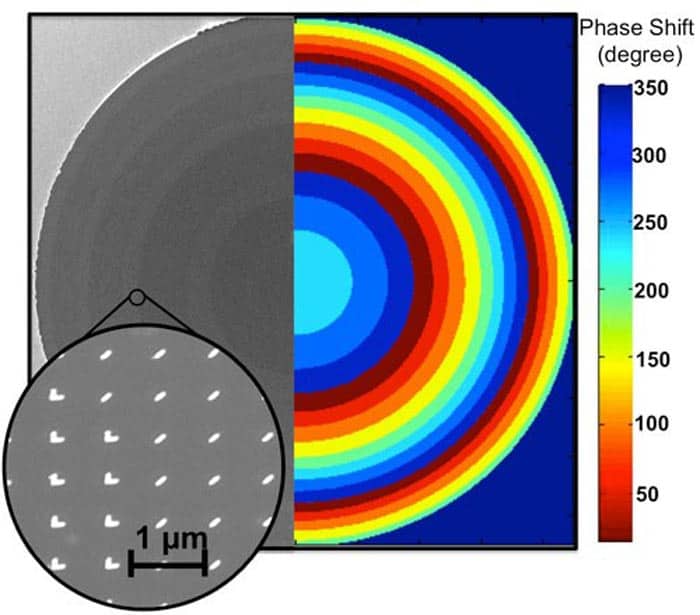
The new flat ultrathin lens is different in that it is a nanostructured “metasurface” made of optically thin beam-shaping elements called optical antennas, which are separated by distances shorter than the wavelength of the light they are designed to focus. These antennas are wavelength-scale metallic elements that introduce a slight phase delay in a light ray that scatters off them. The metasurface can be tuned for specific wavelengths of light by simply changing the size, angle and spacing between the nanoantennas.
“The antenna is nothing more than a resonator that stores light and then releases it after a short time delay,” Capasso says. “This delay changes the direction of the light in the same way that a thick glass lens would.”
The lens surface is patterned with antennas of different shapes and sizes that are oriented in different directions. This causes the phase delays to be radially distributed around the lens so that light rays are increasingly refracted further away from the centre, something that has the effect of focusing the incident light to a precise point.
No monochromatic aberrations
The new lens does not suffer from the image-distorting features, known as monochromatic aberrations, that are typical of lenses with spherical surfaces, adds Capasso. “Spherical aberration, coma and stigmatism are all eliminated and one gets a well-defined diffraction-limited, accurate focal spot. This is true even when light rays hit the lens away from the centre or at a large angle, so no complex corrective techniques are required.”
The Harvard team made its lens by first depositing a nanometre-thin layer of gold. The researchers then stripped away parts of the gold to leave behind an array of V-shaped structures (the nanoantennas) that were evenly spaced in rows across the surface of a silicon wafer.
The most obvious applications for the lens include photography and microscopy, says Capasso. “For example, compact objectives with very large numerical apertures can be envisaged, but we can also imagine optical fibres with patterned facets for new imaging and medical applications, and anywhere in general where a conventional lens could be replaced with a flat one,” he says.
Towards broadband focusing
Although the lens is only at the proof-of-concept stage, Capasso and colleagues have already been inundated with requests from photographers and astronomers from around the world. The focusing efficiency of the lens is still quite small at present but, according to the team, could easily be increased by increasing the packing density of the optical antenna and by using different flat-lens designs. “So far, the lens only focuses specific wavelengths of light but by arranging different antenna patterns onto the metasurface it could be made broadband,” says Capasso.
The researchers fabricated their lens using electron-beam lithography, which is not the most practical technique because it is time-consuming. “Fortunately, there are many emerging nanolithography technologies that could be suitable for mass production, such as nanoimprinting and soft lithography, which might be extremely useful for patterning our lens on flexible substrates,” adds Capasso. “This in itself would open up a host of exciting application areas.”
In a new experiment, a silica fibre just 500 nm across has been shown not to obey Planck’s law of radiation. Instead, say the Austrian physicists who carried out the work, the fibre heats and cools according to a more general theory that considers thermal radiation as a fundamentally bulk phenomenon. The work might lead to more efficient incandescent lamps and could improve our understanding of the Earth’s changing climate, argue the researchers.
A cornerstone of thermodynamics, Planck’s law describes how the energy density at different wavelengths of the electromagnetic radiation emitted by a “black body” varies according to the temperature of the body. It was formulated by German physicist Max Planck at the beginning of the 20th century using the concept of energy quantization that was to go on and serve as the basis for quantum mechanics. While a black body is an idealized, perfectly emitting and absorbing object, the law does provide very accurate predictions for the radiation spectra of real objects once those objects’ surface properties, such as colour and roughness, are taken into account.
However, physicists have known for many decades that the law does not apply to objects with dimensions that are smaller than the wavelength of thermal radiation. Planck assumed that all radiation striking a black body will be absorbed at the surface of that body, which implies that the surface is also a perfect emitter. But if the object is not thick enough, the incoming radiation can leak out from the far side of the object instead of being absorbed, which in turn lowers its emission.
Spectral anomalies spotted before
Other research groups had previously shown that miniature objects do not behave as Planck predicted. For example, in 2009 Chris Regan and colleagues at the University of California, Los Angeles reported that they had found anomalies in the spectrum of radiation emitted by a carbon nanotube just 100 atoms wide.
In this latest work, Christian Wuttke and Arno Rauschenbeutel of the Vienna University of Technology have gone one better by showing experimentally that the emission from a tiny object matches the predictions of an alternative theory.
To produce the 500-nm thick fibre they used in their experiment, Wuttke and Rauschenbeutel heated and pulled a standard optical fibre. They then heated the ultra-thin section, which was a few millimetres long, by shining a laser beam through it and used another laser to measure the rate of heating and subsequent cooling. Bounced between two mirrors integrated into the fibre a fixed distance apart, this second laser beam cycled into and out of resonance as the changing temperature varied the fibre’s refractive index and hence the wavelength of radiation passing through it.
Fluctuational electrodynamics
By measuring the time between resonances, the researchers found the fibre to be heating and cooling much more slowly than predicted by the Stefan–Boltzmann law. This law is a consequence of Planck’s law and defines how the total power radiated by an object is related to its temperature. Instead, they found the observed rate to be a very close match to that predicted by a theory known as fluctuational electrodynamics, which takes into account not only a body’s surface properties, but also its size and shape plus its characteristic absorption length. “We are the first to measure total radiated power and show quantitatively that it agrees with model predictions,” says Wuttke.
According to Wuttke, the latest work could have practical applications. For example, he says that it might lead to an increase in the efficiency of traditional incandescent light bulbs. Such devices generate light because they are heated to the point where the peak of their emission spectrum lies close to visible wavelengths, but they waste a lot of energy because much of their power is still emitted at infrared wavelengths. Comparing a 500nm-thick light-bulb filament with a very short antenna, Wuttke explains that it would not be thick enough to efficiently generate infrared radiation, which has wavelengths above about 700 nm, therefore suppressing emission at these wavelengths and enhancing emission at shorter visible wavelengths. He points out, however, that glass fibre, while ideal for the laboratory, would be a poor candidate for everyday use, since it is an insulator and is transparent to visible light. “A lot of research would be needed to find a material that conducts electricity and is easily heated, while capable of being made small enough and in large quantities,” he says.
Atmospheric applications
The research might also improve understanding of how small particles in the atmosphere, such as those produced by soil erosion, combustion or volcanic eruptions, contribute to climate change. Such particles might cool the Earth, by reflecting incoming solar radiation, or warm the Earth, by absorbing the thermal radiation from our planet, as greenhouse gases do. “The beauty of fluctuational electrodynamics”, says Wuttke, “is that just by knowing the shape and absorption characteristics of the material you can work out from first principles how efficiently and at which wavelengths it is absorbing and emitting thermal radiation.” But, he adds, here too more work would be needed to apply the research to real atmospheric conditions.
One thing that Wuttke and Rauschenbeutel are sure of, however, is that their research does not undermine quantum mechanics. Planck’s theory, explains Rauschenbeutel, is limited by the assumption that absorption and emission are purely surface phenomena and by the omission of wave phenomena. His principle of the quantization of energy, on the other hand, is still valid. “The theory we have tested uses quantum statistics,” he says, “so it is not in contradiction with quantum mechanics. Quite the opposite, in fact.”
Regan describes the latest work as “very elegant”, predicting that it will “illuminate new features of radiative thermal transport and Planck’s law at the nanoscale”. He suggests, however, that using an emissivity model that incorporates the transparency of the thin optical fibres would allow Planck’s law to more accurately describe the radiation from these tiny emitters.
The research is described in a preprint on the arXiv preprint server.
As someone who spent a few years on the Canadian prairies, where the mercury regularly dips to –40 °C, I should be the last one to describe Britain’s winters as cold and dry. Indeed, just a few years ago I was mowing the lawn in January to ensure that the grass wasn’t a rotting mess come spring.
But then in 2009 something changed. The winters here in Bristol seemed to go from being warm and wet to being cold and dry. The NASA satellite image on the right shows the entire island of Great Britain blanketed in snow in January 2010 – something that very rarely happens.
The last few winters were so dry that a drought was declared in much of southern and central England this spring (and then it started raining and hasn’t stopped).
It would be nice to be able to predict what the next British winter will be like – but seasonal forecasts are notoriously difficult to make. The UK’s Met Office used to go public with its predictions, but stopped in 2009 when its promise of a “barbeque summer” turned into a washout.
Now, scientists at the Met Office are saying that their latest forecasting system should be able to forewarn of a cold winter. They say that such cold snaps can be caused by the disruption of the “polar vortex” – a large-scale cyclone that blows in the middle and upper troposphere and in the stratosphere above the polar regions during the winter. In the northern hemisphere, the vortex drives the westerly winds that bring warm, damp air to Britain in the winter.
Such vortex disruptions seem to occur when warm air piles into the stratosphere. In order to predict such events better, the Met Office has begun using a so-called high-top version of its GloSea4 seasonal-forecasting model. This version calculates physical quantities such as winds, humidity and temperature to higher levels in the atmosphere and also at more levels.
Every four years the organization Science Debate sends a list of questions to the two main presidential candidates in the US. In addition to general questions about science education and public policy, this year’s 12 questions also cover issues such as biosecurity, preserving food and freshwater supplies, and how to manage the Internet.
This week’s Facebook poll is inspired by those questions, which I have edited down to the six issues that I think are of most interest to physicists.
Which scientific issue should be of greatest importance to politicians?
Science’s role in economic growth Research funding Science education Climate change and energy security Space exploration Science-based public policy
Have your say by visiting our Facebook page, and please feel free to explain your response by posting a comment below the poll.
You can read the candidates’ responses here and, if you are a US citizen, cast your vote accordingly.
Last week we asked “Do you think the Large Hadron Collider will discover new physics beyond the Standard Model?”. A whopping 84% of you said yes, so let’s hope that there are at least some nascent signs of supersymmetry when the next big round of results are presented at CERN in December.
Protons collide with lead nuclei, sending a shower of particles through the LHC’s detectors. (Courtesy: ALICE/CERN)
By Tushna Commissariat
In the early hours of this morning the Large Hadron Collider (LHC) successfully collided protons and lead ions for the first time, with the collisions being recorded by all of the detectors: ATLAS, CMS, ALICE and LHCb.
Late last year the LHC trialled a similar run, during which it accelerated separate beams of lead ions and protons. However, at that time the beams were not successfully collided, and the run was postponed. To learn more about the 2011 run, take a look at this news story.
The whole business of colliding different particles is a difficult one, as it presents physicists with a number of technical challenges. “Firstly, the collisions are asymmetric in energy, which is a challenge for the experiments,” explains accelerator physicist and lead-ion team leader John Jowett. “At the accelerator level we don’t really see the difference in particle size, but the difference in the beam size and the fact that the beam sizes change at different rates may affect how the particles behave in collisions.”
Also, the LHC normally accelerates two opposing proton beams from 0.45 to 4 TeV, before they collide at a total energy of 8 TeV. Radio-frequency (RF) cavities are used to give the beams the necessary energy boost, as well as to keep them in strict synchrony. But here is where another problem arises: the system ties the momentum of one beam to the momentum of the other, while it needs to account for the differences between the protons and the much heavier lead ions. A lead nucleus, containing 82 protons, is accelerated from 36.9 to 328 TeV, or from 0.18 to 1.58 TeV per proton or neutron, which means that the RF cavities need to be tuned to different frequencies for each beam. This allows both beams to achieve stable orbits within their own ring during injection and acceleration. In the past, other projects have experienced difficulties in getting this just right, as have researchers at the LHC.
“The RF systems of the two rings can be locked together only at top energy before collisions, when the small speed difference that still remains can be absorbed by shifts of the orbits that are acceptably small,” says Jowett. He further explains that the beams then have to be adjusted again by the RF system so that the collisions take place inside detectors, where experiments take physics data, so a lot of preparation has been needed to allow the LHC systems to carry out this new operational cycle.
Researchers are hopeful that this latest short run will deliver the first data for proton–nucleus collisions before a scheduled main run takes place from January to February 2013, just before the accelerator is shut down for maintenance.
A single rod photoreceptor cell taken from the eye of a frog has been fashioned into an extremely sensitive detector that can count individual photons and determine the coherence of extremely weak pulses of light. Created by researchers in Singapore, the work could lead to hybrid light detectors that incorporate living cells.
The eyes of humans and other living organisms are extremely sensitive and versatile detectors of light, which can often outperform man-made devices. Indeed, a rod photoreceptor cell in the human retina will respond to just one photon – something that only the most sensitive man-made detectors are capable of doing. As well as learning how to make better light detectors by studying the eye, a better understanding of its function could lead to the development of “bioquantum” devices that combine biological and man-made components to study aspects of quantum optics such as “squeezed” light.
In this latest study, Leonid Krivitsky and colleagues at the Agency for Science, Technology and Research in Singapore have focused on rods from the eye of the African Clawed Frog (Xenopus laevis), a species that is much studied by biologists.
Stemming the flow
Each rod has an outer segment (OS) that contains rhodosin photopigment – a substance that undergoes a chemical change when exposed to light. When in the dark, a constant current of sodium, potassium and calcium ions flows in and out of the cell. However, when a photon strikes the rhodopsin, it sets off a chain of chemical reactions that switchs off some of the ion-transport channels. This causes the electrical polarization of the cell, which results in an electrical signal that is picked up by the nervous system and relayed to the brain.
Individual rods are about 50 μm long and about 5 μm in diameter. The experiment begins with a rod being sucked into a micropipette and kept alive by being immersed in a special solution that is similar to that in the eye. The micropipette also acts as an electrode, which allows the ion current to be detected using a low-noise amplifier.
The team used green laser light (532 nm wavelength) to study the optical response of individual rods. The team fired several different types of laser pulse at the rods and measured the response. Before a pulse reaches the rod, the light is split into two paths. One path continues to the rod and the other goes to an avalanche photodiode (APD) – an extremely sensitive light detector capable of seeing single photons. This optical set-up is used as a Hanbury–Brown–Twiss interferometer – which allows the team to determine the coherence of the light arriving at the rod.
Counting photons
In one measurement, the team measured the photocurrent produced by the rod while changing the average number of photons per pulse from 30 to 16,000. As expected, the photocurrent increased as a function of number until it saturated at about 1000 photons. The team also looked at how the rods responded to two different types of light pulse – pulses of coherent laser light and “pseudothermal” pulses. The latter are laser pulses that are focused onto a rotating disk that has been roughened using sandpaper grit. The resulting specked light is then sent through a diaphragm and emerges as a pulse with little coherence.
Coherent and pseudothermal pulses have different photon-number distribution statistics, and the team was able to use the rods to detect the difference. This, according to the researchers, means that the rods could be used as highly sensitive detectors of photon statistics. Putting all of the measurements together, the team was also able to conclude that each photon in the pulse interacts with just one rhodopsin molecule.
While the light sources used by the team are classical, the fact that the rods can distinguish between coherent and pseudothermal pulses suggest that they could be used in quantum optics and quantum communication. Indeed, the team plans to study the response of the rods to correlated two-photon light.
Majorana fermions are a source of great intrigue to theorists because they are their own antiparticle. Beenakker traces the history of Majorana fermions from their prediction in 1937 by the Italian physicist Ettore Majorana. He then brings us to the present day by describing the excitement surrounding a recent experimental result from the Netherlands. The researchers at Leiden University published a paper earlier this year suggesting that they may have seen the first clear-cut signs of Majorana fermions by spotting them in nanowires.
Beenakker is also based at Leiden University, though he was not involved in this latest research. He has proposed a collection of research articles on Majorana fermions, which will be appearing later this year in a special issue of New Journal of Physics.
I often lecture on famous female scientists and if I do not mention Chien-Shiung Wu, someone almost invariably asks why. This shows how well known she is among scientists. Not only is Wu highly respected – she is known to some as the "First Lady of Physics" or the "Chinese Marie Curie" – but there is a general opinion that it was an injustice that she did not receive the Nobel Prize for Physics together with Tsung-Dao Lee and Chen Ning Yang in 1957 for her part in the experiment that proved that parity is violated in the weak force. But was this really an example of gender discrimination? To find out, I decided to look into this question and weigh up the evidence.
Born in China in 1912, Wu's father was himself an advocate of gender equality, founding one of the first schools in China that admitted girls, and he instilled the value of education in his daughter. In 1934 Wu received her bachelor's degree in physics, graduating at the top of her class from the National Central University in Nanjing. She then did a few years of research but, unsatisfied with the opportunities for physicists in China at that time, moved to the US where she completed a PhD at the University of California at Berkeley in 1940, and then took up a brief research position. In 1942 she married Luke Chia-Liu Yuan, who was the grandson of the first president of the Republic of China.
In 1943, with many physicists in the US working on military projects as the Second World War reached its peak, Wu was offered a teaching position at Princeton University in New Jersey – one of several "firsts" in her career (see "Fair treatment" below). Her appointment was remarkable given that at that time women were not even allowed to study at Princeton. As a young immigrant Chinese woman teaching one of the most difficult subjects – physics – to the male students of Princeton, her presence was unprecedented. But Wu's teaching time at Princeton did not last long because the following year she was asked to do defence work, joining the Manhattan Project to work on radiation detectors at Columbia University in New York.
In 1945, with the turbulent war years over, Wu started working at Columbia's physics department where she could continue research in the field that she felt very close to, nuclear physics, and within that, beta-decay – one of the weak interactions associated with radioactive decay. Wu was to stay at Columbia for the rest of her career and took an active interest in physics well into her retirement. Wu died in 1997 at the age of 84 following a stroke.
Concept genesis
The work for which Lee and Yang were awarded the Nobel Prize for Physics in 1957 had its roots in the so-called "tau-theta puzzle", which perplexed particle physicists in the early 1950s. Tau and theta were two subatomic particles – types of K-meson – the behaviour of which was hard to explain. They were identical in every aspect but one: they had the same mass, the same spin and the same lifetime, but they decayed to products with different net "parity".
Parity is an intrinsic symmetry property of particles that is characterized by the behaviour of their wave functions under reflection through the origin of their spatial coordinates. In everyday terms, it refers to the relationship between a particle or a process and its mirror image. The mirror image of, say, a right-handed screw is a left-handed screw. Similarly, a particle spinning clockwise produces a mirror image that spins anticlockwise. Based on its behaviour, the parity of a particle is defined as either +1 or –1, and the net parity of a group of particles is the product of the parities of all particles in the group.
The tau-theta puzzle was that the tau decayed to three pions, with a net parity defined as (–1)(–1)(–1) = –1, while the theta decayed to two pions with a net parity of (–1)(–1) = +1. If tau and theta were indeed the same particle – as their other properties indicated – they should have the same parity as well; according to the parity conservation law the parity of a system cannot change under particle decay or production. The implications were that either tau and theta were different particles and we had not learned how to distinguish them yet, or they were the same particle and parity was not conserved. This latter idea was highly controversial.
At a conference in 1956 Lee and Yang opted for the former explanation and suggested that certain elementary particles might occur in two forms with different parities. But during the conference there followed some discussion about the possibility that parity is violated in weak interactions. Lee and Yang later searched the literature and found that there were many cases confirming parity conservation in strong interactions, but in experiments on weak interactions this conservation law had not been tested, so it was impossible to tell whether it was valid for them. Lee and Yang then published their famous paper "Question of parity conservation in weak interactions" (1956 Phys. Rev.104 254), in which they briefly discussed the possibility that parity might be violated in weak interactions. They also suggested ideas for experiments that might test this possibility, each involving two sets of experiments that were mirror images of each other. If the two gave identical results then parity conservation was valid, while if the two results were different, it showed that parity was violated.
Months before publication of their famous paper, Lee, who also worked at Columbia University, consulted Wu on the subject. As Wu later recounted (1973 Adventures in Experimental Physics: Gamma Volume ed. B Maglich), one day in the spring of 1956 Lee went to Wu's office and asked her about the status of experimental knowledge on parity conservation in beta decay. According to Wu, "People not only took it for granted that parity was conserved in all interactions, but this untested notion was also used to discourage others from doing any experiments to test, much less challenge, the validity of this concept."
Wu asked Lee whether anyone had thought of experiments that could show that parity is conserved in weak interactions. Lee mentioned ideas such as using polarized nuclei resulting from nuclear reactions, or a polarized slow neutron beam from a reactor. "Somehow I had great misgivings about using either of these two approaches," wrote Wu. "I suggested that the best bet would be to use a cobalt-60 beta-source polarized by the demagnetization method." After Lee's visit, Wu realized "This was a golden opportunity for a beta-decay physicist to perform a crucial test, and how could I let it pass?"
Competing experiments
And she did not. That spring Wu started planning the experiment and was so keen to do it that she even gave up a trip to China, which she had not visited for some 20 years. The experiment was a complex task because she had to combine two techniques that had never before been used together (see "The parity violation experiments" figure). Even though she was an expert in beta-decay experiments, she lacked the expertise and the equipment to perform them at the required temperatures of near absolute zero. Wu therefore contacted Ernest Ambler at the National Bureau of Standards (NBS, later renamed the National Institute of Standards and Technology) in Washington DC, who was happy to collaborate. In September Wu met Ambler in Washington, and they also invited three NBS associates to work with them: Ralph Hudson, an expert in cryogenics, and radiation-detection experts Raymond Hayward and Dale Hoppes.
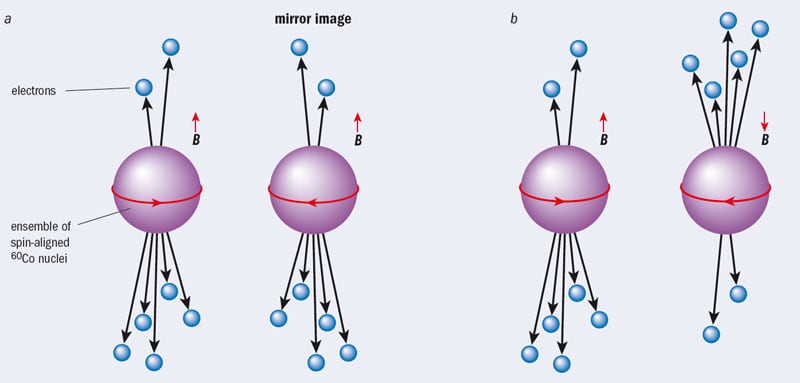
1 The parity violation experiments Until 1956 physicists assumed that fundamental interactions in nature do not change under reflection. The gravitational force, for example, is described in exactly the same way for an object and its mirror image. Parity is a property of elementary particles that expresses their behaviour upon reflection in a mirror. If the parity of a particle does not change during reflection, parity is said to be conserved. In 1956 Tsung-Dao Lee and Chen Ning Yang realized that parity conservation had never been tested for weak interactions, such as radioactive decay. Chien-Shiung Wu suggested an experiment to check this based on the radioactive decay of unstable cobalt-60 nuclei into nickel-60 accompanied by the emission of beta rays (electrons). Very low temperatures were used so that random thermal motion was negligible, enabling a strong magnetic field to align the cobalt nuclei with their spins parallel. The number of emitted electrons was counted in two directions: upward and downward. It was found that the emission of electrons was much greater in the downward direction – the south pole of the spinning nuclei – than the upward direction. In the figure above, (a) shows how a mirror image of this experiment should also produce more electrons going downwards than upwards. However, when the experiment was repeated, with the direction of the magnetic field reversed to change the direction of the spin as it would be in the mirror image, they found that more electrons were produced going upwards (b). The fact that the real-life experiment with reversed spin direction behaved differently from the mirror image proved that parity is violated in the weak interaction of beta decay. The same conclusion – that the weak force does not conserve parity – was also reached by Richard Garwin and Leon Lederman, who observed polarized muons produced by the radioactive decay of pions in a cyclotron by measuring the asymmetry in their decay electrons; and by Jerome Friedman and Valentine Telegdi, who studied the same process using photographic plates.
The group immediately began to work out the details of the joint experiment and started the measurements in October, working through some serious difficulties. Wu could not be at NBS all the time since she had teaching duties at Columbia. This is why she was not present when, on 27 December 1956, her NBS colleagues saw the first signs of the asymmetry that showed that parity conservation can be violated in weak interactions. As part of my research for my upcoming book on women scientists, I was intrigued by Wu's story and tried to collect information about it from the scientists who are still around; Hoppes told me in an e-mail that Wu probably regretted her absence to the last day of her life. As soon as she heard the news, naturally, she hurried to Washington. A few days later, back in New York at Columbia University, she told Lee and Yang about the promising preliminary results.
On 4 January 1957 Lee mentioned the great news to the physicists who had gathered for the regular Chinese lunch that took place at Columbia every Friday. That parity violation may be real triggered the imagination of many experimental physicists. One of those was Leon Lederman, who that night at around 8 p.m. called Richard Garwin at his home with an idea for an alternative experiment to demonstrate parity violation. Lederman had realized that the muons produced at Columbia University's cyclotron might already be polarized and hence also suitable for proving parity violation – Lee and Yang had already suggested trying muon experiments. Garwin, an experienced experimental particle physicist, met Lederman at the cyclotron that very night. Their experiment, for which they used the apparatus built for another project by Lederman's graduate student, Marcel Weinrich, not only worked but did so very convincingly. Within four days they had compelling results and even had a manuscript ready. However, Lee dissuaded them from submitting, saying that this would not be fair to the NBS team, which had by then been working hard on its experiment for months.
The NBS team must have been glad to see confirmation of the effect but the researchers may have felt disappointed by the competition. Having heard their competitors' news, they literally worked around the clock until finally on 9 January at 2 a.m. they were absolutely sure that what they had measured was a real effect. Wu later recalled that "Dr Hudson smilingly opened his drawer and pulled out a bottle of wine and put it on the table with a few small paper cups. We finally drank to the overthrow of the law of parity."
The Department of Physics at Columbia University – with two success stories to boast of – held a press conference on 15 January to announce to the world that a basic law of physics – parity conservation in the weak interactions – had been overthrown. The NBS and the Garwin–Lederman–Weinrich reports were submitted to Physical Review the same day and were published in the February 1957 issue back to back (Phys. Rev.105 1413; Phys. Rev.105 1415).
A third paper describing experimental verification of parity violation was submitted by Valentine Telegdi and Jerome Friedman from the University of Chicago and received by Physical Review on 17 January 1957. They had begun their own experiment the previous summer with no knowledge of the NBS attempt (Phys. Rev.105 1681).
Prize question
Within a year of these historic experiments, Lee and Yang were awarded the 1957 Nobel Prize for Physics – one of the fastest ever Nobel prizes considering that their paper had appeared only in October the previous year. But as their paper suggested but did not prove parity violation, one may wonder whether the 15 January press conference announcing experimental verification of parity violation helped them get the prize – after all, the deadline for submitting Nobel prize nominations is the end of January. Unfortunately, as all nomination records in physics and chemistry have to be kept secret for at least 50 years or for as long as the nominee is still alive, we cannot yet access the official records to see if this was the case.
However, I corresponded with Anders Bárány, the former long-time secretary of the Physics Nobel Committee, who told me that back in 1956 it could not suggest a strong candidate, so when Lee and Yang emerged as truly strong candidates for the 1957 prize, following the experimental verification of parity violation, the committee must have felt pleased to have a compelling recommendation. Bárány's comments are consistent with the citation of Lee and Yang's Nobel prize, as it hints at the importance of the discoveries stemming from the theoretical predictions: "for their penetrating investigation of the so-called parity laws which has led to important discoveries regarding the elementary particles".
And so we arrive at the question at the heart of this story: was it a fair decision not to award Wu a share of the prize? After all, there was an "empty slot" – according to the statutes of the Nobel Foundation a maximum of three people can share a prize in a given category. The NBS experiment was the first to verify parity violation on 27 December and Wu had suggested and was actively involved with the experiment. But Friedman and Telegdi, who also started their experiments in the late summer of 1956 and were already doing measurements in October, may have had some preliminary results by December too. However, what really counts is publications, and in that the NBS group and the Garwin–Lederman–Weinrich group were side by side, with Garwin and Lederman actually finishing their report days before the NBS group did. Whichever way success is measured, it would have been hard to pick one particular experimentalist for the prize.
Fair treatment
Contrary to the view that Chien-Shiung Wu was discriminated against, in line with the idea that she should have received a share of the 1957 Nobel Prize for Physics, there are many examples of her fair treatment and recognition.
First woman to teach at Princeton University (1943)
First woman in the Columbia University physics department to get a tenured position (1952), a professorship (1958) and the Michael I Pupin Professorship of Physics (1973)
First woman to receive an honorary doctorate from Princeton University, with the president of Princeton calling her "the world's foremost female experimental physicist" (1958)
Elected to the US National Academy of Sciences (1958)
First woman elected as president of the American Physical Society (1975)
Received the National Medal of Science from President Ford (1975)
First recipient of the Wolf Prize in Physics (1978)
Posthumously inducted into the American National Women's Hall of Fame (1998)
As it turns out, this discussion is superfluous for legalistic reasons. As Bárány pointed out, "The awarded work must have been published before the year of the prize, in this case before 1 January 1957." Since all three experimental studies were published in early 1957, none of the experimentalists could have been considered for the prize that year. The Nobel Committee could have decided to wait another year to award the prize for parity violation, but with the three experiments and the large number of physicists involved, the decision would always have been a hard one. Also, the committee needed strong candidates in 1957 and it is by no means certain that they had any as strong as Lee and Yang to put forward.
Of course, irrespective of the Nobel prize, the question of which experiment first observed parity violation is important. Telegdi and Friedman, who began their experiment in the late summer of 1956 and started taking measurements in October without knowing of the other attempt, had their progress hampered when Telegdi had to go to Europe for two months that autumn on personal matters. "During this period," says Friedman, "I was starting to see a hint of an effect and I wanted to get more scanning help. But [they] would not give it to me, because the only scanners available were involved in what was thought to be a more promising measurement."
It appears most probable that the NBS team had the first genuine signs of asymmetry, on 27 December, but needed time to verify this under very difficult experimental circumstances. After hearing about these promising preliminary results, Garwin and Lederman began their experiment in early January and it was ready in a flash: they started to measure in the early hours of Saturday 5 January, and – with the machine shut down from Saturday morning until Monday evening – they finished the measurement at dawn on Tuesday 8 January. Theirs was the first clear and conclusive measurement and their article was written on the same day. The Wu et al. paper was completed on 10 January. The two groups submitted their papers on the same day and the papers were received at the journal on 15 January. The Telegdi–Friedman paper was received two days later. Certainly, all the participants of the three papers deserve credit for their hard work, their insight and for embarking on a project that most physicists assumed was a waste of time.
Final thoughts
There is one more question that deserves mention and that is the role of Wu compared with her NBS colleagues in what became known as "the Wu experiment". I wondered about the propriety of this label because of two statements (see "Who deserves the credit?" below) – one by Telegdi and the other by Nicholas Kurti, then at the University of Oxford, and Christine Sutton, current editor of CERN Courier – that questioned it many years ago. Both statements emphasized the importance of the cryogenic measurements and that without the expertise of the respective specialists the experiments could not have been done. Incidentally, Ambler and Hudson of the NBS team had both been Kurti's students at Oxford.
I contacted the surviving participants of the experiment carried out at NBS 56 years ago, and from these interactions I formed the impression that the role of Wu and of Columbia University may have been overemphasized during the first euphoric days following the discovery. On 15 January 1957 a press conference was held at Columbia University. Even though the members of the NBS team were present, the fact that the announcement was made at Columbia added emphasis to Wu's participation. It was also she who had suggested the experiment, which, for brevity, was convenient to call the Wu experiment.
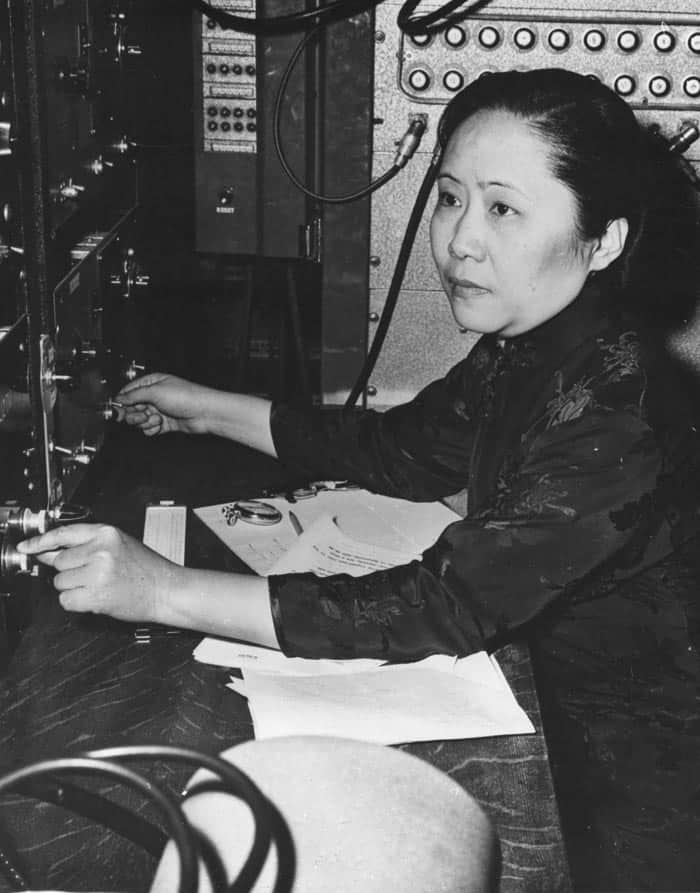
Role model Chien-Shiung Wu at Columbia University in 1963. (Courtesy: Smithsonian Institution Archives)
The notion that it was "the Wu experiment" was further strengthened by the fact that on the report about it Wu was listed as first author, followed by her affiliation, and then came the names of the NBS authors in alphabetical order, followed by their affiliation. This way of presenting the authors was suggested by the NBS team. In Ambler's correspondence with me he said "I invited her to go first in the list of names out of courtesy for having brought the preprint of Lee and Yang's paper prior to actual publication." Other NBS authors think that it was their courtesy towards a woman that made them suggest that her name be listed first, despite this being contrary to the usual NBS custom of following alphabetical order. Wu could have declined this honour had she felt it improper, but apparently she did not.
Furthermore, at no point in the report was it mentioned that the experiment was conducted at NBS. Even its terseness – with the paper comprising a mere two pages – does not justify this omission. This was a misleading oversight; having Wu as first author with her Columbia University affiliation, only the initiated could have known that the experiment might not have been carried out at Columbia. When soon after the event one of the NBS authors was giving a talk at Yale University, during the discussion of the experiment someone in the audience interrupted him to ask if that was the Columbia experiment. The speaker had to respond that yes, it was, but it was done at NBS!
The verdict
My view is that Wu made an outstanding contribution to bringing down the axiom of parity conservation in weak interactions. But to say it was an injustice that she did not win a Nobel prize is an oversimplification of a complex story. In spite of the widespread suggestion that it was discrimination against women that prevented her from sharing the Nobel prize with Lee and Yang, there is no indication in her life that suggests such discrimination. Quite the contrary: from very early on, she was highly respected and by the end of her career she had received an extraordinary number of prizes and other distinctions.
There are plenty of cases in the history of science when talented women were truly denied the opportunity to do research, to participate in university life or to receive proper recognition for their achievements. But Wu was certainly not one of these. She was a remarkable scientist and with her perseverance, her thirst for knowledge, her experimental skills and rigour, and her dedication to her students, she was – and will always remain – a wonderful role model for all young people aspiring to start a career in physics.
Who deserves the credit?
Leon Lederman
Experimentalist who, with Richard Garwin and Marcel Weinrich, submitted evidence of parity violation on 15 January 1957, in an interview with the author in 1997
"[Lee's and Yang's] work was certainly worth the prize. They asked the question. How do we know that parity is conserved?...The breakthrough was that they could consider that there are different forces and that different forces could have different symmetries. That was a tremendous insight."
Valentine Telegdi
Experimentalist who, with Jerome Friedman, submitted evidence of parity violation on 17 January 1957, in an interview with the author in 2002
"I don't think that anybody among the experimentalists deserves the Nobel prize very much in this case. If an experimentalist performs an experiment with known techniques and on top of it that experiment has been clearly suggested by the theorists, where is the merit? This is true for me, too."
Telegdi may not have known that it was actually Wu who had suggested the cobalt-60 experiment to Lee.
Nicholas Kurti and Christine Sutton
Cryophysicist (Kurti) and particle physicist (Sutton), then both at the University of Oxford, writing in a Nature commentary in 1997 (385575)
"At the time many people thought that there was no more to the experiment than for Wu to turn up at NBS and receive from Ambler and Hudson a cerium magnesium nitrate crystal doped with cobalt-60...The purpose of this note is to state for the record that the NBS parity violation experiment was a collaborative team effort in which nuclear physicists and cryophysicists pooled their knowledge and expertise to carry out an experiment proposed by Lee and Yang, thus confirming their hypothesis that parity is not conserved in β-decay."
Kurti and Sutton may not have known either that Wu had suggested the cobalt-60 experiment to Lee.
Val Fitch
Particle physicist who shared the 1980 Nobel Prize for Physics for discovering charge–parity violation, in an interview with the author in 2002
"There were four people...who did the cobalt-60 experiment and they all contributed to it in a major way. Ms Wu is often given the credit but I think that the most dispassionate view would be to recognize that those other guys were very important and it would not have happened without them."