

Delving into extra dimensions

We experience three spatial dimensions in nature: length, width and height. In addition, we perceive time as a fourth dimension. But some theoretical physicists have speculated that “extra” spatial dimensions could exist in addition to the four ordinary space–time dimensions, although they are too small to see with the naked eye. Now, with the advent of new data from the Large Hadron Collider (LHC) at CERN near Geneva in Switzerland, as well as other particle- and astroparticle-physics experiments, it might be possible to answer the fundamental question of whether these extra spatial dimensions exist.

The idea that space–time could have more than four dimensions was first proposed by the German mathematician and physicist Theodor Kaluza and the Swedish theoretical physicist Oskar Klein in the early 20th century. In 1921 Kaluza published an article in which he extended Einstein’s theory of general relativity (which is still the best known description for gravitation) from four to five dimensions, and in 1926 Klein assumed that an additional fourth spatial dimension is curled up into a circle with an extremely small radius – the extra dimension bends round on itself and is said to be “compact”. Indeed, it can be shown that 5D space–time can be separated into Einstein’s theory of gravitation in four dimensions and Maxwell’s theory of electromagnetism. For this reason, a physical model that tries to unify the fundamental forces of gravitation and electromagnetism is known as a Kaluza–Klein theory (KK theory), although nowadays the phrase is used to refer to any theory with extra spatial dimensions.

Trying to imagine extra spatial dimensions is not at all intuitive. How could there be anything other than front-to-back, side-to-side and up-and-down. One analogy to help understand this is to consider a tightrope (figure 1). Seen from a distance, such as from the eyes of a human being balancing on the rope, it might seem possible to move only forwards or backwards. However, on closer inspection, such as from the perspective of an ant, it is possible to move along the rope and also around it. In the same way, extra dimensions could be hidden for someone who is looking at them from a large distance compared with their size.

As for how extra dimensions could reveal themselves, the experimental study of fundamental particles is the most promising route. The energy of a particle in a 3D space consists of the rest energy of its mass, E = mc2, and the kinetic energy of its motion. If extra dimensions exist, the particle will have more freedom to move and so could obtain an additional, independent contribution to its kinetic energy. Since we do not observe the motion of the particle along the extra dimension, we would interpret this kinetic energy as part of its rest energy, or in other words the mass of the particle. To us, the particle would not look like one particle, but a set of particles – all with different masses. The faster the particle moves along the extra dimension, the larger this apparent mass seems to be. It turns out that the mass of each particle is related to the mass of the particle at rest in the extra dimension. We assume that the Standard Model particles are at rest in the extra dimension, and that for each of these known particles there could exist heavier versions that have not yet been discovered. Known as “KK particles”, we can arrange each set of them in a schematic “KK tower” with KK (particle) numbers n = 1, 2, 3… and masses mn = √(m2 + n2/R2), where m is the mass of the Standard Model particle (n = 0) and R is the characteristic size of the extra dimension. For example, one can imagine an electron, which is a Standard Model particle, and a corresponding KK tower of heavier KK electrons.

KK theories are interesting for several reasons. Perhaps most importantly, they can be used to address several of the shortcomings of the Standard Model of particle physics, which is currently our best description of the subatomic world. Although the Standard Model is very successful, it does have a number of problems that point towards the need for it to be extended. KK theories are one possible such extension; others include, for example, supersymmetry, which predicts that for each of the Standard Model particles there exists a heavier “sparticle” sibling, and grand unified theories, in which the strong, weak and electromagnetic interactions are regarded as different aspects of a single force.

Standard Model shortcomings

Among the most famous problems with the Standard Model is that observations of how galaxies move give us a large amount of evidence for there being more matter in the universe than we can see. This additional matter has been termed “dark matter”, although “invisible matter” would perhaps be a better term, since it is not visible (not “luminous”) as ordinary matter is.

The current most plausible solution to this problem is that dark matter is made up of particles that interact very weakly with light. From the particle physics point of view, however the problem with this solution is that none of the known particles in the Standard Model could make up the dark matter. But in some KK theories, it turns out that some of the KK particles that are predicted to exist could be this elusive dark matter as they would not interact with light and would have other characteristics that we expect of dark matter.

Another peculiarity in particle physics is the fact that gravity is much weaker than all of the other fundamental forces. This force is nevertheless important because, unlike the strong and weak forces, it has an infinite range, and most macroscopic objects are electrically neutral and so are not strongly affected by the electromagnetic force, leaving gravity as the only important force for them. From the point of view of quantum physics, the weakness of gravity is a puzzling fact that would seem to require a very precise fine-tuning of the parameters in nature. But in KK theories, the weakness of gravity might be fundamental.

A third problem relates to the properties of neutrinos in the Standard Model. Being electrically neutral and interacting very weakly with other matter, neutrinos are very difficult to detect. In fact, the Standard Model says that all neutrinos are massless. However, observations of neutrinos turning from one form into another – a phenomenon known as “neutrino oscillation” – strongly indicate that neutrinos do have mass. We would therefore have to extend the Standard Model to take this fact into account, but the problem is that neutrinos are much lighter than all other known (Standard Model) particles. In KK theories, natural mechanisms that generate these small neutrino masses can be obtained.

Universal pictures

The bottom line is that to have avoided detection thus far, any extra dimensions would have to be compact and small. Indeed, one might naively imagine that extra dimensions must be so small that we will never be able to observe them, at least in the foreseeable future. However, in recent years different models have been proposed that avoid such stringent constraints, allowing models of extra dimensions to be tested in high-energy physics experiments.

There are three main models that describe extra spatial dimensions. In the scenario of universal extra dimensions (UED model), which was proposed in 2001 by the theoretical physicists Thomas Appelquist, Hsin-Chia Cheng and Bogdan Dobrescu (Phys. Rev. D 64 035002), all of the particles of the Standard Model are allowed to propagate in the extra dimensions, with each fundamental particle having its own KK tower. In this model, there is an extra number (comparable to a particle’s mass or charge) attached to each particle known as “KK parity”, which is assumed to be conserved in particle reactions, meaning that the product of all particles’ KK parities before a reaction should be equal to the product of all remaining particles’ KK parities after the reaction. The KK parity +1 is assigned to all even-numbered KK particles, which includes all Standard Model particles as they have a KK number of 0, whereas odd-numbered KK particles have a KK parity of –1. The consequence of conservation of KK parity is that odd-numbered KK particles can only be produced in pairs, which has a low probability of happening despite being the only allowed option. Furthermore, a second-order KK particle (with parity +1) can decay into two Standard Model particles – because (+1) = (+1)(+1) – but a first-order KK particle (with parity –1) cannot decay into any number of Standard Model particles because –1 never equals (+1)n.

The UED model would give rise to observable effects at the LHC such as the production of two Standard Model particles or more complicated signals, as would the ADD model described below. Another important implication of KK parity is that it ensures that the so-called lightest KK particle (LKP) is stable and hence could be a possible dark-matter candidate. This kind of dark matter is known as Kaluza–Klein dark matter.

Going extra large

The second significant model describes “large extra dimensions”, which were first proposed in 1998 by Nima Arkani-Hamed, Savas Dimopoulos and Gia Dvali, in what is known as the ADD model (Phys. Lett. B 429 263). The novel feature of this model is the assumption that the Standard Model particles are confined to a so-called brane, which is identified with ordinary 4D space–time, but residing in a larger space–time (figure 2). An analogy is the surface of the Earth being a 2D layer that resides in a larger 3D world. In this case, the surface of the Earth would be the brane.
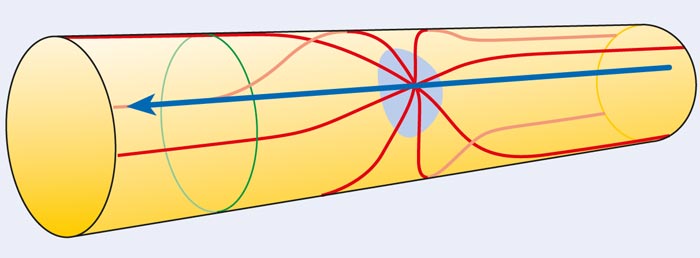
Since Standard Model particles only “live” in the usual dimensions, not in the extra dimensions, they will not help us in setting limits on the size of extra dimensions. On the other hand, the particle responsible for gravity, the graviton, is not a Standard Model particle and is therefore allowed to propagate in the extra dimensions. In principle, the assumption that gravity lives in a larger space–time leads to deviations from Newton’s gravitational law at short distances. However, because of its weakness relative to the other fundamental forces, gravity has only been tested down to distances of the order of microns, and thus the experimental constraints are still quite weak.

Warped thinking

In addition to the ADD model, the theoretical physicists Lisa Randall and Raman Sundrum proposed a similar model in 1999 (Phys. Rev. Lett. 83 4690). This is normally called the Randall–Sundrum (RS) model but is sometimes called the 5D warped geometry theory, and it assumes that the real world is a higher-dimensional universe described by a warped geometry instead of a flat geometry as in the case of the ADD model. (A warped geometry is one in which space is curved, as in Einstein’s general relativity.)

In the ADD and RS models, the weakness of gravity compared with the other fundamental forces is related to the geometry of space–time. Simply speaking, gravity is spread out in a larger space–time than the other forces, which act only in the 4D brane. In fact, this means that all of the four forces could have similar strengths and gravity only appears weaker as a result of this geometric dilution.

One final framework that implies extra dimensions is string theory, though this is very different from and more hypothetical than typical KK theories. This mathematical approach attempts to describe particles as vibrations of tiny strings and predicts that the number of space–time dimensions has to be 10 or 11, depending on the exact formulation of the theory.

The hunt is on

The search for extra dimensions is not just something for the future but is currently ongoing at the LHC. If extra dimensions exist, one could hope to produce KK particles by colliding ordinary particles (protons in the case of the LHC) at very high energies. So far neither ATLAS nor CMS – the LHC’s two main experiments – has found any signs of extra dimensions. However, these non-observations are still useful. The fact that nothing has been observed places stronger constraints on the size of the extra dimensions: if they exist and have not yet been seen, they must simply be even smaller than was previously thought to be necessary.
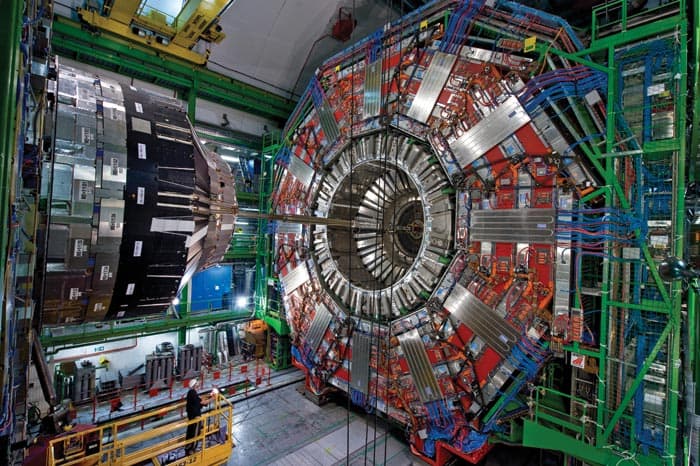
So far, new constraints have been placed on the ADD and RS models by the ATLAS and CMS experiments. For the ADD model, they have found that the so-called effective extra-dimensional Planck scale, which is the highest possible energy scale that makes physical sense within the given model, must be larger than 2–4 TeV, whereas for the RS model, the graviton needs to be heavier than 1–2 TeV. As the energy scale of a KK particle, i.e. its mass, is essentially directly proportional to the inverse size of the extra dimension, this equates to finding a maximum length scale for the extra dimension.

On 4 July this year the ATLAS and CMS collaborations at CERN announced that they had discovered a new particle with a mass of around 125 GeV, which most likely is the famous Higgs particle. If it is the Higgs, then the characteristic size of the extra dimension needs to be smaller than about 1.8 × 10–18 m – about a thousandth of the proton radius. But it should be noted that the LHC has really only just started collecting data, and much could remain to be discovered. Previously, other, less powerful machines have been used to restrict extra dimensions in a similar way, most notably the former accelerators the Large Electron–Positron collider at CERN and the Tevatron at Fermilab in the US.

Limits on extra dimensions could also be identified by the many dark-matter experiments, such as the XENON detector at the Gran Sasso underground laboratory in Italy, the space-borne Fermi and PAMELA satellites, and the IceCube neutrino telescope at the South Pole. Indeed, this year the Fermi collaboration put strong limits on the Planck scale in the ADD model that are compatible with the LHC results: it has to be larger than 230 TeV for two extra dimensions, 16 TeV for three and 2.5 TeV for four. If dark matter is made up of KK particles – i.e. Kaluza–Klein dark matter – then these experiments could prove useful in the study of extra dimensions.

Although neither the LHC nor any dark-matter experiments has yet found conclusive signs of physics beyond the Standard Model, over the next few years the LHC will produce numerous new data that will hopefully show whether extra dimensions exist or not. We may know the answer before the end of this year. Even if we do not, other experiments will continue the hunt, during what is proving to be a very interesting time for physics research at its most fundamental.
SKA names director-general

The British astronomer Philip Diamond has been appointed the first permanent director-general of the Square Kilometre Array (SKA) – the world’s biggest and most sensitive radio telescope. Diamond, who has spent the last two years in Australia as head of astronomy and space science at the CSIRO, will be moving back to the UK in October to head-up the SKA Organisation, which is based at the Jodrell Bank Centre for Astrophysics near Manchester. Diamond had been director of Jodrell Bank before joining the CSIRO in 2010. He replaces the Dutch astronomer Michiel van Haarlem, who has been interim SKA boss since December 2011.

SKA will be a €1.5bn ground-based radio-astronomy telescope used to probe the early universe for clues on galaxy evolution, dark matter and dark energy by looking as far back into time as the first 100 million years after the Big Bang. SKA will consist of more than 3000 radio dishes that will be spread out across thousands of kilometres in both Australia and southern Africa. The dishes will have a total collecting area of more than a square kilometre – hence the facility’s name.

Co-location surprise

The decision to co-locate the telescope on two different continents, which was announced in May 2012 after a six-year-long site-selection process, came as a surprise because the SKA Organisation had been expected to choose either Africa or Australasia to host the facility. SKA is currently in a “pre-construction” phase, where its engineers are testing out components that will make a fully fledged SKA possible. As well as the South Africa and Australia, other members of SKA include Canada, China, Italy, the Netherlands, New Zealand, Sweden and the UK.

“The SKA telescope is now moving from technology concept to the final, detailed design,” says Diamond, who has been involved with the project since 2000. Construction of the first phase of SKA is expected to start in 2016 and last for three years. This will involve building 50 low-frequency antenna stations, 60 mid-frequency dishes in Australia and 190 mid-frequency dishes in South Africa. About 100 existing dishes in both countries will also become part of SKA. The second phase should begin in 2018, with SKA being complete by 2023.

Nitrogen vacancies detect magnetic fields in fluids

A new electron spin resonance (ESR) technique involving tiny diamonds and optical tweezers has been developed by physicists in the US. The method measures local magnetic fields in liquid environments and could be used to monitor a range of phenomena that occur in fluids – including processes in biological cells and electrochemical devices. Indeed, the team believes that it could use the technique to image electromagnetic fields around neurons in the brain.

The diamonds contained nitrogen vacancies (NVs), which are defects that occur when two neighbouring carbon atoms are replaced by a nitrogen atom and an empty lattice site. An NV has an electronic spin that is extremely well isolated from the surrounding lattice, which means that if the NV is placed in a certain spin state it will remain in that state for a relatively long period of time – even at room temperature. What is more, the spin states can be read out reliably and reinitialized when needed. The structures can therefore be used to store quantum information or as quantum probes to detect magnetic fields in their surroundings.

In this latest work, David Awschalom and colleagues at the University of California, Santa Barbara looked at NV centres in “nanodiamonds” just 100 nm in diameter. He explains that “The nanodiamonds themselves can also be placed with nanometre precision wherever we wish in a sample and be moved around at will, something that has potential applications in sensing, tracking and tagging in submicron biophysical systems.”

The team’s nanodiamonds are trapped using optical tweezers, which involves using a single laser beam that is so tightly focused that dielectric particles such as diamond are pulled to the beam focus rather than being pushed forwards by the beam. The particles are therefore held in the focus, optically levitated and trapped. “By moving the laser focus with respect to the fluidic environment, we can choose where to position the particles using an all-optical technique (no wires or physical contacts needed),” says Awschalom.

Monitoring magnetic fields

Awschalom and colleagues used nanodiamonds that had been commercially irradiated to create more than 500 NV centres in every nanodiamond particle. The researchers then use ESR to measure the energy-level structure of the NV centres. ESR occurs when the electron spins are subjected to a magnetic field, which creates an energy difference between different spin orientations. If the sample is exposed to microwaves with energy equal to this difference, the spins will resonate between the two energy levels. Therefore by measuring the resonant frequency, the magnetic field strength can be determined. “We take advantage of the so-called Zeeman effect, which shifts the spin energy levels of the NV centre, to monitor the magnetic fields detected by the NV sensors in the nanodiamonds,” explains Awschalom.

“Being able to measure the local magnetic field at a chosen location in a fluidic environment using a laser to position the nanodiamond sensor may have multiple applications,” he claims. “For example, it could help improve our understanding of biological cellular processes, electrochemical cells, surface catalysis or lipid membranes. It also offers us a new way to visualize important biological and chemical structures that may be difficult to probe with conventional techniques.”

The team says that it is now interested in using functionalized nanodiamonds that have chemical groups attached to them so that they are attracted to certain molecules. These could be used in microfluidic channels in combination with optical trapping and electron spin resonance to maximize the potential for nanodiamond sensing and on-chip sorting to identify and quantify specific targets.

The work is described in the Proceedings of the National Academies of Science.

Ultracold fermions simulate spin–orbit coupling

Two independent groups of physicists are the first to use ultracold fermionic atoms to simulate “spin–orbit coupling” – an interaction that plays an important role in the electronic properties of solid materials. Both experiments were done by firing laser beams at the atoms, which caused their momentum to change by an amount that depends on their intrinsic spin. Because the interactions between atoms in such simulations can be adjusted with great precision, the breakthrough could shed further light on a range of physical phenomena, including magnetism, topological insulators and Majorana fermions.

Spin–orbit coupling describes the interaction between the intrinsic spin of an electron in a material and the magnetic field induced by the electron’s movement relative to its surrounding ions. As well as playing a key role in the magnetic properties of materials, spin–orbit coupling also influences the performance of “spintronic” devices – those that exploit the spin, rather than the charge, of electrons and that could one day lead to faster and more energy-efficient computers.

Quantum simulators

Because of its fundamental nature, physicists are therefore very keen to use clouds of ultracold atoms to simulate spin–orbit coupling. Such “quantum simulations” are carried out by subjecting the gas to laser light and magnetic fields, which lets researchers create interactions between atoms that are similar to those experienced by electrons in a solid. The advantage of these simulations is that – unlike in a solid – the strength of these interactions can be easily adjusted, allowing physicists to test theories of condensed-matter physics.

In 2011 Ian Spielman and colleagues at the National Institute of Standards and Technology (NIST) in Maryland were the first to simulate spin–orbit coupling in an ultracold gas of bosonic atoms. Now, two independent groups – one in China led by Hui Zhai of Tsinghua University and Jing Zhang of Shanxi University, and the other in the US headed by Martin Zwierlein and Lawrence Cheuk at the Massachusetts Institute of Technology (MIT) – have extended Spielman’s technique to fermions. As electrons are fermions and not bosons, the new work is much more relevant to electron physics.

Using potassium-40…

The Chinese team began with about two million potassium-40 atoms that are held in an optical trap and cooled to well below the ensemble’s Fermi temperature. This means that nearly all the atoms in the gas are in the lowest possible energy state, like the conduction electrons in a metal. The team focused on two closely spaced magnetic energy states, which are used to simulate the spin of the electron – one state corresponding to spin up and the other to spin down.

The team then fired two laser beams into the gas from opposing directions. The laser light is set to resonate with a transition between the two spin states – a process that involves the atoms continuously absorbing and emitting photons. As these photons carry momentum, if an atom absorbs a photon moving in one direction and then re-emits it in the same direction, the atom’s momentum will not change. However, an atom can also be stimulated by the opposing beam to emit the photon in the opposite direction – thus changing the atom’s momentum. Such an interaction involves a change in the direction of the atom’s spin and is therefore analogous to spin–orbit coupling – albeit in 1D.

The Chinese team used its system to study several aspects of spin–orbit coupling. In one experiment, the researchers began with a state in which all the spins are initially pointing in the same direction. They then turned on the spin–orbit interaction by pulsing the lasers for a very short time – just a few hundred microseconds. They found that the spins began to point in different directions in a process known as “dephasing”. This is expected from fermions because atoms with the same spin cannot have the same momentum and therefore each atom will be affected differently by the spin–orbit interaction.

Understanding dephasing is important because it has a detrimental effect on technological applications of spin such as spintronics and quantum computing. The team also looked at several other effects related to spin–orbit coupling, including its effect on the momentum distribution of the atoms.

…and lithium-6

The MIT physicists, meanwhile, used a gas of lithium-6 atoms, which meant that their realization of spin–orbit coupling was more difficult than for the Chinese team. The problem is that lighter atoms such as lithium are more prone to heating via the resonant absorption of light. So to get round this problem, the MIT team kept most of its atoms in “reservoir states” in which they do not interact with the light and stayed cool – using radio waves to drive a small number of atoms into the spin–orbit coupling states.

The MIT team focused on showing that ultracold atoms can be used to simulate a “spin diode” – a device that is likely to play a key role in the development of spintronic circuits. It allows spin-up atoms to flow forwards but not backwards, and spin-down atoms backwards but not forward. “The gas acts as a quantum diode, a device that regulates the flow of spin currents,” says Cheuk.

Simulating band structure

By applying radio-frequency radiation to the gas, the MIT physicists were also able to simulate a periodic potential similar to that found in a 1D lattice. As expected for real materials, the periodic potential led to the existence of spin-dependent energy bands. According to the team, the ability to create spin-dependent band structures in this way could lead to the simulation of topological insulators.

The spin–orbit coupling simulated by both teams occurs only in 1D and therefore cannot be used to simulate the 2D and 3D systems found in most real-life electronic devices. However, there are several interesting scenarios that can be investigated in a 1D system. For example, it could be used to simulate the behaviour of electrons in semiconductor/superconductor nanowires. Such systems are believed to harbour quasiparticles that resemble Majorana fermions – long sought-after particles that are also their own antiparticle.

Both experiments are described in Physical Review Letters.

The September 2012 issue of Physics World is out now

By Matin Durrani

PWSep12cover-200.jpg

Ask a non-scientist what a theoretical physicist does and you’re likely get a shrug of the shoulders along with a guess such as “Scribbles equations all day?” Even most physics students probably don’t know what theorists really do.

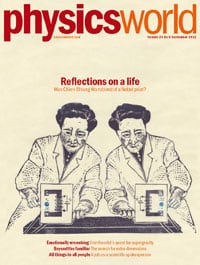
In an attempt to shed light on how theoretical physicists work, the September 2012 issue of Physics World, which is now out, contains the first of an occasional series exploring the emotional challenges behind some of the most elegant, ingenious or important calculations in physics

Our plan is to look at calculations that theorists consider their own favourite or that represented a personal triumph – a reward for years of study or a moment of clarity into what science is all about. This month we examine the work of Peter van Nieuwenhuizen, Daniel Freedman and Sergio Ferrara in 1976 on the theory of “supergravity”, which combines supersymmetry with gravity.

Although there is not yet any experimental proof that supergravity is a valid description of the real world, the tale of how the theory was created – as told by science writer David Appell – is fascinating and gripping. You can read Appell’s feature “When supergravity was born” by clicking here.

Elsewhere in the issue, Magdolna Hargittai from Budapest University of Technology and Economics examines the long-standing question of whether the physicist Chien-Shiung Wu should have received a share in the 1957 Nobel Prize for Physics – or whether she missed out to theorists Tsung-Dao Lee and Chen Ning Yang as a result of gender discrimination. Meanwhile, Henrik Melbéus and Tommy Ohlsson from the KTH Royal Institute of Technology in Sweden look into whether CERN’s Large Hadron Collider could find evidence for “extra dimensions”. Plus reviews, careers, lateral thoughts, feedback and much more.

Members of the Institute of Physics (IOP) can access the entire new issue online through the free digital version of the magazine by following this link or by downloading the Physics World app onto your iPhone or iPad or Android device, available from the App Store and Google Play, respectively.

For the record, here’s a rundown of highlights of the issue:

Support mounts for ‘honeytrap’ physicistMichael Banks looks at the physics community’s attempts to support 68-year-old particle theorist Paul Frampton, who is languishing in an Argentine jail on drug-smuggling charges

Delivering on a promiseShiraz Minwalla says India’s education needs to be reformed before the country can realize its full scientific potential

Critical point: One amazing momentRobert P Crease wonders why physicists are not doing more to celebrate the centenary of one of the most important events in science – the discovery that crystals diffract X-rays

Credit where credit’s due?Magdolna Hargittai asks if physicist Chien-Shiung Wu should have received a share in the 1957 Nobel Prize for Physics – or whether she missed out to theorists Tsung-Dao Lee and Chen Ning Yang as a result of gender discrimination

Delving into extra dimensionsHenrik Melbéus and Tommy Ohlsson describe three different theories of extra dimensions – universal, large and warped – and how these unseen dimensions could be observed, if they exist at all

Crackpots and consequencesMargaret Harris reviews Physics on the Fringe: Smoke Rings, Circlons, and Alternative Theories of Everything by Margaret Wertheim

Science in a dictatorshipGordon Fraser reviews The German Physical Society in the Third Reich: Physicists between Autonomy and Accommodation edited by Dieter Hoffmann and Mark Walker

Speak up – The role of spokespeople on international physics collaborations is important, complex and, as David Wark explains, requires skills that nobody ever taught you during your PhD

Once a physicist: Ralph Palmer – Meet the 12th Baron Lucas – a Conservative member of the House of Lords

Fiddling around with physics – In this month’s Lateral Thoughts column, Nicole Yunger Halpern muses on what would happen if great physics-loving musicians were to meet

If you’re not yet a member, you can join the IOP as an imember for just £15, €20 or $25 a year via this link. Being an IOPimember gives you a full year’s access to Physics World both online and through the apps.

Between the lines: innovation and creativity special

Light bulb made from screwed up paper

Teaching innovation

How do you define innovation? For Roberta Ness, it is simply “creativity with a purpose”, and the aim of her book Innovation Generation is to teach people how to think more creatively. To this end, she identifies a series of discrete stages in the innovation process, from “phrasing the question” properly to generating ideas, incubating them and eventually disseminating them to an appreciative world. Ness’s background is in public health, so many of her examples naturally lean towards the life sciences. Her book is also strongly US-centric, and UK readers will get a good laugh at Ness’s suggestion that they – unlike their benighted American counterparts – do not have to apply for financial support via an “arduous and lengthy…process of peer-reviewed grant submissions” for each experiment they wish to do. But the biggest problem with Innovation Generation is that the book itself is not terribly innovative. In fact, a fair amount of it feels like it has been recycled (with attribution) from earlier books in the science-lite genre, such as Malcolm Gladwell’s The Tipping Point, Steven Levitt and Stephen Dubner’s Freakonomics and James Surowiecki’s The Wisdom of Crowds. Readers who enjoyed those books will enjoy this one too – but only if they can overcome their sense of déjà vu at seeing familiar anecdotes repurposed.

  • 2012 Oxford University Press £18.99/$29.95hb 272pp

No easy answers

If Innovation Generation‘s “let’s break this down into steps” approach to scientific creativity strikes you as overly simplistic, you might want to pick up Drive and Curiosity instead. In it, chemist-turned-science-historian Istvan Hargittai profiles 15 innovative scientists and tries to explain how (and why) they made their career-defining discoveries. His chosen 15 include: the DNA pioneer James Watson; Watson’s sometime rival, Linus Pauling; and two physicists, Peter Mansfield and Rosalyn Yalow, who made Nobel-winning breakthroughs in biomedicine. After analysing the character traits and personal circumstances of all 15, Hargittai concludes that they do not, in fact, have much in common. The only unifying traits he can find are the “drive and curiosity” of the book’s title and, as he puts it, “Drive and curiosity do not always yield discovery, and when they do, the discovery is usually a minor one.” Moreover, a factor that benefits one person might well be disastrous for another. For example, Hargittai suggests that ignorance was a vital ingredient in Watson’s DNA breakthrough, because if Watson had understood the limitations of X-ray crystallography at the time, he might never have tried to probe the molecule’s structure. On the other hand, Pauling was successful precisely because he was, in Hargittai’s words, a “walking data bank” of structural chemistry. For him, ignorance would have been disastrous. Similarly, Pauling benefited from competition, but for Yalow, life in a scientific backwater proved advantageous, as it meant that she and her chief collaborator “could work on problems of their own choosing and develop their work at their own pace”. Hargittai’s insights are not the type that would catapult him into a lucrative third career as a motivational speaker. But after the glib grandiosity of Innovation Generation, the limited conclusions offered in Drive and Curiosity feel both thoughtful and refreshingly honest.

  • 2011 Prometheus Books £22.95/$26.00hb 328pp

A lot of silly ideas

The “Daedalus” column of scientific tomfoolery made its first appearance in New Scientist in the mid-1960s and was later a regular feature in Nature and the Guardian. To write it, author David Jones had to conjure up one silly-but-interesting idea every week for well over 30 years. He also performed regular scientific demonstrations on British and German regional television. That is an admirably long track record of innovative thinking, and fans of Jones’ Daedalian alter ego will be delighted to hear that he has now written an entire book about scientific creativity. The Aha! Moment is actually more like two books in one: its first chapters describe Jones’s theory of creative thought, while later ones give examples of his own creative ideas in action. Jones has undoubtedly had some very good ideas in his career, including an unrideable bicycle, a series of zero-gravity chemistry experiments that flew on the Space Shuttle and an artificial geyser made from a tea kettle, a glass tube and a metal bin lid. However, as he states on several occasions, at least 80% of all ideas turn out to be bad, and unfortunately there is some evidence for this in the book. The author’s less-great ideas include an eyebrow-raising division of creativity into allegedly “male” and “female” forms, the idea that a woman can subconsciously select which of her eggs will be released for fertilization and even suggestions that certain people can psychically influence the outcome of Schrödinger’s-cat-type experiments. True, some of these bad ideas are attributed to Daedalus, rather than to Jones himself, but it is sometimes hard to tell where one begins and the other ends. Those who never read Daedalus in his prime will struggle to understand why some of his jokes were funny, and will gain little from the book’s frequent references to Jones’s past work.

  • 2012 Johns Hopkins University Press £13.00/$25.00pb 264pp p

Geoengineering is ‘comparatively inexpensive’

Researchers in the US have estimated that modification of stratospheric albedo – a widely discussed geoengineering technique to counteract some of the effects of climate change – could cost as little as $5bn a year. Although this is just a small fraction of the gross domestic product (GDP) of most western countries, the team stresses that there are many potential risks of geoengineering the planet in this way.

Geoengineering aims to mitigate man-made climate change by making large-scale modifications to the Earth’s surface or atmosphere. One of the main proposals discussed by scientists is stratospheric albedo modification: changing the reflective power of the atmosphere 10–50 km above the Earth’s surface so that more solar radiation is reflected back into space. Such a modification would be achieved by pumping tiny particles known as aerosols into the upper atmosphere.

Price on pumping

Now, technology and policy expert Jay Apt of Carnegie Mellon University in the US and colleagues have put a price on such aerosol pumping. Using statistical methods, they estimated the cost for various systems of delivering between one and five million tonnes of particles such as sulphur compounds to altitudes of 18–30 km. These systems included the use of existing aircraft, the procurement of new aircraft or airships, the procurement of rockets and guns, and suspended gas pipes.

Apt’s group found that the basic technology exists today to deliver enough aerosols into the stratosphere to offset the man-made warming expected over the next 50 years. In fact, several of the systems under consideration could perform the feat for less than $5bn a year – just 0.03% of US GDP.

Some of the cheapest systems would involve airships, the researchers found, although the development cost and high-altitude performance of these is uncertain. Gas pipes would offer low recurring costs, although their development cost would be high and they would need to demonstrate very high tensile strength. Rocket and gun systems, according to the calculations, would be the most expensive.

Environmental and political risks remain

Apt’s group is quick to point out that the estimated costs should not be seen as a green flag for stratospheric albedo modification, since the researchers have considered neither its potential environmental risks nor its political or moral strains. Their study “simply means that an attribute of [albedo modification] is that it is comparatively inexpensive”, they say.

Indeed, scientists and policy experts have uncovered many disadvantages of stratospheric albedo modification. One problem is that different regions of the world might need different amounts of modification, since global warming is not expected to occur evenly. Another issue is that altering albedo could affect other aspects of the climate, such as rainfall. In fact, some climate models suggest that albedo modification could hasten the droughts that climate change is expected to induce.

Worst, however, is the knowledge that, once begun, albedo modification must be maintained indefinitely. “Abrupt stopping of the delivery of particles to the stratosphere would cause very rapid climate changes,” says Apt.

The research is published in Environmental Research Letters.

Supporting the careers of physics postdocs

By Margaret Harris

If you want to pursue a career in physics, it might help if you like to move around. Last week’s Facebook poll asked what steps you had taken in order to pursue your career in physics, and the most popular responses – by, ahem, a country mile – involved moving to a new location. A lot of those moves involved significant distances, too, with 38% of the 110 poll respondents having moved more than 500 miles at least once in their career, while 13% had moved a shorter distance.

Thumbnail image for Thumbnail image for hands smll.jpg

The most popular non-geographic change, according to the poll, was switching to a different field of research: 19% of respondents had done this. Changing sectors – the example given was moving from academia to industry – was much less popular among poll respondents, with only a handful (5%) having made this type of move.

Respondents who picked the last two options in the poll – “two of the above” and “three or more of the above” – are harder to categorize because there is obviously going to be some overlap. Nevertheless, the 8% of respondents who picked “three or more” must have moved locations, too, and it seems likely that at least some of the 16% who selected “two of the above” will have done so as well. The total figure, then, is around two-thirds, give or take a few per cent.

In retrospect, I wish I had included a “none of the above” option in the poll. I suspect there aren’t many professional physicists out there who have stayed in one location, field and sector for their entire careers, but you never know. If you are one of them, please accept my apologies for not giving you the option of saying so.

This week’s poll is a bit more abstract, and like the poll we presented two weeks ago about choosing a postdoctoral position, it focuses on early-career researchers.

Which of the following actions would be most helpful to physics postdocs?

Better advice on career options outside academia
More training in transferrable skills
Longer-term contracts (e.g. three years rather than one)
Creating more mid-level “permanent postdoc” jobs
Improved support for postdocs with spouses and families

Have your say by visiting our Facebook page, and please feel free to explain your response or give us more suggestions by posting a comment below the poll or by e-mailing us at pwld@iop.org.

Oscar Pistorius is helping to redefine ‘disability’


The athlete Oscar Pistorius made history in July when he became the first amputee sprinter to run alongside able-bodied athletes at the Olympic Games, competing in the 400 m in both the individual and relay events in London. Continuing his busy summer schedule, the South African sprinter is now at the Paralympic Games, also in the UK capital, where he is the defending champion in the 100 m, 200 m and 400 m for his class. Nicknamed the “blade runner” because of the iconic artificial limbs on which he runs, Pistorius has fast become one of the world’s biggest sports stars and he is redefining what it means to be “disabled”.

One of the most poignant moments of the London Olympics followed the second semi-final of the men’s 400 m. After winning the race, Kirani James of Grenada, who would eventually win gold in this event, immediately turned round to seek Pistorius, whom he embraced and made a point of exchanging name bibs with in a gesture of respect. It was a powerful symbol that showed how Pistorius is fully accepted among his fellow competitors. Pistorius finished eighth in the race and so did not qualify for the final, but he told journalists shortly afterwards “I am struggling to find a way to describe it. It is really humbling all the support I have had”. However, the journey to becoming this celebrated Olympian has not always been an easy one for the 25 year old from Pretoria.

Pistorius has not always enjoyed such widespread support. In 2007 his ambition to compete alongside able-bodied athletes faced a major setback when he was banned from competing in all able-bodied athletics competitions by the International Association of Athletics Federations (IAAF). The move came after Pistorius had been invited to take part in a series of scientific tests at Cologne Sports University in Germany under the guidance of one of the university’s academics along with a member of the IAAF. Questions about his performance were raised when Pistorius had started to run sprint events in times comparable to able-bodied athletes. The report, following two days of testing, concluded that when Pistorius is running at the same speeds as able-bodied athletes, he is using less energy. These findings led to an IAAF vote and the subsequent ban. But why did the IAAF take issue with Pistorius? It was surprising given that the history of athletes competing with the aid of varying forms of prostheses dates back to before the original Olympic Games in 776 BC. What was different about this case?

The Cheetah Flex-Foot

Pistorius, who was born without lower leg bones, underwent a double amputation aged just 11 months following the advice of medical professionals who said an early operation would greatly increase his prospects of mobility later in life. Having developed an interest in sport as a child, Pistorius focused on track running at the age of 17, competing in his first track session at the beginning of 2004. It was later in that same year that Pistorius first began using a J-shaped prosthesis known as the Cheetah Flex-Foot. Pioneered by the US bioengineer Van Phillips and now produced by the Icelandic company Össur, the design of this prosthesis has been optimized for sport. This is in contrast to the more typical designs for which day-to-day walking as well as a natural-looking appearance are the top priorities.

Crafted out of carbon fibre, the Flex Foot prostheses are strong and light but also utilize the fact that carbon fibre is anisotropic, meaning that its response varies depending on the direction in which a force is applied to it. The prosthesis is produced so that the grains of carbon fibre are aligned parallel to the curve of the J. The outcome is that the upper part of the J, which attaches below the knee, is desirably rigid because the downward force is parallel to the grain. But at the bottom of the J where the leg makes contact with the ground, the prosthesis flexes, storing energy that is then released back through the limb and into the athlete’s body as they push off for their next stride.

It is this “spring in the step” that led the Cologne study to conclude that Pistorius was able to run with his prosthetic blades at the same speed as able-bodied sprinters with roughly 25% less energy expenditure. The sports engineer David James, who was not involved in the Cologne study, says that, in biomechanical terms, running can be thought of as a series of jumps. “It costs you energy to rebound and to bounce,” he says. “It has led to this interesting question about using this prosthesis because it stores spring energy and returns energy, unlike muscle and bone. Perhaps using these prostheses creates an advantage for the athlete.” James, who is based at the Centre for Sports Engineering Research at Sheffield Hallam University in the UK, discusses the issues surrounding Oscar Pistorius’s running style in this video interview with Physics World.

Pistorius fights back

But Pistorius – who was by now used to facing relentless questions – was not going to take this ruling lying down. Along with his support team, Pistorius has always maintained that the reasons he is able to compete with able-bodied athletes are natural ability and hard work alone. They point out that the Flex Foot prosthesis has been used by Paralympic athletes since 1996 and that Pistorius has been competing with the same pair of blades since 2004, during which time he has achieved a marked improvement. In fact, the prosthesis used by Pistorius is relatively old and “low tech” compared with some of the newer sports prostheses available today.

Pistorius challenged the ban via an appeal and travelled to the US to take part in an alternative series of testing at Rice University in Texas. While the Cologne tests focused only on the biomechanics of Pistorius running at full speed in a straight line, this second study also investigated the elements of track running where Pistorius may face a disadvantage, such as at the start, where athletes need to rapidly accelerate. The results from the Rice tests were analysed by a team of researchers in biomechanics and physiology from six universities led by Hugh Herr of the Massachusetts Institute of Technology. The group’s findings challenged the conclusion of the Cologne study that Pistorius has an unfair advantage in the 400-m race.

Pistorius took his case to the Court of Arbitration for Sport in Lausanne, Switzerland, which was addressed by Herr along with one of his scientific colleagues. In May 2008 a panel unanimously determined that the scientific evidence did not support the claim that Oscar Pistorius has a net advantage over able-bodied athletes. The ban was revoked with immediate effect. “While an athlete’s performance in sprints of very short duration is determined almost entirely by mechanical factors, in races of longer duration, such as the 400 m, performance depends on both mechanical and metabolic factors,” said Herr. In other words, the science is much more complicated than the Cologne study suggested and the basis for the ban was flawed.

Possibly because of the disruption to his training regime caused by the ban and subsequent appeal, Pistorius did not achieve the qualifying times required to be part of the South African team that took part in the 2008 Olympic Games in Beijing. He did compete, however, in that summer’s Paralympics and became the first athlete to win gold in the 100 m, 200 m and 400 m events in the T43/T44 disability sport classification. Over the past four years Pistorius has raced alongside able-bodied athletes and his improved performances enabled him to be included in the South African team for the 2011 IAAF World Championships in Athletics held in Daegu, South Korea. Then came the Olympics this year where he was selected to compete in the South African 4 × 400 m relay team, which opened up the possibility of competing in the individual event despite having narrowly missed out on the South African team’s qualification requirements.

The scientific debate keeps running

While Pistorius’s career goes from strength to strength, the scientific debate about the use of running-specific prostheses has not disappeared entirely. Of particular note, two of the scientists involved in the analysis of the Rice tests, Peter Weyand of the Southern Methodist University in Texas and Matthew Bundle of the University of Montana, have since claimed that prostheses may indeed provide advantages. In a paper published in the November 2009 issue of Journal of Applied Physiology the pair suggests that other mechanical factors, including unusually fast leg swings caused by their light weight, can take prosthetic legs beyond the limits imposed by human biology. “The moment in athletic history when engineered limbs outperform biological limbs has already passed,” they concluded in this paper. A more recent study by researchers in the UK and Malaysia, published earlier this year in Journal of Sports Engineering and Technology, also appears to support this conclusion. These researchers looked in particular at the manner in which sports prostheses can store energy during the early stages of running events, which can then be released to assist the athlete during the latter stages when they are battling with fatigue.

The extent to which this meandering scientific debate affects Pistorius is unclear, but in interviews he appears to be tightly focused on his sporting ambitions and challenges. When asked about his legs, Pistorius regularly quotes his sporting motto “You’re not disabled by the disabilities you have, you are able by the abilities you have”. Seemingly, it is this drive and focus that has enabled Pistorius to achieve so much in such a short space of time. His status as an athlete and cultural icon will undoubtedly be further boosted by his appearance at the Paralympics – an event whose stature is growing exponentially. Whatever happens next in the scientific debate, Pistorius is above all else an elite athlete who is raising profound questions about the use of the term “disabled”. He is helping to transform attitudes and mindsets.

The July issue of Physics World also contains a feature about sports prostheses, exploring prostheses for cycling and the latest technologies that will feed into future prosthetic designs. For a limited period you can download a free copy of this special issue on the physics of sport. You might also want to watch these videos on the biomechanics of running, cycling and swimming.

Infrared and X-ray lasers map chemical bonds

Scientists in the US are the first to combine infrared and X-ray lasers to study the electronic properties of matter. The technique involves firing infrared light at a diamond sample that is also illuminated by X-rays. Some of the light is absorbed by the diamond’s valence electrons and its energy is then transferred to some of the X-rays scattering from the sample. This allows the team to differentiate between X-rays that have interacted with valence electrons and X-rays that have scattered from the sample’s core electrons – something that has never been done before.

X-ray diffraction involves bouncing X-rays off the electron clouds that surround a material’s constituent nuclei and studying the interference patterns that are created. While it gives a wealth of information about the structure and composition of materials, the technique reveals little about the sample’s chemically active valence electrons. This is because the majority of electrons involved in the scattering are “core” electrons, which do not take part in chemical processes.

More than 40 years ago, Isaac Freund and Barry Levine at Bell Labs proposed a way of getting round this problem. They pointed out that if the sample is exposed to laser light, the valence electrons will respond by oscillating at the laser frequency. Some of the oscillation energy is then transferred to the X-rays as they scatter from the valence electrons in a process called “wave mixing”. As a result, X-rays scattered from the valence electrons will emerge at a slightly higher energy that is equal to the sum of the incoming X-ray and laser energies.

High intensity needed

The effect is small, however, and seeing it requires an extremely intense X-ray beam – something that is only now available at the Linac Coherent Light Source (LCLS) at the SLAC National Accelerator Laboratory in California, where this latest work was done by Thornton Glover and colleagues. The team studied diamond because the material’s structural and electronic properties are already well known. While not a laser in the conventional sense, the LCLS is called a free-electron laser (FEL) because it produces laser-like X-ray pulses that are highly coherent.

To study valence electrons, the team fires simultaneous 8 keV X-ray pulses and infrared pulses at the sample. Most of the X-ray beam undergoes normal diffraction and leaves the diamond sample at a specific angle. However, some of the X-ray beam absorbs energy from the valence electrons and is slightly boosted in energy. These X-rays leave the sample at a slightly different angle and are directed through an aperture that blocks out the much more intense diffracted beam.

By measuring the intensity of the energy-boosted X-rays as a function of the scattering angle, the team was able to work out the density of valence electrons along a specific direction of the diamond lattice. The result agreed with what we already know about carbon, showing that the technique works as expected.

Computer simulations

In order to get a complete 3D image of the valence-electron density, the measurement would need to be repeated at a number of different orientations of the diamond crystal – measurements that the team has not yet reported. However, based on their preliminary results, Glover and colleagues have done computer simulations that suggest such measurements should provide maps of valence bonds within the diamond crystal (see image).

Now that it has been shown that wave-mixing measurements can be made using the LCLS, Glover believes that the technique could be used to study a range of materials. “The easiest kinds of diffraction experiments are with crystals, and there’s lots to learn,” he says. “For example, light can be used to alter the magnetic order in advanced materials, yet it’s often unclear just what the light does, on the microscopic scale, to initiate these changes.”

Shedding light on photosynthesis

Looking beyond crystalline materials, Glover also believes that the technique could shed light on photosynthesis, in which photon energy is converted to chemical energy and then transferred in processes that occur on picosecond timescales. “Quantum entanglement plays an important role [in photosynthesis], as an excited electron simultaneously samples many spatially separated sites, probing to find the most efficient energy-transfer pathway,” explains Glover. “It would be great if we could use X-ray and optical wave mixing to make real-space images of this process as it’s happening, to learn more about the quantum aspects of the energy transfer.”

However, Glover points out that such a measurement would require X-ray lasers with much higher repetition rates than are currently available. “FELs of the future will combine high peak brightness with a high repetition rate, and this combination will open up new opportunities for examining the interactions of light and matter on the atomic scale.”

The research is described in Nature.

Copyright © 2026 by IOP Publishing Ltd and individual contributors