Building nanomagnets atom by atom

Physicists in Germany have developed a new technique for making tiny magnets that involves picking up and placing individual iron atoms using a microscope tip. The nanometre-sized magnets can be made in a range of different shapes, while the same microscope tip can also be used to measure their magnetic properties. After comparing their results with elaborate computer simulations of the nanomagnets, the researchers found deviations that could point to hitherto unknown atomic-scale magnetism effects.

“The assembly technique we used is very similar to the children’s game LEGO,” explains team member Jens Wiebe of Hamburg University. “Our building blocks are iron atoms that are laid on a very clean copper surface, and each block behaves like a small compass needle that can point in one of two directions – up or down. This allows us to assemble magnets the constituent atoms of which can be arranged in a variety of different configurations.”

The researchers were led by Roland Wiesendanger at Hamburg University and included scientists from the Institute for Advanced Simulation in Jülich. They used the sharp tip of a spin-polarized scanning tunnelling microscope to build their nanomagnets. The tip can be positioned with high precision above the iron atoms and is able determine the locations of individual atoms on the copper surface. If the tip is brought close enough to an individual atom, it can be used to “pick” the atom up and move it to another position.

Chains, triplets and flowers

“We can build artificial magnets atom by atom that have a variety of different shapes – such as chains, triplets and ‘flowers’,” says Wiebe. “What is more, the tip of the microscope is coated with a magnetic material, which allows us to measure the magnetization curve of each of the constituent iron atoms within the magnet.”

The team compared its experimental results with theoretical calculations based on the Ising model of magnetism. The researchers found that at low applied magnetic fields, the magnetization curves of chains of assembled iron atoms differs from those predicted by theory. However, at higher fields, the theoretical and experimental magnetic curves agree remarkably well.

“Empirically speaking, the opposite sloping curves we saw for the low-field cases hint at an additional magnetic field acting opposite to the applied magnetic field (B), or the presence of an additional magnetic moment that is coupled antiferromagnetically to the end atoms of the chains,” says Wiebe. “Indeed, we are able to reproduce the low-field anomalies of some chains by considering an additional magnetic field in the Ising model that scales with –B (pointing opposite to B) or by including an additional magnetic moment of around 5 Bohr magnetons antiferromagnetically coupled to the chain ends with an ‘exchange constant’ of about –50 µeV.”

The origin of such an additional magnetic field or moment is currently unknown though, he adds, and only seems to affect linear chains and not more compact nanostructures such as the triplets or the flower shapes.

Fundamental questions

According to the team, the same technique, if applied to magnets consisting of a larger number of atoms, could help scientists tackle important fundamental questions in magnetism concerning “spin glasses” or “spin liquids”, which are the magnetic states of particular solid-state materials.

The researchers now hope to build novel hard nanomagnets using an appropriate combination of elements from the periodic table.

The research is described in Nature Physics.

Geophysicists fingerprint sea-level rise

By considering the unique sea-level “fingerprint” created by a melting ice sheet, a team of geophysicists in North America has developed a new method for pinpointing the sources of global sea-level rise. Their approach could provide a way to measure the impact of the Greenland and West Antarctic ice sheets – the greatest sources of uncertainty in projections of future sea-level changes.

Long-term variations in sea level are caused by processes including thermal expansion of the water, changes in ocean circulation, and changes in the size of glaciers and ice sheets. Measurements from tide gauges indicate a global average sea-level rise of 1–2 mm/yr during the 20th century. However, this estimate ignores geographical variations in sea level, and provides no information about the contribution of different processes.

One possible way to pick apart the total sea-level change is to look for the distinct pattern, or fingerprint, of a melting ice sheet. Close to the ice sheet, for example, the sea level tends to fall. This is a result of both the local uplift of the Earth’s crust after being relieved of the great weight of the ice and a reduction in the ice sheet’s gravitational pull on the ocean. Moving further away from the ice sheet, however, the sea level rises progressively.

Looking for fingerprints

Carling Hay at the University of Toronto and colleagues at Harvard University, along with Rutgers University geophysicists in Canada and the US, have developed a new statistical method for identifying these ice-sheet fingerprints. Their approach uses an algorithm known as the Kalman filter, which processes noisy measurements and provides an optimal estimate of a system’s state. The Kalman filter is well suited for analysing sea-level change because it can use known information about the system to fill data gaps – a common occurrence with tide-gauge records.

In order to test this framework, the team created a sea-level record from scratch, containing known contributions from different processes. The researchers first removed the long-term trends from almost 600 tide-gauge records going as far back as 1807, isolating the short-term sea-level variability – the observational “noise”. Then, at each tide-gauge site, a long-term, warming-forced sea-level trend was added, obtained from a climate-model simulation. Changes in land height caused by changes in glacial mass were supplied by an Earth model, and a globally uniform trend of 0.8 mm/yr was added to account for any unmodelled sources of sea-level rise, such as the melting of mountain glaciers.

Melt rates of 0.3 and 0.5 mm/yr were assumed for the Greenland (GIS) and West Antarctic (WAIS) ice sheets, respectively, along with their predicted fingerprints. The researchers then applied the Kalman filter to this synthetic dataset, initializing the algorithm with melt rates of zero.

Matching melt rates

The algorithm was found to estimate the melt rates most accurately when applied to the maximum number of tide gauges, providing enough information for the ice-sheet fingerprints to be separated from the globally uniform trend. The final estimated melt rates for the GIS and WAIS were 0.21 and 0.38 mm/yr, respectively, close to the values used in the synthetic dataset. The 1σ uncertainties associated with these values indicate the magnitude of ice-sheet melting that could potentially be detected in real sea-level records.

“It should be possible to use historical tide-gauge records to robustly infer positive Greenland and West Antarctic ice-sheet melt rates above 0.3 and 0.4 mm/yr, respectively,” explains Hay. “We are now in the process of applying our methodology to historical sea-level records to provide a new estimate of total sea-level rise and ice-sheet melt rates over the 20th century,” she adds.

Eric Leuliette, an oceanographer at NOAA’s Satellite Oceanography and Climatology Division, comments that this approach is, however, unlikely to provide a complete picture of past sea-level changes. “Because of the lack of long tide-gauge records near some regions with glaciers, it may be impossible to use fingerprints to reconstruct all of the individual sources of 20th century sea-level rise,” says Leuliette, who was not involved in this latest research. “But this study demonstrates that it may be possible to use tide gauges to at least constrain the contributions from Antarctica and Greenland.”

Hay and colleagues eventually hope to apply their algorithm to satellite measurements of sea-surface height. Although these data are only available for the past 20 years, they offer near-global coverage.

The research is described in Proceedings of the National Academy of Sciences.

Quasars shine a new light on cosmic distances

An international team of scientists has developed a method to determine the distances to quasars throughout the universe. This could allow quasars to be used as standard candles. The researchers found characteristic patterns in the light given off by a group of quasars and say that these regularities are directly related to the redshift of the quasar. This allows them to reliably derive the unknown redshift – how fast objects are moving away from one another in the expanding universe – of one quasar from the known redshift of another.

Astronomers are always keen to find new and accurate methods to measure cosmic distances and the expansion of the universe. “Standard candles” such as Cephids and supernovae have played important roles in astronomy. Indeed, the discovery of the accelerating expansion of the universe through observations of distant supernovae won Saul Perlmutter, Adam Riess and Brian Schmidt the 2011 Nobel Prize for Physics. But using supernovae to gauge the extreme distances of the universe has its problems – the furthest known supernova is at a redshift of about 1.7 and so reliable measurements of distances greater than that are not possible using supernovae. Also, astronomers have to wait for stars to “go supernova” and then have a short window of time to make their observations.

Contrary to that, the furthest quasar has been found at a redshift of about 7.1, and so looks much further back to the beginnings of the universe. Also, quasars are some of the brightest objects in the universe, and unlike supernovae can be studied for much longer time scales. Unfortunately, quasars emit different amounts of light in all wavelengths, and this makes it very difficult to use them to measure cosmological distances using their luminosity–distance relation. It was only last year that another team of researchers showed that it was possible to use the luminosity–radius relation of active galactic nuclei – a type of quasar – to determine their distance; using them as standard candles.

Quasar light patterns

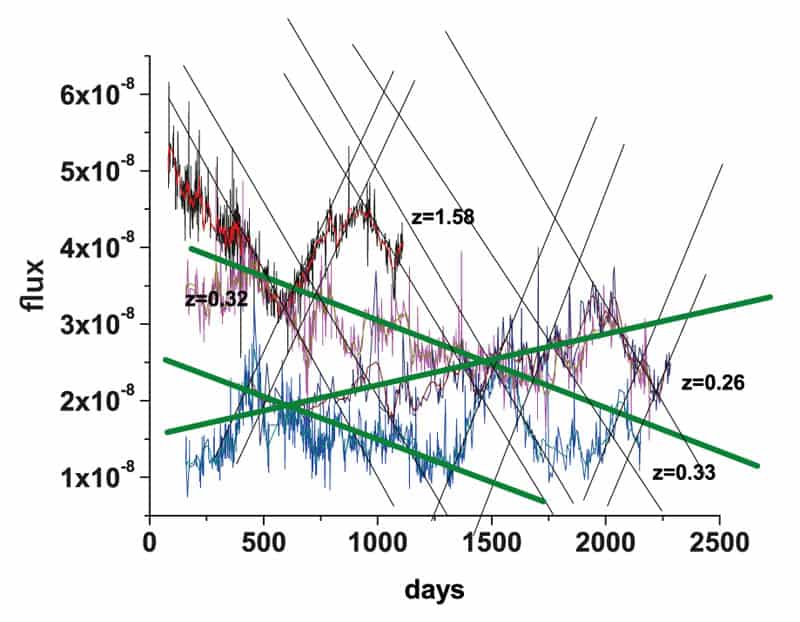
But as it happens, quasars also have regularities in their light curves – how they brighten and dim over time – that could easily be used to determine their redshifts. Dejan Stojkovic from the State University of New York (SUNY) at Buffalo, US, and colleagues found that using the light curves to calculate the redshift of a quasar, independent from its luminosity–distance relation, would then allow quasars to be used as standard candles. They studied the publicly available light curve data from the Massive Compact Halo Objects (MACHO) project, which looked at quasars behind Magellanic Clouds.

“Potentially, quasars are much better [standard candles], but we still do not know them well enough,” says Stojkovic. “Until we noticed that the light curves of quasars follow certain patterns, no known regularities had been studied. And that was because they do look completely different at first glance,” he explains.

The team plotted a graph of the flux of a quasar versus “real time”, and this, according to Stojkovic, was crucial. “Mostly, for quasar variations, people plot their absolute magnitude which is a log of the flux; whereas flux is the actual energy emitted over unit time. So all our values are ‘real’ values,” he says. The team also transformed all the values for the quasar’s rest frame, so that the calculated values were for quantities exactly as “they were emitted right there”. The researchers then only carried out “global transformations” so that they were “not changing the physics of any of the observed values”.

Curve fixing

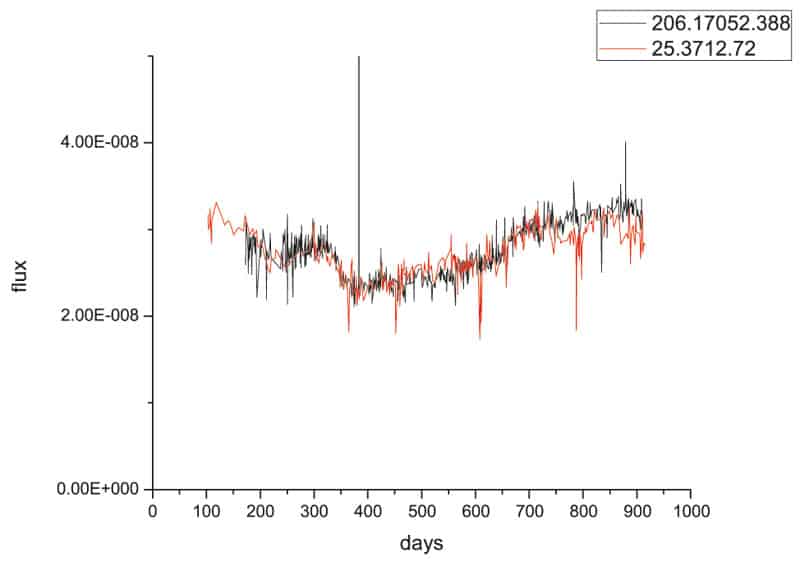
The team found that the light curve data for different quasars matched when the graphs were laid one on top of the other. This led it to conclude that if the light curves were similar, then the redshift of one quasar could be used to calculate the unknown redshift of another quasar using only the unknown quasar’s light curve. To be able to do this, the researchers developed and tested two independent methods.

In the first method, the researchers identify the straight-line segments of the slopes in their graphs and it is these slopes that appear to be directly related to the redshift of the quasars. So then, matching the slope of a quasar with a known redshift determines the redshift of the unknown quasar. Testing this by using quasars with known redshifts and labelling one as the “unknown” gave the researchers extremely accurate values.

The second method is more of a statistical take on the light-curve readings, according to Stojkovic. Again, they used two quasars, both with known redshifts, but deemed one “test quasar” as the “unknown”. Then, instead of plotting only the straight-line segments of the curves, they matched a considerable portion of the light curves – several segments instead of just one – and they were able to “fit” the redshift ratios of the quasars closely. “This means that when we had the best fit for the light curves, we had the redshift, and this was the really exciting part,” explains Stojkovic.

‘Proof of concept’

Both the above techniques suggest that the similar light-curve patterns shared by different quasars could allow them to be used as standard clocks, or candles, combined with separate luminosity–distance calculations. But Stojkovic is quick to point out that it is early days yet for their method, as it is more a “proof of concept” at the present time.

This is because the technique requires high-quality observational data for quasars, where each individual quasar is observed for a minimum of 90 days or more to see the regularities. As people were unaware of these regularities, such data are scarce. Of the 56 quasars observed in the MACHO data, only 14 had enough data for the team to use. “It was very encouraging that our methods worked perfectly for all 14 quasars with sufficient information, but much more data is necessary,” says Stojkovic. He also points out that it might be possible that the method may work only for one type of quasar, and that they may not be able to match light curves of all quasars, but this must once again be tested.

“While our method might not be instantly useful, it might become standard in the future. The method we currently use to detect extrasolar planets – where you look at them transiting across a star – was developed in the 1980s, but they did not have the technology that we do today to pick up a strong enough signal. But now, we routinely use it,” says Stojkovic.

In the months to come Stojkovic is keen to automate the entire process of fitting their various graphs. Currently, this is done “visually” and eliminating human involvement entirely would speed up the process, allowing much more data to be processed and more accurately. Stojkovic’s brother and team member, Branislav Stojkovic, from the computer sciences department at SUNY, is helping to develop algorithms that could easily match the 1D curves from the quasars. More data and faster processing methods over time will tell if quasars will replace supernovae as distance and time markers of our universe.

The research is to be published in Physical Review Letters. A pre-print is available on the arXiv pre-print server.


Particle physicist sentenced for terror plot

By James Dacey

The BBC is reporting that the physicist Adlène Hicheur has been sentenced by a French court to five years in prison.

Hicheur, a 35-year-old French-Algerian, was arrested by French police on 8 October 2009 on suspicion of having links with the organization al-Qaeda in the Islamic Maghreb. Until his arrest, Hicheur was a postdoc at the Swiss Federal Institute of Technology in Lausanne and worked on the Large Hadron Collider at CERN.

During his time in custody, Hicheur had received support from some members of the physics community. In November 2010 the Nobel laureate Jack Steinberger and 18 other physicists wrote to the French Physical Society about their concerns over the continued imprisonment of Hicheur without charge. Hicheur also received support from an “international defence committee”, consisting of about 100 scientists, which wrote to French authorities including the French president Nicolas Sarkozy.

In January 2011 the Swiss authorities announced they would be closing the case into the actions of Hicheur. But the French authorities did not follow suit, and French pre-emptive anti-terrorism laws dictate that any person can be held in prison for up to two and a half years without charge.

According to the BBC article, today’s guilty verdict is based on police-intercepted e-mails from Hicheur to an alleged contact in al-Qaeda. The e-mails apparently suggest that Hicheur was willing to be part of an “active terrorist unit”, attacking targets in France.

Michael Dittmar, a researcher based at ETH Zurich and CERN who had written an article in support of Hicheur in the May 2011 issue of Physics World, expressed his surprise at the verdict. “I just heard it in shock,” he told physicsworld.com.

Dittmar said that he did not want to comment directly on the verdict, having not seen the e-mail exchanges. He did, however, restate his criticism of the French legal system. “It is totally unacceptable to put someone in prison for 2.5 years without charge, to allow the leak of some info to the media about the reasons, resulting in increased fears within society, and all this most likely for some political interests.”

The great graphene name game

University of Exeter researchers


University of Exeter researchers Saverio Russo and Monica Craciun.
(Courtesy: University of Exeter)


By Tushna Commissariat

Here at Physics World, the word graphene gets used a lot. You might find that simply saying the word “graphene” elicits a groan from most of the editorial team. But this is usually followed quite swiftly by a fair amount of interest, because it’s undeniable that graphene is some kind of “wonder material” with a seemingly endless list of bizarre properties and applications. Along with the plethora of potential applications for graphene comes an interesting array of names for graphene-based materials. When our news editor Michael Banks heard that scientists in Spain had created an acoustic analogue for graphene, he dubbed it “graphone” – a name that has a certain resonance to it!

But it seems that researchers at the UK’s University of Exeter really ran out of suitable graphene-related names recently as they have decided to call their new graphene-based material “GraphExeter”. According to the researchers, GraphExeter is the most transparent, lightweight and flexible version of graphene that is also an excellent at conducting electricity, and so “could revolutionize the creation of wearable electronic devices, such as clothing containing computers, phones and MP3 players”.

The researchers created GraphExeter by sandwiching molecules of ferric chloride between two layers of graphene. Ferric chloride enhances the electrical conductivity of graphene without affecting the material’s transparency. The researchers say it is also much more flexible than indium tin oxide (ITO), the main conductive material currently used in electronics. As ITO is used so extensively, it is expensive and resources are expected to run out by 2017. The research is published in the journal Advanced Materials here.

Lead researcher Monica Craciun says “GraphExeter could revolutionize the electronics industry. It outperforms any other carbon-based transparent conductor used in electronics and could be used for a range of applications, from solar panels to ‘smart’ T-shirts. We are very excited about the potential of this material and look forward to seeing where it can take the electronics industry in the future.”

According to a University of Exeter press release, the researchers are “now developing a spray-on version of GraphExeter, which could be applied straight onto fabrics, mirrors and windows”. While the applications of GraphExeter may be varied and interesting, the researchers might have to come up with a slightly more user-friendly name for their new material if they intend to use it in a T-shirt venture!

Do you consider astronomy to be a distinct academic discipline from physics?

By James Dacey

In his editorial article in the May edition of Physics World, Matin Durrani writes about the various “trump cards” that astronomy has over some of the more esoteric areas of physics. He refers to the stunning pictures, the strong amateur involvement via citizen-science projects and the fact that getting your head around the basics of the subject is usually fairly painless.

hands smll.jpg
The theme was inspired by the upcoming transit of Venus, a spectacular astronomical event on 5–6 June that will see our sister planet cross the face of the Sun as viewed from the Earth. Given that this transit will not occur again until 2117, excitement ahead of the event is building among scientists and the media alike. And this highlights another of astronomy’s trump cards: the predictability of such events allows the community to publicize and plan for the occasions long before they occur. The same could not be said, for instance, about the discovery of the next quasiparticle or the formulation of the latest incarnation of string theory.

Most would agree that astronomy does have some unique selling points. Some, however, might push this distinction even further and argue that astronomy is a separate discipline from physics altogether. The argument is that physics is a science concerned with the pursuit of general theories, applicable across the entire universe, that can be tested against empirical observations. Astronomy could be considered to be less fundamental in this respect, being a largely observational discipline.

But what do you think? Let us know via this week’s Facebook poll

Do you consider astronomy to be a distinct academic discipline from physics?
Yes
No

Have your say by casting your vote on our Facebook page. And feel free to post a comment to explain your choice or offer a different comparison between physics and astronomy.

In last week’s poll we acknowledged the 50th anniversary of the UK in space by asking the you who you thought was most likely to reach the next significant milestone in manned space exploration. The majority of voters believe that the future of manned space travel will play out in a different way to how it all began in the 1960s as a two-horse race between the US and the USSR. Some 46% of voters believe that “an emerging space nation such as China or India” will reach the next significant milestone. Another 20% believe that it will be an international collaboration. 16% think it will be a private company, 12% believe it will be the US and just 6% believe it will be Russia.

In addition to votes, the poll also attracted some interesting comments on our Facebook page. Owen Marshall, for instance, believes that the space race never stopped – it has just attracted some speedy new contenders. “While I think that an emerging nation will hit the next significant milestone in space exploration, I also believe that such an event will be a wake-up call to other nations such as the US and Russia, and that they will follow closely,” he wrote.

Thank you for all your participation and we look forward to hearing from you in this week’s poll.

The yoctogram weighs in

Researchers in Spain have made the most sensitive mass sensor ever. Capable of weighing a single proton – which has a mass of 1.7 yoctograms, or about 10–24 g – the device is made of a suspended carbon nanotube. The sensor could be used to detect single molecules or to study chemical reactions as they happen, and could even provide insights into the fundamentals of quantum mechanics.

The new mass sensor was made by Adrian Bachtold and colleagues at the Catalan Institute of Technology in Barcelona. It consists of a single suspended carbon nanotube that resonates at a certain frequency. “We can increase the pitch – or acoustic resonance frequency – of this ‘nanostring’ by reducing its length,” explains team member Julien Chaste. “Our resonator is very short (just 150 nm in length) and is 2 nm in diameter.”

The carbon nanotube resonates at 2 GHz. When a tiny particle sticks to the tube, this resonant frequency drops – with heavier particles lowering it more than lighter ones. The shift in resonant frequency can be monitored and used to calculate the mass of the particle.

Researchers have made such mass sensors before and these devices were able to detect masses of about 100 yoctograms. The new device can weigh objects 100 times lighter still.

Current annealing

Bachtold’s team boosted the sensitivity of the device by passing a large electric current through it to “clean” it. “Such current annealing was sufficient to get rid of some absorbed atoms, which act as contaminating ‘dust’,” Chaste explains. The experiments were also conducted under ultrahigh-vacuum conditions to reduce interference from ambient molecules to a minimum, and at temperatures of just 4 K to reduce thermal effects.

The researchers used their nanobalance to detect single naphthalene molecules and small numbers of xenon atoms. From this, they calculate that the mass sensor has a resolution of 1.7 yoctograms, which is around the mass of a single proton.

Following chemical reactions

The team says that its sensor might be used to distinguish different elements in a compound, which might differ by only a few protons. It would therefore be possible to follow chemical reactions as they occur, says Chaste.

“The record mass sensitivity of our device is related to its tiny size, but the nanoworld in general, and nanoresonators in particular, is ultrasensitive to small masses, forces, charges and magnetic moments,” he adds. “As well as mass detection, nanoresonators operating at ultralow temperatures might also be very interesting for fundamental studies in quantum physics.”

The work was reported in Nature Nanotechnology.

‘Missing silicon problem’ solved, say geophysicists

Researchers in Japan have new evidence that the Earth’s lower mantle contains more silicon than its upper mantle. The results suggest that the composition of the Earth’s silicates match the type of meteorites thought to exist in the solar nebula from which the Earth was created.

The Earth’s mantle can be divided into three sections: the upper mantle, which stretches from the thin crust down to about 400 km in depth; a transition zone of about 250 km; and finally the lower mantle, which stretches from the transition zone to about 2900 km in depth. Most geoscientists agree that the upper mantle is composed mostly of peridotite, a dense igneous rock containing a high proportion of the mineral olivine (Mg,Fe)2SiO4. At the transition zone, a change in the way seismic waves propagate has generally been explained by a phase transition in the structure of the olivine, suggesting that the lower mantle, too, is peridotite in composition. If this is true, however, the Earth would contain far less silicon than chondritic meteorites – the type of meteorites thought to exist at the time of the Earth’s formation.

More or less silicon?

In the past, this “missing silicon problem” has provoked much debate. Some geoscientists believe that the missing silicon must be made up in the Earth’s core, while others believe the lower mantle must contain an additional source of silicon. There has even been a suggestion that the meteorites from which the Earth formed contained less silicon than is generally assumed.

Now, geophysicist Motohiko Murakami of Tohoku University in Sendai and colleagues claim to have solved the missing silicon problem. They believe that the lower mantle in fact contains more silicon than the upper mantle – which is consistent with the Earth having been formed from chondritic meteorites. “The main result of our work is that the mantle has [a] chemically stratified structure with [a] silicon-enriched lower mantle in comparison with the upper mantle,” says Murakami.

Murakami and colleagues performed laboratory-based seismic-velocity measurements on two possible lower-mantel minerals – silicate perovskite, or (Mg Fe)SiO3, and ferropericlase, or (Mg,Fe)O – under very high pressures and temperatures. Comparing these measurements with actual seismic-velocity data using a model, the researchers found that more than 93% of the lower mantle should be made of perovskite, the silicon-rich mineral.

James Connolly, a geoscientist at the Swiss Federal Institute of Technology in Zurich, says that in recent years there has been a trend in seismic models towards a silicon-enriched lower mantle, although he adds that the enrichment proposed by Murakami and colleagues is the “most extreme” he has seen. He thinks the group’s conclusions are interesting because they support the notion that the mantle has two separate layers that circulate independently, and that the Earth was formed by accretion of chondritic meteorites. “The popularity of both of these hypotheses has been waning in recent years,” he says.

Some uncertainty

However, geophysicist Baosheng Li of Stony Brook University in New York thinks there may be a problem with the Japanese researchers’ modelling. For example, he says that there is a “large uncertainty” in their temperature measurements, which may compromise their conclusions. Still, he thinks the group’s techniques are, in general, “first class”. “I found this paper interesting, although in my personal view it still needs more data to confirm [that] the lower mantle holds the ‘missing silicon’,” he adds.

The research is described in Nature.

JUICE picked for launch

The European Space Agency (ESA) has announced that a mission to Jupiter has beaten two other candidates to be the agency’s pick for its first “large” class (L-class) mission. The €850m Jupiter Icy Moons Explorer (JUICE) is expected to launch in 2022 and will travel to Jupiter and its moons. The 19 members of ESA’s Science Programme Committee opted for the craft during a meeting today in Paris following a recommendation from the ESA executive last month. The mission is the first L-class probe as part of ESA’s Cosmic Vision 2015–2025 programme.

JUICE is expected to carry about 11 instruments, which are not included in the mission’s €850m price tag as they will be paid for by the member states that build them. Once launched in 2022, the mission will take eight years to reach Jupiter, where the craft will then test the conditions that may have led to the emergence of habitable environments. “JUICE is a very exciting mission, and it’s about time Europe did another big planetary exploration, so I am not surprised the ESA executive sees this as the obvious thing to do,” says astronomer Andy Lawrence from the University of Edinburgh in the UK.

The missions that have missed out are an X-ray observatory called the Advanced Telescope for High Energy Astrophysics (ATHENA) and the New Gravitational Wave Observatory (NGO). Both ATHENA and NGO are downgraded versions of the €3.8bn International X-ray Observatory (IXO) and €1.8bn Laser Interferometer Space Antenna (LISA), both of which had to be redesigned after the US pulled out because of budget constraints. LISA was designed to measure gravitational waves – tiny ripples in space–time that are an unobserved prediction of Einstein’s general theory of relativity and that are believed to occur whenever massive objects accelerate. IXO was planned for launch in 2021 to study black holes and the hot gas associated with galaxies and stars.

The JUICE mission is also the result of NASA pulling out of the Europa Jupiter System Mission (EJSM/Laplace) – a joint mission with ESA that would have involved sending two probes to Jupiter and its moons: NASA’s Jupiter Europa Orbiter (JEO) and ESA’s Jupiter Ganymede Orbiter (JGO). JUICE is now based on the design for JGO and will focus in particular on studying three of Jupiter’s moons: Ganymede, Callisto and Europa.

“[This decision has] everything to do with NASA, and is really just about money,” says Lawrence. “NASA pulled out of all three predecessor missions – LAPLACE, IXO and LISA – so we just don’t have enough money to carry out the old plan.”

A “scary” decision

The announcement last month that the ESA executive had opted for JUICE caused consternation within groups working on NGO and ATHENA. Indeed, the NGO team sent a letter to Alvaro Gimenez, ESA’s director of science, complaining about how the process was handled, while the ATHENA team started a petition – created by Kirpal Nandra from the Max Planck Institute for Extraterrestrial Physics in Garching, Germany, along with 10 other astronomers – to save the mission.

“ATHENA offers a huge leap forward in capabilities with respect to current X-ray observatories and is at present the only possibility for a major astronomical observatory operating in the X-ray band a decade from now,” the petition authors write. The petition got the support of more than 1450 astronomers, and in addition to being sent to Gimenez was also passed on to representatives of the Science Programme Committee.

“ESA’s report to the Science Programme Committee contains no justification for the recommendation of JUICE,” Nandra told physicsworld.com. “The details of the decision-making process have been kept secret, so officially there is no information as to why we got the result we did.”

Lawrence says that ESA’s decision could damage European X-ray astronomy. “Astronomers will carry on doing X-ray related science,” he says. “But we will lose the technical and engineering skills, so we won’t be ready to build the next big mission when it finally comes. That is scary.”

That view is shared by Nandra, who says that the decision “could be a disaster, not just for X-ray astronomy, but the whole of astronomy and astrophysics”. He adds that there is now a “very real possibility” that there will be no operating X-ray observatory at all in the 2020s, as other national space agencies have nothing planned beyond the current decade.

It is likely, but not certain, that ESA will still launch a second L-class mission before the end of 2030, which will be a choice between ATHENA and NGO. “It’s really all about ATHENA versus NGO,” adds Lawrence.

Acoustic analogue to graphene announced

It may sound inconceivable, but two physicists in Spain claim to have made an acoustic version of the wonder material graphene by simply drilling a honeycomb pattern of holes into a plastic sheet. Daniel Torrent and José Sánchez-Dehesa of the Polytechnic University of Valencia say they have spotted “Dirac cones” – a characteristic feature in the electronic band structure of graphene – in sound waves that propagate on the surface of the plastic. While much more work is required before practical applications could emerge from what the researchers call an “acoustic analogue of graphene”, the material could be used to improve acoustical systems or even gain a better understanding of graphene itself.

Since graphene was discovered in 2004, this 2D honeycomb lattice of carbon has been found to have a wealth of fascinating electronic properties. Many of these arise from the fact that graphene is a semiconductor with zero energy gap between its valence and conduction bands. Near where the two bands meet, the relationship between the energy and momentum of the electron is described by the Dirac equation and resembles that of a photon. These bands, called Dirac cones, enable electrons to travel through graphene at extremely high speeds.

Torrent and Sánchez-Dehesa decided to find out if an acoustic analogue to Dirac cones could exist. They did this by first calculating the properties of sound waves travelling on the surface of poly(methylmethacrylate) – also known as Perspex or Plexiglas – onto which holes had been bored to create a honeycomb lattice. The researchers were particularly interested in the dispersion relation of the sound waves, which is the relationship between the energy of a sound wave and its momentum.

Definitively Dirac

The calculations, which revealed the existence of a Dirac point and Dirac cones, suggest that the surface acoustic waves are best described by the Dirac equation. In particular, the model predicts the existence of surface acoustic waves with a specific Dirac frequency and Dirac velocity that should propagate with ease through the material without scattering.

To look for these waves, Torrent and Sánchez-Dehesa took a sheet of Plexiglas measuring 300 mm by 100 mm and bored 1113 holes in it to create a honeycomb pattern. Each hole had a diameter of 3 mm and depth of 2.88 mm, with the distance between holes being 3.33 mm. As illustrated in the image above, this resulted in the removal of a large amount of material, leaving behind a trellis-like structure.

The sheet was then connected to a loudspeaker and the sound was measured using microphones at two different locations. The physicists blasted the material with short pulses of sound with a central frequency of 22 kHz and a pulse width of about 5 kHz – chosen because the predicted Dirac frequency of the material lay within the pulse.

Sharp dip

Torrent and Sánchez-Dehesa found that the “phase delay” – the time difference in the arrival of the sound waves at each microphone – dipped sharply at about 22 kHz, which they say corresponds to the vertex of the Dirac cone. They also noticed that the dispersion relation of the waves, as calculated from their experiment, revealed a Dirac cone at about 22 kHz, as expected from theory. In particular, they found a linear relationship between momentum and energy near the Dirac point, which is a hallmark of a Dirac cone.

Nicholas Fang of the Massachusetts Institute of Technology in the US describes the work as “exciting” and told physicsworld.com that he agrees with Torrent and Sánchez-Dehesa’s claim of having identified a Dirac cone. “This is quite impressive, as from the theories, to observe such a Dirac cone in an acoustic system would require a precise shape and volume fraction of the structures,” he says.

Both Fang and the original researchers say that it is too early to know if materials with Dirac cones could be put to practical use. One possibility, however, could be to use them for acoustic lenses that can collect sound without losing any of it to reflection.

Torrent and Sánchez-Dehesa are now doing experiments designed to confirm that the acoustic waves travel unimpeded across the material – much like Dirac electrons in graphene. Indeed, Sánchez-Dehesa believes that similar materials could be used to simulate the electronic properties of graphene using sound. This could be useful because important properties such as lattice parameters can be easily changed in Plexiglas – but not in graphene itself.

The work is described in Physical Review Letters.

Copyright © 2026 by IOP Publishing Ltd and individual contributors