Supporting the careers of physics postdocs

By Margaret Harris

If you want to pursue a career in physics, it might help if you like to move around. Last week’s Facebook poll asked what steps you had taken in order to pursue your career in physics, and the most popular responses – by, ahem, a country mile – involved moving to a new location. A lot of those moves involved significant distances, too, with 38% of the 110 poll respondents having moved more than 500 miles at least once in their career, while 13% had moved a shorter distance.

Thumbnail image for Thumbnail image for hands smll.jpg

The most popular non-geographic change, according to the poll, was switching to a different field of research: 19% of respondents had done this. Changing sectors – the example given was moving from academia to industry – was much less popular among poll respondents, with only a handful (5%) having made this type of move.

Respondents who picked the last two options in the poll – “two of the above” and “three or more of the above” – are harder to categorize because there is obviously going to be some overlap. Nevertheless, the 8% of respondents who picked “three or more” must have moved locations, too, and it seems likely that at least some of the 16% who selected “two of the above” will have done so as well. The total figure, then, is around two-thirds, give or take a few per cent.

In retrospect, I wish I had included a “none of the above” option in the poll. I suspect there aren’t many professional physicists out there who have stayed in one location, field and sector for their entire careers, but you never know. If you are one of them, please accept my apologies for not giving you the option of saying so.

This week’s poll is a bit more abstract, and like the poll we presented two weeks ago about choosing a postdoctoral position, it focuses on early-career researchers.

Which of the following actions would be most helpful to physics postdocs?

Better advice on career options outside academia
More training in transferrable skills
Longer-term contracts (e.g. three years rather than one)
Creating more mid-level “permanent postdoc” jobs
Improved support for postdocs with spouses and families

Have your say by visiting our Facebook page, and please feel free to explain your response or give us more suggestions by posting a comment below the poll or by e-mailing us at pwld@iop.org.

Oscar Pistorius is helping to redefine ‘disability’


The athlete Oscar Pistorius made history in July when he became the first amputee sprinter to run alongside able-bodied athletes at the Olympic Games, competing in the 400 m in both the individual and relay events in London. Continuing his busy summer schedule, the South African sprinter is now at the Paralympic Games, also in the UK capital, where he is the defending champion in the 100 m, 200 m and 400 m for his class. Nicknamed the “blade runner” because of the iconic artificial limbs on which he runs, Pistorius has fast become one of the world’s biggest sports stars and he is redefining what it means to be “disabled”.

One of the most poignant moments of the London Olympics followed the second semi-final of the men’s 400 m. After winning the race, Kirani James of Grenada, who would eventually win gold in this event, immediately turned round to seek Pistorius, whom he embraced and made a point of exchanging name bibs with in a gesture of respect. It was a powerful symbol that showed how Pistorius is fully accepted among his fellow competitors. Pistorius finished eighth in the race and so did not qualify for the final, but he told journalists shortly afterwards “I am struggling to find a way to describe it. It is really humbling all the support I have had”. However, the journey to becoming this celebrated Olympian has not always been an easy one for the 25 year old from Pretoria.

Pistorius has not always enjoyed such widespread support. In 2007 his ambition to compete alongside able-bodied athletes faced a major setback when he was banned from competing in all able-bodied athletics competitions by the International Association of Athletics Federations (IAAF). The move came after Pistorius had been invited to take part in a series of scientific tests at Cologne Sports University in Germany under the guidance of one of the university’s academics along with a member of the IAAF. Questions about his performance were raised when Pistorius had started to run sprint events in times comparable to able-bodied athletes. The report, following two days of testing, concluded that when Pistorius is running at the same speeds as able-bodied athletes, he is using less energy. These findings led to an IAAF vote and the subsequent ban. But why did the IAAF take issue with Pistorius? It was surprising given that the history of athletes competing with the aid of varying forms of prostheses dates back to before the original Olympic Games in 776 BC. What was different about this case?

The Cheetah Flex-Foot

Pistorius, who was born without lower leg bones, underwent a double amputation aged just 11 months following the advice of medical professionals who said an early operation would greatly increase his prospects of mobility later in life. Having developed an interest in sport as a child, Pistorius focused on track running at the age of 17, competing in his first track session at the beginning of 2004. It was later in that same year that Pistorius first began using a J-shaped prosthesis known as the Cheetah Flex-Foot. Pioneered by the US bioengineer Van Phillips and now produced by the Icelandic company Össur, the design of this prosthesis has been optimized for sport. This is in contrast to the more typical designs for which day-to-day walking as well as a natural-looking appearance are the top priorities.

Crafted out of carbon fibre, the Flex Foot prostheses are strong and light but also utilize the fact that carbon fibre is anisotropic, meaning that its response varies depending on the direction in which a force is applied to it. The prosthesis is produced so that the grains of carbon fibre are aligned parallel to the curve of the J. The outcome is that the upper part of the J, which attaches below the knee, is desirably rigid because the downward force is parallel to the grain. But at the bottom of the J where the leg makes contact with the ground, the prosthesis flexes, storing energy that is then released back through the limb and into the athlete’s body as they push off for their next stride.

It is this “spring in the step” that led the Cologne study to conclude that Pistorius was able to run with his prosthetic blades at the same speed as able-bodied sprinters with roughly 25% less energy expenditure. The sports engineer David James, who was not involved in the Cologne study, says that, in biomechanical terms, running can be thought of as a series of jumps. “It costs you energy to rebound and to bounce,” he says. “It has led to this interesting question about using this prosthesis because it stores spring energy and returns energy, unlike muscle and bone. Perhaps using these prostheses creates an advantage for the athlete.” James, who is based at the Centre for Sports Engineering Research at Sheffield Hallam University in the UK, discusses the issues surrounding Oscar Pistorius’s running style in this video interview with Physics World.

Pistorius fights back

But Pistorius – who was by now used to facing relentless questions – was not going to take this ruling lying down. Along with his support team, Pistorius has always maintained that the reasons he is able to compete with able-bodied athletes are natural ability and hard work alone. They point out that the Flex Foot prosthesis has been used by Paralympic athletes since 1996 and that Pistorius has been competing with the same pair of blades since 2004, during which time he has achieved a marked improvement. In fact, the prosthesis used by Pistorius is relatively old and “low tech” compared with some of the newer sports prostheses available today.

Pistorius challenged the ban via an appeal and travelled to the US to take part in an alternative series of testing at Rice University in Texas. While the Cologne tests focused only on the biomechanics of Pistorius running at full speed in a straight line, this second study also investigated the elements of track running where Pistorius may face a disadvantage, such as at the start, where athletes need to rapidly accelerate. The results from the Rice tests were analysed by a team of researchers in biomechanics and physiology from six universities led by Hugh Herr of the Massachusetts Institute of Technology. The group’s findings challenged the conclusion of the Cologne study that Pistorius has an unfair advantage in the 400-m race.

Pistorius took his case to the Court of Arbitration for Sport in Lausanne, Switzerland, which was addressed by Herr along with one of his scientific colleagues. In May 2008 a panel unanimously determined that the scientific evidence did not support the claim that Oscar Pistorius has a net advantage over able-bodied athletes. The ban was revoked with immediate effect. “While an athlete’s performance in sprints of very short duration is determined almost entirely by mechanical factors, in races of longer duration, such as the 400 m, performance depends on both mechanical and metabolic factors,” said Herr. In other words, the science is much more complicated than the Cologne study suggested and the basis for the ban was flawed.

Possibly because of the disruption to his training regime caused by the ban and subsequent appeal, Pistorius did not achieve the qualifying times required to be part of the South African team that took part in the 2008 Olympic Games in Beijing. He did compete, however, in that summer’s Paralympics and became the first athlete to win gold in the 100 m, 200 m and 400 m events in the T43/T44 disability sport classification. Over the past four years Pistorius has raced alongside able-bodied athletes and his improved performances enabled him to be included in the South African team for the 2011 IAAF World Championships in Athletics held in Daegu, South Korea. Then came the Olympics this year where he was selected to compete in the South African 4 × 400 m relay team, which opened up the possibility of competing in the individual event despite having narrowly missed out on the South African team’s qualification requirements.

The scientific debate keeps running

While Pistorius’s career goes from strength to strength, the scientific debate about the use of running-specific prostheses has not disappeared entirely. Of particular note, two of the scientists involved in the analysis of the Rice tests, Peter Weyand of the Southern Methodist University in Texas and Matthew Bundle of the University of Montana, have since claimed that prostheses may indeed provide advantages. In a paper published in the November 2009 issue of Journal of Applied Physiology the pair suggests that other mechanical factors, including unusually fast leg swings caused by their light weight, can take prosthetic legs beyond the limits imposed by human biology. “The moment in athletic history when engineered limbs outperform biological limbs has already passed,” they concluded in this paper. A more recent study by researchers in the UK and Malaysia, published earlier this year in Journal of Sports Engineering and Technology, also appears to support this conclusion. These researchers looked in particular at the manner in which sports prostheses can store energy during the early stages of running events, which can then be released to assist the athlete during the latter stages when they are battling with fatigue.

The extent to which this meandering scientific debate affects Pistorius is unclear, but in interviews he appears to be tightly focused on his sporting ambitions and challenges. When asked about his legs, Pistorius regularly quotes his sporting motto “You’re not disabled by the disabilities you have, you are able by the abilities you have”. Seemingly, it is this drive and focus that has enabled Pistorius to achieve so much in such a short space of time. His status as an athlete and cultural icon will undoubtedly be further boosted by his appearance at the Paralympics – an event whose stature is growing exponentially. Whatever happens next in the scientific debate, Pistorius is above all else an elite athlete who is raising profound questions about the use of the term “disabled”. He is helping to transform attitudes and mindsets.

The July issue of Physics World also contains a feature about sports prostheses, exploring prostheses for cycling and the latest technologies that will feed into future prosthetic designs. For a limited period you can download a free copy of this special issue on the physics of sport. You might also want to watch these videos on the biomechanics of running, cycling and swimming.


Infrared and X-ray lasers map chemical bonds

Scientists in the US are the first to combine infrared and X-ray lasers to study the electronic properties of matter. The technique involves firing infrared light at a diamond sample that is also illuminated by X-rays. Some of the light is absorbed by the diamond’s valence electrons and its energy is then transferred to some of the X-rays scattering from the sample. This allows the team to differentiate between X-rays that have interacted with valence electrons and X-rays that have scattered from the sample’s core electrons – something that has never been done before.

X-ray diffraction involves bouncing X-rays off the electron clouds that surround a material’s constituent nuclei and studying the interference patterns that are created. While it gives a wealth of information about the structure and composition of materials, the technique reveals little about the sample’s chemically active valence electrons. This is because the majority of electrons involved in the scattering are “core” electrons, which do not take part in chemical processes.

More than 40 years ago, Isaac Freund and Barry Levine at Bell Labs proposed a way of getting round this problem. They pointed out that if the sample is exposed to laser light, the valence electrons will respond by oscillating at the laser frequency. Some of the oscillation energy is then transferred to the X-rays as they scatter from the valence electrons in a process called “wave mixing”. As a result, X-rays scattered from the valence electrons will emerge at a slightly higher energy that is equal to the sum of the incoming X-ray and laser energies.

High intensity needed

The effect is small, however, and seeing it requires an extremely intense X-ray beam – something that is only now available at the Linac Coherent Light Source (LCLS) at the SLAC National Accelerator Laboratory in California, where this latest work was done by Thornton Glover and colleagues. The team studied diamond because the material’s structural and electronic properties are already well known. While not a laser in the conventional sense, the LCLS is called a free-electron laser (FEL) because it produces laser-like X-ray pulses that are highly coherent.

To study valence electrons, the team fires simultaneous 8 keV X-ray pulses and infrared pulses at the sample. Most of the X-ray beam undergoes normal diffraction and leaves the diamond sample at a specific angle. However, some of the X-ray beam absorbs energy from the valence electrons and is slightly boosted in energy. These X-rays leave the sample at a slightly different angle and are directed through an aperture that blocks out the much more intense diffracted beam.

By measuring the intensity of the energy-boosted X-rays as a function of the scattering angle, the team was able to work out the density of valence electrons along a specific direction of the diamond lattice. The result agreed with what we already know about carbon, showing that the technique works as expected.

Computer simulations

In order to get a complete 3D image of the valence-electron density, the measurement would need to be repeated at a number of different orientations of the diamond crystal – measurements that the team has not yet reported. However, based on their preliminary results, Glover and colleagues have done computer simulations that suggest such measurements should provide maps of valence bonds within the diamond crystal (see image).

Now that it has been shown that wave-mixing measurements can be made using the LCLS, Glover believes that the technique could be used to study a range of materials. “The easiest kinds of diffraction experiments are with crystals, and there’s lots to learn,” he says. “For example, light can be used to alter the magnetic order in advanced materials, yet it’s often unclear just what the light does, on the microscopic scale, to initiate these changes.”

Shedding light on photosynthesis

Looking beyond crystalline materials, Glover also believes that the technique could shed light on photosynthesis, in which photon energy is converted to chemical energy and then transferred in processes that occur on picosecond timescales. “Quantum entanglement plays an important role [in photosynthesis], as an excited electron simultaneously samples many spatially separated sites, probing to find the most efficient energy-transfer pathway,” explains Glover. “It would be great if we could use X-ray and optical wave mixing to make real-space images of this process as it’s happening, to learn more about the quantum aspects of the energy transfer.”

However, Glover points out that such a measurement would require X-ray lasers with much higher repetition rates than are currently available. “FELs of the future will combine high peak brightness with a high repetition rate, and this combination will open up new opportunities for examining the interactions of light and matter on the atomic scale.”

The research is described in Nature.

What happens when novelists turn to physics for inspiration

By Margaret Harris

 Physics in fiction podcast

From science-fiction epics such as H G Wells’ The Time Machine to Ian McEwan’s novel Solar, physics has long been a rich source of themes and characters for fiction writers.

In our latest books podcast, we discuss four recent additions to the “physics in fiction” genre, including works of historical fiction about Newton and Kepler, a thriller about the world of mathematical finance and a novel about the creation of the universe.

Find out how they measure up by listening to the podcast here or downloading it via this link.

Physics in fiction

The podcast is hosted by James Dacey and features four books in total. The first two, The Sky’s Dark Labyrinth and The Sensorium of God, are both fictionalized versions of real episodes in physics history. They are part of a trilogy (the third book is due to be published in 2013) by the science writer Stuart Clark, and in the podcast they are covered by Physics World‘s reviews editor, Margaret Harris.

Next up is a thriller by Robert Harris called The Fear Index. This book is set in the modern-day world of mathematical finance, and as Physics World‘s editor Matin Durrani explains, its main character is a rather unsavoury ex-CERN physicist who has become a hedge-fund tycoon.

The last book discussed in the podcast is Mr g. This one is a bit harder to describe but author Alan Lightman – a physicist at the Massachusetts Institute of Technology – bills it as “a novel about the creation”, which seems pretty spot-on to us.

So are any of these books destined to become classics of physics fiction? Unlike in physics itself, there are no right or wrong answers here – but there are plenty of opinions, and we would love to hear your favourite examples of physics in fiction after you’ve listened to the podcast. You can post them as comments to this article, e-mail them to us at pwld@iop.org or send them to @PhysicsWorld on Twitter.

Special Report: Japan

By Michael Banks

Japan is certainly not resting on its laurels in maintaining its world-leading position in physics.

Only last week a Japanese government committee on high-energy physics released the English-language version of its highly anticipated report looking into the country’s particle-physics research programme for the coming decade.

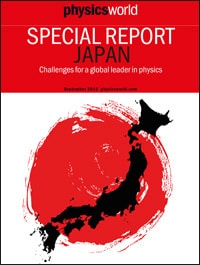
 Physics World Special Report: Japan

The 19-member committee not only recommended that Japan should take a lead in the design for a collider to study the Higgs boson, such as the International Linear Collider, but also that it should lead on plans to build a large-scale neutrino facility to study charge–parity violations in neutrino oscillations.

It is exactly for this reason – Japan’s history as a leading nation in physics – that we decided to take a closer look at physics in the country. Not only the many successes it has enjoyed, but also what challenges it faces in staying ahead.

We’ve now put together a new Physics World special report, which you can view online here, that draws together a selection of our recent articles about physics in Japan. Several of the articles are based on a week-long road trip to Japan that I went on earlier this year that included visiting Tokyo and Osaka.

In the issue we look, for example, at a major upgrade to Japan’s famous KEKB collider, a new asteroid-sample-return mission, as well as the world’s first compact X-ray free-electron laser. But Japan also faces many challenges to its world-beating status in physics, including how to entice foreign scientists to work and study in the country as well as attracting more women into physics.

I hope you find this special report stimulating and please do let us have your comments by e-mailing pwld@iop.org.

Here’s a rundown of what’s inside.

• Recovering from the quake – I discuss how Japan’s World Premier Institutes – set up to attract international researchers – have fared following the Fukushima nuclear accident in 2011

• The only woman in town – Mio Murao of the University of Tokyo explains how to get more women interested in physics in Japan

• Japan’s X-ray vision for the future – I travel to the remote SACLA facility, which houses the world’s first compact X-ray free-electron laser

• JAXA pushes for asteroid encore – Dennis Normile looks at plans to launch a second asteroid-sample-return mission after Japan’s successful Hayabusa probe

• Getting a grip on antimatter – Yasunori Yamazaki of the RIKEN laboratory in Tokyo describes his research on antimatter

• Coping with “Galapagos syndrome” – although Japan has introduced a number of reforms to reverse a trend of increasing isolation, some fear they may not be enough, as Dennis Normile reports

• Revamping Japan’s atom smasher – with the KEKB facility in Tsukuba undergoing a major upgrade, I describe how it could one day help to explain why there is more matter than antimatter in the universe

Scientists see saccharin star

Rho Ophiuchi star-forming region in the infrared


(Courtesy: ALMA (ESO/NAOJ/NRAO)/L Calçada (ESO) and NASA/JPL-Caltech/WISE Team)


By Tushna Commissariat


A team of astronomers in Denmark has spotted sugar molecules in the gas surrounding a young Sun-like star. And why is finding sugar in the gas surrounding a star important, you ask? It’s important because it tells us that complex organic molecules, like the sugars, that form the building blocks of life can be found around young stars at the time when planets could be begin to form around them.

The team found molecules of one of the simplest form of sugar – glycolaldehyde – in the gas surrounding a young binary star known as IRAS 16293-2422, which has a mass similar to that of the Sun. While the sugar has been found in space before – within our galaxy itself – this is the first time it has been found in close proximity to a star; in fact, it’s as close to IRAS 16293-2422 as Uranus is to the Sun. This discovery shows that some of the chemical compounds needed for life existed in this system at the time of planet formation. IRAS 16293-2422 is also located only about 400 light-years away from us – a mere hop, skip and jump in astronomical terms, making it an excellent target for astronomers studying the molecules and chemistry around young stars.

“In the disc of gas and dust surrounding this newly formed star, we found glycolaldehyde, which is a simple form of sugar, not much different to the sugar we put in coffee,” explains Jes Jorgensen from the Niels Bohr Institute in Denmark, who was the lead researcher of the team that used the Atacama Large Millimeter/submillimeter Array (ALMA) to observe the star. “This molecule is one of the ingredients in the formation of RNA, which – like DNA, to which it is related – is one of the building blocks of life.”

The image above shows the Rho Ophiuchi star-forming region in the infrared, as seen by NASA’s Wide-field Infrared Explorer (WISE). IRAS 16293-2422 is the red object in the centre of the small square. The inset image is an artist’s impression of glycolaldehyde molecules, showing glycolaldehyde’s molecular structure (C2H4O2).

“What it is really exciting about our findings is that the ALMA observations reveal that the sugar molecules are falling in towards one of the stars of the system,” says team member Cécile Favre of Aarhus University in Denmark. “The sugar molecules are not only in the right place to find their way onto a planet, but they are also going in the right direction.”

Jorgensen further explains that the gas and dust in clouds surrounding newly formed stars is initially extremely cold (only around 10 degrees above absolute zero at –273 °C) and simple gases such as carbon monoxide and methane settle on particles of dust and solidify as ice, and only after this occurs are more complex molecules formed. The newly formed star then heats its neighbourhood, evaporating the complex molecules from the dust and gas, and these molecules are then detected as radio emissions at low frequencies by telescopes such as ALMA.

“A big question is how complex can these molecules become before they are incorporated into new planets? This could tell us something about how life might arise elsewhere, and the ALMA observations are going to be vital to unravel this mystery,” concludes Jorgensen.

Stephen Hawking to narrate Paralympics opening

By Hamish Johnston

While the opening ceremony of the 2012 Olympics did a wonderful job of highlighting what was great about Britain (and Northern Ireland), I couldn’t help thinking that the nation’s scientists were short-changed. While the ceremony celebrated the industrial revolution, there was no reference to the great British scientists who developed the scientific groundwork that made it possible.

Now it looks as if Britain’s scientists will bask in the glory of this evening’s opening ceremony of the 2012 Paralympics – with Stephen Hawking playing a prominent role. Co-directed by Bradley Hemmings and Jenny Sealey, the ceremony begin at 20:30 BST and is called “Enlightenment” – and yes, it refers to the Enlightenment!

The British press is reporting that it will include references to British scientific giants of that era – with the Daily Telegraph quoting London Olympics and Paralympics head Sebastian Coe as saying “It focuses on that extraordinary period in European history and the great intellectual revolution that took place…Everything from Newton making sense of gravity and motion to Napier with logarithms and Harvey with blood circulation.”

Logarithms – I can’t wait, and if that isn’t enough excitement, the BBC reports that Stephen Hawking will provide some of the narration for the ceremony. “We worked very closely with Professor Hawking to develop a series of messages that are very much integrated into the storytelling of the ceremony,” the BBC quoted Hemmings as saying.

Living tissue is laced with electronic sensors

Embedding electronic circuitry inside human tissue has long been a mainstay of science fiction. Now, scientists in the US have devised a way to grow a culture of live tissue over a matrix containing tiny electronic sensors. As well as leading to better tissue cultures for drug testing, the work could also contribute to the development of synthetic replacement organs.

The growth of living tissue with embedded electronic sensors could have a range of biological and medical applications. However, the only option up to now had been to culture the tissue and then to insert electrodes into it. This is undesirable for two reasons. First, a series of electrodes pushed in like needles do not access the tissue in a precise and sensitive manner. Second, inserting electrodes into tissue will inevitably cause damage.

Now, Charles Lieber’s team of chemists at Harvard University has teamed up with tissue engineers at the Massachusetts Institute of Technology and Boston Children’s Hospital to develop a better way of integrating tissue and electronics. Instead of using traditional electrode-based detectors – which deliver weaker signals as they are made smaller – Lieber and colleagues opted for silicon field-effect transistors (FETs) as detectors. FET sensors can be extremely small – in this case made from 30 nm-diameter nanowires – and still give accurate readings.

Non-invasive process

The FETs, together with the interconnecting circuitry, were embedded within a special porous, biocompatible 3D matrix. The researchers then cultured the tissue over the top of this matrix, which created a fine network of FET sensors embedded inside the tissue. “The big difference between our method and the older method is that our method is a non-invasive process,” says Jia Liu, a student in Lieber’s lab and one of three lead authors of a paper on the work. “When we record or stimulate the tissue, we don’t need to use electrodes that puncture through the tissue.”

The researchers tested to see whether the presence of these sensors would have any impact on cell viability over several weeks and found that any effect was minimal. They admit, however, that longer-term studies would be necessary before the technology could be used to create medical implants.

To demonstrate the usefulness of their technology for drug testing, the researchers produced a tissue of cardiac cells integrated with FET sensors. They used the sensors to monitor the effect on the cardiac tissue of noradrenaline, a drug that speeds up the heart rate. They measured a twofold increase in the tissue’s contraction frequency following the application of the noradrenaline.

Synthetic muscles

“This is an excellent paper and the very first example of combining flexible electronics with tissue engineering. Nanowire-based flexible electronics technology could be one of the best approaches to such 3D tissue scaffolds that can be electrically probed,” says Zhenqiang Ma, an expert on epidermal electronics at the University of Wisconsin-Madison. Ma suggests that the technology could be particularly valuable for producing synthetic versions of tissues such as muscles and neurons that involve electrical signals in their functions.

In the near future, the researchers believe that the work’s applicability is likely to be confined to improving tissue cultures for drug testing. Nevertheless, Liu agrees that, in the long term, the contribution to the quest to produce synthetic versions of body parts could be significant. He explains that researchers in this field already use extracellular matrices of the type used here to culture synthetic tissue. “In the past, however, this tissue scaffold has been a passive material that just supports the cells as they grow,” says Liu. “But right now, we have made a nanoelectronic tissue scaffold that not only supports the growth of the cells, but can also monitor their functionality.”

The research is published in Nature Materials.

Nanocrystalline alloys can take the heat

Using a combination of experiments and analytical thermodynamic modelling, researchers in the US have produced a new tungsten-based nanocrystalline alloy that is stable at temperatures above 1000 °C. Nanocrystalline alloys rarely survive such high temperatures and this breakthrough could lead to the development of new materials that combine great strength with high-impact resistance.

Metals comprising nanocrystalline grains – tiny crystallites measuring just tens of nanometres across – are much stronger than those containing larger micron-sized structures. Unfortunately, these nanocrystalline materials are also more unstable. One problem is that the tiny grains can grow and merge together at high temperatures – something that softens the metal. This is not a welcome phenomenon, given the elevated temperatures routinely employed in metals’ processing. Although researchers have tried to devise methods to prevent such unwanted grain growth, no satisfactory solution has yet been found.

Now a team at the Massachusetts Institute of Technology (MIT) led by Christopher Schuh may have come up with a way. The researchers have designed and fabricated alloys containing nanocrystals that do not coalesce at high temperatures. “Our design method is based on calculating the energies of all the atoms/bonds in a given alloy, including those in crystal environments and those that are located at the grain boundaries, between crystals,” Schuh explains. “We specifically calculate the effects that different alloying elements have on the structure’s energy, and seek to identify which elements can stabilize the grain boundaries and so lead to and maintain the nanocrystalline state.”

Industry has been trying to create alloys with ever-smaller crystalline grains for years now, Schuh says, but nature favours low-energy states, which inevitably means larger crystals.

New blends

Following on from the calculations, the MIT team then successfully synthesized the alloys that it had designed using suitable combinations of different metals in predefined proportions. The researchers also looked at metal blends that are not usually found together and that have never been produced before, even in the lab. For example, in this preliminary work on tungsten alloys they considered combinations of 12 different elements, including titanium, chromium, copper, silver and eight others. “Conventional approaches to designing alloys do not generally take grain boundaries into account but instead focus on how compatible the different metals are,” explains Schuh. “However, grain boundaries are crucial for creating stable nanocrystals, so we decided to include these in our calculations.”

One particular alloy based on tungsten and titanium that the team created has titanium grains that are just 20 nm in size. It was found to remain stable for one week at annealing temperatures of 1100 °C and retained its exceptional strength during this time. It could thus find use in applications where high-impact resistance is needed, such as in industrial machinery or in armour, say the researchers.

“The methodology we developed in our work could easily be exploited to make other new nanostructured materials with equally good or even better strength and stability, and additional desirable properties such as corrosion resistance,” says Schuh. “Finding such alloys would be almost impossible by conventional trial-and-error methods but we are able to calculate which metal combinations work and which do not,” add team members Heather Murdoch and Tongjai Chookajorn.

The team is now busy detailing how its theoretical approach can be extended to many other alloys and structures – work that will be detailed in a future publication.

The work is reported in Science.

Copyright © 2026 by IOP Publishing Ltd and individual contributors