Are earthquakes foretold by maths?

Donald Turcotte is a researcher who has carved a distinguished career in the geosciences by applying mathematical principles to geophysical topics such as volcanism, mountain building and forest fires. In this exclusive interview with Physics World, Turcotte, who is based at the University of California, Davis, turns his focus to the science of earthquake prediction. He explains his belief that the distribution of earthquakes can be described using the basic scaling laws of mathematics.

Specifically, Turcotte explains how the magnitude and spread of earthquakes relates to a fractal distribution – that is, a pattern that repeats across a range of scales. It implies that, on average, any seismic region should experience predictable numbers of smaller and larger earthquakes. “In general, you can expect that where you have 10 magnitude-five earthquakes in a period of time, you expect to have one magnitude six,” he says. Turcotte explains that this mathematics has been used to establish a risk basis globally.

Turcotte concedes, however, that the underlying physics behind this distribution is still not fully understood. And, tellingly, he warns that the approach could not have been used to forecast the Japanese earthquake of 2011 because it still deals in generalities. In other words, there are still great uncertainties when trying to predict specific earthquake events.

This interview was filmed in San Francisco at the 2011 Fall Meeting of the American Geophysical Union.

Majorana fermions and rat brains

Crowd outside the session on Majorana fermions


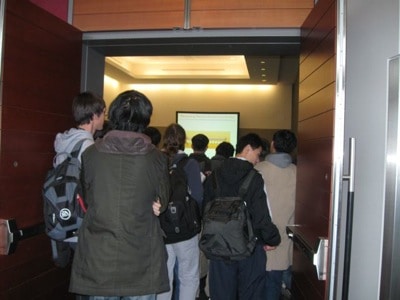
An over-capacity crowd greeted Leo Kouwenhoven’s talk on Majorana fermions

By Margaret Harris

The hottest talk of the APS March Meeting so far took place yesterday, when Leo Kouwenhoven revealed that his group at TU Delft in the Netherlands may have observed Majorana fermions in one-dimensional nanowires.

Majorana fermions have a curious property – they are their own antiparticles – and particle physicists have been looking for fundamental Majorana fermions for decades. A few years ago, condensed-matter physicists got in on the act too, seeking evidence of Majorana-like behaviour in fermionic quasiparticles such as those formed by electrons in superconductors. But so far, no-one has ever found conclusive evidence that such particles exist – so if this nanowire result holds up, it would be quite the coup for Kouwenhoven and his group.

Unfortunately, Kouwenhoven’s talk was so popular that the crowd overflowed into the hallway outside, and with conference centre staff talking anxiously about fire regulations, it proved impossible for me to squeeze in (Eugenie Reich of Nature was luckier – you can read her summary here. So instead, I headed to the room next door, where Krastan Blagoev of the US National Science Foundation was delivering an inspiring talk on the kinetics of metastatic cancer.

(more…)

Consider a spherical person

Map of obesity rates in the US in 2004 and 2008


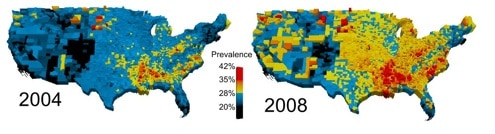
Obesity rates in the US in 2004 and 2008. (Courtesy: Lazaros Gallos)

By Margaret Harris at the APS March Meeting

The data on obesity are pretty unequivocal: we’re fat, and we’re getting fatter. Explanations for this trend, however, vary widely, with the blame alternately pinned on individual behaviour, genetics and the environment. In other words, it’s a race between “we eat too much”, “we’re born that way” and “it’s society’s fault”.

Now, research by Lazaros Gallos has come down strongly in favour of the third option. Gallos and his colleagues at City College of New York treated the obesity rates in some 3000 US counties as “particles” in a physical system, and calculated the correlation between pairs of “particles” as a function of the distance between them. This calculation allowed them to find out whether the obesity rate among, say, citizens of downtown Boston was correlated in any way to the rates in suburban Boston and more distant communities.

It wouldn’t have been particularly surprising if Gallos’ team had found such correlations on a small scale. The economies of Boston and its suburbs are tightly coupled, for one thing, and their demographics are also not so terribly different. But the data indicated that the size of the “obesity cities” – geographic regions with correlated obesity rates – was huge, up to 1000 km. In other words, the obesity rate of downtown Boston was strongly correlated not only with the rates in the city’s suburban hinterland, but also with rates in far-off New York City and hamlets in northern Maine.

This correlation was independent of the obesity rate itself – there are “thin cities” as well as obese ones – and also far stronger than correlations in other factors, such as the economy or population distribution, would suggest. The exception, intriguingly enough, was the food industry, which also showed tight correlations between geographically distant counties.

Gallos isn’t claiming that the food industry is causing obesity. He also doesn’t discount the importance of food choices and genetic factors: what you eat and who you are will clearly play a big role in determining whether or not you, as an individual, will become obese. However, he points out that our genes haven’t changed that much since the US obesity epidemic began in the 1980s, and neither, presumably, has our willpower. The difference, he says, is that on a societal level, increasingly large numbers of us are living in an “obese-o-genic” environment, and “the consensus is that the system makes you eat more”.

Gallos says he’ll post this research on arXiv sometime in the next few days [UPDATE 29/2/12: here’s the link to the paper]. In the meantime, I’ll be testing his hypothesis personally in the obese-o-genic environment of a major scientific conference, complete with multiple breakfasts, receptions and lunches. Pass the pastries, please!

Predicting the next major earthquake

For almost half a century, geophysicists have studied active fault zones in an attempt to predict when and where the next major earthquake might strike. To find out how far we have come in this endeavour, watch this video with David Schwartz, an earthquake geologist with the US Geological Survey.

As Schwartz explains, geoscientists study active fault zones in an attempt to look for signs that an earthquake might be imminent. The difficulty, in his view, is that large earthquakes tend to originate several kilometres below the Earth’s surface, and our planet’s crust varies significantly with depth. “Being able to find one precursor, one thing that’s common to this huge complexity, to give you a signal that something large is impending is very, very difficult,” he says.

However, geophysicists continue to develop systems for monitoring fault zones. One approach Schwartz believes to be particularly promising is the idea of monitoring the Earth from space using the Global Positioning System (GPS). Seismologists could then study in real time how strain varies in rocks to identify particular locales where a slip could be about to occur. “There may be a time when you can turn on your TV at night and in addition to getting the weather report, you’ll get the strain report,” speculates Schwartz.

This interview was filmed in San Francisco at the 2011 Fall Meeting of the American Geophysical Union.

Plasmons boost light emission from quantum dots

Hybrid structures containing semiconductor quantum dots and metal nanoparticles could lead to better light-emitting diodes and new nonlinear photonic devices. That is according to researchers in China, who have studied hybrids made of cadmium–telluride quantum dots and gold nanoparticle arrays. The amount of light emitted by these structures can be increased dramatically by simply tuning the plasma oscillations on the gold particles to resonate with transitions in the quantum dots.

Quantum dots are tiny semiconductor structures in which electrons are confined in all three dimensions. They have electronic and optical properties that can be controlled by adjusting the shape and size of the structures and have been intensively studied over the last two decades. In particular, quantum dots could be ideal for making a new generation of semiconductor lasers with lower threshold currents and higher efficiencies, as well as light-emitting diodes, solar cells and other photonic devices.

More recently, researchers have turned their attention to hybrid structures containing both semiconductor quantum dots and periodic arrays of metallic nanoparticles. Such systems have shown improved optical characteristics and might be useful for a variety of photonic applications, such as photocatalysis, light harvesting and all-optical switching. The improvements come thanks to the interactions between bound states of electrons and holes in the semiconductor – called excitons – and surface plasmons on the nanoparticles. Plasmons are collective oscillations of electrons on metal surfaces, and they interact strongly with light.

Improved optical response

In this latest work, Andrey Rogach and colleagues at the City University of Hong Kong and the Wuhan National Laboratory for Optoelectronics studied the optical properties of hybrid structures composed of cadmium–telluride quantum dots and gold nanoparticle arrays. The researchers found that they could dramatically increase the amount of light emitted by the structures by tuning resonance of the gold surface plasmon to the exciton transitions in the semiconductor quantum dots. “This is possible because the two materials are confined in the same small space – something that leads to the local electromagnetic field of the metal surface plasmon being enhanced,” explains team member Ming Fu. “The interaction of the enhanced field and the excitons in the semiconductor dots can then improve the optical response of the entire system.”

To date, the researchers have only studied the luminescence of the hybrid semiconductor–metal structures. They now plan to investigate the fluorescence behaviour of the materials using techniques such as confocal microscopy. “These experiments will hopefully help us glean more information about the interactions between metal particles and semiconductor quantum dots in general,” says Fu.

The work is described in Applied Physics Letters.

On shaky ground

A spate of recent earthquakes, including major events in Japan, New Zealand and Haiti, has reminded us of the sheer devastation that can be wrought by the Earth’s tectonic plates. But what is also shocking about earthquakes is that they are so difficult to foresee. So why is it so difficult to predict when and where the next major quake will strike? This short film explores this question and looks at the efforts that are being made to develop systems for earthquake forecasting.

The film presents an introduction to the key concepts in earthquake science, through a collection of interviews, explanations and animations. It opens with an account of how people have tried to look for signs that a major earthquake might be imminent. As David Schwartz, an earthquake geologist with the US Geological Survey, points out, “There was radon-gas emission, and that didn’t work. There was animal behaviour, and that didn’t work. And in reality it’s really hard to find something that’s easily definable like that.”

Earthquake forecasting

But seismologists have not given up hope of predicting earthquakes. The film also looks at attempts to identify geographical regions that may be at risk. This is an area of interest to Aldo Zollo, a geophysicist at the University of Naples, Federico II in Italy, whose own career in seismology was triggered by an earthquake. Zollo recounts the day in 1980 when, as a physics student living in the Apennines, he returned home one day to find his house damaged by an earthquake.

Zollo describes his efforts and those of others around the world to develop “earthquake forecasts”, which place probabilities on the likelihood of earthquakes occurring. It works, he explains, by studying the distribution and timing of earthquakes within a defined region. “It helps local administrators, scientists and civil-protection managers to deal with their preparedness for earthquakes, and to educate people to be prepared for the next earthquake,” he says.

Fractal quakes

Another scientist in the film with an interest in forecasting earthquakes is Donald Turcotte, of the University of California, Davis, in the US. Turcotte takes a mathematical approach, which asserts that the magnitude and distribution of earthquakes obey the distinct “scaling laws” described by fractals. “In general, you can expect that where you have 10 magnitude-five earthquakes in a period of time, you expect to have one magnitude six,” he says. “We have used this to establish a risk basis globally.”

Turcotte concedes, however, that the underlying physics behind this distribution is still not fully understood. And, tellingly, that the approach could not have been used to forecast the Japanese earthquake of 2011 because it still deals in generalities. In other words, there are still great uncertainties when trying to predict specific earthquake events.

The film concludes with a look to the future and the possibility of using the Global Positioning System (GPS) to closely monitor fault zones. David Schwartz introduces the idea of studying the changing strain in rocks in real time to identify particular locales where a slip could be about to occur. “There may be a time when you can turn on your TV at night and in addition to getting the weather report, you’ll get the strain report,” speculates Schwartz. “And maybe that’ll be a way to say ‘Hey look, let’s keep our eye on Seattle Washington because it looks like something might be building up’.”

All the interviews were filmed in San Francisco at the 2011 Fall Meeting of the American Geophysical Union.

Common ground for physicists

Photo of Boston Common sign


Boston Common and the Park Street Church, part of the city’s “Freedom Trail”.

By Margaret Harris at the APS March Meeting in Boston

The American Physical Society’s March Meeting doesn’t really kick off until tomorrow morning, but with many of the 6000+ delegates arriving a day early, we’re rapidly heading towards a critical mass of physicists here in Boston. Even the good citizens of New England’s largest city are starting to notice the influx; as I was walking along the “Freedom Trail” of historic landmarks earlier today, I met a park ranger who estimated that I was 10th physicist he’d spoken to that afternoon.

Anyway, from tomorrow until Thursday I’ll be swapping sight-seeing trips for talks on a wide range of physics topics. Many of the sessions are devoted to superconductivity, which remains a popular field a quarter of a century after the famous “Woodstock of Physics” March Meeting when the first high-temperature superconductors took centre stage.

Physicists with a keen interest in graphene will face some particularly tough decisions on which talks to attend, with 39 separate sessions devoted to carbon’s newest and sexiest (well, unless you prefer diamonds or buckyballs) allotrope.

There’s also some intriguing-sounding interdisciplinary sessions on the physics of cancer and the aftermath of the Fukushima nuclear incident. And finally, I’m hoping to learn more about the latest nifty experiments in my PhD field of atomic and molecular physics.

First, though, I need to go eat some of Boston’s famous seafood…

Rain drains energy from the atmosphere

When it comes to dissipating energy in the atmosphere, the humble raindrop punches way above its weight. Researchers in the US have shown that the energy lost as heat by falling liquid water and ice particles is on par with the energy that the wind loses to friction. The team suggests that with the increasing precipitation expected as a result of global warming, the energy sunk into rainfall could reduce the amount available to generate winds.

Many climate physicists view the atmosphere as a giant heat engine that drives a wind and water cycle. The Sun warms the Earth’s surface, creating the hot part of the engine with an average temperature of 288 K, and the atmosphere does work by lifting water vapour towards the engine’s cold side, about 15 km up with an average temperature of 255 K. Taking the atmosphere’s inefficiencies into account, Olivier Pauluis of New York University and Juliana Dias of the National Oceanic and Atmospheric Administration in Boulder, Colorado estimate the total power per unit of surface area of the engine to be 5 Wm–2.

The rising water vapour then cools, condenses and falls as water or ice. Without slowing from the atmosphere, rain would hit the ground at a few hundred kilometres per hour. “You would need to buy a new umbrella,” says Pauluis. Luckily, the atmosphere dissipates most of that energy in microturbulence around the water droplets, keeping their speed at a gentle few kilometres per hour.

On par with the wind

Since kinetic energy doesn’t accumulate in the atmosphere, Pauluis and Dias argue that the total power of its heat engine is roughly the sum of the rate of energy loss due to air-on-air friction in the winds plus rate of energy dissipation from the rain. The wind alone is estimated to disperse between 1–5 Wm–2, and the pair undertook the first analysis to discover the dissipation due to rainfall. Finding it to be about 1.8 Wm–2 on average, they showed that energy loss due to precipitation is as important as the loss due to friction in winds.

Erich Becker of the Leibniz-Institute of Atmospheric Physics in Kühlungsborn, Germany, calls the study “ingenious”. To his knowledge, he says, “nobody has thought before about this frictional heating due to rainfall”.

Pauluis and Dias used data gathered by the Tropical Rainfall Measuring Mission (TRMM), a satellite that spots water and ice particles by bouncing radio waves off them. It looks at six different layers of sky – just above the ground and then 2, 4, 6 10 and 15 km from the Earth’s surface. The reflected waves tell the researchers the size and concentration of the raindrops. The size of the droplets indicates their maximum freefall speed, which in turn gives the drag force required to maintain that speed. By factoring in the distances that the raindrops fall, the pair could work out the total energy dissipated by the drag on precipitation.

More dissipation over continents

Naturally, the local energy lost to rainfall friction is closely tied to the amount of precipitation that the region receives, though Pauluis says the patterns showed interesting features. “To be precise, there is more dissipation over continents than over the ocean,” he says, which is consistent with the fact that convection is stronger over the continents, driving water to greater heights.

Climate models predict that as the temperature of the Earth rises, the amount of precipitation and the height from which it falls will increase as well. This means the atmosphere would expend more energy lifting water vapour, and that could leave less energy for driving the circulation of air around the planet, says Pauluis.

From Becker’s point of view, the study’s key contribution to the field is that it highlights significant source of entropy, or disorder, which was previously ignored. The atmosphere’s tendency to absorb and emit heat unevenly – more comes in at the tropics and leaves at the poles – reduces its entropy. Part of that entropy is made up by the turbulence of the wind, he explains, but the contribution of the rain is equally important and was missing until now. While neither Becker nor Dargan Frierson of the University of Washington, Seattle, believe that this adjustment to the climate models will have a major impact on climate change predictions, Becker says, “It’s certainly worthwhile to take it into account.”

Frierson instead emphasises the fundamental side of the result. He points out that water vapour makes up just 1% of the atmosphere’s mass, while liquid water and ice particles in clouds are a much smaller portion – more like 0.01%. “And it turns out that just around that fraction of falling liquid and ice particles, that’s where much of the friction is dissipated in the atmosphere,” he says. “That, to me, is quite remarkable.”

This research is published in Science 335 953.

Have physicists overhyped the superluminal-neutrino results?

By James Dacey

The big physics story of the week has been the news that neutrinos may not travel faster than the speed of light after all. Researchers in the OPERA collaboration, in Italy, have identified an optical fibre in their experiment that may not have been functioning correctly at the time when the measurements were made.

hands smll.jpg

After all the excitement and speculation, could this “once in a century” result be caused by nothing more than a dodgy cable? Usually when a result like this vanishes into the ether, nobody is to blame except the media for blowing the story completely out of proportion in the first place. But in this instance, it has to be said that CERN and the OPERA collaboration did hold a special press conference last September to allow their researchers to present the findings to the world’s media.

If the faulty cable does explain the result, then I fear there could be a backlash against physics and the physics community. At best it will cause minor embarrassment and gentle derision of “easily excitable” physicists. At worst, it could lead to accusations of time-wasting, and ultimately it could weaken the reputation of physics as a serious science based on critical thinking and careful experimentation.

We want to know your opinion in this week’s poll.

Have physicists overhyped the superluminal-neutrino results?

Yes
No

Have your say by casting your vote on our Facebook page. As always, please feel free to explain your response by posting a comment.

There are, of course, several things to note. First is the fact that nothing has yet been proven, and the optical fibre may yet be innocent. What’s more, the OPERA researchers have always maintained that they are the result’s biggest critics. They vowed to continue to scrutinize all aspects of the experiment in search of systematic errors. So perhaps we should not be too surprised if the result does prove to be void because of something as seemingly trivial as a faulty cable.

It must also be said that the OPERA result was not the first time that a neutrino experiment had glimpsed possible superluminal speeds. In 2007 the MINOS experiment in the US recorded 473 neutrinos that appeared to have travelled from Fermilab near Chicago to a detector in northern Minnesota at speeds in excess of the speed of light. MINOS physicists reported speeds similar to that seen by OPERA, but their experimental uncertainties were much larger.

The final point to note is that the media (and, yes, that includes this website) have clearly got just as excited as the researchers. If physicists created the story, we’ve certainly made a song and dance about it and kept it in the news ever since.

Whatever you think, let us know on Facebook.

In last week’s poll, we addressed another area of physics that has been surrounded by a lot of hype in recent years – quantum computing. We asked you whether you thought that quantum computing is theoretically possible. Some 70% of respondents believe that it is, while just 4% think not. The remaining 26% chose the option of “being caught in a superposition of yes and no”.

Thank you for all of your votes and comments, and we look forward to hearing from you again in this week’s poll.

Doubts grow over superluminal-neutrino result

CERN has released a statement to confirm that the OPERA collaboration has identified a feature of its experiment that could explain its puzzling superluminal-neutrino discovery – a faulty optical fibre. The collaboration is now investigating this, and one other potential source of error, and it plans to carry out new experimental runs in May.

In September last year, the OPERA collaboration at the Gran Sasso underground lab in central Italy sent shockwaves through the physics community. Its researchers revealed that they had observed neutrinos fired from the CERN particle-physics lab near Geneva that appeared to have travelled 730 km to the Italian lab at speeds exceeding the speed of light. The announcement made headlines around the world because it appears to contradict Einstein’s special theory of relativity.

At the time, the OPERA collaboration calculated a confidence level of “6σ”, or a one-in-a-billion chance that the result was a statistical fluke. The results were described in a paper submitted to the arXiv preprint server. However, the collaboration also made it clear that OPERA researchers would continue to scrutinize all aspects of the experiment in a search of systematic errors; in other words, oversights in the experimental set-up. Now, it appears that they may have found their error.

The problem relates to the way that data are transmitted within the experiment. Neutrino speeds are estimated by dividing the baseline distance travelled (as calculated using GPS measurements) by the time-of-flight (as calculated using an atomic clock). The researchers have now realized that an optical fibre connecting the GPS signal to the atomic clock may not have been functioning correctly at the time when the measurements were made. This could have led to an underestimate of the time taken by neutrinos on their journey.

However, the situation is not quite this straightforward. The researchers have also identified another potential source of error that could push the result in the other direction – suggesting that the neutrinos were travelling even faster. This error could be related to an oscillator used to provide timestamps for GPS synchronizations, which could have led to an overestimate of the neutrinos’ journey times.

“The OPERA collaboration has informed its funding agencies and host laboratories that it has identified two possible effects that could have an influence on its neutrino timing measurement,” reads the CERN statement. “The potential extent of these two effects is being studied by the OPERA collaboration. New measurements with short pulsed beams are scheduled for May.”

Copyright © 2026 by IOP Publishing Ltd and individual contributors