Between the lines

ocean wave

The ways of the wave

From ocean waves and sound waves, to the “muscular waves” of human heartbeats and Mexican waves that sweep across a stadium, it is easy to see how this ubiquitous phenomenon grabbed the attention of author Gavin Pretor-Pinney. He decided to write The Wavewatcher’s Companion after spending an afternoon at the Cornish seaside with his daughter – although the prospect of a “research trip” to Hawaii may have helped, too, Pretor-Pinney admits. One of the most interesting wave narratives concerns the German scientist Hans Berger, who conducted the first ever electroencephalograph (EEG) test, apparently on his 15-year-old son, Klaus. Berger carried out further experiments on his daughter as she completed her homework, on toddlers and even on a dying dog; the last of these experiments allowed him to see the EEG trace flatline. As Pretor-Pinney wryly observes, Berger “was clearly unable to restrain himself from hooking up anyone he came across”. Other sections of the book deal with sonar, “nasty waves” such as shock waves and even “sexy waves” such as mating calls and husky human voices. Yet despite these attempts at organization – there are nine “wave types” in total, plus an introduction – the book’s individual sections lack distinct structure. The author’s attention seems to ebb and flow between largely unrelated phenomena, and while his prose is charming in places, a few of his attempts at humour seem tone-deaf. There is one particularly grating reference to “the type of broad who drinks, smokes, doesn’t hold back and is up for anything and everything” in the “sexy waves” chapter. Overall, The Wavewatcher’s Companion reads like the first draft of what could have been a really good book, and it is difficult to understand why it won the 2011 Royal Society Winton Prize for Science Books. While some readers might – like the Winton Prize judges – be inclined to “go with the flow”, it is certainly not for everyone.

  • 2011 Bloomsbury £8.99pb 336pp

A real puzzler

Can you prove that there are at least two people in the city of Tokyo with the same number of hairs on their heads? What about demonstrating that if you take at least one aspirin a day (and 45 aspirin in total) during the month of April, there must be a stretch of consecutive days over which you take precisely 14 aspirin? Or maybe you would prefer to show that if you select 16 integers between 1 and 30, at least two of those integers must differ by exactly 3? All three puzzles are examples of the so-called pigeonhole principle in action, and if they appeal to you, then The Puzzler’s Dilemma will be your ticket to a pleasantly diverting afternoon. In this slim volume, mathematician and New York Times crossword setter Derrick Niederman leads readers through 11 classes of conundrum, offering sample problems and sketching out some of the general principles for solving them. The pigeonhole principle, for example, is discussed in a chapter on turning complex conundrums into simpler ones; other chapters explore such topics as probability theory, induction errors and puzzles that seem easy but are actually impossible. There is even a chapter devoted to “kangaroo puzzles”, where the statement of the puzzle contains a clue to the solution, like a joey in a mother kangaroo’s pouch. Kangaroos notwithstanding, Niederman’s prose certainly hops along nicely, making the book a fairly effortless read – unless, of course, you stop to solve the puzzles before he reveals their solutions.

  • 2012 Duckworth Overlook £14.99hb 216pp

Analogy failure

Analogies are tricky things. A good one will only take you so far, and a bad one can be worse than useless. This lesson was brought home to your reviewer several years ago when, as an undergraduate, a classmate asked a mathematics lecturer to give the class a physically intuitive explanation of curl, ∇ × F. “That’s a tough one,” the lecturer replied. “Can you imagine an infinitely small paddle wheel spinning in the middle of a river?” Unfortunately, the class could not, and the lecturer never tried again. Authors Brian Cox and Jeff Forshaw are made of sterner stuff, however, and in their new book The Quantum Universe: Everything That Can Happen Does Happen they work much harder to bridge the gap between analogy and physics. After a promising start, though, they are soon off into infinitesimal paddle-wheel territory. In their analogy, quantum fields are replaced by an infinite array of clocks, in which the length (squared, of course) of the individual clock hands represents the probability that a particle will be found in a particular spot, and particles deposit additional clocks as they move from place to place. Sometimes, the clocks have to shrink in size for the maths to work out. This is scarcely simpler than the actual physics, and will confuse experts more than it reassures novices. Setting aside the clock analogy for a moment, though, the amount of mathematical detail is fairly high for a popularly oriented book, which should please those who felt that Cox’s Wonders series for BBC television lacked rigour. The authors are not afraid of the occasional equation, and the overall level is similar to that of Feynman’s QED: the Strange Theory of Light and Matter (a fact that Cox and Forshaw acknowledge in the “further reading” section at the end of the book). If you can get past the tortuous clock analogy, you will find the book a real treat. If not, well, there is always the option of watching Cox’s television documentaries instead.

  • 2011 Allen Lane £20.00hb 256pp

How much programming knowledge should a physicist have?

By Hamish Johnston

This week marks the launch of a new computer – but it’s not faster, thinner or sexier than the latest tablet. Instead, it’s purposely low-powered, awkward to use and it comes with no must-have applications.

hands smll.jpg

Meet the Raspberry Pi, which is really just a printed circuit board with a handful of chips that you can buy for about £25. The idea is that you connect your own keyboard and monitor to enjoy the joys of computer programming 1980s style.

Why would anyone try to flog such a throwback to a bygone era of BASIC operating systems and cassette-tape storage?

It seems that young Britons know very little about how to program a computer, and that this is a threat to the nation’s hi-tech economy. The Raspberry Pi Foundation hopes that its cheap-and-cheerful computer will encourage young people to fool around with the basics of programming and learn something useful along the way.

Personally, I think this approach is flawed. I was one of those kids in the 1980s who taught themselves how to program by mucking about on an Apple II Plus – my brother and I bought one with money earned from delivering newspapers. The sort of do-it-yourself programming we did back then is probably exactly what the Raspberry Pi Foundation would like to see kids doing today.

However, there is a fundamental difference between now and then: in the 1980s my brother and I considered ourselves part of a “geek elite” who were using cutting-edge technology to do things that few others could achieve. By contrast, I’m guessing that many Raspberry Pi users will be underwhelmed by its capabilities when compared with an iPad and find it difficult to make the connection between it and the high-powered computers of today.

I suspect that the proponents of Raspberry Pi look back at the 1980s as a golden age of DIY programming that spawned many a successful career in computing – my brother’s included. That may be true, but I don’t think that Raspberry Pi will recreate that spirit.

The launch of Raspberry Pi got me thinking about whether today’s budding physicists have less practical experience of computing programming than my generation – and if so, is that a problem?

So our Facebook poll question this week is:

How much programming knowledge should a physicist have?

None, that’s what IT departments are for
Mastery of MS Office will do
Can write a bit of FORTRAN code
Must dream in machine language

Have your say by casting your vote on our Facebook page. As always, please feel free to explain your response by posting a comment.

Last week we asked you if you thought that physicists had overhyped the preliminary finding by the OPERA collaboration that neutrinos can travel faster than the speed of light – a surprising result that has recently been put into further doubt.

Nearly 60% of you thought that physicists were not to blame, with several commenters putting the blame squarely on the media. “Physicists do science. Media do hype,” said Antoine de Saint-Exupéry, while Dimitris Satkas chipped in “Physicists haven’t overhyped this thing. Media has.”

Normally, I would agree with Saint-Exupéry and Satkas, but in this instance I think the physicists were the guilty party. The smoking gun is the press release issued by CERN on 23 September that invited journalists to watch a webcast of what should have been a sleepy Friday afternoon lecture by an OPERA team member.

We had been following rumours of superluminal neutrinos in the physicsworld.com newsroom, and in the absence of a press release we probably would have used a blog entry to tell our readers about this very preliminary result. But once the press release appeared with the full backing of CERN, we felt that we had to bump the finding up to a news story – and so did the rest of the world’s press. So, in a sense, we followed the physicists’ lead in hyping the result.

Could graphynes be better than graphene?

The “wonder material” graphene might be in for some competition from a new group of materials called graphynes – according to computer simulations done in Germany. Like graphene, a graphyne is a sheet of carbon just one atom thick. But while graphene can only exist with a honeycomb lattice structure, graphynes can assume several different 2D structures.

This latest work suggests that graphynes have unusual and potentially useful electronic properties characterized by “Dirac cones”, which were once thought to be unique to graphene. Indeed, one type of graphyne with a rectangular lattice is particularly interesting because of the effect that its geometry has on the Dirac cones – something that could prove useful in developing new types of carbon-based electronic devices.

Ever since graphene was first created in 2004, its unique electronic and mechanical properties have amazed researchers. Indeed, many claim that it could be used in a host of device applications, even rivalling silicon as the electronics material of choice in the future.

Double-cone features

Graphene’s outstanding electronic properties come thanks to its peculiar band structure that features so-called Dirac cones. These are double-cone features in the band structure of the 2D material where the conduction and valence bands meet in a single point at the Fermi level. The bands approach this point in a linear fashion. As a result, the effective kinetic energies of the conduction electrons (and holes) are directly proportional to their momentum.

This unusual relationship is normally only seen for photons, which are massless, since the energies of electrons and other particles of matter at non-relativistic velocities usually show a quadratic relationship with momentum – that is, their energies depend on the square of their momenta. The result is that the electrons in graphene behave as though they are relativistic particles with no rest mass, and so can whiz through the material at extremely high speeds. This property could be exploited to make transistors that are faster than any that exist today.

Only in graphene?

Researchers had thought that Dirac cones could only exist in graphene, thanks to its hexagonal honeycomb structure. But now, Andreas Görling and colleagues at the University of Erlangen-Nürnberg have turned this idea on its head by calculating the electronic properties of a new group of materials called graphynes.

Graphynes are 2D carbon allotropes similar in structure to graphene but built from doubly- and triply-bonded carbon atoms instead of just double bonds as in graphene. The presence of triple bonds means that graphynes can exists in geometries other than the hexagonal lattice of graphene. In their work, Görling and colleagues studied the band structure of three graphynes – α-graphene, β-graphene and 6,6,12-graphyne (see image) – using density-functional-theory calculations. The first two graphynes have hexagonal structures and the third is rectangular, but the results clearly show that all three graphynes possess Dirac cones.

The 6,6,12-graphyne may be even more amazing than graphene for two reasons, says Görling. First, thanks to its rectangular symmetry, it should have electronic properties that are direction dependent – that is, they will be different along different directions in the plane of the material. For example, this might lead to a conductance that depends on the direction of the current. This property is not seen in graphene, which is (almost) isotropic in the plane of the material. This directional dependence could be put to good use in future nanoscale electronic devices.

Two cones are better than one

Second, graphyne appears to have two different Dirac cones lying slightly above and below the Fermi level. “This means that graphyne is ‘self-doped’,”Görling told physicsworld.com, “and naturally contains conducting charge carriers (electrons and holes), without the need for external doping – unlike graphene.” As a result, it could be used as a semiconductor in electronic devices.

The researchers hope that their calculations will encourage other researchers to create graphyne and investigate its properties in the lab. “In the long run, if materials other than graphene with Dirac cones can be produced, these may be used in carbon-based electronic nanodevices,” adds Görling. So far, however, only extremely small samples of graphynes have been made in the lab.

For its part, the Erlangen-Nürnberg team is continuing its research into graphene alternatives and says it is already in touch with organic and physical chemists with the aim of making large quantities of graphynes and other new 2D carbon allotropes.

Andre Geim of the University of Manchester in the UK, who was awarded the 2010 Nobel Prize for Physics for discovering graphene, says that graphyne is “an extremely interesting material” and that “this report adds to the excitement”.

The simulations are described in Physical Review Letters.

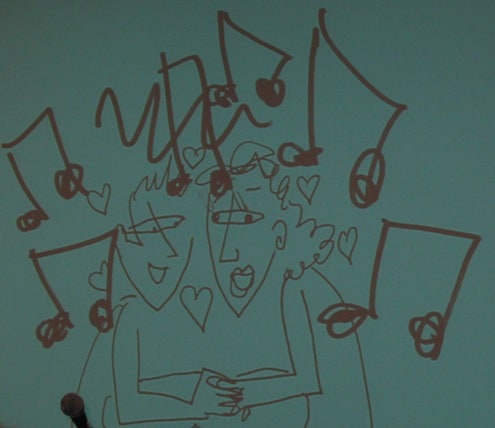
Drawing noise and speaking out

Cartoon of a noisy magnetic system


Cartoonist Flash Rosenberg’s drawing of “noise in a magnetic system.”

By Margaret Harris at the APS March Meeting

This year’s APS meeting has been one of the biggest ever, with nearly 11,000 attendees and 54 parallel sessions. It’s impossible to capture the totality of such a huge conference, but here are a couple of snapshots.

One of the most entertaining talks I saw was given by a cartoonist, Flash Rosenberg. Rosenberg makes videos that pair her quick sketching skills with a scientific voice-over: as the scientists speak, she draws what they are saying. Rosenberg spoke during a session on communicating science to the public, and towards the end of her talk she offered to illustrate audience members’ research questions.

Understandably, several of them leaped at the chance. For the first question – “How do bubbles form in nuclear fuel?” – Rosenberg began by drawing nuclear fuel as an unhappy-looking gremlin. I wasn’t quick enough with my camera to capture the hilarious conclusion of her sketch, but another audience member has posted a video of it here (turn the sound up – it’s worth it).

I was better prepared for the second question, which was “How do you measure noise in a magnetic system?”. As you can see in the image above, Rosenberg’s idea of a noisy magnetic system is a couple whose quiet romantic dinner is being interrupted by loud music. Cute.

(more…)

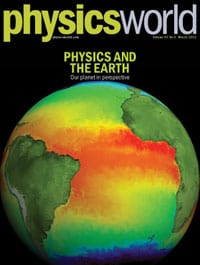
The March 2012 issue of Physics World is out now

By Matin Durrani

cover

The March issue of Physics World magazine is now out, featuring a series of fabulous articles and images on the theme of “Physics and the Earth”. Here’s a brief outline of what we have on offer and there are details at the end of this blog about how to access the entire content of the issue.

• Find out how the latest advances in earthquake forecasting can give the odds that an earthquake above a certain size will occur within a given area and time.

• Gianpaolo Bellini and Livia Ludhova describe how geoneutrinos generated through radioactive decay within the Earth are providing a new technique for understanding our planet.

• François Pétrélis, Jean-Pierre Valet and Jean Besse explain why they think that the movement of the Earth’s plates could be linked to the rate of reversal of the Earth’s magnetic field.

• See what progress is being made in understanding the Earth’s core – including the bizarre possibility that it may hide huge crystals of iron some 10 km long.

• Learn more about the controversy over fracking, which involves pumping sand and chemicals into shale deposits to release trapped natural gas.

• Check out our interview with Robert Hazen, the head of the Deep Carbon Observatory, who wants to find out what happens to carbon that gets subducted into the Earth’s core

• Mike Weightman, chief inspector of nuclear installations and executive head of the Office for Nuclear Regulations in the UK, describes what lessons we can learn from the incident at the Fukushima Daiichi plant one year on.

• Enjoy a series of spectacular images of the Earth from afar, showing the power of Earth observation.

Members of the Institute of Physics (IOP) can read the new issue online for free right now through the digital version of the magazine by following this link or by downloading the Physics World app onto your iPhone or iPad or Android device, available from the App Store and Android Marketplace respectively. The digital version lets you read, share, save, archive and print articles – either fully laid out or in easy-to-read text view – and even have them translated or read out to you.

If you’re not yet a member, you can join the IOP as an imember for just £15, €20 or $25 a year via this link. Being an imember gives you a full year’s access to Physics World both online and through the apps.

A free PDF of the issue will also be available for download from this site from 8 March.

Portrait of our planet

Photo challenge


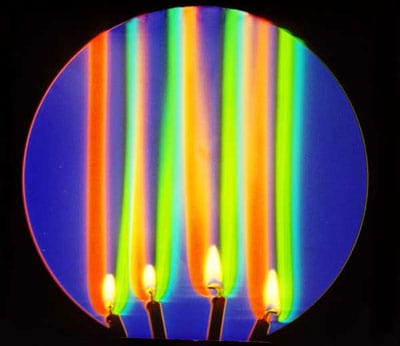
Schlieren candles by adavidhazy

By James Dacey

Thank you to everyone who took part in the first ever Physics World photo challenge. We asked readers to submit photos to our Flickr group relating to the theme of “light in physics”. We had some great submissions, a selection of which are showcased in this article.

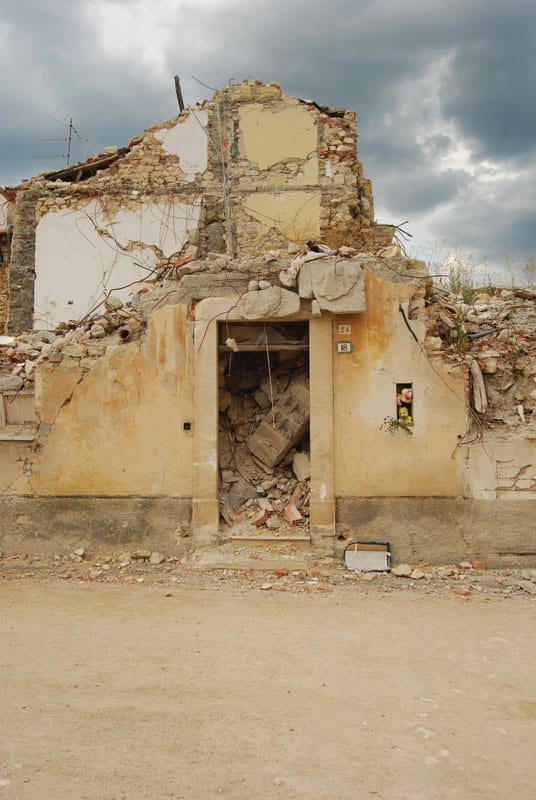
The theme for our new photo challenge is “portrait of our planet”. To tie in with this month’s earth-sciences special issue of Physics World, we want you to submit photos to our Flickr group relating to the scientific study of the physical Earth. It might relate to a geophysical phenomenon such as a fiery volcanic eruption, a tornado or the aftermath of an earthquake. Or you might choose to share a more abstract vision of our planet, such as a colourful geological rock formation or a spectacular ice feature. Be as creative as you like.

Please add your photos by Tuesday 27 March and then after this date we will choose a selection of our favourite images to be showcased on physicsworld.com.

Please also feel free to write a caption to share the story behind the image. Your photos may show an interesting geophysical phenomenon, or may have required some inventive and time-consuming photography. Perhaps, in capturing the perfect shot, you camped out overnight in an isolated wilderness, or maybe you scaled the slopes of a mountain in search of a striking landscape.

Expensive equipment is not necessarily required, however. People prove every day that you can capture an inspiring snapshot using the most basic of cameras, even the one on your mobile phone.

Light in physics – readers’ pictures

To celebrate the connections between light and the physical world, we asked readers to submit photos to our Flickr group on the theme of “light in physics”. Thank you to everyone who took part. Below is a selection of the images we received.

Invented by the German physicist August Toepler in the 19th century, Schlieren photography is used to capture the flow of fluids of varying density. For example, it is used in aeronautical engineering to photograph the flow of air around parts of a plane. It has been used to lovely effect in this photo by Flickr user adavidhazy to reveal the density gradients in the air above a candle flame.

This beautiful photo shows one of the iconic images of physics – the light spectrum. In this case, geezaweezer managed to cleverly capture the phenomenon as natural light poured in through a window onto a browning leaf. The photographer said he had to act quickly because the refraction effect was visible inside the house for less than a minute.

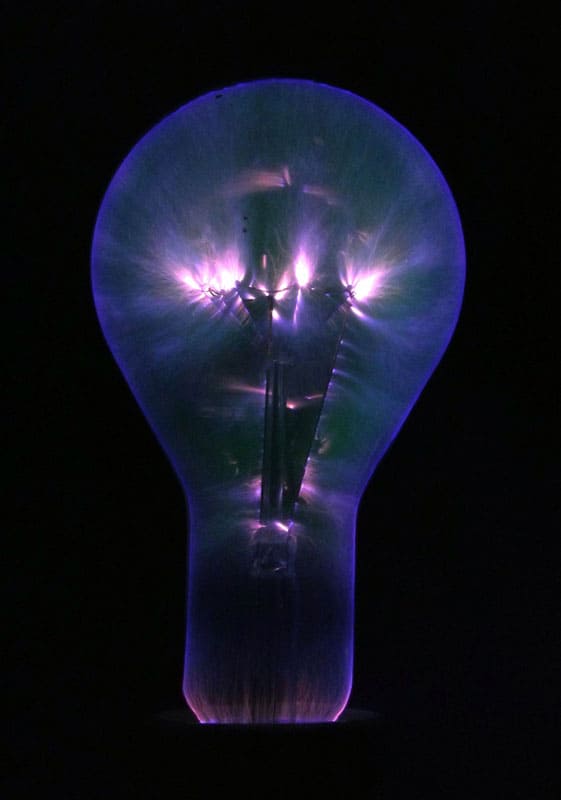
Photographer Tuopeek had a real light-bulb moment in capturing this image. It shows the electrical arcs and sparks generated inside a GLS filament lamp sitting on a Tesla coil. The bright violet light contrasted against the black background creates a dramatic image of a technology that changed the world.

This awe-inspiring photo of a water-filled balloon bursting was made possible thanks to a more recent light technology to emerge from physics – the laser. Lukasz Piatkowski and Yves Rezus from FOM Institute AMOLF in Amsterdam used an 800 nm laser to create an ultrashort light flash that lasted just 50 femtoseconds. This provided fleeting illumination for them to capture this image with a high-speed camera, showing the water droplets while they still maintain the outline of the balloon.

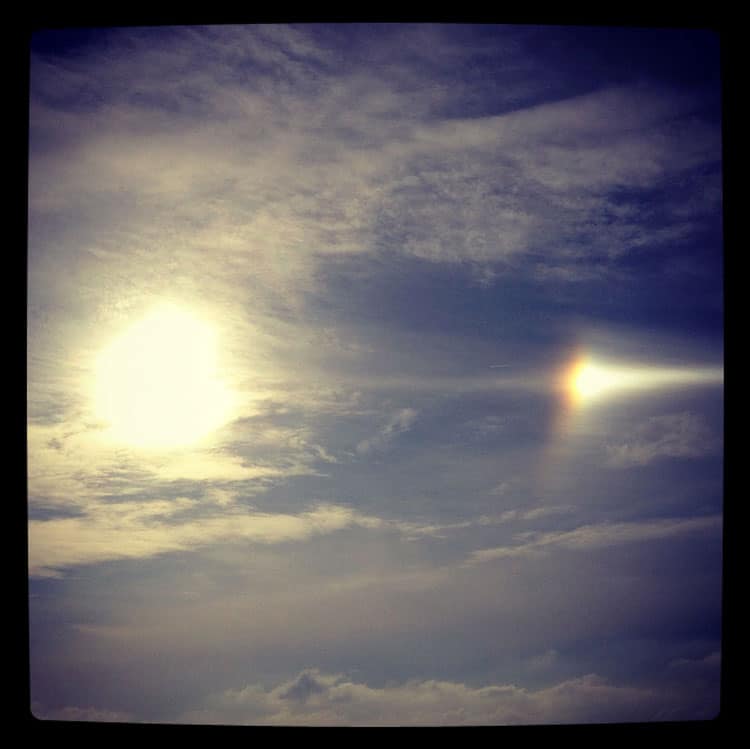
Who says you always need expensive equipment to capture an inspiring shot of nature? Flickr user Madrugaredo whipped out their smart phone at Brighton Beach in New York to photograph this optical effect known as a parhelion, or more colloquially a “Sun dog”. The effect is caused by sunlight refracting through small ice crystals in cold and high cirrus clouds.

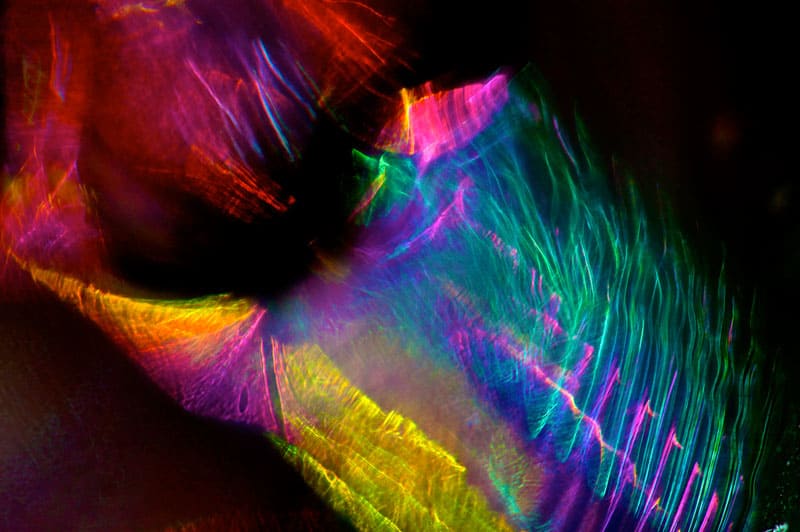
Some more stunning optics effects here, as rays of light streak, shimmer and smudge as they dance along a tube of glass. Photographer Pery Burge was proud to point out that the image was taken with a single exposure with no manipulation using graphics software.

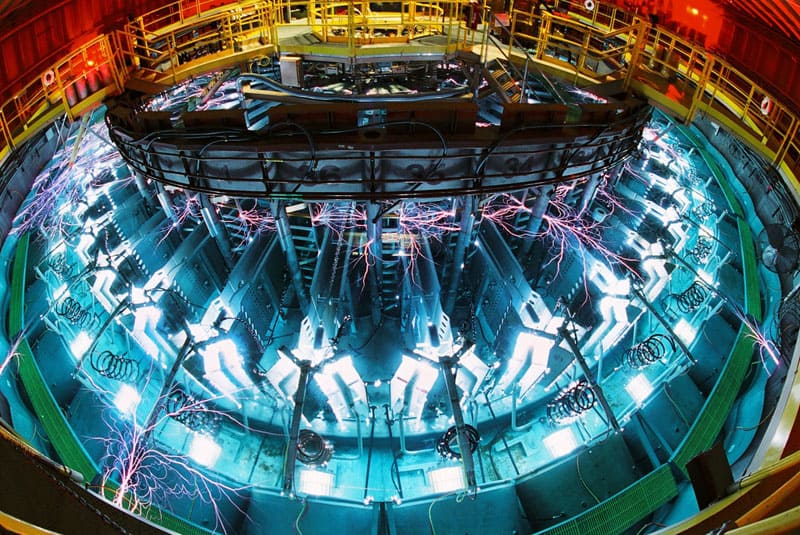
With this photo of a machine called Saturn at Sandia National Laboratories in the US, we enter the realm of sci-fi. Saturn is an X-ray simulation source used to recreate the effects of radiation on electronic and material components. Photographer Randy Montoya has captured this striking image of Saturn in action as electrical pulses shoot out from the machine’s edges towards a central target, across an interface of water and metal.

With this photo, docJ96 transports us to tropical climes as we lie back on a beach and gaze up at the twinkling Sun and its colourful halo, seen through the leaves of a palm tree. The intriguing solar effect is known as a 22° halo, and it is formed as sunlight is refracted in hexagonal ice crystals suspended in the atmosphere.

Finally, we couldn’t conclude this celebration of optical effects in photography without an example of bokeh. The term, originating from the Japanese word for “blur”, is used to describe the way the lens renders out-of-focus points of light, and it can be both aesthetically pleasing and ugly. It has been used to creative effect in this photo by Anjan Reijners of a blade of grass in water, taken at Seven Lakes State Park in Michigan, US.

There were plenty of other striking images, which you can view in our Flickr group, the Physics World photo challenge.

The theme for our next photo challenge is “Portrait of our planet”. To tie in with this month’s earth-sciences special issue of Physics World we want you to submit photos to our Flickr group relating to the scientific study of the physical Earth. It might relate to a geophysical phenomenon such as a fiery volcanic eruption, a tornado or the aftermath of an earthquake. Or you might choose to share a more abstract vision of our planet, such as a colourful geological rock formation or a spectacular ice feature. Be as creative as you like.

Please add your photos to our Flickr group by Tuesday 27 March and then after this date we will choose a selection of our favourite images to be showcased on physicsworld.com.

Members of the Institute of Physics (IOP) can read the earth-sciences special issue free online through the digital version of the magazine by following this link or by downloading the Physics World app to your iPhone or iPad or Android device, available from the App Store and Android Marketplace, respectively.

If you’re not yet a member, you can join the IOP as an imember for just £15, €20 or $25 a year via this link. Being an imember gives you a year’s access to Physics World both online and through the apps.

How to forecast an earthquake

In March 2009 a “swarm” of more than 50 small earthquakes struck within a few kilometres of the southern end of the San Andreas fault in California. Several hours after the largest of these, a magnitude-4.8 tremor that occurred on 24 March, the state’s earthquake experts held a teleconference to assess the risk of an even bigger quake striking in the following days, given the extra stress exerted on the fault. They concluded that the chances of this happening had risen sharply, to between 1 and 5%, and therefore issued an alert to the civil authorities. Thankfully, as expected, no major quake actually took place.

What happened a week later in the medieval town of L’Aquila in central Italy was very different. On 31 March a group of seven Italian scientists and engineers met up as full or acting members of the country’s National Commission for the Forecast and Prevention of Major Risks to assess the dangers posed by a swarm that had been ongoing for about four months and which had seen a magnitude-4.1 tremor shake the town the day before. The experts considered that the chances of a more powerful quake striking in the coming days or weeks were not significantly increased by the swarm, and following the meeting local politicians reassured townspeople that there were no grounds for alarm. Tragically, in the early hours of 6 April a magnitude-6.3 earthquake struck very close to L’Aquila and left 308 people dead. The seven commission members are now on trial for manslaughter, and the then head of Italy’s Civil Protection Department, who set up but was not present at the 31 March meeting, is also being investigated for the same offence.

In the wake of the L’Aquila earthquake, the Civil Protection Department appointed a group of experts known as the International Commission on Earthquake Forecasting (ICEF) to review the potential of the type of forecasting used in California. Known as short-term probabilistic forecasting, it involves calculating the odds that an earthquake above a certain size will occur within a given area and (short) time period. The technique relies on the fact that quakes tend to cluster in space and time – the occurrence of one or more tremors tending to increase the chance that other tremors, including more powerful ones, will take place nearby within the coming days or weeks.

In a report explaining its findings and recommendations, published last August, the ICEF points out that while such forecasting can yield probabilities up to several hundred times background levels, the absolute probabilities very rarely exceed a few per cent. Nevertheless, the commission believes that this short-term forecasting can provide valuable information to civil authorities and urged Italy and all other countries in seismically active regions to use short- term-forecasting models for civil protection.

Scientists have developed many such models, each of which makes slightly different assumptions about the statistical behaviour of earthquake clustering. They are now trying to work out which of these models is the most accurate, and ultimately hope to enhance the predictive power of these models as we gain a better understanding of basic earthquake physics.

“In the past there hasn’t been a lot of motivation for governments to take this short-term forecasting seriously,” says the ICEF’s chairman, Thomas Jordan of the University of Southern California, Los Angeles. “But that is changing, partly because of what happened at L’Aquila.” Jordan argues that the tragedy at L’Aquila highlights how vital it is for us to understand what the most reliable types of forecasting are so that we have the best possible information at our fingertips. But he also believes it underlines the need for governments to work out exactly how to respond to such forecasts and in particular under what conditions they should issue alarms.

Faulty matters

The development of probabilistic forecasting marks a change in strategy for earthquake scientists. Previously, seismologists had pursued deterministic prediction, which involved trying to work out with near certainty when, where and with what magnitude particular earthquakes would strike. Researchers came to realize, however, just how complex earthquakes are and how difficult it is to predict them.

Most earthquakes occur on faults separating two adjacent pieces of the Earth’s crust that move relative to each other. Normally, the faults are locked together by friction, and stresses steadily accumulate over time. But when the faults reach breaking point and two rock faces suddenly slide past each other, a huge amount of energy is released in the form of heat, rock fracture and earthquake-causing seismic waves. Scientists have tried to predict earthquakes on the basis that the slow build-up and then sudden release of stress on any given fault occurs cyclically, with nearly identically powerful tremors spaced equally in time. A number of factors complicate this simple picture, including the fact that a single fault can slip at different stress levels, and also that interactions between neighbouring faults are highly complex.

An alternative route to predicting earthquakes is to try to identify precursors – physical, chemical or biological changes triggered in the build-up to a fault rupture. Perhaps the earliest example, often heard in folklore, is the idea that animals flee an area after somehow sensing an impending quake. Other possible precursors include changes in the rates of strain or conductivity within rocks, fluctuations in groundwater levels, electromagnetic signals near or above the Earth’s surface, and characteristic foreshocks (a distinctive pattern of smaller quakes that would precede a larger quake). However, the ICEF reported that it is “not optimistic” that such precursors can be identified in the near future, and is “not convinced” by the claims of Gioacchino Giuliani, a technician at the Gran Sasso National Laboratory near L’Aquila, who hit the headlines after claiming to have predicted the L’Aquila quake using his prediction system based on variations in the local emissions of radon gas. The committee’s reasoning is based on Giuliani’s treatment of background radon emissions and also the fact that he has yet to publish his results in a peer-reviewed journal.

An alternative to trying to predict earthquakes ahead of time is to send out a warning once a quake has started, giving people a few seconds’ notice of impending ground-shaking by exploiting the fact that information can be sent at close to the speed of light while seismic waves travel at the speed of sound. Japan makes use of such warning systems, but unfortunately they cannot provide accurate information on an earthquake’s magnitude, and also cannot alert people close to the earthquake’s epicentre because the effects there are so immediate.

Uncertain times

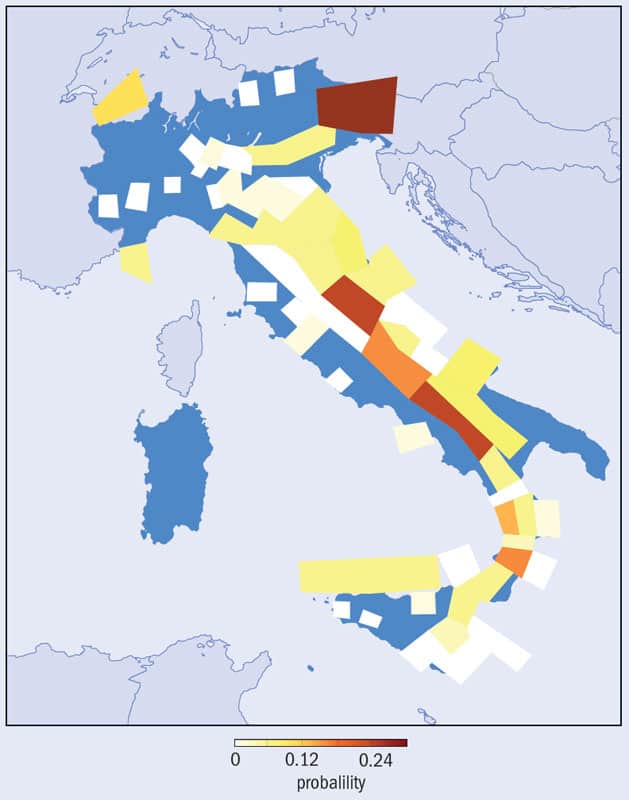
Given the difficulty of earthquake prediction and the limitations of early warnings, forecasting is the main defence against earthquakes. And the key forecasting tool is the seismic-hazard map (figure 1). These are based on long- term time-independent models, which reveal how often – but not when – a certain-sized earthquake is likely to occur. The models, and therefore the maps, do not tell us how the probabilities of major earthquakes change over time as a result of other quakes taking place but instead reveal the expected spatial distribution of quakes of a certain size happening over a certain time period (usually on the scale of decades). The distribution in space relies on seismographic data and historical records, while the distribution by size uses a statistical relationship known as Gutenberg–Richter scaling, which says that the frequency of earthquakes falls off exponentially with their magnitude.

Seismic-hazard maps allow governments to tune the severity of building regulations according to an area’s seismicity (as well as other factors such as the susceptibility of the local terrain to seismic waves) and also enable insurance companies to set premiums. However, the underlying models are only as good as the data used to calibrate them. And unfortunately, seismographic and historical records generally only go back a fraction of the many hundreds of years that typically separate the occurrence of major quakes on most active faults.

This limitation lay behind the complete failure to anticipate the magnitude-9.0 earthquake that struck the Tohoku region in Japan in March last year, which unleashed a devastating tsunami and caused the meltdown of several reactors at the Fukushima Daiichi nuclear plant. The country’s current seismic-hazard maps provide very detailed information about earthquake probabilities across the whole country but, according to ICEF chairman Jordan, they indicated a “very low, if not zero” probability for such a powerful quake because no such quake had occurred in the Tohoku region within the past 1000 years. “They had a magnitude cut-off in that region of Japan,” Jordan points out. In other words, such a high-magnitude earthquake was never expected to strike there.

Jim Mori, an earthquake scientist at the University of Kyoto, says that Japan’s hazard maps are now being re-evaluated to “consider the possibility of magnitude-9 or larger earthquakes”. However, he believes that there are unlikely to be “drastic changes” to Japanese earthquake research, adding that the inclusion of a one-in-a-thousand-year event like that in Tohoku would probably not change the maps a great deal.

Short-term solutions

To calculate how the probability of a major earthquake changes in time by accounting for the occurrence of other quakes, researchers have developed different kinds of time-dependent forecasting models. Some of these models make forecasts for the long term, i.e. over periods of several decades. The simplest form of these models assumes that the time of the next earthquake on a particular fault segment depends only on the time of the most recent quake on that segment, with a repeating cycle of quakes made slightly aperiodic (to try to match the models with observations) by introducing a “coefficient of variation” into the cycle. More sophisticated versions of these models make the time to the next quake also dependent on the past occurrence of major earthquakes nearby.

For a fault segment that has not ruptured for something approaching its mean recurrence time inferred from historical data, these models can yield probabilities roughly twice those obtained with the time-independent models for the occurrence of major quakes. However, such long-term time-dependent models have not fared well when put to the test. In 1984, for example, the US Geological Survey estimated with 95% confidence that a roughly magnitude-6 earthquake would rupture the Parkfield segment of the San Andreas fault in central California before January 1993. This prediction was made on the basis that similar-sized earthquakes had occurred on that segment six times since 1857, the last of which took place in 1966. In the end, however, the next magnitude-6 event did not take place until 2004. Similar failures have occurred when trying to predict earthquakes in Japan and Turkey.

The approach taken with short-term forecasting, which provides probabilities of earthquakes occurring over a matter of days or weeks, is fundamentally different. Once an earthquake has taken place and the stress on that particular fault segment relieved, the chances of another comparable quake taking place on the same fault segment in the short term tends to be lower. But the probability of a quake taking place on a neighbouring fault, thanks to the increased stress brought about by the original tremor, increases.

Short-term models come in a number of different guises. In single- generation versions, such as the Short-Term Earthquake Probability (STEP) model used by the US Geological Survey to make forecasts in California, a single mainshock is assumed to trigger all aftershocks. This contrasts with multiple-generation models, such as Epidemic-Type Aftershock Sequence (ETAS) models, in which each new daughter earthquake itself spawns aftershocks.

When seismic activity is high, short-term time-dependent models can yield probability values that are tens or even hundreds of times higher than those calculated using time-independent models. However, scientists do not yet know which of the many different types of short-term model is the most reliable. Jordan says that even the California Earthquake Prediction Evaluation Council, of which he is a member, does not use properly tested models but instead often relies on “back of the envelope calculations” to generate its forecasts.

Testing the data

To improve confidence in the models, in 2007 Jordan set up a programme known as the Collaboratory for the Study of Earthquake Predictability (CSEP). This provides common software and standardized procedures to test models against prospective seismic data, using independent testers, rather than the authors, to put the models through their paces. Starting from a single test centre in California, it now features centres in other parts of the world, including Italy and Japan, where faulting behaviour, and hence models, are different.

In Italy, Warner Marzocchi and Anna Maria Lombardi of the National Institute of Geophysics and Vulcanology tested an ETAS model against real aftershock data following the L’Aquila earthquake in 2009. Using all of the seismic data since, and including the mainshock on 6 April, the researchers updated their model on a daily basis and carried out aftershock forecasts until the end of September 2009. They found that the calculated distributions of aftershocks broadly tallied with those actually observed. Marzocchi has since teamed up with Jiancang Zhuang of the Institute of Statistical Mathematics in Tachikawa, Japan, to see if the model can in principle be used to forecast mainshocks, as well as aftershocks, on the basis that mainshocks are simply aftershocks that are more powerful than their parent tremors, which are then labelled as foreshocks. After comparing real data with the model, Marzocchi concluded “I am reasonably confident that we can use this kind of model to forecast mainshocks.”

In fact, a few months after the L’Aquila quake Marzocchi and Lombardi used the same model retrospectively to see what kind of forecast could have been made of the 6 April mainshock. They found that a few hours before the quake the model would have given odds of about 1 in 1000 that a powerful tremor would strike within 10 km of L’Aquila within three days, up from the long-term time-independent probability of 1 in 200,000.

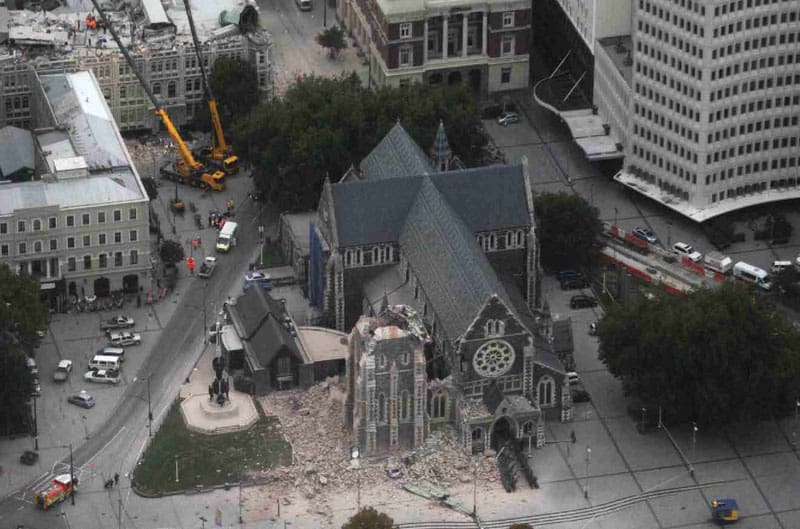
Researchers in New Zealand, meanwhile, have been using probabilistic forecasting to calculate the changing rates of aftershocks in the Canterbury region, following the magnitude-7.1 mainshock near the town of Darfield in September 2010 and the more lethal magnitude-6.2 aftershock that struck close to Christchurch in February last year. Matthew Gerstenberger and colleagues at GNS Science, a geophysics research institute in New Zealand, have used an ensemble of short-, medium- and long-term models to keep the public up to date and to revise building codes in the region. As pointed out by Gerstenberger, who developed the STEP model, time-independent forecasting on its own would be inadequate. “Christchurch was a moderate-to-low hazard region in the national seismic-hazard model prior to these earthquakes,” he says. “But the ongoing sequence has increased its estimated hazard.”

Dramatic changes to earthquake probabilities have also been calculated in Japan, following the Tohoku earthquake last year. Shinichi Sakai and colleagues at the University of Tokyo have worked out that the chances of a magnitude-7 or greater earthquake striking the Tokyo region have skyrocketed to 70% over the next four years. This contrasts with the Japanese government’s estimate of a 70% chance over the next 30 years. The researchers have stated that they obtain a much higher probability because they take into account the effects of a fivefold increase in tremors in Tokyo since the March 2011 event.

The limits of modelling

While ETAS- and STEP-like models can improve on the information available from time-independent forecasts, they are no panacea. In particular, they oversimplify the spatial properties of triggering, by representing earthquakes as point, rather than finite-length, sources, while also ignoring earthquakes’ proximities to major active faults. According to ICEF member Ian Main of the University of Edinburgh, incorporating fault-based information into these models might provide additional probability gain compared with time-independent calculations, given adequate fault and seismicity data. But significant improvements will only be made by gaining a better understanding of the physics of fault interactions. One particular challenge is to understand the extent to which one earthquake triggers another through the bulk movement of the Earth’s crust and how much it does so via the seismic waves it generates. “We know roughly how the statistics of earthquakes scale, and that is why we use statistical models,” says Main. “But the precise physical mechanism that leads to this scaling is underdetermined.”

Even if models can be significantly improved, they will, for the foreseeable future at least, only ever provide quite low probabilities of impending major quakes. That leaves the civil authorities responsible for mitigation actions in a difficult position. The ICEF recommends that governments try to establish a series of predefined responses, based on cost–benefit analyses, that local or national authorities could automatically enact once certain probability thresholds have been exceeded, from placing emergency services on higher alert to mass evacuation. But Marzocchi points out this will not be easy. “I can say from a scientific point of view that such and such is the probability of a certain earthquake occurring,” he says. “But acting on these low probabilities would very likely mean creating false alarms. This raises the problem of crying wolf.”

Some scientists continue to believe, on the other hand, that precursors will be found. Friedemann Freund, a physicist at NASA’s Ames Research Center near San Francisco, is investigating a number of potential precursors, including electromagnetic ones, and he maintains that the combination of such precursors, even if individually they are “fraught with uncertainty”, will lead “in the not-too-distant future to a robust earthquake forecasting system” (see “Breaking new ground”). He contends that seismologists are “too proud to admit that other scientific disciplines could help them out”.

Danijel Schorlemmer of the University of Southern California, who is joint leader of the CSEP model-testing project with Jordan, disagrees. He insists that deterministic earthquake prediction will not be possible “in my lifetime” and adds that, even though he hopes precursors will be identified, “the search has been unsuccessful so far”.

For Jordan, as for many other seismologists, ensuring that buildings are made as resistant as possible remains the most important strategy for combating the destructive power of earthquakes. But he believes that short-term probabilistic forecasting, if carried out properly, has an important role to play. “This approach is tricky,” he concedes, “because no-one can quite agree on which are the best models. So we have uncertainty on uncertainty. But can we ignore the information that they give us? The earthquakes in L’Aquila and New Zealand taught us we don’t have that luxury.”


Finding jobs in hard times

If you have read a newspaper, listened to the radio or browsed the Internet in the last 12 months, you could be forgiven for thinking that the outlook for new graduates is bleak. Graduate numbers are up, employment figures are down and business confidence is teetering on the edge. But are things really that desperate? For this special graduate section, Physics World set out to discover who is hiring physics graduates – and how you can get your application to the top of the pile.

The good news is that the job market for new graduates is looking up. “Things have never been as bad as the headlines might suggest,” says Don Murray, a careers adviser at the University of Edinburgh. “From a low point in 2008, we’ve seen a steady rise in vacancies year on year.” Brian Staines, head of guidance at the University of Bristol careers service, agrees. “The situation for graduates is improving gently,” he explains. “Things have definitely picked up.”

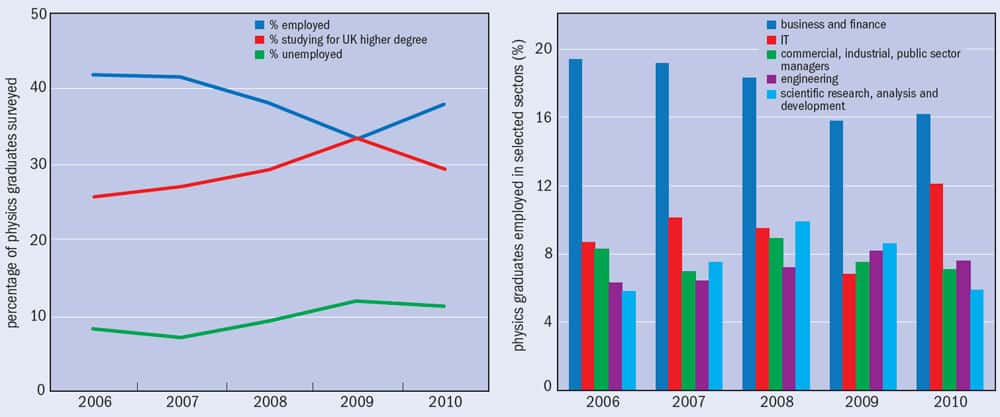
The message from employers is similarly positive. Data from High Fliers Research, the specialist graduate-recruitment market-research company, show that the UK’s leading employers expect to increase their graduate intakes by an average of 6.4% in 2012 compared with 2011. In some sectors, the picture is even more encouraging. Vacancies in engineering and industrial companies are up by 22%; in banking and finance, they are up by 16%. This will be promising news for many physics graduates, says Murray, noting that the top three destinations for Edinburgh’s physicists are engineering, finance and information technology. Data from other universities tell a similar story (see “What physics graduates do: 2006–2010”).

For graduates who want to pursue their interest in science, a range of opportunities are available in energy companies, engineering firms and the research divisions of larger manufacturers. And despite planned cutbacks in government spending, physics graduates should not necessarily overlook the public sector. Recruiters such as the Met Office and the Defence Science and Technology Laboratory are keen to attract high-quality science graduates.

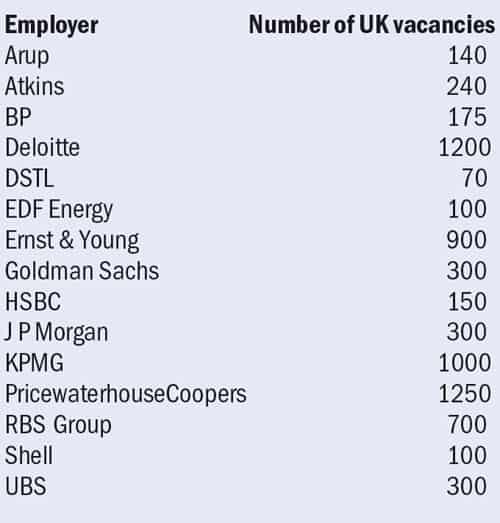
Despite a post-credit-crunch dip in the numbers of graduates entering banking and finance, businesses in this sector remain eager to draw on the numerical skills and problem-solving ability that science graduates can bring. “We are proactively trying to attract people from outside finance and economics, as well as those with financial backgrounds,” says Sarah Harper, head of recruiting for Europe, Middle East and Africa at the investment bank Goldman Sachs. She adds that the firm recently held a careers event aimed specifically at students of STEM (science, technology, engineering and maths) subjects.

The not-so-good news, according to High Fliers Research, is that graduate recruitment is still 6% down on its high point in 2007, and with 50 000 more graduates taking the first step onto the career ladder than five years ago, competition for jobs is fierce. Last year, recruiters from the large, high-profile firms covered by High Fliers Research received an average of 48 applications for each graduate place, and that figure is likely to be even higher in 2012. In such a crowded market, even graduates in the sought-after discipline of physics are going to have to really stand out if they are to find – and secure – their dream job.

Quality, not quantity

Graduates who are trying to boost their applications from “good” to “great” will be pleased to know that many of them will already be more than halfway there, thanks to their educational experience. “We recognize that applicants have already been tested numerous times in their journey through the education system,” says Robin Harbach, head of human resources at the Met Office, adding that those who have an upper second from a good university are “already 70% of the way through the selection process”. The key to the remaining 30%, he explains, is more about an applicant’s attitude than their aptitude. In other words, they need to convince potential employers that they are the right person for that organization, and for that specific role.

The first step to accomplishing this is to learn everything you can about the company and the role that you are applying for. Look at the organization’s website and read the job description carefully. Visit your university’s careers service to find out what information they have. If the company is holding a recruitment event, go along and hear what it has to say. “We expect applicants to know about our company, who we are and how we are structured,” says Vicki Potter, resourcing manager at Oxford Instruments, which recruits physics graduates to a range of roles. Kate Waterstreet, a graduate recruitment adviser at Atkins, an engineering and design consultancy, agrees. “You can tell when someone has really researched what we do,” she says.

This level of research can take a while, however, and it absolutely should not be left until the train journey to your interview. “It is obvious when someone has only started to read the Financial Times over the last week,” observes Harper, of Goldman Sachs. To help students budget their time, careers officers counsel restraint. “Resist the temptation to bash out 25 mediocre applications,” advises Bristol’s Staines. “Focus on quality, not quantity. Target each application at the specific organization and vacancy.” Recruiters, adds Harper, need to understand why you want to work in their company and what excites you about that role. “We are looking for a personal story about why someone is interested in working at our firm, such as particular deals we have been involved in that have caught their attention or discussions with Goldman Sachs professionals who they have met at recruiting events,” she says. Above all, says the Met Office’s Harbach, applicants should show that they really, really want the job. “If you’re not passionate about what you want to do,” he asks, “how will anyone else get passionate about hiring you?”

Being passionate, though, is no excuse for being sloppy. When preparing your cover letter, CV or application form, you must make sure you proof-read it before you send it off. This really should not need saying, but recruiters can provide story after story of poor spelling and grammar, missing attachments and obvious copy-and-paste errors. A genuine, deep interest in a particular role and a perfect cover letter will get you nowhere if you name-check the wrong company in the opening paragraph. “Get the basics right,” urges Edinburgh’s Murray. “A good, clear application will stand out.”

The importance of soft skills

In addition to spell-checking their applications, physics graduates should also remember that, although physics is a very attractive degree from a technical point of view, employers are looking beyond technical competence. “What you know is half the battle,” says Harbach. “How you do it is the other half. We need to know how well you can relate to people.”

This is where skills such as communication, teamwork and leadership can play a vital role. However, it is not sufficient just to say that you have these skills – you need to prove it. This means providing concrete examples of how you have used these skills and what you have achieved. So if you have been the president of your university’s debating society, worked weekends in a shop or volunteered for a local charity, now would be a good time to mention it. And the more relevant these examples are to the job you are applying for, the better. “Target what the employer wants,” says Murray. “Link your own experience and skills to that vacancy. Show why you would be a good employee.”

Work experience, in particular, can make the crucial difference between a good application and a great one. According to High Fliers Research, recruiters estimate that one-third of this year’s entry-level positions will be filled by graduates who have already worked for their organizations, whether through industrial placements, vacation work or undergraduate sponsorship. For investment banks, this figure rises to three-quarters, and recruiters warn that graduates with no previous work experience are unlikely to be successful. “In a highly competitive graduate job market, new graduates who have not had any work experience at all during their time at university have little hope of landing a well-paid job with a leading employer,” says Martin Birchall, managing director of High Fliers Research. This is true, he adds, “irrespective of the academic results they achieve or the university they have attended”.

“Work experience is a key way of being able to differentiate yourself,” agrees Harper at Goldman Sachs. “[For us], something in an investment bank would be best, even if it is just for a week. But anything where you are challenging yourself is good – something where you are able to demonstrate that you can add value.”

On the upside, many leading employers offer paid work-experience programmes for students and recent graduates. Two-thirds provide industrial placements for six to 12 months and more than half have paid vacation internships for three weeks or longer. And if your employment history so far has been somewhat lower key, then don’t worry. “Any form of work experience is important,” says Waterstreet, of Atkins. Potter, at Oxford Instruments, makes a similar point. “We want people who have experience of dealing with customers,” she explains, “even if that is from working in a shop.”

If all goes well, the next stage is an interview or assessment. Here, as in the application, the key to success is preparation. Most recruiters explain on their website what form the interview or assessment will take and what you can expect on the day. Your careers service can also help you to prepare, by coaching you on interview skills, helping you to anticipate questions and directing you to online tests for a bit of practice. For example, Staines notes that nearly all interviews are “competency based”, which means that the interviewer wants to find out whether you have the specific skills the employer needs. Because of this, he says, a well-prepared student should be able to anticipate 70–80% of the questions, especially “the obvious ones” that ask you to give examples of occasions when you have planned your time effectively, worked in a team or overcome difficulties in completing a task.

Still, you will also need to demonstrate your enthusiasm for the industry, the company and the role. “Just answering the questions well will not get you the job these days,” says Harbach at the Met Office, adding that graduates need to show that they are “keen and driven”. Potter says that she is always impressed when an applicant comes armed with questions about the company’s products and markets; this shows that they are interested and that they have done their research.

As with many things in life, the key to success here is hard work. Put in the time, do the research and find out what the employer is looking for. Then show how your skills, qualifications and experience make you the ideal candidate. It is not easy, but this methodical approach pays dividends. If you make “a real effort” with your application, advises Potter, this will “automatically” put you in the top 10%.

When the right job isn’t there

Sometimes, though, things do not go according to plan. Perhaps you cannot decide what you want to do. Maybe you know what you want but the right vacancy is proving elusive. Or perhaps you have been applying for job after job with no success. The key here is not to panic. You do not have to get into your dream career straight away. Sometimes it takes time to find and secure the job that you want.

One suggestion from Bristol’s Staines is to look beyond well- advertised jobs, and submit speculative applications for hands-on work experience in your chosen sector. Small and medium-sized businesses may have vacancies, he says, but many do not advertise heavily with universities. Staines also counsels approaching potential employers just for advice, rather than with a cover letter and CV. “Don’t start by asking ‘Have you got a job going?’, as they can shut the conversation down with a simple ‘no’,” he says. Instead, just explain your situation and ask for advice. “Most will be more than happy to help – and if they do have any vacancies coming up, they’re likely to let you know, too.” It is also worth remembering that many employers recruit graduates year round, not just immediately after graduation.

For those who need more help, university careers services are a good port of call (see “Seeking advice”). Many services maintain networks of alumni, for example, who may be able to advise you on your application or your career choice. Even if you have already graduated, it is still worth visiting, since most careers services continue to support graduates for two or three years after they have left. If you have moved away, and a visit to your own university is not practical, you may find that your local university is able to step in; nearly all careers services are part of a “mutual aid” network and will be able to advise you as if you were one of their own graduates.

If you find that you need to boost your skills, then it might be worth thinking about postgraduate study. Edinburgh careers adviser Murray urges caution, though. “Postgraduate study is not for everyone,” he explains. “To do it solely as a stop-gap measure is not a good idea. Think carefully about where the course will lead you.” Staines agrees, adding that you should only enter into further research or study “if it is what you want or if it will help you with your job prospects”. “Look at the destinations of people who have completed that course and see what they are doing now,” he adds.

The main thing, says Potter at Oxford Instruments, is to do something with your time while you find the right job. “Find a temporary job,” she suggests. “Show that you are willing to work hard. Travel is fine, too. But demonstrate that you are learning something from it. Do anything. Just don’t do nothing.”

Forecasting earthquakes

The vast majority of seismologists would agree that we are still a long way from being able to pinpoint the time and location of the next significant earthquake. A more modest approach is to produce “earthquake forecasts”, which assign probabilities to an earthquake striking within a given time and region. The principle of this approach is discussed in this video interview with Aldo Zollo of the University of Naples, Federico II in Italy.

“Earthquake forecasting is feasible and it is applied worldwide,” says Zollo. “It helps local administrators, scientists and civil-protection managers to deal with their preparedness for the earthquakes, and to educate people to be prepared for the next earthquake.”

Zollo also talks about the importance of earthquake early-warning systems – operational in countries including Japan, Mexico and Taiwan. Depending on where an earthquake strikes, these systems can provide a warning of up to a few tens of seconds before strong shaking occurs in built-up areas. This might not seem very long but it is enough to allow automated processes to be triggered, such as the slowing down of high-speed trains or the switch-off of equipment in chemical plants.

The Italian researcher’s career in seismology was triggered by his personal experience of an earthquake. Zollo recounts the day in 1980 when, as a physics student living in the Apennines, he returned home one day to find his house damaged by an earthquake. His inability to explain the event to his distressed neighbours left a marked impression on the young Zollo.

This interview was filmed in San Francisco at the 2011 Fall Meeting of the American Geophysical Union.

Copyright © 2026 by IOP Publishing Ltd and individual contributors