Getting to the froth of the matter


Whether it is the frothy milk on your cappuccino, the soapy suds in your bath or the large-scale structure of the universe, foams have intrigued physicists for many years. Now, for the first time in a lab, an international group of scientists has made the Weaire–Phelan foam – which physicists believe is the lowest-energy structure for a foam formed of equal-volume bubbles.

Physicist Joseph Plateau first studied the geometry of liquid foams almost two centuries ago, and the first ever theoretical concept for an “ideal foam” of equal-sized bubbles was developed by Lord Kelvin in 1887. Kelvin proposed a foam that was based on a complex cubic honeycomb shape: a crystal structure formed with a truncated octahedron – a 14-sided space-filling polyhedron with six square faces and eight slightly curved hexagonal faces. This was considered as the ideal foam for almost 100 years, until 1994, when Trinity College Dublin physicist Denis Weaire and his student Robert Phelan found a foam at an even lower energy in computer simulations using a software developed by mathematician Kenneth Brakke. The “Weaire–Phelan structure” is a complex 3D structure of two kinds of equal-volume polyhedral bubbles, with 12 and 14 sides, respectively, and is 0.3% lower in energy than the Kelvin foam.

Special template

However, physicists have struggled to create the Weaire–Phelan foam in a lab until now. A team at Trinity College, led by Italian researcher Ruggero Gabbrielli from the University of Trento, managed to create Weaire–Phelan foam using a specially created template. Gabbrielli realized that previous failures at creating the foam could be put down to the shape of the containers used to create it in. “While the Kelvin structure can be confined within a structure with flat boundaries, the Weaire–Phelan structure does not fit against a flat boundary…it requires a special template,” explains Stefan Hutzler, head of the Foams and Complex Systems Research Group in the School of Physics at Trinity.

Gabbrielli worked with Brakke to design a receptacle whose walls had an intricate form that would encourage and accommodate the Weaire–Phelan bubbles. This template was made at Trinity’s Centre for Research on Adaptive Nanostructures and Nanodevices (CRANN) using their 3D printer and proved an instant success when bubbles of the right size were introduced into it. The foam is created by placing the special template in a simple solution of water and the commercially available detergent Fairy Liquid. Bubbles are produced by releasing nitrogen gas from a glass capillary. Bubble size is crucial while developing such foams. Hutzler explains that they tried a variety of sizes and found an optimum bubble size that was not too small or too large such that the bubbles “become squishy”. The resulting foam was then backlit and photographed using a digital SLR camera and it was immediately evident that the Weaire–Phelan structure had been formed. The samples that were produced comprised up to 1500 bubbles.

Foamy futures

So have physicists finally created the ideal foam or could an even lower energy foam be found at some later point? “This confirmation makes the Weaire–Phelan structure the best answer yet to the old “minimum area” problem – though whether there is another shape with even smaller surface area remains an open question – and underlines the importance of surface conditions in making foams,” says Sidney Perkowitz, a professor at Emory University in the US and author of Universal Foam. “The result is also an advance in the active area of soft condensed-matter physics, which deals with deformable or ‘squishy’ matter. And with foam’s widespread everyday and commercial use, from shaving to fighting fires to molecular gastronomy, where its “mouth feel” is highly valued, the chain of insights from Plateau to Kelvin and now to Weaire–Phelan may directly affect people as well,” explains Perkowitz.

Hutzler admits that the realization of the foam, while being quite an achievement, does not have any immediate practical uses. But in solidified form and on various scales, such exotic ordered foams could find applications as chemical filters, heat exchangers and photonic crystals. Interestingly, the Weaire–Phelan foam structure was used to design the Water Cube aquatic centre for the Beijing Olympics. Many millions have admired its elegant framework of steel beams, which follow the pattern of the ideal foam.

The research is published in Philosophical Magazine Letters.

Frequency comb reaches extreme ultraviolet

Physicists in the US have created an optical frequency comb that operates in the extreme ultraviolet (XUV). Touted as the first practical comb to work in this region of the spectrum, the device could be used to look for tiny variations in the fine-structure constant and other physical constants that could point to new physics. An XUV comb could also be used to create better atomic clocks and new techniques for atomic spectroscopy.

Frequency combs are created with an ultrafast mode-locked laser, in which pulses of light bounce back and forth in an optical cavity. The frequency spectrum of the resulting train of pulses from such a laser is a series of very sharp peaks that are evenly spaced in frequency, like the teeth on a comb.

When one comb “tooth” is set to a standard frequency – such as that generated by an atomic clock – the absolute frequency of another light source can be measured to great accuracy by comparing it with the other teeth on the comb. The device therefore offers researchers a way of making very accurate spectroscopic measurements of atoms and molecules, and also a way of comparing atomic clocks.

Current combs operate at optical frequencies, and physicists have struggled to extend them into the ultraviolet and beyond. One promising path is a process called high-harmonic generation (HHG), whereby an intense laser ionizes atoms in a gas and then accelerates the electrons causing them to radiate high-frequency photons. HHG has already been used to create pulses of XUV light, but not trains of pulses that are of high enough quality to create a practical XUV comb.

A fine comb

One difficulty in making a practical XUV comb is ensuring that successive pulses have a high degree of phase coherence over time periods as long as seconds. Another challenge is making the pulses intense enough so that the comb can be used to perform atomic spectroscopy experiments. Now, however, Jun Ye and colleagues at the Joint Institute for Laboratory Astrophysics (JILA) in Boulder, Colorado, are the first to demonstrate a technique that addresses both of these problems.

The technique uses a high-power laser to create an intense infrared comb within an optical cavity. The cavity is then filled with xenon gas, which provides the medium for HHG, whereby the intense infrared pulses create pulses of XUV light. These XUV pulses bounce back and forth in the cavity to create a second comb. According to Ye, much of the glory for the demonstration should go to Ingmar Hartl and colleagues at the Michigan-based firm IMRA America, who designed and supplied the high-power laser.

Krypton factor

The comb was also operated using krypton as the HHG gas. In both cases, the team was able to create combs of light in the 40–120 nm wavelength range, which corresponds to XUV light. To demonstrate the comb, Ye and colleagues used it to study specific atomic transitions in argon and neon at wavelengths of 82 nm and 63 nm, respectively. In both cases they showed that light from a single tooth of the comb was intense enough to resolve the transitions. Patrick Gill of the UK’s National Physical Laboratory described the work as “a good example of using the comb mode of HHG to do single-photon spectroscopy in the XUV”.

Ye told physicsworld.com that the comb opens the door to a wide range of new measurements, including tests of single- and two-body quantum theory in atom-like systems. The combs could also be used in next-generation “nuclear clocks”, which are based on nuclear transitions and “tick” at higher frequencies than atomic clocks. Other important applications could be laboratory and astrophysical measurements of variations of fundamental constants such as the fine-structure constant – which could point to physics beyond the Standard Model.

Ted Hänsch at LMU Munich described the work as “an important milestone on the path towards routine use of XUV frequency combs for spectroscopy”. Hänsch – who shared the 2005 Nobel Prize for Physics for the invention of the frequency comb – told physicsworld.com “I am optimistic that frequency-comb techniques can be pushed to shorter wavelengths, but the required mutual phase coherence of successive pulses will make it rather challenging to reach the X-ray regime.”

The research in reported in Nature.

Between the lines

Pretty physics pictures

A lot of books have been written on the history of physics, but this latest one – called, simply enough, The Physics Book – stands out for two reasons. First, it is beautifully illustrated, with more than 200 full-colour images depicting objects as diverse as the Crab Nebula and the Manhattan Project’s uranium-processing facility. Second, the book is written by Clifford Pickover, an author who has been widely – and, if this book is any example, deservedly – praised for his unusual creativity. The book is arranged chronologically, so of course it begins with the Big Bang. Other early entries, though, are less conventional, such as the nuclear reactor that formed below western Africa around two billion years ago and a throwing tool called an atlatl that helped prehistoric humans hunt mammoths. This mix of the obvious and unusual continues after physics gets properly started; for example, Ben Franklin’s kite (allegedly flown in 1752) rubs metaphorical shoulders with the so-called black drop effect that occurs whenever the planet Venus passes between the Earth and the Sun. The effect was first described in 1761 by the Swedish scientist Torbern Bergman, who noted that as Venus began its transit across the Sun, the planet assumed the shape of a teardrop, with a “ligature” connecting its silhouette to the dark edge of the Sun. Observations planned for this year’s Venus transit on 6 June might explain the origins of the black drop, but we will have to wait much longer to resolve the book’s final entry, which concerns the idea of “quantum resurrection”. The gist of this mind-blowing concept is that, given infinite time, quantum fluctuations could repopulate our dying, empty universe with a range of unlikely objects – including free-floating, disembodied brains.

  • 2011 Sterling £19.99/$29.95hb 528pp

Dogs in space–time

Emmy the dog loves physics. She loves physics so much that her owner, Chad Orzel, has now written two books aimed at helping her – plus a few non-canine readers – to understand her favourite subject. The first such book, How To Teach Quantum Physics To Your Dog (NB its US title leaves out the word “quantum”) covered one of the two great revolutions that hit physics in the early 20th century, so it is only natural that its sequel, How to Teach Relativity To Your Dog, focuses on the other. Like the original, which came second on Physics World’s list of the 10 best physics books of 2010 (December 2010 review), the new book mixes straightforward explanations with dialogues between Orzel and Emmy. These dialogues allow the author to clear up some misconceptions, while also giving readers a glimpse into his life as a physicist at a small US liberal-arts college – and Emmy’s life as a squirrel-obsessed cat-hater. Orzel’s background in atomic physics was a real boon in his first book, and despite the greater distance between atomic physics and relativity, it is surprisingly helpful in this one, too, especially in the early chapters on special relativity. For example, his description of the Michelson–Morley aether experiment is unusually practical for a popular-science book. Among other details, Orzel notes that the pair had to attach their interferometer to a 2 tonne granite block and float it on a vat of liquid mercury in order to reduce errors in their measurement. Later sections of the book cover space–time, particle physics and black holes, which Emmy compares to a dog gobbling up all the treats in its path (meaning that Hawking radiation is the equivalent of…no, best not think about that). The final chapters on cosmology are a bit sketchier; as Orzel himself admits, there is a reason he is an experimental atomic physicist and not a general-relativity theorist. But on the whole, this delightful book lives up to the expectations set by its predecessor.

  • 2012 Basic Books £11.99/$16.99pb 368pp

Life as we do not know it

According to the science writer Marc Kaufman, astrobiologists are “part Carl Sagan, part Indiana Jones, part Watson and Crick [and] part CSI: Mars“. It is an apt description. As Kaufman makes clear in his book First Contact: Scientific Breakthroughs in the Hunt for Life Beyond Earth, the practitioners of this hot new field come from a variety of academic backgrounds, and draw on planetary science, astronomy, biology, geology and more in their quest to understand what conditions could support alien life, and what form that life might take. One question that interests astrobiologists is the same one that puzzled Schrödinger back in the 1940s: just what is life, anyway? Amazingly, there is still little consensus on the answer. One problem, Kaufman explains, is that nearly all definitions run into problems when faced with marginal substances such as desert varnish. This blackish rock coating is found in many places on Earth, and may have been spotted on Mars, but no-one has been able to determine whether its origins are microbiological or geochemical. Kaufman visited many different locations while researching the book, and he excels at describing them. For example, in a South African platinum mine, where biologists have found some unusual microbial life, water spraying into a tunnel is “bathwater hot”, while the extreme heat of the air causes Kaufman to hallucinate “halos of light far broader than anything coming from my miners’ lights”. The book does have some flaws but it is nevertheless a useful introduction to an intriguing subject.

  • 2011 Simon & Schuster £16.63/$26.00hb 224pp

Giorgio Parisi: the Italian activist

Giorgio Parisi

Giorgio Parisi was caught in the eye of a political storm in January 2008. The 63-year-old theoretical physicist, together with 66 other lecturers from La Sapienza, University of Rome, called on the 700-year-old institution to cancel an invitation to Pope Benedict XVI to deliver the inaugural lecture of the academic year. After three days of protests against the pope’s visit, including banners sprawled across campus buildings, the university cancelled the speech. The university did, however, allow the pope to speak immediately after the ceremony at the inauguration of the university chapel.

After the backtrack, students throughout the campus hailed Parisi and his fellow lecturers, while the radical Catholic speaker Father Livio Fanzaga said the signatories “smelled of sulphur”. Although the signed letter was only meant to be seen and distributed within the university, it caused a media and political stir after it was made public by a newspaper only a couple of days before the pope’s visit. Indeed, the Italian government – then led by Silvio Berlusconi – threatened to take legal action against anyone who had signed the letter.

Looking back on those events of four years ago, Parisi defends his stance that the Pope should not have given the lecture. “A religious person – even a rabbi or an imam – is not the appropriate choice for the inauguration of a non-religious institution,” he says. Yet the Catholic Church is not the only institution to cross swords with Parisi. He bemoans the previous Italian government for not supporting science adequately during the economic boom times and failing to see that boosting innovation could grow the country out of the impending recession. “They considered research as a luxury in times of crisis, instead of an opportunity”, he complains. “The drop in investment during Berlusconi’s times was so large that hiring and financing for science was practically blocked.” The result is, in his opinion, a brain drain away from the country that will only put it on a weaker footing in the future.

The drop in investment during Berlusconi’s times was so large that hiring and financing for science was practically blocked.

Giorgio Parisi

Now, with a new administration in Italy led by the economist Mario Monti, Parisi has in many of his public lectures been increasingly lobbying for more science spending in Italy. There are signs that things are improving and Parisi is particularly impressed with the appointment of electrical engineer Francesco Profumo as the new science and education minister. “It is a wonderful choice. I am confident that he will do his best to improve the situation,” he says. Profumo, 58, is also president of the National Research Council (CNR) and had previously served as chancellor of the Polytechnic University of Turin from 2005 to 2011.

Parisi says the appointment of Monti represents progress but he would like Italy’s new prime minister to take economic inequality into account in the attempt to get the country back on track after the Berlusconi years. “Italy needs both budget austerity and a stimulus package that should involve in a massive way science and technology, and culture as a whole,” he adds. “We shall see if science resources will be cut or whether they will increase: it would be a disaster if the cuts were distributed in the same way for institutions that are deemed excellent and those that are not.”

A changing science

Entering Parisi’s office in the Marconi physics building in La Sapienza’s main campus, at first glance it does not look dissimilar to those of his colleagues’, with scientific books sprawled across the desk and table. But there is one particular object that stands out: what looks like a very old television set. Rather than being there for sitting back and watching daytime TV, the device was instead used in 1983 by the prominent theorist Nicola Cabibbo to simulate a cellular automaton called “LIFE” – a computational model where particles on a screen die or survive depending on the interactions with their neighbours. The TV – with a 512 × 512 pixel screen – ran at 50 frames per second and was pioneering technology for its time. Although Parisi describes himself as “not a good experimentalist”, the old TV is a totem to his versatility. Trained as a high-energy theoretical physicist, he later moved into condensed-matter experimental physics, and has now started research in a new area: modelling flocks of starlings flying above Rome’s train station.

Born in Rome in 1948, Parisi attended the city’s famous La Sapienza University, graduating in 1970 with a degree in high-energy physics, during which he studied the Higgs mechanism under the guidance of future collaborator Cabibbo. After his degree Parisi worked at the Laboratori Nazionali di Frascati, on the outskirts of Rome, on the theory of positron and electron collisions, which were being performed at the National Research Council’s Adone accelerator, also in Frascati.

With that background, it is not surprising that Parisi has warm words for Italy’s €650m SuperB experiment – a next-generation particle accelerator that will be located at the campus of the University of Rome Tor Vergata, on the outskirts of the city. SuperB will collide electrons and positrons inside two 1.2 km-circumference rings to study the decay of particles such as B-mesons and tau leptons. Building of the tunnels for the facility’s circular accelerator has been put back from the end of this year to the beginning of 2013, with scientists saying that they are confident the delay will not affect the start-up date of 2016. “SuperB is a very ambitious programme and will be successful only if it sticks to a strict schedule,” says Parisi. “I am sure that the management – and I hope also the government – is well aware of this crucial point.”

During the early 1970s Parisi began to work on the theory of phase transitions within solids. He was particularly attracted by the application of field-theory techniques that were used from high-energy physics to condensed-matter physics. Indeed, it is in this area that Parisi says he made his most important scientific contribution – helping form the physical theory behind spin glasses. These are magnets with “frustrated” interactions caused by disorder and Parisi was awarded the Boltzmann medal in 1992 by the International Union of Pure and Applied Physics for this work.

Since then, Parisi has received other high-profile awards for his theoretical work, including the Dirac Medal in 1999 from the Abdus Salam International Centre for Theoretical Physics (ICTP) and the Max Planck medal last year from the German Physical Society. It is these theoretical methods that Parisi has been using to study and model the shape and dynamics of up to 10,000 flocking starlings, which he says is a “well-defined problem that only physics has the tools to understand”. Yet, while Parisi says he has been fortunate to live in a time where theories from high-energy physics can be successfully exported to other areas, such as condensed-matter physics, he fears that spanning new fields is getting much harder as research becomes ever more specialized.

The Italian job

Despite his criticism of the Italian government, Parisi does not regret developing his career in Italy. “[When I started] it was possible to do good theoretical research,” he says. “I did not find enough reasons to move country then.” Yet he does not feel the same way now after seeing funding in Italy reduce over the past few years. “Too many Italian scientists decide to remain abroad because there are practically no permanent job openings in Italy for people aged around 30,” he adds.

Parisi, however, has not lost his interest in high-energy physics, particularly now that CERN’s Large Hadron Collider is homing in on the Higgs boson. “We are receiving wonderful news from CERN: they found the Higgs in the place where it should be, just at border of the range where Cabibbo, [Luciano] Maiani, [Roberto] Petronzio and myself predicted it 32 years ago,” he says. Indeed, Parisi says he has never had any doubts about the existence of the Higgs after the W and Z bosons were found in the early 1970s. “The theoretical scenario would be quite incomprehensible without the Higgs,” he says. “I am sure that [CERN] will confirm the result next year.”

In person

Born: Rome, 1948

Education: La Sapienza, University of Rome (1970)

Career: Researcher at Laboratori Nazionali di Frascati, Rome (1971–1981); La Sapienza (since 1981). Currently director of the Statistical Mechanics and Complexity R&D Centre, belonging to the National Institute for the Physics of Matter, also in Rome

Family: Married, two daughters

Hobbies: Greek dance, writing short stories for children

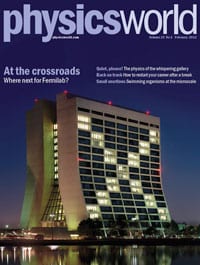
The February 2012 issue of Physics World is out now

By Matin Durrani

PWFeb12cover-200px.jpg

The February issue of Physics World magazine is now out, featuring some great articles that I think I ought to tell you about.

Physics comes to life – Mark Haw from the University of Strathclyde and Otti Croze from the University of Glasgow explore the strange world of swimming micro-organisms – and how it is having an impact on biology, biotechnology and fundamental physics.

Gallery of whispers – Oliver Wright from Hokkaido University in Japan looks at a little-known effect dubbed “whispering-gallery waves”. Dating back to the work of Lord Rayleigh at St Paul’s Cathedral in London, it appears throughout science in fields as diverse as astronomy, optics and acoustics.

Securing the future – John Womersley, chief executive of the UK’s Science and Technology Facilities Council, explains why the country’s research community needs to safeguard its own future.

Careers, interrupted – Jan West describes the work of the Daphne Jackson Trust, which has helped more than 200 people to return to working in science after a career break.

Don’t miss either Rick Trebino’s Lateral Thoughts article “Fire in a crowded theatre”, while over in news and analysis, we have an interview with Italian theorist Giorgio Parisi entitled “The Italian activist” and an update on the work of the SESAME synchrotron being built in the Middle East. Plus enjoy Margaret Harris’s feature “Fermilab’s next frontier” in all its glory.

Members of the Institute of Physics (IOP) can read the new issue free online through the digital version of the magazine by following this link or by downloading the Physics World app to your iPhone or iPad or Android device, available from the App Store and Android Marketplace, respectively.

If you’re not yet a member, you can join the IOP as an imember for just £15, €20 or $25 a year via this link. Being an imember gives you a year’s access to Physics World both online and through the apps.

Fermilab’s next frontier

As I bump across the railway tracks and drive under the blue archway marking the entrance to Fermilab, the US particle-physics centre’s iconic Wilson Hall gleams like marble in the distance. Drive a little further – past the cluster of white farmhouses, the small herd of American bison, and the huge orange and blue warehouse that is home to one of the lab’s two high-energy-physics experiments – and the 16-storey structure appears to rise out of the flat Illinois landscape like a concrete cathedral. Up close, though, slight imperfections begin to emerge. A bit of scaffolding here. A blocked entrance there. And then, spilling out from the glassed-in atrium, I hear the muffled sound of drilling.

Wilson Hall, like Fermilab itself, was undergoing renovations when I visited in late 2011. But while the changes to the hall are cosmetic, those at the lab could be among the most profound in its 45-year history. On 30 September 2011 Fermilab’s flagship particle accelerator, the Tevatron, collided its last protons and antiprotons. The shutdown signalled the end of a 28-year run of discoveries at the veteran machine, including the top quark (spotted in 1995) and the tau neutrino (2000). It was also a quiet acknowledgment that, for the foreseeable future, the US has ceded its place on the “energy frontier” of physics to Europe, where CERN’s Large Hadron Collider (LHC) is busily churning out data in the search for the Higgs boson.

The end of the Tevatron does not, however, mean the end of Fermilab. “We have 10 accelerators here on site,” says Fermilab physicist Steve Holmes, with the merest hint of irritation. “We turned one of them off, okay?” Like several scientists I spoke to, Holmes was keen to point out that colliding high-energy beams of particles is not the only way of discovering new physics with accelerators. Another option, which Fermilab plans to pursue, is to look for rare interactions between particles at lower energies. In this type of experiment, the key parameter is not a beam’s energy but its intensity: the number of particles produced per second.

The intensity lottery

To understand why intensity matters, consider neutrinos. These mysterious, nearly massless entities are famously shy about interacting with other particles, so the more neutrinos an experiment can produce – by, for example, slamming a super-intense beam of protons into a graphite target – the better its chances are of detecting them. Other processes that are even rarer than neutrino interactions, such as the never-observed neutrinoless decay of muons into electrons, may also be detectable if the number of decays is high enough.

Bob Tschirhart, a Fermilab scientist who has worked on such “intensity frontier” experiments for 20 years, compares the hunt for rare decays to a lottery. “When you play the lottery, everyone knows your chances of winning are greater if you buy more tickets,” he explains. “The whole point of the intensity frontier is to have a large sample of decays, thereby buying more tickets in this lottery of very rare phenomena.”


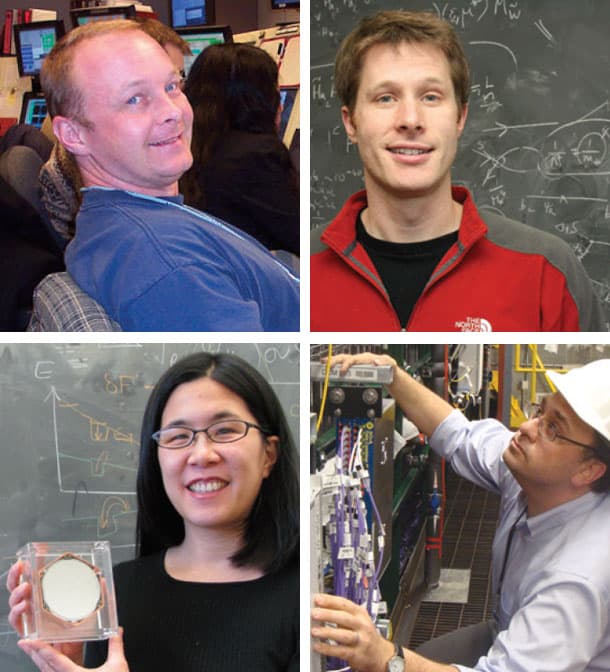
Brendan Casey

For Fermilab, the shift in emphasis from high-energy to high-intensity physics is not so much a lottery as a calculated bet. With funding for science static or falling, and the LHC set to dominate high-energy research for the next decade and beyond, the lab is refocusing its efforts on projects that promise interesting results, require smaller teams of scientists, and take advantage of existing expertise in neutrino research and accelerator design. Holmes notes that these new projects are also unlikely to be outclassed by international competitors, since few other groups are pursuing this type of research. “This is an opportunity for the US to establish a leadership position in this very important area of physics that will last for decades,” he says. “If we do it right, we’ll just blow away the competition.”

Optimism abounds at Fermilab, and all the researchers I met there expressed excitement about the future (see “Voices from Fermilab” and audio clips). Even those still working on the Tevatron’s two detector experiments, CDF and DZero, seemed enthusiastic about performing their last analyses on the Higgs search and other goals, though they also mourned the old workhorse’s retirement. However, there are some potential hazards ahead, and it is never easy for a large organization to change course. Fermilab’s director, Pier Oddone, who has led the lab since 2005, acknowledges that he is still making the case for the lab’s new focus within the wider physics community. The funding situation is also unclear, with several planned intensity-frontier experiments still waiting for the US Congress or the Department of Energy to approve their budgets. A lot of time, effort and planning has gone into Fermilab’s shift towards the intensity frontier, but the odds on this bet are not entirely under the lab’s control. For the physicists working there, these are uncertain as well as exciting times.

Neutrinos in the limelight

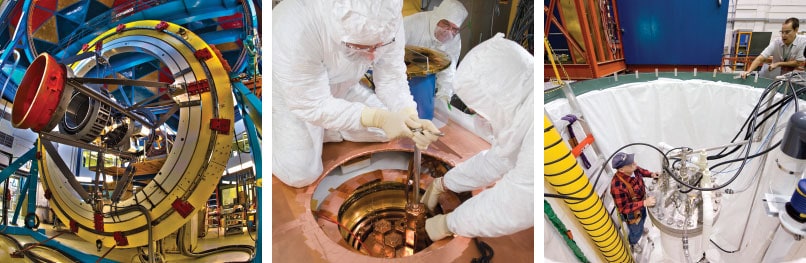
Fermilab’s immediate future is unimaginably tiny, nearly massless and – from my vantage point 100 m underground, in front of the MINERvA detector – currently zipping through my body at (probably) just less than the speed of light. MINERvA sits squarely in the path of the neutrino beam produced when protons from the lab’s Main Injector accelerator collide with a graphite target. Bursts of several trillion neutrinos pass through it every 2.2 s. Despite its prime location, though, MINERvA is a bit of an unsung hero in neutrino physics. “The goal of MINERvA is really to understand the way neutrinos interact with lots of different nuclei all at once,” MINERvA co-spokesperson Debbie Harris explains as she shows me around the room-sized detector. To achieve this, MINERvA scientists have stacked thick “slices” of five different materials – carbon, iron, lead, water and helium – in front of a tank of liquid scintillator and a sensitive CCD camera. When a neutrino interacts with one of these materials, the resulting scattered particles produce telltale flashes of light in the scintillator, which the camera records. Data from these scattering events are important for many other neutrino experiments, Harris says, because the materials in the MINERvA detector are often the same ones that other experiments use. “We help them understand their data better,” she says proudly.

One Fermilab experiment that is benefitting from MINERvA’s results is MINOS, which sits just downstream from it in the NuMI (Neutrinos at the Main Injector) beam. Its location reflects one of the beauties of studying neutrinos: because the particles interact so rarely, it is perfectly possible to pile up multiple detectors in the same beam. MINOS, in fact, has two detectors: a near detector at Fermilab and a far detector deep inside the Soudan Mine in Minnesota, some 735 km away. This separation allows MINOS scientists to study how neutrinos change, or “oscillate”, between their different “flavours” – electron, muon and tau – as they travel through the Earth. At the near detector, almost all of the neutrinos in the NuMI beam are muon neutrinos. But by the time they reach the far detector 2.5 ms later, a tiny fraction of these muon neutrinos will have oscillated into electron neutrinos. The aim of MINOS’s paired detectors is to catch the neutrinos in this act of transformation.

The transformation from muon to electron neutrinos is associated with a parameter known as θ13, one of three “mixing angles” in a matrix that describes neutrino behaviour. While the other two mixing angles are known, θ13 is not, and measuring it is a major near-term goal of Fermilab’s intensity-frontier programme. Results from MINOS and competitors such as T2K in Japan and Double Chooz in France suggest that the value of a related number, sin213, is greater than zero. However, the MINOS experiment is approaching the limits of its sensitivity, so it may not be able to pin down θ13 much further. Gina Rameika, a Fermilab physicist who has worked on several of the lab’s neutrino experiments, attributes this to the relative lack of knowledge about neutrinos when MINOS was designed in the mid-1990s. “Science wanders around,” she says. “You go down a certain path because it just seems obvious to do that. Then you learn something, and you end up heading down a different path. You don’t really know what you’re going to discover until you do the experiment.”

Andrew Norman

With that principle in mind, Fermilab is in the process of building a second long-distance neutrino experiment that will pick up where MINOS leaves off. Known as NOvA, the new experiment will incorporate a 200 tonne near detector at Fermilab and a 14 kilotonne far detector 810 km away in Ash River, Minnesota. The extra distance will make NOvA more sensitive than MINOS to muon-to-electron-neutrino oscillations, as will the decision to locate the far detector slightly off the neutrino beam’s axis, at an angle where the oscillations are expected to peak.

During my visit, Fermilab physicists and technicians were putting the finishing touches to NOvA’s prototype near detector. In late December 2011 their colleagues in Minnesota began assembling the “block pivoter” apparatus that will help them piece together the far detector. The entire $200m experiment is expected to be completed in 2014, with the first results due within the following year.

NOvA, however, is not the only new neutrino experiment in the works at Fermilab. An even bigger project, known as the Long Baseline Neutrino Experiment (LBNE), promises to do much of what NOvA can do, only better, while also answering some physics questions that NOvA will merely hint at. As LBNE project manager Jim Strait explains, knowing the value of sin213 is really just the start. If, as current data suggest, it is not zero, physicists will be able to use the LBNE to search for a difference in the oscillation rates of neutrinos and antineutrinos. Such a difference would violate the Standard Model of particle physics, which incorporates a fundamental symmetry between particles and antiparticles, known as CP “charge–parity”) symmetry. Finding physics beyond the Standard Model would be exciting enough, but if CP violation were observed in neutrinos, it would suggest that these tiny, nearly massless particles could have tipped the balance between matter and antimatter in the early universe – thereby producing the matter-dominated universe we see today.

Patrick Fox

Current plans for the LBNE call for a new near detector to be built at Fermilab, with a far detector located 1300 km away in South Dakota’s Homestake mine. The cost of these detectors is estimated at $400–500m, depending on their design, and Rameika, a project scientist on the LBNE, says that construction could begin as early as 2014. If that happens, the entire project could be up and running by 2020, just as NOvA is winding down.

More power, more science

The LBNE’s timeline, however, depends on money. Funding is a perennial concern among US particle physicists thanks to Congress’s budgetary process, which allocates funds one year at a time. This can pose problems for projects such as the LBNE – and indeed Fermilab’s entire intensity-frontier programme – that take several years to complete. When I spoke to Oddone, funding for the LBNE and two other new experiments had already been held up for 16 months because Congress had delayed giving its approval to the fiscal year 2011 budget. Though such delays are not uncommon – to say budgets never get done on time “would be an exaggeration”, Oddone says diplomatically – the economic downturn and political gridlock in Washington has made the situation worse than usual. “A year and a half ago we were talking about doubling the budget for physical sciences,” Oddone says. “Today, people tell you that you’ll be lucky if you get the same amount of money you had in the previous year. The doubling has gone by the wayside.”

Oddone observes wryly that this is “problematic” for a laboratory in transition. Historically, though, funding problems have usually meant that projects get delayed, not cancelled. NOvA, for example, spent the first half of 2008 in financial limbo before Congress allocated it money to continue. So the LBNE seems likely to become a reality, though perhaps not as quickly as Fermilab’s neutrino physicists hope.

The outlook is fuzzier for an even bigger Fermilab experiment, known enigmatically as Project X. This $1–2bn linear-accelerator complex would be a real game-changer for the lab’s intensity-frontier programme, supercharging the LBNE while also delivering intense beams of protons to several other experiments. One of these will attempt to measure the electric dipole moment of neutrons and heavy nuclei; a nonzero value would violate CP symmetry. Others will look for evidence of rare processes in muons and kaons, such as the decay of a long-lived neutral kaon into a neutral pion, a neutrino and an antineutrino. The Standard Model predicts that this should occur only once in every 1010 kaon decays, so recording data on a large number of decays will give physicists a new way of testing the theory. The neutrinoless conversion of a muon to an electron is even rarer, occurring once in every 1017 decays at most. Theorists believe the process would be mediated by a particle so massive that even high-energy accelerators such as the LHC could never observe it directly. Looking for these muon decays is thus a roundabout way of studying high-energy physics, says Tschirhart, who is helping researchers develop proposals for Project X.

The design of Project X calls for two new linear accelerators, or linacs, to be built in the middle of the now-defunct Tevatron Ring, which has a circumference of 6.3 km (figure 1). The first linac will accelerate protons from rest up to 3 GeV and send 95% of them hurtling towards the rare-decay and heavy nuclei experiments. The remaining 5% of protons will enter the second linac, which will boost their energies up to the 8 GeV required to load protons into the existing Main Injector accelerator. Once in the ring, the protons will be accelerated to 120 GeV and slammed into a target, producing an intense shower of neutrinos that will make the existing NuMI beam seem like a trickle.

The design phase of Project X is expected to last until 2015 and Holmes, its project manager, says that construction could begin the following year “if the requisite funding is in place”. Tschirhart is upbeat about the chances. Funding agencies are currently supporting Project X’s development, he notes, and policymakers understand how important it is for the future of particle-physics research in the US.

Scientists working on the three beneficiaries of Project X’s intense proton beams – experiments on neutrinos, rare decays and heavy nuclei – will go ahead with their work even if Project X is delayed, and will initially use Fermilab’s current beamline. The loss of Project X would be a major setback for their research, though. “From my point of view, the LBNE without Project X is not something that I look forward to,” Rameika says. Project X, she explains, would send a 2.3 MW beam of protons to the LBNE’s target – more than three times as powerful as the NuMI beam, even after that beam’s imminent upgrade from 400 to 700 kW. Without Project X’s extra punch, she says, “we could literally be running for 30 years to make significant measurements. Science moves faster than that”.

Rameika notes that if Project X is delayed or cancelled, and LBNE physicists decide they cannot wait 30 years to accumulate sufficient data, they could consider building a larger detector. This would essentially compensate for the lower intensity by giving fewer neutrinos a bigger target to hit. However, a bigger detector would also be much more expensive, and “maybe I can afford 100 kilotonnes, but I cannot afford 300,” Rameika shrugs. Keeping costs down on the LBNE also offers opportunities for other experiments, she adds, since overall funding for particle physics is likely to remain constant.

Back to the frontier

In addition to securing funding for Project X, Fermilab will also have to overcome some technical challenges to build it. Here, the scientists I spoke to seem on surer ground, convinced that they can develop the tools and expertise they need to build this intense proton source.

One reason for their confidence is the Illinois Accelerator Research Center (IARC), a new $71m facility that is currently being built to support research, development and industrialization of particle-accelerator technologies. As its project manager Bob Kephart explains, IARC will help bridge the gap between having a great idea for using accelerators and putting that idea into practice commercially. Industrial-research experts commonly refer to this gap as the “valley of death” because so many ideas fall into it, and never progress any further.

As an example, Kephart cites the suggestion that an accelerator could irradiate sludge from wastewater-treatment plants, making it safe to use as fertilizer. “You might say, ‘Wow, this is a good idea’, but people thought about it in the 1970s,” he says. “The problem is that there are not a lot of accelerator experts in your average municipal waste-treatment plant. You need a product that is bulletproof. In fact, it better just have an on–off switch.”

Lauren Hsu

When I visited Fermilab, construction workers with earth-moving machines were building IARC’s car park, and the lab later held a groundbreaking ceremony for the centre itself on 16 December 2011. IARC is being built with support from the Illinois state government, which is providing $20m for the 3900 m2 main building, while the Department of Energy has chipped in $13m to convert part of CDF’s $38m detector hall into a dedicated heavy-assembly facility. When it is finished in late 2013 or early 2014, IARC will provide 200 hi-tech jobs, and speakers at the groundbreaking ceremony touted its potential to make Chicago’s western suburbs a “world leader” in accelerator development.

This venture into applied and industrial science represents something of a new direction for Fermilab. “For years, our staff have been trained in how to turn dollars into research,” says Kephart. “What we need now [for IARC] is people who can turn research into dollars.” However, both he and Holmes, of Project X, stress that IARC will also benefit the lab’s particle-physics programme. The centre is expected to become a test-bed for superconducting radiofrequency (SRF) accelerator components, which will form the heart of Project X’s two linacs. In addition, partnering with private-sector firms to develop SRF technology should help drive down costs, Holmes says, making it more likely that Project X will gain Congressional approval.

A new flagship experiment such as Project X would be a significant development for this big lab on the Illinois prairie, with its proud tradition of doing science on several frontiers (see “The cosmic frontier”). But many here are looking still further into the future, and dreaming big. In addition to their scientific missions, Holmes says, Project X and IARC will help keep the US accelerator-science sector alive and healthy. Such investment could pay off handsomely for Fermilab when – or if – the international particle-physics community picks a location for next-generation facilities such as a successor to CERN’s LHC, a muon collider or a neutrino factory. For Fermilab, the energy frontier may be gone, but it is certainly not forgotten.

Voices from Fermilab

Brendan Casey
Fermilab physicist and collaborator on DZero and the muon g-2 experiment
The exciting thing now is that I’m designing a new detector, and I’ve never had an opportunity to do that before. Sometimes I have to force myself to step back and work on analysing Tevatron data because it’s so exciting to design a new detector from scratch.

Patrick Fox
Fermilab theorist
The switch to intensity-frontier experiments makes my job a little bit more interesting. It used to be that if I knew how an electromagnetic calorimeter worked, I could talk to somebody on CDF or DZero and at least have a lunchtime conversation about how they do their analyses. Now I have to understand how a neutrino detector works, how a kaon detector works, how a fixed-target machine works – all these things.

Lauren Hsu
Postdoc, Cryogenic Dark Matter Search
As a physicist, I think you face many challenges, from crawling around on the floor looking for cables that aren’t hooked up properly to spending a lot of time in meetings arguing about details. There’s just a huge range of things you have to do, and I think that’s what keeps our work interesting. We have to wear many hats.

Andrew Norman
Fermilab physicist and NOvA computing specialist
Computing is a tool that lets you access the physics. I love the mathematics of the algorithms, I love the challenges of the computing, and I love the physics that we’re doing. They all just naturally tie together to give a unified picture of what science is about today.

The cosmic frontier

High-energy and high-intensity physics are not the only subjects being studied at Fermilab. The lab also supports a research programme on the so-called cosmic frontier, participating in experiments that study cosmic rays, dark matter and dark energy.

DES
One such project is the Dark Energy Survey (DES). This successor to the Sloan Digital Sky Survey, in which Fermilab played a major role, will use the 4 m Blanco telescope at Chile’s Inter-Tololo Observatory to produce the biggest ever 3D map of the universe. Scientists working at the lab and 25 other institutions in the US, Europe and South America have built a new CCD camera and other upgrades for the 36-year-old telescope. The survey will take 10 years, with “first light” this April.

CDMS

Members of the Cryogenic Dark Matter Search (CDMS) collaboration use a suite of cryogenic germanium and silicon detectors to search for evidence of weakly interacting massive particles (WIMPs). Finding such particles would be a major advance in our understanding of dark matter – the mysterious substance that accounts for around 80% of the universe’s total matter – and also a boon for proponents of supersymmetry theories, which predict that WIMPs should exist. Fermilab is one of around 20 institutions participating in the experiment, which is located 800 m underground in Minnesota’s Soudan Mine. Such extreme depths are necessary to reduce interactions between the detectors and cosmic rays. In December 2011 scientists at Soudan began installing an upgrade to the existing detectors that will improve the experiment’s sensitivity by up to a factor of seven.

COUPP
The Chicagoland Observatory for Underground Particle Physics (COUPP), is exploring an alternative approach to WIMP detection that revives one of the oldest technologies in particle physics: the bubble chamber. COUPP’s updated bubble chamber consists of a quartz jar containing superheated liquid CF3I, and the idea is that a dark-matter particle passing through the liquid will cause it to boil, forming a particular kind of bubble that experimenters can detect. Since the experiment began in 2003, physicists working on COUPP have constructed a series of ever-larger bubble chambers to test the technology and determine its sensitivity to dark matter. In its current 60 kg incarnation, COUPP’s detector is located at Fermilab, nestled in the NuMI tunnel alongside the MINERvA and MINOS neutrino experiments. In May, a new, larger version will be installed at SNOLAB in Canada.


Heating cools a semiconductor

Laser cooling has been used on a solid film of semiconductor for the first time, reducing its temperature to a chilly 4 K. The work has been done by researchers in Denmark, who suggest that with future developments the semiconductor's temperature could be chilled further so that its vibrations are reduced almost to the quantum ground state in at least one direction. This would allow the semiconductor to sense the slightest of mechanical motions or tiny electrical currents.

In a solid material, thermal energy exists mostly in the form of jiggling atoms. If some of these vibrations are removed, the temperature of the material drops. In this latest study, a group led by Eugene Polzik of the University of Copenhagen reduced the vibrations of a semiconductor membrane that is placed in an optical cavity so that it captures light between two reflectors. While vibrations in materials such as dielectric mirrors and membranes have been damped out by the pressure of photons building up between themselves and a mirror, this latest device exploits the semiconductor's ability to absorb photons, turning them into electrical excitations.

For the scheme to work, a thin film of high-quality semiconductor must be used. This was created by Peter Lodahl and colleagues, who made a rectangle of the semiconductor gallium arsenide, just over 1 mm to a side but a mere 160 nm thick. The semiconductor is suspended on a square frame such that the rectangle was bowed slightly, creating a concave shape to face the concave mirror that formed the other side of the optical cavity. Thermal vibrations, their amplitude set by the temperature of the semiconductor, caused the membrane to oscillate like a drum, explains Polzik.

Kicking electrons

In the experiment, led by Koji Usami, the team set the distance between the mirror and the membrane to resonate with the light from a near-infrared laser. This is done by making the distance a multiple of half the light's wavelength. The cavity traps the photons, which are at just the right energy to kick electrons out of the gallium arsenide's valence band and into its conduction band. If they made just one pass at the gallium arsenide they would stand only an 8% chance of being absorbed. However, because they bounced back and forth between the mirror and the gallium arsenide, each photon's chance of kicking an electron into the conduction band rises to 50%.

Once the electrons fall back into the valence band, they release their energy as heat and caused the semiconductor film to expand, exaggerating its concave shape. This changes the length of the cavity, diminishing its resonance with the laser so it does not trap light as well. As a result, the semiconductor cools and contracts, improving the resonance once more. These opposing influences tend to dampen the membrane's oscillations, reducing their amplitude to a temperature equivalent of 4 K.

Polzik acknowledges that their experiment has not set records – other optical cooling methods can bring their targets down to millikelvin temperatures. Even so, Andrew Armour of the University of Nottingham, UK, says that the approach has "interesting possibilities because it involves the electrons and optical absorption of the semiconductor". He also points out that there is a large body of knowledge in the field of semiconductors, and applying this know-how to optomechanical cooling could push the field forward another step.

Hot or cold?

Hajime Okamoto of Nippon Telegraph and Telephone's Basic Research Laboratory in Kanagawa, Japan, agrees that exploiting the band gap is intriguing but he points out that the electrons only served to heat the material, and that thermal damping has been demonstrated before.

Polzik's team suggests that the electrons could be persuaded to stick around rather than dumping their energy as heat. A quantum well, made by placing a 20 nm layer of indium gallium arsenide inside the 160 nm gallium arsenide membrane, could keep the electrons away from the surface of the material, which is where they go to rejoin the valence band. By reducing the overall heat in the material, while still causing it to expand, Polzik is optimistic that this approach could reduce the vibrations further – possibly to millikelvin levels. Alternatively, he says that their findings might inform efforts to cool optically all of the membrane's vibrational modes through its band gap, reducing its overall temperature.

"Finding a way to cool effectively semiconductor electronics is very important," says Polzik, adding that overheating has become one of the main barriers to creating faster, smaller devices. Although he calls the idea of laser-cooling electronics "futuristic", Polzik believes that their experiment is a step in that direction.

This research is published in Nature Physics.

Ancient Islamic architects created perfect quasicrystals

A researcher in the US reports to have found the first examples of perfect quasicrystal patterns in Islamic architecture. Her upcoming paper also describes how the designers were creating these geometric patterns from as early as the 12th century CE using nothing but rudimentary tools. It was not until the 1970s that academics began to develop mathematics that could explain these striking patterns seen in nature.

Quasicrystals are patterns that fill all of a space but do not have the translational symmetry that is characteristic of true crystals. In two dimensions this means that sliding an exact copy of the pattern over itself will never produce an exact match, though rotating the copy will often produce a match. They were first described mathematically by the British academic Roger Penrose in the guise of the famous Penrose tiles. About 10 years later Danny Schechtman of Israel's Technion University showed that the positions of atoms in a metallic alloy had a quasicrystalline structure. Since then, hundreds of different quasicrystals have been discovered in nature.

Mesmerizing patterns

Various people from both scientific and design fields have noted the similarity between quasicrystal structures and certain forms of Islamic decorative art. These mesmerizing geometric patterns, often located in places of worship, comprise repetitive patterns that reveal different features depending on whether you look at small sections or larger regions of the design.

In 2007 two physicists in the US reported that they had found an example of a 15th-century geometric pattern in Iran that showed an "almost perfect" example of Penrose tiling. These researchers concluded that the Islamic craftsmen most likely created the patterns using a set of tiles of distinct shapes, each decorated with lines that join to form the final patterns. Several other studies have also suggested that quasiperiodic patterns in Islamic architecture were constructed through local rules such as subdividing or overlapping of tiles. But none of the proposed methods has able to explain how the ancients ended up creating global long-range order in their patterns.

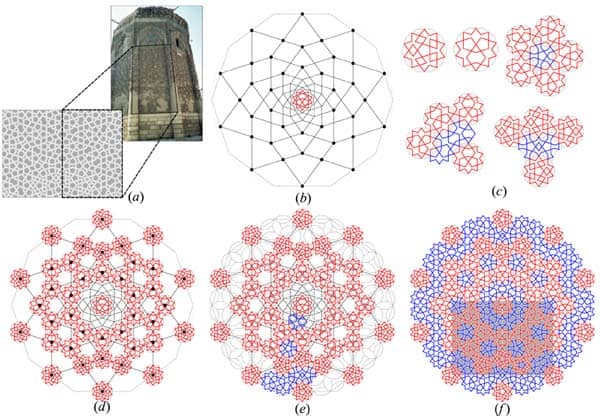
Now an explanation may be at hand. In this latest work, Rima Ajlouni, an architectural researcher at Texas Tech University in the US, believes that she has identified three examples of quasiperiodic patterns in Islamic architecture without any imperfections. The first pattern is a quasiperiodic cartwheel pattern that commonly used in the architecture of the Seljuk region, an empire that stretched from Turkey to Afghanistan. Ajlouni identifies specific cases in Iran at the Darb-i Imam shrine and the Friday Mosque in Isfahan. The second pattern is from the interior walls of the courtyard of the Madrasa al-'Attarin in Fez, Morocco, dating back to 1323. And the third case, dated to 1197, is seen on the external walls of the Gunbad-I Kabud tomb tower in Maragha, Iran.

From seed to beauty

In her paper, Ajlouni also shows that ancient Muslim designers were able to resolve the complicated long-range principles of quasicrystalline formations. In other words, these designers were fully aware of the extent of connectedness within their work. In all three examples, Ajlouni reconstructs the patterns and shows that the size of a central "seed" figure is proportional to the size of the overall framework of the pattern. She demonstrates that the three patterns could have been created using nothing more than a compass and a straightedge. This construction method that was widespread in Islamic societies to create a variety of media such as woodworks, ceramics and tapestries.

"We never gave these designers enough credit for the art they were creating. They were able to create some of the patterns of complex modern mathematics using basic principles alone," Ajlouni tells physicsworld.com. The strong geometries seen in Islamic architecture are said to reflect the deep philosophical and cosmological approach of the Islamic faith. Worshippers viewed the repetitive geometric formations as a reflection of the unity that can be derived from the multiplicity of forms. "The act of making the geometry was part of the worship," adds Ajlouni.

Ajlouni believes that her work could bring about a "paradigm shift" for designers, given that these ancient Islamic periodic patters can now be recreated using any simple drafting software. She also believes that the work could provide scientists with a deeper understanding of the structure of quasicrystals at an atomic scale.

"A fascinating conjecture"

Rónán McGrath, a quasicrystals researcher at the University of Liverpool in the UK, is fascinated by the strictly geometric approach developed by Ajlouni. "The suggestion that this method was used by the ancient Islamic architects is a fascinating conjecture, and the paper is an interesting contribution to the sometimes controversial debate on the degree of quasiperiodicity of these patterns," he says.

McGrath is not convinced, however, that the study will contribute much to the fundamental study of quasicrystals. "The structure of quasicrystals has been determined with great accuracy, at least in some questions, and the question is how they grow with such perfection. Geometric methods cannot address this question as they do not encompass the effects of chemical bonding."

The research will be published in the March issue of Acta Crystallographica Secion A.

Rydberg atom simulates Trojan asteroids

The atom may not be a planetary system, but under specific circumstances it can behave like one. That is the curious finding of physicists in Austria and the US, who have confirmed a 1994 prediction that, in the presence of an applied electromagnetic field, electrons in very highly energized atomic states should behave like the Trojan asteroids of Jupiter.

Atoms with at least one electron excited to an extremely high energy level are called Rydberg atoms – after the 19th century physicist Johannes Rydberg, who pioneered the study of hydrogen energy levels. Today, researchers can access energy levels with principal quantum numbers in the hundreds and the electron is relatively far from the nucleus where the attraction is much weaker. Rydberg atoms are therefore highly prone to ionization by stray electromagnetic fields and must be very well shielded.

Although such atoms conjure up images of a planet orbiting the Sun, quantum mechanics dictates that the electron is likely to be found in variety of different places in a large and diffuse orbital. As a result, a Rydberg atom shares little in common with a planetary system.

However, it is mathematically possible to produce a superposition of atomic states that is localized in space. An electron in such a superposition will behave much like a classical particle – or a planet. The problem, however, is that the states that make up the superposition evolve in time at different rates, and so the state very quickly falls apart. But in 1994, Joseph Eberly of the University of Rochester in New York and two colleagues realized the heavens provided them with a clue about how to stabilize this fragile superposition.

Heavenly inspiration

The trio's inspiration came from the planet Jupiter and its 4000 or so Trojan asteroids. These sit at the two so-called Lagrange points in Jupiter's orbit – one 60° ahead of the planet and the other 60° behind it – and rotate in lockstep with the planet.

Similarly, Eberly and colleagues showed that the role of Jupiter could be played by a rotating external electromagnetic filed. As a result, it should be possible to create Lagrange points in a Rydberg atom, creating stable, localized electronic orbitals and bridging the divide between quantum mechanics and classical mechanics.

Until now, however, producing such a system in a laboratory has proven to be extremely difficult. In the new research – a collaboration between experimentalists at Rice University in Houston, Texas and theorists at Vienna University of Technology and Oak Ridge National Laboratory – a laser is used to excite the lone outermost electrons of potassium atoms to principal quantum numbers above 300. The researchers then apply a circularly rotating electromagnetic field, which combines several nearby orbitals to create "Trojan wave-packets".

Macroscopic atom

Finally, having achieved stable states with the electron wave-functions localized at the Lagrange points, they very slowly reduce the frequency of their applied field. The orbital period of an electron increases with distance from the nucleus just as the orbital period of a planet increases with distance from the Sun – therefore turning down the applied frequency forces the localized electron to move even further from the nucleus. As a result, the principal quantum number of the electron is boosted to around 600, making the atom about the size of the dot above the letter "i".

Barry Dunning of Rice University explains "The electron is locked to the drive field and if you very slowly change that drive field the electron stays locked to it. We can use that to move it out to very much larger orbits – in principle arbitrarily large, but of course at some point all the stray fields begin to take over."

Astronomical differences

Despite the similarities between a Trojan asteroid and the Trojan wave-packet, quantum mechanics dictates that the Trojan wave-packet describes only the probability of finding the electron at a given location – whereas classical mechanics tells us exactly where an asteroid will be. What the researchers were measuring was the probability of finding that single electron in a particular place – the Rice team had to make thousands of measurements on thousands of atoms and compare their findings with a mathematical model from the theorists in Vienna to work out the shape of the orbiting packet.

"The transition zone between quantum mechanics and classical physics is, I would say, the most fascinating and the least understood frontier in physics," says Eberly. "That area is so full of fascinating puzzles and this is such a nice way to explore one aspect of that frontier zone."

The research is described in Physical Review Letters.

Carbon membranes excel at separating liquids

Two independent teams have made ultrathin, cabon-based membranes with extraordinary properties that could be used in a range of applications, from water filtration to petroleum processing. One team, based at the University of Manchester in the UK, has made membrane from graphene oxided that appears to be highly permeable to water while being impermeable to all other liquids and gases. The other group, at Japan's National Institute for Materials Science, has made membranes from diamond-like carbon (DLC) that are highly permeable to certain organic solvents, but not others.

The Manchester team is led by Andre Geim, who co-discovered graphene in 2004. Graphene is a sheet of carbon just one atom thick in which the atoms are arranged in a lattice. Graphene oxide is like ordinary graphene but is covered with molecules, such as hydroxyl groups (OH). Graphene-oxide sheets stack atop each other to form extremely thin membranes.

Geim and colleagues found that water passes through a film of graphene oxide extremely fast while all other gases and liquids are completely blocked by the film. “We know that helium, for example, can leak through several millimetre-thick glass, which blocks water completely, so the behaviour we observed in graphene-oxide membranes could not be any stranger,” says team member Irina Grigorieva.

Like passing through air

The membranes consist of millions of small flakes of graphene oxide with nanometre-sized empty channels (or capillaries) between the flakes. According to the researchers, water is able to flow through the capillaries without any friction. Even more surprisingly, the water diffuses though the graphene-oxide sheets so quickly that the rate that it goes through is the same as if it were passing through empty air.

The graphene oxide sheets are arranged in such a way that there is room only for one layer of water molecules. When water passes through the capillaries it blocks the channels and so does not allow any other substance to go through, explains Grigorieva. In the absence of water, however, the capillaries shrink and do not let anything through this way. This is why the material is impermeable to everything but water.

This new property could be important for designers of filters and selective membranes, she said, and in situations where you need to remove water from a mixture or container while keeping in all the other ingredients. The work also shows that phenomena on the nanoscale are so different to those seen in the everyday, macroscopic world. “These phenomena defy our intuition but also open the door to a completely different world,” she tells physicsworld.com.

Brilliant ideas wanted

“Let experts in separation and filtration techniques now mull over these new results,” comments Geim. “Hopefully, they will come up with lots of brilliant application ideas.” As for the Manchester researchers, they say that they will continue looking for other unusual behaviour in graphene. “You cannot help wondering what else graphene has in store for us,” adds Geim.

Meanwhile, in Japan, Izumi Ichinose and colleagues National Institute for Materials Science in Ibaraki have created a carbon nanosheet that is extremely permeable to some organic solvents. Indeed, the membranes were used to separate organic dyes at rates 1000 times faster than commercially available membranes. The membranes are made of diamond-like carbon (DLC) – an amorphous material in which the bonds between carbon atoms are similar to those in diamond.

The team made its membranes by plasma-enhanced chemical vapour deposition (PECVD) of several different organic gases on an ultrathin substrate of cadmium nanostrands – which are then etched away to leave a free-standing film of DLC. The most successful membrane was made using acetylene but membranes were also made using pyridine and hexamethyldisiloxane.

The resulting free-standing DLC films are about 30 nm thick and about 12% of the surface of each film is perforated by tiny pores about 1 nm in diameter. The team measured the elasticity of the membranes, which they found to be in the range 90–170 GPa. This is on par with metals such as copper and titanium.

Hexane is the quickest

The researchers then looked at how permeable the films are to 10 different organic solvents. They found that hexane – a major component of petrol (gasoline) – was the quickest to move through the membrane. The alcohol butanol was the slowest to go through, moving at about 10% the speed of hexane.

According to Ichinose, the membranes are the first nanopore structures that are permeable to organic solvents – rather than water. As such, the team believes that the membranes could have a range of practical applications including cleaning up chemical spills, oil extraction in the food industry and the production of biofuels.

Indeed, Ichinose tells physicsworld.com that the team is currently working on the development of "large-scale porous carbon nanosheets". In principle, the team's technique could be used to make membranes on an industrial scale. But before this can be done, the team must find a low-cost alternative to the cadmium substrate. According to Ichinose, viable alternatives include durable carbon-fibre sheets or cross-linked polyimide sheets.

Cees Dekker of the Delft University of Technology in the Netherlands says that when taken together, the studies reveal an "unexpected phenomenon" – that ultrathin carbon membranes can have permeability values that are very selective for certain molecules.

The work of both teams is reported in two separate papers in Science.

Copyright © 2026 by IOP Publishing Ltd and individual contributors